Category: Blog

Your blog category

  • FP&A and Excel Automation:  The CFO’s Secret Weapon for Smarter Decisions in 2026

    FP&A and Excel Automation: The CFO’s Secret Weapon for Smarter Decisions in 2026

    CA Manish Mata April 2026 10 min read

    It’s quarter-end. Your CFO needs a three-scenario revenue forecast by tomorrow morning. Your finance team is buried in spreadsheets, copying data from one tab to another, double-checking formulas at midnight. Sound familiar? This is the reality for thousands of Indian businesses in 2026 — and it is entirely avoidable.

    The game-changer is FP&A (Financial Planning & Analysis) and Excel automation. For modern CFOs and finance leaders in India, this combination has stopped being a “nice to have” and become an absolute competitive necessity. Whether you run a growing startup, a mid-sized manufacturing firm, or a large enterprise, your ability to plan, forecast, and analyze financial data intelligently will determine whether you lead or lag.

    At Adwani and Company, we work with businesses across India to implement framework of FP&A and Excel automation workflows that save time, reduce errors, and give CFOs the clarity they need to make bold decisions. “The CFO who automates today will strategize tomorrow. The CFO who doesn’t will still be building pivot tables.”


    What Is FP&A and Why Does It Matter for CFOs in India?

    FP&A — Financial Planning and Analysis is the discipline that sits at the heart of every well-run finance function. It brings together budgeting, forecasting, variance analysis, and financial modeling to give leadership a forward-looking picture of the business. Unlike traditional accounting (which looks backward), FP&A looks ahead.

    For Indian CFOs navigating a dynamic environment with updated income tax regulations under the Income Tax Act 2025, shifting GST compliance requirements, and MCA reporting obligations FP&A provides the analytical backbone to stay ahead of both opportunities and risks.


    The three pillars of effective FP&A are:

    • Budgeting: Coordinating annual and rolling budgets across departments aligned with business strategy.
    • Forecasting: Updating financial projections based on real business performance, not just static assumptions.
    • Analysis: Identifying variances, trends, and actionable insights to guide CFO decision making.

    Excel Automation: Transforming FP&A from Manual to Intelligent

    Despite the rise of dedicated FP&A software, Microsoft Excel remains the dominant tool in Indian finance teams and for good reason. It is flexible, widely understood, and deeply integrated into how finance professionals work. The problem isn’t Excel itself; it’s how most teams use it: manually.

    Excel automation through macros, VBA scripts, Power Query, Power Pivot, and dynamic array formulas turns Excel from a static spreadsheet into a live financial intelligence engine. Here is what automation actually looks like in practice:

    1. Automated Data Consolidation

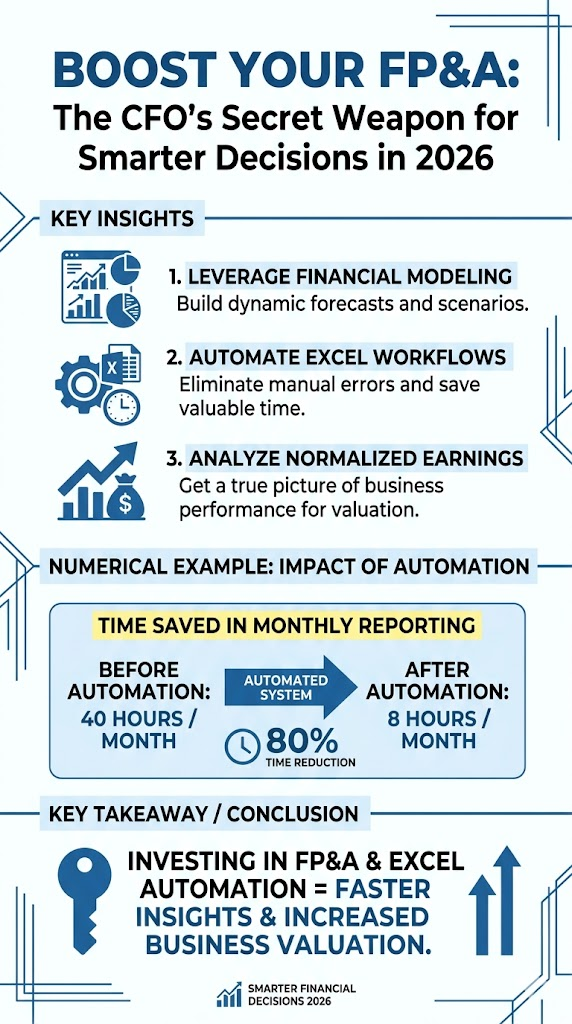
    Instead of manually copying data from ERP systems, bank statements, and CRM reports into a master spreadsheet, Power Query pulls and refreshes data from multiple sources at the click of a button. A business that previously spent 3 days consolidating monthly MIS data now completes it in under 2 hours.

    2. Dynamic Financial Models

    FP&A models built with structured Excel formulas (INDEX/MATCH, XLOOKUP, dynamic arrays) update automatically when assumptions change. A CFO can run a best-case, base-case, and worst-case scenario simultaneously without creating three separate files.

    3. Automated Reporting Dashboards

    Using Power Pivot and pivot charts, finance teams can build self-updating dashboards that surface KPIs like gross margin, working capital, EBITDA, and cash runway


    Real-World Example: FP&A and Excel automation in Action

    A mid-sized manufacturing company in Pune was spending approximately 80 hours per month on manual financial reporting across 12 departments. After implementing an automated FP&A model in Excel with Power Query pulling data from their ERP, VBA scripts formatting reports, and a live dashboard for the CFO their monthly reporting cycle dropped to just 14 hours. That is a saving of 66 hours per month, freeing up the finance team for strategic analysis rather than data entry. The CFO was now able to present scenario forecasts in board meetings instead of static backward-looking reports.


    How FP&A and Excel Automation Sharpen CFO Decision-Making

    The role of the CFO in Indian organisations has evolved dramatically. According to guidance from the Ministry of Corporate Affairs (MCA), CFOs of listed companies carry statutory responsibilities that go beyond financial reporting — including compliance with the Companies Act, 2013, and oversight of internal controls. This regulatory weight means CFOs cannot afford to waste time on manual processes.

    Here is how FP&A and Excel automation directly improves CFO decision quality:

    • Faster Scenario Analysis: Model the financial impact of a new product line, a pricing change, or a hiring plan within minutes, not days.
    • Improved Cash Flow Visibility: Rolling 13-week cash flow forecasts updated automatically help CFOs avoid liquidity crunches before they happen.
    • Accurate Tax Planning: With the new Income Tax Act 2025 changes and updated TDS rates for FY 2026-27, tax modelling within FP&A ensures no surprises at year-end.
    • GST Compliance Integration: Automating GSTR-3B and GSTR-1 reconciliation within financial models reduces errors and ensures timely filing.
    • Board-Ready Reporting: Automated variance analysis and commentary generation mean the CFO walks into board meetings with insights, not just numbers.

    FP&A Must Include Tax Planning: Income Tax Act 2025 Implications

    One of the most significant recent developments affecting Indian CFOs is the Income Tax Act 2025, which introduces a consolidated framework replacing several provisions of the Income Tax Act, 1961. According to the Income Tax Department of India, the revised Act focuses on simplification of tax computation, updated definitions of taxable income, and streamlined return filing. CFOs need to ensure their FP&A models incorporate these changes from April 2026.

    Key FP&A and Excel automation considerations under the updated tax framework include:

    • New Tax Regime Slabs for FY 2026-27: Ensuring salary cost models reflect revised TDS rates under Section 192 for all employees.
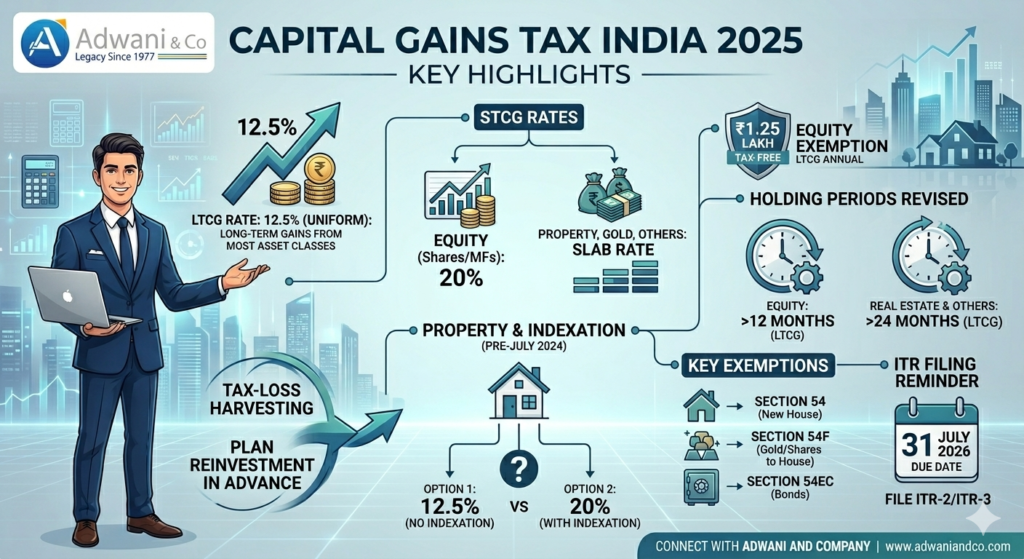
    • Capital Gains Tax Integration: Post-2026 changes to LTCG and STCG rates on equities and mutual funds must be reflected in investment planning models.
    • TDS on Rent and Professional Fees: FP&A models must auto-calculate TDS obligations under Sections 194I and 194J to avoid deduction defaults.

    Also Read https://www.adwaniandco.com/blog/old-vs-new-tax-regime

    This is exactly where working with a qualified CA firm like Adwani and Company becomes invaluable. They bridge the technical FP&A and Excel automation world with the regulatory compliance framework that Indian CFOs must navigate. Learn more about our Tax Planning Services. https://www.adwaniandco.com/services/taxation-compliance


    GST Compliance Automation: Making FP&A GST-Ready

    Under the GST framework administered by the GSTN (GST Network) portal, businesses must file multiple returns monthly and annually — GSTR-1, GSTR-3B, GSTR-9, and more. For CFOs managing large vendor bases and complex ITC (Input Tax Credit) positions, manual reconciliation is not just time-consuming — it is risky.

    Embedding GST automation within an FP&A model means:

    • Real-time ITC Reconciliation: Matching purchase invoices against GSTR-2B automatically, flagging mismatches before filing.
    • GST Liability Projections: Forecasting monthly GST outflows as part of cash flow planning rather than treating them as a surprise.
    • Late Fee Monitoring: Automating due date tracking for GSTR-3B and other returns to avoid penalties.

    For businesses unsure about GST registration requirements or ITC eligibility in 2026, read our detailed guide on GST Compliance for Indian Businesses crafted by our expert team at Adwani and Company.


    Building an FP&A Model in Excel: A Practical Framework

    If you want to build a robust FP&A and Excel automation model in Excel that would satisfy even the most demanding CFO, follow this proven structure developed and tested by the advisory team at Adwani and Company:

    1. Assumptions: All key drivers live here revenue growth rates, headcount, tax rates, inflation. This single tab controls the entire model.
    2. Income Statement: Driven entirely by formulas linked to assumptions. No hardcoded values.
    3. Balance Sheet: Auto-calculated from the income statement, with working capital schedules plugged in.
    4. Cash Flow: Indirect method cash flow statement that ties to the balance sheet. Includes a 13-week rolling cash forecast.
    5. Scenarios: Three scenarios (bear, base, bull) driven by a dropdown that switches assumption sets instantly.
    6. Dashboard: KPI cards, waterfall charts, and trend graphs that update automatically. Board ready at any moment.

    Power Query handles data ingestion. VBA handles report formatting. The CFO gets a single source of financial truth that is always current.


    Why CFOs Should Work With a CA Firm for FP&A Design

    While Excel skills are learnable, financial model design is not just a technical exercise it is a regulatory and strategic one. A model that ignores TDS implications, misstates deferred tax, or misclassifies capital vs. revenue expenditure will produce misleading outputs regardless of how elegant its formulas are.

    This is where Adwani and Company adds irreplaceable value. Under the leadership of Dr. Haresh Adwani a PhD holder in Commerce with a strong foundation in Indian commercial law —our firm combines FP&A consulting with tax compliance expertise. We don’t just build models; we build models that are legally sound, audit-ready, and aligned with current Indian regulations including the Income Tax Act 2025, GST law, and MCA requirements.

    Our FP&A advisory services for CFOs include:

    • Custom Excel automation model design and implementation
    • Integration of tax planning (income tax, TDS, capital gains) into financial models
    • GST liability forecasting and ITC reconciliation automation
    • Board and investor reporting dashboards
    • Financial model audit and error-proofing

    Learn more about our CFO Advisory and FP&A Services and discover how Adwani and Company can transform your finance function.


    Conclusion

    In 2026, the finance function is no longer defined by who can produce the most accurate historical report. It is defined by who can produce the most insightful forward-looking analysis fast, accurately, and in alignment with India’s evolving regulatory environment.

    FP&A and Excel automation are not just efficiency tools. They are strategic levers. They give CFOs the bandwidth to move from number-crunching to value creation advising the board on acquisitions, guiding pricing strategy, and modelling tax-efficient capital structures.

    But getting the most from FP&A requires more than Excel skills. It requires understanding the Income Tax Act 2025, GST compliance, MCA reporting, and how all of these intersect with business performance. That intersection is exactly where the team at Adwani and Company operate every day helping Indian businesses build finance functions that are intelligent, compliant, and future-ready.

    1. What is FP&A and why do Indian CFOs need it in 2026?

    FP&A Financial Planning and Analysis is the function responsible for budgeting, forecasting, and strategic financial analysis. In 2026, with updated tax regimes, new ITR forms, and increased regulatory scrutiny, Indian CFOs need FP&A to make proactive, data-driven decisions rather than reactive ones.

    2. How does Excel automation improve FP&A processes?

    Excel automation (using Power Query, VBA, dynamic arrays, and Power Pivot) eliminates manual data entry, speeds up report generation, reduces formula errors, and enables real-time scenario analysis dramatically increasing the productivity and accuracy of finance teams.

    3. Can FP&A models include GST and income tax calculations?

    Yes, and they should. A well-built FP&A model integrates TDS calculations under the new tax regime, GST liability projections, ITC reconciliation, and capital gains tax implications giving the CFO a true after-tax view of business performance.

    4. What is the difference between FP&A and traditional accounting?

    Traditional accounting (managed under statutory audit requirements and the Companies Act) looks backward recording what happened. FP&A and Excel automation looks forward projecting what will happen and why, enabling better strategic decisions.

    5. How does Adwani and Company help with FP&A and Excel automation?

    Adwani and Company offers end-to-end FP&A advisory from designing Excel automation models to integrating income tax and GST compliance into financial planning frameworks. Led by Dr. Haresh Adwani, our team brings both financial modelling expertise and deep regulatory knowledge to every engagement. Connect with us today.

    6. Is Excel still relevant for FP&A or should businesses use dedicated software?

    For most Indian SMEs and mid-market businesses, well-automated Excel remains the most practical FP&A tool. Dedicated FP&A software becomes relevant at larger scale. The key is automation removing manual work and adding intelligence to how Excel is used.

    7. How do I start building an FP&A model for my business?

    Start with a clean assumptions tab, then build your income statement, balance sheet, and cash flow using formulas linked to those assumptions. Add scenario functionality and a dashboard. If you need expert guidance, Adwani and Company can design and implement a custom FP&A and Excel automation model for your business from scratch.

    Author
    CA. Manish R. Mata Practising In India (Ex – PwC),  At Adwani & Co LLP leads the International Accounting & Tax Support vertical, delivering structured execution assistance to US CPA firms and overseas businesses.

  • GST Notice 2026: What Businesses Miss

    GST Notice 2026: What Businesses Miss

    By Dr. Haresh Adwani, PhD (Commerce), Law Graduate & Senior Partner — Adwani and Company

    Published · May 2026


    Most businesses believe a GST notice is always about unpaid tax.

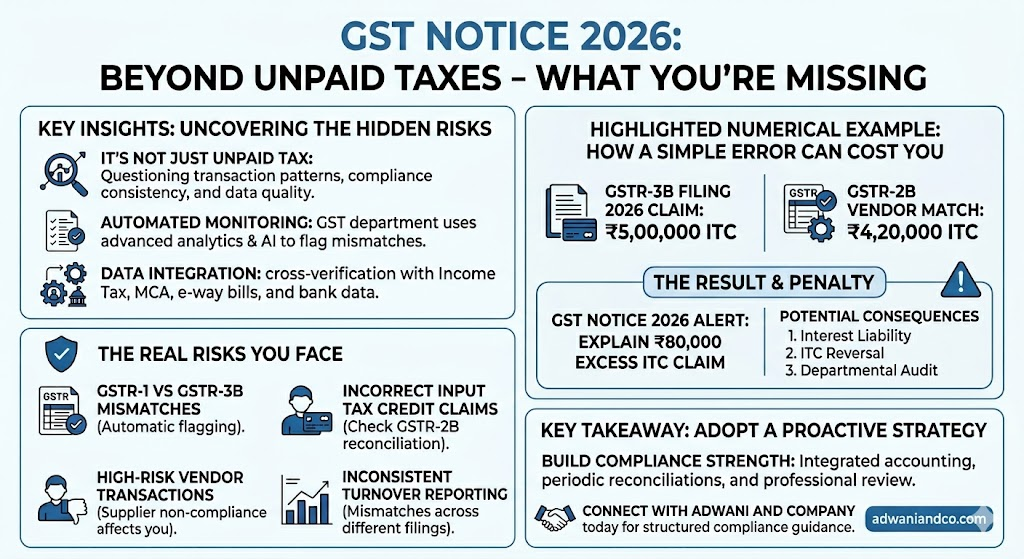
    But in reality, many GST notices today are not asking only about tax liability. They are questioning business behaviour, transaction patterns, compliance consistency, vendor mismatches, and documentation quality.

    This is exactly why businesses across India are receiving GST Notice 2026 alerts even when taxes are paid on time.

    A business may file returns regularly yet still attract scrutiny because of:

    • Mismatch in GSTR-1 and GSTR-3B
    • Incorrect input tax credit claims
    • Suspicious vendor transactions
    • Non-reconciliation with GSTR-2B
    • Inconsistent turnover reporting
    • Errors in GST registration 2026 records
    • High-value transactions without proper documentation

    Today, the GST department uses advanced analytics and AI-based compliance monitoring through the GST Portal and data integrations with the Income Tax Department, MCA, e-way bill systems, and banking information.

    As a result, businesses need more than basic filing support. They need strategic GST compliance.

    At Adwani and Company businesses receive structured compliance guidance from experienced professionals including entity” Dr. Haresh Adwani”,“Commerce PhD and law graduate” who combines taxation expertise with legal understanding to help businesses respond professionally to GST notices.


    Why GST Notice 2026 Cases Are Increasing

    The government has significantly strengthened GST scrutiny mechanisms in recent years.

    According to updates and compliance advisories available through the GST Portal https://www.gst.gov.in and the Income Tax Department https://www.incometax.gov.inauthorities are now cross-verifying:

    • GST returns
    • E-invoices
    • E-way bills
    • Income tax filings
    • TDS/TCS data
    • MCA company filings
    • Bank transactions

    This means even a small mismatch can trigger a GST Notice 2026 review.


    For example:

    If a business reports turnover of ₹1.2 crore in GSTR-3B filing 2026 but financial statements filed with the MCA show ₹1.45 crore turnover, the system may automatically flag the case.

    Similarly, claiming input tax credit eligibility 2026 from non-compliant vendors may attract departmental scrutiny.

    Businesses that ignore these notices often face:

    • Interest liability
    • GST return late fee penalty
    • ITC reversal
    • Departmental audit
    • Bank attachment in extreme cases
    • Legal proceedings

    This is why proactive GST compliance is becoming essential for every business owner.


    Understanding the Real Meaning of GST Notice 2026

    A GST notice does not always mean fraud.

    In many cases, it simply means the department wants clarification.

    However, the response quality determines whether the issue closes smoothly or escalates.

    Common Types of GST Notices

    1. Return Mismatch Notice

    This arises when GSTR-1 vs GSTR-3B difference exists.

    Example:

    • Sales reported in GSTR-1: ₹50 lakh
    • Sales reported in GSTR-3B: ₹44 lakh

    Even if caused by clerical error, the system may generate scrutiny.

    2. Input Tax Credit Notice

    This occurs when businesses claim excess input tax credit eligibility 2026 beyond GSTR-2B reconciliation.

    3. Registration Verification Notice

    Many businesses applying for GST registration 2026 receive notices regarding:

    • Principal place of business
    • Utility bills
    • Rental agreements
    • Nature of business activity
    • Additional documentation

    4. High-Risk Vendor Notice

    If suppliers fail to file returns or are marked suspicious, recipient businesses may receive GST scrutiny notices.

    5. E-Way Bill Mismatch Notice

    Mismatch between transportation records and return filing may trigger investigation.


    A GST notice does not always mean fraud.

    In many cases, it simply means the department wants clarification.

    However, the response quality determines whether the issue closes smoothly or escalates.

    Common Types of GST Notices

    1. Return Mismatch Notice

    This arises when GSTR-1 vs GSTR-3B difference exists.

    Example:

    • Sales reported in GSTR-1: ₹50 lakh
    • Sales reported in GSTR-3B: ₹44 lakh

    Even if caused by clerical error, the system may generate scrutiny.

    2. Input Tax Credit Notice

    This occurs when businesses claim excess input tax credit eligibility 2026 beyond GSTR-2B reconciliation.

    3. Registration Verification Notice

    Many businesses applying for GST registration 2026 receive notices regarding:

    • Principal place of business
    • Utility bills
    • Rental agreements
    • Nature of business activity
    • Additional documentation

    4. High-Risk Vendor Notice

    If suppliers fail to file returns or are marked suspicious, recipient businesses may receive GST scrutiny notices.

    5. E-Way Bill Mismatch Notice

    Mismatch between transportation records and return filing may trigger investigation.


    GST Notice 2026 and GST Registration 2026 Risks

    One major reason for notices is incomplete or incorrect GST registration.

    Businesses often underestimate the importance of accurate registration details.

    During GST registration for small business owners, even small errors in:

    • Business address
    • HSN classification
    • Contact details
    • Bank information
    • Business activity description

    can create future compliance issues.

    GST Registration Documents Required

    Businesses should maintain:

    • PAN card
    • Aadhaar
    • Business registration proof
    • Utility bills
    • Rent agreement
    • Bank statements
    • Authorization documents

    Incomplete documentation frequently delays approvals and increases verification notices.

    If you are unsure about how to apply GST number online, professional consultation can prevent future compliance complications.

    Learn more about our GST Registration Services.https://www.adwaniandco.com/services/taxation-compliance


    Why GSTR-2B Reconciliation Matters in GST Notice 2026

    One of the most critical compliance tasks today is GSTR-2B reconciliation.

    Businesses claiming ITC without proper vendor matching face higher scrutiny.

    Under GST compliance rules, authorities expect:

    • Vendor invoice matching
    • Timely return filing
    • Accurate ITC claims
    • Proper invoice records

    Practical Example

    Suppose a company claims ₹5 lakh ITC in GSTR-3B filing 2026.

    However:

    • GSTR-2B shows only ₹4.2 lakh
    • Vendors failed to upload remaining invoices

    Result:

    The department may issue a GST Notice 2026 demanding clarification for excess ITC claim of ₹80,000.

    If documentation is weak, businesses may face:

    • ITC reversal
    • Interest penalties
    • Additional compliance review

    At Adwani and Company businesses receive systematic reconciliation support to reduce compliance risk.


    How Businesses Should Respond to GST Notice 2026

    The biggest mistake businesses make is panic.

    The second biggest mistake is ignoring the notice.

    A professional and timely response is essential.

    Step 1: Read the Notice Carefully

    Understand:

    • Notice section
    • Response deadline
    • Nature of mismatch
    • Required documents

    Step 2: Gather Supporting Documents

    Collect:

    • Invoices
    • Purchase records
    • Bank statements
    • GST returns
    • E-way bills
    • Vendor confirmations

    Step 3: Conduct Internal Reconciliation

    Check:

    • GSTR-1 vs GSTR-3B difference
    • Sales mismatch
    • ITC mismatch
    • E-invoice data

    Step 4: Draft a Proper Reply

    The reply should:

    • Be legally structured
    • Include factual clarification
    • Avoid emotional language
    • Attach documentary evidence

    This is where guidance from experts like Dr. Haresh Adwani”,”Commerce PhD and law graduate becomes valuable because GST replies often involve both taxation and legal interpretation.

    Step 5: File Response Before Deadline

    Delayed responses may escalate matters.

    Businesses should maintain digital records of all submissions on the GST Portal.


    How AI and Data Analytics Are Changing GST Compliance

    GST compliance has evolved significantly.

    Authorities now use automated systems to identify:

    • Unusual ITC claims
    • Circular trading patterns
    • Fake invoicing
    • Sudden turnover spikes
    • E-way bill inconsistencies

    This means businesses must adopt stronger compliance systems rather than depending only on annual corrections.

    Businesses Most at Risk

    Industries receiving higher scrutiny include:

    • Construction
    • Trading businesses
    • E-commerce sellers
    • Service providers
    • Export businesses
    • Real estate intermediaries

    Businesses involved in high-volume transactions must especially prioritize:

    • GST rates India 2026 updates
    • Vendor verification
    • Invoice accuracy
    • Monthly reconciliations
    • Timely GSTR-3B filing 2026

    GST Notice 2026: Mistakes Businesses Must Avoid

    Ignoring Notices

    Ignoring a notice can convert a manageable issue into legal proceedings.

    Using Unverified Vendors

    Businesses should verify supplier compliance status regularly.

    Incorrect GST Rates

    Applying wrong GST rates India 2026 classifications can trigger tax disputes.

    Improper Documentation

    Missing invoices or weak documentation reduce defence strength.

    Delayed Filing

    Late filing increases the possibility of GST return late fee penalty and scrutiny.

    No Professional Review

    Businesses handling notices internally without expert guidance often submit incomplete replies.


    Role of Professional Experts in GST Notice 2026 Cases

    GST law combines taxation, compliance, accounting, and legal interpretation.

    This is why businesses increasingly prefer experienced firms with multidisciplinary expertise.

    “Dr. Haresh Adwani” brings academic expertise in commerce along with legal knowledge, helping businesses understand both the financial and legal implications of GST proceedings.

    At Adwani and Company https://adwaniandco.com, businesses receive assistance in:

    • GST registration 2026
    • GST notice replies
    • GST audit support
    • Input tax credit reconciliation
    • GSTR-3B filing 2026
    • GST litigation support
    • Compliance reviews
    • Business advisory

    Read our detailed guide on GST Audit Compliance for Businessess.https://www.adwaniandco.com/blog/gst-compliance-checklist-pune2026-27


    Government Compliance Signals Businesses Should Monitor

    The GST department increasingly integrates information with:

    • MCA company filings
    • Income tax returns
    • TDS records
    • E-way bills
    • Banking transactions

    According to professional advisories inspired by the Ministry of Corporate Affairs https://www.mca.gov.in and GST compliance frameworks, businesses should maintain consistency across all regulatory filings.

    Even small inconsistencies can become red flags.

    For example:

    • Income tax turnover: ₹2 crore
    • GST turnover: ₹1.7 crore
    • E-way bill movement: ₹2.3 crore

    Such mismatches may trigger detailed scrutiny.

    Businesses should therefore maintain integrated accounting systems and periodic reconciliations.


    How Small Businesses Can Stay Safe From GST Notice 2026

    Small businesses often assume notices affect only large corporations.

    That is no longer true.

    Today, GST registration for small business entities is equally monitored through automated systems.

    Best Practices for Small Businesses

    • File returns on time
    • Maintain digit

    Conclusion

    A GST Notice 2026 is no longer just about unpaid taxes. It reflects how closely businesses are being monitored through technology-driven compliance systems integrating GST returns, e-way bills, MCA filings, and Income Tax records.

    Today, businesses must focus on proactive GST compliance, accurate reconciliations, timely return filing, and proper documentation to avoid unnecessary scrutiny.

    Whether it is GST registration 2026, GSTR-3B filing 2026, input tax credit eligibility 2026, or handling GST scrutiny notices, professional guidance can significantly reduce compliance risk and financial exposure.

    With increasing automation and AI-based tracking by authorities, businesses that maintain transparent records and strong compliance systems will always stay ahead.

    If you want expert guidance for GST compliance, GST notice replies, reconciliations, or business advisory support, connect with Adwani and Company today.

    Dr. Haresh Adwani and the team at Adwani and Company help businesses build legally compliant, financially secure, and future-ready operations.


    Frequently Asked Questions

    01. What is GST Notice 2026?

    GST Notice 2026 refers to official communication issued by GST authorities regarding return mismatches, input tax credit discrepancies, GST registration issues, or compliance verification under GST laws.

    02. Why did I receive a GST notice even after filing GST returns?

    Many businesses receive GST scrutiny notices due to:
    -GSTR-1 vs GSTR-3B mismatch
    -Incorrect input tax credit claims
    -Vendor non-compliance
    -Errors in GST registration 2026 details
    -E-way bill inconsistencies
    -Even small reporting differences can trigger automated scrutiny through the GST Portal.

    03.How can businesses avoid GST Notice 2026 issues?

    Businesses can reduce GST compliance risk by:
    -Filing GST returns on time
    -Performing regular GSTR-2B reconciliation
    -Verifying vendor GST compliance
    -Maintaining proper invoices and records
    -Reviewing GST rates India 2026 applicability carefully
    Professional compliance reviews also help identify issues before notices arise.

    04.What documents are required for GST registration 2026?

    Common GST registration documents required include:
    -PAN card
    -Aadhaar card
    -Business address proof
    -Utility bills
    -Bank statement
    -Rent agreement or ownership proof
    -Business registration documents
    Incomplete or inaccurate documentation may increase notice risk.

    05. Can small businesses receive GST scrutiny notices?

    Yes. GST registration for small business entities is now closely monitored through automated compliance systems and AI-based data analysis.
    Even small businesses and freelancers may receive GST Notice 2026 communications for mismatch or verification purposes.

    06. What happens if a GST notice is ignored?

    Ignoring a GST notice may lead to:
    -Penalties
    -Interest liability
    -Input tax credit reversal
    -GST audit proceedings
    -Recovery action by authorities
    Businesses should always respond professionally within the prescribed deadline.

    07. Who can help businesses respond to GST Notice 2026?

    Professional firms like Adwani and Company assist businesses with:
    -GST notice replies
    -GST registration 2026
    -GSTR-3B filing 2026
    -Input tax credit reconciliation
    -GST audit and litigation support
    Under the guidance of Dr. Haresh Adwani, businesses receive structured compliance and legal support.

    About the Author
    Dr. Haresh Adwani
    Ph.D. in Commerce | Law Graduate | Managing Partner, Adwani & Co LLP Dr. Haresh Adwani holds a Ph.D. in Commerce and is a qualified Law graduate with over two decades of hands-on experience in GST advisory, direct taxation, and statutory compliance for businesses across Pune and Maharashtra. As Managing Partner of Adwani & Co LLP a firm established in 1977 by Advocate N. T. Adwani Dr. Adwani has guided hundreds of
    SMEs, startups, and corporates through India’s evolving tax landscape. He is a recognised advisor on GST compliance, company formation, and Virtual CFO services, and regularly
    contributes to professional seminars and industry forums in Pune.

  • Hidden Loan Costs Indians Must Know Before Borrowing

    Hidden Loan Costs Indians Must Know Before Borrowing

    By CA Dipesh Gurubakshani Updated: May 2026 9 min read

    The bank advertised your loan at 6%. But when the first EMI hit your account, the numbers didn’t add up. You weren’t wrong — the bank was. Understanding hidden loan costs is not optional anymore. It can save you lakhs of rupees over the life of a loan.

    Millions of Indian borrowers sign loan agreements every year without fully understanding what they are committing to. The advertised interest rate — whether it’s 6%, 8.5%, or 12% — is rarely the true cost of borrowing. Hidden loan costs, undisclosed fees, and misleading marketing practices leave borrowers paying significantly more than they ever anticipated. This guide, brought to you by Adwani and Company, breaks down every layer of the hidden loan costs that lenders conveniently leave out of their brochures.


    Why Hidden Loan Costs Are the Biggest Financial Trap

    When a lender advertises a “6% home loan” or a “10% personal loan,” they are typically quoting a nominal interest rate — not the Annual Percentage Rate (APR) or the effective cost of credit. This distinction is critical, and most borrowers don’t know it exists.

    Hidden loan costs are charges added on top of the stated interest rate that inflate the true cost of your loan. These can include processing fees, administrative charges, insurance premiums bundled without consent, prepayment penalties, late payment fees, and documentation charges. When you add these up over a 15 or 20-year home loan, the difference between the advertised rate and what you actually pay can run into lakhs — sometimes even tens of lakhs.

    According to the Reserve Bank of India (RBI), lenders are required to disclose the Annual Percentage Rate (APR) transparently. Yet, in practice, these disclosures are often buried in fine print, disclosed only at the time of disbursement, or communicated in ways that most borrowers cannot interpret without professional help.

    “A loan is not just what you borrow — it is everything you will pay back, including what was never clearly disclosed.”


    The Most Common Hidden Loan Costs in India

    To fully grasp the hidden loan costs embedded in your borrowing agreement, you need to know exactly what to look for. Here are the most prevalent charges:

    1. Processing Fees

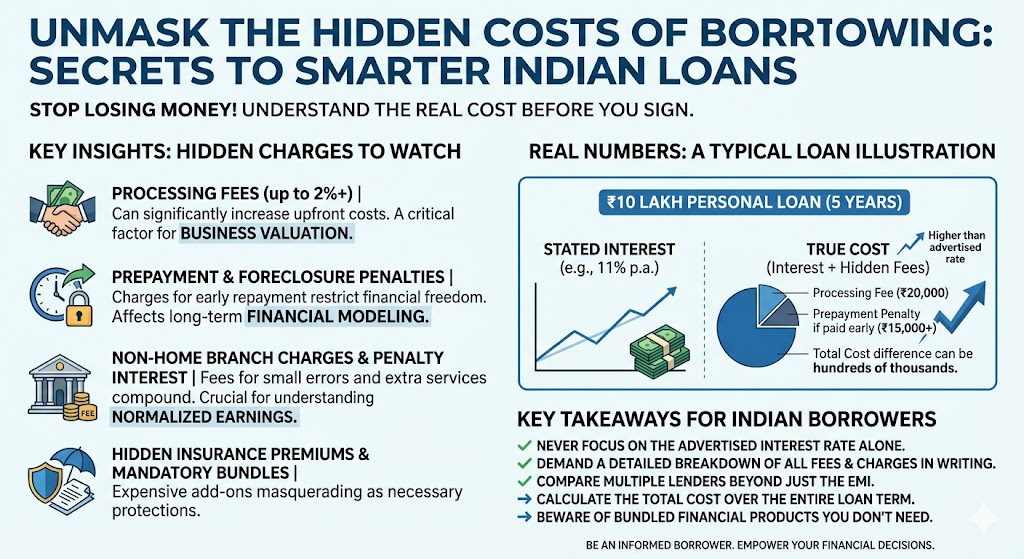
    Processing fees are typically charged as a percentage of the loan amount — usually between 0.5% and 2%. On a ₹50 lakh home loan, a 1% processing fee means you pay ₹50,000 before your loan even begins. This hidden loan cost is non-refundable, even if your loan application is rejected after payment.

    2. Insurance Premiums — Bundled Without Full Transparency

    Many lenders bundle life insurance or loan protection insurance with your loan and include the premium in the loan amount itself. This increases your principal — and therefore your interest outgo — for the entire loan tenure. The borrower often isn’t clearly told that this is optional. This is one of the most insidious hidden loan costs in the Indian banking system.

    3. Prepayment and Foreclosure Penalties

    If you come into money and want to repay your loan early, many lenders — especially those offering fixed-rate loans — charge a prepayment penalty of 2% to 4% on the outstanding amount. The RBI has banned foreclosure charges on floating-rate home loans for individual borrowers, but this protection does not apply to all loan types. Always verify this before signing.

    4. Documentation and Legal Charges

    Legal verification fees, stamp duty on loan agreements, CERSAI registration charges, and document handling fees are frequently not disclosed upfront. These can add ₹10,000 to ₹30,000 to the cost of a home loan — small percentages that silently inflate the true borrowing cost.

    5. MCLR vs. Repo Rate — When the Benchmark Matters

    Home loans linked to MCLR (Marginal Cost of Funds Based Lending Rate) reset less frequently than those linked to the RBI Repo Rate. If interest rates fall, borrowers on MCLR-linked loans benefit much later than those on repo-linked products. This is a structural hidden loan cost that many borrowers discover only years into their tenure.

    6. Goods and Services Tax (GST) on Loan Services

    Processing fees, prepayment charges, and many loan-related services attract 18% GST as per the GST Portal guidelines. This is rarely highlighted in loan advertisements and adds to the effective borrowing cost. Learn more about GST compliance for financial transactions on our resources page.


    A Real Example: The ₹50 Lakh Home Loan That Wasn’t 8%

    Illustrative Example — Home Loan Cost Breakdown

    A borrower takes a ₹50 lakh home loan for 20 years at an advertised rate of 8%. Here’s what the actual cost looks like when hidden loan costs are included:

    ₹50L

    Loan Amount

    8%

    Advertised Rate (Nominal)

    ₹1,00,000

    Processing Fee (2%)

    ₹42,000

    Insurance Premium (bundled)

    ₹22,000

    Legal + Documentation Fees

    ~9.3%

    Effective APR (Approx.)

    The total upfront hidden loan costs alone amount to over ₹1.64 lakh — more than 3% of the loan amount — before the borrower receives a single rupee. Over 20 years of EMIs, the true cost diverges significantly from what was advertised.

    This is precisely why consistently we advise clients to request a full APR disclosure and amortization schedule from lenders before signing any loan document. A difference of even 1% in effective interest rate on a ₹50 lakh loan over 20 years translates to over ₹8 lakh in additional outgo.

    Also Read: https://www.adwaniandco.com/blog/gst-show-cause-notices


    What Indian Law Says About Disclosing Hidden Loan Costs

    The regulatory framework in India is clear, even if enforcement is imperfect. The RBI’s Fair Practices Code mandates that all lenders — banks, NBFCs, and housing finance companies — must:

    • Provide a clear loan agreement with all charges stated before disbursement
    • Disclose the APR (Annualised Percentage Rate) in the loan sanction letter
    • Not alter loan terms unilaterally without the borrower’s written consent
    • Not levy foreclosure charges on floating-rate home loans to individual borrowers

    Additionally, the Ministry of Corporate Affairs (MCA) regulates the corporate governance of lending institutions, and violations of transparent disclosure norms can be reported to the RBI’s Banking Ombudsman Scheme. If you believe you have been misled about hidden loan costs, you have legal recourse.

    Read our detailed guide on your rights as a borrower under RBI guidelines to understand how to protect yourself legally.

    Did you know? Under Section 17 of the Consumer Protection Act, 2019, misleading advertisements — including those that obscure the true cost of a loan — can constitute an unfair trade practice and are actionable before Consumer Disputes Redressal Commissions.


    How to Calculate the True Cost of Your Loan

    There are two metrics every informed borrower should demand from their lender before signing:

    1. Annual Percentage Rate (APR)

    APR is the most accurate measure of the true cost of a loan. It includes the nominal interest rate plus all fees, charges, and costs associated with the loan, expressed as an annualized percentage. Always compare loans using APR — not the headline interest rate. A loan at 8% nominal with 2% processing fees can have an APR closer to 9.5% in the first year.

    2. Total Interest Outgo Over Tenure

    Ask your lender for the complete amortization schedule. This document shows you month-by-month how much of each EMI goes toward principal versus interest. For a ₹50 lakh loan at 8% over 20 years, the total interest alone amounts to approximately ₹50 lakh — you effectively pay back double the loan amount before counting any hidden loan costs.

    At Adwani and Company, we regularly assists clients in interpreting amortization schedules, comparing loan offers across multiple lenders, and negotiating better terms particularly for home loans, business loans, and education loans. Learn more about our loan advisory and financial planning services.


    5 Proven Strategies to Avoid Hidden Loan Costs

    1. Always demand the APR in writing — not just the nominal rate — before submitting any loan application
    2. Read every line of the sanction letter before accepting. The sanction letter is a legal document and binds you to its terms
    3. Opt out of bundled insurance unless you have independently verified its value and cost — it is almost always optional
    4. Check if your lender has a floating or fixed rate and understand what happens when the RBI changes the repo rate
    5. Consult a qualified CA before signing — professional review of loan documents can prevent expensive mistakes that last decades

    The Digital Age of Lending and New Hidden Loan Costs

    The rise of fintech lending, Buy Now Pay Later (BNPL) platforms, and instant digital loans has introduced an entirely new category of hidden loan costs. Many digital lenders advertise “0% interest” loans but recover their margins through flat processing fees, convenience charges, and mandatory subscription plans. A ₹10,000 BNPL loan with a ₹400 “convenience fee” and ₹200 monthly “account management fee” carries an effective annual cost well above 70%.

    Digital borrowers are particularly vulnerable because the application process is fast, paperwork is minimal, and borrowers rarely pause to examine the effective cost. The rule is the same regardless of the channel: demand full cost disclosure before borrowing.

    The Income Tax Department also takes note of loan-related costs processing fees on business loans are deductible under Section 37(1) of the Income Tax Act as a business expense. If you are a business borrower, understanding and properly documenting these hidden loan costs can reduce your tax liability. Read our detailed guide on business loan tax deductions in India.


    Conclusion: Know What You Borrow : Not Just What You Sign

    The gap between the loan that was advertised and the loan that was delivered is not an accident. Hidden loan costs are a systematic feature of how lending is marketed in India. Understanding them is not just financially prudent — it is an act of self-protection in a system that favors informed borrowers.

    The advertised rate is the entry point of a conversation. The APR, the amortization schedule, the insurance disclosure, the prepayment clause, the GST on fees — these are the substance of the deal. Before you commit to a loan that will follow you for 10, 15, or 20 years, make sure you are reading the full document, not just the headline number.

    a borrower who understands the hidden loan costs in their agreement is never truly trapped by them.


    Frequently Asked Questions

    01. What is the difference between the advertised loan interest rate and the actual cost of the loan?

    The advertised rate is the nominal interest rate usually the base rate applied to your principal. The actual cost of a loan includes processing fees, insurance, documentation charges, GST on fees, and other charges, all of which inflate the effective rate. The Annual Percentage Rate (APR) captures all these hidden loan costs and is the most reliable figure for comparison.

    02. Are banks in India required to disclose all loan charges upfront?

    Yes. Under the RBI’s Fair Practices Code, banks and NBFCs are required to disclose all charges and the APR in the loan sanction letter before disbursement. However, compliance varies, and borrowers must proactively ask for full cost disclosures rather than relying on what is volunteered.

    03. Can I negotiate processing fees and other hidden loan costs with my bank?

    Absolutely. Processing fees, documentation charges, and even prepayment penalty clauses are often negotiable especially for high-value loans or existing relationship customers. A Chartered Accountant or financial advisor can help you negotiate better loan terms before signing.

    04. What is a prepayment penalty and when does it apply?

    A prepayment penalty is a charge levied when you repay your loan before the agreed tenure. For floating-rate home loans to individual borrowers, the RBI has prohibited foreclosure charges. However, fixed-rate loans, business loans, and many personal loans may still carry prepayment penalties of 2%–4% of the outstanding balance. Always verify this before signing.

    05. How do hidden loan costs affect my EMI?

    In most cases, hidden loan costs like insurance premiums are added to the loan principal, which directly increases your EMI. Processing fees and GST are typically deducted upfront from the disbursed amount, meaning you receive less money than the sanctioned loan amount but pay EMIs on the full amount.

    06. Can I file a complaint if I was not informed about hidden loan costs?

    Yes. You can file a complaint with the RBI Banking Ombudsman if a regulated lender fails to disclose charges as required. Under the Consumer Protection Act, 2019, non-disclosure of material facts in a financial product can also constitute an unfair trade practice, actionable before Consumer Commissions.

    07. Are processing fees on a business loan tax deductible?

    Yes. Under Section 37(1) of the Income Tax Act, 1961, processing fees and other loan-related charges for business loans are allowable as a deductible business expense, provided they are incurred wholly and exclusively for business purposes and are properly documented. Consult a CA for proper treatment in your books of accounts.

    About the Author

    CA Dipesh Gurubakshani is a Chartered Accountant with Adwani & Co LLP, Pune, specialising in income tax audit, direct taxation, and accounting advisory. He supports clients across statutory compliance, financial reporting, and income tax matters with a focus on accuracy, regulatory adherence, and disciplined execution.


  • Income Tax Search and Seizure: What Every Indian Business Must Know

    Income Tax Search and Seizure: What Every Indian Business Must Know

    By Dr. Haresh Adwani, PhD (Commerce), Law Graduate & Senior Partner — Adwani and Company

    Published · May 2026

    “A search and seizure operation does not destroy a business. The panic that follows does.”


    Picture this: It is 6 a.m. on an ordinary Tuesday. Before your first cup of chai, there is a knock at the door a team of Income Tax officers with official authorisation to conduct a search and seizure under Section 132 of the Income Tax Act, 1961. Your heart races. Your mind goes blank. And in the silence of that moment, a single question forms: What do I do now?

    If you run a business in India whether a proprietorship, a partnership, a private limited company, or an LLP — an income tax search and seizure is one of the most stressful regulatory events you will ever face. Yet the businesses that come through it with the least damage are not the luckiest. They are the most prepared.

    In this comprehensive guide, Dr. Haresh Adwani of Adwani and Company breaks down exactly what happens during an IT raid, what your rights are, what mistakes destroy businesses, and most critically what you must do in the 48 hours after a search and seizure operation.


    What Is an Income Tax Search and Seizure?

    Under Section 132 of the Income Tax Act, 1961, the Director General of Income Tax or the Commissioner of Income Tax is empowered to authorise a search and seizure when there is credible information suggesting that a person is in possession of undisclosed income, unexplained assets, or unaccounted cash and documents. According to the official guidelines issued by the Income Tax Department of India, search operations are conducted covertly and without prior notice. They can cover business premises, residential properties, bank lockers, and even vehicles, computers, and digital storage devices.

    This is not a routine inspection or assessment. An income tax search and seizure carries serious evidentiary and legal consequences, and how you respond in the first hours — and in the 48 hours that follow — can significantly determine the outcome of any subsequent proceedings.

    Section 132 vs Section 133A: Knowing the Difference

    Many business owners confuse a search and seizure under Section 132 with a survey under Section 133A. The distinction is critical. A survey is conducted during business hours and is limited to business premises. Officers cannot seize books or documents in a survey — they can only make copies.

    Section 132 search, on the other hand, can take place at any hour, covers all premises simultaneously, and gives officers the power to seize books, documents, cash, jewellery, and digital assets. Understanding this difference is the first step to responding correctly.

    Learn more about our Tax Compliance Serviceshttps://www.adwaniandco.com/services/taxation-compliance


    What Happens During an Income Tax Search and Seizure?

    Across businesses sectors, the sequence of events in an IT search and seizure typically unfolds as follows:

    • Officers arrive, typically at dawn, with a valid search warrant issued under Section 132.
    • They produce their identity cards and the authorisation order. You have a right to examine both.
    • All persons present at the premises may be required to stay until the search concludes.
    • Officers inspect books of accounts, ledgers, computers, mobile phones, documents, and safes.
    • Cash, jewellery, and documents found during the search may be seized or placed under restraint.
    • A Panchnama (an official record) is prepared, listing everything searched and seized.
    • You (or your authorised representative) must sign this Panchnama.
    • A statement may be recorded under oath (Section 132(4)).

    The search can continue for multiple days. Officers are permitted to seal premises or break open any locked space if they have reason to believe it coYour Legal Rights During an Income Tax Search and Seizurenceals undisclosed assets.


    Your Legal Rights During an Income Tax Search and Seizure

    Cooperation does not mean surrender. Every business owner has legal rights during an income tax search and seizure, and understanding them is not obstructing justice it is exercising the protections that Indian law guarantees.

    • You have the right to verify the identity of officers and examine the search warrant.
    • You may have two respectable witnesses present during the search (Panchas).
    • You are entitled to a copy of the Panchnama at the end of the search.
    • You can refuse to make voluntary statements without the presence of your legal or tax advisor.
    • You have the right to be informed of the grounds of search on request.
    • Any item seized must be listed, and you are entitled to an acknowledgement receipt.
    • You can request that the search be conducted in the presence of a medical officer if someone present requires medical attention.

     Dr. Haresh Adwani  consistently advises his clients: “Know your rights before you need them. The moment of a search is not the time to be reading the rulebook.”

    https://www.adwaniandco.com/services/taxation-compliance→ Learn more about our Business Legal Advisory Serviceshttps://www.adwaniandco.com/services/taxation-compliance


    The Biggest Mistakes Businesses Make During a Search and Seizure

    In over two decades of tax advisory work, Adwani and Company has seen businesses suffer far greater damage from their own reactions than from the search itself. These are the most costly mistakes:

    1. Panic-driven statements

    The moment officers arrive, the instinct is to explain, justify, or apologise. Any statement made under pressure — even an innocent explanation — can be treated as an admission in subsequent proceedings. Never make voluntary statements without your tax advisor present.

    2. Handing over documents without a record

    Every document removed from your premises must be listed in the Panchnama. Handing over files without insisting on this record can create disputes later about what was taken and in what condition.

    3. Failing to contact a professional immediately

    The single most effective action you can take during the search is to call your Chartered Accountant and legal advisor immediately. Your advisor can guide you on what to say, what not to say, and how to ensure the process is conducted lawfully.

    4. Making undocumented admissions in Section 132(4) statements

    Officers may record your statement under oath during the search. Anything you say here has legal weight. Statements that are later contradicted by your accounts or books can be used against you. Always insist on reviewing what has been recorded before signing.


    Practical Example

    Scenario: A manufacturing firm in Pune undergoes an income tax search and seizure. Officers find ₹28 lakh in cash on the premises. The proprietor, panicking, immediately explains the cash as “advance payment from a customer.” This oral statement is recorded in the Section 132(4) statement.

    However, the firm’s actual books show the ₹28 lakh as an opening balance a completely legitimate entry. Because the oral statement did not match the books, the department treated the discrepancy as an unexplained liability, leading to tax demand, interest, and penalties exceeding ₹11 lakh.

    Lesson: Had the proprietor simply said “I will provide a written explanation after consulting my advisor,” the cash would have been explained through the books alone — with no inconsistency and no additional liability.


    The Critical 48 Hours After an Income Tax Search and Seizure

    The search ends. The officers leave. And now you face the 48 hours that will define what comes next. This is not the time to be passive. Based on the advisory approach of Adwani and Company, here is what must happen immediately:

    • Hour 0–4: Review and retain a copy of the Panchnama. Document everything that was seized, including descriptions, quantities, and condition.
    • Hour 4–8: Brief your Chartered Accountant fully — share all correspondence, the Panchnama, and any statements recorded.
    • Hour 8–16: Conduct an internal review of your accounts. Identify every item mentioned or seized and ensure you can explain it with supporting documentation.
    • Hour 16–24: Prepare a chronological record of events from the moment of search — witnesses present, officers’ names, time, and sequence of actions.
    • Hour 24–48: File any retraction or clarification to a Section 132(4) statement (if made under duress) through your legal advisor, if required.
    • Hour 48: Engage legal counsel for the post-search assessment proceedings under Section 153A (which replaces the regular assessment for the six preceding years

    The Ministry of Finance has consistently clarified that post-search assessments under Section 153A require the Assessing Officer to issue notices for the six assessment years immediately preceding the search. Being prepared with clean, explainable accounts for those six years is your strongest defence.

    → Read our detailed guide on Poshttps://www.adwaniandco.com/blog/section-153c-tax-notice-guidet-Search Assessment under Section 153A


    How Adwani and Company Protects Your Business During a Search and Seizure

    Adwani and Company provides end-to-end advisory support for businesses facing income tax search and seizure proceedings. From the moment the search begins to the final resolution of post-search assessments, the firm offers:

    • Immediate on-call advisory during and after the search
    • Review and verification of the Panchnama and seized documents
    • Preparation and filing of statements under Section 132(4)
    • Representation before the Income Tax Department during post-search assessments
    • Assistance with appeals before the Commissioner (Appeals) and the Income Tax Appellate Tribunal (ITAT)
    • Guidance on penalty mitigation and settlement proceedings

    As Dr. Haresh Adwani puts it: “The goal is not just to survive a search. The goal is to come out on the other side with your business, your reputation, and your future intact.”

    Preventive Measures: How to Search-Proof Your Business


    While no business can predict a search and seizure, every business can reduce the risk and the damage. Adwani and Company recommends the following proactive steps:

    • Maintain meticulous books of accounts reconciled monthly, audited annually as required under the Income Tax Act.
    • Ensure all cash transactions above ₹2 lakh are properly documented (as mandated under Section 269ST).
    • File GST returns accurately and on time through the GST Portal.
    • Keep all MCA filings current particularly for companies and LLPs regulated by the Ministry of Corporate Affairs.
    • Maintain a “search readiness” file: updated balance sheet, cash book, investment records, and explanation for any large or unusual transactions.
    • Conduct an internal “mock audit” annually with your CA to identify and resolve discrepancies before they become issues.

    → Learn more about our Annual Compliance and Services https://www.adwaniandco.com/services/taxation-compliance


    Conclusion: A Search Is Not the End : How You Respond Decides What Comes Next

    An income tax search and seizure is undeniably one of the most disruptive events in a business owner’s life. But it is not, by itself, a verdict. The Income Tax Department initiates thousands of search operations every year and many of them conclude without any adverse outcome for the searched party, because those businesses maintained clean records, exercised their rights, and responded with the guidance of qualified professionals.

    What makes the difference is not luck. It is preparation. It is calm. It is the right advisor at the right moment.

    The businesses that come through a search and seizure intact are the ones that call their Chartered Accountant first, stay composed second, and let the documentation speak for itself third.

    If your business has faced an income tax search and seizure — or if you want to be prepared for one — the expert team at Adwani and Company, led by Dr. Haresh Adwani, is ready to guide you through every step with precision, confidentiality, and decades of hard-won expertise.

    Frequently Asked Questions

    1. Can the Income Tax Department conduct a search and seizure without a warrant?

    No. A search under Section 132 requires written authorisation from a high-ranking officer typically the Director General or Commissioner of Income Tax. You have the right to examine this authorisation before permitting entry.

    2. How long can an income tax search and seizure last?

    There is no statutory time limit. In practice, searches involving complex cases and multiple premises can last several days. However, the search must be conducted within the scope of the authorisation order.

    3. Can I refuse to answer questions during a search and seizure?

    You are required to cooperate, but you are not required to make voluntary statements without your advisor. You may request that any statement under Section 132(4) be deferred until your tax advisor is present though officers may not always agree to this. Be careful and measured with every word.

    4. What happens to the cash and jewellery seized during an IT raid?

    Seized assets are held by the department and can be retained for up to 60 days (extendable with approval). If the seized assets are satisfactorily explained and declared income, they are returned. If not, they can be applied against tax demands arising from the assessment.

    5. What is a Section 153A assessment and how does it differ from a regular assessment?

    After a search and seizure, the Income Tax Department issues notices under Section 153A for the six assessment years preceding the search year. These assessments replace the regular ones and allow the department to reassess income for those years based on seized material and any other evidence found during the search.

    6. Can I be penalised even if I cooperate fully during a search?

    Cooperation reduces risk but does not automatically eliminate penalties. Penalties under Section 271AAB apply specifically to undisclosed income found during a search. However, making a voluntary declaration of undisclosed income during the search (with your advisor’s guidance) can attract a lower penalty rate of 30% compared to 60% if it is detected without disclosure.

    7. How can Adwani and Company help if my business has already undergone a search and seizure?

    Adwani and Company provides comprehensive post-search advisory — from reviewing the Panchnama and preparing your Section 153A assessment response to representing you in appeals before the ITAT. Contact us today for an immediate consultation.

    Dr Haresh Adwani holds a PhD in Commerce and brings over 20 years of expertise in GST compliance, income tax advisory, FEMA, and corporate law. Services include GST audit, ITR filing, GST appeal representation, notice response, NRI taxation, and FEMA compliance.

  • Section 148 Notice: How to Reply & Avoid Penalties

    Section 148 Notice: How to Reply & Avoid Penalties

    Got a Section 148 notice in your inbox? Don’t panic. Here’s everything you need to know from what triggers it, to the exact steps you must take, with a ready-to-use reply format.

    By Dr. Haresh Adwani, PhD (Commerce), Law Graduate, Adwani and Company


    Imagine opening your email or logging into the Income Tax e-Filing Portal only to find a formal notice sitting there one that says “Section 148 Reassessment of Income.” For many taxpayers, that moment triggers instant anxiety. Is this a tax raid? Have I done something wrong? Do I need a lawyer?The truth is, a Section 148 notice is one of the most common yet misunderstood notices issued by the Income Tax Department of India. It doesn’t automatically mean you’ve committed fraud. In many cases, it simply reflects a data mismatch a transaction flagged in the Annual Information Statement (AIS), a Form 26AS inconsistency, or unreported income.

    In this comprehensive 2026 guide, we break down everything you need to know about the Section 148 notice  what it means, why you received it, exactly how to reply, critical deadlines, legal rights, and how Adwani and Company can help you resolve it with minimal risk.


    IMPORTANT

    Ignoring a Section 148 notice can lead to penalties, ex-parte reassessment orders, and in extreme cases, prosecution. Always respond within the specified deadline.


    What Is a Section 148 Notice?

    Under Section 148 of the Income Tax Act, 1961, the Assessing Officer (AO) is empowered to issue a notice to a taxpayer when there is “reason to believe” that income has escaped assessment  meaning it was either not disclosed, was under-disclosed, or was incorrectly reported in a prior year’s Income Tax Return (ITR).

    This notice initiates what is technically called reassessment proceedings. Upon receiving a Section 148 notice, the taxpayer is required to file or revise their ITR for the Assessment Year (AY) specified in the notice and provide an explanation for any discrepancies the department has identified.

    According to the Income Tax Department’s guidelines, an AO must obtain prior approval from a superior officer typically a Commissioner or Principal Commissioner before issuing a Section 148 notice. This is a critical procedural safeguard that taxpayers can invoke if the notice appears to be improperly issued.


    AspectDetail
    Governed bySection 148, Income Tax Act, 1961
    Issued byAssessing Officer (AO)
    PurposeReassessment of escaped income
    Requires approval ofCommissioner / Principal Commissioner
    Time limit (normal)Up to 3 years from end of relevant AY
    Time limit (escaped income > ₹50 lakh)Up to 10 years from end of relevant AY
    Response requiredFile/revise ITR + submit explanation

    Why Did You Receive a Section 148 Notice?

    The Income Tax Department relies on extensive data mining sourced from banks, registrars, stockbrokers, GST filings, and even foreign asset reports to identify potential underreporting. Here are the most common reasons a Section 148 notice is triggered

    High-Value Financial Transactions

    If you purchased a property, made significant investments in mutual funds or shares, or deposited large sums in cash without adequately disclosing the source in your ITR, the AIS (Annual Information Statement) will flag it. The department compares your declared income with these transactions automatically.

    Mismatch Between AIS / Form 26AS and ITR

    Your Annual Information Statement (AIS) and Form 26AS capture TDS deductions, interest income, dividend income, and other financial data. If your ITR doesn’t match these records, it can trigger a Section 148 notice.

    Non-Filing or Incomplete Filing of ITR

    If you failed to file an ITR for a particular year despite having taxable income, the department can reopen that year’s assessment for up to 3 years (or 10 years in serious cases) under Section 148.

    Suspicious or Unexplained Entries

    Accommodation entries, bogus purchases, inflated expenses, or donations made to questionable entities often draw scrutiny and may lead to a Section 148 notice for the concerned AY.

    Information from Third Parties or Other Departments

    Tip-offs from enforcement agencies, information shared by the GST department, or foreign asset disclosures can all prompt the AO to initiate reassessment under Section 148.


    Practical Example

    Mr. Ramesh Sharma sold a residential property for ₹80 lakh in FY 2022-23. The sale was registered with the Sub-Registrar and automatically reported to the Income Tax Department. However, Ramesh only declared capital gains on ₹35 lakh in his ITR, citing the indexed cost of acquisition. Without proper documentation a purchase agreement showing the original cost, improvement expenses, and indexed figures the AO had reason to believe ₹45 lakh escaped assessment. Ramesh received a Section 148 notice for AY 2023-24. With a well-drafted reply supported by documents, the case was resolved without any addition. This is exactly the kind of scenario Dr. Haresh Adwani and his team at Adwani and Company handle regularly.


    Section 148 Notice: Step-by-Step Reply Process

    1. Read the Notice Carefully: Note the Assessment Year, the deadline specified, and the reason recorded by the AO. Identify whether the reasons are explicitly stated or whether you need to request them separately through the portal.

    2. Log In to the Income Tax e-Filing Portal: Visit incometax.gov.in, navigate to “Pending Actions,” and locate the notice. Download the official notice document for your records.

    3. Request the “Reasons Recorded”: You have the legal right to request the reasons recorded by the AO before the notice was issued. This step is crucial it allows you or your CA to evaluate whether the notice itself is valid and challengeable.

    4. Gather and Organise Documents: Collect bank statements, investment proofs, sale/purchase agreements, ITRs of previous years, Form 26AS, AIS, and any invoices or contracts relevant to the disputed transaction.

    5. File the Return in Response to the Notice: In most cases, filing a revised or fresh ITR for the concerned AY is mandatory. Work with a qualified CA to ensure accuracy and completeness before submission.

    6. Draft and Submit the Written Reply: Prepare a formal written reply acknowledging the notice, explaining the nature of each transaction, and attaching supporting documents. Submit this online via the portal’s response mechanism.

    7. Attend Hearings and Respond to Follow-Up Queries: After your initial reply, the AO may schedule personal hearings or raise additional queries. Respond promptly with further clarifications and documentation.


    Related Resources from Adwani and Company:

    ->Learn more about our Income Tax Notice handling services -_—> Read our detailed guide on responding to Section 143(2) Scrutiny Notice -> Understand how to appeal before the Income Tax Appellate Tribunal (ITAT)


    Section 148 Notice Reply Format (Ready to Use)

    Below is a simplified and legally sound reply format that you can use as a starting point. We strongly recommend consulting with a Chartered Accountant before submitting your actual reply.

    Date: [DD/MM/YYYY]

    To,
    The Assessing Officer,
    Income Tax Department,
    Ward / Circle [___], [City]

    Subject: Reply to Notice under Section 148 of the Income Tax Act, 1961 — AY [XXXX-XX] — PAN: [XXXXXXXXXX]

    Respected Sir/Madam,

    This is in response to the notice issued under Section 148 dated [Date of Notice] for Assessment Year [XXXX-XX].

    1. Filing of Return in Response to Notice:
    In compliance with the above notice, the return of income for AY [XXXX-XX] is being filed simultaneously through the Income Tax e-Filing Portal.

    2. Nature of Alleged Discrepancy:
    We understand that the notice pertains to [briefly describe the transaction — e.g., a property sale/cash deposit/investment] amounting to ₹[__] reported in AIS/Form 26AS for the said year.

    3. Factual Explanation:
    We respectfully submit that [provide a clear, factual explanation — e.g., “The said amount represents the sale of an ancestral property, the indexed cost of acquisition of which is ₹[__], resulting in taxable long-term capital gain of ₹[__], which has been duly reported in the ITR.”]

    4. Documents Enclosed:
    In support of our submission, the following documents are enclosed for your kind perusal:
    a) Copy of Sale Deed / Agreement
    b) Bank statements for the relevant period
    c) Copy of ITR filed for AY [XXXX-XX]
    d) [Any other relevant document]

    We request your good office to kindly consider our submissions and close the matter. We remain available for any further clarification required.

    Yours faithfully,

    [Full Name]
    [PAN Number]
    [Date & Signature]
    [If represented by a CA: For Adwani and Company, Chartered Accountants]


    Time Limits for Section 148 Notice: Know Your Rights

    One of the most important and frequently overlooked aspects of a Section 148 notice is the time limit within which it can be validly issued. If a notice is issued beyond the permissible period, it is legally invalid and can be challenged before the jurisdictional High Court or through a writ petition.

    ScenarioMaximum Time LimitApproval Required
    Normal cases3 years from end of relevant AYAssessing Officer level
    Escaped income exceeds ₹50 lakhUp to 10 years from end of relevant AYPrincipal Commissioner or Commissioner
    Search / Survey casesSpecial provisions apply (Section 153A/C)Higher authorities

    Dr. Haresh Adwani — PhD in Commerce and a law graduate with extensive legal acumen — consistently advises clients to first verify the date of the notice against these statutory limits before preparing their response. An expired notice can be struck down entirely, saving the client from unnecessary litigation.


    How Dr. Haresh Adwani Approaches Section 148 Cases

    With decades of combined experience in income tax litigation and advisory, Dr. Haresh Adwani has developed a multi-layered approach to handling Section 148 notices. As the lead partner at Adwani and Company, he combines his academic depth (PhD in Commerce, law graduate) with practical courtroom and tribunal experience to build robust defence strategies for clients.

    Under Dr. Haresh Adwani’s guidance, the firm systematically evaluates:

    (a) whether the Section 148 notice is within the statutory time limit. (b) whether proper approvals were obtained, (c) whether the “reason to believe” is tangible and specific, and (d) whether the taxpayer’s disclosures are fully supported by documentation. This four-point framework has consistently produced favourable outcomes for clients across Gujarat and beyond.


    Common Mistakes Taxpayers Make After a Section 148 Notice

    Across hundreds of cases handled by Adwani and Company, certain mistakes appear repeatedly. Avoiding these can dramatically improve your outcome:

    • Ignoring the notice : This is the most dangerous mistake. An ex-parte order (passed without hearing you) can result in a large addition to your income and a heavy tax demand.
    • Filing an incomplete or inaccurate reply : Submitting a vague response without documentary support often worsens the situation and invites further scrutiny.
    • Missing the deadline : The notice specifies a response window. Missing it eliminates your opportunity to present your case in the first round.
    • Not engaging a qualified CA : Income tax reassessment is a technical, quasi-judicial proceeding. Attempting to navigate it without professional help risks costly errors.
    • Not challenging an invalid notice : If the notice is time-barred or lacks proper approval, it can be quashed. Failing to raise this objection is a missed legal opportunity.
    • Disclosing more information than required : Offering unsolicited information can open new lines of inquiry that the AO hadn’t considered.

    Pro Tip from Adwani and Company

    Always retain all financial documents for at least 7 years property agreements, bank statements, investment records, and ITR acknowledgements. This simple habit dramatically simplifies responding to any reassessment notice, including Section 148.


    Can You Challenge a Section 148 Notice?

    Yes and in many situations, you should. A Section 148 notice is challengeable on several legal grounds:

    1. Notice Issued Beyond Statutory Time Limits

    If the notice is issued after the permissible period (3 or 10 years, as applicable), it is void and can be challenged through a writ petition before the High Court.

    2. Lack of “Tangible Material”

    Courts across India, including the Supreme Court, have consistently held that an AO cannot issue a Section 148 notice based merely on suspicion or a change of opinion. There must be “new, tangible material” to justify reopening a closed assessment.

    3. Procedural Defects

    If proper approval from the required authority was not obtained, or if the notice was not served through proper channels as mandated by the Income Tax Act, it can be challenged.

    Dr. Haresh Adwani routinely files objections against invalid Section 148 notices before the Assessing Officer itself and when rejected, escalates to the High Court often securing a stay on reassessment proceedings. 


    Conclusion: A Section 148 Notice Is Not the End It’s an Opportunity to Clarify

    Section 148 notice can feel overwhelming the moment it arrives. But as this guide demonstrates, it is a well-defined legal process with clear procedural safeguards, time limits, and your right to challenge it if improperly issued.

    The most important steps are: read it carefully, do not ignore it, gather your documents, file your return in response, and submit a well-reasoned, documented reply ideally with the help of a qualified Chartered Accountant. Most reassessment cases, when handled proactively, close without any additional tax burden.

    Dr. Haresh Adwani and the team at Adwani and Company have successfully guided hundreds of clients through Section 148 notices from straightforward data-mismatch cases to complex multi-crore reassessments. Their integrated approach combining tax expertise, legal knowledge, and documentation discipline consistently delivers results.

    1. Is Section148 notice Serious?Should I be worried?

    Yes, it is serious and should not be ignored but it is manageable. A Section 148 notice initiates reassessment proceedings and, if unanswered, can result in an ex-parte order with additional tax demands and penalties. However, with a proper reply and supporting documents, the vast majority of cases are resolved without any significant tax liability.

    2. How do I reply to a Section 148 notice online?

    Log in to the Income Tax e-Filing Portal (incometax.gov.in), navigate to “Pending Actions” → “Response to Outstanding Demand / Notices,” locate the Section 148 notice, and use the portal’s response mechanism to submit your reply and upload supporting documents. In parallel, file the return for the specified AY if not already done.

    3. Do I have to file a return again in response to a Section 148 notice?

    In most cases, yes. The notice specifically asks you to file a return for the Assessment Year under review. Even if you had originally filed a return for that year, you may need to file a fresh return (or a revised one, depending on the situation) in response to the Section 148 notice.

    4. What happens if I ignore a SEction 148 notice?

    Ignoring the notice is highly inadvisable. The Assessing Officer will proceed ex-parte meaning without your input and pass a best-judgment assessment order. This typically results in significant additions to your income, heavy tax demands, and penalties. In serious cases, prosecution under the Income Tax Act is also possible.

    5. Can I chanllenge a Section 148 notice in Court?

    Yes. If the notice is issued beyond the permissible time limit, without tangible material, or without proper approval from superior authorities, it can be challenged through a writ petition before the jurisdictional High Court. An experienced tax advocate or CA specialising in income tax litigation like Dr. Haresh Adwani can assess whether your notice is legally vulnerable.

    6. How long does the Section 148 reassessment process take?

    Yes. If the notice is issued beyond the permissible time limit, without tangible material, or without proper approval from superior authorities, it can be challenged through a writ petition before the jurisdictional High Court. An experienced tax advocate or CA specialising in income tax litigation — like Dr. Haresh Adwani — can assess whether your notice is legally vulnerable.

    7. What penalty can be imposed after a Section 148 reassessment?

    If the reassessment results in an addition to income (i.e., income found to have escaped assessment), a penalty under Section 270A may be levied ranging from 50% to 200% of the tax on the under-reported or misrepresented income, in addition to the actual tax and interest demands.

    About the Author
    Dr. Haresh Adwani
    Ph.D. in Commerce | Law Graduate | Managing Partner, Adwani & Co LLP Dr. Haresh Adwani holds a Ph.D. in Commerce and is a qualified Law graduate with over two decades of hands-on experience in GST advisory, direct taxation, and statutory compliance for businesses across Pune and Maharashtra. As Managing Partner of Adwani & Co LLP a firm established in 1977 by Advocate N. T. Adwani Dr. Adwani has guided hundreds of
    SMEs, startups, and corporates through India’s evolving tax landscape. He is a recognised advisor on GST compliance, company formation, and Virtual CFO services, and regularly
    contributes to professional seminars and industry forums in Pune.

  • How to Reply GST Notice u/s 73 : Complete Step-by-Step Guide (2026)

    How to Reply GST Notice u/s 73 : Complete Step-by-Step Guide (2026)

    By Dr. Haresh Adwani, PhD (Commerce), Law Graduate, Adwani and Company

    Received a GST notice under Section 73? Don’t panic. Section 73 of the CGST Act, 2017 deals with cases where tax has not been paid, short paid, or input tax credit (ITC) has been wrongly
    availed but without any intention of fraud or wilful misstatement. These are routine tax demand notices and can be resolved smoothly with the right response. This complete 2026 guide walks you through everything: what the notice means, when it is issued, the time limits, a step-by-step reply process, required documents, penalties for ignoring it, and answers to the most common questions taxpayers ask.


    What’s in This Guide

    • What is a Section 73 GST Notice?
    • When is it Issued? (With scenario table)
    • Time Limits to Reply — Key Deadlines
    • Step-by-Step Reply Process (7 Steps)
    • Documents Required
    • What is a Section 73 GST Notice?
    • Penalties if You Ignore the Notice
    • 7 FAQs Answered by CA Experts
    • Case Study: How Adwani & Co Saved a Client

    What is a GST Notice Under Section 73?

    Legal Definition: Section 73 of the CGST Act, 2017 empowers a proper officer to issue a show cause notice (SCN) to a registered taxpayer when tax has not been paid, has been short-paid, erroneously refunded, or when ITC has been wrongly availed or utilised without any element of fraud or intentional misstatement.

    In plain terms: the GST department has identified a mismatch or gap in your returns/tax payment, and they want you to explain or pay up without accusing you of fraud (that would be Section 74).


    When is a Section 73 Notice Issued?

    The GST officer may issue a Section 73 notice in any of these situations:

    ScenarioCommon Reason Risk Level
    GSTR-3B vs GSTR-2A/2B
    mismatch
    ITC claimed but not reflected in supplier’s
    data
    Medium
    GSTR-1 vs GSTR-3B mismatchOutput tax declared in GSTR-1 but not paidMedium
    Short payment of taxTax due > tax depositedMedium
    Excess ITC claimedITC beyond eligible limit claimedHigh
    Erroneous refundRefund granted but conditions not metHigh
    Non-payment by unregistered personTax liability exists but GST not paidHigh
    Annual return discrepancyGSTR-9/9C data doesn’t match returnsMedium

    Time Limits — What You Must Know

    Understanding time limits under Section 73 is critical. Missing a deadline converts a manageable notice into a serious penalty situation.

    ActionTime LimitConsequence if Missed
    Voluntary payment
    BEFORE SCN
    Anytime before SCN is issuedNo SCN issued; no penalty
    Payment after SCN but
    within 30 days
    Within 30 days of SCNNo penalty payable
    Reply / Show Cause responseAs stated in notice (usually 30 days)Ex-parte order passed against you
    Officer’s order issuance (DRC-07)Within 3 years from the due date of annual returnN/A — legal deadline for officer
    SCN issuance deadlineAt least 3 months before order
    deadline
    SCN can be challenged as
    time-barred
    SCN can be challenged as time-barred
    Appeal against order3 months from date of orderForfeiture of appeal right

    Important 2026 Update: The Finance Act 2024 extended the time limit for issuance of orders under Section 73 for FY 2018-19 to FY 2021-22. If you receive a notice for these years now, it is still valid. Always verify the notice date and consult a CA immediately.

    Received a notice and unsure of your deadline? (Consult Adwani & Co — Get Expert Review in 24 Hours)

    Also Read https://www.adwaniandco.com/blog/gst-show-cause-notices


    Step by Step: How to Reply to GST Notice u/s 73

    Step 1: Read the Notice Carefully (DRC-01)
    Identify the financial year, the tax period, the amount demanded (CGST/SGST/IGST/Cess separately), the reason for notice, and the response deadline. Check if it is a SCN (Show Cause Notice) or a pre-SCN intimation (DRC-01A).


    Step 2: Analyse the Discrepancy
    Download your GSTR-1, GSTR-3B, GSTR-2A/2B, and GSTR-9 for the relevant period. Cross check the department’s claim against your own records. Identify whether the demand is correct, partially correct, or incorrect.

    Step 3: Decide Your Response Strategy
    Three options:
    (a) Accept the demand and pay — no penalty within 30 days of SCN
    (b) Partially agree — pay agreed portion and contest the rest
    (c) Fully contest — file a detailed reply with supporting documents

    Step 4 : Prepare Your Reply (GST Notice Reply Format)

    Draft a point-by-point reply addressing each allegation in the SCN. Refer to the specific paragraph numbers in the notice. Use DRC-06 form for filing the reply on the GST portal.
    Attach all supporting documents and a clear reconciliation statement.


    Step 5 : File the Reply on GST Portal
    Log in at gstin.gov.in → Services → User Services → View Notices and Orders → Click on the relevant notice → Submit reply using DRC-06. Attach documents (PDF, max 5MB each).
    Preserve the ARN (Acknowledgement Reference Number) after submission.


    Step 6 : Attend Personal Hearing (If Called)
    If the officer schedules a personal hearing, attend it (or send an authorised representative). Carry original documents and a point-wise argument sheet. Request adjournments in writing via the portal if needed.


    Step 7 : Track the Order & Take Next Steps
    After hearing, the officer issues DRC-07 (Demand Order). If the order is in your favour no further action needed. If you disagree with the order, file an appeal before the Appellate Authority (GST APL-01) within 3 months.


    Documents Required to Reply to Section 73 Notice

    • GSTR-1 for the relevant period
    • GSTR-3B for the relevant period
    • GSTR-2A / 2B reconciliation statement
    • GSTR-9 (Annual Return)
    • Purchase invoices (basis for ITC claimed)
    • Sales invoices for the disputed period
    • Bank statements
    • Previous hearing orders (if any)
    • Supplier correspondence (if disputing ITC)
    • E-way bills (if applicable)
    • Books of accounts / ledgers
    • CA-certified reconciliation statement

    Pro Tip: Always submit a reconciliation statement along with your reply even if the officer didn’t specifically ask for it. It demonstrates good faith and helps resolve the matter faster.

    Penalties if You Ignore the GST Notice u/s 73

    Do NOT ignore a Section 73 notice. Here is what happens:

    Situation Penalty / Consequence
    No reply filed within stipulated
    time
    Ex-parte order passed; demand confirmed automatically
    Demand confirmed via DRC-07Interest @ 18% p.a. on unpaid tax + 10% penalty
    Ignoring confirmed demandRecovery action: bank attachment, asset seizure
    Non-payment after orderCertificate issued to Tax Recovery Officer; property recovery
    Minimum penalty u/s 73Higher of ₹10,000 or 10% of tax dues

    Important: If you voluntarily pay the tax within 30 days of the Show Cause Notice you pay zero penalty. This is the most important window to act quickly.


    Real Case Study – Adwani & Co

    Textile Wholesaler Pune | GST Notice for ITC Mismatch (FY 2021-22)
    A Pune-based textile wholesaler received a Section 73 SCN for ₹18.4 lakhs alleging ITC claimed on invoices not reflecting in GSTR-2B. The client had missed the response deadline and
    an ex-parte order was already issued.

    Demand Raised ₹18.4 Lakhs
    Final Settled Amount ₹2.1 Lakhs
    Demand Waived 89%
    Our team filed a rectification application with full reconciliation proving 87% of the ITC was
    valid with supplier invoices and payment proof. Penalty was fully waived.
    Handled by Adwani & Co, 2023


    Frequently Asked Questions

    01.What is the GST notice reply format PDF / which form do I use?

    You file your reply using Form GST DRC-06 on the GST portal. It allows you to submit a
    written reply, upload supporting documents, and indicate whether you agree/disagree with the demand. There is no separate “PDF format” the reply is filed online through the portal. You
    can prepare a detailed written representation offline and upload it as a PDF attachment with DRC-06.

    02.How to reply to a GST notice — is it the same as an income tax notice?

    No. Income tax notices are handled under the Income Tax Act 1961 via the Income Tax portal
    (incometax.gov.in), while GST notices are handled under CGST Act 2017 via the GST portal (gst.gov.in). The forms, deadlines, and processes are completely different. This guide covers GST notices only.

    03.What is the time limit to reply to a GST notice u/s 73?

    The reply deadline is mentioned in the notice itself — typically 30 days from the date of the
    notice. If you need more time, you can request an extension in writing via the portal. If you
    received an intimation (DRC-01A) before the SCN, you have 30 days to pay or explain before the formal SCN is issued.

    04.Can I avoid paying the penalty under Section 73?

    Yes — if you pay the full tax demand within 30 days of receiving the Show Cause Notice
    (SCN), no penalty is levied under Section 73(8). If you pay voluntarily even before the SCN is
    issued (upon receiving DRC-01A), you pay zero penalty and no SCN is even issued.

    Q5. What if I disagree with the entire demand?

    You file a detailed reply via DRC-06 on the GST portal, contesting each point with evidence
    invoices, ledgers, reconciliation statements, etc. The officer will schedule a personal hearing. If the order still goes against you, you can appeal before the GST Appellate Authority (GST APRIL-01) within 3 months of the order.

    Q6. Is Section 73 notice serious? Will I face criminal action?

    Section 73 notices are civil/tax proceedings — not criminal. Criminal prosecution under GST
    applies only to Section 132 offences involving fraud, fake invoicing, or tax evasion above ₹5
    crore. A Section 73 notice (no fraud element) will not result in criminal action if you respond
    properly. However, ignoring it will lead to demand orders and recovery proceedings.

    Q7. Can I hire a CA or tax consultant to handle the GST notice reply?

    Absolutely and it is strongly recommended for demands above ₹1 lakh or complex ITC
    mismatch cases. A qualified CA can review the notice, identify errors in the department’s claim,
    prepare a legally sound reply, represent you in hearings, and negotiate settlements. Adwani & Co specialises in GST notice handling with a 90%+ success rate in demand reduction

    About the Author
    Dr. Haresh Adwani
    Ph.D. in Commerce | Law Graduate | Managing Partner, Adwani & Co LLP Dr. Haresh Adwani holds a Ph.D. in Commerce and is a qualified Law graduate with over two decades of hands-on experience in GST advisory, direct taxation, and statutory compliance for businesses across Pune and Maharashtra. As Managing Partner of Adwani & Co LLP a firm established in 1977 by Advocate N. T. Adwani Dr. Adwani has guided hundreds of
    SMEs, startups, and corporates through India’s evolving tax landscape. He is a recognised advisor on GST compliance, company formation, and Virtual CFO services, and regularly
    contributes to professional seminars and industry forums in Pune.


  • Complete GST Compliance Checklist for Small Businesses in Pune (FY 2026–27)

    Complete GST Compliance Checklist for Small Businesses in Pune (FY 2026–27)

    By Dr. Haresh Adwani, PhD (Commerce), Law Graduate, Adwani and Company

    Small businesses in Pune with annual turnover above ₹40 lakh (₹20 lakh for services) must register under GST and file GSTR-1 by the 11th and GSTR-3B by the 20th of every month. Key annual obligations include GSTR-9 by 31 December and timely ITC reconciliation. Missing deadlines triggers ₹50/day late fees plus 18% interest on unpaid tax.

    Why GST Compliance Matters for Pune’s Small Businesses


    Pune is one of Maharashtra’s fastest-growing business hubs, home to thousands of MSMEs, startups, and trading firms. Whether you run a manufacturing unit in Pimpri-Chinchwad, a
    services firm in Baner, or a retail shop in Shivajinagar GST compliance directly affects your cash flow, vendor relationships, and legal standing.

    From 1 January 2026, the GST portal enforces stricter validations. Returns older than three years are permanently blocked. Incorrect filings are flagged within days. The cost of non- GST compliance is no longer just a fine it can freeze your ITC, block your e-way bill generation and damage your reputation with buyers.

    Important: Under the new GST compliance rules effective January 2026, businesses cannot file returns more than three years past their original due date. Any pending Input Tax Credit is permanently lost after that window.


    Step 1: Who Must Register for GST in Pune?
    GST registration is mandatory for any business in Pune that crosses these thresholds:


    ▸ Goods suppliers: Annual turnover exceeding ₹40 lakh
    ▸ Service providers: Annual turnover exceeding ₹20 lakh
    ▸ E-commerce sellers: Mandatory registration regardless of turnover
    ▸ Businesses with interstate supply: Mandatory regardless of turnover
    ▸ Reverse Charge Mechanism (RCM) applicants: Mandatory regardless of turnover

    Registration is free and done online at the GST portal (www.gst.gov.in). From 2026, the portal verifies bank account details during registration ensure your business account is
    active and linked before applying.


    Step 2: The GST Filing Calendar — Every Deadline You Must Know
    Missing even one filing deadline has cascading consequences. Use this calendar to set reminders for every key date:

    Return / Action Deadline
    GSTR-1 (Sales invoices upload) 11th of every month
    GSTR-2B (ITC reconciliation) Download by 14th of every month
    GSTR-3B (Monthly tax payment) 20th of every month
    PMT-06 (QRMP quarterly filers)25th of month following each quarter
    GSTR-9 (Annual return) 31st December of following FY
    GSTR-9C (Reconciliation, if turnover > ₹5 cr)31st December of following FY
    ITC Reversal ITC-03 (if switching to Composition)30 May 2026
    QRMP Scheme selection for FY 2026–27 30 April 2026

    Pro Tip: QRMP (Quarterly Return Monthly Payment) scheme is available for businesses with turnover below ₹5 crore. It allows quarterly GSTR-1 and GSTR-3B filing but requires monthly tax deposit via PMT-06.


    Step 3: Your Monthly GST Compliance Checklist

    By the 14th of Each Month
    ▸ Download GSTR-2B from the GST portal
    ▸ Identify missing invoices and ITC discrepancies: Reconcile GSTR-2B against your purchase register
    ▸ Their failure to file GSTR-1 blocks your ITC: Follow up with non-compliant suppliers


    By the 20th of Each Month

    ▸ File GSTR-3B and pay all outstanding GST
    ▸ Unmatched ITC claims trigger notices and reversals: Claim only ITC appearing in
    GSTR-2B
    ▸ Legal services, GTA, director remuneration, and certain imports attract Reverse Charge: Pay RCM tax if applicable
    ▸ Accept valid invoices, reject invalid ones: Check IMS portal


    Step 4: Annual GST Compliance — What Pune Businesses Must Do


    Reset Invoice Numbering : Due: 1 April Each Year
    Every GST registered business must start a fresh invoice number series from 1 April 2026.Invoice numbers must be unique within each financial year per GSTIN. Continuing the old series creates reconciliation errors during audits.


    File GSTR-9 : Due: 31 December 2026 (for FY 2025–26)
    GSTR-9 is the annual return summarising all monthly/quarterly filings for the year. Businesses with turnover above ₹5 crore must also file GSTR-9C, a reconciliation statement certified by a Chartered Accountant. Late filing after 31 December attracts automatic late fees from 1 January.


    ITC Reconciliation :Critical Before September 2026
    Any Input Tax Credit for FY 2025–26 purchases that is not claimed by the due date of the September 2026 GSTR-3B return is permanently lost. This is one of the most common and
    expensive mistakes made by small businesses in Pune. Reconcile your purchase register against GSTR-2B every month do not leave it to the year-end.


    Step 5: Should Your Pune Business Opt for the GST Composition

    If your annual turnover is below ₹1.5 crore (₹75 lakh for service providers), the GST Composition Scheme may significantly reduce your compliance burden.

    Feature Regular vs Composition Scheme
    Return frequencyMonthly vs Quarterly
    Tax rate Standard GST rate vs Flat 1–5% on turnover
    ITC eligibility Available vs Not available
    Opt-in deadline — vs 31 March each year (Form CMP-02)
    Suitable foBusinesses with high ITC vs Small retailers, restaurants, traders

    Note: Under the Composition Scheme, you cannot charge GST from your customers or issue a tax invoice. You must issue a Bill of Supply instead.


    Step 6: Penalties for Non-GST Compliance : Real Numbers
    Understanding the financial cost of non-compliance helps prioritise timely filing. Here are the
    actual penalties under GST law in 2026:

    ▸ GSTR-3B late fee: ₹50 per day (₹25 CGST + ₹25 SGST) for businesses with tax
    liability, capped at ₹5,000 or 0.25% of annual turnover (whichever is higher)
    ▸ Nil return late fee: ₹20 per day (₹10 CGST + ₹10 SGST)
    ▸ Interest on unpaid tax: 18% per annum from the due date
    ▸ Section 73 penalty (non-fraud): 10% of tax due or ₹10,000 (whichever is higher)
    ▸ Section 74 penalty (fraud): 100% of tax evaded
    ▸ E-way bill blockage: Failure to file GSTR-3B can block e-way bill generation, halting all goods movement

    Real example:

    A ₹200 filing fee unpaid for 200 days can accumulate to ₹20,000 with
    late fees and interest more than 100x the original amount.

    Read More

    https://www.adwaniandco.com/blog/gst-show-cause-notices


    Step 7: 6 Common GST Compliance Mistakes by Pune Small Businesses (And How to Avoid Them)

    ▸ Even if there are no transactions in a month, a nil GSTR-1 and GSTR 3B must
    be filed. Missing nil returns accumulates late fees.: Not filing nil returns
    ▸ Claiming ITC without supplier uploading their GSTR1 leads to reversals and
    notices.: Not reconciling ITC monthly
    ▸ Incorrect classification causes tax rate mismatches and audit notices. Update
    your masters at the start of every financial year.: Wrong HSN/SAC codes
    ▸ Services like legal fees, goods transport (GTA), and director salaries attract
    reverse charge. Many small businesses miss this.: Ignoring RCM obligations
    ▸ (Internal note only, remove before publishing): Blocking AI crawlers
    inadvertently via Cloudflare
    ▸ From January 2026, unverified bank accounts can trigger automatic GST
    registration suspension.: Not updating bank details on GST portal
    ▸ GST returns older than 3 years are permanently blocked. If you have any pending old returns, file them immediately: Missing the 3 year time bar

    Frequently Asked Questions


    Q1. What is the GST registration threshold for a small business in Pune?

    Businesses in Pune supplying goods must register if annual turnover exceeds ₹40 lakh.
    Service providers must register at ₹20 lakh. Certain categories such as e-commerce
    sellers, businesses making interstate supplies, and those liable under the Reverse Charge
    Mechanism must register regardless of turnover.

    Q2. How often does a small business in Pune need to file GST returns?

    Monthly filers must submit GSTR-1 by the 11th and GSTR3B by the 20th of each month.
    Businesses with turnover below ₹5 crore can opt for the QRMP scheme and file quarterly
    returns, but must deposit tax monthly via PMT-06. The annual return GSTR9 is due by 31
    December each year.

    Q3. What is the late fee for missing a GSTR-3B deadline?

    The late fee is ₹50 per day (₹25 CGST + ₹25 SGST) for businesses with tax liability, capped
    at ₹5,000 or 0.25% of annual turnover whichever is higher. For nil return filers, the fee is
    ₹20 per day. Interest on unpaid tax is charged at 18% per annum from the original due date.

    Q4. Is the GST Composition Scheme suitable for my Pune business?

    The Composition Scheme suits small traders, retailers, and manufacturers with turnover up
    to ₹1.5 crore (₹75 lakh for service providers) who do not have significant input tax credit to
    claim. It offers quarterly filing and flat tax rates but disallows ITC and collection of GST from
    customers. You must opt in by 31 March each year using Form CMP-02.

    Q5. What happens if my supplier does not file their GSTR-1?

    If your supplier fails to upload invoices in their GST-1, those invoices will not appear in your
    GSTR2B. You cannot legally claim ITC on those invoices until they appear. Regularly follow
    up with non compliant suppliers or consider switching to GST compliant vendors to protect
    your working capital.

    Q6. Do I need to file GST returns even if I have no business in a month?

    Yes. Even if there are zero transactions in a month, you must file a nil GSTR-1 and nil
    GSTR-3B before the respective deadlines. Missing nil returns attracts late fees of ₹20 per
    day and can eventually lead to GST registration suspension.

    Q7. What is the e-invoicing threshold in 2026?

    Businesses with Aggregate Annual Turnover (AATO) exceeding 10 crore must generate e-
    invoices through the Invoice Registration Portal (IRP) within 30 days of the invoice date. IRN
    generation is blocked beyond the 30 day window. Below 10 crore, e-invoicing is optional
    but recommended for accuracy.

    Q8. How can Adwani & Co help with GST compliance in Pune?

    Adwani & Co LLP provides end-to-end GST compliance services for small and medium
    businesses in Pune, including monthly GSTR1 and GSTR3B filing, ITC reconciliation,
    annual return preparation, GST registration, Composition Scheme advisory, andrepresentation before GST authorities.

    About the Author
    Dr. Haresh Adwani
    Ph.D. in Commerce | Law Graduate | Managing Partner, Adwani & Co LLP Dr. Haresh Adwani holds a Ph.D. in Commerce and is a qualified Law graduate with over two decades of hands-on experience in GST advisory, direct taxation, and statutory compliance for businesses across Pune and Maharashtra.

  • STT Hike 2024: How Rising Transaction Costs Are Quietly Cutting Your Trading Profits

    STT Hike 2024: How Rising Transaction Costs Are Quietly Cutting Your Trading Profits

    By Dr. Haresh Adwani, PhD (Commerce), Law Graduate, Adwani and Company

    You haven’t changed a single line of your trading strategy. Your win rate looks fine on paper. Yet something feels off  your actual take-home profits are quietly shrinking. If this resonates with you, you are not alone, and the culprit may not be the market. The STT hike on trading profits introduced in the Union Budget 2024 is one of the most underreported yet financially significant changes affecting Indian F&O traders and equity investors today.

    In this guide, Dr. Haresh Adwani of Adwani and Company walks you through exactly what changed, why it matters far more than most traders realise, and what smart money is already doing to adapt for STT calculation with latest rates,examplees,and tips to understand your real post trading discruption

    +150%

    Futures STT hike (0.02% → 0.05%)

    +50%

    Options STT hike (0.10% → 0.15%)

    20%

    Interest deduction cap on dividends

    Capital Gains

    Buybacks now taxed as CG, not dividend

    What Is the STT Hike on Trading Profits and Why Should You Care?


    Securities Transaction Tax (STT) is a small percentage levy charged on every buy or sell transaction on Indian stock exchanges. It is collected at source by the exchange and remitted directly to the government. According to the Income Tax Department of India, STT was introduced under Chapter VII of the Finance (No. 2) Act, 2004, to bring transparency to equity markets and reduce tax evasion.

    The Union Budget 2024 revised STT rates significantly. The STT hike on trading profits affects two critical segments:

    SegmentOld STT RateNew STT Rate% Increase
    Futures (Sell side)0.0125%0.02%+60%
    Futures (on turnover)0.02%0.05%+150%
    Options (on premium)0.10%0.15%+50%

    For a casual investor making a handful of trades per month, this might seem trivial. For an active F&O trader executing dozens of trades per day, the STT hike impact on trading costs is anything but small.

    Key insight: STT is charged on the notional value of futures contracts and on the option premium  not just your profit. That means you pay STT whether the trade made money or not.


    Practical Example: How the STT Hike Drains F&O Trading Profits


    Real Numerical ExampleScenario: An active Nifty Futures trader executes 10 round trips per day, with an average notional value of ₹15,00,000 per trade (1 lot Nifty Futures ~ ₹15 lakh notional).

    Old STT per lot (sell side @ 0.02%): ₹15,00,000 × 0.02% = ₹300

    New STT per lot (sell side @ 0.05%): ₹15,00,000 × 0.05% = ₹750

    Extra STT per trade: ₹450

    10 round trips/day × ₹450 × 22 trading days: = ₹99,000 extra per month

    That is nearly ₹1.2 lakh in additional tax outgo per year from a single lot, trading conservatively. Scale this to a professional trader running multiple lots and strategies, and the STT hike on trading profits can easily erode ₹5–20 lakh annually.

    This is the number that most traders miss when they review their P&L. As Dr. Haresh Adwani, with deep legal expertise in taxation, consistently advises clients: “Your gross returns are vanity. Your post-cost, post-tax returns are reality.”

    Learn more about calculating your real post-tax trading returns.

    https://www.adwaniandco.com/blog/share-trading-tax-business-income-or-capital-gains-2026

    How Smart Traders Are Adapting Their Strategy After the STT Hike


    The STT hike on trading profits is not a reason to exit the market. It is a reason to trade smarter. Here is what experienced traders and institutions are already doing:Factoring STT into minimum profit targets: Instead of targeting ₹500 per trade, smart traders now set net targets after accounting for STT, brokerage, GST, and SEBI fees.

    • Reducing overtrading: More trades do not mean more profit. Post-STT hike, fewer, higher-conviction trades often produce better net P&L.
    • Position sizing discipline: Larger positions magnify STT costs. Traders are now more disciplined about lot sizes relative to expected profit.
    • Using spread strategies efficiently: Multi-leg strategies that reduce net premium exposure also reduce absolute STT outgo.
    • Annual tax-loss harvesting: Working with a CA to book and set off losses before year-end to reduce the tax impact on profitable trades.

    As Dr. Haresh Adwani frames it for clients at Adwani and Company: “Edge in trading is no longer just about entry and exit. In 2024 and beyond, it is equally about controlling costs and managing tax leakage. The traders who understand this will survive long-term. The rest will slowly bleed.”

    Government Compliance: What Every Trader Must Know


    The Ministry of Corporate Affairs (MCA) and the Income Tax Department have been systematically tightening compliance requirements for active market participants. Key compliance checkpoints include:

    • F&O trading turnover must be computed correctly for tax audit applicability under Section 44AB of the Income Tax Act.
    • Losses in F&O trading require filing ITR-3, not ITR-2. Incorrect ITR form can result in scrutiny or penalty.
    • GST registration may be required if your brokerage income or trading-as-business turnover exceeds the threshold.
    • STT paid is eligible for a rebate against your income tax liability in certain cases a benefit many traders miss.

    The Income Tax Department of India regularly updates guidelines for speculative and non-speculative business income treatment of F&O profits and losses (incometax.gov.in). Staying updated with these is critical.

    Read our detailed guide on ITR filing for F&O traders →https://www.adwaniandco.com/blog/fo-trading-taxation-in-india-2026-complete-simple-guide


    Conclusion: The STT Hike Is a Behaviour Filter – Adapt Now


    The STT hike on trading profits is not just a tax revision. It is the government’s way of filtering casual, high-frequency speculation from disciplined, informed trading. The traders and investors who understand this shift, adapt their cost structures, and plan their taxes proactively will continue to build wealth. Those who ignore it will see their edge slowly eroded not by bad trades, but by invisible costs. As Dr. Haresh Adwani,  always emphasises to clients at Adwani and Company: “In the new tax environment, your CA is as important to your portfolio as your broker.” The most

    successful investors combine market skill with tax intelligence  and that combination is exactly what Adwani and Company delivers.

    For further reference on official STT rates and compliance requirements, visit the Income Tax Department’s official portal at incometax.gov.in and the GST portal at gst.gov.in.

    Is your trading strategy accounting for the new STT hike?


    If you are trading F&O or investing actively and haven’t reviewed your real post-tax returns, now is the time. Connect with Adwani and Company  led by Dr. Haresh Adwani, PhD (Commerce) and Law Graduate  for personalised tax planning, ITR filing for traders, and compliance guidance that protects your profits.

    Frequently Asked Questions


    1. What is the STT hike on futures trading and when did it take effect?

    The Securities Transaction Tax on futures was revised in Union Budget 2024, effective from October 1, 2024. The rate on the sell side of futures contracts increased from 0.02% to 0.05% of the notional value  a 150% increase. This significantly increases the trading cost for active futures traders and directly impacts net trading profits.

    2. How does the STT hike affect options traders specifically?

    For options, the STT on the sell side increased from 0.10% to 0.15% of the option premium. For high-frequency options traders and those employing multi-leg strategies (straddles, spreads), this hike on trading costs is compounded across every leg of each strategy and across every expiry traded.

    3. Can I claim STT as a deduction in my income tax return

    Yes, in certain cases. If you are treating your trading as a business (non-speculative income in case of F&O), STT paid can be treated as a business expense and deducted from your gross trading income. However, if you are reporting F&O profits as capital gains (which is not the correct treatment per IT guidelines), the deduction rules differ. Consult a CA for accurate treatment specific to your profile.

    4. Will the STT hike on trading affect long-term equity investors?

    For long-term buy-and-hold investors, the direct STT impact is minimal since transactions are infrequent. However, the related changes  such as buybacks being taxed as capital gains and the 20% cap on dividend interest deduction  do affect equity investors’ post-tax returns

    5. Is redemption of Sovereign Gold Bonds (SGBs) always tax-free?

    No. Tax-free redemption at maturity is available only to original subscribers who purchased directly from the RBI during the issuance window and hold until the 8-year maturity date. If you bought SGBs from the secondary market (stock exchange), your redemption proceeds are subject to capital gains tax.

    6. How should I adjust my F&O trading strategy to manage the STT hike impact?

    Key adjustments include: recalibrating minimum profit targets to account for higher transaction costs, reducing unnecessary trades, employing tighter position sizing, using spread strategies to reduce net premium and thus absolute STT, and working with a qualified CA to optimise tax-loss harvesting and annual filings.

    7. Which ITR form should F&O traders use to report income?

    F&O income and loss must be reported under ITR-3 as business income (non-speculative). Filing under ITR-2 as capital gains is incorrect and can attract scrutiny. If total turnover exceeds ₹1 crore (or ₹10 crore in certain cases with cash turnover limits), a tax audit under Section 44AB is mandatory.

    Dr. Haresh Adwani holds a PhD in Commerce and brings over 20 years of expertise in GST compliance, income tax advisory, FEMA, and corporate law. Services include GST audit, ITR filing, GST appeal representation, notice response, NRI taxation, and FEMA compliance.

  • Old vs New Tax Regime2025: Stop Guessing, Start Calculating

    Old vs New Tax Regime2025: Stop Guessing, Start Calculating

    Old vs New Tax Regime

    The one financial decision most salaried Indians get wrong every single year.  

    Every year, crores of Indian taxpayers file their returns and every year, a significant portion of them quietly leave money on the table. Not because they chose the wrong investments. Not because they missed a deadline (though that happens too). But because they made one seemingly simple decision without running the numbers: choosing between the old vs new tax regime.

    With the rollout of the Income Tax Act, 2025, this choice has never carried more financial weight. The new regime offers lower headline tax rates, while the old regime rewards those who invest strategically and claim deductions. Neither is universally “better.” Your best option depends entirely on your numbers your income, your investments, your HRA, your home loan. This guide gives you everything you need to make that call with confidence.


    What is the Old vs New Tax Regime?

    India currently operates two parallel personal income tax systems, and every taxpayer must elect one at the time of filing or, in the case of salaried employees, communicate their preference to their employer at the start of the financial year.

    According to the Income Tax Department of India, the old tax regime allows taxpayers to claim a wide range of deductions and exemptions HRA, standard deduction, LTA, Section 80C (up to ₹1.5 lakh), 80D for health insurance, home loan interest under Section 24(b), and much more. These deductions directly reduce your taxable income, which means the effective tax you pay can be significantly lower than the published slab rates suggest.

    The new tax regime, significantly restructured in Budget 2023 and further refined under the Income Tax Act, 2025, offers lower slab rates but eliminates most deductions. The government has made it the default option meaning if you do nothing, you are automatically placed in the new regime. The new regime is designed to simplify compliance and is especially attractive for those who do not have significant deductions.

    Income SlabOld Regime RateNew Regime Rate (2025)
    Up to ₹3,00,000NilNil
    ₹3,00,001 – ₹7,00,0005%5%
    ₹7,00,001 – ₹10,00,00020%10%
    ₹10,00,001 – ₹12,00,00030%15%
    ₹12,00,001 – ₹15,00,00030%20%
    Above ₹15,00,00030%30%

    On the surface, the new regime looks attractive. But tax slabs alone don’t tell the full story. Your effective tax rate what you actually pay after deductions can be dramatically different.


    Key Deductions: What You Give Up in the New Tax Regime

    Understanding the old vs new tax regime comparison is impossible without understanding what deductions the new regime removes. Here is what salaried taxpayers commonly lose access to when they opt for the new regime:

    • HRA (House Rent Allowance): One of the most powerful deductions for metro and urban workers. Not available in the new regime.
    • Section 80C (₹1.5 lakh limit): Covers PPF, ELSS, LIC premiums, EPF, home loan principal repayment, and more. Not available in the new regime.
    • Section 80D: Deduction for health insurance premiums for self and family. Not available in the new regime.
    • Home loan interest (Section 24b): Up to ₹2 lakh deduction on interest for self-occupied property. Not available in the new regime.
    • LTA (Leave Travel Allowance): Not available in the new regime.

    What is available in the new regime? 

    The standard deduction of ₹75,000 for salaried individuals (revised in 2024) and the employer’s NPS contribution (up to 14% of basic salary under Section 80CCD (2) remain eligible in the new regime. These are important benefits often overlooked by taxpayers.


    Old vs New Tax Regime: A Real-World Numerical Example

    Practical Example

    Case: Ravi, Salaried Employee Gross Income ₹15,00,000

    Ravi earns ₹15 lakh per year. He pays rent in Mumbai, has an active PPF and ELSS investment, and pays health insurance premiums for his family. Here is how the two regimes compare for him:

    ItemOld RegimeNew Regime
    Gross Income₹15,00,000₹15,00,000
    Standard Deduction−₹50,000−₹75,000
    HRA Exemption−₹1,80,000Not Applicable
    Section 80C−₹1,50,000Not Applicable
    Section 80D−₹25,000Not Applicable
    Home Loan Interest (24b)−₹1,00,000Not Applicable
    Net Taxable Income₹9,95,000₹14,25,000
    Approximate Tax (incl. cess)~₹1,34,000~₹1,85,000

    In this scenario, Ravi saves approximately ₹51,000 more by choosing the old regime. Tax savings are illustrative and will vary with actual figures.

    This is the math most taxpayers never do. As Dr. Haresh Adwani, founder of Adwani and Company, consistently points out during consultations: “The regime that looks cheaper at the slab level often turns out to be more expensive at the effective tax level once you factor in the deductions a disciplined investor claims.

    Also Read:


    Which Regime is Better at Different Income Levels?

    The old vs new tax regime debate does not have a universal answer. But there are useful income-based patterns that emerge from detailed tax calculations:

    Income up to ₹12.75 lakh: The new regime, combined with the standard deduction of ₹75,000 and a tax rebate under Section 87A (up to ₹60,000 in the new regime for FY 2025-26), can result in zero tax liability. This makes the new regime extremely compelling for this income band especially if the taxpayer does not have significant deductions.

    Income around ₹15 lakh: This is the battleground. If you have HRA, 80C investments, and a home loan the old regime almost certainly wins. If you have minimal deductions, the new regime may be marginally better or comparable.

    Income above ₹20 lakh: The lower slab rates in the new regime start to overpower the benefit of deductions for many taxpayers, especially those without a home loan. The new regime often gains the advantage here but this must be calculated individually.


    Critical Mistakes to Avoid When Choosing Your Tax Regime

    Mistake 1: Not informing your employer on time

    If you are a salaried employee and you wish to opt for the old regime, you must inform your employer before the start of the financial year (typically before April 1). Failing to do so means your employer will deduct TDS under the new regime by default. This can result in lower in-hand salary throughout the year and an unexpected tax liability or a refund headache at the time of filing. As the Income Tax Department guidance clearly outlines, the responsibility of intimating regime choice lies with the employee.

    Mistake 2: Comparing regimes based on slabs alone

    A large number of taxpayers make regime decisions based on rate comparisons without plugging in their actual deductions. Running both scenarios through an income tax calculator or better, consulting a CA takes minutes and can save tens of thousands of rupees annually. Dr. Haresh Adwani, with his expertise spanning commerce, law, and taxation, emphasizes that personalised tax planning not generalized assumptions is what protects your income.

    Mistake 3: Business income taxpayers assuming unlimited regime switches

    Unlike salaried individuals who can switch regimes every year, taxpayers with business or professional income (who file under ITR-3 or ITR-4) can switch from the new regime to the old regime only once. After that, if they switch back to the new regime, they cannot return to the old regime again. This rule, as outlined in Section 115BAC of the Income Tax Act, is frequently misunderstood and can result in irreversible decisions.

    Mistake 4: Ignoring NPS employer contribution in the new regime

    Section 80CCD (2) allows a deduction for the employer’s contribution to the National Pension System up to 14% of basic salary in the new regime (10% in the old regime for private sector employees). Many employees miss negotiating this benefit with their employer. It is one of the most valuable, legitimate tax tools available in the new regime, and Adwani and Company frequently helps clients restructure their CTC to maximise this benefit.

    Old vs New Tax Regime for Business Owners and Freelancers

    Self-employed individuals, freelancers, and business owners face a different landscape than salaried employees. The ability to claim business expenses, depreciation, and set off losses makes the old regime more nuanced for this group. However, the presumptive taxation scheme under Section 44AD (for businesses up to ₹3 crore turnover) and 44ADA (for professionals) is compatible with the new regime offering simplicity without the burden of maintaining detailed books purely for deduction purposes.

    The GST Portal and MCA (Ministry of Corporate Affairs) registrations don’t directly impact your income tax regime choice but your business structure (proprietorship vs LLP vs private limited) significantly affects how income is taxed. For incorporated entities, regime choice applies to individual promoters on their personal income, not to the company’s corporate terms


    How to Calculate and Decide: A Practical Framework

    A simple five-step process for every taxpayer before the financial year begins:

    1. List your expected gross income for the year salary, rent, capital gains, business income.
    2. List all deductions you will legitimately claim HRA, 80C, 80D, home loan interest, NPS.
    3. Calculate your net taxable income under both regimes use the Income Tax Department’s online calculator or a CA-prepared spreadsheet.
    4. Apply the applicable slab rates to each and compute the final tax including surcharge and 4% cess.
    5. Choose the lower outcome and communicate it to your employer or record it in your ITR before the deadline.

    This process takes less than 30 minutes with a professional’s guidance, yet it directly determines how much of your hard-earned income stays in your pocket.


    Authority Reference: 

    The Income Tax Department’s official tax calculator at the incometax.gov.in portal allows taxpayers to compare their liability under both regimes using actual income and deduction inputs. It is updated for each assessment year and is the most reliable starting point for the comparison.


    Conclusion: Stop Following Others, Start Calculating

    The old vs new tax regime debate is not a matter of opinion it is a matter of arithmetic. And yet, year after year, taxpayers choose their regime the same way they pick a restaurant: by seeing what their colleagues are having.

    Your tax planning is personal. Your income is unique. Your deductions are different from your neighbour’s. The regime that saves your colleague ₹40,000 might cost you ₹60,000 and vice versa. The Income Tax Act, 2025 has given taxpayers more structure and clarity, but the decision still requires you to sit down with actual numbers and make a deliberate, informed choice.

    As Dr. Haresh Adwani has guided hundreds of clients over the years: “Tax saving is not about which regime old vs new looks better in a presentation. It is about which regime performs better with your specific income, your specific investments, and your specific life situation.”

    Don’t leave money on the table. Don’t wait until March. Start now, calculate both old vs new regimes, and make the right decision for your financial future.

    1. Which is better old vs new tax regime in 2025?

    There is no universally better regime. The old regime benefits those with significant deductions like HRA, 80C, and home loans. The new regime works better for those with minimal investments or income up to ₹12.75 lakh. Always calculate both before choosing.

    2. Can I switch between old vs new tax regime every year?

    Salaried individuals can switch regimes every financial year. However, taxpayers with business or professional income can switch from new to old only once; after reverting to new, they cannot switch back to old.

    3. Is HRA exempt in the new tax regime?

    No. House Rent Allowance (HRA) exemption is not available under the new tax regime. This is one of the most significant reasons why the old regime may be better for salaried employees living on rent in cities.

    4. What deductions are available in the new tax regime?

    The new regime allows the standard deduction of ₹75,000 (for salaried employees), employer’s NPS contribution under Section 80CCD(2), and a few other limited exemptions. Most major deductions (80C, 80D, HRA, 24b) are not available.

    5. Is income up to ₹12 lakh tax-free in the new regime?

    Under the new tax regime for FY 2025–26, taxpayers with income up to ₹12 lakh (and ₹12.75 lakh for salaried individuals after the ₹75,000 standard deduction) may have zero tax liability due to the revised Section 87A rebate. Consult a CA to confirm your specific eligibility.

    6. What happens if I don’t inform my employer about my regime choice?

    If you don’t inform your employer, TDS will be deducted under the new regime (the default). This could result in excess TDS (requiring refund) or insufficient TDS (resulting in a year-end demand) depending on which regime would have been optimal for you.

    7. Should I consult a CA for regime selection?

    Yes especially if your income exceeds ₹10 lakh, if you have business income, if you have a home loan or rental income, or if you are self-employed. A qualified CA like those at Adwani and Company can run a precise comparison and help you structure your income tax planning for maximum savings.

    About the Author

    CA Dipesh Gurubakshani is a Chartered Accountant with Adwani & Co LLP, Pune, specialising in income tax audit, direct taxation, and accounting advisory. He supports clients across statutory compliance, financial reporting, and income tax matters with a focus on accuracy, regulatory adherence, and disciplined execution.
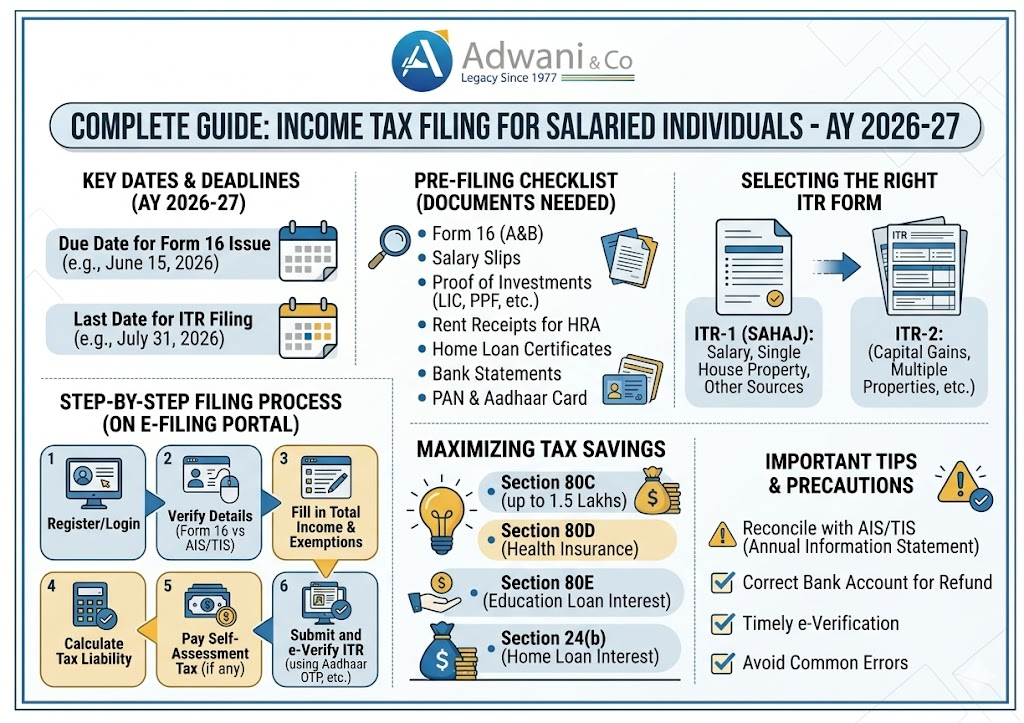
  • Section 80GGC Deduction Disallowance: ITAT Rules That Suspicion Is Not Enough,  A Guide for Indian Taxpayers

    Section 80GGC Deduction Disallowance: ITAT Rules That Suspicion Is Not Enough, A Guide for Indian Taxpayers

    Every year, thousands of honest Indian taxpayers find their legitimate deductions disallowed not because of anything wrong they did, but because someone else they transacted with came under scrutiny. A recent ITAT ruling has drawn a firm legal line: suspicion, however compelling, cannot substitute for evidence when it comes to Section 80GGC tax deduction disallowance.

    This ruling matters for anyone who has claimed or plans to claim a deduction for donations made to a registered political party under Section 80GGC of the Income-Tax Act, 1961. At Adwani & Co LLP, we have successfully applied this legal principle to defend clients against wrongful disallowances. Here is everything you need to understand to protect your tax position.

    Also Read:

    https://www.adwaniandco.com/blog/share-trading-tax-business-income-or-capital-gains-2026

    What Is Section 80GGC and Who Can Claim It?

    Section 80GGC of the Income-Tax Act, 1961 allows individual taxpayers not companies to claim a 100% deduction for donations made to:

    The rationale is straightforward: the government incentivises transparent, traceable political funding over unaccounted cash donations. Accordingly, cash donations are explicitly excluded only payments via banking channels (NEFT, RTGS, cheque, online transfer) qualify.

    Importantly, Section 80GGC remains available under both the old and new tax regimes in 2026, making it one of the few deductions that provides value regardless of which regime you choose.

    Key Eligibility Conditions for Section 80GGC Payment must be via banking channel (no cash). Recipient must be a registered political party or electoral trust. Deduction amount = 100% of donation (no cap). Must be declared in your ITR filing through the income tax portal

    The ITAT Ruling on Section 80GGC Disallowance: What Happened?

    The ruling at the centre of this article arose from a case where the Income Tax Department disallowed a taxpayer’s Section 80GGC deduction of ₹2,00,000 not because anything was wrong with the taxpayer’s own conduct, but because the recipient political party was under a general investigation for financial irregularities.

    Case ElementDetails
    Deduction Claimed₹2,00,000 under Section 80GGC (political donation)
    Assessment YearAY 2024-25
    Mode of PaymentNEFT bank transfer full banking trail maintained
    Documentation HeldOfficial receipt from political party + ITR declaration
    Department’s Basis for DisallowanceGeneral investigation of recipient political party
    ITAT OutcomeDisallowance DELETED. Deduction fully restored to taxpayer.

    Why Did the Department Disallow the Deduction and Why Was It Wrong?

    The Income Tax Officer’s reasoning followed a pattern we see frequently in post-investigation assessments:

    • Guilt by association: Because the recipient party was under investigation for unrelated financial irregularities, the officer argued that all donations to it should be disallowed regardless of the individual donor’s conduct.
    • Reliance on general investigation reports: The officer relied on broad findings about the organisation rather than any evidence specific to this taxpayer’s transaction.
    • Precautionary over-reach: The department effectively penalised a fully compliant taxpayer for another entity’s alleged wrongdoing.
    The Fatal Gap in the Department’s Case The Income Tax Department could not answer one simple question: How is this specific taxpayer’s bank-documented ₹2,00,000 donation connected to the organization’s alleged irregularities? The answer: it was not. And that gap the absence of any specific nexus proved legally fatal to the disallowance.

    ITAT’s Four Key Observations That Set the Precedent

    The Tribunal made four decisive observations that now serve as the legal foundation for defending Section 80GGC deductions and indeed, all deduction disallowances based on third-party investigations:

    Observation 1: No Evidence of Fund Return

    The ITAT found that the department provided no evidence that the donated funds were returned to the taxpayer in any form, or that the taxpayer received any irregular benefit. A clean outward banking transfer with no corresponding inward receipt is powerful documentation of a genuine donation.

    Observation 2: No Direct Nexus Established

    This is the cornerstone of the ruling. The Tribunal held that no direct nexus no specific, demonstrable link was established between this taxpayer’s individual donation and the alleged irregular transactions of the recipient organisation. The fact of donating to an investigated organisation does not implicate the donor unless the department can prove a specific connection.

    Observation 3: No Assessee-Specific Material on Record

    The ITAT emphasised that the department had general investigation files but nothing specifically implicating this taxpayer’s transaction. This principle applies broadly in any tax audit, reassessment, or deduction disallowance, the department must bring assessee-specific material on record, not just general investigative conclusions.

    Observation 4: Violation of Natural Justice

    The taxpayer was never given the opportunity to review or contest the investigative findings that formed the basis of the disallowance. This denial of the right to cross-examine is a standalone procedural ground for overturning an assessment independent of the substantive merits of the case.

    ITAT Verdict: Deduction Fully Restored All four observations led the Tribunal to delete the disallowance in its entirety. The taxpayer’s Section 80GGC deduction of ₹2,00,000 was restored. This ruling is precedent-setting for similar tax deduction disallowance cases across India particularly where investigation of a third party is used as the basis for penalising an unrelated, compliant taxpayer.

    The Nexus Requirement: When Is Disallowance Justified vs Not?

    ‘Nexus’ a direct, logical connection between a taxpayer’s specific action and the allegation against them is the legal bridge that must exist before any deduction can be disallowed or income added. Without nexus, the department’s action is arbitrary and legally indefensible.

    Strong nexus disallowance generally justified:

    • A taxpayer receives kickbacks from a supplier they also claimed as a deductible expense (direct benefit from the wrongdoing)
    • A company claims deductions for services that were demonstrably never rendered (direct false claim)
    • A director channels funds through a shell entity and reclaims them as income (direct round-tripping)

    Weak or absent nexus disallowance generally NOT justified:

    • A person donates to a political party that subsequently faces investigation (the donor’s conduct was entirely separate)
    • A vendor you paid legitimately is under audit your purchase transaction was compliant and properly documented
    • Your investment fund manager faces fraud charges after you made a routine, compliant investment

    The ITAT ruling makes clear: you cannot be penalised for a recipient’s conduct unless the department proves your transaction was itself improper.

    Your Due Process Rights in Assessment and Audit Proceedings

    The ITAT’s emphasis on natural justice is critically important for any taxpayer facing an income tax assessment, audit, or reassessment. You have statutory rights to:

    • Receive specific, written notice of all allegations against you not vague references to third-party investigative findings
    • Review the actual documents, reports, and evidence the Assessing Officer relies upon
    • Submit a written defence and present oral arguments before the assessment is finalised
    • Challenge investigative reports and cross-examine the evidence base
    • Appeal to the Commissioner (Appeals), ITAT, High Court, and Supreme Court if rights are violated

    As Dr. Haresh Adwani notes: “When the department skips due process, they hand the taxpayer additional grounds to overturn the assessment regardless of the substantive merits.” Procedural violations are often easier to argue and faster to resolve than substantive disputes.

    Practical Example: How Adwani & Co LLP Defended a Section 80GGC Claim

    Case Study – Dr. Ramesh Kulkarni, Pune Scenario: Dr. Ramesh Kulkarni donated ₹1,50,000 to a registered political party in FY 2024-25 via NEFT transfer and claimed the Section 80GGC deduction. In 2026, the party faced an Election Commission inquiry. The Income Tax Officer issued a notice proposing to disallow the deduction based on the inquiry.  Adwani & Co LLP’s Response: We filed a detailed objection citing the ITAT ruling and established: (1) the NEFT transfer showed a clean outward payment with no fund return; (2) no nexus existed between the EC inquiry and Dr. Kulkarni’s individual donation; (3) a proper receipt and ITR declaration were in place; (4) no assessee-specific material was produced by the officer.  Outcome: The disallowance was withdrawn at the objection stage itself the matter never proceeded to ITAT.

    What to Do If Your Section 80GGC Deduction Has Been Disallowed

    If you have received a notice proposing to disallow your Section 80GGC deduction based on investigation of the recipient organisation, take these steps immediately:

    • Do not ignore the notice. Respond within the specified time silence is treated as acceptance.
    • Request a written nexus explanation. Ask the officer to specify exactly what connects your transaction to the alleged irregularity.
    • Compile your documentation: bank statement showing the NEFT/cheque transfer, official party receipt, ITR declaration, and any correspondence with the party.
    • Engage a CA experienced in tax appellate work. ITAT proceedings require precise legal arguments a generic response rarely suffices.

    How Adwani & Co LLP Defends Against Wrongful Disallowance

    Adwani & Co LLP, under CA Dipesh Gurubakshani and the broader leadership of Dr. Haresh Adwani, provides a structured, evidence-driven defence against wrongful tax deduction disallowance:

    • Nexus analysis: We immediately test whether the department’s allegations establish any specific connection to your transaction. No nexus means immediate challenge at the assessment stage, before the matter even reaches ITAT.
    • Due process verification: We verify whether you received proper notice, access to evidence, and fair hearing. Procedural violations are standalone grounds for reversal.
    • ITAT precedent leverage: We cite directly relevant ITAT rulings and High Court decisions to demonstrate that the department’s approach is legally unsustainable.
    • Documentation fortification: We ensure your evidence file is complete banking records, official receipts, ITR declarations, and a comprehensive factual narrative.
    • Layered appellate strategy: Whether before the Commissioner (Appeals), ITAT, or High Court, we build arguments combining factual, legal, and procedural grounds.

    Conclusion: Your Good-Faith Compliance Is Legally Protected

    The ITAT’s ruling on Section 80GGC tax deduction disallowance establishes a principle that should reassure every honest taxpayer: suspicion cannot replace evidence. The Income Tax Department cannot disallow your legitimately documented, bank-transferred political donation simply because the recipient organization is under scrutiny. Your transaction stands independently assessed on its own merits, protected by the nexus requirement and your due process rights.

    Proper banking documentation, accurate ITR reporting, and genuine transactional intent are a taxpayer’s strongest legal armour. If your deductions have been disallowed on flimsy grounds, you have solid legal recourse and Adwani & Co LLP is here to exercise it on your behalf.

    Frequently Asked Questions -Section 80GGC and ITAT Ruling

    1.Can my Section 80GGC deduction be disallowed because the recipient party is under investigation?

    No. Based on the ITAT ruling, the department must prove that your specific donation was improper. The recipient organization being investigated is not sufficient a direct nexus to your individual transaction must be established.

    2.What evidence do I need to protect my Section 80GGC deduction?

    You need: (1) bank statement showing the NEFT or cheque transfer, (2) official receipt from the political party, (3) ITR filing declaring the donation, and (4) any acknowledgment from the party. Cash donations do not qualify.

    3.What should I do if my deduction was disallowed due to general investigation findings?

    Immediately request written specifics from the officer on what nexus connects the investigation to your transaction. If no nexus is established, file a detailed objection or appeal citing this ITAT precedent. Contact Adwani & Co LLP for guidance.

    4.Can I be reassessed based on investigation findings alone?

    A reassessment notice can reference investigation findings, but it must cite issues specific to your assessment and establish nexus with your transactions. A generic reference to organizational findings without assessee-specific material can be challenged as legally invalid.

    5.What are my rights to cross-examination in an income tax assessment?

    You have the right to receive written details of all allegations, review all evidence the officer relies on, submit written and oral defences, and challenge investigative reports. Denial of these rights is a procedural violation that independently grounds a reversal.
     

    6.Is Section 80GGC available under the new tax regime in 2026?

    Yes. Section 80GGC is one of the very few deductions available under both the old and new tax regimes, making it especially valuable. Ensure the donation meets the banking channel and receipt requirements to withstand scrutiny.

    7.Does this ITAT ruling apply to other deductions disallowed due to third-party investigations?

    Yes. The nexus principle applies broadly. In any assessment where deductions or expenses are disallowed based on a third-party investigation without assessee-specific evidence, the same legal framework protects you.

    About the Author

    CA Dipesh Gurubakshani is a Chartered Accountant with Adwani & Co LLP, Pune, specialising in income tax audit, direct taxation, and accounting advisory. He supports clients across statutory compliance, financial reporting, and income tax matters with a focus on accuracy, regulatory adherence, and disciplined execution.