Category: Blog

Your blog category

  • Share Trading Tax: Business Income or Capital Gains 2026?

    Share Trading Tax: Business Income or Capital Gains 2026?

    Share Trading Tax
    Share Trading Tax

    1. The ₹12 Lakh Question Every Share Trader Is Asking

    Every tax season, a particular question circulates in trading groups, WhatsApp chats, and CA waiting rooms across India. In FY 2025–26 (AY 2026–27), with the new tax regime firmly in place and the ₹12 lakh rebate under Section 87A making headlines, that question has reached a fever pitch:

    “If my total income is below ₹12 lakhs, can I show my share trading profits as Business Income to bring my taxable income below the rebate threshold and pay zero tax?”

    It sounds clever. It sounds like a legal loophole. But according to Indian tax law and the consistent position taken by the Income Tax Department the share trading tax treatment is not a matter of personal convenience. It is a matter of legal classification governed by well-settled principles.

    At Adwani and Company, one of Pune’s most trusted CA firms, we deal with exactly this share trading tax classification question every single week. Dr. Haresh Adwani, has guided hundreds of investors and active traders through the maze of share trading tax rules. This blog is your definitive guide to understanding how your share market profits are legally classified and what you absolutely must not get wrong in your ITR.

    Also Read:

    https://www.adwaniandco.com/blog/business-growth-strategy

    2. What the Income Tax Act Actually Says About Share Trading Tax

    Let us start with the single most important truth in this entire debate: there is no specific section in the Income Tax Act, 1961 that categorically declares share trading income must always be Business Income. Equally, no provision forces every investor to treat profits as Capital Gains.

    The share trading tax classification depends on applying principles drawn from three key provisions:

    SectionProvisionRelevance to Share Trading Tax
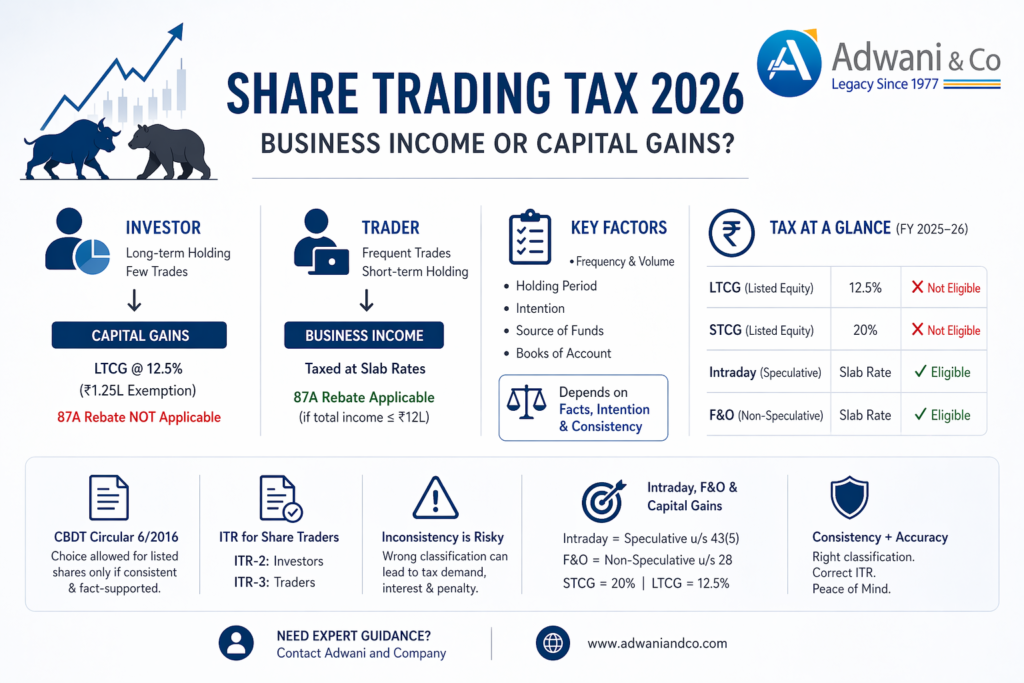
    Section 2(13)Definition of BusinessIncludes any trade, commerce, or adventure in the nature of trade. Courts have interpreted this broadly to cover frequent share trading.
    Section 28Profits and Gains from Business or ProfessionGoverns taxation of profits from any business carried on by the assessee applicable when trading is the primary activity.
    Section 45Capital GainsAny profit from transfer of a capital asset is taxable here the natural classification for long-term investors holding shares as investments.

    The Income Tax Department does not automatically assign you a category. The classification of share trading tax whether as Business Income or Capital Gains is entirely fact-specific. It depends on who you are, how you trade, why you trade, and how you maintain your books of account.

    Reference: Income Tax Department of India incometaxindia.gov.in

    3. Business Income vs Capital Gains: The Real Legal Test

    Courts and the Income Tax Department have consistently held that the real test in determining share trading tax treatment is a simple but powerful question: Are you an investor or a trader?

    This is not a question you can answer arbitrarily based on what saves you tax. As Dr. Haresh Adwani explains to clients at Adwani and Company:

    “The answer to whether your share trading income is Business Income or Capital Gains must emerge from the facts of your situation not from whichever classification happens to reduce your tax liability.”   Dr. Haresh Adwani, Adwani and Company

    Indian courts, including various High Courts and the Hon’ble Supreme Court, have developed a well-settled body of case law around this distinction. The intention of the taxpayer at the time of entering a transaction is a central factor but intention must always be corroborated by actual conduct and documentary evidence.

    4. Key Factors That Determine Share Trading Tax Classification

    The Assessing Officer (AO), during a scrutiny assessment under Section 143(3), applies a multi-factor test to determine whether your share trading income should be taxed as Business Income or Capital Gains. Here are the five factors the Income Tax Department consistently examines:

    FactorWhat the AO ExaminesInvestor SignalTrader Signal
    Frequency & VolumeHow many trades and how often?Few trades per yearHundreds of trades per month
    Holding PeriodHow long were shares held?Months to yearsDays to weeks
    IntentionWhy were shares purchased?Dividend & long-term growthProfit from price movement
    Source of FundsOwn money or borrowed?Own savings / surplus fundsMargin / broker funding
    Books of AccountHow shares recorded?Shown as ‘Investments’Shown as ‘Stock-in-trade’

    These factors are never applied in isolation. The AO looks at the totality of facts. A taxpayer who holds shares for 8 months but trades daily in other stocks, or uses borrowed funds for some and own funds for others, will face a more nuanced and often unfavorable classification if records are not maintained carefully.

    Learn more about our income tax filings and classification advisory services at Adwani and Company.

    5. CBDT Circular 6/2016: What It Really Permits for Share Trading Tax

    The Central Board of Direct Taxes (CBDT) issued Circular No. 6/2016 specifically to address the share trading tax classification issue for listed shares. This circular is frequently cited and even more frequently misunderstood.

    What CBDT Circular 6/2016 actually says: For listed shares and securities, the taxpayer’s consistent stand investor or trader may be accepted by the Assessing Officer, provided the stand is supported by facts and has been maintained over time.   It does NOT create an open, free choice to switch classifications whenever it is tax-advantageous.

    The operative word in that circular is consistent. Dr. Haresh Adwani specifically cautions clients at Adwani and Company: if you have been classifying your share profits as Capital Gains for years, suddenly switching to Business Income in FY 2025–26 because the ₹12 lakh rebate makes it attractive is precisely the kind of inconsistency that flags a case for scrutiny.

    The Income Tax Department has made this position clear through multiple assessment orders: income classification is not a menu from which taxpayers pick the most favorable option each year. The share trading tax treatment you choose must reflect your actual investment or trading behavior and it must be consistent.

    Reference: CBDT Circular No. 6/2016 Income Tax Department of India

    6. Real Example: Two Traders, Two Very Different Share Trading Tax Outcomes

    To make the share trading tax classification concrete, consider this practical example from FY 2025–26:

    ProfileTrader A (Active Trader)Trader B (Long-Term Investor)
    Activity200+ trades/month, all held under 30 days15 trades/year, average holding 14 months
    Source of FundsMargin funding from brokerOwn savings
    Books of AccountShares recorded as stock-in-tradeShares recorded as investments
    Profit (FY 2025-26)₹9 lakh₹9 lakh
    Correct ClassificationBusiness Income (slab rate)Long-Term Capital Gains @ 12.5%
    Tax Payable (approx.)Taxable at applicable slab in new regimeTaxed @ 12.5% after ₹1.25L exemption
    Can claim ₹12L rebate?Yes if total income is below ₹12LNo LTCG under 112A is excluded from 87A rebate
    Can Trader A claim LTCG?No AO will reclassify during scrutiny if Trader A triesN/A

    This example illustrates the critical point: both traders earn the same profit ₹9 lakh. But their share trading tax treatment is entirely different, and neither can simply choose the other’s classification because it saves tax. The facts determine the outcome, not the taxpayer’s preference.

    Key insight for FY 2025–26: Even if your share trading income qualifies as Business Income and your total income is below ₹12 lakhs, the Section 87A rebate only applies if the income is taxable at slab rates not at special rates. F&O and intraday business income may qualify. Ensure proper ITR filing with a CA to confirm eligibility.

    7. Which ITR Form Should Share Traders File?

    One of the most Googled share trading tax questions in India is: ‘Which ITR form should I use for share market income?’ The answer depends directly on your income classification:

    ITR FormWho Should Use ItApplicable Income Type
    ITR-2Investors with capital gains only (no business income)LTCG, STCG from listed/unlisted shares, mutual funds
    ITR-3Traders with business income (F&O, intraday, or high-frequency delivery trading)Speculative & non-speculative business income, plus capital gains
    ITR-4 (Sugam)Not applicable for share tradingPresumptive business income under Section 44AD cannot be used for F&O or share trading

    Important: Filing the wrong ITR form for example, using ITR-2 when you should have filed ITR-3 is a defective return. The Income Tax Department may issue a notice under Section 139(9) asking you to rectify it. A defective return, if not corrected within the prescribed time, is treated as if no return was filed at all.

    Read our detailed guide on ITR form selection for share traders and investors.

    8. Intraday and F&O: Where They Stand in Share Trading Tax

    For two very common types of share market activity, the Income Tax Act leaves no room for classification debate:

    ActivityTax ClassificationGoverning SectionSet-off of Losses
    Intraday Trading (same-day, no delivery)Speculative Business IncomeSection 43(5)Only against speculative profits (4-year carry-forward)
    F&O Trading (Futures & Options)Non-Speculative Business IncomeSection 28Against all heads except salary (8-year carry-forward)
    Short-Term Capital Gains (held < 12 months)STCG @ 20%Section 111AAgainst STCG / LTCG only
    Long-Term Capital Gains (held > 12 months)LTCG @ 12.5%Section 112AAgainst LTCG only; ₹1.25L annual exemption

    As Dr. Haresh Adwani notes: “For intraday and F&O, there is no classification debate the law is settled. The complexity and the risk arises with delivery-based equity trades, where facts and intention govern the share trading tax outcome. This is where most taxpayers and many non-specialist accountants get it wrong.”

    9. Why Reclassifying Share Trading Income for Tax Saving Is Risky

    The Income Tax Department has been consistently expanding its data analytics capabilities. In FY 2025–26, the department cross-references data from stock exchanges, depositories (CDSL/NSDL), SEBI, and broker-furnished Annual Information Statements (AIS) and Statements of Financial Transactions (SFT) to identify high-frequency traders who may be misclassifying income.

    When a taxpayer who has executed hundreds of transactions during the year then classifies all gains as long-term capital gains specifically to claim the ₹12 lakh rebate this inconsistency surfaces in the system. Such cases are flagged for scrutiny assessment under Section 143(3), and the Assessing Officer may:

    1. Re-examine the nature, frequency, and volume of all trades during the year.
    2. Reclassify the share trading income from Capital Gains to Business Income.
    3. Deny the LTCG exemption and 12.5% preferential rate entirely.
    4. Raise a demand for additional tax, plus interest under Sections 234B and 234C.
    5. Levy a penalty under Section 270A for under-reporting of income ranging from 50% to 200% of the tax evaded.
    A real cost calculation: If ₹5 lakhs in share trading income was misclassified to save ₹65,000 in tax, and the AO reclassifies it, the resulting demand could be: ₹65,000 (tax) + ₹15,000 (interest) + ₹32,500–65,000 (penalty) = up to ₹1,45,000 in total outgo more than double the original ‘saving’. The share trading tax shortcut costs more.

    The Adwani and Company team has represented multiple clients in scrutiny assessments arising from exactly this scenario. The financial cost and the stress of a wrongly filed return far exceeds any tax saved through incorrect share trading tax classification.

    Learn more about our tax scrutiny assessment representation services at Adwani and Company.

    10. Share Trading Tax Rates at a Glance (FY 2025–26)

    Type of IncomeSectionTax RateSection 87A Rebate Eligible?Key Notes
    Long-Term Capital Gains (LTCG) on listed equity112A12.5%No₹1.25 lakh annual exemption applies
    Short-Term Capital Gains (STCG) on listed equity111A20%NoHeld under 12 months; post-Budget 2024 revision
    Speculative Business Income (Intraday)43(5)Slab rateYes (if total income ≤ ₹12L)Losses set off only vs speculative income
    Non-Speculative Business Income (F&O)28Slab rateYes (if total income ≤ ₹12L)Losses set off vs all heads except salary
    LTCG Exemption112ANil up to ₹1.25LN/AFirst ₹1.25 lakh of LTCG is tax-free per year
    Critical clarification Section 87A rebate and share trading tax (FY 2025–26): As per the Finance Act 2024 and subsequent CBDT clarifications, the ₹12 lakh rebate under Section 87A in the new tax regime is NOT available against special-rate incomes including LTCG under Section 112A and STCG under Section 111A. This point changes the entire tax-saving math for share investors.   Slab-rate business income (F&O / intraday) may qualify for the rebate if total income is below ₹12 lakhs. But even this requires accurate ITR-3 filing and expert review.

    Conclusion: Correct Share Trading Tax Classification Is the Only Safe Path

    The share market may reward bold bets but the Income Tax Department rewards consistency, accuracy, and documentation. The share trading tax treatment you choose must reflect the reality of your trading activity. It cannot be an annual arithmetic exercise designed to minimize liability.

    The ₹12 lakh rebate under the new tax regime is a genuine benefit for eligible taxpayers. But attempting to engineer your share trading tax classification to fall within that threshold against the actual facts of your trading behavior is a risk the Income Tax Department is fully equipped to detect, examine, and penalize.

    As Dr. Haresh Adwani often reminds clients: “Your share market profit may be correct. Make sure your share trading tax treatment is too.”

    The right approach is to understand your classification honestly, document it consistently year after year, file your return in the correct ITR form, and consult a qualified Chartered Accountant who knows both the letter and the spirit of Indian tax law.

    Get Expert Share Trading Tax Guidance Adwani and Company Confused about how your share market profits should be classified? Whether you are a long-term investor, active delivery trader, intraday trader, or F&O participant Adwani and Company offers personaliszed, legally sound share trading tax advisory tailored to your exact situation.   Dr. Haresh Adwani and CA Dipesh Gurubakshani have helped hundreds of traders and investors across India navigate ITR filing, income classification, scrutiny assessments, and tax planning with confidence.   Connect with Adwani and Company today: Website: www.adwaniandco.com Based in Pune | Serving clients Pan-India.

    FAQs: Share Trading Tax Classification in India (FY 2025–26)

    Q1. Can I choose whether my share trading income is Business Income or Capital Gains?

    Not freely. While CBDT Circular 6/2016 gives some flexibility for listed shares, your classification must be consistent, fact-supported, and cannot be changed solely to reduce tax liability. The Assessing Officer retains the authority to examine and reclassify. Adwani and Company recommends documenting your investment intent clearly from the start of each financial year.

    Q2. Is intraday trading always taxable as Business Income under share trading tax rules?

    Yes. Under Section 43(5) of the Income Tax Act, intraday trading buying and selling shares on the same day without delivery is always classified as Speculative Business Income. This is non-negotiable. Losses from intraday trading can only be set off against speculative profits, not against other heads of income.

    Q3. Is the ₹12 lakh rebate under Section 87A available on LTCG from shares?

    No. The Section 87A rebate (up to ₹12 lakhs under the new tax regime) is not available against long-term capital gains taxable under Section 112A or short-term capital gains under Section 111A. These are taxed at special rates, and the rebate explicitly does not apply. This is one of the most common share trading tax misconceptions, and acting on it can result in a defective or incorrect return.

    Q4. How is F&O trading income taxed in India?

    Futures and Options trading income is classified as Non-Speculative Business Income under Section 28. It is taxed at the applicable slab rate under whichever tax regime the taxpayer has chosen. F&O losses can be set off against all heads of income except salary in the same year, and carried forward for up to 8 years.

    Q5. Which ITR form should I file for share trading income?

    Use ITR-2 if you have only capital gains (no business income). Use ITR-3 if you have F&O income, intraday trading income, or delivery-based trading income classified as business income. Filing ITR-4 for share trading income is incorrect ITR-4 is for presumptive income under Section 44AD, which explicitly excludes speculative and F&O income.

    About the Author

    CA Dipesh Gurubakshani

    Chartered Accountant | Adwani and Company, Pune CA Dipesh Gurubakshani is a Chartered Accountant with professional expertise in audit, direct taxation, and accounting advisory services. He supports clients across statutory compliance, financial reporting, and income-tax matters with a strong focus on accuracy, regulatory adherence, and practical guidance for investors and traders.

  • Smart Business Growth Strategy(2026): Find the Bypass

    Smart Business Growth Strategy(2026): Find the Bypass

    Smart Business Growth Strategy: Stop Pushing Harder and Find the Bypass

    Here is a truth that most business owners learn too late: the biggest obstacle to growth is almost never what you think it is. You blame the sales team. You blame the market. You blame the economy. But the real problem the one quietly draining your revenue, your margins, and your energy is usually hiding in plain sight, disguised as something you have always accepted as normal.

    The most effective business growth strategy is not about pushing harder through obstacles. It is about finding the bypass the smarter, faster, less crowded path that everyone else overlooked.

    At Adwani and Company, we see this pattern repeatedly. Businesses generating ₹50 crore, ₹100 crore, or more in revenue come to us frustrated. Growth has stalled. Costs are rising. Customers are complaining. And the owner is convinced the solution is more effort, more investment, more pressure.

    It rarely is.

    In this blog, we will explore why the most powerful business growth strategy often involves subtraction, not addition removing the hidden friction points that silently sabotage your business. We will share a real-world example, actionable frameworks, and the thinking that separates businesses that scale from businesses that struggle.

    Also Read:

    https://www.adwaniandco.com/blog/capital-gains-exemption


    Why Pushing Harder Is Not a Business Growth Strategy

    There is a deeply ingrained belief in Indian business culture that success comes from relentless effort. Work longer hours. Hire more salespeople. Spend more on marketing. Push, push, push.

    And effort absolutely matters. Nobody builds a successful business without hard work.

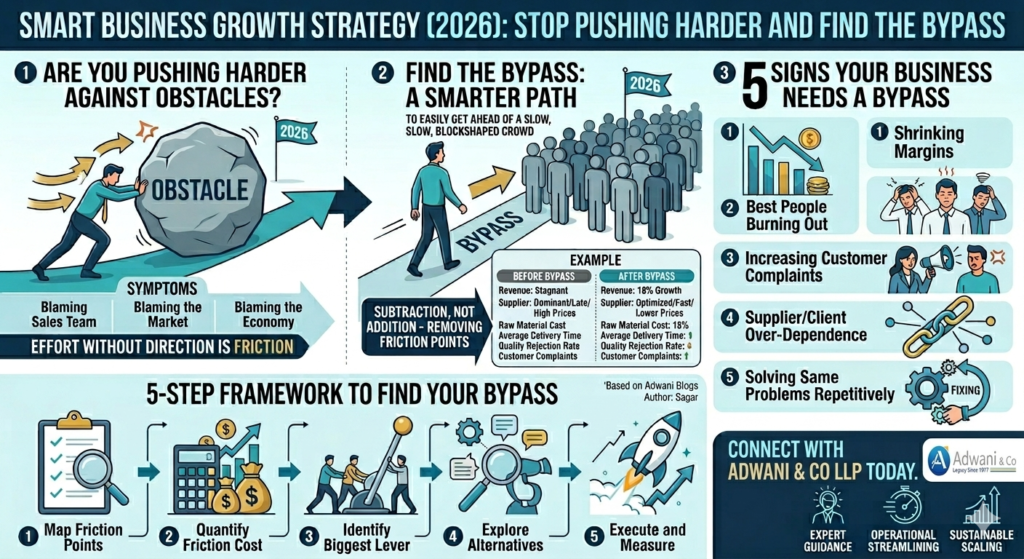
    But here is the problem: effort without direction is just friction. And friction, compounded over months and years, destroys businesses.

    Consider this scenario. You are walking briskly one morning clear mind, strong focus, productive energy. Then you encounter a group blocking your path. Moving slowly. Chatting casually. Unaware of anyone behind them.

    You have three options:

    1. Wait behind them patient, but slow.
    2. Force your way through aggressive, but creates conflict.
    3. Find a side lane a simple bypass that gets you ahead without friction.

    Option three is almost always the best choice. And it is almost always the one people overlook.

    Business works the same way. The most effective business growth strategy is not about exerting more force against the same obstacle. It is about recognising the obstacle for what it is and finding a smarter route around it.


    The Hidden Bottleneck: A Real-World Business Growth Strategy Example

    Let us look at a situation that Dr. Haresh Adwani and the advisory team at Adwani and Company encountered with a client a mid-sized manufacturing business with annual revenue exceeding ₹50 crore.

    The Symptoms

    The business was showing classic signs of stagnation:

    • Revenue growth had slowed to near zero.
    • Customer complaints were increasing quarter over quarter.
    • Gross margins were shrinking despite stable pricing.
    • The operations team was working harder but achieving less.

    The owner was convinced the problem was sales. “We need more customers. We need a better sales team. We need to spend more on marketing.”

    The Diagnosis

    When we looked deeper beyond the P&L statement and into the operational mechanics a different picture emerged.

    The root cause was not sales. It was one supplier.

    This supplier was well-known in the market. Popular. In demand. Every manufacturer wanted to work with them. And because of that dominant position:

    • Prices kept rising 8–12% annually, far above market averages.
    • Deliveries kept slipping lead times had grown from 2 weeks to 6 weeks.
    • Quality became inconsistent rejection rates had doubled in 18 months.

    The business was haemorrhaging money, not because of a sales problem, but because of a supplier dependency problem. More than ₹50 crore in annual revenue was being exposed to decisions made by someone else’s business.

    The Bypass

    Instead of renegotiating harder (pushing through the crowd), we helped the client find the bypass.

    We conducted a comprehensive supplier review evaluating alternatives across quality, pricing, delivery reliability, and scalability. The result was a newer, less crowded supplier that offered:

    • 15% lower pricing on key raw materials.
    • 60% faster delivery times from 6 weeks back to under 2 weeks.
    • Significantly better quality consistency rejection rates dropped by 70%.

    The shift looked small on paper. One supplier changed.

    The impact was anything but small:

    MetricBefore BypassAfter Bypass
    Raw material cost₹18.5 crore/year₹15.7 crore/year
    Average delivery time6 weeks1.5 weeks
    Quality rejection rate8.2%2.4%
    Customer complaints45/month12/month
    Revenue growth (next 12 months)~0%18%

    That is the power of a well-executed business growth strategy not more effort, but better decisions.


    Pattern Recognition: The Core of Every Great Business Growth Strategy

    Warren Buffett does not succeed because he works harder than other investors. He succeeds because he sees patterns others miss. Steve Jobs did not build Apple by outspending competitors. He built it by recognising what customers wanted before they knew they wanted it.

    The best business growth strategy is rooted in pattern recognition the ability to look at a complex business and identify the one lever that, when pulled, unlocks disproportionate results.

    As Dr. Haresh Adwani often explains: “Numbers tell you what is happening. Patterns tell you why. And understanding why is where real advisory value begins.”

    Most business owners are drowning in data. Revenue reports, expense dashboards, sales funnels, customer analytics. But data without interpretation is noise. The role of a strategic advisor is to cut through that noise and find the signal the one insight that changes the trajectory.


    Five Signs Your Business Needs a Bypass, Not More Effort

    How do you know when pushing harder is the wrong approach? Here are five patterns we frequently identify at Adwani and Company:

    1. Revenue Is Growing but Margins Are Shrinking

    If your top line is increasing but your bottom line is flat or declining, you have a structural problem not a sales problem. The bypass might be in your cost structure, your pricing model, or your customer mix.

    2. Your Best People Are Burning Out

    When high performers start leaving or disengaging, it is rarely about compensation. It is usually about friction inefficient processes, unclear priorities, or systemic bottlenecks that make their work unnecessarily difficult. The bypass is operational, not motivational.

    3. Customer Complaints Are Increasing Despite Good Products

    This almost always points to a supply chain or delivery issue. Your product may be excellent, but if it arrives late, arrives damaged, or arrives inconsistently, customers will leave. The bypass is upstream, not downstream.

    4. You Are Over-Dependent on One Supplier, One Client, or One Channel

    Concentration risk is the silent killer of mid-sized businesses. If more than 30% of your revenue or supply chain depends on a single entity, you are one decision away from crisis. The bypass is diversification systematic, strategic, and planned.

    5. You Keep Solving the Same Problems

    If the same issues resurface every quarter cash flow crunches, inventory mismatches, compliance delays you are treating symptoms, not causes. The bypass requires going deeper and restructuring the root process.

    How to Build a Business Growth Strategy Around Finding Bypasses

    Here is a practical framework that any business owner can implement:

    Step 1: Map Your Friction Points

    List every area where your business experiences recurring delays, cost overruns, or quality issues. Be brutally honest. Common areas include procurement, logistics, compliance, hiring, and collections.

    Step 2: Quantify the Cost of Friction

    For each friction point, estimate the annual cost in money, time, and opportunity. You will be surprised how much “accepted” inefficiency is actually costing you. A ₹50 crore business can easily be losing ₹3–5 crore annually to friction it has never measured.

    Step 3: Identify the Biggest Lever

    Not all friction points are equal. Find the one that, if resolved, would have the largest cascading impact on revenue, margins, and customer satisfaction. This is your primary bypass.

    Step 4: Explore Alternatives Relentlessly

    Do not accept the first alternative you find. Evaluate multiple options. Test small before committing large. The best business growth strategy decisions are informed, not impulsive.

    Step 5: Execute and Measure

    Implement the change, track the metrics, and iterate. A bypass is not a one-time fix it is a new path that needs to be maintained and optimised over time.


    The Role of Advisory in Modern Business Growth Strategy

    Here is something most business owners do not want to hear: you cannot see your own blind spots.

    You are too close to the business. You have too many emotional attachments to existing relationships, processes, and decisions. The supplier who is costing you ₹3 crore a year might also be someone you have known for 15 years. The process that is bleeding efficiency might be one you designed yourself.

    This is where external advisory becomes invaluable not to replace your judgment, but to complement it with objectivity.

    At Adwani and Company, our advisory approach goes beyond spreadsheets and compliance. Led by Dr. Haresh Adwani, our team works with business owners to identify hidden friction, quantify its impact, and design practical solutions that drive measurable growth.

    Whether it is a supplier review, a cost restructuring, a compliance overhaul, or a full strategic reassessment, the goal is always the same: find the bypass that unlocks your next phase of growth.

    The Ministry of Corporate Affairs (MCA) and regulatory frameworks like the Companies Act increasingly demand that businesses maintain robust governance and operational structures. A strong business growth strategy must account for compliance as a growth enabler, not just a cost centre.

    Conclusion: The Smartest Business Growth Strategy Is Seeing What Others Miss

    Every business owner faces crowded paths saturated markets, rising costs, difficult suppliers, demanding customers. The instinct is to push harder, move faster, and outwork the competition.

    But the most successful businesses the ones that scale sustainably and profitably do something different. They pause. They observe. They find the bypass.

    The side lane nobody noticed. The supplier nobody evaluated. The process nobody questioned. The insight nobody connected.

    That is not laziness. That is strategic intelligence. And it is the foundation of every truly effective business growth strategy.

    Where in your business are you pushing harder when you should be looking for the bypass?

    If you want expert guidance to identify hidden growth opportunities, streamline operations, and build a business growth strategy that actually works, connect with Adwani and Company today. Dr. Haresh Adwani and our advisory team are ready to help you find the path that transforms your business.

    1. What is a business growth strategy?

    A business growth strategy is a structured plan to increase revenue, improve margins, and scale operations sustainably. It involves identifying opportunities, removing bottlenecks, and making strategic decisions about markets, products, pricing, and operations.

    2. Why does pushing harder sometimes fail as a business growth strategy?

    Because effort without direction creates friction. If the underlying problem is structural a bad supplier, an inefficient process, a flawed pricing model more effort will not solve it. You need to identify and address the root cause.

    3. How do I identify hidden bottlenecks in my business?

    Start by mapping every area where recurring problems occur delays, cost overruns, complaints, rework. Quantify the cost of each. The largest hidden cost is usually your biggest bottleneck and your most valuable bypass.

    4. How often should a business review its growth strategy?

    At minimum, annually. However, high-growth businesses benefit from quarterly strategic reviews. Market conditions, supplier dynamics, and customer needs change constantly your business growth strategy must evolve accordingly.

    5. Can a single supplier really impact business growth?

    Absolutely. As our real-world example demonstrated, one over-relied-upon supplier can silently erode margins, delay deliveries, and damage customer relationships putting crores of revenue at risk.

    6. What role does a CA firm play in business growth strategy?

    A modern CA firm like Adwani and Company goes beyond compliance. We analyse financial data, identify operational inefficiencies, advise on tax-efficient structuring, and help business owners make strategic decisions backed by numbers and expertise.

    Author
    CA. Manish R. Mata Practising In India (Ex – PwC),  At Adwani & Co LLP leads the International Accounting & Tax Support vertical, delivering structured execution assistance to US CPA firms and overseas businesses.

  • Capital Gains Exemption: Asset vs Gain View Explained (2026)

    Capital Gains Exemption: Asset vs Gain View Explained (2026)

    Capital Gains Exemption: Asset vs Gain View Explained (2026)
    Capital Gains Exemption: Asset vs Gain View Explained (2026)

    Capital Gains Exemption: Why One Word Change in 2025 Can Alter Your Entire Tax Position.

    In the world of Indian tax law, precision is everything. A single word sometimes even a comma — can redefine your entire tax liability. If you have ever claimed a capital gains exemption on the sale of property, business assets, or investments, you already know that the language of the law matters just as much as the numbers on your return.

    But here is something most taxpayers, and even many professionals, are not paying close enough attention to: the proposed Income Tax Bill, 2025, quietly changes one critical phrase that could reshape how capital gains exemption eligibility is determined across India.

    The shift? From “Long-Term Capital Asset” to “Long-Term Capital Gain.”

    At first glance, it looks like a cosmetic edit. In practice, it could trigger disputes, change eligibility, and force a complete rethinking of how depreciable assets, real estate holdings, and business investments are treated at the time of sale.

    At Adwani and Company, led by Dr. Haresh Adwani, we have been studying the proposed bill closely. In this blog, we break down exactly what this change means, why it matters, and how you should prepare — whether you are a CA student, a tax practitioner, or a business owner planning your next asset sale.

    Also Read:

    https://www.adwaniandco.com/blog/form-16-explained


    Understanding the Core of Capital Gains Exemption in India

    Before we dive into the 2025 changes, let us establish a solid foundation.

    When you sell a capital asset whether it is land, a building, shares, or machinery the profit you earn is called a capital gain. Depending on how long you held the asset, this gain is classified as either short-term or long-term. And this classification determines whether you can claim a capital gains exemption under provisions like Section 54, 54EC, 54F, and others under the Income Tax Act, 1961.

    Here is the traditional framework:

    • Short-Term Capital Asset: Held for less than 24 months (or 12/36 months depending on asset type).
    • Long-Term Capital Asset: Held beyond the specified period.

    If the asset qualifies as long-term, you may be eligible for various capital gains exemption benefits — provided you meet the reinvestment and procedural conditions.

    Simple enough, right? Not always.


    The Section 50 Complication: When Holding Period Does Not Matter

    This is where things get interesting, and where many taxpayers and even experienced professionals stumble.

    Imagine you own a piece of machinery used in your business. You purchased it eight years ago. By any normal measure, it is a long-term capital asset. You sell it today at a profit.

    Logically, you would expect this to be treated as a long-term capital gain, making you eligible for capital gains exemption.

    But the law says otherwise.

    What Section 50 Actually Does

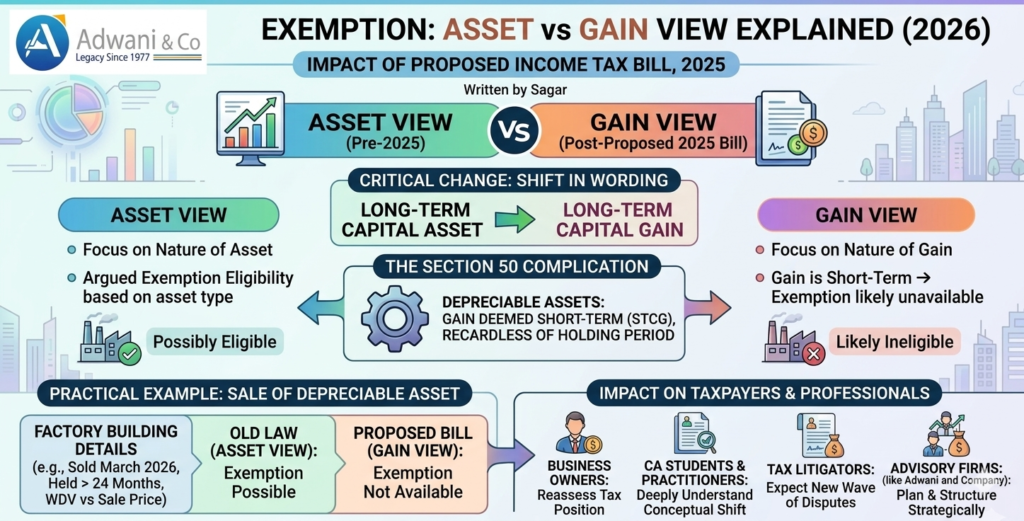
    Under Section 50 of the Income Tax Act, when you sell a depreciable asset an asset on which you have been claiming depreciation the gain is always treated as a short-term capital gain, regardless of how long you held it.

    This means:

    • You held the asset for 8 years → Still short-term gain.
    • You held the asset for 20 years → Still short-term gain.
    • The asset is clearly long-term by holding period → The gain is still deemed short-term.

    This legal fiction has been a source of confusion and litigation for decades. The asset is long-term, but the gain is short-term. And your eligibility for capital gains exemption depends on which one the law prioritises.

    As Dr. Haresh Adwani often explains to clients at Adwani and Company: “Section 50 is one of the most misunderstood provisions in Indian tax law. The holding period gives you a false sense of security. What matters is how the gain is characterised.”


    The Traditional View: Focus on the Asset

    Historically, the language of exemption sections like Section 54, 54EC, and 54F used the phrase “long-term capital asset.”

    This meant the eligibility test was tied to the nature of the asset, not the nature of the gain.

    Under this interpretation, some taxpayers and practitioners argued:

    • The asset is long-term by holding period.
    • Section 50 only deems the gain as short-term for computation purposes.
    • The asset itself remains long-term.
    • Therefore, capital gains exemption should still be available.

    This “asset view” found support in certain tribunal decisions and was a popular planning strategy particularly for businesses selling old depreciable assets like buildings, vehicles, and plant and machinery.

    However, this interpretation was not universally accepted, and it led to frequent disputes with assessing officers who took the opposite position.


    The 2025 Shift: Focus Moves to the Gain

    Now, here is the critical development.

    Under the proposed Income Tax Bill, 2025, the wording in key exemption provisions is being changed. Instead of referring to a “long-term capital asset,” the new language refers to a “long-term capital gain.”

    Read that again. The test is no longer about the asset. It is about the gain.

    Why This One Word Changes Everything for Capital Gains Exemption

    Let us revisit our earlier example:

    • You sell a depreciable asset held for 8 years.
    • Under Section 50, the gain is deemed short-term.
    • Under the old law, you could argue the asset is long-term → exemption possible.
    • Under the new law, the gain is short-term → exemption may not be available.

    This is not a theoretical distinction. It has real financial consequences.

    Consider a manufacturing business selling an old factory building:

    ParameterOld LawProposed 2025 Bill
    Asset holding period15 years (long-term)15 years (long-term)
    Depreciation claimedYesYes
    Gain classification (Sec 50)Short-term gainShort-term gain
    Exemption test language“Long-term capital asset”“Long-term capital gain”
    Exemption eligibility argumentAsset is long-term → possibly eligibleGain is short-term → likely ineligible

    The financial impact? On a sale generating ₹2 crore in capital gains, losing capital gains exemption eligibility could mean an additional tax outflow of ₹30–40 lakh or more, depending on the applicable rate and surcharge.


    A Practical Example: How This Plays Out in Real Life

    Let us work through a detailed numerical example.

    Scenario: Mr. Rajesh, a Delhi-based manufacturer, sells a factory building in March 2026.

    • Original cost (2010): ₹80 lakh
    • Written Down Value (WDV) as of sale date: ₹18 lakh (after years of depreciation)
    • Sale price: ₹2.50 crore

    Under Section 50: Capital gain = Sale price − WDV = ₹2,50,00,000 − ₹18,00,000 = ₹2,32,00,000

    This entire amount is treated as short-term capital gain under Section 50, despite 16 years of holding.

    Under old law (asset view): Rajesh could argue the asset is long-term and explore exemption under Section 54 (if reinvesting in residential property) or other applicable sections.

    Under the proposed 2025 bill (gain view): The gain is short-term. The exemption test now looks at the nature of the gain. Rajesh may not be eligible for capital gains exemption at all.

    Tax impact: At the short-term capital gains tax rate applicable to his income slab (say 30% plus surcharge and cess), Rajesh could face a tax liability exceeding ₹75 lakh on this single transaction — with no exemption route available.

    This is exactly the kind of scenario where professional guidance becomes non-negotiable. At Adwani and Company, Dr. Haresh Adwani and his team regularly advise businesses on structuring asset sales to minimise such exposures before they become irreversible.

    What This Means for Taxpayers and Professionals

    For Business Owners

    If you own depreciable assets — factories, office buildings, vehicles, plant and machinery — and you are planning a sale in the next few years, you need to reassess your tax position under the proposed framework. The capital gains exemption strategies that worked earlier may no longer be available.

    For CA Students and Practitioners

    This is a conceptual shift you must understand deeply. Exam questions and professional scenarios will increasingly test whether you can distinguish between the “asset view” and the “gain view.” More importantly, clients will expect you to know the difference.

    For Tax Litigators

    Expect a new wave of disputes. Taxpayers who have already planned transactions based on the asset view may find themselves in conflict with revenue authorities applying the gain view. Historical tribunal decisions supporting the asset view may lose relevance under the new statutory language.


    How to Prepare for the Capital Gains Exemption Changes

    Here are actionable steps recommended by the advisory team at Adwani and Company:

    1. Review pending asset sales: If you are planning to sell depreciable assets, evaluate whether completing the sale before the new bill takes effect could preserve your exemption eligibility.
    2. Restructure holdings: In some cases, transferring assets out of the depreciation block before sale (where legally permissible) may alter the tax treatment. This requires careful professional analysis.
    3. Document your position: If you choose to claim capital gains exemption under the current law, ensure your documentation and legal reasoning are watertight.
    4. Stay updated: The proposed bill is still under discussion. Track amendments, committee recommendations, and final enacted language. The Income Tax Department portal and the Ministry of Finance are your primary sources.
    5. Seek expert advice: This is not a do-it-yourself situation. The interplay between Section 50, exemption provisions, and the new bill’s language requires specialist interpretation.

    The Bigger Lesson: In Tax, Every Word Counts

    This entire discussion reinforces a fundamental truth about Indian tax law: the exact words in the statute matter more than assumptions or common sense.

    As Dr. Haresh Adwani frequently reminds his team: “Tax planning is not about finding loopholes. It is about reading the law more carefully than anyone else in the room.”

    The shift from “long-term capital asset” to “long-term capital gain” is a masterclass in legislative precision. One word changes the eligibility test. One word changes your tax liability. One word can mean the difference between a ₹0 tax bill and a ₹75 lakh tax bill.

    Conclusion: Do Not Let One Word Cost You Lakhs

    The proposed shift from “long-term capital asset” to “long-term capital gain” in the Income Tax Bill, 2025, is not a minor drafting change. It is a fundamental reorientation of how capital gains exemption eligibility will be determined for millions of Indian taxpayers.

    Whether you are a business owner planning an asset sale, a CA student preparing for exams, or a practitioner advising clients, this is a development you cannot afford to overlook. The distinction between the asset view and the gain view will define tax outcomes worth crores of rupees in the years ahead.

    Tax law rewards those who read carefully and plan proactively. It penalises those who assume yesterday’s rules still apply.

    If you want expert guidance on capital gains exemption, asset sale planning, or any aspect of the proposed Income Tax Bill 2025, connect with Adwani and Company today. Led by Dr. Haresh Adwani, our team delivers the precise, strategic advice that protects your wealth and keeps you ahead of the law.

    Schedule a consultation with Adwani and Company →

    Frequently Asked Questions About Capital Gains Exemption

    1. What is capital gains exemption under Indian tax law?

    Capital gains exemption refers to provisions under the Income Tax Act (such as Sections 54, 54EC, 54F) that allow taxpayers to reduce or eliminate tax on capital gains by reinvesting the proceeds in specified assets within prescribed timelines.

    2. How does Section 50 affect capital gains exemption eligibility?

    Section 50 deems the gain on sale of depreciable assets as short-term, regardless of holding period. This can affect eligibility for capital gains exemption, especially under the proposed 2025 bill where the test shifts to the nature of the gain.

    3. What is the difference between the asset view and the gain view for capital gains exemption?

    The asset view focuses on whether the asset itself qualifies as long-term. The gain view focuses on whether the resulting capital gain is classified as long-term. The proposed Income Tax Bill, 2025, appears to shift the test toward the gain view.

    4. Will the Income Tax Bill 2025 remove capital gains exemption for depreciable assets?

    While the bill does not explicitly remove exemptions, the change in wording from “long-term capital asset” to “long-term capital gain” may make it significantly harder to claim capital gains exemption on depreciable assets where the gain is deemed short-term under Section 50.

    5. How can I protect my capital gains exemption eligibility before the 2025 changes?

    Review your asset portfolio, consider timing your sales strategically, and consult a qualified tax professional. Firms like Adwani and Company can help you evaluate your options under both the current and proposed law.

    6. Where can I read the proposed Income Tax Bill 2026?

    The proposed bill and related documents are available on the Income Tax Department’s official portal and the Ministry of Finance website.

    7. Does capital gains exemption apply to all types of assets?

    No. Each exemption section has specific conditions regarding the type of asset sold, the type of asset purchased, the timeline for reinvestment, and the amount eligible. Professional guidance is essential to determine applicability.

    Author

    CA.Dipesh Gurubakshani. He is a Chartered Accountant with professional experience in audit, direct taxation, and accounting advisory services. supports clients across statutory compliance, financial reporting, and income-tax related matters, with a strong focus on accuracy, regulatory adherence, and disciplined execution.

  • Form 16 Guide:Complete 2026 Guide for Salaried Employees

    Form 16 Guide:Complete 2026 Guide for Salaried Employees

    Form 16
    Form 16

    Key Takeaways

    • Form 16 is a TDS certificate legally required under Section 203, Income Tax Act, if your employer deducted any tax on your salary.
    • Deadline: June 15, 2026. Your employer must issue Form 16 by this date or face ₹100/day penalty.
    • Form 16 has two parts: Part A (TRACES TDS certificate) and Part B (salary breakdown). Both are critical for ITR filing.
    • Cross-check Form 16 against Form 26AS to catch discrepancies. Wrong PAN on Form 16 means lost TDS credit.
    • You can file ITR without Form 16 using salary slips + Form 26AS, but Form 16 makes filing faster and reduces errors.

    What is Form 16? Learn everything about Form 16 its parts, importance, due date, how to download it, and how to use it to file your income tax return in 2026. Simple guide by Adwani & Co LLP.


    Every year, around the time income tax returns are due, one document becomes the most searched, most asked-about, and honestly most misunderstood piece of paper in the life of a salaried employee in India.

    That document is Form 16.

    If you’ve ever wondered what Form 16 actually is, why your employer gives it to you, what all those numbers inside it mean, or how to use it to file your income tax return you’re in the right place.

    This guide breaks it all down. No jargon. No confusion. Just a clear, honest explanation of everything you need to know about Form 16 in 2026.

    Also Read:

    https://www.adwaniandco.com/blog/fatca-crs-foreign-assets-disclosure-doctors


    What Is Form 16?

    Form 16 is a TDS certificate issued by your employer. TDS stands for Tax Deducted at Source which means your employer deducts income tax from your salary every month before paying you, and deposits that tax directly with the government on the official Income Tax Portal.

    Form 16 is proof of that. It tells you and the Income Tax Department exactly how much salary you earned and how much tax was deducted from it during the financial year.

    Think of it as your employer’s official statement saying: “Here’s what we paid this employee, here’s what we deducted as tax, and here’s what we deposited with the government.”

    Under Section 203 of the Income Tax Act, every employer who deducts TDS on salary is legally required to issue Form 16 to their employees.


    Who Gets Form 16?

    Not every salaried employee automatically gets Form 16. Here’s the rule:

    SituationDo You Get Form 16?
    Your salary is above the basic exemption limit and TDS was deductedYes employer must issue Form 16
    Your salary is below the exemption limit and no TDS was deductedTechnically not mandatory, but many employers still issue it
    You switched jobs during the yearYou get Form 16 from each employer separately
    You worked on contract / as a freelancerYou get Form 16A, not Form 16 (different document)

    The basic exemption limit for FY 2025–26 is ₹2.5 lakh under the old tax regime and ₹3 lakh under the new tax regime. If your income exceeds this and your employer has deducted TDS you will receive Form 16.


    When Does Your Employer Issue Form 16?

    By law, Form 16 must be issued by 15th June of the year following the financial year.

    Financial YearForm 16 Deadline
    FY 2025-26 (Apr 2025 – Mar 2026)June 15, 2026

    So if you’re filing your ITR for FY 2025–26, your employer must give you Form 16 by 15th June 2026. Most employers issue it a few weeks earlier, especially in large organizations.

    If your employer hasn’t issued Form 16 by 15th June, they can face a penalty of ₹100 per day under Section 272A(2)(g) of the Income Tax Act. So you have every right to follow up and ask for it.


    The Two Parts of Form 16 – Explained Simply

    This is where most people get confused. Form 16 is not one document it has two distinct parts: Part A and Part B. Both are important. Both serve a different purpose.

    Form 16 Part A The TDS Summary

    Part A is generated directly by the TRACES portal (the Income Tax Department’s TDS system). Your employer downloads it from there and issues it to you. This is why Part A has a TRACES watermark and a unique certificate number.

    Part A is generated from the official TRACES portal

    Part A tells you:

    Information in Part AWhat It Means
    Employer’s name, address, and TANDetails of who deducted your TDS
    Your name, address, and PANConfirms it’s your certificate
    Assessment YearThe year for which tax was deducted (e.g., AY 2026–27)
    Period of employmentThe months during which you worked with this employer
    Summary of TDS deducted and depositedQuarter-wise breakdown of how much tax was deducted and deposited

    One critical check: Make sure your PAN number on Form 16 Part A is correct. If the PAN is wrong, the TDS credit won’t show up in your Form 26AS and you won’t be able to claim credit for the tax deducted.

    Form 16 Part B – Your Salary Breakdown

    Part B is prepared by your employer (not downloaded from TRACES). It is a detailed statement of your salary and the various deductions applied under the Income Tax Act before arriving at your taxable income.

    Part B typically includes:

    Component in Part BWhat It Covers
    Gross salaryTotal CTC components basic, HRA, allowances, bonuses, etc.
    Exempt allowancesHRA exemption, LTA exemption, standard deduction (₹50,000)
    Net taxable salaryGross salary minus exempt allowances
    Deductions under Chapter VI-ASection 80C (PF, LIC, ELSS, PPF), 80D (health insurance), 80G (donations), etc.
    Total taxable incomeAfter all deductions
    Tax computedBased on applicable tax slab
    Rebate under Section 87AIf applicable (income below ₹5 lakh / ₹7 lakh under new regime)
    TDS deductedFinal tax deducted from salary

    Part B is essentially a ready-made income tax computation done by your employer. When you sit down to file your ITR, most of the numbers you need are right here.

    The Real Story: Why Form 16 Verification Matters

    Rajesh Kumar, 32, IT Professional, ₹18 lakh salary

    Rajesh received Form 16 in June 2025 and immediately filed his ITR using Part B numbers without verification. Three months later: Section 143(2) notice arrived. The issue? His employer had wrongly calculated HRA exemption in Form 16 Part B (₹4 lakh claimed vs ₹2.5 lakh eligible based on actual rent paid).

    Consequence: Additional tax of ₹65,000 + 20% penalty + interest charges + 18 months of correspondence.

    Our Solution: We filed detailed response with rent receipts and landlord’s PAN, requested closure under Settlement scheme. Result: Penalty waived, only ₹40,000 additional tax finally paid.Key Learning: Never use Form 16 blindly. Verify Part B calculations against salary slips. HRA, allowances, and deductions must match reality


    Form 16 vs Form 16A vs Form 16B – What’s the Difference?

    This confuses a lot of people. Let’s clear it up once and for all:

    DocumentIssued ByFor What IncomeWho Receives It
    Form 16EmployerSalary incomeSalaried employees
    Form 16ABanks, companies, othersNon-salary income (FD interest, professional fees, rent, etc.)Anyone on whom TDS is deducted for non-salary income
    Form 16BProperty buyerSale of immovable propertyProperty seller

    If you have a salary job and also earn FD interest, you’ll receive both Form 16 (from your employer) and Form 16A (from your bank). Both need to be considered when filing your ITR.


    How to Download Form 16 Step by Step

    As an employee, you typically receive Form 16 directly from your employer either physically or via email. But if you need to verify it or download it yourself, here’s how:

    For employees through TRACES:

    1. Visit traces.gov.in
    2. Log in as a taxpayer using your PAN and password
    3. Go to Downloads → Form 16
    4. Select the relevant assessment year
    5. Download Form 16 Part A

    Note: Only Part A is available on TRACES for individual employees. Part B is issued by the employer and is not available on the portal.

    Pro tip: Always cross-check your Form 16 data with your Form 26AS and Annual Information Statement (AIS) on the Income Tax portal. If there are mismatches, resolve them before filing your ITR mismatches are one of the most common triggers for income tax notices.


    How to Use Form 16 to File Your Income Tax Return (ITR)

    This is the part that really matters. Here’s a simple step-by-step guide to using Form 16 for ITR filing:

    Step 1 – Collect All Your Form 16s

    If you changed jobs during the year, collect Form 16 from each employer. You need all of them the income and TDS from each period needs to be combined.

    Step 2 – Check Form 26AS and AIS

    Log into incometax.gov.in, go to your account, and download your Form 26AS and AIS. These show all income and TDS details as recorded by the IT Department. Match them with your Form 16 they should align. Any mismatch needs to be sorted out before you proceed.

    Step 3 – Choose the Right ITR Form

    Your SituationITR Form to Use
    Salaried income + one house property + savings interestITR-1 (Sahaj)
    Salaried income + capital gains (stocks, mutual funds)ITR-2
    Business income in addition to salaryITR-3
    Salaried employee with presumptive business incomeITR-4

    For most salaried employees, ITR-1 is the right form.

    Step 4 – Enter Income Details from Part B

    Using Form 16 Part B, fill in:

    • Gross salary
    • Exempt allowances (HRA, LTA, standard deduction)
    • Net taxable salary
    • Deductions under Chapter VI-A (80C, 80D, etc.)
    • Total taxable income

    Step 5- Verify TDS Credit from Part A

    From Form 16 Part A, confirm the TDS amount that was deducted and deposited. This will appear as a credit in your tax calculation reducing your final tax liability.

    Step 6- Calculate and Pay Any Balance Tax

    If your total tax liability exceeds the TDS already deducted, you need to pay the balance as Self Assessment Tax before filing. If TDS exceeds your liability, you’ll get a refund after filing.

    Step 7- File and Verify Your ITR

    Submit your return on the Income Tax portal and complete e-verification within 30 days using Aadhaar OTP, net banking, or by sending a signed ITR-V to the CPC, Bangalore.


    What If You Don’t Receive Form 16?

    This happens more than you’d think especially with small employers or if you’ve left a company on bad terms. Here’s what you can do:

    SituationWhat to Do
    Employer hasn’t issued Form 16 by 15th JuneFormally request it in writing / email
    Employer refuses or is unresponsiveFile a complaint on the TRACES portal or with your jurisdictional income tax officer
    You lost your Form 16Ask HR for a duplicate; Part A can be re-downloaded from TRACES
    Can you file ITR without Form 16?Yes use your salary slips, Form 26AS, and AIS to reconstruct the data

    Filing your ITR without Form 16 is possible but more effort-intensive. You’ll need your monthly payslips, bank statements, and the TDS data from Form 26AS to piece everything together.


    Important Things to Check on Your Form 16

    Before you use Form 16 for anything cross-check these details carefully:

    What to CheckWhy It Matters
    Your PAN numberWrong PAN = TDS credit not reflected in your account
    Employer’s TANIncorrect TAN means TDS deposit may not be traceable
    Assessment YearEnsure it’s the correct year (AY 2026–27 for FY 2025–26)
    Period of employmentEspecially important if you joined or left mid-year
    HRA exemption calculationVerify it matches your actual rent paid and city of residence
    80C deductionsCheck that all your investments (PF, LIC, ELSS, etc.) are correctly reflected
    TDS amountMust match what’s shown in Form 26AS any mismatch needs resolution

    Common Form 16 Mistakes and How to Avoid Them

    1. Not collecting Form 16 from all employers If you changed jobs, you need Form 16 from every employer you worked with that year. Missing one means under-reporting income which can lead to a notice.

    2. Blindly copying Form 16 data without checking AIS The Annual Information Statement captures income from all sources including freelance work, capital gains, and rental income. Cross-check before filing.

    3. Claiming HRA exemption without proper documentation Just because your employer has given HRA exemption in Form 16 doesn’t mean you’re automatically safe. If you’re ever asked, you need rent receipts and landlord’s PAN (for rent above ₹1 lakh per year).

    4. Ignoring the new tax regime option In 2026, the new tax regime is the default. Your employer may have calculated TDS under the new regime. But you can still choose the old regime while filing if it’s more beneficial for you especially if you have significant 80C investments. The comparison is worth doing every year.

    5. Not verifying Form 16 against salary slips Sometimes perquisites or bonuses are included in gross salary on Form 16 but an employee doesn’t notice. Always match Form 16 Part B numbers against your monthly payslips.


    Form 16 and the New Tax Regime in 2026

    With the new tax regime now being the default for most taxpayers, Form 16 in 2026 may look a little different from what you’re used to. Under the new regime:

    FeatureOld Tax RegimeNew Tax Regime
    Standard Deduction₹50,000₹75,000 (enhanced from FY 2024–25)
    HRA ExemptionAvailableNot available
    80C DeductionsAvailableNot available
    80D (Health Insurance)AvailableNot available
    Tax SlabsHigher rates with exemptionsLower rates, no exemptions
    Default RegimeNoYes (from FY 2023–24 onwards)

    If your employer is deducting TDS under the new regime but you want to switch to the old regime while filing you can do that at the time of ITR filing. The Form 16 will still be valid; you’ll simply recalculate your tax under the old regime.

    Deciding which regime is better for you depends entirely on your income level and how much you invest in tax-saving instruments. A tax advisor can run the numbers in minutes and save you thousands.


    Penalties Related to Form 16

    OffencePenalty
    Employer fails to issue Form 16 by 15th June₹100 per day of default under Section 272A(2)(g)
    Employer issues Form 16 with incorrect informationLiable for penalties under Section 271H
    Employee files ITR with incorrect income (due to ignoring Form 16 data)Interest, penalty, and possible scrutiny notice
    TDS deducted but not deposited by employerEmployee can still claim credit if shown in Form 26AS; employer faces heavy penalties

    Frequently Asked Questions (FAQs)

    Q1. What is Form 16 and why is it important?

    Form 16 is a TDS certificate issued by your employer showing your total salary earned and tax deducted during the financial year. It is the primary document used for filing your income tax return as a salaried employee.

    Q2. What is the due date for Form 16 in 2026?

    Employers must issue Form 16 by 15th June 2026 for the financial year 2025–26.

    Q3. What is the difference between Form 16 Part A and Part B?

    Part A is a TRACES-generated TDS summary showing tax deducted and deposited quarter-wise. Part B is employer-prepared and shows the detailed salary breakup and deductions used to compute taxable income.

    Q4. Can I file ITR without Form 16?

    Yes. You can use your salary slips, bank statements, Form 26AS, and AIS to file your ITR even without Form 16. However, Form 16 makes the process much easier and reduces the risk of errors.

    Q5. What if my Form 16 shows wrong information?

    Contact your employer’s HR or payroll department immediately. If Part A has errors, they need to revise the TDS return on TRACES. If Part B has errors, they need to issue a corrected certificate.

    About the Author

    CA Dipesh Gurubakshni specializes in Income Tax Compliance and Individual Tax Planning at Adwani & Co LLP, he has guided salaried professionals through ITR filing, tax notice resolution, and Form 16 discrepancies.

  • FATCA CRS Foreign Assets Disclosure: 7 Critical Things Every Doctor Must Know

    FATCA CRS Foreign Assets Disclosure: 7 Critical Things Every Doctor Must Know

    FATCA CRS Foreign Assets Disclosure
    FATCA CRS Foreign Assets Disclosure

    A Doctor. A Foreign Account. A Notice That Changed Everything.

    A Doctor. A Foreign Account. A Notice That Changed Everything.

    A doctor maintained a foreign savings account for years. It was opened during his fellowship abroad, kept active for convenience — occasional deposits, minor interest income, nothing extravagant. He never declared it in his Income Tax Return because, frankly, he did not think it mattered.

    Then a notice arrived from the Income Tax Department.

    The department already knew about the account. The balance. The interest earned. The transactions. All of it.

    How? Through the silent, relentless data-sharing machinery of FATCA CRS foreign assets disclosure frameworks that have fundamentally changed how foreign asset reporting works across 120+ countries.

    This is not a hypothetical story. Dr. Haresh Adwani, Partner of Adwani and Company, has personally guided numerous doctors and professionals through exactly this situation. And the pattern is almost always the same: a well-meaning professional, an undisclosed foreign account, and a notice that triggers panic.

    As Dr. Haresh Adwani puts it: “I personally know doctors who had no idea their foreign savings accounts were visible to the Indian tax department. They maintained them for years without declaration. And then the notices came.”

    This blog is your comprehensive guide to understanding FATCA CRS foreign assets disclosure, why it matters especially for doctors, and how to ensure you are fully compliant before the department comes knocking.

    What Is FATCA CRS Foreign Assets Disclosure?

    FATCA CRS Foreign Assets Disclosure: The FATCA Framework Explained

    FATCA was originally enacted by the United States in 2010 to combat tax evasion by US persons holding accounts abroad. However, its impact has been global. Under FATCA, foreign financial institutions (FFIs) worldwide are required to report information about accounts held by tax residents of partner countries including India.

    India signed an Inter-Governmental Agreement (IGA) with the US on 9 July 2015, with the implementing Rules (114F to 114H) notified on 7 August 2015 and the agreement coming into force on 31 August 2015, making Indian financial institutions subject to FATCA reporting requirements from that date. But more importantly for Indian taxpayers, this agreement also works in reverse — foreign financial institutions report Indian residents’ account information to the Indian tax authorities.

    CRS: The Common Reporting Standard

    While FATCA is US-centric, the Common Reporting Standard (CRS) is a global framework developed by the Organisation for Economic Co-operation and Development (OECD). Under CRS:

    • Over 120 jurisdictions have committed to automatically exchanging financial account information
    • Financial institutions identify accounts held by foreign tax residents
    • Account information is reported to the local tax authority, which then shares it with the account holder’s home country

    India adopted CRS in 2017 under Rule 114F to 114H of the Income Tax Rules.

    What Information Gets Exchanged Under FATCA CRS Foreign Assets Disclosure?

    The scope of information sharing is comprehensive:

    • Account holder identity: Name, address, tax identification number (PAN)
    • Account balance: Year-end balance or value
    • Interest income: Gross interest credited during the year
    • Dividend income: Dividends received during the year
    • Sales proceeds: Gross proceeds from sale of financial assets
    • Other income: Any other income credited to the account

    This means the Income Tax Department potentially has access to your foreign account details before you even file your return. This is the reality of modern FATCA CRS foreign assets disclosure — and ignoring it is no longer an option.

    Also Read:

    https://www.adwaniandco.com/blog/role-of-hr-in-a-ca-firm

    Why Doctors Are Particularly Vulnerable to FATCA CRS Foreign Assets Disclosure Issues

    The Medical Professional’s Global Footprint

    Doctors, more than almost any other professional group, have legitimate reasons for maintaining foreign financial connections:

    • Medical fellowships abroad: Many Indian doctors spend 2–5 years training in the US, UK, Australia, or other countries, opening bank accounts during their stay. These accounts often remain open long after they return to India.
    • Conference travel and honorariums: International medical conferences sometimes pay honorariums or reimbursements into foreign accounts.
    • Investments made during overseas training: Some doctors invest in mutual funds, retirement accounts (like 401(k) in the US or pension funds in the UK), or even property during their time abroad.
    • NRI to Resident status transition: Doctors who return to India after extended overseas practice often retain NRE/NRO accounts or foreign accounts that need different tax treatment once residential status changes.
    • Collaborative research funding: International research grants may be channeled through foreign institutional accounts where the doctor has beneficial ownership.
    • Inheritance: Some doctors inherit foreign assets from family members settled abroad.

    The problem is not having these accounts or assets. The problem is not disclosing them in the Indian ITR which triggers FATCA CRS foreign assets disclosure compliance failures.

    The Common Misconception About FATCA CRS Foreign Assets Disclosure

    Most doctors Dr. Haresh Adwani encounters share a common misconception: “The account is dormant / the balance is small / I do not use it anymore so it does not need to be declared.”

    This is incorrect.

    Under Indian tax law, every foreign asset must be disclosed in Schedule FA of your ITR, regardless of:

    • Whether the account is active or dormant
    • The balance amount (even zero-balance accounts with potential opening during the year)
    • Whether any income was earned
    • Whether the income was received in India or abroad

    Schedule FA: The Mandatory Foreign Assets Declaration

    What Is Schedule FA?

    Schedule FA (Foreign Assets and Foreign Income) is a section in the Indian Income Tax Return where taxpayers must declare all foreign assets and income. It applies to individuals who are Resident and Ordinarily Resident (ROR) in India.

    What Must Be Disclosed in Schedule FA?

    The disclosure requirements are extensive:

    • Foreign bank accounts: Every account, including dormant ones, with details of the bank name, country, account number, peak balance during the year, and closing balance
    • Foreign financial accounts: Investment accounts, custodial accounts, insurance products with cash value
    • Foreign immovable property: Property owned abroad, with purchase details, country, total investment, and income derived
    • Foreign equity or debt interest: Shares, debentures, or any other interest in a foreign entity, with name of entity, country, nature of interest, and total investment
    • Foreign trusts: Beneficial interest as trustee, beneficiary, or settler in any foreign trust
    • Any other foreign asset: Any other capital asset held outside India
    • Foreign income: All sources including salary, interest, dividends, rental income, and capital gains

    5 Key Points Most Doctors Miss About FATCA CRS Foreign Assets Disclosure

    1. Dormant accounts count. Even if you have not used the account in years, if it exists and has a balance (even $100), it must be declared.
    2. Retirement accounts abroad count. Your US 401(k) or UK pension fund needs to be disclosed in Schedule FA.
    3. Income received in India from foreign sources counts. If a foreign entity pays you a consulting fee and deposits it in your Indian bank account, it is still foreign income that needs proper classification.
    4. Jointly held accounts count. If you are a joint holder on a family member’s foreign account, your interest may need to be disclosed.
    5. Signing authority matters. Even if you do not own the account but have signing authority on it, disclosure obligations may apply.

    The Black Money Act: Severe Consequences for Non-Compliance

    What Is the Black Money Act?

    The Black Money (Undisclosed Foreign Income and Assets) and Imposition of Tax Act, 2015 commonly called the Black Money Act was specifically enacted to deal with undisclosed foreign assets and income. It is one of the most stringent tax laws in India.

    Penalties Under the Black Money Act

    • Undisclosed foreign income: Tax at 30% flat rate (no slab benefit) + penalty of 90% of the tax amount (effective rate: approximately 120% of the undisclosed income)
    • Failure to disclose foreign assets in Schedule FA: Penalty of ₹10 lakh per assessment year of non-disclosure
    • Willful attempt to evade tax on foreign income: Rigorous imprisonment of 3–10 years + fine

    These penalties are in addition to regular income tax liability. And unlike regular tax proceedings, the Black Money Act penalties are not easily negotiable or reducible.

    A Real-World Example of FATCA CRS Foreign Assets Disclosure Penalties

    Dr. Priya Sharma (name changed for privacy) maintained a bank account in the United States with an average balance of $40,000 (approximately ₹33 lakh). The account earned interest of $800 per year. She never disclosed the account or the interest income in her ITR for 5 years.g FATCA CRS foreign assets disclosure is not just important it is financially critical.

    When the information reached the Indian tax department through FATCA:

    Liability HeadAmount
    Penalty for non-disclosure of foreign asset₹10 lakh × 5 years = ₹50 lakh
    Tax on undisclosed interest income30% of total interest over 5 years
    Additional penaltyUp to 90% of the tax amount
    Total potential liability₹55 lakh+

    This is precisely why understanding FATCA CRS foreign assets disclosure is not just important it is financially critical.

    How the Income Tax Department Uses FATCA CRS Data

    The FATCA CRS Foreign Assets Disclosure Data Pipeline

    Here is how the information flows:

    1. Foreign financial institution identifies an account held by an Indian tax resident
    2. Foreign tax authority collects this data from institutions in its jurisdiction
    3. Data is transmitted to the Indian Income Tax Department through automatic exchange
    4. The department matches this data against the taxpayer’s filed ITR
    5. If there is a mismatch an asset not declared, income not reported a notice is generated

    According to the Income Tax Department, India has been actively receiving and processing FATCA/CRS data since 2017, and the matching algorithms have become increasingly sophisticated.

    The AIS Connection

    Your Annual Information Statement (AIS) now includes foreign asset and income information received through FATCA/CRS. Before filing your ITR, you can check your AIS to see what the department already knows about your foreign financial life.

    Dr. Haresh Adwani strongly recommends this as a first step for all clients with any foreign connections: “Check your AIS before you file. If the department already has the information, there is no point in not disclosing it. Voluntary compliance is always the less painful path.


    The FEMA Angle: Double Jeopardy for Non-Compliance

    It is important to note that FATCA CRS foreign assets disclosure failures do not just create income tax problems. They can also trigger issues under the Foreign Exchange Management Act (FEMA), administered by the Reserve Bank of India.

    If you are a resident Indian holding foreign assets without proper RBI authorization, you may face:

    • Penalties under FEMA for unauthorized holding of foreign assets
    • Compounding proceedings before the RBI
    • Scrutiny of the original source of funds used to acquire the foreign asset

    The Income Tax Department and RBI have information-sharing mechanisms, which means a tax notice can snowball into a FEMA investigation and vice versa.

    This dual regulatory framework makes it even more critical for doctors to ensure full FATCA CRS foreign assets disclosure compliance across both regimes.n assets disclosure compliance across both regimes.


    What Should You Do Right Now?

    Step 1: Audit Your Foreign Financial Footprint

    Make a comprehensive list of every foreign financial relationship you have or have ever had:

    • Bank accounts (active and dormant)
    • Investment accounts
    • Retirement/pension accounts
    • Property ownership
    • Signing authority on any account
    • Beneficial interest in foreign entities

    Step 2: Check Your Past ITRs

    Review your filed returns for the last 5–6 years. Did you fill out Schedule FA? Were all foreign assets disclosed? Was foreign income properly reported?

    If you filed through a CA or tax preparer, ask them specifically whether Schedule FA was completed.

    Step 3: Download Your AIS and TIS

    Your Annual Information Statement (AIS) and Taxpayer Information Summary (TIS) on the Income Tax e-filing portal may already contain information received through FATCA/CRS. Check whether foreign account data appears there.

    Step 4: Consider Voluntary FATCA CRS Foreign Assets Disclosure

    If you discover that your foreign assets were not disclosed in past returns, the voluntary disclosure route is always the less painful path. While penalties may still apply, proactive disclosure demonstrates good faith and can significantly reduce the severity of consequences.

    Dr. Haresh Adwani advises: “Voluntary disclosure, done correctly and timely, is always better than waiting for a notice. The department is far more lenient with taxpayers who come forward than with those who are caught.”

    Step 5: Engage a Specialist

    Foreign asset taxation sits at the intersection of Indian tax law, international treaties, FEMA regulations, and country-specific tax rules. This is not a DIY exercise. Engage a Chartered Accountant with specific experience in international taxation and FATCA/CRS compliance.

    At Adwani and Company, we have a dedicated practice for NRI taxation and foreign asset compliance.

    Key DTAA Benefits You Might Be Missing {#dtaa}

    What Is DTAA?

    India has signed Double Taxation Avoidance Agreements (DTAA) with over 90 countries. These agreements ensure that the same income is not taxed twice — once in the country where it is earned, and again in India.

    How DTAA Applies to FATCA CRS Foreign Assets Disclosure

    If you earn interest on a US bank account, for example:

    • The US may withhold tax at 15% (under the India-US DTAA)
    • You must declare this income in your Indian ITR
    • You can claim tax credit for the US tax paid under Section 90/91
    • Your effective Indian tax on this income is reduced by the foreign tax credit

    Many taxpayers miss this benefit, ending up paying double tax — or worse, not declaring the income at all because they assume tax has already been paid abroad. Proper FATCA CRS foreign assets disclosure includes optimizing your DTAA benefits.


    Real-World Resolution: How Adwani and Company Helps

    The Situation: A surgeon who returned to India in 2018 after a 6-year practice in the UK. He retained a UK bank account with £25,000 and a small pension fund. He filed Indian ITRs since 2018 but never completed Schedule FA. In 2024, he received a notice from the Income Tax Department referencing CRS data.

    Our Approach:

    1. Comprehensive review of all foreign accounts and their history
    2. Reconciliation of foreign income with Indian tax filings for each year
    3. Preparation of revised returns with complete Schedule FA disclosure
    4. Drafting a detailed response to the income tax notice explaining the oversight and demonstrating good faith
    5. Liaison with the Assessing Officer to settle the matter at the assessment stage
    6. FEMA compliance review to ensure RBI requirements were also met

    The Outcome: The matter was resolved with minimal penalties. No prosecution. No extended investigation. The key factor? Proactive, professional, and transparent engagement with the department..

    Conclusion: FATCA CRS Foreign Assets Disclosure Is a Legal Necessity

    The world has changed. Financial borders have dissolved — not for money, but for information. With FATCA and CRS, your foreign accounts are no longer your private secret. They are data points in a global network that connects over 120 countries, and the Indian Income Tax Department is an active participant in this network.

    For doctors and professionals with foreign assets, the message is clear: FATCA CRS foreign assets disclosure is not optional, not a formality, and not something to be deferred. It is a legal obligation with severe consequences for non-compliance.

    But here is the silver lining voluntary compliance, done correctly, is the less painful path. It protects you from penalties, prosecution, and the stress of responding to a notice you were not prepared for.

    As Dr. Haresh Adwani consistently advises: “The department often knows before you file. The question is not whether to disclose it is whether you disclose on your terms or on theirs.”

    If you have foreign assets, accounts, or income that need to be properly disclosed, connect with Adwani and Company today. Our team has deep expertise in international tax compliance, FATCA/CRS reporting, and Black Money Act advisory. We will ensure your disclosures are accurate, complete, and strategically optimized.

    Your expertise saves lives. Let ours protect your financial well-being.

    Do not wait for the notice. Take control of your FATCA CRS foreign assets disclosure compliance today with Adwani and Company.

    “This blog is for informational purposes only and does not constitute legal or tax advice. Please consult a qualified professional for advice specific to your situation.”

    1. What is FATCA CRS foreign assets disclosure?

    refers to the mandatory reporting and declaration of foreign financial accounts and assets under the Foreign Account Tax Compliance Act (FATCA) and Common Reporting Standard (CRS). Indian taxpayers must declare all foreign assets in Schedule FA of their ITR.

    2. Do I need to disclose a dormant foreign bank account in my ITR?

    tax law, every foreign bank account — whether active, dormant, or even zero-balance — must be disclosed in Schedule FA if you are a Resident and Ordinarily Resident (ROR) in India.

    3. What is the penalty for not disclosing foreign assets in India?

    Act, 2015, non-disclosure of foreign assets attracts a penalty of ₹10 lakh per assessment year. Additional penalties of up to 90% of the tax amount and imprisonment of 3–10 years may also apply.

    4. How does the Income Tax Department know about my foreign accounts?

    FATCA and CRS, over 120 countries automatically share financial account information with India. Your foreign bank reports your account details to its local tax authority, which then transmits it to the Indian Income Tax Department

    5. Can I file a revised return to disclose previously undisclosed foreign assets?

    can file a revised or updated return to correct past omissions within the prescribed time limits. Voluntary FATCA CRS foreign assets disclosure is always viewed more favorably than forced disclosure after a notice. Consult Adwani and Company for guidance.

    6. Are foreign retirement accounts like 401(k) reportable in India?

    Yes. Foreign retirement accounts, pension funds, and similar instruments are reportable under Schedule FA. The income treatment may vary based on the specific DTAA provisions between India and the relevant country.

    7. How can Dr. Haresh Adwani help with FATCA CRS foreign assets disclosure?

    Haresh Adwani and the team at Adwani and Company provide end-to-end support for FATCA CRS foreign assets disclosure — from asset mapping and AIS verification to Schedule FA preparation, DTAA benefit optimization, and notice response. Contact us today.

    Author

    Dr. Haresh Adwani PhD (Commerce)  •  Adwani & Company, Pune Dr. Haresh Adwani holds a PhD in Commerce and brings over 20 years of expertise in GST compliance, income tax advisory, FEMA, and corporate law. He is one of Pune’s most trusted Chartered Accountants for GST litigation, demand notice resolution, appeal management, and tax planning for businesses and individuals. Services include GST audit, ITR filing, GST appeal representation, notice response, NRI taxation, and FEMA compliance.

  • Role of HR in a CA Firm:7 Powerfull Reasons Why It Matters More Than You Think

    Role of HR in a CA Firm:7 Powerfull Reasons Why It Matters More Than You Think

    Role of HR in a CA Firm

    Role of HR in a CA Firm
    Role of HR in a CA Firm

    Role of HR in a CA Firm: The Invisible Force Behind Every Deadline Met and Every Client Served

    There is a beautiful analogy that Nidhi Adwani recently shared: “HR in a CA firm is like salt in every dish. Not always visible during client meetings or filings… But the moment it is missing, everything feels off.”

    Think about that for a moment.

    When a client’s tax return is filed on time, they thank the CA. When an audit report is delivered without errors, the partner gets the credit. When a GST return is submitted before the deadline, the team celebrates. But behind every one of those moments, there is an invisible force that made it possible Human Resources.

    The role of HR in a CA firm is perhaps the most underestimated function in the entire profession. In a world obsessed with numbers, compliance, and deadlines, it is easy to forget that behind every balance sheet is a human being someone who needs to be hired, trained, motivated, supported, and retained.

    At Adwani and Company (https://www.adwaniandco.com/), we have long recognized that our greatest asset is not our technical expertise alone it is our people. And the function responsible for nurturing those people is HR. In this blog, we explore why the role of HR in a CA firm is the backbone of every successful practice and how it quietly shapes culture, performance, and growth.

    Also read:

    https://www.adwaniandco.com/blog/credit-card-income-tax-notice

    Why Most CA Firms Underestimate the Role of HR

    The “Technical-First” Mindset

    Let us be honest. Most CA firms are built around technical excellence. The partners are Chartered Accountants. The managers are CAs. Even the article assistants are aspiring CAs. In such an environment, the natural tendency is to prioritize technical skills over people management.

    HR is often treated as an administrative function someone who handles attendance, processes salaries, and posts job openings. This narrow view fundamentally undermines the role of HR in a CA firm and leads to problems that compound over time:

    • High attrition, especially among article assistants and semi-qualified staff
    • Burnout during peak seasons with no structured support system
    • Inconsistent onboarding that leaves new hires confused and unproductive
    • Cultural issues that go unaddressed until they become toxic

    The firms that recognize HR as a strategic partner not just a support function are the ones that consistently outperform their peers.

    The Numbers Behind the Problem

    According to industry surveys, CA firms in India experience annual attrition rates of 25-40% among junior staff. The cost of replacing a trained team member factoring in recruitment, onboarding, training, and lost productivity can be 3 to 6 months of that person’s salary.

    Now multiply that across a firm with 30-50 employees, and you will realize that poor HR practices are not just a “soft” problem they are a direct hit to the firm’s profitability.

    The Core Functions of HR That Define the Role of HR in a CA Firm

    1. Recruitment and Talent Acquisition

    The role of HR in a CA firm begins with finding the right people. And in the accounting profession, “right” does not just mean technically qualified. It means finding individuals who can handle pressure, work collaboratively, communicate with clients, and grow within the firm’s culture.

    Effective HR departments in CA firms:

    • Build relationships with commerce colleges and CA coaching institutes for pipeline hiring
    • Create structured interview processes that assess both technical and soft skills
    • Develop employer branding that attracts top talent (yes, even CA firms need employer branding)
    • Manage articleship registrations and ICAI compliance for article assistants

    At Adwani and Company, our recruitment process is designed to identify not just skill but character. Dr. Haresh Adwani often says, “We can teach tax law. We cannot teach integrity and work ethic. HR helps us find people who already have both.”

    2. Onboarding and Training

    The first 30 days of a new hire’s experience determine whether they will stay for three years or leave in three months. HR ensures that new team members:

    • Understand the firm’s culture, values, and expectations from day one
    • Receive structured training on the firm’s software, processes, and client protocols
    • Are paired with mentors who guide them through the initial learning curve
    • Have clarity on their career path and growth opportunities within the firm

    For article assistants, this is particularly critical. These young professionals are often experiencing their first workplace, and the quality of their onboarding shapes their entire perception of the CA profession.

    3. Performance Management and Feedback

    In the absence of structured performance management, CA firms tend to operate on an informal system: if no one complains, you are doing fine. This approach is deeply flawed because it provides no mechanism for growth, recognition, or early course correction.

    A robust HR function implements:

    • Quarterly performance reviews tied to specific, measurable goals
    • 360-degree feedback that includes input from peers, seniors, and clients
    • Recognition programs that celebrate outstanding work (not just during annual events)
    • Performance improvement plans for team members who are struggling, before resorting to termination

    4. Workload Management During Peak Seasons

    This is where the role of HR in a CA firm becomes absolutely critical. Tax season particularly July through October and then again during January through March is brutal. 12-16 hour workdays, weekend work, constant client pressure, and zero room for error.

    Without HR intervention, peak season becomes a survival exercise rather than a managed process. Effective HR teams:

    • Forecast workload in advance and plan temporary staffing if needed
    • Implement shift rotations to prevent burnout
    • Monitor team well-being through regular check-ins
    • Organize stress-relief activities even something as simple as ordering dinner for the team during late nights
    • Ensure compensatory leave after peak season to allow recovery

    Nidhi Adwani captures this perfectly: “During peak tax season, when pressure is high and hours are long, HR becomes the anchor keeping teams motivated, aligned, and supported.”

    5. Employee Retention and Engagement

    Retention is the ultimate test of HR effectiveness. In the CA profession, where skilled professionals are in constant demand, keeping your best people is both the hardest and most important challenge.

    The strategies that work:

    • Competitive compensation benchmarked against industry standards (the Institute of Chartered Accountants of India (https://www.icai.org) periodically publishes stipend guidelines for article assistants)
    • Clear career progression – from article assistant to semi-qualified to qualified CA to manager to partner
    • Work-life balance initiatives -flexible timing during non-peak months, work-from-home options, wellness programs
    • Continuous learning opportunities – sponsoring CPE seminars, technical workshops, and soft skills training
    • Transparent communication – town halls, open-door policies, and genuine listening

    6. Compliance and Legal Requirements

    HR in a CA firm must also manage internal compliance – an ironic but essential responsibility for a profession built on compliance. This includes:

    • Employment contracts and appointment letters
    • Provident Fund (PF) and Employee State Insurance (ESI) compliance
    • Leave policies aligned with applicable labor laws
    • Prevention of Sexual Harassment (POSH) compliance, including constituting an Internal Complaints Committee
    • Articleship registration and documentation as per ICAI norms (https://www.icai.org)

    The Cultural Impact of Strong HR: Why the Role of HR in a CA Firm Extends Beyond Policies

    Building a Firm People Want to Stay At

    When people talk about the “culture” of a CA firm, they are really talking about the cumulative effect of hundreds of HR decisions how conflicts are resolved, how achievements are celebrated, how feedback is delivered, how mistakes are handled.

    The role of HR in a CA firm extends far beyond policies and processes. It shapes the experience of working there.

    Consider two scenarios:

    Firm A: No structured HR. New joiners figure things out on their own. Performance feedback is limited to annual appraisals (if at all). During tax season, the expectation is “just get it done.” People leave quietly, and no exit interview is conducted.

    Firm B: Dedicated HR function. New joiners go through a week-long onboarding program. Quarterly reviews with specific feedback. During tax season, the firm provides meals, arranges transportation for late nights, and ensures comp-offs afterward. Exit interviews are conducted, and feedback is acted upon.

    Which firm retains better talent? Which firm delivers better client service? Which firm grows faster?

    The answer is obvious. And the difference is HR.

    At Adwani and Company (https://www.adwaniandco.com/), we have invested in building a culture where professionals feel valued, supported, and empowered. This culture did not happen by accident it was deliberately built, one HR initiative at a time.

    The Cost of Ignoring the Role of HR in a CA Firm

    What happens when CA firms neglect HR? The consequences are predictable and painful:

    • No structured recruitment → Poor talent quality, frequent bad hires
    • No onboarding/training → High early-stage attrition, client errors
    • No performance management → Demotivated staff, unclear expectations
    • No workload management → Burnout, health issues, mass resignations
    • No retention strategy → Constant talent drain, increased costs
    • No culture building → Toxic work environment, low morale

    The financial cost is staggering. Replacing a trained professional costs 2-3 times their annual salary when you factor in recruitment, training, lost productivity, and client relationship disruption.

    A Practical Example: HR During Tax Season at Adwani and Company

    During the July-September income tax filing season, Adwani and Company implements a structured HR protocol:

    1. Pre-season planning (June): HR works with team leaders to forecast workload, identify resource gaps, and arrange temporary support if needed.
    2. Daily check-ins: Brief morning huddles to distribute tasks, address bottlenecks, and check on team well-being.
    3. Wellness initiatives: Weekly stress-relief activities from group lunches to short breaks and team bonding.
    4. Logistical support: Meals during late-night work sessions, transportation support for team members working past regular hours.
    5. Post-season recognition: After the deadline passes, HR organizes team celebrations and provides compensatory time off.

    This is not just good management. It is strategic HR that directly translates to better client service and higher employee retention. It exemplifies the true role of HR in a CA firm.

    How to Strengthen the Role of HR in Your CA Firm: A Practical Roadmap

    If you are a CA firm partner who recognizes the need for better HR practices, here is a practical roadmap:

    Step 1: Designate an HR Responsibility Owner Even if you cannot hire a full-time HR professional immediately, assign the responsibility to someone who has the interest and aptitude.

    Step 2: Document Your Core HR Processes Create written policies for recruitment, onboarding, leave management, performance reviews, and exit procedures. Documentation brings consistency.

    Step 3: Implement a Simple Performance Review System Start with bi-annual reviews. Use a simple format: What went well? What could improve? What are the goals for the next six months?

    Step 4: Invest in Team Well-Being During Peak Season Budget for meals during late-night work, transportation support, and compensatory time off.

    Step 5: Conduct Exit Interviews And Act on Them When someone leaves, understand why. If the same reasons keep appearing, you have a systemic problem.

    Step 6: Build Employer Branding Share your firm’s culture on social media, particularly LinkedIn. Highlight team achievements, learning opportunities, and work culture.

    The Future of HR in the Accounting Profession

    The CA profession is evolving rapidly. Automation, AI-driven compliance tools, and cloud-based accounting are transforming how work gets done. But one thing technology cannot replace is the human element.

    As routine tasks get automated, the value of skilled professionals those who can advise clients, interpret complex regulations, and build relationships increases. The role of HR in a CA firm will shift from managing headcount to managing talent quality and professional development.

    Firms that invest in HR today are not just solving today’s attrition problem they are building the foundation for tomorrow’s competitive advantage.

    Dr. Haresh Adwani envisions this future clearly: “The firms that thrive in the next decade will not be the ones with the most clients. They will be the ones with the most committed, well-supported teams. And that is an HR outcome.”

    Conclusion: The Best CA Firms Are Built by Great HR

    Let us return to the analogy we started with. HR in a CA firm is like salt in every dish. You do not see it in the client meeting. You do not see it in the audit report. You do not see it in the tax return. But it is there in the confidence of the team that prepared it, in the morale of the associate who worked late to get it right, in the loyalty of the senior who chose to stay another year.

    The role of HR in a CA firm is not a luxury. It is a necessity. It is the difference between a firm that merely survives each deadline and a firm that thrives through every season.

    As Nidhi Adwani wisely notes: “The best HR teams do not make noise. They create stability, consistency, and a culture where professionals can truly perform. And just like salt in a dish when HR gets it right, everything else falls into place.”

    If you are looking for a CA firm that values its people as much as its professional standards, connect with Adwani and Company today (https://www.adwaniandco.com/). Whether you need tax planning, audit services, or business advisory, you will work with a team that is supported, motivated, and committed to excellence.

    Reach out to Adwani and Company where people power drives professional excellence.

    Frequently Asked Questions

    1. What is the role of HR in a CA firm?

    The role of HR in a CA firm encompasses recruitment, training, performance management, workload distribution, retention strategies, and culture building. HR ensures the people behind the compliance work remain motivated and effective.

    2. Does a small CA firm need dedicated HR?

    Not necessarily at the start. Even assigning HR responsibilities to an existing team member and implementing basic processes (onboarding, reviews, leave management) can make a significant difference. As the firm grows beyond 15-20 people, a dedicated HR professional becomes essential.

    3. How does HR help during tax season in a CA firm?

    HR plays a critical role by forecasting workloads, managing shift rotations, monitoring team well-being, arranging logistical support (meals, transport), and ensuring compensatory leave after the season ends.

    4. What are the biggest HR challenges in CA firms?

    The top challenges are high attrition among junior staff, burnout during peak seasons, inconsistent training and onboarding, lack of structured career progression, and difficulty in attracting top talent due to poor employer branding.

    5. How can HR improve employee retention in a CA firm?

    Through competitive compensation, clear career paths, work-life balance initiatives, continuous learning opportunities, recognition programs, and transparent communication. Retention is a multi-factor outcome.

    6. Is HR compliance important for CA firms?

    Absolutely. CA firms must comply with PF, ESI, POSH Act, labor law requirements, and ICAI articleship norms. Non-compliance exposes the firm to legal risk which is particularly concerning for a profession built on compliance advisory.

    7. How does Adwani and Company approach the role of HR in a CA firm?

    Adwani and Company treats HR as a strategic function. From structured onboarding and mentorship programs to peak-season well-being initiatives and continuous professional development, the firm invests in its people as its primary competitive advantage. Learn more at https://www.adwaniandco.com/.

    About the Author
    Nidhi Adwani is the Human Resources Manager at Adwani & Co. She is a Law Graduate and holds an MBA in Human Resources. She manages recruitment, employee engagement, team development, workplace culture, and the firm’s social media and content activities. Passionate about people and organizational growth, she also contributes articles for ITRAdvisor and Adwani & Co. Her writing focuses on HR practices, leadership, workplace engagement, and professional development, offering practical insights for professionals and businesses.

    Legal Disclaimer: This article is published for informational and educational purposes only. Nothing contained herein constitutes legal, financial, or tax advice, nor should it be treated as a substitute for professional consultation tailored to your specific circumstances. Tax laws, rates, and provisions are subject to change; readers are strongly advised to consult a qualified Chartered Accountant or tax advisor before acting on any information in this article.

    All content is original. References to government portals and statutory provisions are paraphrased for educational purposes in compliance with fair use principles. No content has been reproduced from third-party sources

  • Credit Card Income Tax Notice: Essential Guide to Avoid Penalties

    Credit Card Income Tax Notice: Essential Guide to Avoid Penalties

    Credit Card Income Tax Notice
    Credit Card Income Tax Notice

    A Swipe Today, a Notice Tomorrow?

    Imagine this scenario. You have paid ₹12 lakh towards your credit card bills throughout the financial year. Your declared income? Just ₹6 lakh. You have never evaded tax intentionally. Your family uses your card. Friends occasionally swipe and repay. Business and personal expenses are all tangled up on a single plastic card.

    Sounds familiar, doesn’t it?

    Now here is the part most people miss. The Income Tax Department does not see each individual swipe. They do not know whether you bought groceries, booked a flight, or paid a hospital bill. What they see is one consolidated number: total credit card payments of ₹12,00,000. And when that number does not match your declared income, it raises a red flag that can lead to a credit card payments income tax notice.

    At Adwani and Company (https://www.adwaniandco.com/), we have seen this situation unfold more times than we can count. Professionals, salaried individuals, small business owners all caught off guard by a simple mismatch between their spending and their reported income. This blog will walk you through exactly how the Income Tax Department tracks your credit card payments, what Section 69C means for you, and how you can protect yourself from unnecessary scrutiny.

    As CA Dipesh Gurubakshani recently highlighted in a powerful insight: “It is not about how much you spend. It is about how well you can explain it.” This single line captures the reality that millions of credit card holders in India need to understand before it is too late.Understanding how a credit card income tax notice works is the first step toward protecting yourself from unnecessary scrutiny.

    Also Read:

    https://www.adwaniandco.com/blog/gst-appeal-pre-deposit-apl-01-fix-april-2026

    How the Income Tax Department Tracks Your Credit Card Payments

    The SFT Reporting Mechanism Under Rule 114E

    If you think your credit card payments are a private matter between you and your bank, think again. Under Rule 114E of the Income Tax Rules, financial institutions including banks and credit card companies are required to file a Statement of Financial Transactions (SFT) with the Income Tax Department.

    Here is the critical threshold: if your total credit card payments exceed ₹10 lakh in a single financial year, your bank is legally obligated to report this to the department. This information is then reflected in your Annual Information Statement (AIS), which the Income Tax Department uses to cross-verify your filed returns.

    According to the Income Tax Department of India (https://www.incometax.gov.in), the AIS is a comprehensive statement that contains details of all financial transactions carried out by a taxpayer during the year. It includes information about savings account interest, dividends, securities transactions, property purchases and yes, credit card payments.

    The takeaway? Every rupee you pay towards your credit card is being watched. Not in a sinister way, but through a data-driven compliance framework designed to identify discrepancies.

    What Exactly Gets Reported?

    Let us be specific. The SFT report for credit card payments includes:

    • Aggregate credit card bill payments made during the financial year.
    • Cash payments exceeding ₹1 lakh against credit card bills.
    • Any single transaction exceeding ₹10 lakh in credit card payments.

    This means even if no single transaction was large, if the cumulative payments cross the threshold, it gets flagged. And this is precisely where the mismatch between income and credit card payments income tax notice issues begin.

    Your Annual Information Statement Reveals Everything

    Since the introduction of the Annual Information Statement (AIS), taxpayers can now see exactly what the government sees. Your AIS, accessible through the Income Tax e-filing portal, displays:

    • Total credit card payments made during the year
    • High-value cash deposits
    • Mutual fund and stock transactions
    • Property purchases
    • Foreign remittances

    When your credit card payments and income tax return show a glaring mismatch, the system automatically flags your profile. This is not a manual process it is algorithm-driven, and it is getting smarter every year.

    Why a Credit Card Payments Income Tax Notice Gets Triggered

    The Simple Math the Tax Department Uses

    The logic is straightforward. If your declared income is ₹6 lakh but your credit card payments total ₹12 lakh, the department has a legitimate question: Where did the remaining ₹6 lakh come from?

    You might have perfectly valid explanations:

    • Your spouse or parents used your card and reimbursed you
    • A friend swiped for a purchase and transferred money back
    • Business expenses were routed through your personal card
    • You used savings from previous years

    But here is the problem valid explanations need valid documentation. Without proper records, you are left scrambling to prove the source of funds after receiving a credit card payments income tax notice.

    SituationTax ImpactAction
    Payments > ₹10 lakhReported in AIS (SFT)Track yearly usage
    Spending > IncomeNotice riskReconcile & justify source
    Third-party usageTreated as your expenseKeep bank proof
    No explanationTax under Sec 69C (~78%)Maintain documentation

    Here’s a real-world case of a credit card income tax notice

    Let us share a practical example that we frequently encounter at Adwani and Company.

    Mr. Sharma (name changed for privacy) is a mid-level IT professional in Pune.

    • Annual salary income declared: ₹8,50,000
    • Total credit card payments in FY: ₹14,20,000
    • Cash deposits in savings account: ₹2,50,000
    • Mutual fund investments: ₹1,80,000

    Now look at this from the tax department’s perspective:

    • Income: ₹8.5 lakh
    • Total outflows (credit card + investments + deposits): ₹18.5 lakh

    Where did the extra ₹10 lakh come from?

    Mr. Sharma’s wife, a homemaker, frequently used his credit card for household purchases, children’s tuition fees, and online shopping. His parents, who lived with him, occasionally used the card for medical expenses. His brother had repaid ₹3 lakh for a shared vacation.

    Mr. Sharma received a notice under Section 69C asking him to explain the source of funds for his credit card payments. Because he had maintained no records of reimbursements from family members and had no paper trail showing the flow of funds, what should have been a simple clarification turned into a stressful, months-long process.

    At Adwani and Company, our team helped Mr. Sharma compile bank statements, family member declarations, and a detailed reconciliation of every major transaction. The case was eventually resolved but it could have been entirely avoided with proper planning.

    Understanding Section 69C: Unexplained Expenditure and Your Credit Card

    What Is Section 69C?

    Section 69C of the Income Tax Act, 1961 deals with unexplained expenditure. If the Assessing Officer finds that a taxpayer has incurred expenditure that is not satisfactorily explained, and the source of such expenditure is not disclosed, the amount may be deemed as income and taxed accordingly.

    In the context of credit card payments, this means:

    • If your total credit card payments significantly exceed your declared income
    • And you cannot explain the source of those funds
    • the excess amount can be treated as your income and taxed at the applicable rate60% flat tax + 25% surcharge + 4% cess, resulting in an effective rate of 78% under Section 115BBE.

    Let us put this in perspective with numbers:

    If ₹5 lakh of your credit card spending is deemed unexplained under Section 69C, you could face a tax demand of approximately ₹3,90,000 (effective rate of 78%) on ₹5 lakh deemed as unexplained income — and this can go even higher if penalty under Section 271AAC is also levied) on money you may have already spent and possibly did not even owe tax on, had you documented it properly.

    How Section 69C Applies to Your Credit Card Payments Income Tax Notice

    The section does not require the department to prove that you earned undisclosed income. The burden of proof shifts to you, the taxpayer. You must demonstrate:

    1. Source of funds Where did the money come from?
    2. Nature of transactions What were the payments for?
    3. Reimbursement proof If someone else used your card, can you prove it?

    This is a significant legal burden, and it is one that catches many taxpayers unprepared. This is precisely why Dr. Haresh Adwani consistently reminds clients: “Section 69C does not punish spending. It punishes the inability to explain spending. Documentation is your shield.”

    For a deeper understanding of how tax provisions affect your finances, explore our tax advisory services at Adwani and Company (https://www.adwaniandco.com/).

    A credit card income tax notice under Section 69C can result in your unexplained spending being taxed at 60% plus surcharge.

    Common Scenarios That Lead to a Credit Card Payments Income Tax Notice

    1. Family Members Using Your Credit Card

    This is perhaps the most common scenario in Indian households. Your card, your liability but the spending is collective. The problem? Banks report the payment in your name, and the tax department associates it with your income.

    Solution: Maintain a simple monthly log of who spent what. Ask family members to transfer their share to your account via bank transfer (not cash) so there is a clear trail.

    2. Friends Swiping and Repaying Later

    We have all been there a group dinner, a vacation booking, a last-minute purchase. You swipe, they repay. But if the repayment is in cash or through informal channels, there is no documentary evidence.

    Solution: Always insist on bank transfers for repayments. A simple UPI transfer creates a timestamped, traceable record.

    3. Mixing Business and Personal Expenses

    Small business owners and freelancers are particularly vulnerable. When business expenses like client entertainment, travel, or supplies are charged to a personal credit card, the lines get blurred.

    Solution: Maintain separate credit cards for business and personal use. If that is not possible, keep a detailed spreadsheet categorizing each transaction. At Adwani and Company, we recommend this as a non-negotiable best practice for all our business clients.

    4. Reward-Chasing and Card Churning

    Many financially savvy individuals route all payments rent, insurance premiums, mutual fund SIPs through credit cards to maximize reward points. While there is nothing illegal about this, it inflates the total payment figure reported under SFT.

    Solution: Ensure your ITR accurately reflects all sources of income, including savings and investments, that justify the total outflow.

    5. EMI Conversions on High-Value Purchases

    High-value purchases converted to EMIs still reflect as lump-sum payments in SFT reporting. A ₹2 lakh laptop purchase on EMI appears as a ₹2 lakh credit card payment even though you are paying it in monthly installments.

    Solution: Keep purchase receipts and EMI conversion confirmation emails as supporting documentation.

    Each of these everyday situations can quietly build up the spending gap that eventually triggers a credit card income tax notice from the department.

    How to Protect Yourself from a Credit Card Payments Income Tax Notice

    Step 1: Track Your Annual Credit Card Payments

    This sounds obvious, but most people do not do it. At the start of every financial year, set up a simple tracker a spreadsheet, an app, or even a diary to log your monthly credit card payments. If you are approaching ₹10 lakh, be extra mindful about documentation.

    Step 2: Check Your Annual Information Statement (AIS)

    The AIS is available on the Income Tax e-Filing Portal (https://www.incometax.gov.in). Review it before filing your return. If the credit card payment figure does not match your records, investigate the discrepancy before the department does.

    Step 3: Maintain Documentation for Third-Party Usage

    If anyone else uses your credit card, create a paper trail. Bank transfers, written acknowledgements, or even email confirmations can serve as evidence.

    Step 4: Reconcile Income and Expenditure Before Filing

    Before filing your ITR, do a basic reconciliation. Does your total expenditure (including credit card payments, EMIs, rent, and cash withdrawals) align with your declared income plus savings? If there is a gap, identify and document the source.

    Step 5: Separate Business and Personal Cards

    If you are a freelancer, consultant, or business owner, this is non-negotiable. Use a dedicated card for business expenses and another for personal spending. This clean separation makes it infinitely easier to justify your credit card payments income tax filings.

    Step 6: Declare All Sources of Income

    If you have income from freelancing, capital gains, rental income, or any other source declare it. An undeclared ₹2 lakh freelancing income might be exactly the gap that turns your credit card spending into “unexplained expenditure.”

    Step 7: Consult a CA Before the Notice Arrives

    Proactive consultation is always less expensive than reactive damage control. At Adwani and Company (https://www.adwaniandco.com/), we conduct pre-filing reviews specifically designed to identify potential red flags in your financial profile including credit card spending patterns.The best way to avoid a credit card income tax notice is to maintain proper documentation of every third-party card usage.

    What to Do If You Have Already Received a Credit Card Payments Income Tax Notice

    If a notice under Section 142(1), 148, or any assessment-related provision has already arrived due to your credit card spending, here is your action plan:

    1. Do not panic, but do not ignore it. Every notice has a response deadline. Missing it escalates the situation.
    2. Gather all supporting documents bank statements, credit card statements, UPI transaction records, reimbursement proofs, and employer certificates.
    3. Prepare a detailed reconciliation showing the source of every major payment.
    4. Engage a qualified Chartered Accountant who has experience handling income tax scrutiny cases. The response needs to be precise, professional, and legally sound.

    Dr. Haresh Adwani and his team at Adwani and Company have successfully represented hundreds of clients in assessment proceedings. “A well-drafted response, backed by solid documentation, resolves most cases at the first stage itself,” he notes.

    The Bigger Picture: India’s Expanding Financial Surveillance

    The government’s ability to track financial transactions has grown exponentially in recent years. Between SFT reporting, AIS, the Faceless Assessment Scheme, Project Insight, and data analytics, the Income Tax Department now has a 360-degree view of your financial life.

    Credit card payments are just one piece of the puzzle. The department cross-references your:

    • Bank deposits and withdrawals
    • Property registrations
    • Mutual fund and equity transactions
    • Foreign remittances
    • GST filings (for businesses)

    Conclusion: Do Not Let Your Credit Card Become a Tax Liability

    Your credit card is a financial tool convenient, rewarding, and essential in today’s digital economy. But every payment you make creates a data point in the tax department’s vast surveillance network. The days of flying under the radar are long gone.

    A credit card payments income tax notice is not a criminal accusation it is a request for explanation. But an unprepared response can snowball into penalties, interest, and prolonged assessments.Remember, a credit card income tax notice is not a criminal charge but an unprepared response can lead to serious financial consequences.

    The solution is simple: track, document, and reconcile. And when in doubt, seek professional guidance.

    If you want expert guidance on credit card tax compliance, income tax notices, or financial planning, connect with Adwani and Company today (https://www.adwaniandco.com/). With decades of experience and a team led by seasoned professionals including CA Dipesh Gurubakshani and Dr. Haresh Adwani, we ensure your finances are always compliant, transparent, and optimized.

    Reach out to us today  because the best time to prepare is before the notice arrives.

    Now let us answer the most commonly searched questions about credit card income tax notice on Google.

    1. Can I receive a credit card payments income tax notice?

    Yes, absolutely. If your total credit card payments exceed ₹10 lakh in a financial year and are reported under SFT (Rule 114E), the Income Tax Department can issue a notice if there is a mismatch with your declared income.

    2. What is the SFT limit for credit card payments?

    Banks must report credit card payments exceeding ₹10 lakh in aggregate during a financial year. Additionally, cash payments exceeding ₹1 lakh against credit card bills are also reported.

    3. What happens under Section 69C if I cannot explain my credit card spending?

    Under Section 69C, unexplained expenditure can be treated as your income and taxed at 60% plus surcharge and cess under Section 115BBE. This can result in significant tax liability, interest, and penalties.

    4. Does using a credit card for someone else’s purchase create tax problems?

    It can, if you do not maintain proper documentation. Since the card is in your name, the payment is attributed to you. Always keep proof of reimbursement through bank transfers.

    5. How can I check if my credit card payments are reported in AIS?

    Log in to the Income Tax e-Filing Portal (https://www.incometax.gov.in), navigate to the AIS section, and review the SFT data. Your credit card payment details will be listed there.

    6. Is it necessary to declare credit card payments in my ITR?

    While you do not declare credit card payments directly in your ITR, your income declaration must be consistent with your overall spending. If total payments exceed your income, you should be prepared to explain the source.

    7. How can Adwani and Company help me with a credit card income tax notice?

    At Adwani and Company (https://www.adwaniandco.com/), we specialize in income tax compliance, notice responses, and tax planning. Our team can help you reconcile your credit card payments, prepare documentation, and respond effectively to any notice

    Author

    CA Dipesh Gurubakshani is a Chartered Accountant with Adwani & Co LLP, Pune, specialising in income tax audit, direct taxation, and accounting advisory. He supports clients across statutory compliance, financial reporting, and income tax matters with a focus on accuracy, regulatory adherence, and disciplined execution.

    Legal Disclaimer: This article is published for informational and educational purposes only. Nothing contained herein constitutes legal, financial, or tax advice, nor should it be treated as a substitute for professional consultation tailored to your specific circumstances. Tax laws, rates, and provisions are subject to change; readers are strongly advised to consult a qualified Chartered Accountant or tax advisor before acting on any information in this article.

    All content is original. References to government portals and statutory provisions are paraphrased for educational purposes in compliance with fair use principles. No content has been reproduced from third-party sourcesAuthor

  • GST Appeal Pre-Deposit: APL 01 Field Now Editable After April 2026 Portal Fix

    GST Appeal Pre-Deposit: APL 01 Field Now Editable After April 2026 Portal Fix

    GST appeal pre-deposit
    GST appeal pre-deposit

    The Double Payment Trap: GST Appeal Pre-Deposit Paid Twice.The GST appeal pre-deposit process in India has a critical flaw and GSTN finally fixed it on 6 April 2026. Here is what happened and what you need to do now.Last week, a manufacturing client from Pune called me in a panic. He had already paid ₹10 lakhs as GST appeal pre-deposit through DRC-03 correctly, by the book. But when he opened APL-01 to file the appeal, the portal was demanding ₹10 lakhs again. He thought he had made an error. He hadn’t. The GST portal had a critical bug and it was affecting hundreds of businesses just like his.

    Imagine this. You have already paid your GST appeal pre-deposit through DRC-03. You followed the rules. You paid the correct 10% of the disputed tax demand. Then you open Form APL-01 to file your GST appeal and the portal ignores your payment entirely.

    It auto-populates a fresh 10% liability, locks the pre-deposit field, and demands you pay again. You have done nothing wrong. But the system is treating your valid payment as if it never happened and blocking your appeal unless you pay a second time.

      This Was Not a Rare Edge Case This was happening to hundreds of businesses across India filing GST appeals after paying pre-deposits through DRC-03. The portal mismatch was causing real financial and legal consequences including blocked ITC, delayed appeals, and unnecessary working capital stress.

    As I highlighted in a recent LinkedIn post, this exact situation was encountered with a client last month creating unnecessary delays, back-and-forth with the portal, and significant stress.

    The good news: GSTN fixed this on 6 April 2026. The pre-deposit field in Form APL-01 is now editable. But before you breathe easy, there are critical details you need to understand about the fix, the legal requirements that remain unchanged, and the correct filing process going forward.

    Also Read:

    https://www.adwaniandco.com/blog/essential-guide-to-upskilling-in-taxation-5-pillars-for-smart-ca-professionals

    What Is the GST Appeal Pre-Deposit and Why Does It Matter?

    Under Section 107 of the CGST Act, 2017, when a taxpayer disagrees with a GST demand order and wants to file an appeal before the Appellate Authority, they must mandatorily deposit 10% of the disputed tax amount as a pre-deposit. This amount is paid upfront as a security before the appeal is even admitted.

    According to guidelines issued by the Central Board of Indirect Taxes and Customs (CBIC), this GST appeal pre-deposit must be made before or at the time of filing Form APL-01 the official appeal form submitted to the First Appellate Authority.

    GST Appeal Pre-Deposit Key FactsDetail
    Governing SectionSection 107, CGST Act 2017
    Pre-Deposit Amount10% of disputed tax (not penalty/interest)
    Form for Pre-DepositDRC-03 (voluntary payment)
    Form for Filing AppealAPL-01 (First Appellate Authority)
    Portal Fix Effective Date6 April 2026
    Legal Requirement StatusUNCHANGED Still Mandatory

    How the GST Portal Was Forcing Businesses to Pay Their Pre-Deposit Twice

    The problem arose from a disconnect between two GST portal systems the DRC-03 voluntary payment mechanism and the APL-01 appeal filing system. Here is the exact sequence of what was going wrong:

    Stage 1: Correct Payment Made via DRC-03

    A taxpayer receives a GST demand order. They calculate 10% of the disputed amount as the GST appeal pre-deposit and pay it correctly using Form DRC-03 the designated voluntary payment form under GST. They receive an ARN (Application Reference Number) confirming payment.

    Stage 2: Portal Ignores the DRC-03 Payment in APL-01

    When the same taxpayer opens Form APL-01 to file the appeal, the system does not map the DRC-03 payment to the relevant demand ID. Instead, the portal independently calculates 10% as a fresh liability, auto-populates this figure in the pre-deposit field, and locks it so the taxpayer cannot edit it.

    Stage 3: Forced into Double Payment or Appeal Abandonment

      The Impossible Choice Option A: Pay the pre-deposit again block double the required working capital, with no certainty of refund timeline.  Option B: Don’t pay and risk missing the appeal window entirely, leaving the original GST demand unchallenged and enforceable.

    For businesses with large demands running into lakhs or crores this portal error was causing serious cash flow crises and compliance failures. The GST portal had, in effect, made the GST appeal pre-deposit process dysfunctional for businesses who correctly paid via DRC-03 first.

    The April 6 Fix: GST Appeal Pre-Deposit Field Now Editable

    Effective 6 April 2026, GSTN deployed a targeted fix to Form APL-01.

      What Changed The pre-deposit amount field in Form APL-01 is now EDITABLE. Taxpayers can modify the auto-populated figure to match the actual amount already paid through DRC-03, instead of being forced into the system-calculated value.
    ScenarioBefore April 6, 2026After April 6, 2026
    Pre-deposit field in APL-01Locked Auto-populated onlyEditable Can match DRC-03
    DRC-03 payment mappingNot mapped to demand IDCan be reflected manually
    Double payment riskHigh Forced in many casesResolved
    Working capital impactDoubled unnecessarilyOnly 10% required as intended

    Real-World Example: How This Fix Saves a Business ₹10 Lakhs in Blocked Capital

    PRACTICAL EXAMPLE   Manufacturing Business, Pune GST Demand: ₹1 Crore  |  Pre-Deposit Required: ₹10 Lakhs Before April 6, 2026 (The Problem): Business pays ₹10 lakhs via DRC-03. Opens APL-01. Portal auto-calculates fresh ₹10 lakh liability, locks the field. To file the appeal, the business must pay another ₹10 lakhs total ₹20 lakhs blocked against a ₹1 crore demand. After April 6, 2026 (The Fix): Business pays ₹10 lakhs via DRC-03. Opens APL-01. Edits the pre-deposit field to show ₹10 lakhs (matching DRC-03 payment). Appeal filed. No duplicate payment. Only ₹10 lakhs blocked as legally required.   Working Capital Freed Up Immediately: ₹10,00,000  |  For businesses with crore-level demands, this saving is transformational.

    Who Is Most Affected by This GST Appeal Pre-Deposit Update?

    This update is directly and immediately relevant to the following categories of taxpayers:

    Businesses Under Active GST Demand Orders: If you have received a GST assessment order, adjudication order, or rectification order and plan to challenge it you must understand the updated APL-01 process before you file.

    Businesses That Already Paid via DRC-03: If you paid your GST appeal pre-deposit through DRC-03 before 6 April 2026 and have not yet filed APL-01 the editable field now allows you to correctly reflect that payment when you file.

    Businesses with High-Value GST Demands: For demands above ₹50 lakhs, the earlier double-payment issue was creating significant working capital pressure. This fix directly addresses that problem.

    CA Firms and GST Practitioners: The APL-01 filing workflow has changed. All client communication and filing procedures for GST appeals should be updated to reflect the April 2026 editable field change.

    What the Legal Requirement Still Says: The Portal Fix Changes Nothing Legally

    Here is the most critical point one that Dr. Haresh Adwani specifically emphasised. The portal fix does not change the legal requirement for the GST appeal pre-deposit.

    The obligation under Section 107 of the CGST Act remains fully intact. The Appellate Authority will still:

    • Verify that the correct 10% pre-deposit has been paid against the demand
    • Cross-check the DRC-03 payment details against the correct demand ID
    • Review the completeness and accuracy of the payment documentation
    • Flag any discrepancy between the amount stated in APL-01 and actual payment records
    • Reject or delay appeals where documentation does not support the pre-deposit claim
    ℹ  Important Reminder from Adwani & Company The GSTN portal change simplifies the technical filing process. It does not reduce your legal obligation. Proper reconciliation between your DRC-03 payment and your APL-01 filing supported by complete documentation is still essential for every GST appeal pre-deposit.

    Conclusion: The Portal Is Fixed But Your Documentation Must Be Airtight

    The GSTN fix to Form APL-01 effective 6 April 2026 is one of those quiet but consequential portal updates that carries significant real-world impact. It ends the double-payment trap that was forcing businesses to block double the legally required amount just to exercise their right to appeal a GST demand.

    However, as Dr. Haresh Adwani of Adwani and Company consistently emphasises: portal changes simplify processes, but they do not replace professional diligence. The Appellate Authority will continue to verify every GST appeal pre-deposit submission. Correct DRC-03 mapping, complete documentation, and accurate reconciliation remain the determining factors between a smoothly admitted appeal and a costly, delayed one.

    Filing a GST Appeal? Don’t Leave It to Chance. If you have received a GST demand notice, are planning to file an appeal, or are unsure whether your pre-deposit has been correctly mapped connect with Adwani and Company today. Dr. Haresh Adwani and our GST litigation team will review your case before you submit.

    1. What is the GST appeal pre-deposit requirement under Section 107?

    Under Section 107 of the CGST Act, 2017, a taxpayer filing an appeal before the First Appellate Authority must mandatorily pay 10% of the disputed tax amount as a pre-deposit before the appeal is admitted. This applies specifically to the disputed tax portion not to penalty or interest components.

    2. Can I pay the GST appeal pre-deposit through DRC-03?

    Yes. Form DRC-03 is the accepted method for making the GST appeal pre-deposit voluntarily. After the GSTN fix effective 6 April 2026, the APL-01 portal now allows you to edit the pre-deposit field to reflect the exact amount paid via DRC-03.

    3. What exactly changed in Form APL-01 on April 6, 2026?

    Prior to April 6, 2026, the pre-deposit field in Form APL-01 was locked. Effective 6 April 2026, GSTN made the pre-deposit field editable. Taxpayers can now manually modify the amount to reflect the actual payment made through DRC-03, eliminating the double-payment problem entirely.

    4. Will the Appellate Authority accept my DRC-03 payment as a valid pre-deposit?

    Yes, provided the DRC-03 payment is correctly mapped to the relevant demand ID and fully documented. The Appellate Authority will still verify the pre-deposit the portal fix changes the filing process, not the legal scrutiny of the payment.

    5. What happens if the DRC-03 payment is not mapped to the correct demand ID?

    If the payment is not correctly mapped, the Appellate Authority may treat the pre-deposit as insufficient or absent which can result in the appeal being rejected or delayed. Always verify the demand ID on your DRC-03 receipt before filing APL-01.

    6. Can I get a refund of the GST appeal pre-deposit if I win the appeal?

    Yes. If the appeal is decided in your favour and the demand is set aside or reduced, the pre-deposit amount is refundable. The refund process requires a separate refund application on the GST portal.

    7. Do I need a CA to file a GST appeal and manage the pre-deposit process?

    While there is no strict legal mandate, the complexity of the process including pre-deposit calculation, DRC-03 mapping, APL-01 documentation, and appellate proceedings makes professional CA assistance strongly advisable. Adwani and Company has handled hundreds of GST appeal cases successfully.

    Author:

    Dr. Haresh Adwani PhD (Commerce)  •  Adwani & Company, Pune Dr. Haresh Adwani holds a PhD in Commerce and brings over 20 years of expertise in GST compliance, income tax advisory, FEMA, and corporate law. Services include GST audit, ITR filing, GST appeal representation, notice response, NRI taxation, and FEMA compliance.

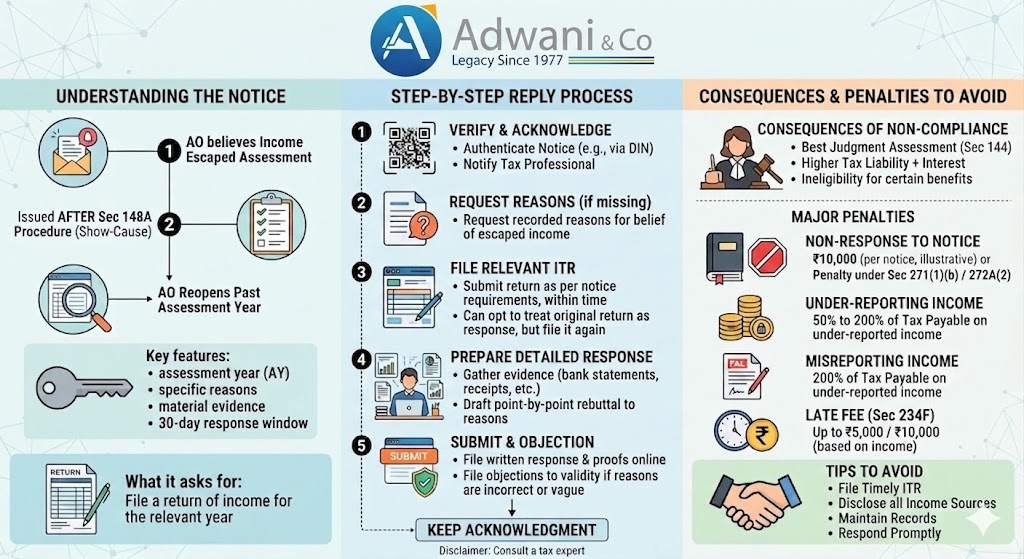
    Legal Disclaimer: This article is published for informational and educational purposes only. Nothing contained herein constitutes legal, financial, or tax advice, nor should it be treated as a substitute for professional consultation tailored to your specific circumstances. Tax laws, rates, and provisions are subject to change; readers are strongly advised to consult a qualified Chartered Accountant or tax advisor before acting on any information in this article.

  • Essential Guide to Upskilling in Taxation: 5 Pillars for Smart CA Professionals

    Essential Guide to Upskilling in Taxation: 5 Pillars for Smart CA Professionals

    “In taxation, the professional who stops learning today becomes the professional who gives wrong advice tomorrow.”

    Essential Guide to Upskilling in Taxation: 5 Pillars for Smart CA Professionals
    Essential Guide to Upskilling in Taxation: 5 Pillars for Smart CA Professionals

    Upskilling in taxation is not a one-time checkbox for CA professionals it is a non-negotiable, continuous discipline. If you work in taxation as a Chartered Accountant, tax consultant, HR professional, or finance manager, you already know that GST rates change, Income Tax provisions get amended, and new CBDT circulars arrive on a Monday morning with immediate effect. The professional who relies solely on knowledge from their CA exams or a seminar three years ago is operating with an outdated map in a city that has been rebuilt.

    This is the philosophy at the core of Adwani and Company, one of India’s trusted CA firms, where Dr. Hareh Adwani has championed continuous taxation learning for over a decade. As Dr. Adwani often says: “Knowledge in taxation has an expiry date. Upskilling is how you stay relevant.”

    Why Upskilling in Taxation Is No Longer Optional

    India’s tax landscape is among the most dynamic in the world. Since the landmark GST rollout in 2017, there have been hundreds of notifications, circulars, and amendments. The Income Tax Department regularly revises filing norms, introduces new forms, and updates compliance timelines. The GST Portal itself undergoes technical and regulatory overhauls that directly impact how professionals file returns and respond to notices. Upskilling in taxation bridges the gap between what you once knew and what is currently applicable and in today’s environment, that gap widens faster than ever.

    Also Read:

    https://www.adwaniandco.com/blog/nri-tax-rules-10-critical-questions-before-returning-to-india

    The 5 Pillars of Upskilling in Taxation

    At Adwani and Company, Dr. Hareh Adwani has identified five core areas where upskilling in taxation must be focused and structured not ad hoc or reactive.

    1. Staying current with law changes

    Regular tracking of amendments in GST, Income Tax Act, Customs, and allied tax laws is the foundation of any serious taxation upskilling effort. This means reading CBDT and CBIC notifications as they are issued, understanding their practical impact, and updating internal processes accordingly. The Ministry of Corporate Affairs (MCA) also periodically revises compliance norms, making cross-law awareness essential.

    2. Understanding practical application in taxation upskilling

    Law reading alone is insufficient. A professional truly excels at continuous taxation learning when they can interpret how a new provision translates to real client situations whether it’s a manufacturing firm’s input tax credit reversal or a startup’s TDS obligations on ESOP payouts. Bridging theory and application is where competent upskilling in taxation delivers the most value.

    3. Building analytical and advisory thinking

    The shift from pure compliance to advisory is where upskilling in taxation truly delivers business value. As Dr. Hareh Adwani puts it: “Clients don’t just need someone to file returns they need a trusted advisor who can see around corners.” Analytical thinking, nurtured through case studies and scenario planning, is the vehicle for that shift.

    4. Leveraging technology in taxation upskilling

    AI-enabled reconciliation tools, automated notice management systems, and real-time GST data analytics are now mainstream. A professional committed to upskilling in taxation must be comfortable not just with the law, but with the technology platforms that implement it. Digital fluency is now inseparable from tax competency.

    5. Learning from experience and peers

    Internal case discussions, cross-team knowledge sharing, and peer review of complex tax positions are underrated but powerful upskilling mechanisms. At Adwani and Company, structured internal sessions where team members present recent cases have become a cornerstone of the firm’s ongoing taxation learning culture.

    What Continuous Upskilling in Taxation Really Looks Like

    There is a common misconception that continuous learning in taxation means attending webinars or subscribing to a newsletter. In practice, a genuine upskilling framework at the organizational level includes weekly law update briefings (20-minute internal sessions covering new notifications and tribunal decisions), monthly deep-dives into one complex topic through case studies, quarterly external training via ICAI or CPE providers, annual skill assessments to identify knowledge gaps, and technology training cycles whenever new portal features or automation tools are adopted. This structure is not theoretical Adwani and Company has implemented it precisely this way, with measurable results in client satisfaction, reduced compliance errors, and team retention.

    Elements of a Strong Taxation Learning Framework

    • Weekly law update briefings  20-minute internal sessions covering new notifications, circulars, and tribunal decisions.
    • Monthly deep-dives  One complex topic per month, explored through case studies and hypotheticals (e.g., “How do the new ITC reversal rules affect mixed supply businesses?”).
    • Quarterly external training  Structured programs from ICAI, industry bodies, or recognized CPE providers.
    • Annual skill assessments  Self-assessments or peer reviews to identify knowledge gaps and guide individual development plans.
    • Technology training cycles  Hands-on sessions whenever new portal features, compliance software updates, or automation tools are adopted.

    This is not theoretical. Adwani and Company has implemented precisely this structure, and the results in terms of client satisfaction, reduced compliance errors, and team retention have been measurable and significant.

    The HR Role in Building a Taxation Upskilling Culture

    Upskilling in taxation cannot happen in a vacuum it requires deliberate organizational design. HR plays a decisive role in designing regular technical training calendars aligned with the tax compliance cycle, creating platforms for knowledge sharing, encouraging cross-functional dialogue between tax and advisory teams, and supporting employees during peak-pressure periods like March year-end or GST annual return season. Most importantly, HR must promote a culture where asking questions is celebrated as intellectual curiosity, not penalized as ignorance. As Dr. Hareh Adwani has noted: “When people feel safe asking questions, the quality of work improves. Fear of looking uninformed is the enemy of upskilling.”

    HR Actions That Drive Taxation Upskilling

    • Designing regular technical training calendars aligned with the tax compliance cycle.
    • Creating platforms for knowledge sharing from internal wikis to structured debrief meetings.
    • Encouraging cross-functional dialogue between tax, audit, and advisory teams.
    • Supporting employees during peak-pressure periods (March year-end, GST annual return season) with guidance rather than adding workload.
    • Promoting a culture where asking questions is celebrated as intellectual curiosity, not penalized as ignorance.
    • As Dr. Hareh Adwani has noted in firm-wide communications: “When people feel safe asking questions, the quality of the work improves. Fear of looking uninformed is the enemy of upskilling.” This mindset, embedded in the culture of Adwani and Company, is what separates high-performing tax firms from average ones.

    ·        


    Real-World Cost of Not Upskilling in Taxation

    Consider a mid-sized manufacturing company whose internal tax team was unaware of the October 2023 CBIC circular clarifying the reversal of ITC on capital goods proportionately used for exempt supplies. The team filed GST returns without making the required reversal. When a GST audit was triggered, the company faced a demand of ₹18.4 lakh including interest and penalty for FY 2022-23 alone. Had their team participated in even one structured upskilling in taxation session covering that circular, the error would have been caught before filing. The cost of that single knowledge gap exceeded what a full year’s professional development program would have cost.

    How Technology Is Reshaping Upskilling in Taxation

    Upskilling in taxation today is inseparable from technology literacy. The GST Portal’s GSTR-2B reconciliation mechanism, the new Annual Information Statement (AIS) on the Income Tax portal, and MCA’s V3 portal all require tax professionals to be digitally fluent not just legally aware. Online learning platforms, micro-certification courses, and ICAI’s e-learning modules have made continuous taxation learning more accessible than ever. The barrier to upskilling is no longer access to content it is the discipline to prioritize it consistently.

    Government Sources Essential for Upskilling in Taxation

    Key Official Sources to Follow

    • Income Tax Department  Circulars, press releases, new ITR forms, and CBDT orders are published here first. Bookmarking this is non-negotiable.
    • GST Portal: Notifications, clarifications, and portal update advisories. The GSTN regularly publishes user advisories that contain critical compliance intelligence.
    • MCA Portal : For professionals advising companies, MCA’s circulars on company law, LLP regulations, and compliance deadlines are essential reading.
    • ITAT and High Court judgments: Case law shapes how provisions are interpreted in practice. Tracking key judicial decisions is a hallmark of an upskilled taxation professional.
    • At Adwani and Company, the team maintains curated trackers of government portal updates, ensuring that no significant change goes unnoticed or unaddressed in client work.

           The Organizational Payoff of Investing in Taxation Upskilling

    • The firms that invest seriously in upskilling in taxation do not just build more knowledgeable teams. They build competitive advantages that compound over time. They deliver fewer errors. Their professionals give more confident, proactive advice. Their clients stay longer, trust deeper, and refer more. Their teams experience lower burnout because competence breeds confidence, and confidence reduces anxiety in high-pressure situations.
    • This is what Dr. Hareh Adwani has built at Adwani and Company not a firm that waits for the next regulation to react, but one that anticipates change, upskills proactively, and delivers accordingly. Continuous taxation learning is not a cost on the P&L of a professional firm. It is the investment that protects and grows every other line on it.

    Conclusion: Upskilling in Taxation Is a Professional Commitment

    The professionals and firms that thrive in India’s evolving tax environment are not those with the most degrees or the longest experience they are those with the discipline to keep learning. Upskilling in taxation is not a seminar you attend once a year. It is a structured, conscious, and continuous commitment to staying current, thinking analytically, and serving clients with the highest standard of accuracy and insight.

    Dr. Hareh Adwani and the team at Adwani and Company have made this commitment the foundation of the firm’s identity. Success, as they demonstrate every day, does not come from what you already know. It comes from your willingness to keep learning consistently, consciously, and continuously.

    Frequently Asked Questions on Upskilling in Taxation

    1. What does upskilling in taxation mean for CA professionals?

    For CA professionals, upskilling in taxation means continuously updating knowledge of GST, Income Tax, and allied laws through structured training, practical case study reviews, technology literacy, and analytical skill development not just occasional seminar attendance.

    2. How often should a tax professional upskill?

    Given the frequency of amendments and notifications in India’s tax system, meaningful upskilling in taxation should happen monthly at a minimum with weekly awareness updates for active practitioners managing client compliance.

    3. What are the best sources for taxation continuous learning in India?

    The Income Tax Department portal, GST Portal, MCA website, ICAI e-learning modules, and curated legal databases like TaxSutra or TaxMann are the most reliable sources for authoritative taxation upskilling content.

    4. How can a CA firm build a taxation upskilling culture?

    By designing structured internal training programs, encouraging knowledge-sharing sessions, tracking government notifications systematically, and creating a safe environment where team members can ask questions and learn from complex client cases as practiced at Adwani and Company.

    5. What is the role of HR in supporting upskilling in taxation?

    HR professionals in CA firms play a critical role in designing training calendars, enabling cross-functional learning platforms, providing support during peak compliance seasons, and building a culture where continuous taxation learning is valued and rewarded.

    6. Does upskilling in taxation include technology training?

    Absolutely. Modern taxation upskilling must include proficiency in the GST Portal, Income Tax AIS/TIS, MCA V3, and practice management and automation tools. Technology literacy is now inseparable from tax competency.

    7. What happens if a tax professional does not upskill regularly?

    Outdated tax knowledge leads to compliance errors, missed credits or deductions, incorrect advice, penalty exposure for clients, and erosion of professional credibility. As illustrated in our example, a single knowledge gap can cost multiples of what an upskilling program would have required.

    About the Author
    Nidhi Adwani is the Human Resources Manager at Adwani & Co. She is a Law Graduate and holds an MBA in Human Resources. She manages recruitment, employee engagement, team development, workplace culture, and the firm’s social media and content activities. Passionate about people and organizational growth, she also contributes articles for ITRAdvisor and Adwani & Co. Her writing focuses on HR practices, leadership, workplace engagement, and professional development, offering practical insights for professionals and businesses.

    Legal Disclaimer: This article is published for informational and educational purposes only. Nothing contained herein constitutes legal, financial, or tax advice, nor should it be treated as a substitute for professional consultation tailored to your specific circumstances. Tax laws, rates, and provisions are subject to change; readers are strongly advised to consult a qualified Chartered Accountant or tax advisor before acting on any information in this article.

    All content is original. References to government portals and statutory provisions are paraphrased for educational purposes in compliance with fair use principles. No content has been reproduced from third-party sources

  • NRI Tax Rules: 10 Critical Questions Before Returning to India

    NRI Tax Rules: 10 Critical Questions Before Returning to India

    NRI Tax Rules: 10 Critical Questions Before Returning to India
    NRI Tax Rules: 10 Critical Questions Before Returning to India

    Why NRI Tax Planning Before Returning to India Matters

    Every year, thousands of Non-Resident Indians working in the United States, Canada, United Kingdom, UAE, Australia, and other countries make the decision to return home. For many, it is driven by family, career opportunities, or simply the desire to reconnect with their roots. But what often comes as a surprise sometimes a very expensive one is how dramatically their tax situation changes the moment they step back on Indian soil for good.

    According to guidelines issued by the Income Tax Department of India, your residential status determines the scope of your tax liability. As an NRI, you are taxed only on income earned or received in India. The moment your status changes to Resident, however, India gains the right to tax your global income including income from foreign bank accounts, rental earnings from property abroad, dividends from US or UK stocks, and money you earn from global investments.

    This is why NRI tax planning before the return journey is not just advisable it is essential. Dr. Haresh Adwani of Adwani & Company has guided hundreds of returning NRIs through this transition, and consistently observes that those who plan ahead save significantly more, comply cleanly, and avoid stressful tax notices later.

    Important Alert

    Many NRIs believe their foreign income is permanently outside India’s tax net. This is incorrect once you become a tax resident. The planning window particularly your RNOR period is limited and time-sensitive.


    NRI Tax Rules: When Do You Become Resident, RNOR, or ROR?

    Understanding your residential status is the very first step in NRI tax planning in India. The Income Tax Act, 1961 defines three categories of residential status for individuals:

    StatusWhat It MeansIndian Tax on Foreign Income?
    NRI (Non-Resident Indian)Stays less than 182 days in India in a year (general rule)Not Taxable
    RNOR (Resident but Not Ordinarily Resident)Transitional status for returning NRIs; limited foreign tax exposurePartially Exempt
    ROR (Resident and Ordinarily Resident)Full tax resident; all global income taxable in IndiaFully Taxable

    The RNOR status is arguably the most valuable tool available to a returning NRI — but it is available only for a limited period, typically two to three financial years after returning, depending on your prior NRI history. During this window, your foreign income remains outside India’s tax net, giving you critical time to restructure investments and repatriate funds in a tax-efficient manner.

    Dr. Haresh Adwani strongly advises every returning professional to calculate their RNOR window as the very first step, ideally six to twelve months before the planned return date.

    Also Read:

    https://www.adwaniandco.com/blog/the-120-day-rule-that-is-silently-taxing-thousands-of-nris-in-india


    The 120-Day Rule That Silently Traps NRIs

    Here is a less-known but critically important provision in India’s NRI tax rules that catches many people completely off guard. Most NRIs believe that as long as they live outside India, their NRI status is protected. But there is a specific rule, introduced via the Finance Act 2020, that can strip your NRI status even if you live abroad.

    If the following three conditions are all true, you may be classified as a tax resident of India even though you live abroad:

    The Three-Condition Rule

    1. Your income from India exceeds ₹15 lakh in the financial year
    2. You stayed in India for 120 days or more in that financial year
    3. You stayed in India for 365 days or more cumulatively over the previous four financial years

    120 days sounds like a lot. But consider this you come for a wedding in December, stay through January. You visit again in April for a family function. You attend a relative’s medical emergency in August. Without consciously tracking, you may have crossed the 120-day threshold without even realising it. And if your Indian income salary from an Indian employer, rent from property, or dividend from Indian shares exceeds ₹15 lakh, India’s tax jurisdiction now extends to your global income.

    This is not a hypothetical risk. At Adwani & Company, we have advised clients who received income tax notices specifically because of this provision. The solution is straightforward track your travel days carefully and consult a qualified NRI tax advisor well before the end of each financial year (March 31).


    10 NRI Tax Questions You Cannot Afford to Ignore

    Based on years of advising professionals returning from the US, UK, UAE, Canada, Singapore, and Australia, Dr. Haresh Adwani has compiled the ten most important NRI tax questions that arise during the return transition. Each of these has significant financial implications if not addressed in advance.

    1. When exactly will I become Resident, RNOR, or ROR in India? 

    Your status depends on your physical presence over multiple financial years. Calculating this accurately determines your tax liability strategy.

    2. If I sell my US or UK stocks after returning, where will the capital gains be taxed?

     Gains on foreign stocks can be taxed in both India and the country where the assets are held, unless DTAA provisions apply. Selling while still RNOR can make a significant difference.

    3. How can I avoid double taxation between India and my country of work? 

    India has Double Taxation Avoidance Agreements (DTAA) with over 90 countries. Understanding which provisions apply to your income type is crucial.

    4. Can I claim Foreign Tax Credit (FTC) in India for taxes already paid abroad? 

    Yes, under Rule 128 of the Income Tax Rules, you can claim credit for foreign taxes paid. However, the process requires Form 67 and specific documentation.

    5. What happens to my foreign bank accounts and investments once I become a resident?

     Your NRE and FCNR accounts must be re-designated to RFC (Resident Foreign Currency) accounts. Failure to do so is a FEMA violation with serious penalties.

    6. Do I need to report foreign assets in my Indian income tax return? 

    Absolutely. Once you become a full Resident (ROR), you must disclose all foreign assets, accounts, and income in Schedule FA of your ITR. Non-disclosure attracts severe penalties under the Black Money Act.

    7. Should I sell some investments while I am still RNOR rather than waiting until ROR? 

    In many cases, yes. Since foreign income is not taxable during the RNOR period, strategic divestment of foreign assets during this window can produce significant tax savings.

    8. How are RSUs, ESOPs, and stock compensation from foreign employers taxed in India? 

    This is complex. RSUs may be taxed both when they vest (as salary income) and when sold (as capital gains). DTAA provisions and the nature of your resident status at both events determine the outcome.

    9. What are the tax implications if I sell property in India after returning? 

    The tax treatment depends on the holding period, whether you are RNOR or ROR at time of sale, and available exemptions under Section 54 or 54EC of the Income Tax Act.

    10. How can I bring my foreign savings to India in a legal and efficient way? 

    FEMA governs the repatriation of foreign funds. The RFC account and LRS (Liberalised Remittance Scheme) framework provides structured pathways to bring money in compliantly.


    Real-World Example: IT Professional Returning from the US

    Rajesh S., Software Engineer San Francisco to Pune

    Rajesh worked in the US for 14 years on an H-1B visa and decided to return to India in July 2025. He had accumulated USD 280,000 in a US brokerage account (mostly tech stocks with significant unrealised gains), USD 95,000 in a 401(k) retirement account, and owned a property in Pune generating ₹18 lakh annual rent.

    Without Planning: Had Rajesh returned and immediately converted his NRE account, sold his US stocks after becoming ROR, he would have faced Indian capital gains tax on the full appreciation potentially ₹40–50 lakh in additional tax liability, plus mandatory disclosure of all foreign assets.

    With Planning via Adwani & Company: By calculating his RNOR window (approximately 2 financial years), Rajesh sold his US stocks strategically during that period when foreign income was not taxable in India. His NRE and FCNR accounts were re-designated to RFC accounts in time. Form 67 was filed correctly to claim US tax credit. Penalty exposure was eliminated entirely.


    FEMA Compliance for Returning NRIs: What You Must Do

    The Foreign Exchange Management Act (FEMA) governs how Indian residents including returning NRIs manage their foreign currency assets, bank accounts, and international transactions. Violations under FEMA are taken seriously by the Enforcement Directorate and can attract penalties many times the value of the transaction involved.

    As per Reserve Bank of India (RBI) guidelines, the following changes must be made immediately upon returning to India as a resident:

    Account/Asset TypeAction RequiredDeadline
    NRE (Non-Resident External) AccountRe-designate to RFC or Resident Savings AccountImmediately upon change of status
    FCNR (Foreign Currency NR) AccountRe-designate to RFC accountAt maturity or immediately
    NRO (Non-Resident Ordinary) AccountRe-designate to ordinary resident savings accountImmediately upon change of status
    Foreign Bank AccountsDeclare in ITR Schedule FA; permitted to retain under FEMAAnnual ITR filing deadline
    Foreign InvestmentsDeclare and report under FEMA OI regulationsAnnual reporting cycle

    Dr. Haresh Adwani advises every returning NRI to consult an authorised FEMA practitioner as a first step not after they have returned, but three to six months before the anticipated return date. This provides time to restructure accounts, repatriate funds, and file necessary declarations without rushing.

    Learn more about our NRI FEMA Compliance Services at Adwani & Company.


    Pre-Return NRI Tax Planning Checklist

    If you are planning to return to India within the next six to eighteen months, use this checklist to ensure you enter the transition fully prepared:

    • Calculate your RNOR eligibility window based on your exact NRI years — this is your most valuable planning asset
    • Identify all foreign assets: stocks, mutual funds, retirement accounts (401k, IRA, pension), bank accounts, and property
    • Evaluate which assets to sell before returning versus during the RNOR window versus after becoming ROR
    • Check whether DTAA provisions between India and your country of residence apply to your income types
    • Arrange re-designation of NRE, FCNR, and NRO accounts to RFC before or immediately upon return
    • Obtain Form 67 documentation for claiming Foreign Tax Credit on income taxed abroad
    • Ensure your ITR includes Schedule FA for all foreign assets once you attain ROR status
    • Consult a qualified NRI tax advisor ideally one registered with ICAI and experienced in international tax

    Read our detailed guide on NRI Taxation and FEMA Compliance — A Complete Handbook for deeper coverage of each checklist item.


    DTAA Benefits: How Returning NRIs Can Avoid Double Taxation

    One of the most powerful tools available to a returning NRI is the Double Taxation Avoidance Agreement (DTAA). India has signed DTAAs with over 90 countries including the United States, United Kingdom, UAE, Canada, Australia, Singapore, and Germany. These agreements ensure that the same income is not taxed twice once in the country where it is earned and again in India.

    However, DTAA benefits are not automatic. You must actively claim them, file the correct forms, and provide the necessary documentation including Tax Residency Certificates (TRC) and Form 10F. The specific provisions vary significantly by country and income type. For instance, the India-US DTAA has specific provisions for employment income, dividends, and capital gains each with different conditions and rates.

    DTAA Quick Tip

    For NRIs returning from the UAE, note that the India-UAE DTAA was renegotiated and updated. The provisions affecting salary income and capital gains have changed. Ensure you are referencing the most current treaty text, or consult Adwani & Company for up-to-date guidance specific to your income profile.


    Conclusion: Your Return to India Deserves a Well-Crafted Tax Strategy

    Returning to India after years abroad is an emotionally significant and practically complex decision. The financial implications spanning NRI tax rules, RNOR status planning, FEMA compliance, DTAA benefits, and foreign asset disclosure require careful attention and expert guidance well before the moving date.

    The good news is that with proper NRI tax planning, the transition can be managed smoothly. The RNOR window is a legitimate and powerful tool. DTAA provisions can significantly reduce your tax burden. FEMA compliance, when handled proactively, is straightforward. The 120-day rule, once you are aware of it, is entirely manageable.

    The critical factor is timing. Tax planning done before the return preserves options. Tax planning attempted after the return or worse, after a notice from the Income Tax Department is reactive, expensive, and stressful. As Dr. Haresh Adwani consistently advises clients: the best time to plan your return tax strategy is at least six to twelve months before you board that flight home.

    1. What is RNOR statusand how does it benifit a returning NRI?

    RNOR stands for Resident but Not Ordinarily Resident. It is a transitional tax status available to returning NRIs for a limited period typically two to three financial years after returning, depending on the number of years they were NRI. During the RNOR period, India does not tax income that is earned outside India and not received in India. This makes the RNOR window a critical opportunity to restructure foreign investments and repatriate funds tax-efficiently. Calculating your exact RNOR window is the most important first step in any returning NRI tax planning exercise.

    2. Do i need to report my foreign bank accounts after returning to india?

    Yes. Once you attain ROR (Resident and Ordinarily Resident) status, you are required to disclose all foreign bank accounts, financial assets, and income from foreign sources in Schedule FA (Foreign Assets) of your Income Tax Return. Non-disclosure is treated as a violation under the Black Money (Undisclosed Foreign Income and Assets) and Imposition of Tax Act, 2015, which prescribes severe penalties including a flat 30% tax plus a 90% penalty on undisclosed amounts. Proactive disclosure and professional guidance from a qualified NRI tax advisor is strongly recommended.

    3. How are RSUs and ESOPs from a US employer taxed when i return to india?

    RSUs (Restricted Stock Units) and ESOPs (Employee Stock Option Plans) granted by foreign employers are taxed at two points first at vesting (treated as perquisite or salary income) and again at sale (capital gains). If you are RNOR when the shares vest, there may be no Indian tax at vesting for foreign-source income. However, gains on sale after becoming ROR are fully taxable in India. The India-US DTAA may provide relief on employment income. Given the complexity, consulting a specialist NRI tax advisor who handles cross-border equity compensation is highly advisable.

    4. can keep my NRE account after returning to india?

    No. Under FEMA regulations, once your residential status changes to Resident Indian, your NRE (Non-Resident External) account must be re-designated to a Resident Foreign Currency (RFC) account or a regular resident savings account. Continuing to operate an NRE account after becoming a resident is a FEMA violation and can attract penalties under the Enforcement Directorate. The re-designation must happen promptly upon change in status. Similarly, FCNR accounts must be re-designated to RFC accounts at maturity.

    5.Is the 120-day rule applicable to all NRIs only thoes with high indian income?

    The 120-day rule applies specifically to NRIs whose Indian income exceeds ₹15 lakh in the relevant financial year. If your Indian income is below this threshold, the standard 182-day rule applies for determining NRI status. However, if your Indian income from sources such as rent, salary from Indian companies, or interest from NRO accounts exceeds ₹15 lakh, then staying 120 days or more in India in a financial year, combined with a cumulative stay of 365 days in the previous four years, can make you a resident for tax purposes. Tracking your India travel days carefully is essential if you have significant Indian income.

    6.what is best time to sell foreign stock-before returning or after returning

    The timing of foreign asset liquidation is one of the highest-impact NRI tax planning decisions. Selling before returning (when you are still an NRI) means the gains are taxed only in the country where the asset is held not India. Selling during the RNOR window means the gains from foreign sources are not taxable in India under current provisions. Selling after becoming ROR means full Indian capital gains tax applies. The optimal strategy depends on the specific country, the type of asset, applicable DTAA provisions, and your income profile. Dr. Haresh Adwani and the team at Adwani & Company specialise in creating personalised divestment plans for returning NRIs.

    7. How do i claim Foreign Tax Credit(FTC) in india?

    Foreign Tax Credit in India is governed by Rule 128 of the Income Tax Rules, 1962. To claim FTC, you must file Form 67 on the income tax e-filing portal before the due date of your return. You will need documentation including a tax payment certificate or withholding statement from the foreign country confirming the taxes paid. The credit is available against the Indian tax payable on the same income, up to the Indian tax liability on that income. FTC cannot create a refund it can only reduce your Indian tax to zero on the relevant income. Missing the Form 67 deadline means losing the credit entirely.

    Author

    CA. Manish R. Mata Practising In India (Ex – PwC),  At Adwani & Co LLP leads the International Accounting & Tax Support vertical, delivering structured execution assistance to US CPA firms and overseas businesses.

    Legal Disclaimer: This article is published for informational and educational purposes only. Nothing contained herein constitutes legal, financial, or tax advice, nor should it be treated as a substitute for professional consultation tailored to your specific circumstances. Tax laws, rates, and provisions are subject to change; readers are strongly advised to consult a qualified Chartered Accountant or tax advisor before acting on any information in this article.

    All content is original. References to government portals and statutory provisions are paraphrased for educational purposes in compliance with fair use principles. No content has been reproduced from third-party sources