Blog

  • ITR Filing 2026: No Longer Optional

    ITR Filing 2026: No Longer Optional

    By CA Dipesh Gurubakshani May 2026 10 minutes

    The Moment Most Indian Taxpayers Realise They Got It Wrong

    There is a conversation that plays out in CA offices across India every August. A salaried professional confident, financially responsible, earning well walks in with a stack of bank statements. He has just received a scrutiny notice from the Income Tax Department. His bank flagged a high value credit card payment. His loan application was rejected because his ITR for last year shows income inconsistent with his claimed salary. He missed two deductions worth ₹54,000. And he filed his return in the last three days of July on a portal that was so congested his entries auto-populated incorrectly.

    “I thought ITR filing was just a formality,” he says.

    It is not. It never was. And in 2026, ITR filing has moved so far beyond a routine compliance checkbox that treating it as one is one of the most expensive financial mistakes an Indian taxpayer can make.

    This blog resonated deeply with thousands of Indian professionals expands on a simple but powerful truth: filing your income tax return in 2026 is no longer optional. Not legally, not financially, and not practically.

    Learn more about our IITR Filing 2026: Smart Strategies to Beat the Deadline, Slash Your Tax Bill & Secure Your Future


    Why ITR Filing 2026 Has Fundamentally Changed

    ITR Filing Is Now Your Financial Identity Document

    A decade ago, your ITR was a document you filed because the law said so and perhaps to claim a refund. Today, it is something far more powerful and far more consequential.

    Banks, non-banking financial companies, housing finance institutions, and even private lenders now routinely ask for the last two to three years of filed income tax returns as a primary proof of income. Not salary slips. Not employer letters. Filed ITRs with an acknowledgement number from the Income Tax Department at incometax.gov.in.

    Visa officers at the US, UK, Canadian, and Schengen consulates treat your ITR history as a financial credibility document evidence that you are a tax-compliant individual with a legitimate, verifiable income stream. Embassy rejections linked to missing or inconsistent ITRs are no longer rare.

    Mutual fund and stock broking accounts above certain transaction thresholds now require ITR cross-referencing for KYC purposes. Real estate developers for high-value property transactions ask for it. Even some premium insurance underwriters factor ITR consistency into their risk assessment.


    ITR filing 2026 is no longer a tax document. It is your financial identity.

    The Government Has More Data on You Than You Realise

    The Annual Information Statement (AIS) available on the Income Tax e-filing portal now aggregates data from over 40 different sources simultaneously. Your bank deposits, your mutual fund redemptions, your stock market transactions, your credit card payments above ₹1 lakh per month, your foreign remittances, your property registrations, your dividend income, your savings account interest all of it flows into the AIS automatically.

    The Income Tax Department of India cross-references this data with your filed ITR the moment you submit it. Any mismatch even an apparently minor one can trigger a Section 143(1)(a) adjustment notice or a full Section 143(2) scrutiny assessment.

    As Dr. Haresh Adwani, PhD (Commerce) and Law Graduate, Managing Partner of Adwani and Company, explains to every new client: “The government’s data infrastructure has fundamentally changed the risk calculation for non-filers and incorrect filers. If you have income appearing in the AIS that you have not reported in your ITR, a notice is a mathematical certainty — not a possibility.”

    This is why ITR filing in 2026 demands accuracy and professional care, not a last-minute online self-filing exercise.


    ITR Filing 2026 Deadlines: Know Exactly Where You Stand

    One of the most important changes introduced by Budget 2026 is the formal bifurcation of the ITR filing last date 2026 by taxpayer category. This is no longer a single deadline that applies to everyone.

    Taxpayer CategoryITR FormITR Filing Last Date 2026
    Salaried employees and pensionersITR-1 / ITR-231 July 2026
    Freelancers, consultants, small business (non-audit)ITR-3 / ITR-431 August 2026
    Audit-required businesses under Section 44ABITR-3 / ITR-431 October 2026
    Belated ITR (missed original deadline)All applicable31 December 2026
    Updated Return under Section 139(8A)ITR-U31 March 2031

    Critical upgrade from Budget 2026: The revised ITR window has been extended to 31 March 2027 for AY 2026-27, giving taxpayers who discover errors after filing an unprecedented correction window. Additionally, the Updated Return (ITR-U) under Section 139(8A) has been extended to 4 years (48 months) from the end of the relevant assessment year allowing taxpayers to correct unreported income without facing the full force of a scrutiny proceeding.


    7 Powerful Reasons ITR Filing 2026 Is Non-Negotiable

    1. ITR Filing 2026 Is Legally Mandatory for Most Indians

    The Income Tax Act, 1961, and the Central Board of Direct Taxes (CBDT) have progressively lowered the practical threshold for mandatory filing. Even if your income is below the basic exemption limit of ₹3 lakh under the new tax regime, you are legally required to file an ITR if you meet any one of these conditions:

    • You deposited more than ₹1 crore in bank accounts during the year
    • You spent more than ₹2 lakh on foreign travel
    • Your electricity bills exceeded ₹1 lakh in the year
    • You have foreign assets or foreign income of any amount
    • You received TDS/TCS above ₹25,000 (₹50,000 for senior citizens)
    • Your business turnover exceeded ₹60 lakh or professional receipts exceeded ₹10 lakh

    These thresholds capture a far larger population than most people realise. A retiree with a fixed deposit earning interest plus a foreign trip this year may be legally required to file — regardless of their total income level.

    2. Carry Forward of Losses Requires Timely ITR Filing 2026

    If you made losses in the stock market from F&O trading, intraday transactions, or delivery-based equity those losses can be carried forward for up to 8 years and offset against future gains. But only if your ITR is filed on or before the due date.

    A trader who lost ₹4.5 lakh in F&O trading this year and fails to file by July 31st loses the right to carry forward those losses permanently. In subsequent years when their F&O trades are profitable, they will pay full tax on gains — with no offset available.

    This is one of the most underestimated consequences of late ITR filing 2026.

    Also Read : F&O Trading Taxation in India (2026): Complete & Simple Guide

    3. Your Tax Refund Depends Entirely on a Filed ITR

    The Income Tax Department of India processes refunds only for filed returns. If your employer deducted excess TDS based on projected income that was lower than actual earnings — or if advance tax was paid in excess — the only way to recover that money is through a timely, accurately filed return.

    Early filers in July consistently receive refunds in 15 to 30 days. Late filers who submit in the last week of July or in August face delays of 60 to 90 days due to portal congestion and processing queues.

    4. Visa Applications Demand Clean ITR History

    The UK, USA, Canada, Australia, and most Schengen countries now require 2 to 3 years of filed ITRs as part of the financial documentation for visa applications. Missing returns — or returns that show income inconsistent with your stated bank balance — are among the leading causes of visa rejections for Indian applicants.

    ITR filing 2026 is not just about this year’s taxes. It is about building a three-to-five-year track record of financial credibility that opens international borders.

    5. Home Loan, Car Loan, and Business Loan Approvals

    Every major bank and NBFC in India from SBI and HDFC to Bajaj Finance and Tata Capital asks for ITR acknowledgements as primary income proof in loan applications. Lenders assess loan eligibility based on your net taxable income as declared in your ITR, not your gross salary.

    A professional earning ₹15 lakh but claiming maximum deductions reducing net taxable income to ₹8.5 lakh will have their loan eligibility calculated on the lower figure. This makes professional ITR filing assistance critical you need to balance legitimate tax minimization with maintaining sufficient declared income for borrowing purposes.

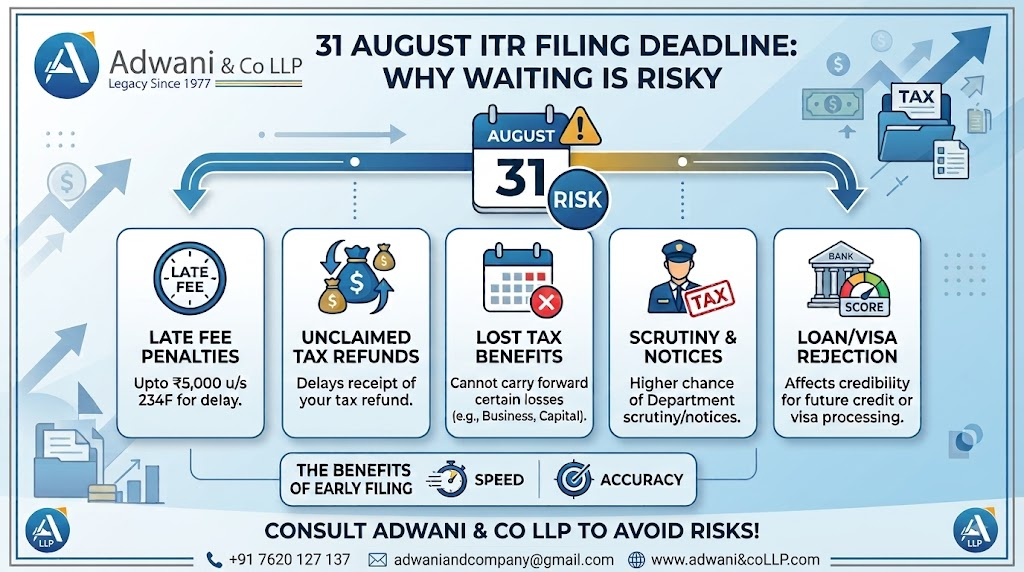
    6. Avoid Costly Penalties Under Section 234F

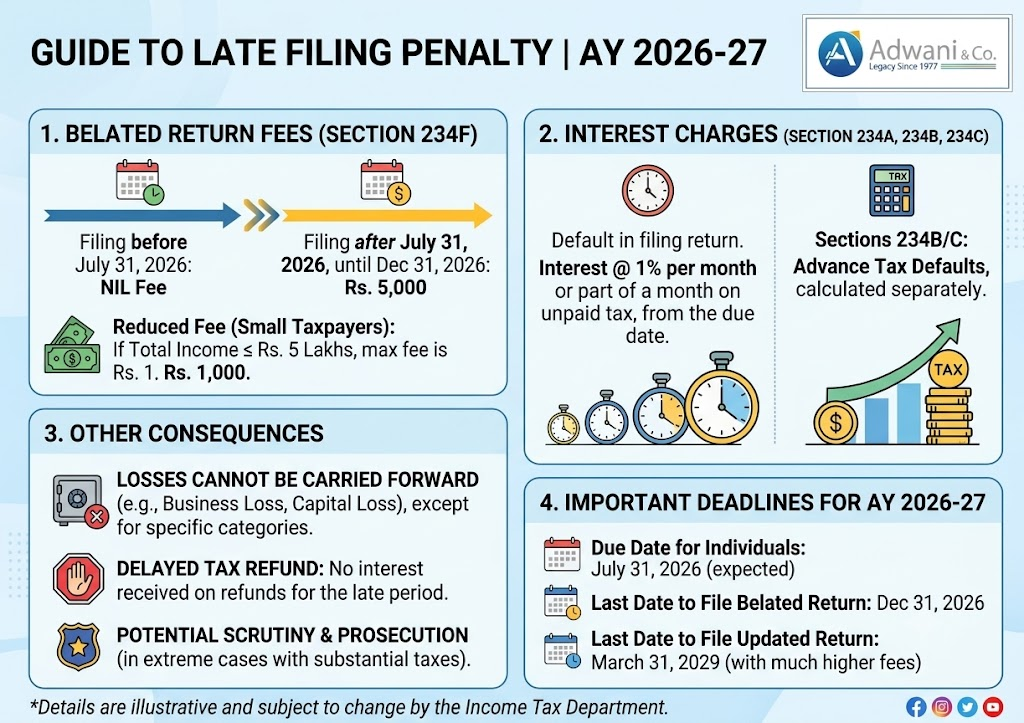
    Missing the ITR filing 2026 deadline is not just an administrative inconvenience. Under Section 234F of the Income Tax Act, late filers pay:

    • ₹1,000 if total income is below ₹5 lakh
    • ₹5,000 if total income exceeds ₹5 lakh

    Additionally, Section 234A charges interest at 1% per month on any outstanding tax liability from the original due date. For someone with ₹50,000 in unpaid tax filing six months late, that is ₹3,000 in interest alone plus the penalty. Combined, these costs routinely run to ₹8,000–₹15,000 for a single delayed return.

    7. Protection Against Scrutiny and Black Money Act Notices

    The Black Money (Undisclosed Foreign Income and Assets) and Imposition of Tax Act, 2015, and the Benami Transactions (Prohibition) Act impose severe penalties including criminal prosecution for undisclosed assets and income. Non-filing creates gaps in your financial record that attract exactly the kind of scrutiny these laws enable.

    A filed, accurate ITR is your best legal defence. It demonstrates voluntary, transparent disclosure the standard that the Income Tax Department consistently rewards with lower scrutiny probability.


    Practical Example

    Priya Nair, a 38year-old architect from Mumbai earning ₹18.5 lakh annually, had filed her own ITR for six consecutive years using an online platform. She claimed Section 80C (₹1.5 lakh) and her employer’s standard deduction and nothing else.

    When she approached Adwani and Company for ITR filing 2026, Dr. Haresh Adwani’s team conducted a comprehensive income and deduction review:

    Deduction / ExemptionPreviously ClaimedCorrectly ClaimedDifference
    Section 80C₹1,50,000₹1,50,000
    Section 80D (Health Insurance — self + parents)₹0₹50,000+₹50,000
    HRA Exemption (correctly computed)₹72,000₹1,44,000+₹72,000
    Section 24(b) — Home Loan Interest₹0₹2,00,000+₹2,00,000
    Professional Development Expenses (under business head)₹0₹48,000+₹48,000
    Total Additional Deductions Unlocked₹3,70,000

    At applicable income tax slab rates, these additional deductions reduced Priya’s taxable income from ₹18.5 lakh to approximately ₹14.8 lakh generating a verified tax saving of ₹67,450 compared to her previous year’s payment.

    She had been overpaying taxes for six years. The cumulative overpayment conservatively estimated exceeded ₹3 lakh.

    This is what expert-assisted ITR filing 2026 delivers: not just compliance, but financial justice.


    How to File ITR Online for AY 2026-27: The Right Way

    Step 1: Gather All Required Documents Before You Begin

    Rushing to the portal without complete documentation is the primary cause of ITR errors. Assemble these before opening the Income Tax e-filing portal:

    • Form 16 (from all employers for FY 2025-26)
    • Form 26AS downloaded from incometax.gov.in
    • Annual Information Statement (AIS) from the e-filing portal
    • Bank statements for all accounts April 2025 to March 2026
    • Mutual fund capital gains statements (CAS from CAMS/KFintech)
    • Stock broker’s capital gains report
    • Home loan interest certificate from lender
    • Investment proof for all Section 80C instruments
    • Health insurance premium receipts (Section 80D)
    • Rental receipts if claiming HRA exemption
    • Details of any foreign assets or foreign income

    Step 2: Choose the Correct ITR Form

    Your Income ProfileCorrect Form
    Salary only, one house, income below ₹50 lakhITR-1
    Salary + capital gains, or more than one propertyITR-2
    Business/professional income, F&O tradingITR-3
    Presumptive income (Section 44AD/44ADA)ITR-4

    Using the wrong form results in a defective return notice — and mandatory refiling.

    Step 3: Reconcile AIS Before Filing

    The most critical pre-filing step in 2026 is AIS reconciliation. Download your AIS, compare every entry against your own records, and raise objections for incorrect entries before filing. Declaring income inconsistent with AIS data is the single biggest trigger for scrutiny.

    Step 4: E-File and E-Verify Within 30 Days

    File on the Income Tax portal at incometax.gov.in and e-verify within 30 days using Aadhaar OTP, net banking, or a pre-validated bank account. A filed but unverified return is legally treated as non-filed.http://incometax.gov.in

    Step 5: Track Your Refund

    After e-verification, track refund status at incometax.gov.in under “My Account → Refund/Demand Status.” File early refunds for early July filers typically process in under 3 weeks.

    ITR Filing 2026 for Freelancers and Self-Employed Professionals

    Freelancers and self-employed professionals in India face a materially different ITR filing 2026 landscape than salaried individuals. Their key obligations include:

    • Reporting all income including cash payments, international client payments in foreign currency, and platform-based income from apps and marketplaces
    • Reconciling income with Form 26AS TDS credits from clients who have deducted TDS under Section 194J
    • Evaluating eligibility for presumptive taxation under Section 44ADA (50% of gross receipts treated as net income for professionals with receipts below ₹75 lakh)
    • Computing and paying advance tax in four installments if estimated tax liability exceeds ₹10,000
    • Filing using ITR-3 or ITR-4 depending on whether presumptive scheme is adopted

    The ITR filing last date 2026 for freelancers using non-audit ITR-3/ITR-4 is 31 August 2026 a new, one-month extension introduced by Budget 2026.


    Why Adwani and Company Is the Trusted Choice for ITR Filing 2026

    Adwani and Company, provides professional ITR filing services that go well beyond data entry and form submission.

    What the Adwani and Company team delivers:

    • Comprehensive AIS and Form 26AS reconciliation before filing
    • Complete deduction review across all applicable sections — 80C through 80U
    • Capital gains computation from stocks, mutual funds, property, and other assets
    • GST-ITR consistency check for business taxpayers
    • Legal interpretation of complex situations HUF planning, NRI taxation, foreign asset disclosure, RNOR status
    • Year-round support: post-filing notices, revised returns, scrutiny assessments, appeals

    As Dr. Haresh Adwani states in every client interaction: “The goal of ITR filing is not just to avoid a notice. It is to ensure every rupee of legally permissible deduction reaches the taxpayer, the return stands up to any level of scrutiny, and the client’s financial record supports every ambition they have whether that is a home loan, a visa, or a business expansion.”

    Thousands of salaried employees, freelancers, business owners, NRIs, and high-net-worth individuals across Pune and India trust Adwani and Company for exactly this standard of work.

    Frequently Asked Questions

    Q1. Why is ITR filing 2026 mandatory even if I have no tax to pay?

    ITR filing in 2026 is legally mandatory if you meet any of the high-value transaction conditions specified by the CBDT regardless of your income level. Additionally, filing is necessary to claim refunds, carry forward losses, apply for loans, and maintain a clean financial record for visa applications and other purposes.

    Q2. What is the ITR filing last date 2026 for salaried employees?

    The ITR filing last date 2026 for salaried individuals and pensioners filing ITR-1 or ITR-2 is 31 July 2026, as confirmed by the Central Board of Direct Taxes (CBDT). Freelancers and non-audit business filers have until 31 August 2026.

    Q3. What documents do I need for ITR filing 2026?

    Key documents include Form 16 from your employer, Form 26AS and AIS from the Income Tax portal, bank statements for all accounts, capital gains statements from mutual funds and brokers, home loan interest certificates, health insurance receipts, and investment proof for Section 80C claims.

    Q4. Can I file a revised ITR after submitting for AY 2026-27?

    Yes. Budget 2026 extended the revised ITR window to 31 March 2027 for AY 2026-27. You can revise your return to correct errors or claim missed deductions within this extended window.

    Q5. What is the penalty for missing the ITR filing 2026 deadline?

    Under Section 234F, a late filing fee of ₹1,000 (income below ₹5 lakh) or ₹5,000 (income above ₹5 lakh) applies. Section 234A charges 1% interest per month on outstanding tax from the due date. You also permanently lose the ability to carry forward business and capital losses.

    Q6. Is ITR filing 2026 necessary for freelancers and consultants?

    Yes. Freelancers, independent consultants, and gig workers must file ITR using ITR-3 or ITR-4 depending on their income structure. Their ITR filing 2026 last date is 31 August 2026 for non-audit cases. They must report all receipts, reconcile TDS credits in Form 26AS, and evaluate presumptive taxation eligibility under Section 44ADA.

    Q7. How can Adwani and Company help with ITR filing 2026 for NRIs?

    Adwani and Company provides comprehensive NRI ITR filing services including capital gains computation on Indian asset sales, NRE/NRO interest taxability, RNOR status tax planning, foreign asset disclosure under Schedule FA, and DTAA benefit claims. Contact Dr. Haresh Adwani’s team for a personalised NRI tax consultation.

    Conclusion:

    Your ITR filing 2026 is the document that proves your income to every lender, every visa officer, every government authority, and every institution that matters to your financial life. It is the record that protects you from scrutiny, unlocks your refunds, preserves your ability to carry forward losses, and establishes your credibility as a financially responsible Indian citizen.

    The deadlines are firm 31 July 2026 for salaried taxpayers, 31 August 2026 for freelancers and small businesses. The penalties for delay are real. The cost of errors is measurable and as Priya Nair’s example shows the cost of filing without expert guidance can run to lakhs of rupees over a career.

    File early. File accurately. File with professionals who understand that your ITR is not paperwork it is your financial identity.


    Author

    CA Dipesh Gurubakshani is a Chartered Accountant with Adwani & Co LLP, Pune, specialising in income tax audit, direct taxation, and accounting advisory. He supports clients across statutory compliance, financial reporting, and income tax matters with a focus on accuracy, regulatory adherence, and disciplined execution.

  • Income Tax Filing for Salaried Individuals: A Complete Guide for AY 2025-26

    Income Tax Filing for Salaried Individuals: A Complete Guide for AY 2025-26

    Every year, millions of salaried employees across India face the same question: “Have I filed my income tax return correctly?” With Assessment Year 2025-26 upon us, navigating new regime defaults, updated standard deductions, and evolving ITR forms makes income tax filing for salaried individuals more consequential than ever. This guide cuts through the complexity giving you everything you need to file accurately, on time, and with complete confidence.


    Why Income Tax Filing for Salaried Individuals Matters More Than Ever

    Many salaried employees assume their employer’s TDS settlement is the end of the story. It is not. Income tax filing for salaried individuals in AY 2025-26 is a legal obligation under Section 139(1) of the Income Tax Act, 1961 if your gross total income exceeds the basic exemption limit. More importantly, filing your ITR unlocks refunds, validates creditworthiness for home loans and visa applications, and protects you from late-filing penalties of up to Rs 5,000 under Section 234F.

    At Adwani and Company  a legacy CA firm serving clients since 1977 — we see thousands of salaried professionals make avoidable mistakes each Assessment Year. Missing an income source, choosing the wrong ITR form, or overlooking eligible deductions costs taxpayers crores of rupees in excess taxes paid or penalties levied.

    In this comprehensive income tax filing guide, Dr. Haresh Adwani  PhD holder in Commerce and qualified law graduate walks you through every step of the AY 2025-26 income tax return process, from choosing the correct ITR form to claiming every deduction legally available to you.


    Understanding AY 2025-26: Key Changes for Income Tax Filing

    The Assessment Year 2025-26 covers income earned in the Previous Year 2024-25 (April 1, 2024 to March 31, 2025). Several significant changes affect income tax filing for salaried individuals this year:

    • New Regime Remains Default: The new tax regime continues as the default under Section 115BAC. You must actively opt for the old regime to claim deductions like 80C, 80D, and HRA.
    • Enhanced Standard Deduction: Under the new tax regime, the standard deduction was increased to Rs 75,000 in Union Budget 2024 (from Rs 50,000). Under the old regime, it remains Rs 50,000.
    • Rebate Under Section 87A: For new regime filers, income up to Rs 7 lakh attracts zero tax liability due to the rebate. This limit remains Rs 5 lakh under the old regime.
    • Annual Information Statement (AIS): The Income Tax Department now captures near-complete financial data through AIS, making it essential to reconcile before filing.

    Which ITR Form is Right for Income Tax Filing for Salaried Individuals?

    Choosing the correct ITR form is one of the most misunderstood aspects of income tax filing for salaried individuals. Filing the wrong form means your return is treated as defective by the department. Here is how ITR forms are categorised for salaried taxpayers in AY 2025-26:

    • ITR-1 (Sahaj): For salaried individuals with total income up to Rs 50 lakh from salary, one house property, and other sources only. Business or capital gains income is NOT permitted.
    • ITR-2: For salaried individuals with capital gains from mutual funds, stocks or property, multiple house properties, or foreign assets and income. This is mandatory if you sold equity shares or redeemed mutual funds in FY 2024-25.
    • ITR-3: Required if you have both salary income and income from business or profession, including freelance or consultancy work.
    • ITR-4 (Sugam): For those opting for presumptive taxation under Sections 44AD, 44ADA, or 44AE along with salary income.

    As Dr. Haresh Adwani advises clients at Adwani and Company: the ITR form is the foundation of your income tax return. An error here invalidates the entire filing. Learn more about our comprehensive income tax filing services to ensure you always start on the right form.


    Essential Documents for Income Tax Filing in AY 2025-26

    Organised documentation is the backbone of stress-free income tax filing for salaried individuals. Collect these before logging into the Income Tax portal:

    • Form 16 Part A and Part B from your employer (issued by July 15, 2025)
    • Form 26AS and Annual Information Statement (AIS) from TRACES portal
    • Salary slips for April 2024 through March 2025
    • Bank statements for all accounts including savings, FD, and RD
    • Investment proofs: ELSS receipts, PPF passbook, LIC premium certificates
    • Home loan interest certificate for Section 24(b) deduction under old regime
    • Rent receipts and employer HRA declaration if claiming House Rent Allowance
    • Medical insurance premium receipts for Section 80D claims
    • Capital gains statements from your stockbroker or mutual fund platform
    • PAN card, Aadhaar card, and pre-validated bank account details

    Old Regime vs New Regime: The Most Critical Decision in Income Tax Filing

    For income tax filing for salaried individuals in AY 2025-26, the regime choice is the single most impactful financial decision. There is no universally correct answer — it depends on your income level, investments, and specific deductions available to you.

    Practical Example: Old Regime vs New Regime (FY 2024-25)

    ParticularsOld Regime (Rs)New Regime (Rs)
    Gross Salary12,00,00012,00,000
    Standard Deduction50,00075,000
    Section 80C (ELSS + PPF)1,50,000Not applicable
    Section 80D (Health Insurance)25,000Not applicable
    HRA Exemption84,000Not applicable
    Net Taxable Income8,91,00011,25,000
    Approximate Tax (incl. 4% cess)Rs 82,524Rs 65,000 approx.

    Key Insight: In this example the new regime results in lower tax despite a higher taxable income, because the slab rates are significantly reduced. However, this balance shifts if you have higher deductions — particularly for those with home loans or large 80C investments.

    Dr. Haresh Adwani’s Rule of Thumb: If your total deductions under the old regime (80C + 80D + HRA + home loan interest) exceed Rs 3.75 lakh for a salary of Rs 12 lakh, the old regime likely benefits you more. Always calculate both before finalising your income tax filing for AY 2025-26.


    Section 80C and Key Deductions: Maximising Income Tax Savings

    Under the old regime, income tax filing for salaried individuals opens the door to a wide range of deductions. These are the cornerstone of strategic income tax planning:

    Section 80C: Up to Rs 1.5 Lakh Deduction

    Section 80C allows deductions for PPF contributions, ELSS mutual fund investments, NSC, 5-year tax-saving FDs, life insurance premiums, ULIP, tuition fees for two children, and home loan principal repayment. This is the most important deduction in income tax filing for salaried individuals and should be fully utilised every year.

    Section 80D: Medical Insurance Deduction

    Premiums paid for health insurance for self, spouse, and children attract a deduction up to Rs 25,000 per year. An additional Rs 25,000 (Rs 50,000 for senior citizen parents) is available for parents’ health insurance. This is a deduction many salaried employees forget to include during income tax filing.

    Section 24(b): Home Loan Interest Deduction

    If you have a home loan, interest paid up to Rs 2 lakh on a self-occupied property is deductible under the old regime. For a let-out property, there is no upper cap on interest deduction, making income tax filing even more advantageous for property investors. Read our detailed guide on home loan tax benefits for salaried individuals for a complete breakdown.

    Section 80TTA and 80TTB: Interest Income Deduction

    Under Section 80TTA, savings bank interest up to Rs 10,000 is exempt. Senior citizens enjoy a higher limit of Rs 50,000 under Section 80TTB, covering both savings account interest and fixed deposit interest. These are commonly overlooked deductions in income tax filing for salaried individuals.


    Step-by-Step: How to File Income Tax Return for Salaried Individuals

    1. Gather All Documents: Collect Form 16, bank statements, investment proofs, and all income statements well before the July 31 deadline.

    2. Verify AIS and Form 26AS: Log into the Income Tax portal. Cross-check your Annual Information Statement for all income, TDS, and high-value transactions.

    3. Choose Your Tax Regime: Calculate tax liability under both old and new regimes. Select the one that results in a lower net tax payment for AY 2025-26.

    4. Select the Correct ITR Form: Based on your income sources ITR-1 for simple salary, ITR-2 for capital gains, ITR-3 for business income alongside salary.

    5. Fill Income and Deductions: Enter salary details from Form 16, compute eligible deductions, reconcile TDS deducted, and verify pre-filled data from AIS.

    6. Pay Self-Assessment Tax: If tax payable exceeds TDS already deducted, pay the balance via Challan 280 at the NSDL portal before submitting your ITR.

    7. File and E-Verify Immediately: Submit your return and e-verify within 30 days using Aadhaar OTP, net banking, or demat account. Unverified returns are invalid.

    8. Track Your Refund: Monitor ITR processing status on the Income Tax portal. Refunds are typically credited


    Common Mistakes in Income Tax Filing for Salaried Individuals

    Drawing from over four decades of practice, Dr. Haresh Adwani and the team at Adwani and Company identify these as the most frequent and costly errors during income tax filing for salaried individuals:

    • Not reporting interest income from savings accounts, fixed deposits, or recurring deposits all taxable under income from other sources
    • Claiming HRA deduction without proper rent receipts or landlord PAN (mandatory if monthly rent exceeds Rs 8,333)
    • Ignoring capital gains from mutual fund redemptions or equity share sales — now visible in AIS and easily cross-checked by the department
    • Overlooking salary from a previous employer when you changed jobs during FY 2024-25 both Form 16 certificates must be consolidated
    • Failing to reconcile Form 26AS with actual TDS deducted, leading to mismatched returns and subsequent notices
    • Choosing the wrong ITR form and receiving a defective return notice requiring revised filing
    • Forgetting to e-verify the return within 30 days of filing, rendering the entire submission invalid
    • Not disclosing foreign assets or RRSP accounts if you are an NRI or returning resident with overseas investments

    Income Tax Department Alert: The Income Tax Department of India has significantly enhanced its data matching capabilities through AIS. Income reported in your ITR is cross-verified against information from banks, mutual funds, registrars, and employers. Discrepancies trigger automated notices under Section 143(1) or scrutiny under Section 143(2). Accurate income tax filing for salaried individuals has never been more important.


    Income Tax Deadlines for AY 2025-26: Key Dates for Salaried Individuals

    Critical Deadlines : Do Not Miss:

    July 15, 2025 : Last date for employers to issue Form 16

    July 31, 2025 : Last date for income tax filing for salaried individuals (non-audit cases) PRIMARY DEADLINE

    October 31, 2025 : Due date for audit cases and partners in firms requiring tax audit

    December 31, 2025 : Last date for belated return filing (with penalty under Section 234F)

    March 31, 2026 : Last date for revised return if corrections are needed after original filing

    A belated income tax return filed after July 31 but before December 31, 2025 attracts a late fee: Rs 1,000 if total income is below Rs 5 lakh, and Rs 5,000 for all others. Additionally, interest under Section 234A applies on the outstanding tax amount from the original due date.


    How Adwani and Company Simplifies Income Tax Filing for Salaried Individuals

    Since 1977, Adwani and Company has guided thousands of salaried professionals, executives, business owners, and NRIs through every aspect of the income tax filing process. Led by Dr. Haresh Adwani — a PhD holder in Commerce and a law graduate with deep legal expertise — the firm brings an unmatched combination of technical tax knowledge and personalised service.

    Our dedicated team for AY 2025-26 income tax filing offers: complete document review, old vs new regime comparison analysis, ITR form selection, deduction optimisation, return preparation, e-filing, and comprehensive post-filing support including handling scrutiny notices and departmental queries. Our practice is registered with the Ministry of Corporate Affairs and maintains full compliance with GST Network regulations for all our clients.


    Conclusion

    Income tax filing for salaried individuals in AY 2025-26 is far more than a compliance formality it is a financial act that shapes your creditworthiness, refund eligibility, investment planning, and long-term wealth. With the dual-regime system firmly in place, enhanced standard deductions, improved AIS reporting, and stringent deadline enforcement, the stakes for getting your income tax filing right have never been higher.

    The core advice remains constant: start early, gather all documents before June, compare both tax regimes carefully, choose the right ITR form, claim every legitimate deduction available under your chosen regime, and e-verify your return immediately after submission. If complexity arises multiple employers, capital gains, foreign assets, or home loan deductions professional guidance is not merely convenient, it is essential for error-free income tax filing.

    Dr. Haresh Adwani and the expert team at Adwani and Company have navigated India’s evolving tax landscape with distinction since 1977. Their depth of knowledge — spanning income tax law, corporate compliance, GST advisory, and financial planning makes Adwani and Company the trusted partner for accurate, timely, and optimised income tax filing for salaried individuals across India.


    Frequently Asked Questions

    Q1. What is the last date for income tax filing for salaried individuals in AY 2025-26?

    The due date for income tax filing for salaried individuals in AY 2025-26 is July 31, 2025. Filing after this date without an extension attracts a late fee under Section 234F of Rs 1,000 (income below Rs 5 lakh) or Rs 5,000 (income above Rs 5 lakh). A belated return can still be filed until December 31, 2025.

    Q2. Which ITR form should I use as a salaried employee for AY 2025-26?

    Most salaried individuals with income below Rs 50 lakh from salary and one house property should file ITR-1 (Sahaj). If you have capital gains from stocks or mutual funds, use ITR-2. If you have freelance or business income in addition to salary, ITR-3 is mandatory. The Income Tax portal offers a guided tool to select the correct form based on your income profile.

    Q3. Can I switch between the old and new tax regime every year during income tax filing?

    es. Salaried individuals without business income have complete flexibility to choose between the old and new tax regimes at the time of filing their income tax return each year. However, if you have business income, switching back to the old regime after opting out is significantly restricted. Inform your employer of your regime preference at the start of each financial year for correct TDS computation.

    Q4. Is income tax filing mandatory even if my employer has already deducted TDS?

    Yes. TDS deducted by your employer does not replace your obligation to file an income tax return. Under Section 139(1), income tax filing for salaried individuals is mandatory if gross income exceeds the basic exemption limit Rs 3 lakh under the new regime and Rs 2.5 lakh under the old regime. Filing is also essential to claim tax refunds, carry forward capital losses, and maintain a clean tax compliance record.

    Q5. What is Form 16 and why is it the most important document for ITR filing?

    Form 16 is a TDS certificate issued by your employer under Section 203 of the Income Tax Act. Part A contains a summary of quarterly TDS deducted and deposited with the government. Part B provides a detailed salary break-up including allowances, perquisites, and deductions declared by you. It is the primary input document for income tax filing for salaried individuals and must be obtained from your employer before filing your ITR.

    Q6. How do I claim an income tax refund for excess TDS deducted?

    If your actual income tax liability is lower than TDS deducted by your employer (for example, due to investments not declared to the employer or a regime switch at filing time), the excess amount will be refunded by the Income Tax Department directly to your registered bank account. Ensure your bank account is pre-validated and linked to your PAN on the portal before filing your income tax return for AY 2025-26.

    Q7. Can I still file my income tax return after the July 31 deadline?

    Yes. A belated income tax return can be filed until December 31, 2025 for AY 2025-26. However, this attracts a late fee under Section 234F (Rs 1,000 to Rs 5,000), interest under Section 234A on unpaid taxes, and the loss of the right to carry forward certain capital losses. A revised return, to correct errors in the original filing, can be submitted until March 31, 2026.

    Dr. Haresh Adwani

    PhD – Commerce | Law Graduate

    Founder and Senior Partner, Adwani and Company. Over 40 years of expertise in income tax, corporate law, GST, and financial advisory.

  • ITR Filing 2026: Beat the Deadline & Save More

    ITR Filing 2026: Beat the Deadline & Save More

    By CA Dipesh Gurubakshani  Updated: May 2026 9 min read

    Introduction:Why ITR Filing 2026 Cannot Wait

    Every year, thousands of Indian taxpayers rush to file their Income Tax Returns in the final days of July —crashing the government portal, making costly errors, and missing legitimate deductions worth lakhs of rupees. “The difference between a smart taxpayer and a stressed taxpayer is preparation and preparation begins the day the financial year ends, not the day the deadline arrives.”

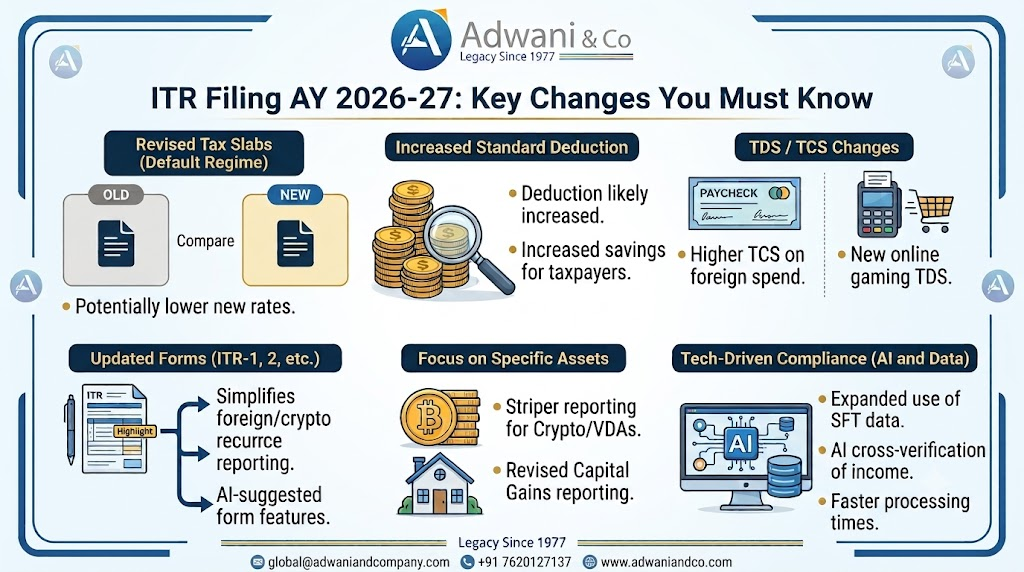
    ITR filing 2026 is not just a compliance formality. It is your single most powerful tool for financial legitimacy enabling faster loan approvals, smoother visa processing, faster refunds, and zero unnecessary scrutiny from the Income Tax Department. For FY 2025-26 (Assessment Year 2026-27), the filing season is open and the clock is ticking.

    This comprehensive guide will walk you through everything you need to know about ITR filing 2026: the correct deadlines by taxpayer category, the right forms to use, common mistakes to avoid, and how Adwani and Company can help you file accurately, on time, and with maximum tax savings.


    ITR Filing 2026 Last Date : Know Your Exact Deadline

    One of the biggest sources of confusion every year is the ITR filing last date 2026. Budget 2026 introduced a landmark change: the deadline is no longer the same for everyone. It now depends on the ITR form you use, your income type, and whether your accounts require a statutory tax audit. incometax.gov.inOne of the biggest sources of confusion every year is the ITR filing last date 2026. Budget 2026 introduced a landmark change: the deadline is no longer the same for everyone. It now depends on the ITR form you use, your income type, and whether your accounts require a statutory tax audit.

    Here is a category-wise breakdown confirmed by the Income Tax Department of India (incometax.gov.in)

    Taxpayer CategoryApplicable ITR FormITR Filing Last Date 2026
    Salaried, pensioners, single house propertyITR-1 / ITR-231 July 2026
    Freelancers, professionals, small business (non-audit)ITR-3 / ITR-431 August 2026
    Businesses requiring statutory tax auditITR-3 / ITR-431 October 2026
    Belated return (missed deadline)All forms31 December 2026
    Updated Return (ITR-U)ITR-U31 March 2031

    Important Note: When logging into incometax.gov.in for AY 2026-27, always select

    Tab 1: Income Tax Act, 1961

    Tab 2 is for Tax Year 2026-27 returns to be filed in 2027. Selecting the wrong tab will invalidate your filing entirely.

    At Adwani and Company, we explain“Knowing which deadline applies to you is step one. Choosing the wrong assumption about your due date can result in avoidable penalties and notices. Always verify your taxpayer category before filing.”


    What Changed in ITR Filing 2026 : Budget 2026 Updates

    Budget 2026 brought meaningful reforms that make ITR filing 2026 more taxpayer-friendly than any previous year. Understanding these changes is essential for every filer.

    Extended Deadline for Freelancers and Small Businesses

    For the first time, non-audit filers using ITR-3 and ITR-4 covering freelancers, consultants, small business owners, and independent professionals have been given an extra month to file. Their ITR filing last date 2026 is now 31 August 2026 instead of 31 July. This change, introduced specifically to reduce last-minute chaos and improve the quality of filings, gives business taxpayers adequate time to close accounts and perform proper reconciliations.

    Revised Return Window Extended to March 31

    One of the most taxpayer-friendly changes of the decade: the window to file a Revised ITR has been extended to 31 March 2027 for AY 2026-27. Previously capped at 31 December, this extension allows taxpayers who discover missed deductions or errors after filing to correct their returns without fear simply by paying a small revision fee. This change strongly reduces involuntary non-compliance.

    Updated Return (ITR-U) Window Extended to 4 Years

    Under Section 139(8A) of the Income Tax Act, 1961, the Updated Return window has been extended to 48 months (4 years) from the end of the relevant assessment year. For AY 2026-27, this means eligible taxpayers can file an ITR-U all the way up to 31 March 2031. This is particularly beneficial for taxpayers who realize they have missed reporting income from investments, freelance work, or capital gains.


    How to File ITR Online for AY 2026-27 : Step-by-Step

    ITR filing online has become progressively simpler, but errors are still common when taxpayers rush. Adwani and Company recommends the following structured approach for smooth ITR filing 2026:

    1. Download Form 26AS and AIS: Log in to incometax.gov.in and download your Annual Information Statement (AIS) and Form 26AS. Cross-verify that all TDS credits, bank interest, and income entries are correct. Any mismatch with your Form 16 must be resolved with your employer or bank before proceeding.

    2. Choose the Correct ITR Form: Using the wrong ITR form leads to defective return notices and rejection. ITR-1 is for salaried individuals earning up to ₹50 lakh from salary, one house property, and interest. ITR-2 covers individuals with capital gains or more than one property. ITR-3 and ITR-4 are for business and professional income.

    3 . Compute Total Income and Deductions: Gather all your income sources salary, rental income, interest, capital gains, freelance income and list all eligible deductions under Section 80C (up to ₹1.5 lakh), Section 80D (health insurance), HRA, and home loan interest. “Most taxpayers leave money on the table simply because they don’t know which deductions they are legally entitled to. A one-hour consultation can save you ₹20,000 to ₹50,000 in taxes.”

    4 . E-File and E-Verify: Complete ITR filing online through the Income Tax Portal (incometax.gov.in) and e-verify within 30 days using Aadhaar OTP, net banking, or by sending a physical ITR-V to CPC Bengaluru. An unfiled e-verification makes your return invalid.

    5. Track Refund Status: After successful filing and e-verification, track your refund status on incometax.gov.in under “My Account → Refund/Demand Status.” Early filers typically receive refunds faster due to lower portal congestion.

    [Learn more about our ITR Filing Services at Adwani and Company]https://www.adwaniandco.com/services/taxation-compliance


    Practical Example

    How Correct ITR Filing 2026 Saved ₹42,000

    Consider Mr. Ramesh Sharma, a 34-year-old software engineer from Pune earning ₹12 lakh per year. In previous years, he filed his own return hastily in the last week of July, claiming only basic 80C deductions.

    This year, guided by Adwani and Company, here is what his tax computation looked like:

    DeductionAmount Saved
    Section 80C (ELSS + PPF)₹1,50,000
    Section 80D (Health Insurance)₹25,000
    HRA Exemption (correct computation)₹84,000
    Home Loan Interest (Section 24b)₹2,00,000
    Total Deductions Claimed₹4,59,000

    By correctly computing his HRA exemption which he had been computing incorrectly for three years and properly claiming home loan interest that he had been ignoring, Ramesh reduced his taxable income from ₹12 lakh to approximately ₹7.41 lakh. At applicable slab rates, this resulted in a tax saving of approximately ₹42,000 compared to his previous year’s filing.

    This is the power of expert assisted ITR filing 2026, as practiced by Dr. Haresh Adwani and his team at Adwani and Company.


    Penalty for Late ITR Filing 2026: What You Risk by Waiting

    The Income Tax Act is clear about the cost of missing the ITR filing last date 2026. Under Section 234F, the following penalties apply:

    • ₹1,000 late filing fee if your total income is below ₹5 lakh
    • ₹5,000 late filing fee if your total income exceeds ₹5 lakh
    • 1% interest per month on outstanding tax dues under Section 234A
    • Loss of ability to carry forward losses from business, capital gains, or other heads — a particularly painful consequence for investors and traders
    • Increased scrutiny risk from the Income Tax Department, including notices and assessments

    The belated ITR filing last date for 2026 is 31 December 2026. Beyond that, the only recourse is the Updated Return (ITR-U) mechanism under Section 139(8A), which carries additional tax costs and cannot be used to claim fresh deductions.

    As the Income Tax Department of India consistently emphasizes, voluntary and timely compliance is the most cost-effective path for every taxpayer.

    Read our detailed guide on Penalty Provisions Under Income Tax Act: https://www.adwaniandco.com/blog/paid-your-taxes-honestly-still-got-an-income-tax-notice-2026-guide


    ITR Filing 2026 for Salaried vs Business Taxpayers : Key Differences

    Understanding the difference in ITR filing obligations between salaried and business taxpayers is critical for compliance under AY 2026-27.

    Salaried Taxpayers (ITR-1 / ITR-2)

    Salaried individuals represent the largest taxpayer category in India. Their income is primarily documented through Form 16 issued by employers, with TDS already deducted and deposited under Section 192. Their ITR filing 2026 due date is 31 July 2026. Key focus areas: correct HRA computation, Section 80C through 80U deductions, capital gains from mutual funds or stocks, and accurate AIS reconciliation.

    Business and Professional Taxpayers (ITR-3 / ITR-4)

    Freelancers, consultants, traders, and small business owners have more complex compliance needs. They must maintain proper books of account, compute business income accurately, reconcile GST returns with income tax filings, and — if turnover exceeds the prescribed threshold under Section 44AB — get a tax audit done before the October deadline. Dr. Haresh Adwani, with his dual expertise in Commerce (PhD) and law, specifically helps business owners navigate this intersection of income tax compliance, GST reconciliation, and legal risk — making Adwani and Company a one-stop solution for complete financial compliance


    Common ITR Filing Mistakes to Avoid in 2026

    Even wellintentioned taxpayers make errors that attract notices or reduce their refunds. Adwani and Company has compiled the most frequently observed mistakes during ITR filing 2026:

    1. Wrong ITR Form : Filing ITR-1 when you have capital gains from mutual funds requires ITR-2. Incorrect form selection results in defective return notices.
    2. Not Reconciling AIS and Form 26AS : Mismatches between your declared income and the government’s data are one of the top triggers for scrutiny.
    3. Missing Bank Interest Income : Interest from savings accounts, fixed deposits, and recurring deposits is fully taxable and must be reported even if TDS has been deducted.
    4. Incorrect HRA Calculation : HRA exemption is computed as the minimum of three values, not simply the full HRA received. Incorrect computation is a common, expensive error.
    5. Not Claiming Eligible Deductions : Many salaried employees are unaware they can claim Section 80TTA (savings interest up to ₹10,000) and Section 80EEA (first-home loan interest benefit).
    6. Skipping E-Verification : A filed but unverified ITR is treated as if it was never filed.

    [Read our detailed guide on How to Avoid Income Tax Notices in India]

    https://www.adwaniandco.com/blog/income-tax-notice-received


    Why Choose Adwani and Company for ITR Filing 2026

    At Adwani and Company, ITR filing 2026 is handled not by generic software but by qualified professionals led by Dr. Haresh Adwani — a PhD holder in Commerce and a law graduate with deep legal knowledge of Indian tax statutes.

    What sets Adwani and Company apart:

    • Complete AIS/Form 26AS reconciliation before filing to eliminate mismatch risk
    • Deduction maximization thorough review of all eligible deductions the client is legally entitled to claim
    • Dual expertise in income tax and GST ensuring your ITR filing is consistent with your GST returns, a critical requirement for business taxpayers
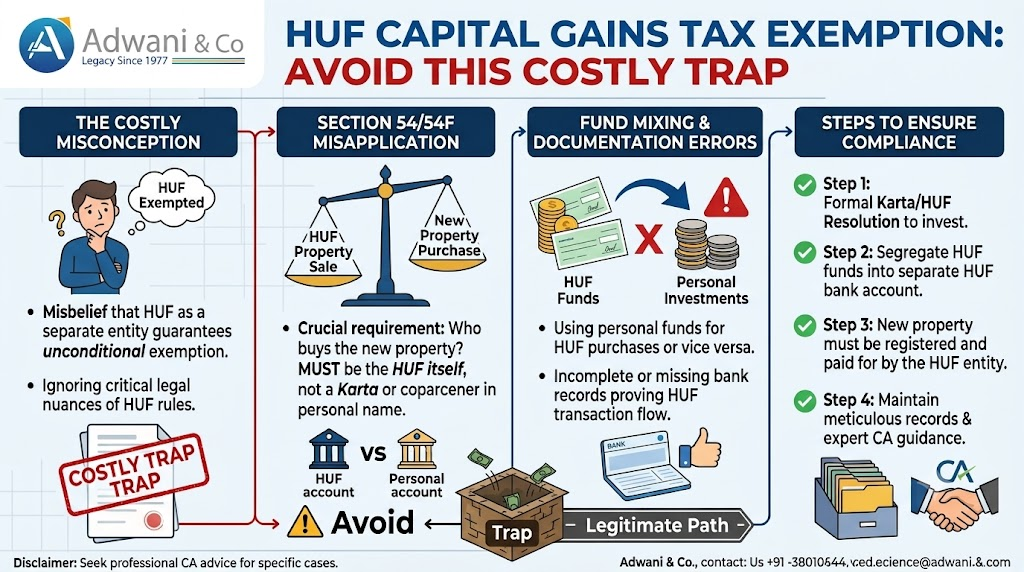
    • Legal interpretation Dr. Haresh Adwani’s law background allows Adwani and Company to advise on legally gray areas such as capital gains classification, HUF planning, and business income structuring
    • Year-round support not just at filing time, but for notices, assessments, appeals, and tax planning

    Thousands of satisfied clients across Pune and India trust Adwani and Company for accurate, timely, and legally compliant ITR filing every year.

    Conclusion:

    ITR filing 2026 is not a task to defer until the last minute. Whether you are a salaried professional, a freelancer, or a business owner, your ITR is the foundation of your financial credibility in the eyes of banks, government authorities, and investment institutions.

    The July 31 and August 31 deadlines for AY 2026-27 are firm. The Income Tax Department of India has made the e-filing infrastructure robust and accessible at incometax.gov.in but the portal still sees massive congestion in the final days of July every year. Filing early gives you faster refunds, time to correct errors, and the peace of mind that comes from knowing you are fully compliant.

    “Tax compliance is not a burden. It is the most powerful financial habit an Indian citizen can build. File correctly, file on time, and let your tax record open doors for you.”

    Frequently Asked Questions

    Q1. What is the last date for ITR filing 2026 for salaried employees?

    The ITR filing last date 2026 for salaried individuals filing ITR-1 or ITR-2 is 31 July 2026, as confirmed by the Central Board of Direct Taxes (CBDT) and the Income Tax Department of India.

    Q2. What happens if I miss the ITR filing 2026 deadline?

    You can file a belated ITR by 31 December 2026 with a late filing fee of ₹1,000 (income below ₹5 lakh) or ₹5,000 (income above ₹5 lakh) under Section 234F, plus applicable interest under Section 234A. Beyond December 31, you must file an Updated Return (ITR-U).

    Q3. Can I file a revised ITR after July 31, 2026?

    Yes. Budget 2026 extended the revised ITR deadline to 31 March 2027 for AY 2026-27. You can revise your original return to correct errors or claim missed deductions by paying a small revision fee.

    Q4. Which ITR form should freelancers and consultants use for AY 2026-27?

    Freelancers and independent professionals should use ITR-3 or ITR-4, depending on whether they are opting for presumptive taxation under Section 44ADA. Their ITR filing 2026 deadline is 31 August 2026 (non-audit cases).

    Q5. Is it mandatory to file an ITR if my employer has already deducted TDS?

    Yes, ITR filing is mandatory if your gross income exceeds the basic exemption limit, regardless of TDS already deducted. Filing also enables refund claims, carry-forward of losses, and financial documentation for loans, visas, and more.

    Q6. What documents do I need for ITR filing 2026?

    Key documents include Form 16 (from employer), Form 26AS (from income tax portal), Annual Information Statement (AIS), bank statements, investment proof for Section 80C, health insurance premium receipts, and home loan interest certificates.

    Q7. Can Adwani and Company file my ITR if I’m an NRI?

    Yes. Adwani and Company assists NRI taxpayers with ITR filing 2026, covering NRI capital gains tax on Indian assets, rental income from Indian properties, and DTAA (Double Taxation Avoidance Agreement) benefits.

    CA Dipesh Gurubakshani  is a Chartered Accountant with Adwani & Co LLP, Pune, specialising in income tax audit, direct taxation, and accounting advisory. He supports clients across statutory compliance, financial reporting, and income tax matters with a focus on accuracy, regulatory adherence, and disciplined execution.

  • Financial Modelling for Cash Flow:The Definitive Business Guide

    Financial Modelling for Cash Flow:The Definitive Business Guide

    Imagine running a business that is profitable on paper — yet struggling to pay salaries at the end of the month. It sounds contradictory, but it is one of the most common crises Indian businesses face. Profit is an accounting concept; cash is reality. And the bridge between the two is financial modelling for cash flow — a discipline that, when done right, gives business owners and CFOs the power to see financial turbulence before it arrives.

    In today’s fast-moving business environment, financial modelling is no longer a luxury reserved for large corporations and investment bankers. Every small business, startup, and mid-size enterprise in India needs a robust cash flow model to make smarter decisions, attract investors, and stay compliant with frameworks set by the Income Tax Department of India and the Ministry of Corporate Affairs (MCA). This guide explains everything you need to know — with practical examples, expert insights from Adwani and Company, and actionable steps you can implement today.

    82%

    of business failures are linked to poor cash flow management

    40%

    increase in investor confidence when a financial model is presented

    3–6xI


    What Is Financial Modelling for Cash Flow?

    Financial modelling for cash flow is the process of building a quantitative representation of a business’s expected cash inflows and outflows over a defined period typically 12 to 36 months. Unlike a simple cash flow statement (which is historical), a financial model is forward-looking. It simulates different scenarios: what happens if a key client delays payment by 60 days? What if raw material costs spike 15%? What if a new product line launches six months late?

    According to the Ministry of Corporate Affairs (MCA), companies registered under the Companies Act, 2013 are expected to maintain accurate financial records and projections as part of good corporate governance. A cash flow model is at the heart of that expectation.

    At Adwani and Company, the approach to financial modelling for cash flow is grounded in three pillars: accuracy of assumptions, transparency of logic, and scenario resilience. This is the philosophy championed by Dr. Haresh Adwani  a PhD holder in Commerce with a background in law whose dual expertise in financial strategy and legal compliance makes his advisory uniquely valuable for Indian businesses navigating complex regulatory environments.


    Why Financial Modelling for Cash Flow Matters in Business Finance

    The phrase “cash is king” is not a cliché it is a survival principle. Many businesses that appear healthy on their Profit & Loss (P&L) statement are dangerously illiquid. A well-constructed financial modelling for cash flow framework serves several critical purposes in business finance:

    1. Early Warning System for Liquidity Crises

    A rolling cash flow model flags potential shortfalls 60 to 90 days in advance, giving business owners the time to act — whether by negotiating extended credit terms with vendors, accelerating receivables collection, or drawing on a working capital facility.

    2. Credibility with Banks and Investors

    Whether you are approaching a bank for a term loan or pitching to a venture capital firm, a detailed cash flow model signals that your business is professionally managed. The Reserve Bank of India guidelines on MSME lending increasingly emphasise cash flow-based assessment over traditional collateral-based models making your financial model a direct tool for accessing better credit.

    3. GST and Tax Planning Alignment

    Integrating your GST outflow cycles into your cash flow model is essential. Many businesses are blindsided by large GST liability payments because they have not accounted for the timing mismatch between revenue recognition and tax payment. The GST Portal provides real-time liability data; incorporating this into your model prevents compliance-driven cash crunches.

    4. Strategic Decision-Making

    Should you hire five engineers this quarter? Can you afford to offer 60-day payment terms to a major new client? Can you invest ₹50 lakh in new equipment without jeopardising payroll? A financial model for cash flow answers these questions with data, not intuition.


    Key Components of a Financial Modelling for Cash Flow Framework

    A professional cash flow model the kind Adwani and Company builds for clients is not a single spreadsheet tab. It is an interconnected system with distinct modules:

    ModuleWhat It CapturesWhy It Matters
    Revenue ProjectionExpected sales by product, geography, or channelDrives all inflow assumptions
    Accounts Receivable (AR) AgingWhen customers actually pay, not when invoices are raisedMost critical variable in cash timing
    Operating ExpensesSalaries, rent, utilities, subscriptionsFixed outflows that define minimum cash requirement
    Tax & GST OutflowsAdvance tax, TDS, GST payable cyclesPrevents compliance-driven cash crises
    Capital Expenditure (CapEx)Asset purchases, infrastructure investmentsLarge one-time outflows that must be planned
    Debt ServiceLoan EMIs, interest paymentsNon-negotiable fixed outflows
    Scenario AnalysisBest case / base case / stress caseTests model resilience under different conditions

    Also Read https://www.adwaniandco.com/blog/financial-modeling-for-business-valuation-normalized-eps-explained-india-guide


    How to Build a Financial Model for Cash Flow: Step-by-Step

    Building an effective financial modelling for cash flow framework requires structured thinking and clean data. Here is the process that Dr. Haresh Adwani and the team at Adwani and Company recommend for Indian businesses:

    1. Gather 24 Months of Historical Data: Collect actual bank statements, invoices, payroll records, and tax payment receipts. The model is only as reliable as the data it is built on. For registered companies, MCA filings and ITR-6 data provide a useful starting baseline.
    2. Define Your Cash Inflow Drivers: Identify all sources of cash: customer payments, loans disbursed, investment inflows, asset sales. For each, define the timing lag — how many days after a sale does cash actually arrive in your bank account?
    3. Map Every Fixed and Variable Outflow: List all cash outflows: salaries, vendor payments, EMIs, GST, advance tax, insurance. Separate fixed costs (which exist regardless of revenue) from variable costs (which scale with activity).
    4. Build the 13-Week Rolling Cash Flow: Start with a short-range weekly model covering 13 weeks. This is the operational heartbeat of your business finance — it tells you exactly when your cash balance will hit critical lows and by how much.
    5. Extend to a 12–36 Month Forecast: Expand the model to a monthly view over 12 to 36 months, incorporating your growth assumptions, planned hirings, and capital expenditure roadmap. This is the model you will present to investors and banks.
    6. Run Scenario and Sensitivity Analysis: Test three scenarios: optimistic (revenue 20% above plan), base (as expected), and stress (revenue 20% below plan, customer payment delay of 30 days). This is where financial modelling for cash flow becomes genuinely powerful and where Adwani and Company adds the most value for clients.
    7. Review and Update Monthly: A financial model is a living document. Compare actuals versus projections each month, identify deviations, and update assumptions accordingly. The Income Tax Department of India expects businesses to maintain consistent, accurate records a well-maintained model supports that compliance.

    Financial Modelling for Cash Flow: A Real World Example

    Case Study: Manufacturing Company in Pune

    A mid-size manufacturing company with annual revenue of ₹8 crore approached Adwani and Company after facing a sudden cash shortfall despite reporting profits of ₹72 lakh for the year.

    When Dr. Haresh Adwani built a detailed financial modelling for cash flow analysis, the root cause became clear:

    • The company offered 90-day payment terms to its top 3 clients (who accounted for 65% of revenue)
    • But vendor payments were due in 30 days
    • GST liability of ~₹9.5 lakh was due on the 20th of each month, regardless of when clients paid
    • Advance tax instalments of ₹18 lakh annually were not modelled into their cash plan

    The model revealed a recurring cash gap of ₹22–28 lakh every quarter during the collection lag period. The solution was a combination of renegotiating payment terms (reducing client terms to 60 days), applying for a ₹30 lakh working capital line, and restructuring the vendor payment schedule.

    Within two quarters, the company’s cash buffer stabilised at ₹18 lakh enough to cover 45 days of operating expenses. Profitability did not change; only the timing management of cash improved. This is the transformative power of professional financial modelling for cash flow.

    Financial Modelling Tools for Cash Flow in Indian Businesses

    The right tool depends on your business size, technical capability, and the complexity of your financial model for cash flow:

    Microsoft Excel / Google Sheets

    For most SMEs, a well-structured Excel model remains the gold standard. It is flexible, universally understood, and easy to share with accountants and bankers. The key is disciplined structure — separate input, calculation, and output sheets — so the model does not become an unmanageable tangle of formulas.

    Zoho Books / Tally Integration

    Businesses already using Tally Prime or Zoho Books can extract live data to feed into their financial model for cash flow, reducing manual data entry errors significantly.

    Dedicated Financial Modelling Software

    Platforms like Finmark, Causal, or Cube are gaining traction among funded startups and mid-size enterprises for their real-time scenario modelling capabilities and investor-friendly dashboards.


    Common Financial Modelling Mistakes That Destroy Cash Flow Accuracy

    Even experienced finance professionals make errors that undermine the reliability of their financial modelling for cash flow. These are the most damaging ones to avoid:

    Confusing Revenue with Cash Receipts

    Recognising ₹1 crore in revenue this month means nothing if none of it has been collected. Always model cash flow based on actual payment collection dates, not invoice dates.

    Ignoring Seasonal Patterns

    Many Indian businesses experience sharp seasonal cash flow swings — retail peaks around Diwali, agriculture-linked businesses spike post-harvest, and B2B companies slow sharply in March as clients freeze budgets for financial year-end. A flat monthly model misses these entirely.

    Not Modelling Tax Outflows

    Advance tax under Section 208 of the Income Tax Act, 1961 requires taxpayers with liability exceeding ₹10,000 to pay in four instalments (June 15, September 15, December 15, and March 15). Missing these in your cash flow model creates painful surprises. The Income Tax Department of India has increasingly automated penalty notices — cash flow planning is your best defence.

    Over-Optimism in Revenue Assumptions

    Hope is not a financial strategy. Build your base case on conservative assumptions, and treat the optimistic scenario as an upside bonus — not the plan.

     Learn more about our Taxation & Compliance Services — ensuring your cash flow model is aligned with India’s advance tax, TDS, and GST payment cycles.


    Financial Modelling for Cash Flow and Business Fundraising

    If you are seeking equity investment, bank funding, or a government MSME scheme, your financial modelling for cash flow is the centrepiece of your pitch. Investors do not just want to see growth they want to see that you understand when cash moves, why it moves, and what you will do when it does not.

    The team at Adwani and Company, led by Dr. Haresh Adwani, has supported hundreds of Indian businesses through fundraising exercises —from seed-stage startups to established family businesses seeking structured debt. In each case, the cash flow model was the difference between a credible pitch and a dismissed one.

    Investors in India whether angel investors, venture capital firms, or private equity funds increasingly look for SEBI-compliant financial disclosures, MCA consistent corporate structuring, and GST-clean businesses. A model that integrates all these elements does not just present numbers; it presents a governance story.


    Conclusion: Financial Modelling for Cash Flow Is a Business Imperative

    Cash flow is the lifeblood of every business. It does not matter how strong your brand is, how talented your team is, or how promising your market is if cash runs dry, the business stops. Financial modelling for cash flow is not an exercise in spreadsheet complexity; it is an exercise in business survival, strategic clarity, and stakeholder confidence.

    When done well, a financial model transforms the way you make decisions. It tells you when to hire and when to hold, when to invest and when to conserve, when to push growth and when to fortify your cash position. It gives you the language investors, banks, and regulators want to see and it gives you the confidence that comes from knowing your numbers, deeply and honestly.

    As Dr. Haresh Adwani often says: “A business without a cash flow model is like a pilot flying without instruments the weather may be clear today, but you won’t see the storm coming until it’s too late.”

    The good news is that professional financial modelling for cash flow is more accessible than ever and the right advisory partner can build, maintain, and update your model as your business evolves.

    Frequently Asked Questions

    1. What is financial modelling in simple terms?

    Financial modelling for cash flow is the process of creating a structured, forward-looking spreadsheet or software model that predicts when money will enter and leave your business. Unlike a profit report, it shows you real-time liquidity the actual cash available in your bank account at any future point in time. For Indian businesses, it typically covers 13 weeks in detail and 12 to 36 months at a higher level.

    2. Why do Indian business fail despite being profitable?

    The most common reason is a timing mismatch between when revenue is earned and when cash is actually received. A business can show ₹50 lakh in profit for a quarter while having zero cash to pay salaries because its clients pay 90 days after invoice. Financial modelling for cash flow reveals and solves this gap before it becomes a crisis.

    3. How does financial modelling help with GST and tax planning?

    By integrating GST payment due dates (typically the 20th of each month) and advance tax instalments (June, September, December, March) directly into your cash flow model, you can ensure the business always has liquidity set aside for these obligations. Many businesses are caught off-guard by tax outflows; a model eliminates that surprise entirely. Adwani and Company specifically builds tax cycle alignment into every financial model it creates for clients.

    4. What is 13-week (or quarterly) rolling cash flow model and do I need one?

    A 13-week (or quarterly) rolling cash flow model is a week-by-week forecast of cash inflows and outflows for the next three months. It is the operational backbone of business finance. Banks and investors often request it during due diligence. For businesses facing rapid growth, seasonal swings, or debt obligations, a 13-week model is not optional it is essential.

    5. How much does professional financial modelling cost in India?

    The cost of a professionally built financial model varies based on business complexity, the number of revenue lines, and the level of scenario analysis required. At Adwani and Company, financial modelling services are offered as part of the Virtual CFO package or as standalone engagements — ensuring businesses of all sizes can access institutional-quality financial planning without needing a full-time CFO.

    6. Can financial modelling improve my chances of getting a bank loan?

    Absolutely. Banks in India particularly under the RBI’s updated MSME lending guidelines increasingly assess creditworthiness based on projected cash flows rather than collateral alone. A well-prepared financial model demonstrating healthy debt service coverage ratios (DSCR) and positive operating cash flow can significantly strengthen a loan application.

    7. What are the most important cash flow ratios for business finance?

    The three most critical ratios for business finance are:
    (1) Operating Cash Flow Ratio — operating cash flow divided by current liabilities, indicating short-term liquidity;
    (2) Cash Flow Margin — operating cash flow as a percentage of revenue, showing how efficiently the business converts sales into cash; and (3) Debt Service Coverage Ratio (DSCR) — net operating income divided by total debt service, which banks use to assess repayment capacity. A DSCR above 1.25x is generally considered healthy by Indian lenders.

    About the Author
    Dr. Haresh Adwani
    Ph.D. in Commerce | Law Graduate | Managing Partner, Adwani & Co LLP Dr. Haresh Adwani holds a Ph.D. in Commerce and is a qualified Law graduate with over two decades of hands-on experience in GST advisory, direct taxation, and statutory compliance for businesses across Pune and Maharashtra. As Managing Partner of Adwani & Co LLP a firm established in 1977 by Advocate N. T. Adwani Dr. Adwani has guided hundreds of
    SMEs, startups, and corporates through India’s evolving tax landscape. He is a recognised advisor on GST compliance, company formation, and Virtual CFO services, and regularly
    contributes to professional seminars and industry forums in Pune.

  • FP&A and Excel Automation:  The CFO’s Secret Weapon for Smarter Decisions in 2026

    FP&A and Excel Automation: The CFO’s Secret Weapon for Smarter Decisions in 2026

    CA Manish Mata April 2026 10 min read

    It’s quarter-end. Your CFO needs a three-scenario revenue forecast by tomorrow morning. Your finance team is buried in spreadsheets, copying data from one tab to another, double-checking formulas at midnight. Sound familiar? This is the reality for thousands of Indian businesses in 2026 — and it is entirely avoidable.

    The game-changer is FP&A (Financial Planning & Analysis) and Excel automation. For modern CFOs and finance leaders in India, this combination has stopped being a “nice to have” and become an absolute competitive necessity. Whether you run a growing startup, a mid-sized manufacturing firm, or a large enterprise, your ability to plan, forecast, and analyze financial data intelligently will determine whether you lead or lag.

    At Adwani and Company, we work with businesses across India to implement framework of FP&A and Excel automation workflows that save time, reduce errors, and give CFOs the clarity they need to make bold decisions. “The CFO who automates today will strategize tomorrow. The CFO who doesn’t will still be building pivot tables.”


    What Is FP&A and Why Does It Matter for CFOs in India?

    FP&A — Financial Planning and Analysis is the discipline that sits at the heart of every well-run finance function. It brings together budgeting, forecasting, variance analysis, and financial modeling to give leadership a forward-looking picture of the business. Unlike traditional accounting (which looks backward), FP&A looks ahead.

    For Indian CFOs navigating a dynamic environment with updated income tax regulations under the Income Tax Act 2025, shifting GST compliance requirements, and MCA reporting obligations FP&A provides the analytical backbone to stay ahead of both opportunities and risks.


    The three pillars of effective FP&A are:

    • Budgeting: Coordinating annual and rolling budgets across departments aligned with business strategy.
    • Forecasting: Updating financial projections based on real business performance, not just static assumptions.
    • Analysis: Identifying variances, trends, and actionable insights to guide CFO decision making.

    Excel Automation: Transforming FP&A from Manual to Intelligent

    Despite the rise of dedicated FP&A software, Microsoft Excel remains the dominant tool in Indian finance teams and for good reason. It is flexible, widely understood, and deeply integrated into how finance professionals work. The problem isn’t Excel itself; it’s how most teams use it: manually.

    Excel automation through macros, VBA scripts, Power Query, Power Pivot, and dynamic array formulas turns Excel from a static spreadsheet into a live financial intelligence engine. Here is what automation actually looks like in practice:

    1. Automated Data Consolidation

    Instead of manually copying data from ERP systems, bank statements, and CRM reports into a master spreadsheet, Power Query pulls and refreshes data from multiple sources at the click of a button. A business that previously spent 3 days consolidating monthly MIS data now completes it in under 2 hours.

    2. Dynamic Financial Models

    FP&A models built with structured Excel formulas (INDEX/MATCH, XLOOKUP, dynamic arrays) update automatically when assumptions change. A CFO can run a best-case, base-case, and worst-case scenario simultaneously without creating three separate files.

    3. Automated Reporting Dashboards

    Using Power Pivot and pivot charts, finance teams can build self-updating dashboards that surface KPIs like gross margin, working capital, EBITDA, and cash runway


    Real-World Example: FP&A and Excel automation in Action

    A mid-sized manufacturing company in Pune was spending approximately 80 hours per month on manual financial reporting across 12 departments. After implementing an automated FP&A model in Excel with Power Query pulling data from their ERP, VBA scripts formatting reports, and a live dashboard for the CFO their monthly reporting cycle dropped to just 14 hours. That is a saving of 66 hours per month, freeing up the finance team for strategic analysis rather than data entry. The CFO was now able to present scenario forecasts in board meetings instead of static backward-looking reports.


    How FP&A and Excel Automation Sharpen CFO Decision-Making

    The role of the CFO in Indian organisations has evolved dramatically. According to guidance from the Ministry of Corporate Affairs (MCA), CFOs of listed companies carry statutory responsibilities that go beyond financial reporting — including compliance with the Companies Act, 2013, and oversight of internal controls. This regulatory weight means CFOs cannot afford to waste time on manual processes.

    Here is how FP&A and Excel automation directly improves CFO decision quality:

    • Faster Scenario Analysis: Model the financial impact of a new product line, a pricing change, or a hiring plan within minutes, not days.
    • Improved Cash Flow Visibility: Rolling 13-week cash flow forecasts updated automatically help CFOs avoid liquidity crunches before they happen.
    • Accurate Tax Planning: With the new Income Tax Act 2025 changes and updated TDS rates for FY 2026-27, tax modelling within FP&A ensures no surprises at year-end.
    • GST Compliance Integration: Automating GSTR-3B and GSTR-1 reconciliation within financial models reduces errors and ensures timely filing.
    • Board-Ready Reporting: Automated variance analysis and commentary generation mean the CFO walks into board meetings with insights, not just numbers.

    FP&A Must Include Tax Planning: Income Tax Act 2025 Implications

    One of the most significant recent developments affecting Indian CFOs is the Income Tax Act 2025, which introduces a consolidated framework replacing several provisions of the Income Tax Act, 1961. According to the Income Tax Department of India, the revised Act focuses on simplification of tax computation, updated definitions of taxable income, and streamlined return filing. CFOs need to ensure their FP&A models incorporate these changes from April 2026.

    Key FP&A and Excel automation considerations under the updated tax framework include:

    • New Tax Regime Slabs for FY 2026-27: Ensuring salary cost models reflect revised TDS rates under Section 192 for all employees.
    • Capital Gains Tax Integration: Post-2026 changes to LTCG and STCG rates on equities and mutual funds must be reflected in investment planning models.
    • TDS on Rent and Professional Fees: FP&A models must auto-calculate TDS obligations under Sections 194I and 194J to avoid deduction defaults.

    Also Read https://www.adwaniandco.com/blog/old-vs-new-tax-regime

    This is exactly where working with a qualified CA firm like Adwani and Company becomes invaluable. They bridge the technical FP&A and Excel automation world with the regulatory compliance framework that Indian CFOs must navigate. Learn more about our Tax Planning Services. https://www.adwaniandco.com/services/taxation-compliance


    GST Compliance Automation: Making FP&A GST-Ready

    Under the GST framework administered by the GSTN (GST Network) portal, businesses must file multiple returns monthly and annually — GSTR-1, GSTR-3B, GSTR-9, and more. For CFOs managing large vendor bases and complex ITC (Input Tax Credit) positions, manual reconciliation is not just time-consuming — it is risky.

    Embedding GST automation within an FP&A model means:

    • Real-time ITC Reconciliation: Matching purchase invoices against GSTR-2B automatically, flagging mismatches before filing.
    • GST Liability Projections: Forecasting monthly GST outflows as part of cash flow planning rather than treating them as a surprise.
    • Late Fee Monitoring: Automating due date tracking for GSTR-3B and other returns to avoid penalties.

    For businesses unsure about GST registration requirements or ITC eligibility in 2026, read our detailed guide on GST Compliance for Indian Businesses crafted by our expert team at Adwani and Company.


    Building an FP&A Model in Excel: A Practical Framework

    If you want to build a robust FP&A and Excel automation model in Excel that would satisfy even the most demanding CFO, follow this proven structure developed and tested by the advisory team at Adwani and Company:

    1. Assumptions: All key drivers live here revenue growth rates, headcount, tax rates, inflation. This single tab controls the entire model.
    2. Income Statement: Driven entirely by formulas linked to assumptions. No hardcoded values.
    3. Balance Sheet: Auto-calculated from the income statement, with working capital schedules plugged in.
    4. Cash Flow: Indirect method cash flow statement that ties to the balance sheet. Includes a 13-week rolling cash forecast.
    5. Scenarios: Three scenarios (bear, base, bull) driven by a dropdown that switches assumption sets instantly.
    6. Dashboard: KPI cards, waterfall charts, and trend graphs that update automatically. Board ready at any moment.

    Power Query handles data ingestion. VBA handles report formatting. The CFO gets a single source of financial truth that is always current.


    Why CFOs Should Work With a CA Firm for FP&A Design

    While Excel skills are learnable, financial model design is not just a technical exercise it is a regulatory and strategic one. A model that ignores TDS implications, misstates deferred tax, or misclassifies capital vs. revenue expenditure will produce misleading outputs regardless of how elegant its formulas are.

    This is where Adwani and Company adds irreplaceable value. Under the leadership of Dr. Haresh Adwani a PhD holder in Commerce with a strong foundation in Indian commercial law —our firm combines FP&A consulting with tax compliance expertise. We don’t just build models; we build models that are legally sound, audit-ready, and aligned with current Indian regulations including the Income Tax Act 2025, GST law, and MCA requirements.

    Our FP&A advisory services for CFOs include:

    • Custom Excel automation model design and implementation
    • Integration of tax planning (income tax, TDS, capital gains) into financial models
    • GST liability forecasting and ITC reconciliation automation
    • Board and investor reporting dashboards
    • Financial model audit and error-proofing

    Learn more about our CFO Advisory and FP&A Services and discover how Adwani and Company can transform your finance function.


    Conclusion

    In 2026, the finance function is no longer defined by who can produce the most accurate historical report. It is defined by who can produce the most insightful forward-looking analysis fast, accurately, and in alignment with India’s evolving regulatory environment.

    FP&A and Excel automation are not just efficiency tools. They are strategic levers. They give CFOs the bandwidth to move from number-crunching to value creation advising the board on acquisitions, guiding pricing strategy, and modelling tax-efficient capital structures.

    But getting the most from FP&A requires more than Excel skills. It requires understanding the Income Tax Act 2025, GST compliance, MCA reporting, and how all of these intersect with business performance. That intersection is exactly where the team at Adwani and Company operate every day helping Indian businesses build finance functions that are intelligent, compliant, and future-ready.

    1. What is FP&A and why do Indian CFOs need it in 2026?

    FP&A Financial Planning and Analysis is the function responsible for budgeting, forecasting, and strategic financial analysis. In 2026, with updated tax regimes, new ITR forms, and increased regulatory scrutiny, Indian CFOs need FP&A to make proactive, data-driven decisions rather than reactive ones.

    2. How does Excel automation improve FP&A processes?

    Excel automation (using Power Query, VBA, dynamic arrays, and Power Pivot) eliminates manual data entry, speeds up report generation, reduces formula errors, and enables real-time scenario analysis dramatically increasing the productivity and accuracy of finance teams.

    3. Can FP&A models include GST and income tax calculations?

    Yes, and they should. A well-built FP&A model integrates TDS calculations under the new tax regime, GST liability projections, ITC reconciliation, and capital gains tax implications giving the CFO a true after-tax view of business performance.

    4. What is the difference between FP&A and traditional accounting?

    Traditional accounting (managed under statutory audit requirements and the Companies Act) looks backward recording what happened. FP&A and Excel automation looks forward projecting what will happen and why, enabling better strategic decisions.

    5. How does Adwani and Company help with FP&A and Excel automation?

    Adwani and Company offers end-to-end FP&A advisory from designing Excel automation models to integrating income tax and GST compliance into financial planning frameworks. Led by Dr. Haresh Adwani, our team brings both financial modelling expertise and deep regulatory knowledge to every engagement. Connect with us today.

    6. Is Excel still relevant for FP&A or should businesses use dedicated software?

    For most Indian SMEs and mid-market businesses, well-automated Excel remains the most practical FP&A tool. Dedicated FP&A software becomes relevant at larger scale. The key is automation removing manual work and adding intelligence to how Excel is used.

    7. How do I start building an FP&A model for my business?

    Start with a clean assumptions tab, then build your income statement, balance sheet, and cash flow using formulas linked to those assumptions. Add scenario functionality and a dashboard. If you need expert guidance, Adwani and Company can design and implement a custom FP&A and Excel automation model for your business from scratch.

    Author
    CA. Manish R. Mata Practising In India (Ex – PwC),  At Adwani & Co LLP leads the International Accounting & Tax Support vertical, delivering structured execution assistance to US CPA firms and overseas businesses.

  • GST Notice 2026: What Businesses Miss

    GST Notice 2026: What Businesses Miss

    By Dr. Haresh Adwani, PhD (Commerce), Law Graduate & Senior Partner — Adwani and Company

    Published · May 2026


    Most businesses believe a GST notice is always about unpaid tax.

    But in reality, many GST notices today are not asking only about tax liability. They are questioning business behaviour, transaction patterns, compliance consistency, vendor mismatches, and documentation quality.

    This is exactly why businesses across India are receiving GST Notice 2026 alerts even when taxes are paid on time.

    A business may file returns regularly yet still attract scrutiny because of:

    • Mismatch in GSTR-1 and GSTR-3B
    • Incorrect input tax credit claims
    • Suspicious vendor transactions
    • Non-reconciliation with GSTR-2B
    • Inconsistent turnover reporting
    • Errors in GST registration 2026 records
    • High-value transactions without proper documentation

    Today, the GST department uses advanced analytics and AI-based compliance monitoring through the GST Portal and data integrations with the Income Tax Department, MCA, e-way bill systems, and banking information.

    As a result, businesses need more than basic filing support. They need strategic GST compliance.

    At Adwani and Company businesses receive structured compliance guidance from experienced professionals including entity” Dr. Haresh Adwani”,“Commerce PhD and law graduate” who combines taxation expertise with legal understanding to help businesses respond professionally to GST notices.


    Why GST Notice 2026 Cases Are Increasing

    The government has significantly strengthened GST scrutiny mechanisms in recent years.

    According to updates and compliance advisories available through the GST Portal https://www.gst.gov.in and the Income Tax Department https://www.incometax.gov.inauthorities are now cross-verifying:

    • GST returns
    • E-invoices
    • E-way bills
    • Income tax filings
    • TDS/TCS data
    • MCA company filings
    • Bank transactions

    This means even a small mismatch can trigger a GST Notice 2026 review.


    For example:

    If a business reports turnover of ₹1.2 crore in GSTR-3B filing 2026 but financial statements filed with the MCA show ₹1.45 crore turnover, the system may automatically flag the case.

    Similarly, claiming input tax credit eligibility 2026 from non-compliant vendors may attract departmental scrutiny.

    Businesses that ignore these notices often face:

    • Interest liability
    • GST return late fee penalty
    • ITC reversal
    • Departmental audit
    • Bank attachment in extreme cases
    • Legal proceedings

    This is why proactive GST compliance is becoming essential for every business owner.


    Understanding the Real Meaning of GST Notice 2026

    A GST notice does not always mean fraud.

    In many cases, it simply means the department wants clarification.

    However, the response quality determines whether the issue closes smoothly or escalates.

    Common Types of GST Notices

    1. Return Mismatch Notice

    This arises when GSTR-1 vs GSTR-3B difference exists.

    Example:

    • Sales reported in GSTR-1: ₹50 lakh
    • Sales reported in GSTR-3B: ₹44 lakh

    Even if caused by clerical error, the system may generate scrutiny.

    2. Input Tax Credit Notice

    This occurs when businesses claim excess input tax credit eligibility 2026 beyond GSTR-2B reconciliation.

    3. Registration Verification Notice

    Many businesses applying for GST registration 2026 receive notices regarding:

    • Principal place of business
    • Utility bills
    • Rental agreements
    • Nature of business activity
    • Additional documentation

    4. High-Risk Vendor Notice

    If suppliers fail to file returns or are marked suspicious, recipient businesses may receive GST scrutiny notices.

    5. E-Way Bill Mismatch Notice

    Mismatch between transportation records and return filing may trigger investigation.


    A GST notice does not always mean fraud.

    In many cases, it simply means the department wants clarification.

    However, the response quality determines whether the issue closes smoothly or escalates.

    Common Types of GST Notices

    1. Return Mismatch Notice

    This arises when GSTR-1 vs GSTR-3B difference exists.

    Example:

    • Sales reported in GSTR-1: ₹50 lakh
    • Sales reported in GSTR-3B: ₹44 lakh

    Even if caused by clerical error, the system may generate scrutiny.

    2. Input Tax Credit Notice

    This occurs when businesses claim excess input tax credit eligibility 2026 beyond GSTR-2B reconciliation.

    3. Registration Verification Notice

    Many businesses applying for GST registration 2026 receive notices regarding:

    • Principal place of business
    • Utility bills
    • Rental agreements
    • Nature of business activity
    • Additional documentation

    4. High-Risk Vendor Notice

    If suppliers fail to file returns or are marked suspicious, recipient businesses may receive GST scrutiny notices.

    5. E-Way Bill Mismatch Notice

    Mismatch between transportation records and return filing may trigger investigation.


    GST Notice 2026 and GST Registration 2026 Risks

    One major reason for notices is incomplete or incorrect GST registration.

    Businesses often underestimate the importance of accurate registration details.

    During GST registration for small business owners, even small errors in:

    • Business address
    • HSN classification
    • Contact details
    • Bank information
    • Business activity description

    can create future compliance issues.

    GST Registration Documents Required

    Businesses should maintain:

    • PAN card
    • Aadhaar
    • Business registration proof
    • Utility bills
    • Rent agreement
    • Bank statements
    • Authorization documents

    Incomplete documentation frequently delays approvals and increases verification notices.

    If you are unsure about how to apply GST number online, professional consultation can prevent future compliance complications.

    Learn more about our GST Registration Services.https://www.adwaniandco.com/services/taxation-compliance


    Why GSTR-2B Reconciliation Matters in GST Notice 2026

    One of the most critical compliance tasks today is GSTR-2B reconciliation.

    Businesses claiming ITC without proper vendor matching face higher scrutiny.

    Under GST compliance rules, authorities expect:

    • Vendor invoice matching
    • Timely return filing
    • Accurate ITC claims
    • Proper invoice records

    Practical Example

    Suppose a company claims ₹5 lakh ITC in GSTR-3B filing 2026.

    However:

    • GSTR-2B shows only ₹4.2 lakh
    • Vendors failed to upload remaining invoices

    Result:

    The department may issue a GST Notice 2026 demanding clarification for excess ITC claim of ₹80,000.

    If documentation is weak, businesses may face:

    • ITC reversal
    • Interest penalties
    • Additional compliance review

    At Adwani and Company businesses receive systematic reconciliation support to reduce compliance risk.


    How Businesses Should Respond to GST Notice 2026

    The biggest mistake businesses make is panic.

    The second biggest mistake is ignoring the notice.

    A professional and timely response is essential.

    Step 1: Read the Notice Carefully

    Understand:

    • Notice section
    • Response deadline
    • Nature of mismatch
    • Required documents

    Step 2: Gather Supporting Documents

    Collect:

    • Invoices
    • Purchase records
    • Bank statements
    • GST returns
    • E-way bills
    • Vendor confirmations

    Step 3: Conduct Internal Reconciliation

    Check:

    • GSTR-1 vs GSTR-3B difference
    • Sales mismatch
    • ITC mismatch
    • E-invoice data

    Step 4: Draft a Proper Reply

    The reply should:

    • Be legally structured
    • Include factual clarification
    • Avoid emotional language
    • Attach documentary evidence

    This is where guidance from experts like Dr. Haresh Adwani”,”Commerce PhD and law graduate becomes valuable because GST replies often involve both taxation and legal interpretation.

    Step 5: File Response Before Deadline

    Delayed responses may escalate matters.

    Businesses should maintain digital records of all submissions on the GST Portal.


    How AI and Data Analytics Are Changing GST Compliance

    GST compliance has evolved significantly.

    Authorities now use automated systems to identify:

    • Unusual ITC claims
    • Circular trading patterns
    • Fake invoicing
    • Sudden turnover spikes
    • E-way bill inconsistencies

    This means businesses must adopt stronger compliance systems rather than depending only on annual corrections.

    Businesses Most at Risk

    Industries receiving higher scrutiny include:

    • Construction
    • Trading businesses
    • E-commerce sellers
    • Service providers
    • Export businesses
    • Real estate intermediaries

    Businesses involved in high-volume transactions must especially prioritize:

    • GST rates India 2026 updates
    • Vendor verification
    • Invoice accuracy
    • Monthly reconciliations
    • Timely GSTR-3B filing 2026

    GST Notice 2026: Mistakes Businesses Must Avoid

    Ignoring Notices

    Ignoring a notice can convert a manageable issue into legal proceedings.

    Using Unverified Vendors

    Businesses should verify supplier compliance status regularly.

    Incorrect GST Rates

    Applying wrong GST rates India 2026 classifications can trigger tax disputes.

    Improper Documentation

    Missing invoices or weak documentation reduce defence strength.

    Delayed Filing

    Late filing increases the possibility of GST return late fee penalty and scrutiny.

    No Professional Review

    Businesses handling notices internally without expert guidance often submit incomplete replies.


    Role of Professional Experts in GST Notice 2026 Cases

    GST law combines taxation, compliance, accounting, and legal interpretation.

    This is why businesses increasingly prefer experienced firms with multidisciplinary expertise.

    “Dr. Haresh Adwani” brings academic expertise in commerce along with legal knowledge, helping businesses understand both the financial and legal implications of GST proceedings.

    At Adwani and Company https://adwaniandco.com, businesses receive assistance in:

    • GST registration 2026
    • GST notice replies
    • GST audit support
    • Input tax credit reconciliation
    • GSTR-3B filing 2026
    • GST litigation support
    • Compliance reviews
    • Business advisory

    Read our detailed guide on GST Audit Compliance for Businessess.https://www.adwaniandco.com/blog/gst-compliance-checklist-pune2026-27


    Government Compliance Signals Businesses Should Monitor

    The GST department increasingly integrates information with:

    • MCA company filings
    • Income tax returns
    • TDS records
    • E-way bills
    • Banking transactions

    According to professional advisories inspired by the Ministry of Corporate Affairs https://www.mca.gov.in and GST compliance frameworks, businesses should maintain consistency across all regulatory filings.

    Even small inconsistencies can become red flags.

    For example:

    • Income tax turnover: ₹2 crore
    • GST turnover: ₹1.7 crore
    • E-way bill movement: ₹2.3 crore

    Such mismatches may trigger detailed scrutiny.

    Businesses should therefore maintain integrated accounting systems and periodic reconciliations.


    How Small Businesses Can Stay Safe From GST Notice 2026

    Small businesses often assume notices affect only large corporations.

    That is no longer true.

    Today, GST registration for small business entities is equally monitored through automated systems.

    Best Practices for Small Businesses

    • File returns on time
    • Maintain digit

    Conclusion

    A GST Notice 2026 is no longer just about unpaid taxes. It reflects how closely businesses are being monitored through technology-driven compliance systems integrating GST returns, e-way bills, MCA filings, and Income Tax records.

    Today, businesses must focus on proactive GST compliance, accurate reconciliations, timely return filing, and proper documentation to avoid unnecessary scrutiny.

    Whether it is GST registration 2026, GSTR-3B filing 2026, input tax credit eligibility 2026, or handling GST scrutiny notices, professional guidance can significantly reduce compliance risk and financial exposure.

    With increasing automation and AI-based tracking by authorities, businesses that maintain transparent records and strong compliance systems will always stay ahead.

    If you want expert guidance for GST compliance, GST notice replies, reconciliations, or business advisory support, connect with Adwani and Company today.

    Dr. Haresh Adwani and the team at Adwani and Company help businesses build legally compliant, financially secure, and future-ready operations.


    Frequently Asked Questions

    01. What is GST Notice 2026?

    GST Notice 2026 refers to official communication issued by GST authorities regarding return mismatches, input tax credit discrepancies, GST registration issues, or compliance verification under GST laws.

    02. Why did I receive a GST notice even after filing GST returns?

    Many businesses receive GST scrutiny notices due to:
    -GSTR-1 vs GSTR-3B mismatch
    -Incorrect input tax credit claims
    -Vendor non-compliance
    -Errors in GST registration 2026 details
    -E-way bill inconsistencies
    -Even small reporting differences can trigger automated scrutiny through the GST Portal.

    03.How can businesses avoid GST Notice 2026 issues?

    Businesses can reduce GST compliance risk by:
    -Filing GST returns on time
    -Performing regular GSTR-2B reconciliation
    -Verifying vendor GST compliance
    -Maintaining proper invoices and records
    -Reviewing GST rates India 2026 applicability carefully
    Professional compliance reviews also help identify issues before notices arise.

    04.What documents are required for GST registration 2026?

    Common GST registration documents required include:
    -PAN card
    -Aadhaar card
    -Business address proof
    -Utility bills
    -Bank statement
    -Rent agreement or ownership proof
    -Business registration documents
    Incomplete or inaccurate documentation may increase notice risk.

    05. Can small businesses receive GST scrutiny notices?

    Yes. GST registration for small business entities is now closely monitored through automated compliance systems and AI-based data analysis.
    Even small businesses and freelancers may receive GST Notice 2026 communications for mismatch or verification purposes.

    06. What happens if a GST notice is ignored?

    Ignoring a GST notice may lead to:
    -Penalties
    -Interest liability
    -Input tax credit reversal
    -GST audit proceedings
    -Recovery action by authorities
    Businesses should always respond professionally within the prescribed deadline.

    07. Who can help businesses respond to GST Notice 2026?

    Professional firms like Adwani and Company assist businesses with:
    -GST notice replies
    -GST registration 2026
    -GSTR-3B filing 2026
    -Input tax credit reconciliation
    -GST audit and litigation support
    Under the guidance of Dr. Haresh Adwani, businesses receive structured compliance and legal support.

    About the Author
    Dr. Haresh Adwani
    Ph.D. in Commerce | Law Graduate | Managing Partner, Adwani & Co LLP Dr. Haresh Adwani holds a Ph.D. in Commerce and is a qualified Law graduate with over two decades of hands-on experience in GST advisory, direct taxation, and statutory compliance for businesses across Pune and Maharashtra. As Managing Partner of Adwani & Co LLP a firm established in 1977 by Advocate N. T. Adwani Dr. Adwani has guided hundreds of
    SMEs, startups, and corporates through India’s evolving tax landscape. He is a recognised advisor on GST compliance, company formation, and Virtual CFO services, and regularly
    contributes to professional seminars and industry forums in Pune.

  • Hidden Loan Costs Indians Must Know Before Borrowing

    Hidden Loan Costs Indians Must Know Before Borrowing

    By CA Dipesh Gurubakshani Updated: May 2026 9 min read

    The bank advertised your loan at 6%. But when the first EMI hit your account, the numbers didn’t add up. You weren’t wrong — the bank was. Understanding hidden loan costs is not optional anymore. It can save you lakhs of rupees over the life of a loan.

    Millions of Indian borrowers sign loan agreements every year without fully understanding what they are committing to. The advertised interest rate — whether it’s 6%, 8.5%, or 12% — is rarely the true cost of borrowing. Hidden loan costs, undisclosed fees, and misleading marketing practices leave borrowers paying significantly more than they ever anticipated. This guide, brought to you by Adwani and Company, breaks down every layer of the hidden loan costs that lenders conveniently leave out of their brochures.


    Why Hidden Loan Costs Are the Biggest Financial Trap

    When a lender advertises a “6% home loan” or a “10% personal loan,” they are typically quoting a nominal interest rate — not the Annual Percentage Rate (APR) or the effective cost of credit. This distinction is critical, and most borrowers don’t know it exists.

    Hidden loan costs are charges added on top of the stated interest rate that inflate the true cost of your loan. These can include processing fees, administrative charges, insurance premiums bundled without consent, prepayment penalties, late payment fees, and documentation charges. When you add these up over a 15 or 20-year home loan, the difference between the advertised rate and what you actually pay can run into lakhs — sometimes even tens of lakhs.

    According to the Reserve Bank of India (RBI), lenders are required to disclose the Annual Percentage Rate (APR) transparently. Yet, in practice, these disclosures are often buried in fine print, disclosed only at the time of disbursement, or communicated in ways that most borrowers cannot interpret without professional help.

    “A loan is not just what you borrow — it is everything you will pay back, including what was never clearly disclosed.”


    The Most Common Hidden Loan Costs in India

    To fully grasp the hidden loan costs embedded in your borrowing agreement, you need to know exactly what to look for. Here are the most prevalent charges:

    1. Processing Fees

    Processing fees are typically charged as a percentage of the loan amount — usually between 0.5% and 2%. On a ₹50 lakh home loan, a 1% processing fee means you pay ₹50,000 before your loan even begins. This hidden loan cost is non-refundable, even if your loan application is rejected after payment.

    2. Insurance Premiums — Bundled Without Full Transparency

    Many lenders bundle life insurance or loan protection insurance with your loan and include the premium in the loan amount itself. This increases your principal — and therefore your interest outgo — for the entire loan tenure. The borrower often isn’t clearly told that this is optional. This is one of the most insidious hidden loan costs in the Indian banking system.

    3. Prepayment and Foreclosure Penalties

    If you come into money and want to repay your loan early, many lenders — especially those offering fixed-rate loans — charge a prepayment penalty of 2% to 4% on the outstanding amount. The RBI has banned foreclosure charges on floating-rate home loans for individual borrowers, but this protection does not apply to all loan types. Always verify this before signing.

    4. Documentation and Legal Charges

    Legal verification fees, stamp duty on loan agreements, CERSAI registration charges, and document handling fees are frequently not disclosed upfront. These can add ₹10,000 to ₹30,000 to the cost of a home loan — small percentages that silently inflate the true borrowing cost.

    5. MCLR vs. Repo Rate — When the Benchmark Matters

    Home loans linked to MCLR (Marginal Cost of Funds Based Lending Rate) reset less frequently than those linked to the RBI Repo Rate. If interest rates fall, borrowers on MCLR-linked loans benefit much later than those on repo-linked products. This is a structural hidden loan cost that many borrowers discover only years into their tenure.

    6. Goods and Services Tax (GST) on Loan Services

    Processing fees, prepayment charges, and many loan-related services attract 18% GST as per the GST Portal guidelines. This is rarely highlighted in loan advertisements and adds to the effective borrowing cost. Learn more about GST compliance for financial transactions on our resources page.


    A Real Example: The ₹50 Lakh Home Loan That Wasn’t 8%

    Illustrative Example — Home Loan Cost Breakdown

    A borrower takes a ₹50 lakh home loan for 20 years at an advertised rate of 8%. Here’s what the actual cost looks like when hidden loan costs are included:

    ₹50L

    Loan Amount

    8%

    Advertised Rate (Nominal)

    ₹1,00,000

    Processing Fee (2%)

    ₹42,000

    Insurance Premium (bundled)

    ₹22,000

    Legal + Documentation Fees

    ~9.3%

    Effective APR (Approx.)

    The total upfront hidden loan costs alone amount to over ₹1.64 lakh — more than 3% of the loan amount — before the borrower receives a single rupee. Over 20 years of EMIs, the true cost diverges significantly from what was advertised.

    This is precisely why consistently we advise clients to request a full APR disclosure and amortization schedule from lenders before signing any loan document. A difference of even 1% in effective interest rate on a ₹50 lakh loan over 20 years translates to over ₹8 lakh in additional outgo.

    Also Read: https://www.adwaniandco.com/blog/gst-show-cause-notices


    What Indian Law Says About Disclosing Hidden Loan Costs

    The regulatory framework in India is clear, even if enforcement is imperfect. The RBI’s Fair Practices Code mandates that all lenders — banks, NBFCs, and housing finance companies — must:

    • Provide a clear loan agreement with all charges stated before disbursement
    • Disclose the APR (Annualised Percentage Rate) in the loan sanction letter
    • Not alter loan terms unilaterally without the borrower’s written consent
    • Not levy foreclosure charges on floating-rate home loans to individual borrowers

    Additionally, the Ministry of Corporate Affairs (MCA) regulates the corporate governance of lending institutions, and violations of transparent disclosure norms can be reported to the RBI’s Banking Ombudsman Scheme. If you believe you have been misled about hidden loan costs, you have legal recourse.

    Read our detailed guide on your rights as a borrower under RBI guidelines to understand how to protect yourself legally.

    Did you know? Under Section 17 of the Consumer Protection Act, 2019, misleading advertisements — including those that obscure the true cost of a loan — can constitute an unfair trade practice and are actionable before Consumer Disputes Redressal Commissions.


    How to Calculate the True Cost of Your Loan

    There are two metrics every informed borrower should demand from their lender before signing:

    1. Annual Percentage Rate (APR)

    APR is the most accurate measure of the true cost of a loan. It includes the nominal interest rate plus all fees, charges, and costs associated with the loan, expressed as an annualized percentage. Always compare loans using APR — not the headline interest rate. A loan at 8% nominal with 2% processing fees can have an APR closer to 9.5% in the first year.

    2. Total Interest Outgo Over Tenure

    Ask your lender for the complete amortization schedule. This document shows you month-by-month how much of each EMI goes toward principal versus interest. For a ₹50 lakh loan at 8% over 20 years, the total interest alone amounts to approximately ₹50 lakh — you effectively pay back double the loan amount before counting any hidden loan costs.

    At Adwani and Company, we regularly assists clients in interpreting amortization schedules, comparing loan offers across multiple lenders, and negotiating better terms particularly for home loans, business loans, and education loans. Learn more about our loan advisory and financial planning services.


    5 Proven Strategies to Avoid Hidden Loan Costs

    1. Always demand the APR in writing — not just the nominal rate — before submitting any loan application
    2. Read every line of the sanction letter before accepting. The sanction letter is a legal document and binds you to its terms
    3. Opt out of bundled insurance unless you have independently verified its value and cost — it is almost always optional
    4. Check if your lender has a floating or fixed rate and understand what happens when the RBI changes the repo rate
    5. Consult a qualified CA before signing — professional review of loan documents can prevent expensive mistakes that last decades

    The Digital Age of Lending and New Hidden Loan Costs

    The rise of fintech lending, Buy Now Pay Later (BNPL) platforms, and instant digital loans has introduced an entirely new category of hidden loan costs. Many digital lenders advertise “0% interest” loans but recover their margins through flat processing fees, convenience charges, and mandatory subscription plans. A ₹10,000 BNPL loan with a ₹400 “convenience fee” and ₹200 monthly “account management fee” carries an effective annual cost well above 70%.

    Digital borrowers are particularly vulnerable because the application process is fast, paperwork is minimal, and borrowers rarely pause to examine the effective cost. The rule is the same regardless of the channel: demand full cost disclosure before borrowing.

    The Income Tax Department also takes note of loan-related costs processing fees on business loans are deductible under Section 37(1) of the Income Tax Act as a business expense. If you are a business borrower, understanding and properly documenting these hidden loan costs can reduce your tax liability. Read our detailed guide on business loan tax deductions in India.


    Conclusion: Know What You Borrow : Not Just What You Sign

    The gap between the loan that was advertised and the loan that was delivered is not an accident. Hidden loan costs are a systematic feature of how lending is marketed in India. Understanding them is not just financially prudent — it is an act of self-protection in a system that favors informed borrowers.

    The advertised rate is the entry point of a conversation. The APR, the amortization schedule, the insurance disclosure, the prepayment clause, the GST on fees — these are the substance of the deal. Before you commit to a loan that will follow you for 10, 15, or 20 years, make sure you are reading the full document, not just the headline number.

    a borrower who understands the hidden loan costs in their agreement is never truly trapped by them.


    Frequently Asked Questions

    01. What is the difference between the advertised loan interest rate and the actual cost of the loan?

    The advertised rate is the nominal interest rate usually the base rate applied to your principal. The actual cost of a loan includes processing fees, insurance, documentation charges, GST on fees, and other charges, all of which inflate the effective rate. The Annual Percentage Rate (APR) captures all these hidden loan costs and is the most reliable figure for comparison.

    02. Are banks in India required to disclose all loan charges upfront?

    Yes. Under the RBI’s Fair Practices Code, banks and NBFCs are required to disclose all charges and the APR in the loan sanction letter before disbursement. However, compliance varies, and borrowers must proactively ask for full cost disclosures rather than relying on what is volunteered.

    03. Can I negotiate processing fees and other hidden loan costs with my bank?

    Absolutely. Processing fees, documentation charges, and even prepayment penalty clauses are often negotiable especially for high-value loans or existing relationship customers. A Chartered Accountant or financial advisor can help you negotiate better loan terms before signing.

    04. What is a prepayment penalty and when does it apply?

    A prepayment penalty is a charge levied when you repay your loan before the agreed tenure. For floating-rate home loans to individual borrowers, the RBI has prohibited foreclosure charges. However, fixed-rate loans, business loans, and many personal loans may still carry prepayment penalties of 2%–4% of the outstanding balance. Always verify this before signing.

    05. How do hidden loan costs affect my EMI?

    In most cases, hidden loan costs like insurance premiums are added to the loan principal, which directly increases your EMI. Processing fees and GST are typically deducted upfront from the disbursed amount, meaning you receive less money than the sanctioned loan amount but pay EMIs on the full amount.

    06. Can I file a complaint if I was not informed about hidden loan costs?

    Yes. You can file a complaint with the RBI Banking Ombudsman if a regulated lender fails to disclose charges as required. Under the Consumer Protection Act, 2019, non-disclosure of material facts in a financial product can also constitute an unfair trade practice, actionable before Consumer Commissions.

    07. Are processing fees on a business loan tax deductible?

    Yes. Under Section 37(1) of the Income Tax Act, 1961, processing fees and other loan-related charges for business loans are allowable as a deductible business expense, provided they are incurred wholly and exclusively for business purposes and are properly documented. Consult a CA for proper treatment in your books of accounts.

    About the Author

    CA Dipesh Gurubakshani is a Chartered Accountant with Adwani & Co LLP, Pune, specialising in income tax audit, direct taxation, and accounting advisory. He supports clients across statutory compliance, financial reporting, and income tax matters with a focus on accuracy, regulatory adherence, and disciplined execution.

  • Income Tax Search and Seizure: What Every Indian Business Must Know

    Income Tax Search and Seizure: What Every Indian Business Must Know

    By Dr. Haresh Adwani, PhD (Commerce), Law Graduate & Senior Partner — Adwani and Company

    Published · May 2026

    “A search and seizure operation does not destroy a business. The panic that follows does.”


    Picture this: It is 6 a.m. on an ordinary Tuesday. Before your first cup of chai, there is a knock at the door a team of Income Tax officers with official authorisation to conduct a search and seizure under Section 132 of the Income Tax Act, 1961. Your heart races. Your mind goes blank. And in the silence of that moment, a single question forms: What do I do now?

    If you run a business in India whether a proprietorship, a partnership, a private limited company, or an LLP — an income tax search and seizure is one of the most stressful regulatory events you will ever face. Yet the businesses that come through it with the least damage are not the luckiest. They are the most prepared.

    In this comprehensive guide, Dr. Haresh Adwani of Adwani and Company breaks down exactly what happens during an IT raid, what your rights are, what mistakes destroy businesses, and most critically what you must do in the 48 hours after a search and seizure operation.


    What Is an Income Tax Search and Seizure?

    Under Section 132 of the Income Tax Act, 1961, the Director General of Income Tax or the Commissioner of Income Tax is empowered to authorise a search and seizure when there is credible information suggesting that a person is in possession of undisclosed income, unexplained assets, or unaccounted cash and documents. According to the official guidelines issued by the Income Tax Department of India, search operations are conducted covertly and without prior notice. They can cover business premises, residential properties, bank lockers, and even vehicles, computers, and digital storage devices.

    This is not a routine inspection or assessment. An income tax search and seizure carries serious evidentiary and legal consequences, and how you respond in the first hours — and in the 48 hours that follow — can significantly determine the outcome of any subsequent proceedings.

    Section 132 vs Section 133A: Knowing the Difference

    Many business owners confuse a search and seizure under Section 132 with a survey under Section 133A. The distinction is critical. A survey is conducted during business hours and is limited to business premises. Officers cannot seize books or documents in a survey — they can only make copies.

    Section 132 search, on the other hand, can take place at any hour, covers all premises simultaneously, and gives officers the power to seize books, documents, cash, jewellery, and digital assets. Understanding this difference is the first step to responding correctly.

    Learn more about our Tax Compliance Serviceshttps://www.adwaniandco.com/services/taxation-compliance


    What Happens During an Income Tax Search and Seizure?

    Across businesses sectors, the sequence of events in an IT search and seizure typically unfolds as follows:

    • Officers arrive, typically at dawn, with a valid search warrant issued under Section 132.
    • They produce their identity cards and the authorisation order. You have a right to examine both.
    • All persons present at the premises may be required to stay until the search concludes.
    • Officers inspect books of accounts, ledgers, computers, mobile phones, documents, and safes.
    • Cash, jewellery, and documents found during the search may be seized or placed under restraint.
    • A Panchnama (an official record) is prepared, listing everything searched and seized.
    • You (or your authorised representative) must sign this Panchnama.
    • A statement may be recorded under oath (Section 132(4)).

    The search can continue for multiple days. Officers are permitted to seal premises or break open any locked space if they have reason to believe it coYour Legal Rights During an Income Tax Search and Seizurenceals undisclosed assets.


    Your Legal Rights During an Income Tax Search and Seizure

    Cooperation does not mean surrender. Every business owner has legal rights during an income tax search and seizure, and understanding them is not obstructing justice it is exercising the protections that Indian law guarantees.

    • You have the right to verify the identity of officers and examine the search warrant.
    • You may have two respectable witnesses present during the search (Panchas).
    • You are entitled to a copy of the Panchnama at the end of the search.
    • You can refuse to make voluntary statements without the presence of your legal or tax advisor.
    • You have the right to be informed of the grounds of search on request.
    • Any item seized must be listed, and you are entitled to an acknowledgement receipt.
    • You can request that the search be conducted in the presence of a medical officer if someone present requires medical attention.

     Dr. Haresh Adwani  consistently advises his clients: “Know your rights before you need them. The moment of a search is not the time to be reading the rulebook.”

    https://www.adwaniandco.com/services/taxation-compliance→ Learn more about our Business Legal Advisory Serviceshttps://www.adwaniandco.com/services/taxation-compliance


    The Biggest Mistakes Businesses Make During a Search and Seizure

    In over two decades of tax advisory work, Adwani and Company has seen businesses suffer far greater damage from their own reactions than from the search itself. These are the most costly mistakes:

    1. Panic-driven statements

    The moment officers arrive, the instinct is to explain, justify, or apologise. Any statement made under pressure — even an innocent explanation — can be treated as an admission in subsequent proceedings. Never make voluntary statements without your tax advisor present.

    2. Handing over documents without a record

    Every document removed from your premises must be listed in the Panchnama. Handing over files without insisting on this record can create disputes later about what was taken and in what condition.

    3. Failing to contact a professional immediately

    The single most effective action you can take during the search is to call your Chartered Accountant and legal advisor immediately. Your advisor can guide you on what to say, what not to say, and how to ensure the process is conducted lawfully.

    4. Making undocumented admissions in Section 132(4) statements

    Officers may record your statement under oath during the search. Anything you say here has legal weight. Statements that are later contradicted by your accounts or books can be used against you. Always insist on reviewing what has been recorded before signing.


    Practical Example

    Scenario: A manufacturing firm in Pune undergoes an income tax search and seizure. Officers find ₹28 lakh in cash on the premises. The proprietor, panicking, immediately explains the cash as “advance payment from a customer.” This oral statement is recorded in the Section 132(4) statement.

    However, the firm’s actual books show the ₹28 lakh as an opening balance a completely legitimate entry. Because the oral statement did not match the books, the department treated the discrepancy as an unexplained liability, leading to tax demand, interest, and penalties exceeding ₹11 lakh.

    Lesson: Had the proprietor simply said “I will provide a written explanation after consulting my advisor,” the cash would have been explained through the books alone — with no inconsistency and no additional liability.


    The Critical 48 Hours After an Income Tax Search and Seizure

    The search ends. The officers leave. And now you face the 48 hours that will define what comes next. This is not the time to be passive. Based on the advisory approach of Adwani and Company, here is what must happen immediately:

    • Hour 0–4: Review and retain a copy of the Panchnama. Document everything that was seized, including descriptions, quantities, and condition.
    • Hour 4–8: Brief your Chartered Accountant fully — share all correspondence, the Panchnama, and any statements recorded.
    • Hour 8–16: Conduct an internal review of your accounts. Identify every item mentioned or seized and ensure you can explain it with supporting documentation.
    • Hour 16–24: Prepare a chronological record of events from the moment of search — witnesses present, officers’ names, time, and sequence of actions.
    • Hour 24–48: File any retraction or clarification to a Section 132(4) statement (if made under duress) through your legal advisor, if required.
    • Hour 48: Engage legal counsel for the post-search assessment proceedings under Section 153A (which replaces the regular assessment for the six preceding years

    The Ministry of Finance has consistently clarified that post-search assessments under Section 153A require the Assessing Officer to issue notices for the six assessment years immediately preceding the search. Being prepared with clean, explainable accounts for those six years is your strongest defence.

    → Read our detailed guide on Poshttps://www.adwaniandco.com/blog/section-153c-tax-notice-guidet-Search Assessment under Section 153A


    How Adwani and Company Protects Your Business During a Search and Seizure

    Adwani and Company provides end-to-end advisory support for businesses facing income tax search and seizure proceedings. From the moment the search begins to the final resolution of post-search assessments, the firm offers:

    • Immediate on-call advisory during and after the search
    • Review and verification of the Panchnama and seized documents
    • Preparation and filing of statements under Section 132(4)
    • Representation before the Income Tax Department during post-search assessments
    • Assistance with appeals before the Commissioner (Appeals) and the Income Tax Appellate Tribunal (ITAT)
    • Guidance on penalty mitigation and settlement proceedings

    As Dr. Haresh Adwani puts it: “The goal is not just to survive a search. The goal is to come out on the other side with your business, your reputation, and your future intact.”

    Preventive Measures: How to Search-Proof Your Business


    While no business can predict a search and seizure, every business can reduce the risk and the damage. Adwani and Company recommends the following proactive steps:

    • Maintain meticulous books of accounts reconciled monthly, audited annually as required under the Income Tax Act.
    • Ensure all cash transactions above ₹2 lakh are properly documented (as mandated under Section 269ST).
    • File GST returns accurately and on time through the GST Portal.
    • Keep all MCA filings current particularly for companies and LLPs regulated by the Ministry of Corporate Affairs.
    • Maintain a “search readiness” file: updated balance sheet, cash book, investment records, and explanation for any large or unusual transactions.
    • Conduct an internal “mock audit” annually with your CA to identify and resolve discrepancies before they become issues.

    → Learn more about our Annual Compliance and Services https://www.adwaniandco.com/services/taxation-compliance


    Conclusion: A Search Is Not the End : How You Respond Decides What Comes Next

    An income tax search and seizure is undeniably one of the most disruptive events in a business owner’s life. But it is not, by itself, a verdict. The Income Tax Department initiates thousands of search operations every year and many of them conclude without any adverse outcome for the searched party, because those businesses maintained clean records, exercised their rights, and responded with the guidance of qualified professionals.

    What makes the difference is not luck. It is preparation. It is calm. It is the right advisor at the right moment.

    The businesses that come through a search and seizure intact are the ones that call their Chartered Accountant first, stay composed second, and let the documentation speak for itself third.

    If your business has faced an income tax search and seizure — or if you want to be prepared for one — the expert team at Adwani and Company, led by Dr. Haresh Adwani, is ready to guide you through every step with precision, confidentiality, and decades of hard-won expertise.

    Frequently Asked Questions

    1. Can the Income Tax Department conduct a search and seizure without a warrant?

    No. A search under Section 132 requires written authorisation from a high-ranking officer typically the Director General or Commissioner of Income Tax. You have the right to examine this authorisation before permitting entry.

    2. How long can an income tax search and seizure last?

    There is no statutory time limit. In practice, searches involving complex cases and multiple premises can last several days. However, the search must be conducted within the scope of the authorisation order.

    3. Can I refuse to answer questions during a search and seizure?

    You are required to cooperate, but you are not required to make voluntary statements without your advisor. You may request that any statement under Section 132(4) be deferred until your tax advisor is present though officers may not always agree to this. Be careful and measured with every word.

    4. What happens to the cash and jewellery seized during an IT raid?

    Seized assets are held by the department and can be retained for up to 60 days (extendable with approval). If the seized assets are satisfactorily explained and declared income, they are returned. If not, they can be applied against tax demands arising from the assessment.

    5. What is a Section 153A assessment and how does it differ from a regular assessment?

    After a search and seizure, the Income Tax Department issues notices under Section 153A for the six assessment years preceding the search year. These assessments replace the regular ones and allow the department to reassess income for those years based on seized material and any other evidence found during the search.

    6. Can I be penalised even if I cooperate fully during a search?

    Cooperation reduces risk but does not automatically eliminate penalties. Penalties under Section 271AAB apply specifically to undisclosed income found during a search. However, making a voluntary declaration of undisclosed income during the search (with your advisor’s guidance) can attract a lower penalty rate of 30% compared to 60% if it is detected without disclosure.

    7. How can Adwani and Company help if my business has already undergone a search and seizure?

    Adwani and Company provides comprehensive post-search advisory — from reviewing the Panchnama and preparing your Section 153A assessment response to representing you in appeals before the ITAT. Contact us today for an immediate consultation.

    Dr Haresh Adwani holds a PhD in Commerce and brings over 20 years of expertise in GST compliance, income tax advisory, FEMA, and corporate law. Services include GST audit, ITR filing, GST appeal representation, notice response, NRI taxation, and FEMA compliance.

  • Section 148 Notice: How to Reply & Avoid Penalties

    Section 148 Notice: How to Reply & Avoid Penalties

    Got a Section 148 notice in your inbox? Don’t panic. Here’s everything you need to know from what triggers it, to the exact steps you must take, with a ready-to-use reply format.

    By Dr. Haresh Adwani, PhD (Commerce), Law Graduate, Adwani and Company


    Imagine opening your email or logging into the Income Tax e-Filing Portal only to find a formal notice sitting there one that says “Section 148 Reassessment of Income.” For many taxpayers, that moment triggers instant anxiety. Is this a tax raid? Have I done something wrong? Do I need a lawyer?The truth is, a Section 148 notice is one of the most common yet misunderstood notices issued by the Income Tax Department of India. It doesn’t automatically mean you’ve committed fraud. In many cases, it simply reflects a data mismatch a transaction flagged in the Annual Information Statement (AIS), a Form 26AS inconsistency, or unreported income.

    In this comprehensive 2026 guide, we break down everything you need to know about the Section 148 notice  what it means, why you received it, exactly how to reply, critical deadlines, legal rights, and how Adwani and Company can help you resolve it with minimal risk.


    IMPORTANT

    Ignoring a Section 148 notice can lead to penalties, ex-parte reassessment orders, and in extreme cases, prosecution. Always respond within the specified deadline.


    What Is a Section 148 Notice?

    Under Section 148 of the Income Tax Act, 1961, the Assessing Officer (AO) is empowered to issue a notice to a taxpayer when there is “reason to believe” that income has escaped assessment  meaning it was either not disclosed, was under-disclosed, or was incorrectly reported in a prior year’s Income Tax Return (ITR).

    This notice initiates what is technically called reassessment proceedings. Upon receiving a Section 148 notice, the taxpayer is required to file or revise their ITR for the Assessment Year (AY) specified in the notice and provide an explanation for any discrepancies the department has identified.

    According to the Income Tax Department’s guidelines, an AO must obtain prior approval from a superior officer typically a Commissioner or Principal Commissioner before issuing a Section 148 notice. This is a critical procedural safeguard that taxpayers can invoke if the notice appears to be improperly issued.


    AspectDetail
    Governed bySection 148, Income Tax Act, 1961
    Issued byAssessing Officer (AO)
    PurposeReassessment of escaped income
    Requires approval ofCommissioner / Principal Commissioner
    Time limit (normal)Up to 3 years from end of relevant AY
    Time limit (escaped income > ₹50 lakh)Up to 10 years from end of relevant AY
    Response requiredFile/revise ITR + submit explanation

    Why Did You Receive a Section 148 Notice?

    The Income Tax Department relies on extensive data mining sourced from banks, registrars, stockbrokers, GST filings, and even foreign asset reports to identify potential underreporting. Here are the most common reasons a Section 148 notice is triggered

    High-Value Financial Transactions

    If you purchased a property, made significant investments in mutual funds or shares, or deposited large sums in cash without adequately disclosing the source in your ITR, the AIS (Annual Information Statement) will flag it. The department compares your declared income with these transactions automatically.

    Mismatch Between AIS / Form 26AS and ITR

    Your Annual Information Statement (AIS) and Form 26AS capture TDS deductions, interest income, dividend income, and other financial data. If your ITR doesn’t match these records, it can trigger a Section 148 notice.

    Non-Filing or Incomplete Filing of ITR

    If you failed to file an ITR for a particular year despite having taxable income, the department can reopen that year’s assessment for up to 3 years (or 10 years in serious cases) under Section 148.

    Suspicious or Unexplained Entries

    Accommodation entries, bogus purchases, inflated expenses, or donations made to questionable entities often draw scrutiny and may lead to a Section 148 notice for the concerned AY.

    Information from Third Parties or Other Departments

    Tip-offs from enforcement agencies, information shared by the GST department, or foreign asset disclosures can all prompt the AO to initiate reassessment under Section 148.


    Practical Example

    Mr. Ramesh Sharma sold a residential property for ₹80 lakh in FY 2022-23. The sale was registered with the Sub-Registrar and automatically reported to the Income Tax Department. However, Ramesh only declared capital gains on ₹35 lakh in his ITR, citing the indexed cost of acquisition. Without proper documentation a purchase agreement showing the original cost, improvement expenses, and indexed figures the AO had reason to believe ₹45 lakh escaped assessment. Ramesh received a Section 148 notice for AY 2023-24. With a well-drafted reply supported by documents, the case was resolved without any addition. This is exactly the kind of scenario Dr. Haresh Adwani and his team at Adwani and Company handle regularly.


    Section 148 Notice: Step-by-Step Reply Process

    1. Read the Notice Carefully: Note the Assessment Year, the deadline specified, and the reason recorded by the AO. Identify whether the reasons are explicitly stated or whether you need to request them separately through the portal.

    2. Log In to the Income Tax e-Filing Portal: Visit incometax.gov.in, navigate to “Pending Actions,” and locate the notice. Download the official notice document for your records.

    3. Request the “Reasons Recorded”: You have the legal right to request the reasons recorded by the AO before the notice was issued. This step is crucial it allows you or your CA to evaluate whether the notice itself is valid and challengeable.

    4. Gather and Organise Documents: Collect bank statements, investment proofs, sale/purchase agreements, ITRs of previous years, Form 26AS, AIS, and any invoices or contracts relevant to the disputed transaction.

    5. File the Return in Response to the Notice: In most cases, filing a revised or fresh ITR for the concerned AY is mandatory. Work with a qualified CA to ensure accuracy and completeness before submission.

    6. Draft and Submit the Written Reply: Prepare a formal written reply acknowledging the notice, explaining the nature of each transaction, and attaching supporting documents. Submit this online via the portal’s response mechanism.

    7. Attend Hearings and Respond to Follow-Up Queries: After your initial reply, the AO may schedule personal hearings or raise additional queries. Respond promptly with further clarifications and documentation.


    Related Resources from Adwani and Company:

    ->Learn more about our Income Tax Notice handling services -_—> Read our detailed guide on responding to Section 143(2) Scrutiny Notice -> Understand how to appeal before the Income Tax Appellate Tribunal (ITAT)


    Section 148 Notice Reply Format (Ready to Use)

    Below is a simplified and legally sound reply format that you can use as a starting point. We strongly recommend consulting with a Chartered Accountant before submitting your actual reply.

    Date: [DD/MM/YYYY]

    To,
    The Assessing Officer,
    Income Tax Department,
    Ward / Circle [___], [City]

    Subject: Reply to Notice under Section 148 of the Income Tax Act, 1961 — AY [XXXX-XX] — PAN: [XXXXXXXXXX]

    Respected Sir/Madam,

    This is in response to the notice issued under Section 148 dated [Date of Notice] for Assessment Year [XXXX-XX].

    1. Filing of Return in Response to Notice:
    In compliance with the above notice, the return of income for AY [XXXX-XX] is being filed simultaneously through the Income Tax e-Filing Portal.

    2. Nature of Alleged Discrepancy:
    We understand that the notice pertains to [briefly describe the transaction — e.g., a property sale/cash deposit/investment] amounting to ₹[__] reported in AIS/Form 26AS for the said year.

    3. Factual Explanation:
    We respectfully submit that [provide a clear, factual explanation — e.g., “The said amount represents the sale of an ancestral property, the indexed cost of acquisition of which is ₹[__], resulting in taxable long-term capital gain of ₹[__], which has been duly reported in the ITR.”]

    4. Documents Enclosed:
    In support of our submission, the following documents are enclosed for your kind perusal:
    a) Copy of Sale Deed / Agreement
    b) Bank statements for the relevant period
    c) Copy of ITR filed for AY [XXXX-XX]
    d) [Any other relevant document]

    We request your good office to kindly consider our submissions and close the matter. We remain available for any further clarification required.

    Yours faithfully,

    [Full Name]
    [PAN Number]
    [Date & Signature]
    [If represented by a CA: For Adwani and Company, Chartered Accountants]


    Time Limits for Section 148 Notice: Know Your Rights

    One of the most important and frequently overlooked aspects of a Section 148 notice is the time limit within which it can be validly issued. If a notice is issued beyond the permissible period, it is legally invalid and can be challenged before the jurisdictional High Court or through a writ petition.

    ScenarioMaximum Time LimitApproval Required
    Normal cases3 years from end of relevant AYAssessing Officer level
    Escaped income exceeds ₹50 lakhUp to 10 years from end of relevant AYPrincipal Commissioner or Commissioner
    Search / Survey casesSpecial provisions apply (Section 153A/C)Higher authorities

    Dr. Haresh Adwani — PhD in Commerce and a law graduate with extensive legal acumen — consistently advises clients to first verify the date of the notice against these statutory limits before preparing their response. An expired notice can be struck down entirely, saving the client from unnecessary litigation.


    How Dr. Haresh Adwani Approaches Section 148 Cases

    With decades of combined experience in income tax litigation and advisory, Dr. Haresh Adwani has developed a multi-layered approach to handling Section 148 notices. As the lead partner at Adwani and Company, he combines his academic depth (PhD in Commerce, law graduate) with practical courtroom and tribunal experience to build robust defence strategies for clients.

    Under Dr. Haresh Adwani’s guidance, the firm systematically evaluates:

    (a) whether the Section 148 notice is within the statutory time limit. (b) whether proper approvals were obtained, (c) whether the “reason to believe” is tangible and specific, and (d) whether the taxpayer’s disclosures are fully supported by documentation. This four-point framework has consistently produced favourable outcomes for clients across Gujarat and beyond.


    Common Mistakes Taxpayers Make After a Section 148 Notice

    Across hundreds of cases handled by Adwani and Company, certain mistakes appear repeatedly. Avoiding these can dramatically improve your outcome:

    • Ignoring the notice : This is the most dangerous mistake. An ex-parte order (passed without hearing you) can result in a large addition to your income and a heavy tax demand.
    • Filing an incomplete or inaccurate reply : Submitting a vague response without documentary support often worsens the situation and invites further scrutiny.
    • Missing the deadline : The notice specifies a response window. Missing it eliminates your opportunity to present your case in the first round.
    • Not engaging a qualified CA : Income tax reassessment is a technical, quasi-judicial proceeding. Attempting to navigate it without professional help risks costly errors.
    • Not challenging an invalid notice : If the notice is time-barred or lacks proper approval, it can be quashed. Failing to raise this objection is a missed legal opportunity.
    • Disclosing more information than required : Offering unsolicited information can open new lines of inquiry that the AO hadn’t considered.

    Pro Tip from Adwani and Company

    Always retain all financial documents for at least 7 years property agreements, bank statements, investment records, and ITR acknowledgements. This simple habit dramatically simplifies responding to any reassessment notice, including Section 148.


    Can You Challenge a Section 148 Notice?

    Yes and in many situations, you should. A Section 148 notice is challengeable on several legal grounds:

    1. Notice Issued Beyond Statutory Time Limits

    If the notice is issued after the permissible period (3 or 10 years, as applicable), it is void and can be challenged through a writ petition before the High Court.

    2. Lack of “Tangible Material”

    Courts across India, including the Supreme Court, have consistently held that an AO cannot issue a Section 148 notice based merely on suspicion or a change of opinion. There must be “new, tangible material” to justify reopening a closed assessment.

    3. Procedural Defects

    If proper approval from the required authority was not obtained, or if the notice was not served through proper channels as mandated by the Income Tax Act, it can be challenged.

    Dr. Haresh Adwani routinely files objections against invalid Section 148 notices before the Assessing Officer itself and when rejected, escalates to the High Court often securing a stay on reassessment proceedings. 


    Conclusion: A Section 148 Notice Is Not the End It’s an Opportunity to Clarify

    Section 148 notice can feel overwhelming the moment it arrives. But as this guide demonstrates, it is a well-defined legal process with clear procedural safeguards, time limits, and your right to challenge it if improperly issued.

    The most important steps are: read it carefully, do not ignore it, gather your documents, file your return in response, and submit a well-reasoned, documented reply ideally with the help of a qualified Chartered Accountant. Most reassessment cases, when handled proactively, close without any additional tax burden.

    Dr. Haresh Adwani and the team at Adwani and Company have successfully guided hundreds of clients through Section 148 notices from straightforward data-mismatch cases to complex multi-crore reassessments. Their integrated approach combining tax expertise, legal knowledge, and documentation discipline consistently delivers results.

    1. Is Section148 notice Serious?Should I be worried?

    Yes, it is serious and should not be ignored but it is manageable. A Section 148 notice initiates reassessment proceedings and, if unanswered, can result in an ex-parte order with additional tax demands and penalties. However, with a proper reply and supporting documents, the vast majority of cases are resolved without any significant tax liability.

    2. How do I reply to a Section 148 notice online?

    Log in to the Income Tax e-Filing Portal (incometax.gov.in), navigate to “Pending Actions” → “Response to Outstanding Demand / Notices,” locate the Section 148 notice, and use the portal’s response mechanism to submit your reply and upload supporting documents. In parallel, file the return for the specified AY if not already done.

    3. Do I have to file a return again in response to a Section 148 notice?

    In most cases, yes. The notice specifically asks you to file a return for the Assessment Year under review. Even if you had originally filed a return for that year, you may need to file a fresh return (or a revised one, depending on the situation) in response to the Section 148 notice.

    4. What happens if I ignore a SEction 148 notice?

    Ignoring the notice is highly inadvisable. The Assessing Officer will proceed ex-parte meaning without your input and pass a best-judgment assessment order. This typically results in significant additions to your income, heavy tax demands, and penalties. In serious cases, prosecution under the Income Tax Act is also possible.

    5. Can I chanllenge a Section 148 notice in Court?

    Yes. If the notice is issued beyond the permissible time limit, without tangible material, or without proper approval from superior authorities, it can be challenged through a writ petition before the jurisdictional High Court. An experienced tax advocate or CA specialising in income tax litigation like Dr. Haresh Adwani can assess whether your notice is legally vulnerable.

    6. How long does the Section 148 reassessment process take?

    Yes. If the notice is issued beyond the permissible time limit, without tangible material, or without proper approval from superior authorities, it can be challenged through a writ petition before the jurisdictional High Court. An experienced tax advocate or CA specialising in income tax litigation — like Dr. Haresh Adwani — can assess whether your notice is legally vulnerable.

    7. What penalty can be imposed after a Section 148 reassessment?

    If the reassessment results in an addition to income (i.e., income found to have escaped assessment), a penalty under Section 270A may be levied ranging from 50% to 200% of the tax on the under-reported or misrepresented income, in addition to the actual tax and interest demands.

    About the Author
    Dr. Haresh Adwani
    Ph.D. in Commerce | Law Graduate | Managing Partner, Adwani & Co LLP Dr. Haresh Adwani holds a Ph.D. in Commerce and is a qualified Law graduate with over two decades of hands-on experience in GST advisory, direct taxation, and statutory compliance for businesses across Pune and Maharashtra. As Managing Partner of Adwani & Co LLP a firm established in 1977 by Advocate N. T. Adwani Dr. Adwani has guided hundreds of
    SMEs, startups, and corporates through India’s evolving tax landscape. He is a recognised advisor on GST compliance, company formation, and Virtual CFO services, and regularly
    contributes to professional seminars and industry forums in Pune.

  • How to Reply GST Notice u/s 73 : Complete Step-by-Step Guide (2026)

    How to Reply GST Notice u/s 73 : Complete Step-by-Step Guide (2026)

    By Dr. Haresh Adwani, PhD (Commerce), Law Graduate, Adwani and Company

    Received a GST notice under Section 73? Don’t panic. Section 73 of the CGST Act, 2017 deals with cases where tax has not been paid, short paid, or input tax credit (ITC) has been wrongly
    availed but without any intention of fraud or wilful misstatement. These are routine tax demand notices and can be resolved smoothly with the right response. This complete 2026 guide walks you through everything: what the notice means, when it is issued, the time limits, a step-by-step reply process, required documents, penalties for ignoring it, and answers to the most common questions taxpayers ask.


    What’s in This Guide

    • What is a Section 73 GST Notice?
    • When is it Issued? (With scenario table)
    • Time Limits to Reply — Key Deadlines
    • Step-by-Step Reply Process (7 Steps)
    • Documents Required
    • What is a Section 73 GST Notice?
    • Penalties if You Ignore the Notice
    • 7 FAQs Answered by CA Experts
    • Case Study: How Adwani & Co Saved a Client

    What is a GST Notice Under Section 73?

    Legal Definition: Section 73 of the CGST Act, 2017 empowers a proper officer to issue a show cause notice (SCN) to a registered taxpayer when tax has not been paid, has been short-paid, erroneously refunded, or when ITC has been wrongly availed or utilised without any element of fraud or intentional misstatement.

    In plain terms: the GST department has identified a mismatch or gap in your returns/tax payment, and they want you to explain or pay up without accusing you of fraud (that would be Section 74).


    When is a Section 73 Notice Issued?

    The GST officer may issue a Section 73 notice in any of these situations:

    ScenarioCommon Reason Risk Level
    GSTR-3B vs GSTR-2A/2B
    mismatch
    ITC claimed but not reflected in supplier’s
    data
    Medium
    GSTR-1 vs GSTR-3B mismatchOutput tax declared in GSTR-1 but not paidMedium
    Short payment of taxTax due > tax depositedMedium
    Excess ITC claimedITC beyond eligible limit claimedHigh
    Erroneous refundRefund granted but conditions not metHigh
    Non-payment by unregistered personTax liability exists but GST not paidHigh
    Annual return discrepancyGSTR-9/9C data doesn’t match returnsMedium

    Time Limits — What You Must Know

    Understanding time limits under Section 73 is critical. Missing a deadline converts a manageable notice into a serious penalty situation.

    ActionTime LimitConsequence if Missed
    Voluntary payment
    BEFORE SCN
    Anytime before SCN is issuedNo SCN issued; no penalty
    Payment after SCN but
    within 30 days
    Within 30 days of SCNNo penalty payable
    Reply / Show Cause responseAs stated in notice (usually 30 days)Ex-parte order passed against you
    Officer’s order issuance (DRC-07)Within 3 years from the due date of annual returnN/A — legal deadline for officer
    SCN issuance deadlineAt least 3 months before order
    deadline
    SCN can be challenged as
    time-barred
    SCN can be challenged as time-barred
    Appeal against order3 months from date of orderForfeiture of appeal right

    Important 2026 Update: The Finance Act 2024 extended the time limit for issuance of orders under Section 73 for FY 2018-19 to FY 2021-22. If you receive a notice for these years now, it is still valid. Always verify the notice date and consult a CA immediately.

    Received a notice and unsure of your deadline? (Consult Adwani & Co — Get Expert Review in 24 Hours)

    Also Read https://www.adwaniandco.com/blog/gst-show-cause-notices


    Step by Step: How to Reply to GST Notice u/s 73

    Step 1: Read the Notice Carefully (DRC-01)
    Identify the financial year, the tax period, the amount demanded (CGST/SGST/IGST/Cess separately), the reason for notice, and the response deadline. Check if it is a SCN (Show Cause Notice) or a pre-SCN intimation (DRC-01A).


    Step 2: Analyse the Discrepancy
    Download your GSTR-1, GSTR-3B, GSTR-2A/2B, and GSTR-9 for the relevant period. Cross check the department’s claim against your own records. Identify whether the demand is correct, partially correct, or incorrect.

    Step 3: Decide Your Response Strategy
    Three options:
    (a) Accept the demand and pay — no penalty within 30 days of SCN
    (b) Partially agree — pay agreed portion and contest the rest
    (c) Fully contest — file a detailed reply with supporting documents

    Step 4 : Prepare Your Reply (GST Notice Reply Format)

    Draft a point-by-point reply addressing each allegation in the SCN. Refer to the specific paragraph numbers in the notice. Use DRC-06 form for filing the reply on the GST portal.
    Attach all supporting documents and a clear reconciliation statement.


    Step 5 : File the Reply on GST Portal
    Log in at gstin.gov.in → Services → User Services → View Notices and Orders → Click on the relevant notice → Submit reply using DRC-06. Attach documents (PDF, max 5MB each).
    Preserve the ARN (Acknowledgement Reference Number) after submission.


    Step 6 : Attend Personal Hearing (If Called)
    If the officer schedules a personal hearing, attend it (or send an authorised representative). Carry original documents and a point-wise argument sheet. Request adjournments in writing via the portal if needed.


    Step 7 : Track the Order & Take Next Steps
    After hearing, the officer issues DRC-07 (Demand Order). If the order is in your favour no further action needed. If you disagree with the order, file an appeal before the Appellate Authority (GST APL-01) within 3 months.


    Documents Required to Reply to Section 73 Notice

    • GSTR-1 for the relevant period
    • GSTR-3B for the relevant period
    • GSTR-2A / 2B reconciliation statement
    • GSTR-9 (Annual Return)
    • Purchase invoices (basis for ITC claimed)
    • Sales invoices for the disputed period
    • Bank statements
    • Previous hearing orders (if any)
    • Supplier correspondence (if disputing ITC)
    • E-way bills (if applicable)
    • Books of accounts / ledgers
    • CA-certified reconciliation statement

    Pro Tip: Always submit a reconciliation statement along with your reply even if the officer didn’t specifically ask for it. It demonstrates good faith and helps resolve the matter faster.

    Penalties if You Ignore the GST Notice u/s 73

    Do NOT ignore a Section 73 notice. Here is what happens:

    Situation Penalty / Consequence
    No reply filed within stipulated
    time
    Ex-parte order passed; demand confirmed automatically
    Demand confirmed via DRC-07Interest @ 18% p.a. on unpaid tax + 10% penalty
    Ignoring confirmed demandRecovery action: bank attachment, asset seizure
    Non-payment after orderCertificate issued to Tax Recovery Officer; property recovery
    Minimum penalty u/s 73Higher of ₹10,000 or 10% of tax dues

    Important: If you voluntarily pay the tax within 30 days of the Show Cause Notice you pay zero penalty. This is the most important window to act quickly.


    Real Case Study – Adwani & Co

    Textile Wholesaler Pune | GST Notice for ITC Mismatch (FY 2021-22)
    A Pune-based textile wholesaler received a Section 73 SCN for ₹18.4 lakhs alleging ITC claimed on invoices not reflecting in GSTR-2B. The client had missed the response deadline and
    an ex-parte order was already issued.

    Demand Raised ₹18.4 Lakhs
    Final Settled Amount ₹2.1 Lakhs
    Demand Waived 89%
    Our team filed a rectification application with full reconciliation proving 87% of the ITC was
    valid with supplier invoices and payment proof. Penalty was fully waived.
    Handled by Adwani & Co, 2023


    Frequently Asked Questions

    01.What is the GST notice reply format PDF / which form do I use?

    You file your reply using Form GST DRC-06 on the GST portal. It allows you to submit a
    written reply, upload supporting documents, and indicate whether you agree/disagree with the demand. There is no separate “PDF format” the reply is filed online through the portal. You
    can prepare a detailed written representation offline and upload it as a PDF attachment with DRC-06.

    02.How to reply to a GST notice — is it the same as an income tax notice?

    No. Income tax notices are handled under the Income Tax Act 1961 via the Income Tax portal
    (incometax.gov.in), while GST notices are handled under CGST Act 2017 via the GST portal (gst.gov.in). The forms, deadlines, and processes are completely different. This guide covers GST notices only.

    03.What is the time limit to reply to a GST notice u/s 73?

    The reply deadline is mentioned in the notice itself — typically 30 days from the date of the
    notice. If you need more time, you can request an extension in writing via the portal. If you
    received an intimation (DRC-01A) before the SCN, you have 30 days to pay or explain before the formal SCN is issued.

    04.Can I avoid paying the penalty under Section 73?

    Yes — if you pay the full tax demand within 30 days of receiving the Show Cause Notice
    (SCN), no penalty is levied under Section 73(8). If you pay voluntarily even before the SCN is
    issued (upon receiving DRC-01A), you pay zero penalty and no SCN is even issued.

    Q5. What if I disagree with the entire demand?

    You file a detailed reply via DRC-06 on the GST portal, contesting each point with evidence
    invoices, ledgers, reconciliation statements, etc. The officer will schedule a personal hearing. If the order still goes against you, you can appeal before the GST Appellate Authority (GST APRIL-01) within 3 months of the order.

    Q6. Is Section 73 notice serious? Will I face criminal action?

    Section 73 notices are civil/tax proceedings — not criminal. Criminal prosecution under GST
    applies only to Section 132 offences involving fraud, fake invoicing, or tax evasion above ₹5
    crore. A Section 73 notice (no fraud element) will not result in criminal action if you respond
    properly. However, ignoring it will lead to demand orders and recovery proceedings.

    Q7. Can I hire a CA or tax consultant to handle the GST notice reply?

    Absolutely and it is strongly recommended for demands above ₹1 lakh or complex ITC
    mismatch cases. A qualified CA can review the notice, identify errors in the department’s claim,
    prepare a legally sound reply, represent you in hearings, and negotiate settlements. Adwani & Co specialises in GST notice handling with a 90%+ success rate in demand reduction

    About the Author
    Dr. Haresh Adwani
    Ph.D. in Commerce | Law Graduate | Managing Partner, Adwani & Co LLP Dr. Haresh Adwani holds a Ph.D. in Commerce and is a qualified Law graduate with over two decades of hands-on experience in GST advisory, direct taxation, and statutory compliance for businesses across Pune and Maharashtra. As Managing Partner of Adwani & Co LLP a firm established in 1977 by Advocate N. T. Adwani Dr. Adwani has guided hundreds of
    SMEs, startups, and corporates through India’s evolving tax landscape. He is a recognised advisor on GST compliance, company formation, and Virtual CFO services, and regularly
    contributes to professional seminars and industry forums in Pune.