By Dr. Haresh Adwani, PhD (Commerce), Law Graduate & Senior Partner — Adwani and Company
Published · May 2026
Most businesses believe a GST notice is always about unpaid tax.
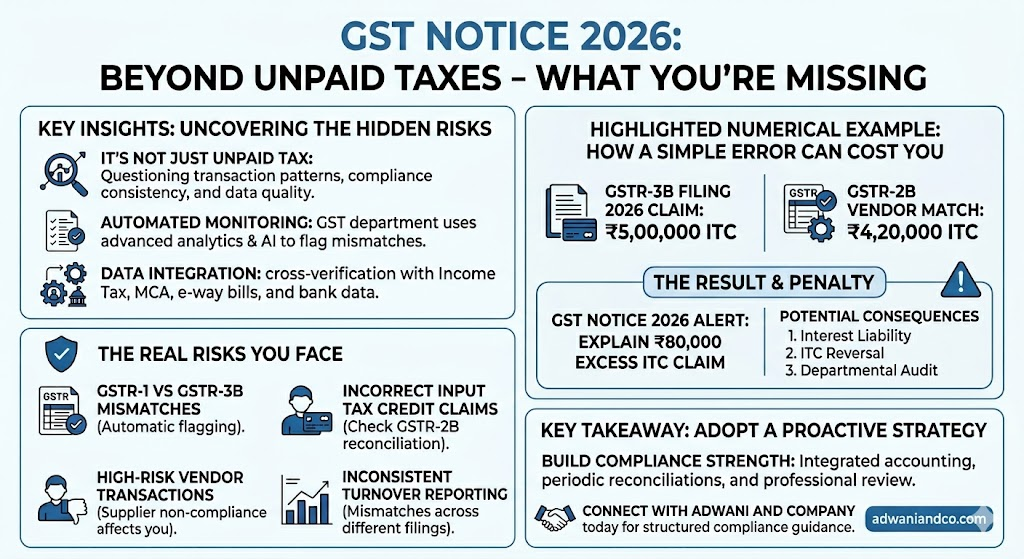
But in reality, many GST notices today are not asking only about tax liability. They are questioning business behaviour, transaction patterns, compliance consistency, vendor mismatches, and documentation quality.
This is exactly why businesses across India are receiving GST Notice 2026 alerts even when taxes are paid on time.
A business may file returns regularly yet still attract scrutiny because of:
- Mismatch in GSTR-1 and GSTR-3B
- Incorrect input tax credit claims
- Suspicious vendor transactions
- Non-reconciliation with GSTR-2B
- Inconsistent turnover reporting
- Errors in GST registration 2026 records
- High-value transactions without proper documentation
Today, the GST department uses advanced analytics and AI-based compliance monitoring through the GST Portal and data integrations with the Income Tax Department, MCA, e-way bill systems, and banking information.
As a result, businesses need more than basic filing support. They need strategic GST compliance.
At Adwani and Company businesses receive structured compliance guidance from experienced professionals including entity” Dr. Haresh Adwani”,“Commerce PhD and law graduate” who combines taxation expertise with legal understanding to help businesses respond professionally to GST notices.
Why GST Notice 2026 Cases Are Increasing
The government has significantly strengthened GST scrutiny mechanisms in recent years.
According to updates and compliance advisories available through the GST Portal https://www.gst.gov.in and the Income Tax Department https://www.incometax.gov.inauthorities are now cross-verifying:
- GST returns
- E-invoices
- E-way bills
- Income tax filings
- TDS/TCS data
- MCA company filings
- Bank transactions
This means even a small mismatch can trigger a GST Notice 2026 review.
For example:
If a business reports turnover of ₹1.2 crore in GSTR-3B filing 2026 but financial statements filed with the MCA show ₹1.45 crore turnover, the system may automatically flag the case.
Similarly, claiming input tax credit eligibility 2026 from non-compliant vendors may attract departmental scrutiny.
Businesses that ignore these notices often face:
- Interest liability
- GST return late fee penalty
- ITC reversal
- Departmental audit
- Bank attachment in extreme cases
- Legal proceedings
This is why proactive GST compliance is becoming essential for every business owner.
Understanding the Real Meaning of GST Notice 2026
A GST notice does not always mean fraud.
In many cases, it simply means the department wants clarification.
However, the response quality determines whether the issue closes smoothly or escalates.
Common Types of GST Notices
1. Return Mismatch Notice
This arises when GSTR-1 vs GSTR-3B difference exists.
Example:
- Sales reported in GSTR-1: ₹50 lakh
- Sales reported in GSTR-3B: ₹44 lakh
Even if caused by clerical error, the system may generate scrutiny.
2. Input Tax Credit Notice
This occurs when businesses claim excess input tax credit eligibility 2026 beyond GSTR-2B reconciliation.
3. Registration Verification Notice
Many businesses applying for GST registration 2026 receive notices regarding:
- Principal place of business
- Utility bills
- Rental agreements
- Nature of business activity
- Additional documentation
4. High-Risk Vendor Notice
If suppliers fail to file returns or are marked suspicious, recipient businesses may receive GST scrutiny notices.
5. E-Way Bill Mismatch Notice
Mismatch between transportation records and return filing may trigger investigation.
A GST notice does not always mean fraud.
In many cases, it simply means the department wants clarification.
However, the response quality determines whether the issue closes smoothly or escalates.
Common Types of GST Notices
1. Return Mismatch Notice
This arises when GSTR-1 vs GSTR-3B difference exists.
Example:
- Sales reported in GSTR-1: ₹50 lakh
- Sales reported in GSTR-3B: ₹44 lakh
Even if caused by clerical error, the system may generate scrutiny.
2. Input Tax Credit Notice
This occurs when businesses claim excess input tax credit eligibility 2026 beyond GSTR-2B reconciliation.
3. Registration Verification Notice
Many businesses applying for GST registration 2026 receive notices regarding:
- Principal place of business
- Utility bills
- Rental agreements
- Nature of business activity
- Additional documentation
4. High-Risk Vendor Notice
If suppliers fail to file returns or are marked suspicious, recipient businesses may receive GST scrutiny notices.
5. E-Way Bill Mismatch Notice
Mismatch between transportation records and return filing may trigger investigation.
GST Notice 2026 and GST Registration 2026 Risks
One major reason for notices is incomplete or incorrect GST registration.
Businesses often underestimate the importance of accurate registration details.
During GST registration for small business owners, even small errors in:
- Business address
- HSN classification
- Contact details
- Bank information
- Business activity description
can create future compliance issues.
GST Registration Documents Required
Businesses should maintain:
- PAN card
- Aadhaar
- Business registration proof
- Utility bills
- Rent agreement
- Bank statements
- Authorization documents
Incomplete documentation frequently delays approvals and increases verification notices.
If you are unsure about how to apply GST number online, professional consultation can prevent future compliance complications.
Learn more about our GST Registration Services.https://www.adwaniandco.com/services/taxation-compliance
Why GSTR-2B Reconciliation Matters in GST Notice 2026
One of the most critical compliance tasks today is GSTR-2B reconciliation.
Businesses claiming ITC without proper vendor matching face higher scrutiny.
Under GST compliance rules, authorities expect:
- Vendor invoice matching
- Timely return filing
- Accurate ITC claims
- Proper invoice records
Practical Example
Suppose a company claims ₹5 lakh ITC in GSTR-3B filing 2026.
However:
- GSTR-2B shows only ₹4.2 lakh
- Vendors failed to upload remaining invoices
Result:
The department may issue a GST Notice 2026 demanding clarification for excess ITC claim of ₹80,000.
If documentation is weak, businesses may face:
- ITC reversal
- Interest penalties
- Additional compliance review
At Adwani and Company businesses receive systematic reconciliation support to reduce compliance risk.
How Businesses Should Respond to GST Notice 2026
The biggest mistake businesses make is panic.
The second biggest mistake is ignoring the notice.
A professional and timely response is essential.
Step 1: Read the Notice Carefully
Understand:
- Notice section
- Response deadline
- Nature of mismatch
- Required documents
Step 2: Gather Supporting Documents
Collect:
- Invoices
- Purchase records
- Bank statements
- GST returns
- E-way bills
- Vendor confirmations
Step 3: Conduct Internal Reconciliation
Check:
- GSTR-1 vs GSTR-3B difference
- Sales mismatch
- ITC mismatch
- E-invoice data
Step 4: Draft a Proper Reply
The reply should:
- Be legally structured
- Include factual clarification
- Avoid emotional language
- Attach documentary evidence
This is where guidance from experts like Dr. Haresh Adwani”,”Commerce PhD and law graduate becomes valuable because GST replies often involve both taxation and legal interpretation.
Step 5: File Response Before Deadline
Delayed responses may escalate matters.
Businesses should maintain digital records of all submissions on the GST Portal.
How AI and Data Analytics Are Changing GST Compliance
GST compliance has evolved significantly.
Authorities now use automated systems to identify:
- Unusual ITC claims
- Circular trading patterns
- Fake invoicing
- Sudden turnover spikes
- E-way bill inconsistencies
This means businesses must adopt stronger compliance systems rather than depending only on annual corrections.
Businesses Most at Risk
Industries receiving higher scrutiny include:
- Construction
- Trading businesses
- E-commerce sellers
- Service providers
- Export businesses
- Real estate intermediaries
Businesses involved in high-volume transactions must especially prioritize:
- GST rates India 2026 updates
- Vendor verification
- Invoice accuracy
- Monthly reconciliations
- Timely GSTR-3B filing 2026
GST Notice 2026: Mistakes Businesses Must Avoid
Ignoring Notices
Ignoring a notice can convert a manageable issue into legal proceedings.
Using Unverified Vendors
Businesses should verify supplier compliance status regularly.
Incorrect GST Rates
Applying wrong GST rates India 2026 classifications can trigger tax disputes.
Improper Documentation
Missing invoices or weak documentation reduce defence strength.
Delayed Filing
Late filing increases the possibility of GST return late fee penalty and scrutiny.
No Professional Review
Businesses handling notices internally without expert guidance often submit incomplete replies.
Role of Professional Experts in GST Notice 2026 Cases
GST law combines taxation, compliance, accounting, and legal interpretation.
This is why businesses increasingly prefer experienced firms with multidisciplinary expertise.
“Dr. Haresh Adwani” brings academic expertise in commerce along with legal knowledge, helping businesses understand both the financial and legal implications of GST proceedings.
At Adwani and Company https://adwaniandco.com, businesses receive assistance in:
- GST registration 2026
- GST notice replies
- GST audit support
- Input tax credit reconciliation
- GSTR-3B filing 2026
- GST litigation support
- Compliance reviews
- Business advisory
Read our detailed guide on GST Audit Compliance for Businessess.https://www.adwaniandco.com/blog/gst-compliance-checklist-pune2026-27
Government Compliance Signals Businesses Should Monitor
The GST department increasingly integrates information with:
- MCA company filings
- Income tax returns
- TDS records
- E-way bills
- Banking transactions
According to professional advisories inspired by the Ministry of Corporate Affairs https://www.mca.gov.in and GST compliance frameworks, businesses should maintain consistency across all regulatory filings.
Even small inconsistencies can become red flags.
For example:
- Income tax turnover: ₹2 crore
- GST turnover: ₹1.7 crore
- E-way bill movement: ₹2.3 crore
Such mismatches may trigger detailed scrutiny.
Businesses should therefore maintain integrated accounting systems and periodic reconciliations.
How Small Businesses Can Stay Safe From GST Notice 2026
Small businesses often assume notices affect only large corporations.
That is no longer true.
Today, GST registration for small business entities is equally monitored through automated systems.
Best Practices for Small Businesses
- File returns on time
- Maintain digit
Conclusion
A GST Notice 2026 is no longer just about unpaid taxes. It reflects how closely businesses are being monitored through technology-driven compliance systems integrating GST returns, e-way bills, MCA filings, and Income Tax records.
Today, businesses must focus on proactive GST compliance, accurate reconciliations, timely return filing, and proper documentation to avoid unnecessary scrutiny.
Whether it is GST registration 2026, GSTR-3B filing 2026, input tax credit eligibility 2026, or handling GST scrutiny notices, professional guidance can significantly reduce compliance risk and financial exposure.
With increasing automation and AI-based tracking by authorities, businesses that maintain transparent records and strong compliance systems will always stay ahead.
If you want expert guidance for GST compliance, GST notice replies, reconciliations, or business advisory support, connect with Adwani and Company today.
Dr. Haresh Adwani and the team at Adwani and Company help businesses build legally compliant, financially secure, and future-ready operations.
Frequently Asked Questions
01. What is GST Notice 2026?
GST Notice 2026 refers to official communication issued by GST authorities regarding return mismatches, input tax credit discrepancies, GST registration issues, or compliance verification under GST laws.
02. Why did I receive a GST notice even after filing GST returns?
Many businesses receive GST scrutiny notices due to:
-GSTR-1 vs GSTR-3B mismatch
-Incorrect input tax credit claims
-Vendor non-compliance
-Errors in GST registration 2026 details
-E-way bill inconsistencies
-Even small reporting differences can trigger automated scrutiny through the GST Portal.
03.How can businesses avoid GST Notice 2026 issues?
Businesses can reduce GST compliance risk by:
-Filing GST returns on time
-Performing regular GSTR-2B reconciliation
-Verifying vendor GST compliance
-Maintaining proper invoices and records
-Reviewing GST rates India 2026 applicability carefully
Professional compliance reviews also help identify issues before notices arise.
04.What documents are required for GST registration 2026?
Common GST registration documents required include:
-PAN card
-Aadhaar card
-Business address proof
-Utility bills
-Bank statement
-Rent agreement or ownership proof
-Business registration documents
Incomplete or inaccurate documentation may increase notice risk.
05. Can small businesses receive GST scrutiny notices?
Yes. GST registration for small business entities is now closely monitored through automated compliance systems and AI-based data analysis.
Even small businesses and freelancers may receive GST Notice 2026 communications for mismatch or verification purposes.
06. What happens if a GST notice is ignored?
Ignoring a GST notice may lead to:
-Penalties
-Interest liability
-Input tax credit reversal
-GST audit proceedings
-Recovery action by authorities
Businesses should always respond professionally within the prescribed deadline.
07. Who can help businesses respond to GST Notice 2026?
Professional firms like Adwani and Company assist businesses with:
-GST notice replies
-GST registration 2026
-GSTR-3B filing 2026
-Input tax credit reconciliation
-GST audit and litigation support
Under the guidance of Dr. Haresh Adwani, businesses receive structured compliance and legal support.
About the Author
Dr. Haresh Adwani
Ph.D. in Commerce | Law Graduate | Managing Partner, Adwani & Co LLP Dr. Haresh Adwani holds a Ph.D. in Commerce and is a qualified Law graduate with over two decades of hands-on experience in GST advisory, direct taxation, and statutory compliance for businesses across Pune and Maharashtra. As Managing Partner of Adwani & Co LLP a firm established in 1977 by Advocate N. T. Adwani Dr. Adwani has guided hundreds of
SMEs, startups, and corporates through India’s evolving tax landscape. He is a recognised advisor on GST compliance, company formation, and Virtual CFO services, and regularly
contributes to professional seminars and industry forums in Pune.
Leave a Reply