Most professionals believe that knowing the law is enough to survive income tax assessment proceedings. Years of hands-on experience prove otherwise, and that lesson usually arrives the hard way in a scrutiny room, across a table from an assessing officer, with a client waiting anxiously for answers.
Early in a career built around direct tax advisory, the sections of the Income-tax Act, 1961 feel like the whole game. Section 132, Section 153A, Section 143(3) the provisions are memorised, the timelines are known, the exemptions are on the tip of the tongue. Then real income tax assessment proceedings begin, and a different kind of learning starts.
What Income Tax Assessment Proceedings Actually Involve
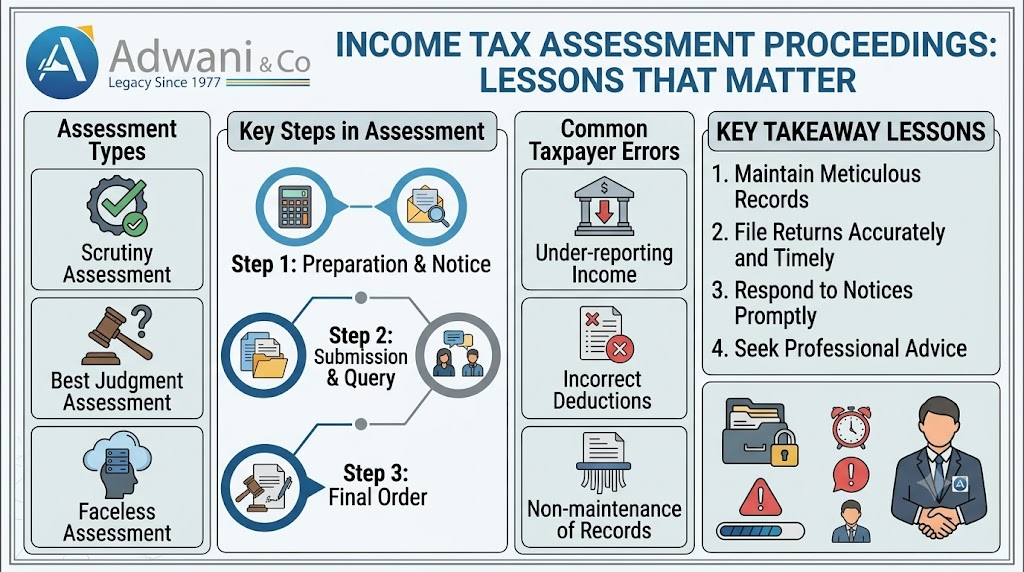
Income tax assessment proceedings are not a courtroom debate over legal interpretation alone. They are an examination of facts bank statements, invoices, vendor confirmations, cash flow patterns, and the story those documents tell together. An assessing officer is not only asking “what does the law say,” but also “what do these facts actually show.”
This is where many taxpayers, and even some advisors, get caught off guard. A return that is technically correct can still attract scrutiny if the supporting facts are poorly documented or inconsistently presented. Income tax assessment proceedings reward preparation, not just knowledge of statute.
Why Search and Seizure Changes Everything
If ordinary assessment proceedings test your documentation, an income tax search and seizure action tests your composure. Under Section 132 of the Income-tax Act, authorised officers can enter business or residential premises, examine books of account, and seize cash, jewellery, digital records, and other assets connected to undisclosed income.
What Happens During a Search
A search typically involves:
Entry and examination of premises by authorised officers
Statements recorded under oath under Section 132(4), which are admissible as evidence
Seizure of unexplained assets, documents, and digital data
Preparation of a panchnama listing everything examined and seized
Following a search, the department can initiate block assessment proceedings under Section 153A, covering up to six assessment years prior to the search year, in addition to the current year. This is a serious escalation from a routine notice, and it changes the entire posture of income tax assessment proceedings that follow.
The Real Cost of a Poorly Handled Response
Search and seizure matters rarely resolve quickly. Statements recorded during a search carry weight in later assessment proceedings, and an admission made under pressure is difficult to walk back later. This is precisely why calm, evidence-based responses matter more than fast ones. Patience during income tax assessment proceedings is not passivity it is discipline.
A Practical Example
Consider a business reporting turnover of ₹1.4 crore in its GST returns, while its financial statements filed with the Ministry of Corporate Affairs (MCA) show turnover of ₹1.65 crore.
Example: A ₹25 lakh mismatch between GST turnover and MCA financial statements is exactly the kind of gap that automated data-matching systems flag for review.
That gap, however innocent the explanation, is exactly the kind of mismatch that data-matching systems flag. Once flagged, the case can move from a routine query to full-fledged income tax assessment proceedings, with the burden falling on the taxpayer to reconcile the difference convincingly. A well-documented explanation, prepared in advance, can resolve this in a single hearing. A defensive, unprepared response can stretch it across months. Cases like this are exactly why Dr. Haresh Adwani, PhD in Commerce and a practising law graduate, insists on reconciling the numbers before drafting any reply.
Beyond Knowing the Law: What Assessment Proceedings Demand
Real income tax assessment proceedings teach three things that no textbook fully captures:
Facts must be examined as carefully as the law. A correct legal position built on shaky facts rarely survives scrutiny.
The other side has a perspective too. Understanding how an assessing officer reads a case changes how a response is drafted.
Not every matter resolves on your timeline. Search and seizure cases, in particular, demand patience alongside preparation.
At Adwani & Company, this philosophy shapes how income tax assessment proceedings and search cases are handled — not as a purely legal exercise, but as a careful balance of facts, documentation, and legal interpretation.
The Advisor’s Role: A Bridge, Not Just a Consultant
Over years of handling assessment proceedings, search cases, and appeals, the role of a tax advisor shifts. It stops being purely about giving advice and starts being about building a bridge between the client and the tax administration, between the facts on record and the law that applies to them, between a difficult notice and the right way forward.
Dr. Haresh Adwani, a PhD holder in Commerce and a law graduate, brings exactly this combination to income tax assessment proceedings at Adwani & Company. His dual grounding in commerce and law allows him to read a case the way an assessing officer might, while still building the strongest possible position for the client. This blend of tax expertise and legal training is central to how the firm approaches search and seizure matters and other high-stakes income tax assessment proceedings.
Clients facing income tax assessment proceedings often arrive anxious, assuming the worst. Dr. Haresh Adwani’s approach, refined over years of litigation and scrutiny work, is to slow the process down first establish the facts, understand the notice, and only then decide the strategy. This is a markedly different approach from firms that rush to respond without full documentation in hand.
How to Prepare for Income Tax Assessment Proceedings
A few habits consistently separate smooth outcomes from prolonged disputes:
Reconcile regularly match GST returns: income tax filings, and MCA financial statements periodically, not just at year-end
Document as you go : keep vendor confirmations, bank narrations, and supporting evidence organised in real time
Respond, don’t react: a notice deserves a considered reply, not an immediate, unprepared one
Know your rights during a search : review the panchnama carefully before signing, and note objections where warranted
Get experienced representation early : the framing of your first response to income tax assessment proceedings often shapes the outcome of everything that follows
Government Authority and Compliance Signals
Guidance available through the Income Tax Department and the Ministry of Corporate Affairs (MCA) continues to emphasise cross-verification between GST filings, income tax returns, and company filings. Businesses that treat these as separate silos are the ones most likely to face unexpected income tax assessment proceedings.
Learn more about our Income Tax Litigation Support to understand how integrated compliance reduces this risk. Read our detailed guide on GST Notice 2026 Compliance for a related look at how automated cross-matching triggers scrutiny.
1. What triggers income tax assessment proceedings?
Mismatches between GST returns, income tax filings, MCA records, high-value transactions, or information received from a search can all trigger income tax assessment proceedings.
2. How long do income tax assessment proceedings usually take?
Timelines vary by case complexity. Straightforward scrutiny may close within a few hearings, while search-related block assessments under Section 153A can extend over months given the six-year assessment window involved.
3. What should I do if I receive an income tax notice?
Read it carefully, gather the relevant documentation, and respond with facts rather than assumptions. Avoid reacting before understanding exactly what the notice is asking.
4. Can statements made during a search be used later?
Yes. Statements recorded under Section 132(4) during a search are admissible as evidence in subsequent assessment and penalty proceedings, which is why careful, honest responses matter at every stage.
5. Do small businesses face income tax assessment proceedings too?
Yes. Automated data matching across GST, income tax, and MCA systems means businesses of every size can face income tax assessment proceedings, not just large corporations.
Conclusion
Income tax assessment proceedings are rarely just about the law. They are about facts, patience, and the ability to see a case from more than one side. If you are facing a notice, a scrutiny case, or a search and seizure matter, connect with Adwani and Company today for experienced, fact-based representation.
About the Author Dr. Haresh Adwani Ph.D. in Commerce | Law Graduate | Managing Partner, Adwani & Co LLP Dr. Haresh Adwani holds a Ph.D. in Commerce and is a qualified Law graduate with over two decades of hands-on experience in GST advisory, direct taxation, and statutory compliance for businesses across Pune and Maharashtra. As Managing Partner of Adwani & Co LLP a firm established in 1977 by Advocate N. T. Adwani Dr. Adwani has guided hundreds of SMEs, startups, and corporates through India’s evolving tax landscape. He is a recognised advisor on GST compliance, company formation, and Virtual CFO services, and regularly contributes to professional seminars and industry forums in Pune.
Disclaimer: This article is intended for informational purposes only and does not constitute legal, tax, or professional advice. Every case involving income tax assessment proceedings depends on its own facts, and readers should consult a qualified tax professional before acting on any information contained here.
Every tax season, the same ritual plays out: books closed, ledgers reconciled, GST and TDS returns matched, and the balance sheet finalised usually for one audience, the tax department, the bank, or the auditor. Yet the most important reader of that balance sheet is rarely the business owner, which is a costly oversight. Done properly, balance sheet analysis is one of the few tools that shows not just how a business performed, but what it has actually become.
Many businesses fail after becoming profitable. The cause is rarely a sales problem it’s usually sitting quietly in the balance sheet, unread.
Why Balance Sheet Analysis Matters More Than Tax Compliance
Most business owners treat the balance sheet as a compliance document something prepared once a year for the Income Tax Department, a banker, or an auditor. Balance sheet analysis, when used correctly, is something else entirely: a leadership dashboard.
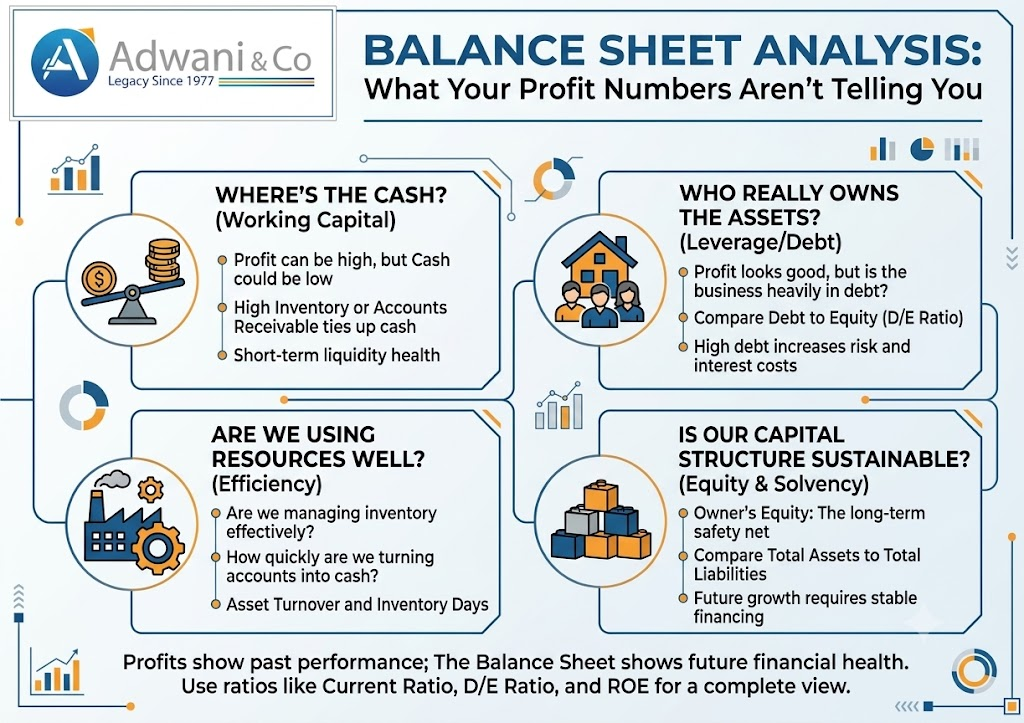
A profit and loss account tells you how the business performed over a period. Balance sheet analysis tells you what the business has become as a result. A company can report a healthy profit and still be in financial distress revenue growing while customers pay late, profits looking strong while cash flow stays weak, sales rising while inventory quietly eats up working capital. None of that shows up clearly in a P&L. It shows up in the balance sheet.
The Questions Balance Sheet Analysis Should Force You to Ask
A good leader shouldn’t stop at “how much profit did we make?” Balance sheet analysis pushes further:
Where is the cash actually sitting in the bank, or stuck with customers?
How efficiently is working capital being used?
Are borrowings funding growth, or funding inefficiency?
Is the business financially stronger than it was twelve months ago?
Are GST, TDS, and other statutory positions clean, or building exposure?
These aren’t accounting questions they’re leadership questions, and balance sheet analysis is how you answer them with evidence instead of instinct.
Profit vs Cash Flow: What Balance Sheet Analysis Reveals
One of the clearest reasons to prioritise balance sheet analysis is the gap between profit and cash. Profit is an accounting figure; cash is what actually pays salaries, vendors, and statutory dues. A business can show a 15% profit margin on paper while its bank balance tells a very different story.
This gap usually shows up in trade receivables. When receivable days stretch out customers taking 60 or 90 days to pay instead of the agreed 30 profit sits on paper as debtors rather than as usable cash. Balance sheet analysis that tracks receivable days over multiple periods catches this drift before it becomes a cash crunch.
Working Capital and Balance Sheet Analysis: The Hidden Drain
Working capital is where balance sheet analysis often uncovers the most uncomfortable truths. Rising sales are usually treated as unambiguously good news. But if inventory grows faster than sales, or collection cycles lengthen while supplier payment terms shorten, the business quietly finances its own growth out of a shrinking cash cushion.
A simple working capital cycle calculation inventory days plus receivable days minus payable days is one of the most useful numbers a business owner can track. A lengthening cycle, spotted early through routine balance sheet analysis, is far easier to correct than one discovered during a liquidity crisis.
Borrowings and Debt: A Core Part of Balance Sheet Analysis
Borrowings are not inherently a problem used well, they fund expansion, equipment, and working capital gaps during growth phases. The question balance sheet analysis is built to answer is simpler: are borrowings rising in proportion to genuine business growth, or are they rising faster, quietly funding inefficiency instead?
Tracking the debt to equity ratio and interest coverage over consecutive years, rather than looking at a single year in isolation, is where balance sheet analysis earns its value. A debt-to-equity ratio that climbs steadily while turnover stays flat is an early warning sign worth acting on, not waiting out.
GST, TDS, and Statutory Mismatches: A Blind Spot in Balance Sheet Analysis
Statutory balances GST payable, TDS payable, provisions for tax often sit at the bottom of the balance sheet and get the least attention, despite carrying real legal and financial exposure. Reconciliation gaps between books and returns filed on the GST Portal, or mismatches flagged during scrutiny by the Income Tax Department, frequently trace back to balances that were never reviewed until the year end rush.
Businesses that also file with the Ministry of Corporate Affairs (MCA) carry an added cross-verification risk: turnover figures reported to MCA, GST, and Income Tax authorities are increasingly cross-checked, and inconsistencies can trigger scrutiny even without any fraud involved. Dr. Haresh Adwani a PhD holder in Commerce and a law graduate routinely advises clients to treat this reconciliation as part of ongoing balance sheet analysis, not a once-a-year scramble.
Read our detailed guide on GST and TDS Reconciliation for Businesses for a closer look at how these mismatches build up. For official filing references, see the GST Portal and the Income Tax Department.
A Practical Balance Sheet Analysis Framework for Business Leaders
Balance sheet analysis doesn’t need to be complicated to be useful. A workable quarterly routine covers:
Receivable days : is collection speeding up or slowing down?
Inventory days : is stock moving, or accumulating?
Payable days : are supplier terms being honoured or stretched?
Debt-to-equity ratio : is leverage rising faster than the business itself?
Net worth trend : is the business genuinely stronger than a year ago?
Statutory balances : are GST, TDS, and provisions reconciled and current?
Reviewed quarterly rather than only at year-end, this kind of balance sheet analysis turns a compliance document into an early-warning system.
Real Example: Balance Sheet Analysis in Practice
Practical Example A trading business with an annual turnover of ₹4 crore reported a net profit of ₹32 lakh (8% margin) healthy on the surface. Balance sheet analysis told a different story: trade receivables rose from ₹58 lakh to ₹95 lakh though turnover grew only 12%, inventory rose from ₹40 lakh to ₹68 lakh, and short-term borrowings jumped from ₹30 lakh to ₹72 lakh to plug the resulting cash shortfall. Nearly all of the reported profit and more was tied up in unsold stock and slow-paying customers, funded by expensive short-term debt.
On paper, the business was profitable. In practice, balance sheet analysis showed the business was quietly getting weaker, not stronger and without this review, it would likely have kept expanding into a worsening cash position.
How Adwani & Company Supports Balance Sheet Analysis for Businesses
At Adwani & Company, balance sheet analysis is treated as a core advisory service, not a year-end formality. The approach combines ratio analysis, working capital review, and statutory reconciliation across GST, TDS, and MCA filings, giving business owners an evidence-based picture of financial health rather than just a compliance-ready document.
Dr. Haresh Adwani, who holds a PhD in Commerce and is also a qualified law graduate, brings a combined financial and legal lens to balance sheet analysis valuable when statutory mismatches carry both tax and legal consequences. Under his guidance, Adwani & Company helps clients move from reactive, once-a-year reviews to structured quarterly balance sheet analysis.
1.What is balance sheet analysis and why does it matter for small businesses?
Balance sheet analysis reviews a company’s assets, liabilities, and net worth to assess financial health beyond the profit figure. For small businesses, it matters because profit alone can hide cash stress or working capital strain that a P&L doesn’t reveal.
2.How often should a business conduct balance sheet analysis?
Ideally, quarterly rather than annually. Reviewing receivables, inventory, payables, and borrowings every quarter catches problems early, while annual-only reviews often catch them too late.
3.Can a profitable business still fail due to poor balance sheet health?
Yes. Profit is often tied up in receivables and inventory rather than available as cash precisely the gap balance sheet analysis is designed to expose.
4.What ratios matter most in balance sheet analysis?
Receivable days, inventory days, payable days, the debt-to-equity ratio, and net worth trend over time are among the most useful indicators.
5.How does GST and TDS reconciliation connect to balance sheet analysis?
Statutory balances for GST and TDS sit within the balance sheet, and unreconciled figures can trigger scrutiny from the GST Portal or the Income Tax Department. Including statutory reconciliation in balance sheet analysis reduces this risk.
6.Can Adwani & Company help with balance sheet analysis for my business?
Yes. Adwani & Company offers structured balance sheet analysis covering working capital, borrowings, and statutory reconciliation, guided by Dr. Haresh Adwani’s combined financial and legal expertise.
Conclusion: Make Balance Sheet Analysis Part of How You Lead
Profit tells you how the business performed. Balance sheet analysis tells you what the business has become and whether it’s genuinely getting stronger. Treating the balance sheet as a leadership dashboard, reviewed regularly rather than once a year for the auditor or the bank, is one of the simplest shifts a business owner can make to catch financial stress before it becomes a crisis.
About the Author:
Mukesh Chavan is a dedicated indirect taxation and compliance professional associated with Adwani & Co LLP, specializing in GST advisory, GST audits, GST assessments, and RERA compliance services. With extensive experience in handling complex regulatory matters, he assists businesses in ensuring compliance with evolving GST laws and real estate regulations while minimizing risks and enhancing operational efficiency.
Mukesh has successfully guided clients through GST registrations, return compliance, departmental assessments, audits, litigation support, and tax planning strategies. He also possesses significant expertise in RERA compliance, helping real estate developers, promoters, and stakeholders navigate regulatory requirements and maintain seamless project compliance.
Through his articles and professional insights, Mukesh aims to simplify complex GST and RERA provisions, offering practical guidance that empowers businesses to remain compliant, avoid disputes, and make informed decisions in an increasingly dynamic regulatory environment. His approach combines technical expertise with practical business understanding, enabling clients to focus on growth while meeting their statutory obligations with confidence.
Disclaimer
This article is for informational purposes only and does not constitute financial, legal, or professional advice. Every business’s financial position is unique, and readers should consult a qualified chartered accountant or financial advisor before making decisions based on this content.
Introduction: A Question That Deserved a Longer Answer
On 1st April 2026, a colleague asked a question that stuck with me: “My CA mentioned something about a new Income Tax Act. Does that actually change anything for me?” The honest answer was bigger than he expected. That day, India quietly retired a 60year old law. The Income Tax Act, 1961 the statute that governed every tax return, every notice, and every assessment for six decades was replaced by the Income Tax Act 2025. Most taxpayers, like my colleague, barely noticed.
But here is what deserves attention: the Income Tax Act 2025 is not simply a rename. It is built for a compliance system that already knows more about your finances than most taxpayers realise. At Adwani and Company, we work with individuals and businesses every day who are only now discovering how deep this visibility goes – and how the Income Tax Act 2025 formalises it further.
What Is the Income Tax Act 2025?
The Income Tax Act 2025 received Presidential assent on 21st August 2025 and came into force on 1st April 2026, repealing the Income Tax Act, 1961 in its entirety. According to the Income Tax Department’s official FAQs, the 1961 Act stood repealed from that date, though transitional provisions ensure pending assessments and appeals from earlier years continue smoothly under the old framework.
The Income Tax Act 2025 condenses 819 sections and 14 schedules from the old law into 536 sections and 16 schedules. It does not introduce a new tax burden – its stated purpose is to make the law more predictable, more readable, and easier to comply with, reducing dependence on expert interpretation for routine matters.
Income Tax Act 2025 vs Income Tax Act 1961: What Actually Changed
From “Previous Year” and “Assessment Year” to a Single “Tax Year”
One of the most visible shifts under the Income Tax Act 2025 is the replacement of the old dual-year system. Under the 1961 Act, income earned in a “Previous Year” was taxed in the following “Assessment Year” a structure that confused generations of taxpayers. The Income Tax Act 2025 collapses both into one concept: the Tax Year, a 12-month period running from 1st April to 31st March, applicable from Tax Year 2026-27 onward.
Fewer Sections, More Structure
TDS provisions that were once scattered from Section 192 to Section 194T under the old law are now consolidated primarily under Sections 392 and 393 of the Income Tax Act 2025. Deductions under familiar provisions such as Section 80C and 80D are retained in substance, simply renumbered and reorganised into clearer, tabular chapters.
Why the Income Tax Act 2025 Is Really About Visibility
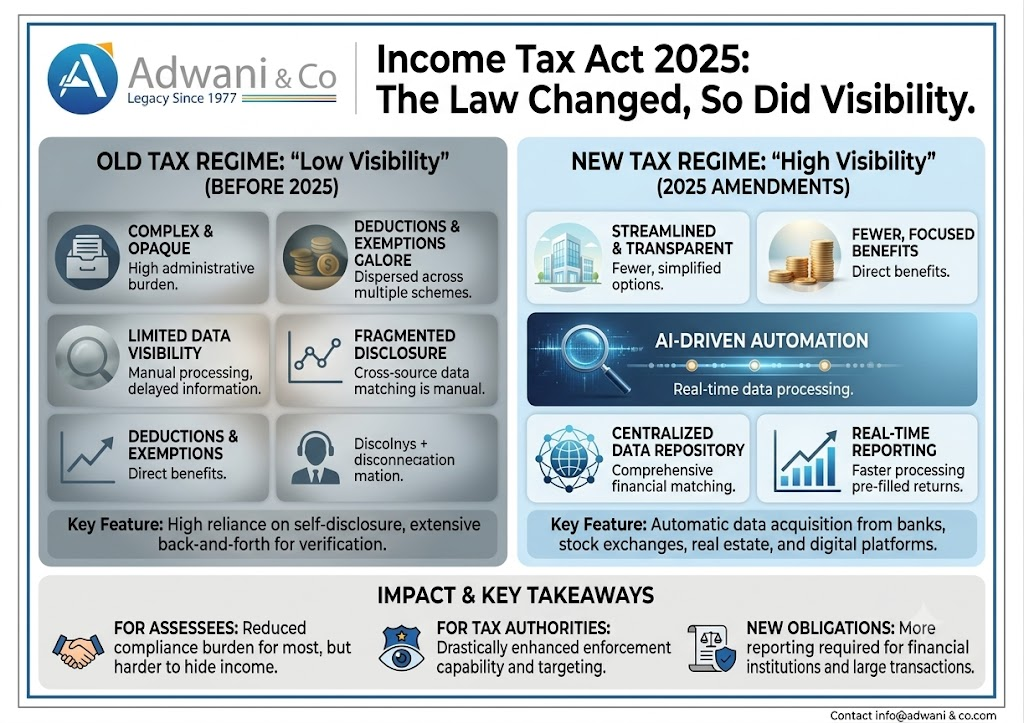
My colleague’s question was not really about the law – it was about visibility. Whether the system sees him before he even speaks. It does, and the Income Tax Act 2025 is designed to make that visibility sharper, not weaker. Here is how it actually works in practice:
Banks report specified high value transactions large cash deposits, big fixed deposits, and high value credit card spends – to the tax department.
Mutual funds, registrars, and sub-registrars report your investments and property transactions, often before you file your return.
TDS and TCS data from employers, banks, and buyers is matched automatically against your PAN.
All of this consolidates into your Annual Information Statement (AIS) a financial mirror of you that the department reviews before you do.
Under the Income Tax Act 2025, this matching architecture, including the faceless assessment framework, now has direct statutory backing rather than resting on executive schemes.
At Adwani and Company, Dr. Haresh Adwani a PhD holder in Commerce and a law graduate – frequently explains to clients that the Income Tax Act 2025 does not create this data-matching system; it simply gives the existing digital compliance framework a firmer legal foundation.
Understanding Your AIS Under the Income Tax Act 2025
Your Income Tax Return is not the only document telling the government about your finances. It is the summary. The real story is already being written, transaction by transaction, well before you sit down to file and under the Income Tax Act 2025, that story is checked with more automation than ever.
Suppose your salary employer reports TDS on income of ₹18 lakh for the year, your bank reports a fixed deposit interest credit of ₹1.5 lakh, and a mutual fund house reports redemption proceeds of ₹6 lakh.
If your filed ITR shows total income of only ₹15 lakh, the mismatch between your AIS data and your return is flagged automatically. In the vast majority of such cases, the gap is not deliberate under-reporting – it is simply unawareness of what has already been reported against your PAN.
This is precisely why, under the Income Tax Act 2025 compliance environment, checking your AIS before filing is no longer optional diligence it is a basic filing step.
What Individuals and Businesses Must Do Under the Income Tax Act 2025
Download and review your AIS and Form 26AS before filing your return.
Reconcile AIS entries against your bank statements, investment records, and books of account.
Flag and correct any inaccurate third-party reporting through the feedback mechanism on the AIS portal.
Maintain consistent figures across your ITR, GST returns (where applicable), and MCA filings, since the Income Tax Act 2025 framework increasingly cross-references these sources.
Retain supporting documentation for high-value transactions, since these are the entries most likely to be scrutinised under the Income Tax Act 2025.
Common Mistakes That Invite Scrutiny Under the Income Tax Act 2025
Filing returns without checking AIS or Form 26AS first.
Ignoring small mismatches, assuming they are too minor to matter.
Reporting income figures inconsistent with TDS/TCS already matched to your PAN.
Treating the transition to the Income Tax Act 2025 as a reason to delay routine compliance.
Responding to a mismatch notice without professional review of the underlying AIS entries.
How Adwani and Company Helps You Navigate the Income Tax Act 2025
Interpreting a newly re-codified statute alongside decades of case law built under the old Act requires both technical and legal grounding. Dr. Haresh Adwani, who holds a PhD in Commerce and a law degree, brings exactly that combination to the firm’s advisory work, helping clients read the Income Tax Act 2025 in light of its practical, day-to-day compliance implications rather than just its renumbered sections.
1. What is the Income Tax Act 2025 and when does it apply?
The Income Tax Act 2025 is India’s new direct tax law that replaced the Income Tax Act, 1961 with effect from 1st April 2026. It applies to income earned from Tax Year 2026-27 onward, while income earned up to 31st March 2026 continues to be governed by the 1961 Act.
2. Does the Income Tax Act 2025 increase my tax liability?
No. The Income Tax Act 2025 is primarily a simplification and re-codification exercise. It reorganises sections, introduces the single “Tax Year” concept, and streamlines TDS provisions, but it does not itself impose new taxes or change existing slab rates.
3. What is the Annual Information Statement (AIS) and why does it matter under the Income Tax Act 2025?
The AIS is a consolidated statement showing the financial transactions reported to the Income Tax Department by banks, mutual funds, registrars, and employers. Under the Income Tax Act 2025, this reporting and matching framework continues, and often intensifies, making AIS reconciliation essential before filing your return.
4. What is the “Tax Year” under the Income Tax Act 2025?
Tax Year is a single 12-month period from 1st April to 31st March that replaces the earlier dual concept of “Previous Year” and “Assessment Year” used under the Income Tax Act, 1961.
5. Will pending income tax notices or assessments be affected by the Income Tax Act 2025?
No. Pending proceedings, assessments, and appeals relating to periods before 1st April 2026 continue to be governed by the Income Tax Act, 1961 under the transitional provisions.
6. How can I avoid receiving a notice under the Income Tax Act 2025 framework?
The most common cause of notices is a mismatch between your ITR and your AIS, not deliberate under-reporting. Reviewing your AIS, reconciling it against your books, and filing accurately are the most effective safeguards.
Conclusion: The Law Has Changed, the Visibility Has Not Gone Anywhere
The Income Tax Act 2025 has changed the law’s structure, language, and section numbers. What it has not changed is the underlying reality: the tax department sees your financial footprint before you file, and under the Income Tax Act 2025, that visibility is, if anything, sharper. Mismatches remain the leading cause of notices – not deliberate under-reporting, but unawareness.
Check your AIS. Match it against what you are about to file. And if you want expert guidance from professionals like Dr. Haresh Adwani on how the Income Tax Act 2025 applies to your specific situation, connect with Adwani and Company today.
Nidhi Adwani is the Human Resources Manager at Adwani & Co. She is a Law Graduate and holds an MBA in Human Resources. She manages recruitment, employee engagement, team development, workplace culture, and the firm’s social media and content activities. Passionate about people and organizational growth, she also contributes articles for ITRAdvisor and Adwani & Co. Her writing focuses on HR practices, leadership, workplace engagement, and professional development, offering practical insights for professionals and businesses.
Legal Disclaimer:This article is published for informational and educational purposes only. Nothing contained herein constitutes legal, financial, or tax advice, nor should it be treated as a substitute for professional consultation tailored to your specific circumstances. Tax laws, rates, and provisions are subject to change; readers are strongly advised to consult a qualified Chartered Accountant or tax advisor before acting on any information in this article.
All content is original. References to government portals and statutory provisions are paraphrased for educational purposes in compliance with fair use principles. No content hasbeen reproduced from third-party sources
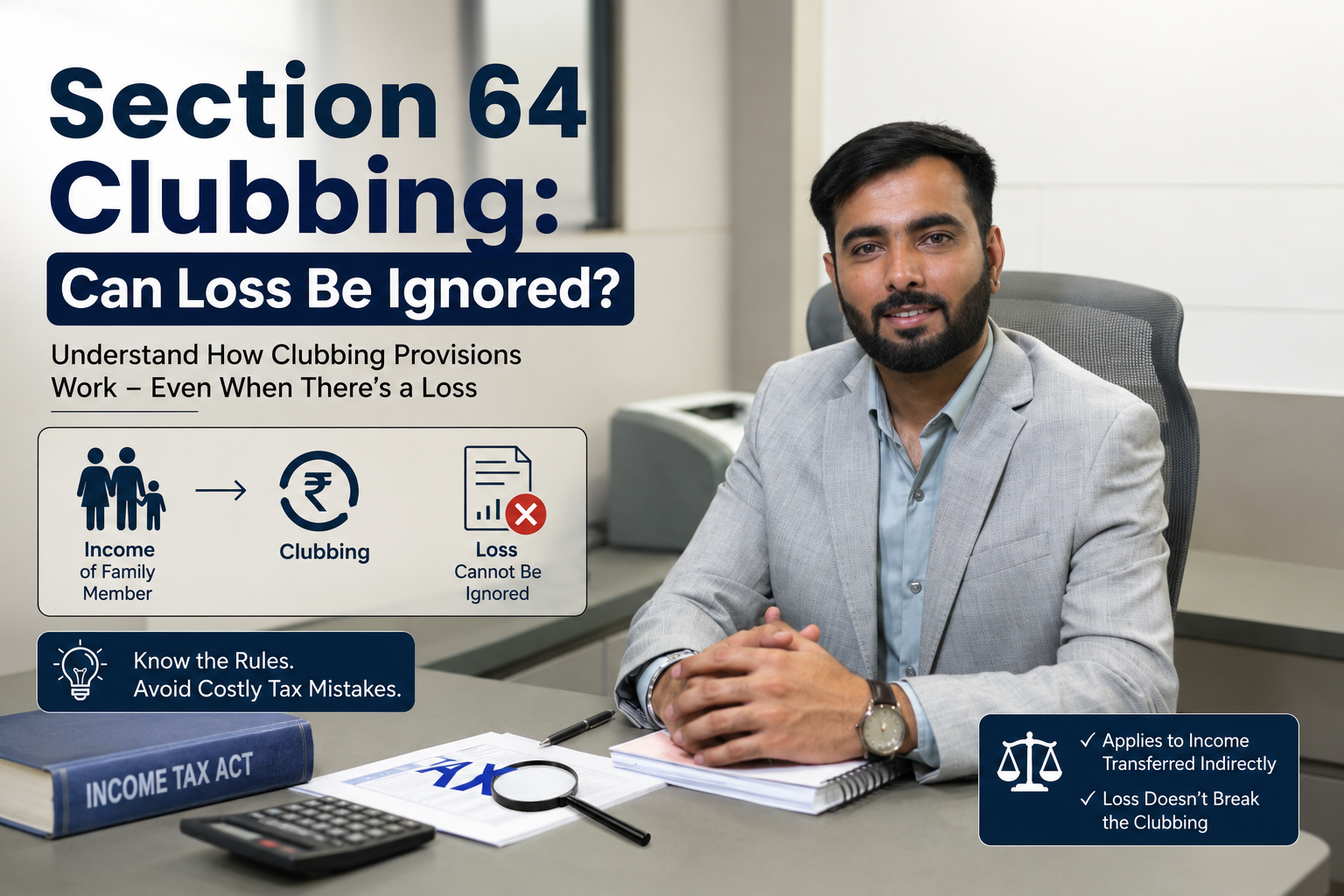
There’s a question most taxpayers never think to ask: If the Income Tax Department can club the profit from your spouse’s investments in your hands, can it simply ignore the loss from that very same investment?
That’s not a hypothetical. That’s exactly the issue that came before the Income Tax Appellate Tribunal and the answer could change how lakhs of taxpayers handle their family finances.
This blog breaks down the landmark ITAT ruling, the logic of Section 64 clubbing provisions, and what it means for you if your spouse invests using funds gifted by you whether in equity trading, F&O (Futures & Options), or any other asset.
What Are Section 64 Clubbing Provisions?
Section 64 of the Income Tax Act, 1961 is the cornerstone of India’s anti-avoidance framework for family transactions. Under Section 64(1)(iv), any income arising from assets transferred to a spouse (without adequate consideration) is clubbed or added to the income of the person who made the transfer.
In plain terms: if you gift money or an asset to your spouse, and your spouse earns income from it, that income is taxable in your hands not theirs.
This rule exists to prevent a common tax-planning tactic: high-income individuals transferring assets to a lower-taxed spouse to reduce the family’s total tax outgo.
The Income Tax Department (India) has long enforced these income tax clubbing provisions vigorously, and courts have consistently upheld the principle behind them.
Section 64 Clubbing & the Loss Question: The ITAT Ruling
A recent ruling by the Income Tax Appellate Tribunal, Lucknow Bench, brought this issue into sharp focus.
Case Reference: Vipin Yadav vs. ITO (ITAT Lucknow)
A husband gifted a sum of money to his wife. She deployed those funds in equity and F&O (Futures & Options) trading. The trades resulted in financial losses not profits. The husband argued: if Section 64 would have taxed any profits in my hands, shouldn’t the same logic apply to losses? The loss arose from the very same gifted funds.
The Income Tax Department’s Stand
The Income Tax Department disagreed. Its position was essentially: Section 64 is triggered only when there is income. A loss is not income. Therefore, there is nothing to club.
This is, on the surface, a technically defensible position but it creates a deeply inequitable outcome.
The ITAT’s Reasoning
The Tribunal examined a core principle of tax law: can a provision follow the profit but ignore the loss arising from the very same source?
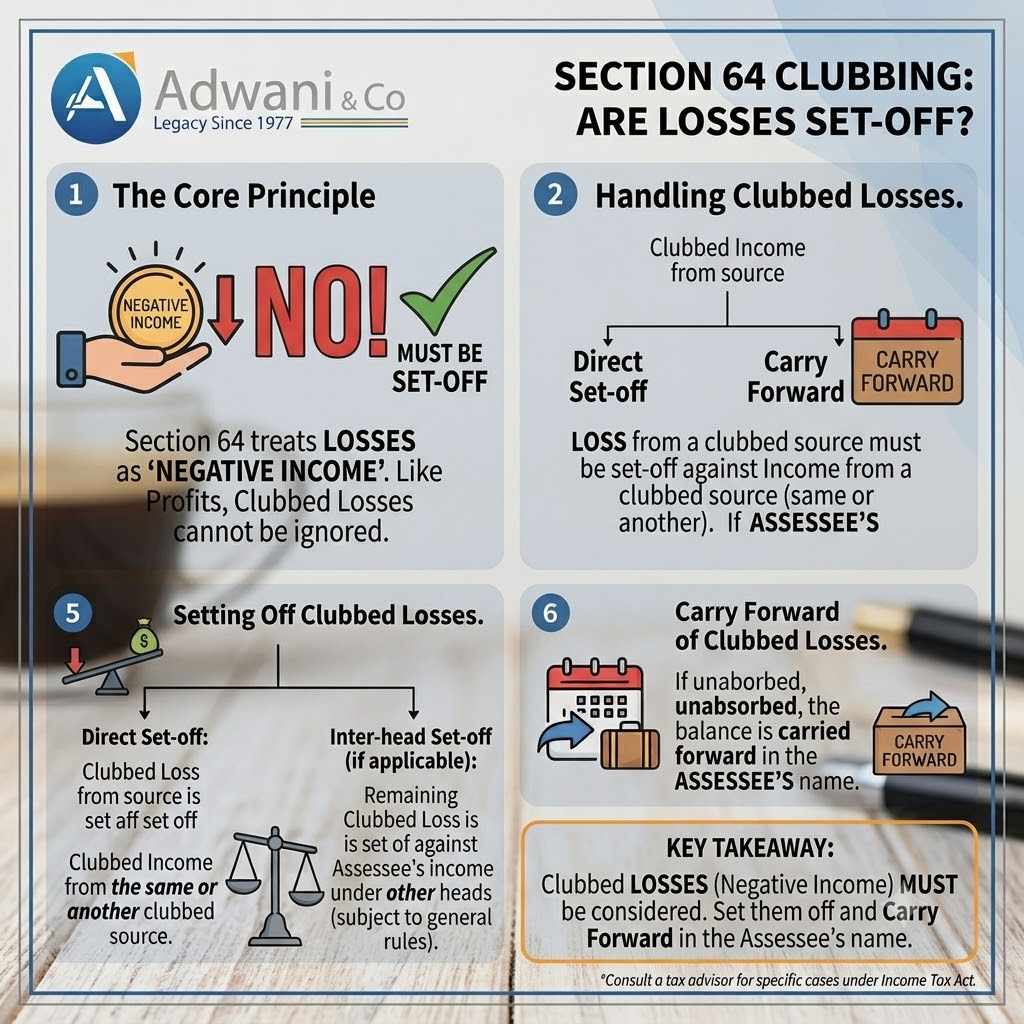
The ITAT held that where income from a gifted asset is liable to be clubbed under Section 64, losses arising from that same source cannot be dismissed simply because they are losses. The provision works both ways.
However and this is crucial the taxpayer must establish a clear and documented link between the gifted funds and the loss being claimed.
Section 64 Clubbing: Real Example with Numbers
Let’s put this into concrete terms to understand the practical impact:
Scenario
Amount / Outcome
Tax Treatment
Husband gifts ₹10 lakh to wife
Wife invests in F&O trading
Section 64(1)(iv) applies
F&O trades result in ₹2.3 lakh profit
Profit clubbed in husband’s hands
Taxed as husband’s income
Same year: F&O trades result in ₹2.3 lakh loss
Loss from same gifted funds
ITAT: Loss should be clubbed too
Husband’s other income: ₹8 lakh
Loss setoff: ₹8L − ₹2.3L
Net taxable income = ₹5.7 lakh*
*Subject to applicable provisions, documentation, and professional verification. Consult a qualified CA for advice specific to your situation
In this scenario, the loss clubbing under Section 64 results in meaningful tax savings for the husband but only if the paper trail from gift to trading loss is airtight. Without documentation, the claim may be disallowed entirely.
AtAdwani and Company, Dr. Haresh Adwani a PhD holder in Commerce and a law graduate has guided numerous clients through exactly these kinds of documentation-intensive tax matters. The devil, as always, is in the details.
Section 64 Clubbing Provisions: Not Just for Gains
What this ITAT ruling establishes or at least strongly signals — is that clubbing provisions cannot be treated as one-sided instruments.
Tax professionals and individual taxpayers have for years operated under the assumption that clubbing is always a disadvantage it increases the donor’s income. But this case flips that narrative.
Key Principle Established:
If profits from a gifted asset are taxed in the donor’s hands → Section 64 applies
If losses arise from the same gifted asset → those losses may also be eligible for clubbing
The taxpayer must establish a direct nexus between the gifted funds and the loss
Documentation is not optional it is the foundation of the entire claim
According to compliance advisories and legal guidance available through the Income Tax Department’s official portal, taxpayers are expected to maintain complete records of all financial transactions, including intra-family transfers and their downstream use.
When Section 64 Clubbing Provisions Work in Your Favour
This ruling opens a practical planning avenue but only for those who have their documentation in order. Here’s when the clubbing of losses might actually benefit a taxpayer:
1. F&O Trading Losses by Spouse
F&O (Futures & Options) trading losses are treated as business losses under the Income Tax Act. If your spouse’s F&O losses arose from funds gifted by you, and those profits would have been clubbed in your hands, the losses from the same source may reduce your taxable income provided the ITAT principle is followed and documentation is maintained.
2. Equity Trading Losses by Spouse
Short-term capital losses or speculative losses from equity trading on gifted funds can similarly be clubbed, potentially offsetting capital gains in the donor’s hands. This needs careful analysis of the type of loss versus the type of gains available for setoff.
3. Business Losses from Gifted Business Capital
If business capital was gifted to a spouse and the business incurred losses, this ruling may support the argument that such losses belong to the donor under Section 64’s symmetry principle.
Risks and Precautions: Section 64 Clubbing Compliance
While this ruling is favourable for taxpayers in loss scenarios, Dr. Haresh Adwani consistently advises clients that applying a tribunal ruling without professional guidance can backfire. Here is why:
Documentation Failure
The ITAT itself conditioned its ruling on establishing a clear link between the gifted funds and the loss. If you cannot demonstrate through bank records, brokerage statements, and fund transfer evidence that the specific gifted amount was used in the specific investment, the claim will fail.
Applicability Limitations
This ruling is from the ITAT Lucknow Bench and is not binding on all ITOs across India. Your Assessing Officer may take a contrary position. A well-supported claim backed by documentary evidence and professional representation significantly improves outcomes.
Nature of Loss Classification
F&O losses, short-term capital losses, long-term capital losses, and speculative losses all have different setoff rules under the Income Tax Act. Not all of them can be freely set off against all types of income. The type of loss must match the available income for setoff.
The team at Adwani and Company, led by Dr. Haresh Adwani, brings deep legal and financial expertise to every client engagement ensuring that claims like these are made on solid, defensible ground.
Section 64 Clubbing and Income Tax Return Filing 2026
With ITR filing for AY 2026-27 underway, this ruling has direct relevance. If your spouse incurred trading losses from funds you gifted, you may want to revisit your ITR filing strategy
Ensure the gift is properly documented (gift deed or bank transfer records)
Obtain your spouse’s trading account statements linking the gifted funds to the trades
Consult a qualified CA to assess whether the Section 64 clubbing of losses can be claimed in your ITR
File your return accurately do not claim the loss without professional review
Be prepared to substantiate the claim with documents if an income tax notice is received
Q1: What are Section 64 clubbing provisions in income tax?
Section 64 of the Income Tax Act requires that income earned from assets gifted to a spouse (or minor child) be ‘clubbed’ i.e., added to the income of the person who made the gift. This ensures taxpayers cannot reduce their tax liability simply by transferring income-generating assets to family members.
Q2: Can losses from gifted funds be clubbed under Section 64?
Yes, according to the ITAT ruling in Vipin Yadav vs. ITO (ITAT Lucknow), where income from a gifted asset is taxable in the hands of the donor under Section 64(1)(iv), losses arising from that same asset should receive similar treatment provided the taxpayer can establish a clear documentary link between the gifted funds and the loss
Q3: Does Section 64 apply to F&O trading losses of a spouse?
Based on the ITAT ruling, if a husband gifts money to his wife and she uses those funds for F&O trading resulting in a loss, Section 64 clubbing provisions may allow that loss to be claimed in the husband’s hands. Documentation of the fund transfer and its use in trading is essential.
Q4: What is the Vipin Yadav vs ITO ITAT ruling about?
The ITAT Lucknow ruling in Vipin Yadav vs. ITO held that the clubbing principle under Section 64 cannot be applied selectively only to profits but not losses. If profits from a gifted asset are taxable in the donor’s hands, losses from the same asset deserve equal treatment, subject to proper documentation.
Q6: Can I claim my wife’s equity trading loss against my income?
If your wife’s equity or F&O trading was done using funds gifted by you, the ITAT ruling suggests such losses may be clubbed in your hands under Section 64 for income tax purposes. However, this is subject to adequate documentation and is a nuanced legal matter professional advice from a qualified CA is strongly recommended.
Q6: What documents are needed for clubbing losses of a spouse?
To claim loss clubbing under Section 64, you need: (a) bank records showing the gift/transfer to the spouse, (b) evidence that the spouse used these specific funds for investment/trading, (c) trading account statements showing the F&O or equity losses, and (d) a clear paper trail connecting gifted funds to the loss-making transactions.
Conclusion: Section 64 Clubbing : A Principle That Cuts Both Ways
The ITAT ruling in Vipin Yadav vs. ITO is a small case with a big principle at its core. Section 64 clubbing provisions cannot be applied selectively taxing profits while ignoring losses when both arise from the very same gifted asset.
For taxpayers who have gifted funds to spouses engaged in equity or F&O trading, this opens a meaningful but documentation-dependent avenue to claim losses. For tax professionals, it signals the growing need to apply income tax clubbing provisions with full symmetry not just when it suits the department.
Author
CA Dipesh Gurubakshani is a Chartered Accountant with Adwani & Co LLP, Pune, specialising in income tax audit, direct taxation, and accounting advisory. He supports clients across statutory compliance, financial reporting, and income tax matters with a focus on accuracy, regulatory adherence, and disciplined execution.
Legal Disclaimer:This article is published for informational and educational purposes only. Nothing contained herein constitutes legal, financial, or tax advice, nor should it be treated as a substitute for professional consultation tailored to your specific circumstances. Tax laws, rates, and provisions are subject to change; readers are strongly advised to consult a qualified Chartered Accountant or tax advisor before acting on any information in this article.
All content is original. References to government portals and statutory provisions are paraphrased for educational purposes in compliance with fair use principles. No content hasbeen reproduced from third-party sources
The key takeaway: the law treats profit and loss from the same source consistently. And with the right professional guidance like that offered by Adwani and Company you can ensure that every legitimate tax benefit is claimed correctly and defensibly.
Every tax season, salaried employees and employers spend hours debating what the New Tax Regime took away HRA, LTA, and most of Chapter VI-A. But almost nobody is asking the more useful question: what did it quietly make better? Hidden inside the Income Tax Act is a provision that most taxpayers overlook, and it happens to be one of the few deductions that genuinely improved when the New Tax Regime came into force. That provision is the Section 80CCD(2) deduction, and understanding it properly could change how you and your employer structure salary for FY 2026-27.
If you are a private sector employee, a payroll manager, or a founder trying to design a competitive and tax-efficient compensation package, this guide breaks down exactly how the Section 80CCD(2) deduction works, how much you can legitimately claim, and why so many employers have not yet updated their policies to take advantage of it.
What Is the Section 80CCD(2) Deduction?
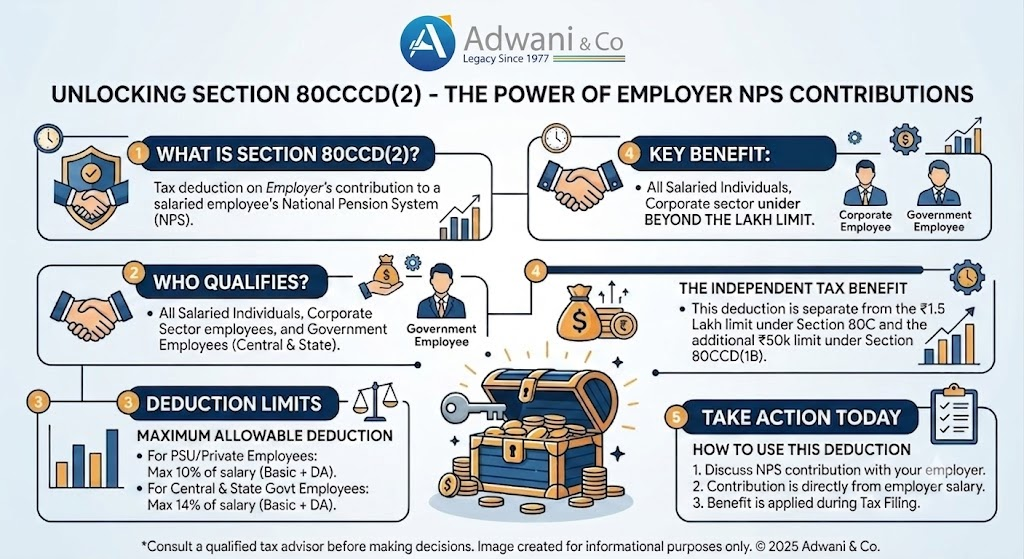
The Section 80CCD(2) deduction relates to the employer’s contribution to an employee’s National Pension System (NPS) account. Unlike most other retirement-linked deductions, it does not disappear if you opt for the New Tax Regime it is one of a small handful of provisions that survives the shift away from the Old Tax Regime’s exemption-heavy structure.
In simple terms, when your employer contributes a percentage of your salary to your NPS account, that contribution is treated as a deductible business expense for the company and, up to a prescribed limit, is not taxable in your hands either. The Section 80CCD(2) deduction is what defines that prescribed limit and it is precisely this limit that changed favourably under the New Tax Regime.
Section 80CCD(2) Deduction Limit: Old vs New Tax Regime Compared
The clearest way to understand the improvement is to compare the Section 80CCD(2) deduction limit across both tax regimes for different categories of employees.
Employee Category
Old Tax Regime
New Tax Regime
Government Employees
Up to 14% of Salary*
Up to 14% of Salary*
Private Sector / Other Employees
Up to 10% of Salary*
Up to 14% of Salary*
*Salary, for the purpose of this deduction, means Basic Salary plus Dearness Allowance, to the extent it forms part of retirement benefits.
Notice what happened here. Government employees always had access to a 14% Section 80CCD(2) deduction, under both regimes. Private sector employees, however, were historically capped at 10% under the Old Tax Regime. Under the New Tax Regime, that cap has been raised to 14% bringing private sector employees to full parity with government employees for the first time.
This makes the Section 80CCD(2) deduction one of the rare instances where choosing the New Tax Regime does not mean giving something up it means gaining a genuinely larger benefit, provided your employer’s compensation structure is designed to use it.
How the Section 80CCD(2) Deduction Works for Private Sector Employees
The Section 80CCD(2) deduction is not something you claim by writing a cheque yourself. It depends entirely on your employer’s payroll and compensation policy. A few operating rules are essential to understand:
The deduction applies only to the employer’s contribution to NPS voluntary or personal contributions you make yourself do not qualify under this section.
Whether your employer contributes to NPS at all, and at what percentage, is a matter of company policy, not a statutory entitlement you can demand individually.
The contribution must be routed through a recognised NPS account structure and reported correctly in payroll and Form 16.
Real Example: Calculating Your Section 80CCD(2) Deduction Benefit
Consider Priya, a private sector employee with a Basic Salary plus DA of ₹12,00,000 per year, who has opted for the New Tax Regime for FY 2026-27.
Under the Old Tax Regime, her employer could contribute a maximum of 10% of ₹12,00,000 = ₹1,20,000 towards NPS, and this entire amount would qualify for the Section 80CCD(2) deduction.
Under the New Tax Regime, her employer can now contribute up to 14% of ₹12,00,000 = ₹1,68,000 towards NPS, and this larger amount qualifies for the Section 80CCD(2) deduction.
That is an additional ₹48,000 of tax-free retirement contribution every year simply by aligning the compensation structure to the New Tax Regime’s enhanced limit.
Over a working career, that difference compounds significantly, both in terms of tax efficiency and retirement corpus growth. This is exactly the kind of practical, numbers-based planning that separates a well-structured salary from a generic one.
The ₹7.5 Lakh Aggregate Cap on Employer Retirement Contributions
The Section 80CCD(2) deduction does not operate in isolation. Under Section 17(2)(vii) of the Income Tax Act, the combined employer contribution to NPS, Recognised Provident Fund (RPF), and Approved Superannuation Fund is capped at an aggregate of ₹7.5 lakh per year. Any amount contributed beyond this combined threshold becomes taxable as a perquisite in the employee’s hands, along with any notional interest or growth attributable to the excess.
Key Takeaways
The Section 80CCD(2) deduction covers only the employer’s NPS contribution, not personal contributions.
Private sector employees can now claim up to 14% of salary under the New Tax Regime, up from 10% under the Old Tax Regime.
Government employees continue to enjoy a 14% deduction limit under both regimes.
Combined employer contributions to NPS, RPF, and superannuation fund are capped at ₹7.5 lakh annually under Section 17(2)(vii). This is one of the few deductions where the New Tax Regime is genuinely more generous than the Old Tax Regime.
Frequently Asked Questions
1. Is the Section 80CCD(2) deduction available under the New Tax Regime?
Yes. Unlike most Chapter VI-A deductions, the Section 80CCD(2) deduction for employer NPS contribution remains available under the New Tax Regime, at an even higher limit for private sector employees.
2. What is the current Section 80CCD(2) deduction limit for private sector employees?
Private sector employees can claim a Section 80CCD(2) deduction of up to 14% of salary (Basic + qualifying DA) under the New Tax Regime, compared to 10% under the Old Tax Regime.
3. Can I claim the Section 80CCD(2) deduction for my own NPS contributions?
No. The Section 80CCD(2) deduction applies only to the employer’s contribution. Personal NPS contributions are governed separately under Sections 80CCD(1) and 80CCD(1B).
4. Is there a cap on combined employer contributions to retirement funds?
Yes. Under Section 17(2)(vii), combined employer contributions to NPS, RPF, and Approved Superannuation Fund are capped at ₹7.5 lakh annually, with any excess taxed as a perquisite.
5. Do government employees benefit from the same Section 80CCD(2) deduction increase?
No change applies to them government employees already had access to a 14% deduction limit under both the Old and New Tax Regimes.
6. Should my employer revise our compensation policy for this deduction?
It is worth a professional review. Structuring part of compensation as an employer NPS contribution can materially improve tax efficiency for employees without added cost to the company.
The New Tax Regime is usually framed as a trade-off — simpler slabs in exchange for fewer deductions. The Section 80CCD(2) deduction tells a different story. For private sector employees, it is a genuine improvement, and it only delivers value when the employer’s compensation structure is built to capture it. As FY 2026-27 progresses, reviewing whether your salary structure is optimised for the Section 80CCD(2) deduction is one of the simplest, highest-value exercises a business can undertake.
If you want expert guidance on structuring your compensation policy around the Section 80CCD(2) deduction, or on any aspect of tax planning under the New Tax Regime, connect with Adwani & Co LLP today.
About the Author:
Mukesh Chavan is a dedicated indirect taxation and compliance professional associated with Adwani & Co LLP, specializing in GST advisory, GST audits, GST assessments, and RERA compliance services. With extensive experience in handling complex regulatory matters, he assists businesses in ensuring compliance with evolving GST laws and real estate regulations while minimizing risks and enhancing operational efficiency.
Mukesh has successfully guided clients through GST registrations, return compliance, departmental assessments, audits, litigation support, and tax planning strategies. He also possesses significant expertise in RERA compliance, helping real estate developers, promoters, and stakeholders navigate regulatory requirements and maintain seamless project compliance.
Through his articles and professional insights, Mukesh aims to simplify complex GST and RERA provisions, offering practical guidance that empowers businesses to remain compliant, avoid disputes, and make informed decisions in an increasingly dynamic regulatory environment. His approach combines technical expertise with practical business understanding, enabling clients to focus on growth while meeting their statutory obligations with confidence.
DISCLAIMER
This blog is intended for informational and educational purposes only. It does not constitute legal, financial, or professional tax advice. Tax laws and provisions under the Income Tax Act, 1961, are subject to amendment; figures and deadlines mentioned are based on information available as of the date of publication. Readers are strongly advised to consult a qualified Chartered Accountant or tax professional before taking any action based on this content. Adwani and Company and Dr. Haresh Adwani shall not be held liable for any decisions made on the basis of information provided herein. Always refer to official sources at incometax.gov.in and cbdt.gov.in for the latest and authoritative information.
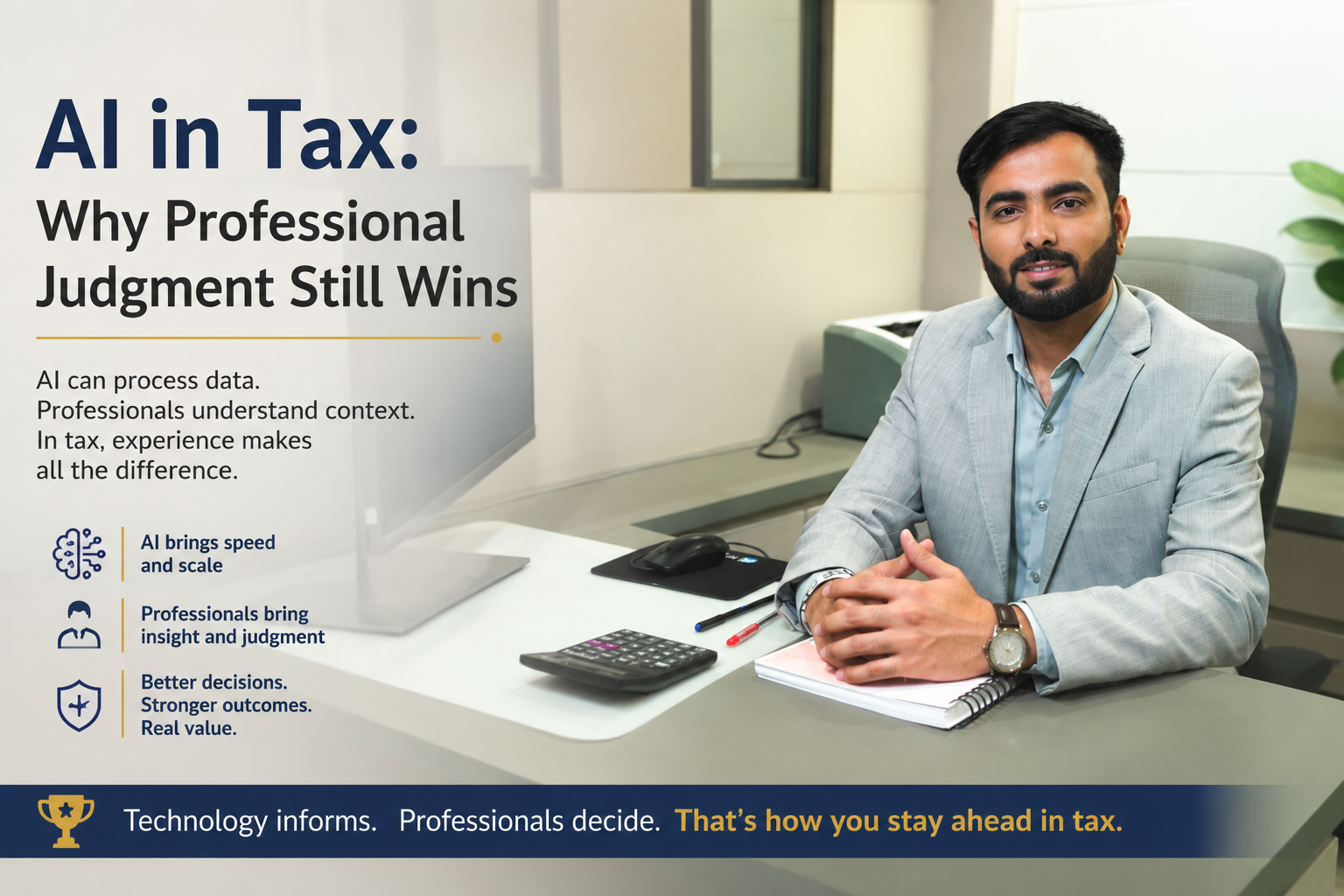
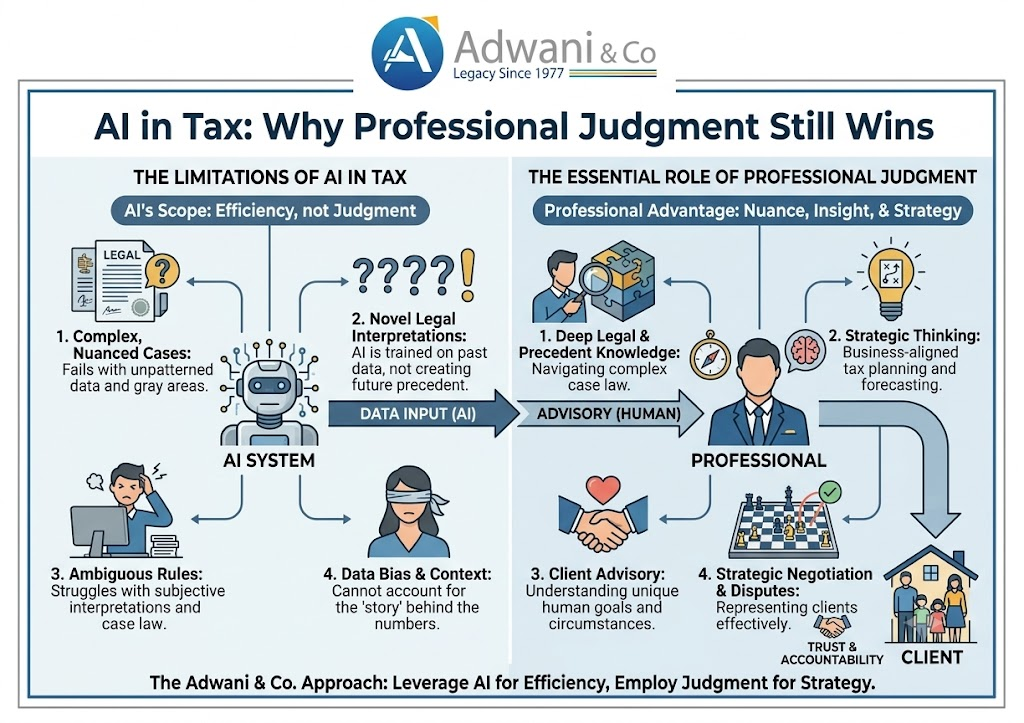
Everyone is asking whether AI can prepare tax returns. Almost nobody is asking the more important question: who will defend the tax position behind them?
That single question who defends the reasoning, not just the numbers is quietly reshaping the future of tax compliance across India and globally. And for businesses, founders, and professionals navigating the increasingly scrutinised landscape of income tax, GST compliance, and cross-border taxation in 2026, it is the question that matters most.
AI in tax return preparation is already impressive. It extracts data from documents, populates schedules, identifies missing information, and generates draft returns in minutes. The Income Tax Department’s own AIS (Annual Information Statement) system and the GST Portal now integrate AI-driven analytics to detect mismatches before a return even reaches a scrutiny desk. In that environment, a technically accurate return is just the starting point not the finish line.
The real risk in modern tax compliance is not a calculation error. It is a reasoning error. And reasoning errors are exactly where AI in tax professional judgment gaps show up most sharply.
AI in Tax Compliance: What It Does Well in 2026
To be fair to the technology, AI is genuinely transforming the mechanics of tax compliance. What previously took hours of manual data entry now happens in minutes. For routine income tax return filing, GST return preparation, and reconciliation tasks, AI-assisted tools have meaningfully improved speed and reduced data-entry errors.
The capabilities that AI brings to tax compliance include:
Extracting structured data from invoices, bank statements, Form 16, and TDS certificates
Pre-populating ITR forms based on AIS and Form 26AS data available on the Income Tax Department portal
Identifying gaps between GSTR-1 and GSTR-3B or flagging GSTR-2B mismatches before filing
Generating draft tax computations with standard deduction and exemption claims
Flagging potential income tax notice triggers based on patterns in prior filings
These are genuine productivity gains. A CA firm that uses AI tools intelligently can serve more clients, reduce routine errors, and spend less time on administrative work.
But productivity is not the same as judgment. And in taxation especially for businesses managing GST compliance 2026, handling cross-border transactions, or responding to income tax notices judgment is where the real risk lives.
Why AI in Tax Return Preparation Is Not Enough on Its Own
Consider a straightforward scenario.
A business files its ITR. The numbers are correct. Every document is available. The return passes all system validation checks. Yet three critical questions remain unanswered:
The Questions AI Cannot Answer for You
→ Is the taxpayer actually eligible for the benefit claimed?
→ Does a restriction or limitation provision apply under the Income Tax Act?
→ Is there a more advantageous tax position available that has not been explored?
→ What assumptions underlie the computation, and can they withstand scrutiny?
→ If the Income Tax Department issues a notice, can the position be professionally defended?
These are not edge cases. They represent the core of professional tax advisory and they are precisely where AI in tax professional judgment gaps become expensive.
The Income Tax Department and CBDT have significantly increased their use of data analytics and AI-driven scrutiny. Cross-referencing of ITR data with AIS, TDS data, MCA filings, GST turnover, and banking transactions is now routine. As per guidance available through the Income Tax Department portal, cases are increasingly selected for scrutiny based on risk-scoring models that evaluate the consistency and commercial logic of reported positions not just the arithmetic.
In that environment, a return that is numerically correct but logically indefensible is not a safe return. It is a delayed problem.
A Real-World Tax Risk Example: Where AI Missed and Judgment Mattered
Practical Example A proprietary trading firm with an annual turnover of ₹3.2 crore used an AI-assisted platform to prepare and file its ITR-3 for AY 2025-26. The AI correctly: • Computed speculative and non-speculative business income separately • Applied the correct tax rates • Populated all required schedules What the AI did not evaluate: • Whether certain derivatives transactions qualified as speculative or non-speculative under Section 43(5) of the Income Tax Act a distinction that affects set-off of losses • Whether the firm’s expenses claimed as business deductions met the ‘wholly and exclusively for business’ test • Whether turnover disclosed in the ITR was consistent with GST returns and bank statements, given the firm also had an NBFC registration Result: An income tax notice was issued under Section 143(2) querying the loss set-off and expense claims. A CA reviewing the return before filing would have identified these risk points and either restructured the position or documented the reasoning making the notice either avoidable or significantly easier to defend.
This is not a rare situation. It is representative of exactly the kind of reasoning error that automated tax preparation cannot prevent because preventing it requires judgment about facts, law, and professional risk, not just calculation.
AI vs. Professional Judgment in Tax: A Practical Comparison
What AI Handles Well in Tax Compliance
Where Professional Judgment in Tax Is Required
Extracting data from Form 16, TDS certificates, AIS
Evaluating whether all income sources are correctly characterised
Populating ITR schedules based on available data
Deciding which ITR form is appropriate given the taxpayer’s income profile
Identifying GSTR-1 vs GSTR-3B mismatches
Determining the legal significance of the mismatch and how to resolve it
Flagging excess ITC claims against GSTR-2B
Advising whether to reverse ITC, dispute the claim, or pursue vendor rectification
Generating draft tax computations
Reviewing whether deductions, exemptions, and set-offs are correctly applied
Detecting variance from prior-year filings
Explaining the variance and assessing whether it creates scrutiny risk
Preparing income tax notice response templates
Drafting a legally sound reply that addresses the actual notice ground
Professional Judgment in Tax: What It Actually Means
The phrase is used frequently in professional circles, but it has a concrete meaning in the context of AI in tax compliance.
Interpreting Provisions:Not Just Applying Them
The Income Tax Act, 1961, and the GST law contain thousands of provisions. Many are straightforward. Some are ambiguous, subject to judicial interpretation, or apply differently depending on facts. An AI system applies the provision as trained. A professional interprets it in context.
Dr. Haresh Adwani, a PhD holder in Commerce and a law graduate, regularly applies this dual lens at Adwani and Company evaluating tax positions not only through a finance lens but through the legal framework that governs their validity.
Evaluating Whether Assumptions Are Commercially Defensible
Every tax return carries assumptions about the nature of transactions, the classification of income, the eligibility for benefits. AI generates those assumptions from patterns. A professional evaluates whether they hold up to scrutiny in a specific business context.
Managing Risk Across the Compliance Lifecycle
Tax risk does not end at filing. It extends to assessments, scrutiny, notices, and appeals. Professional judgment in tax includes structuring positions that can be defended through the full lifecycle of compliance not just at the point of return preparation.
As AI-driven scrutiny by the Income Tax Department and GST authorities becomes more sophisticated, the cost of an indefensible position rises. This is the core dynamic reshaping what tax professionals are paid to do.
AI in Tax and the Income Tax Notice Risk
One of the most practical implications of AI in tax compliance for businesses and individuals is the income tax notice risk.
Under Section 143(2), Section 148, and other scrutiny provisions, the Income Tax Department can issue notices based on risk-scoring that increasingly relies on cross-database analytics. The parameters include:
Significant variation between ITR-reported income and AIS data
Mismatch between GST turnover and income tax turnover
High-value transactions without corresponding income disclosure
Unusual deduction or exemption claims relative to prior years
Discrepancies between MCA-reported financials and tax filings
An AI-prepared return can tick all the validation checkboxes and still contain the exact kind of inconsistency that triggers one of these notices—because the inconsistency is in the reasoning, not the arithmetic.
This is where Adwani and Company‘s approach to tax advisory adds measurable value. The firm’s review process, guided by Dr. Haresh Adwani‘s academic grounding in Commerce and legal knowledge, evaluates both the technical accuracy and the commercial defensibility of every significant tax position before filing.
Everything said about income tax applies equally and in some ways more acutely to GST compliance in 2026.
AI tools can prepare GSTR-3B, match GSTR-2B for input tax credit reconciliation, and flag vendor-level discrepancies. But the judgment questions in GST compliance are substantial:
Is a particular supply correctly classified, and has the right GST rate been applied?
Does a transaction qualify for input tax credit eligibility, or does a restriction under Section 17(5) apply?
Is an export zero-rated correctly, or does a condition remain unsatisfied?
When a GST notice arrives questioning ITC claims, is the response legally adequate?
According to compliance advisories and updates available on the GST Portal (gst.gov.in) and cross-referenced with MCA (mca.gov.in) data, authorities are increasingly scrutinising the commercial rationale of transactions—not just their documentation.
A business with ₹80 lakh in ITC claims but a vendor base that shows irregular GSTR-1 filing is not just a documentation risk. It is a legal risk that requires professional assessment and, where necessary, a structured response strategy.
The Most Valuable Tax Skills in an AI-Enabled World
The LinkedIn post that inspired this article asked a pointed question: what will be the most valuable skill in an AI-enabled tax world?
Based on work across diverse client engagements at Adwani and Company, here is a grounded answer:
High-Value Tax Skills for the AI Era 1. Analytical Review of AI Outputs ability to critically evaluate AI-generated computations, identify reasoning gaps, and flag positions that look correct but carry hidden risk 2. Regulatory Interpretation applying the Income Tax Act, GST law, FEMA, and related frameworks to specific facts in a way that produces a defensible position 3. Risk Communication translating technical tax risk into commercially actionable language for founders, CFOs, and business owners 4. Notice and Litigation Management structuring responses to income tax notices, GST scrutiny, and assessment proceedings with legal and factual rigour 5. Cross-Border Tax Judgment advising on NRI taxation, transfer pricing, DTAA benefits, and FEMA compliance in situations where AI outputs are least reliable
These are not replaceable skills. They are enhanced by AI but their value lies precisely in the human judgment that AI cannot replicate.
Key Takeaways
Summary • AI in tax return preparation handles the mechanical and computational layer well data extraction, schedule population, reconciliation flagging. • The gap between an AI-prepared return and a professionally reviewed one lies in reasoning: assumptions, eligibility, risk assessment, and defensibility. • As the Income Tax Department and GST authorities increase AI-driven scrutiny, the cost of indefensible tax positions is rising. • Professional judgment in tax covers interpretation, commercial context, risk management, and accountability across the full compliance lifecycle. • The future of tax practice is not AI replacing professionals it is AI handling scale while professionals provide the judgment that determines outcome. • For any significant tax position, cross-border transaction, notice response, or restructuring, professional review is not a legacy stepit is the critical step.
Frequently Asked Questions:
1. Can AI tools file income tax returns accurately without a CA reviewing them?
For straightforward salary-based returns with limited income sources, AI tools perform adequately. For business income, capital gains, multiple income sources, or any position that carries interpretation risk—such as deduction eligibility or income characterisation—professional review before filing is strongly recommended. An accurate calculation is not the same as a defensible position.
2. What is the biggest risk in AI-generated tax computations?
The biggest risk is not arithmetic—it is assumption. AI systems apply rules as trained, without evaluating whether those rules apply to the specific facts of a taxpayer’s situation. Where eligibility conditions, limitations, or judgment-based classifications are involved, the AI output may be technically formatted but commercially or legally incorrect.
3. How does the Income Tax Department use AI to scrutinise returns?
The Income Tax Department and CBDT increasingly use risk-scoring systems that cross-reference ITR data with AIS, TDS records, GST turnover, MCA filings, and banking data. Returns are selected for scrutiny based on inconsistency and risk indicators—not just arithmetic errors. A return that is numerically correct but logically inconsistent across data sources can still attract a Section 143(2) notice.
4. What should a business do when it receives an income tax notice?
First, read the notice carefully to identify the specific ground being raised—whether it concerns turnover mismatch, deduction claims, or unreported income. Second, do not respond without professional guidance; an incomplete or poorly structured reply can escalate the matter. Third, engage a qualified CA firm to assess the position and draft a legally adequate response. Adwani and Company provides structured income tax notice reply support across all major notice types.
5. Is professional judgment still needed for GST compliance if I use accounting software?
Yes. Accounting software and AI tools improve GST return preparation speed and reduce data entry errors. They do not evaluate whether your ITC claims are legally valid, whether your GST rate classifications are correct, or whether a vendor-mismatch creates a legal exposure requiring action. GST compliance in 2026 requires both good systems and professional advisory—especially for businesses with complex transactions or ITC-heavy operations.
6. What makes Adwani and Company different from a standard CA firm for tax advisory?
Adwani and Company brings a multi-disciplinary approach to tax advisory. Dr. Haresh Adwani combines a PhD in Commerce with a law degree, allowing the firm to evaluate tax positions through both a financial accounting lens and a legal framework. This is particularly valuable in situations where the tax question involves statutory interpretation, litigation risk, or cross-jurisdictional complexity.
7. How can small businesses use AI in tax without taking on excessive risk?
Small businesses can use AI tools for routine compliance tasks—return preparation, reconciliation, and data organisation—while ensuring that any significant position (deduction claims, ITC eligibility, income characterisation) is reviewed by a qualified professional before filing. Treating AI output as a first draft subject to professional review is the practical approach that balances efficiency with risk management.
Conclusion: Professional Judgment in Tax Is the New Competitive Advantage
AI is not a threat to the tax profession. It is a clarification of what the tax profession is actually for.
When AI handles the mechanical layer data extraction, schedule population, reconciliation flagging what remains is the professional judgment layer: interpretation, risk evaluation, position defence, and client advisory. That layer has always been where the real value sits. AI just makes it more visible.
The future tax professional, as the LinkedIn post that inspired this article noted, will spend less time preparing returns and more time validating assumptions, challenging conclusions, and managing risk. In the context of India’s increasingly analytics-driven tax administration where the Income Tax Department, CBDT, and GST authorities cross-reference multiple data sources in real time that shift is not optional. It is already underway.
For businesses and individuals who want to stay ahead of that curve, the right question is not ‘can AI prepare my return?’ It is ‘who is reviewing the reasoning behind it?’
Connect With Adwani and Company If you want expert guidance on income tax compliance, GST advisory, tax notice responses, or cross-border taxation, connect with Adwani and Company today. Dr. Haresh Adwani and the team bring the combination of deep tax expertise and legal knowledge that complex tax positions require whether you are a founder filing business income, a company managing GST scrutiny, or an NRI with cross-border tax obligations. → Learn more about our Income Tax Advisory Services → Explore our GST Compliance and Notice Reply Support → Read about our Virtual CFO and Financial Reporting Services Website: adwaniandco.com
CA Dipesh Gurubakshani is a Chartered Accountant with Adwani & Co LLP, Pune, specialising in income tax audit, direct taxation, and accounting advisory. He supports clients across statutory compliance, financial reporting, and income tax matters with a focus on accuracy, regulatory adherence, and disciplined ex
Legal Disclaimer:This blog post is intended for informational and educational purposes only. It does not constitute legal, financial, or tax advice. Tax laws and deadlines are subject to change by the Central Board of Direct Taxes (CBDT) and the Government of India. Readers are advised to consult a qualified Chartered Accountant or tax professional, such as Adwani and Company, before making any tax-related decisions. All content is original. References to government portals (incometax.gov.in, gst.gov.in) are cited under fair use principles for informational accuracy.
One document arrives in your inbox. Thousands of tax filing mistakes follow.
That document is Form 16. Every salaried employee in India receives it from their employer once the financial year ends and almost every year, lakhs of taxpayers make the same critical error: they treat Form 16 as the complete picture, file their Income Tax Return (ITR) based on it alone, and unknowingly leave out income that the Income Tax Department already knows about.
The result? Tax notices, demand letters, and avoidable penalties.
According to the Income Tax Department of India, every taxpayer is individually responsible for disclosing all sources of income even those not reflected in their salary certificate. Form 16 for income tax filing is a powerful starting point, but it is only the beginning.
In this guide, tax experts at Adwani and Companyled by Dr. Haresh Adwani, PhD in Commerce and a law graduate with extensive legal knowledge break down everything you need to know about Form 16, what it covers, what it misses, and how to use it correctly for a clean, accurate ITR filing in AY 2026-27.
What Is Form 16 for income tax filing and Why Does It Matter for Income Tax Filing?
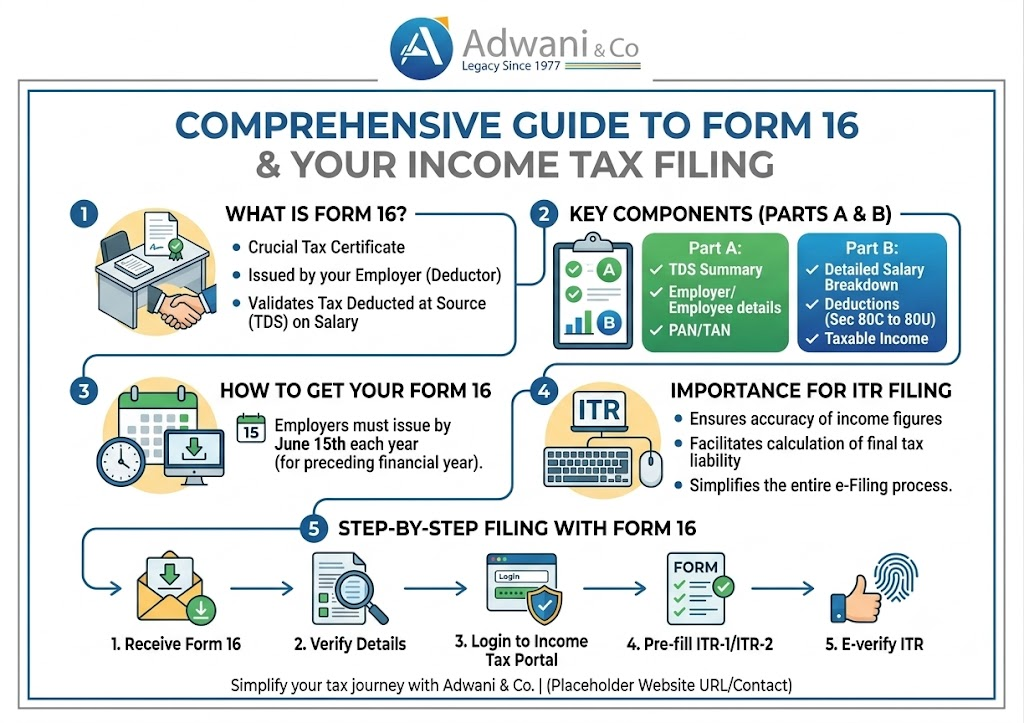
Form 16 is a TDS Certificate issued by your employer under Section 203 of the Income Tax Act, 1961. It serves as a formal record of:
Your total salary paid during the financial year
Tax Deducted at Source (TDS) on your salary by the employer
Deductions claimed under Chapter VI-A (80C, 80D, HRA, etc.)
Tax deposited with the Central Government on your behalf
The document is divided into two critical parts that every taxpayer must understand before proceeding with Form 16 income tax return filing:
Form 16 Part A
Form 16 Part B
Employer details, PAN, TAN
Detailed salary breakup
TDS amount deposited with government
Allowances: HRA, LTA, Special
Quarter-wise TDS deposition summary
Exemptions claimed under Section 10
Generated via TRACES portal (CBDT)
Deductions under Chapter VI-A (80C, 80D, etc.)
Mandatory for all salaried employees
Taxable income computation
The Most Dangerous Misconception About Form 16 for Income Tax Filing
Here is the single most dangerous assumption salaried professionals make every year:
“My employer gave me Form 16. My taxes are sorted. I just upload it and I’m done.”
This assumption is incorrect and it costs taxpayers money, time, and stress every filing season.
Form 16 only captures income your employer paid you and the TDS they deducted on it. It does not cover income you earned independently throughout the year. The Income Tax Department receives data from multiple sources banks, mutual fund registrars, stockbrokers, SEBI-registered entities through the Annual Information Statement (AIS) and Form 26AS. If you omit income that already appears in the AIS, a mismatch notice under Section 143(1) becomes almost inevitable.
As Dr. Haresh Adwani of Adwani and Company explains: “Every year we see clients who receive notices for income they forgot to declare not because they were dishonest, but because they simply assumed Form 16 covered everything. It does not. A complete ITR demands a complete disclosure of all income.”
Income Sources Not Covered in Form 16 for Income Tax Filing
The following income categories are commonly missed by salaried taxpayers who rely solely on Form 16 for income tax filing. You must disclose all of these separately in your ITR:
1. Interest Income from Savings Accounts and Fixed Deposits
Banks and post offices report interest paid to the Income Tax Department. Interest income from savings accounts beyond ₹10,000 per year is taxable (Section 80TTA provides a deduction up to ₹10,000 for savings interest). Fixed deposit interest is fully taxable at your slab rate. Many taxpayers forget to add FD interest and banks already report it to the AIS.
Practical Example: Mr. Suresh earns ₹12 lakh salary. His Form 16 shows ₹1,08,000 TDS. But he also has ₹85,000 interest from three FDs across two banks. He files ITR without adding FD interest. The AIS shows the FD interest. He receives a Section 143(1) demand of ₹26,350 plus interest under Sections 234A/B. A simple ₹85,000 omission costs him over ₹26,000 in taxes and penalties.
2. Capital Gains from Shares and Mutual Funds
If you sold equity shares, equity mutual funds, debt funds, or debt mutual funds during FY 2025-26, the capital gains must be reported. This is among the most frequently missed disclosures:
#
Asset Type
Tax Treatment
1
Equity shares / Equity MFs held > 12 months
LTCG taxable above ₹1.25 lakh at 12.5% (post-Budget 2024)
2
Equity shares / Equity MFs held < 12 months
STCG at 20%
3
Debt mutual funds (all holding periods)
Taxable at slab rate as per FY 2023-24 amendment
4
Unlisted shares held > 24 months
LTCG at 12.5% without indexation
5
Unlisted shares held < 24 months
Taxable at slab rate
The Central Board of Direct Taxes (CBDT) receives transaction data from depositories (CDSL, NSDL) and registrar and transfer agents (CAMS, KFintech). Your gains are visible to the department even if your employer is unaware.
3. Rental Income from Property
If you own and rent out residential or commercial property, the rental income — after deducting a standard 30% on net annual value and home loan interest — must be declared under Income from House Property. Form 16 does not touch this income. Many salaried employees who rent out a second property forget this entirely.
4. Income from Previous Employers
If you changed jobs during FY 2025-26, you will receive multiple Form 16s — one from each employer. Both salaries must be totalled and reported. A common mistake: employees let the new employer compute TDS based only on current employer income, leading to shortfall in tax payment and a demand notice at the time of ITR processing.
5. Freelance, Consultancy, or Business Income
Any income earned through freelancing, content creation, part-time consulting, or online platforms (Upwork, Fiverr, YouTube monetization, Instagram collaborations) is taxable as Income from Business or Profession or Income from Other Sources, depending on regularity and scale. Salaried professionals who moonlight often forget that this income sits outside their Form 16 entirely.
6. Gifts and Other Income
Gifts received from non-relatives exceeding ₹50,000 in a financial year are taxable under Section 56(2)(x). Lottery winnings, game show prizes, and online gaming winnings now face a flat 30% TDS under Section 194BA. All must be declared.
How to Cross-Check Form 16 Against AIS and Form 26AS Before Filing
Before you submit your Form 16 income tax return filing, always cross-check your Form 16 against two government documents:
Annual Information Statement (AIS): Available on the Income Tax e-filing portal. Shows all income reported to the department across 50+ transaction categories.
Form 26AS: The traditional TDS/TCS credit statement. Cross-check that all TDS deducted by your employer matches Form 26AS discrepancies can cause credit denial.
If you find income in the AIS that is not in your Form 16 interest, dividends, mutual fund redemptions, property purchases include all of it in your ITR. Deliberately omitting AIS-reflected income attracts penalties under Section 270A, which can be up to 200% of the tax evaded in cases of under-reporting.
The team at Adwani and Company routinely reconciles AIS data with Form 16 for clients before filing a step that prevents the majority of notices they would otherwise receive.
Choosing the Right ITR Form When Filing With Form 16
Not everyone with a Form 16 should file ITR-1. The form you use depends on your total income profile, not just your salary:
Sr. No.
ITR Form
Who Should Use It
1
ITR-1 (Sahaj)
Salary + one house property + other sources (interest). Total income up to ₹50 lakh. No capital gains.
2
ITR-2
Salary + capital gains + more than one property + foreign assets or income. Total income any amount.
3
ITR-3
Salary + business/profession income (freelancers, consultants with regular clients).
4
ITR-4 (Sugam)
Presumptive income (Section 44ADA for professionals). Total income up to ₹50 lakh.
Filing the wrong ITR form such as using ITR-1 when you have capital gains is treated as a defective return under Section 139(9). The department will issue a notice asking you to re-file in the correct form, which adds unnecessary compliance burden. Dr. Haresh Adwani, with his background in commerce and law, emphasises that correct form selection is as important as accurate income disclosure.
Old vs New Tax Regime: What Form 16 Tells You and What It Does Not
Your employer deducts TDS based on the tax regime you chose at the start of the financial year. Form 16 will reflect deductions accordingly. However, at the time of filing, you can switch your regime subject to conditions:
Old Tax Regime
New Tax Regime (Default from FY 2023-24)
Allows deductions: 80C, 80D, HRA, LTA, home loan interest
No most deductions (except NPS, standard deduction)
Better for those with high investments + home loans
Better for those with fewer deductions
Must be opted in at time of filing for non-business income
Default regime; applies unless you opt out
Higher tax rates at lower slabs
Lower slab rates across all income levels
If your employer deducted TDS under the new regime but you have significant 80C/80D investments and home loan interest, switching to the old regime at the time of filing may result in a tax refund. Adwani and Company helps clients run a quick regime comparison before filing to ensure they do not overpay by defaulting to the employer-chosen regime.
Key Takeaways: Form 16 and Income Tax Filing Checklist
Before You File: Complete Form 16 Tax Filing Checklist Download Form 16 Part A and Part B from your employerLog in to incometax.gov.in and download your AIS and Form 26ASList ALL income sources: salary, FD interest, capital gains, rent, freelance, giftsCollect Form 16A / Broker statements / Mutual fund redemption statementsIf you changed jobs, collect Form 16 from all employersRun a regime comparison (old vs new) to optimise tax outflowSelect the correct ITR form based on your complete income profileFile before July 31, 2026 to avoid Section 234F late filing fee (₹1,000–₹5,000)
Frequently Asked Questions
Q1. Can I file my income tax return using only Form 16?
Technically, Form 16 provides the data you need to file ITR-1 if your only income is salary from one employer with no capital gains. However, if you have any other income — interest, dividends, capital gains, rental income, freelance — you must collect and add those details separately. Relying solely on Form 16 without verifying the AIS is the most common cause of mismatch notices.
Q2. What is the difference between Form 16 Part A and Part B?
Form 16 Part A is generated by the employer through the TRACES portal and contains TDS amounts deposited with the government, quarter-wise. Form 16 Part B is prepared by the employer and contains the detailed salary breakup, exemptions claimed, and deductions allowed. Both parts are required for a complete and accurate ITR filing.
Q3. I changed jobs mid-year. How do I handle Form 16 from two employers?
You will receive two Form 16s — one from your old employer and one from your new employer. Add both salary figures and file ITR-2 or ITR-1 as applicable. Importantly, declare the income from your previous employer to your current employer at the start of your new job so that TDS is calculated on the combined income. Failing to do this leads to a tax shortfall and a demand at ITR processing time.
Q6. What happens if my AIS shows income that I do not recognise?
Log in to incometax.gov.in and raise a feedback on the AIS to mark the transaction as incorrect or not relating to you. However, do not ignore it. Filing an ITR that contradicts unresolved AIS entries can trigger a scrutiny assessment. Consult a CA to evaluate the right course of action.
Q7. What is the penalty for filing ITR late after receiving Form 16?
Under Section 234F, a late filing fee of ₹1,000 applies if total income is up to ₹5 lakh, and ₹5,000 if total income exceeds ₹5 lakh. Additionally, interest under Sections 234A, 234B, and 234C applies on any outstanding tax liability. The due date for most salaried taxpayers for AY 2026-27 is July 31, 2026.
Conclusion:
Every July, millions of Indian salaried employees file their income tax returns with the best of intentions and many still receive demand notices months later. Not because they were dishonest, but because they stopped at Form 16 when the filing process required them to go further.
Form 16 for income tax filing is the foundation the salary certificate that tells you what your employer paid you and what TDS was deducted. But the Income Tax Department sees far more: your FD interest, your mutual fund gains, your stock trades, your rental income. The AIS aggregates it all. Your ITR must match.
A thorough, compliant ITR is not complicated it requires organisation, awareness, and ideally, professional guidance. At Adwani and Company, Dr. Haresh Adwani and the CA team have guided hundreds of salaried professionals through exactly this process: ensuring that their Form 16 data, their AIS income, their investments, and their gains are all correctly disclosed in a clean, penalty-free return.
Tax season does not have to be stressful. With the right advisor, your Form 16 income tax return filing becomes straightforward and accurate filed once, filed correctly, filed with confidence.
Founder and Senior Partner, Adwani and Company. Over 40 years of expertise in income tax, corporate law, GST, and financial advisory.
Legal Disclaimer:This article is published for informational and educational purposes only. Nothing contained herein constitutes legal, financial, or tax advice, nor should it be treated as a substitute for professional consultation tailored to your specific circumstances. Tax laws, rates, and provisions are subject to change; readers are strongly advised to consult a qualified Chartered Accountant or tax advisor before acting on any information in this article.
All content is original. References to government portals and statutory provisions are paraphrased for educational purposes in compliance with fair use principles. No content hasbeen reproduced from third-party sources
A client called me last year with a familiar problem. His business had made professional payments across two financial years without deducting TDS. Nobody had caught it at the time. The issue only surfaced during his tax audit and by then, interest had already been building for months.
His first question was simple: “Can Form 26A fix this?”
The honest answer is: partly. Form 26A is a genuine and meaningful relief mechanism. But it does not resolve everything, and businesses that assume it does often find themselves with an unexpected interest burden.
Form 26A helps a payer avoid being treated as an assesse in default under Section 201 if the payee has filed their return, included the income, and paid taxes. However, it does not eliminate interest under Section 201(1A) or guarantee expense allowability under Section 40(a)(ia).
Here is what Form 26A actually does and where it stops.
What Is Form 26A and What Does It Do in a TDS Default Situation?
When a payer fails to deduct TDS on a payment, the Income Tax Department typically treats that payer as an assessee-in-default under Section 201(1). This is not a minor label. It carries real consequences: disallowance of the expense under Section 40(a)(ia), interest liability under Section 201(1A), and a formal default on your record.
The proviso to Section 201(1) offers a conditional path out. A payer will not be treated as an assessee-in-default despite failing to deduct TDS if all three of the following conditions are met on the payee’s side:
The payee (a resident) has filed their return of income under Section 139.
The payee has included this specific income in that return.
The payee has paid the tax due on this income.
If all three are satisfied, a Chartered Accountant certifies these facts in Form 26A. Once submitted, the payer escapes the assessee-in-default classification under Section 201(1).
That is meaningful relief. But many businesses stop reading here and that is precisely where the problem starts.
In a typical Form 26A TDS default case, understanding these limitations is critical to avoid further tax exposure.
Understanding the limits of Form 26A is just as important as knowing what it provides. Here are the four key boundaries businesses and their advisors must be aware of.
Limit 1 Relief Is Not Automatic
Form 26A must be formally obtained and submitted. Simply knowing you may be eligible does not protect you. The default remains on record until the form is actually furnished through the proper procedure. Acting on it early matters.
Limit 2 Interest Under Section 201(1A) Still Applies
New subsection to be inserted within the existing “Interest Liability Under Section 201(1A)” section.
What the Interest Actually Costs
Understanding that interest applies is one thing. Knowing the rate is what makes the risk real.
Section 201(1A) prescribes two distinct rates depending on the nature of the default:
Failure to deduct TDS at all: Interest at 1% per month (or part of a month) on the amount of tax that should have been deducted, running from the date TDS was required to be deducted to the date the payee files their return of income.
TDS deducted but not remitted to the government: Interest at 1.5% per month (or part of a month) on the amount deducted, running from the date of deduction to the date of actual payment.
Both rates may appear modest in isolation, but they compound against time and against the full tax amount not just the delayed portion. In a case where TDS was required in, say, April of a financial year and the payee only files their return fourteen months later in June of the following year, the interest calculation covers that entire period. At 1% per month, that is already a 14% charge on the TDS amount, before any penalties are considered.
The interest under Section 201(1A) is treated by law as a compensatory charge not a penalty for the period during which the government was denied timely access to the tax. This characterisation was affirmed by the Supreme Court in Hindustan Coca-Cola Beverages Pvt. Ltd. v. CIT (2007) 293 ITR 226 (SC), where the Court made clear that even where the payee has paid the underlying tax and the payer is not treated as an assessee-in-default, the compensatory interest still runs its course. It does not disappear simply because the substantive default has been regularised through Form 26A.
For businesses reviewing their books after a TDS audit finding, this calculation is usually the first number their CA should work out because it tells you exactly what is at stake before you even begin the Form 26A process.
Limit 3 Disallowance Under Section 40(a)(ia) Is a Separate Question
Form 26A only addresses Section 201(1). Whether your expense is actually allowed as a deduction is governed by Section 40(a)(ia), which has its own conditions and its own logic.
Here is how Section 40(a)(ia) operates. When a payer fails to deduct TDS on payments such as professional fees, contract payments, rent, commission, interest, or royalties made to a resident, the law restricts the deduction of that expense in the year of default. The current restriction reduced from 100% to 30% by the Finance Act 2014, effective from Assessment Year 2015-16 means that 30% of the gross payment can be disallowed and added back to taxable income. For a business making substantial payments without TDS, this can translate into a meaningful increase in tax liability, not just a compliance note.
The critical link between Form 26A and Section 40(a)(ia) lies in the second proviso to that section, read with the first proviso to Section 201(1). If Form 26A conditions are satisfied payee has filed a return, included the income, and paid taxes then the payer is deemed to have deducted and paid the TDS on the date the payee filed their return of income. As a result, the disallowance under Section 40(a)(ia) does not apply for that year.
But this only works if Form 26A is filed. If the form is not furnished even where the payee has genuinely paid taxes the payer cannot claim this relief automatically. The deemed-payment fiction under the second proviso is triggered only by the act of furnishing the form through the prescribed process.
Two situations where the expense remains at risk despite a payee having paid taxes:
Form 26A is not filed before the assessment is concluded. Courts and the CBDT have consistently taken the position that Form 26A must be furnished before the assessment proceedings are finalised. Filing it after an assessment order is passed may not provide retrospective protection.
The payee is a non-resident. Section 40(a)(ia) covers payments to residents. For payments to non-residents, the relevant provision is Section 40(a)(i), and neither Form 26A nor the proviso to Section 201(1) applies in the same way. (This is addressed separately below under the non-resident limitation.)
The practical takeaway: Form 26A and expense allowability under Section 40(a)(ia) are related but distinct outcomes. Getting the form in place, accurately and on time, is what connects the payee’s compliance to the payer’s tax relief. Without it, the payee having paid taxes is a fact but one that the payer cannot use in their own assessment.
Limit 4 The CA Certification Must Be Rigorous
The Chartered Accountant issuing Form 26A must independently verify all three payee conditions: that the return was filed, that this income was included, and that tax was paid. If this verification is done carelessly or without proper documentary checks, the certification itself can be challenged creating fresh risk rather than resolving the existing one.
Limit 5 Form 26A Does Not Apply to Non-Resident Payees
The proviso to Section 201(1) which enables Form 26A relief applies only where the payee is a resident of India. The statute is explicit on this point. If a business makes a payment to a non-resident whether a foreign company, NRI, or overseas service provider without deducting TDS under the applicable section (most commonly Section 195), Form 26A cannot be used to seek relief.
For non resident payments, the TDS obligation has a different character altogether. The government’s collection mechanism for non-resident income depends substantially on withholding at source because once funds leave India, enforcement becomes significantly more complex. Courts have reinforced this view. In matters involving payments to non-residents without deduction under Section 195, tribunals have consistently declined to extend the Form 26A protection, even where the non-resident has filed a return and paid taxes in India.
Businesses operating in cross-border vendor relationships, making royalty or technical service payments overseas, or buying immovable property from NRIs need to be aware that this relief simply does not extend to their situation. The exposure under Section 201(1) in a non-resident default remains unresolved by Form 26A, and the path to remediation if one exists lies in different provisions, including DTAA applicability, lower deduction certificates under Section 197, or representations to the Assessing Officer under Section 195(2) and (3).
If your business makes both resident and non-resident payments, a compliance review should treat these as two distinct categories with different risk profiles and different available remedies.
Form 26A and TDS Default: Relief Under Section 201
Interest Liability Under Section 201(1A) in TDS Default Cases
Many businesses assume that once Form 26A is obtained, the TDS default is fully resolved. That assumption is incorrect, and the consequences of getting this wrong can be significant.
Interest under Section 201(1A) is not a penalty. It is treated by law as a compensatory charge for the period during which the government was deprived of timely tax collection. The interest runs from the date on which TDS was required to be deducted to the date on which the payee actually files their return of income. This is the case even if the payee has correctly disclosed the income and paid all taxes.
In practice, there is almost always a time gap. A payment may be made during the financial year, but the payee’s return is typically filed months later sometimes beyond the due date. During this entire period, interest accrues without interruption.
The real problem arises because TDS defaults are rarely identified immediately. In most cases including my client’s situation the issue surfaces during a statutory audit, tax audit, or income tax scrutiny. By that point, a substantial period has already passed. What started as a minor compliance lapse has become meaningful financial exposure, purely because of time.
The practical advice here is straightforward: act early. If you suspect a TDS default may exist in your books, get a structured compliance review done before it surfaces in a scrutiny notice. The earlier the detection, the lower the interest exposure.
Judicial and CBDT Context: Why the Law Landed Here:
The Form 26A mechanism did not emerge from a vacuum. It was the legislature’s codification of a principle that courts had already been applying that once the government has received its tax from the payee, the payer should not be subjected to double jeopardy merely for the failure to withhold it.
The Supreme Court in Hindustan Coca-Cola Beverages Pvt. Ltd. v. CIT (2007) 293 ITR 226 (SC) laid the conceptual groundwork. The Court held that if the payee has paid tax on the income received, treating the payer as an assessee in default for failure to deduct results in the government recovering the same tax twice. CBDT Circular No. 275/201/95-IT(B) dated 29th January 1997 had already taken a similar position administratively. The Finance Act 2012 formalised this logic by inserting the first proviso to Section 201(1) and, through Notification No. 37/2012, prescribing Rule 31ACB and Form 26A.
What the Supreme Court also made clear and what CBDT Circular No. 11/2017 subsequently addressed is that interest under Section 201(1A) occupies a different space. The Court characterised it as compensatory rather than penal: it is the price the payer pays for having denied the government access to the withheld amount during the intervening period. This distinction matters because it means the interest survives even the most complete Form 26A filing. Courts do not treat the two assessee-in-default status and interest liability as a single outcome that Form 26A resolves together.
CBDT Circular No. 11/2017 also introduced a narrow relief for interest waiver in specific cases of TDS default under Section 201(1A)(i) for example, where a deductor acted on a jurisdictional High Court order that was subsequently reversed, or in cases involving non-residents where the DTAA was misapplied in good faith. These waivers require an application to the concerned CCIT or DGIT and are granted in exceptional circumstances, not as a matter of routine. Businesses in genuinely ambiguous positions may want to explore whether their facts qualify under these guidelines but should not assume the waiver as a given.
The overall judicial trajectory is consistent: courts protect bona fide payers from double taxation but do not relieve them of the time-value cost of delayed withholding. Form 26A gives you the former. It cannot give you the latter.
How Form 26A Is Filed: The TRACES Process in Practice
The blog so far has focused on what Form 26A does and where it stops. But a business that has identified a TDS default and wants to act on it has one immediate practical question: how does this actually get done?
Form 26A is filed electronically through the TRACES portal (tdscpc.gov.in), the government’s TDS reconciliation and correction platform. The process is dual-step, involving both the deductor and the Chartered Accountant separately.
Step 1 : The Deductor Initiates the Request
The deductor logs into TRACES and raises a request for Form 26A based on the PAN of the payee for whom relief is being sought. The system auto-populates transactions from the deductor’s filed TDS returns where non-deduction or short-deduction is reflected. The deductor identifies the specific transactions, generates the annexure in the prescribed format, and submits it digitally either using a Digital Signature Certificate (DSC) or through Electronic Verification Code (EVC). The form then moves to a status of “Sent to E-Filing.”
Step 2 : The Chartered Accountant Certifies
The assigned CA receives the request in their Income Tax e-Filing portal login under Worklist → For Your Action. Before certifying, the CA must independently verify the three conditions that the law requires: that the payee has filed their return under Section 139, that the specific income paid by the deductor is included in that return, and that the tax due on the declared income has been paid. This verification must be based on actual examination of the payee’s return, acknowledgement, Form 26AS, and tax payment records — not merely on representations made by the payee or the deductor.
The CA fills in the payee’s return filing details date of filing, acknowledgement number, ITR form type, declared income, tax payable, and tax paid and submits the certificate in the prescribed Annexure A format, using their own DSC.
Step 3 : The Deductor Finalises Submission
Once the CA submits, the deductor logs back into the e-Filing portal and submits Form 26A using DSC or EVC. TRACES then processes the form and recalculates the TDS default position. If accepted, the deductor’s status changes from assessee-in-default to relieved, and TRACES recomputes the interest under Section 201(1A) for the applicable period.
What the CA Must Actually Verify
Rule 31ACB of the Income Tax Rules, 1962, which prescribes Form 26A, requires that the CA examine the relevant accounts, documents, and records of the payee not merely accept verbal confirmation. In practice, this means obtaining and retaining copies of:
The payee’s ITR acknowledgement for the relevant assessment year
The payee’s tax computation showing the disputed income was included
Evidence of tax payment (Challan / Form 26AS / AIS)
The deductor’s TDS return showing the transaction in question
A certification that is done without this documentation is not merely careless it is professionally exposed, and could be challenged during assessment, converting a resolved matter into an active dispute.
Conclusion .
Form 26A is useful in a TDS default scenario, but it is not a complete solution.
Form 26A is a useful and legally sound mechanism. When used correctly, with proper CA verification, it provides genuine protection against the assessee-in-default label under Section 201(1).
But it is not a complete fix. Interest under Section 201(1A) still runs. Expense disallowance under Section 40(a)(ia) is a separate question. And the certification itself carries responsibility it must be done with proper documentary verification, not as a formality.
If your business has missed TDS deductions or if you are not entirely sure whether you have a structured compliance review before scrutiny is always the better path. Catching the issue early limits the damage; discovering it during a notice limits your options.
1. What is Form 26A in TDS?
Form 26A is a certificate issued by a Chartered Accountant confirming that the payee has included the relevant income in their return of income and paid the applicable taxes. When furnished properly, it allows the payer to claim relief from being treated as an assessee-in-default under Section 201(1) of the Income Tax Act. (Learn more about TDS defaults and compliance https://www.adwaniandco.com/services
2. Does Form 26A completely remove TDS liability?
No. Form 26A only removes the assessee-in-default classification under Section 201(1), subject to all three payee conditions being met. Interest liability under Section 201(1A) still applies, and the question of expense disallowance under Section 40(a)(ia) is an entirely separate matter.
3. Is interest payable even after filing Form 26A?
Yes. Interest under Section 201(1A) continues to apply and is calculated from the date TDS was originally required to be deducted to the date the payee files their return of income. Form 26A does not eliminate this interest.
4. When should Form 26A be filed?
Form 26A should be filed once it is confirmed that the payee has filed their return of income, included the relevant income in that return, and paid the tax due. The sooner this is done after a default is identified, the better as delay increases interest exposure.
5. What happens if Form 26A is not filed?
Without Form 26A, the payer remains classified as an assessee-in-default under Section 201(1). This can result in a tax demand, interest under Section 201(1A), and potential disallowance of the expense under Section 40(a)(ia). The default also stays on formal record, which can complicate future assessments.
Author
CA Dipesh Gurubakshani is a Chartered Accountant with Adwani & Co LLP, Pune, specialising in income tax audit, direct taxation, and accounting advisory. He supports clients across statutory compliance, financial reporting, and income tax matters with a focus on accuracy, regulatory adherence, and disciplined execution.
Legal Disclaimer:This article is published for informational and educational purposes only. Nothing contained herein constitutes legal, financial, or tax advice, nor should it be treated as a substitute for professional consultation tailored to your specific circumstances. Tax laws, rates, and provisions are subject to change; readers are strongly advised to consult a qualified Chartered Accountant or tax advisor before acting on any information in this article.
All content is original. References to government portals and statutory provisions are paraphrased for educational purposes in compliance with fair use principles. No content hasbeen reproduced from third-party sources
You did everything right. You filed your Income Tax Return, then realized you missed some income a forgotten freelance payment, some interest from a savings account, maybe rental income you overlooked. So you did the responsible thing: you filed an Updated Return (ITR-U) to correct it.
Then the letter arrived .A Section 143(2) notice after ITR-U. And suddenly that correction you filed feels pointless. This is one of the most misunderstood situations in Indian income tax and it catches thousands of honest taxpayers off guard every year.
Quick Answer: Once a Section 143(2) notice after ITR-U is issued, the tax department proceeds on your original return. Your updated return is filed but ignored for that assessment cycle. Filing ITR-U after the notice does NOT stop scrutiny and does NOT update the return being examined.
What is Section 143(2) Notice After ITR-U?
Understanding Section 143(2) in Simple Terms
Section 143(2) of the Income Tax Act is basically the tax department saying: “We have selected your return for a closer look.” It is a scrutiny notice meaning an Assessing Officer (AO) will review your return in detail to make sure you have not underreported income, overclaimed deductions, or underpaid tax.
This notice must be issued within 3 months from the end of the financial year in which you filed your return. If you filed your ITR on 31st July 2024, the last date for this notice is 30th June 2025.
What is ITR-U (Updated Return)?
ITR-U is a provision under Section 139(8A) that lets you correct a previously filed return or even file one you missed entirely. After Budget 2025, the window to file an ITR-U has been extended from 2 years to 4 years from the end of the relevant Assessment Year. This is a huge change that gives taxpayers much more time to come clean voluntarily.
Got a 143(2) Notice After Filing ITR-U? Here is What Actually Happens
Here is where things go wrong. When you receive a Section 143(2) notice after ITR-U, the assessment is locked onto your original return. The Assessing Officer proceeds on what you originally filed your ITR-U correction is set aside for that cycle. It is not that your ITR-U disappears, it is just that it cannot change the course of the ongoing scrutiny.
This is established under CBDT guidelines and supported by multiple tribunal rulings across India.
Filed ITR-U But Got a 143(2) Notice? Here is Why It No Longer
Helps Think of it this way. Imagine a court case is already running. You cannot suddenly submit new evidence from outside and expect the proceedings to restart from scratch. The same logic applies here.
Once scrutiny proceedings begin under Section 143(3), the assessment is in motion. Your ITR-U filed after a Section 143(2) notice after ITR-U cannot override or pause this process. The law is clear on this the updated return has no bearing on an assessment that is already underway.
A Real-World Example
Arjun, a software engineer in Pune, forgot to report Rs. 3 lakh in freelance income from a foreign client. He filed ITR-U to disclose it. But two weeks before filing ITR-U, he had already received a Section 143(2) notice for the same year.
Result: The AO ignored the ITR-U, conducted scrutiny on the original return, added the Rs. 3 lakh as undisclosed income, and imposed a penalty. Arjun had to cooperate with the scrutiny process his ITR-U counted for nothing in that cycle.
Common Triggers That Cause Section 143(2) Notice After ITR-U
Not every taxpayer gets selected for scrutiny.
The tax department uses a system called CASS (Computer Assisted Scrutiny Selection) to automatically flag cases. Here are the most common reasons your case might be picked:
Mismatch with Form 26AS or AIS: If the income shown in your ITR does not match what banks, employers, or other sources have reported, the system flags it automatically.
Large deductions under Chapter VI-A: Claiming very high 80C, 80D, or home loan deductions compared to your income level raises a red flag.
Business losses above Rs. 25 lakh: Loss claims are always scrutinized more carefully.
ITR-U itself can trigger scrutiny: Ironically, filing a large update can draw attention. If your ITR-U shows a significant jump in income from the original, it may invite the very notice you were trying to avoid.
Foreign income or overseas assets: NRIs and those with foreign bank accounts or investments are subject to stricter scrutiny.
High-value transactions not disclosed: Property sales, large cash deposits, or luxury purchases appearing in your AIS but missing from your ITR.
In the financial year 2024-25 alone, over 1.5 lakh cases were selected for scrutiny a 20% increase from the previous year. With AI-driven audits becoming the norm, this number is only going to grow.
Step-by-Step Guide to Respond to Section 143(2) Notice After ITR-U
Receiving this notice is stressful. But it does not have to be a disaster. Here is exactly what to do, in order:
Step 1: Do Not Ignore the Notice
This is the most critical point. Ignoring a Section 143(2) notice after ITR-U is the worst thing you can do. You have a window typically 15 days to acknowledge the notice through the e-Proceedings portal on the Income Tax website. Log in, go to e-Proceedings, and confirm receipt.
Step 2: Understand What Type of Scrutiny You Are Under
There are two types. Limited scrutiny means the AO can only examine specific issues mentioned in the notice for example, a mismatch in capital gains or TDS credits. Complete scrutiny means your entire return is being reviewed. Knowing which one you are dealing with helps you prepare.
Step 3: Gather Your Documents
ITR-V (acknowledgement of your original filed return)
Form 26AS and Annual Information Statement (AIS)
Bank statements for the full financial year
Investment proofs for all deductions claimed (80C, 80D, HRA, etc.)
Details of all income sources including salary slips, rent agreements, freelance invoices
Copy of your ITR-U filing acknowledgement
Step 4: File a Structured Reply
Your reply must address each query raised in the notice, point by point. Use a professional format with clear headings. Attach supporting documents as PDF scans. All replies must go through the e-Proceedings portal emails or physical visits have no legal value under the faceless assessment system.
Step 5: Mention Your ITR-U in the Reply
Even though your ITR-U does not override the scrutiny, mention it in your submission. State clearly that you had filed an Updated Return to voluntarily disclose additional income this demonstrates good faith and may be considered during penalty determination.
Step 6: Consider Hiring a CA
If your case involves complex income sources, large deductions, or significant additional tax demand, hire a Chartered Accountant. Scrutiny proceedings involve technical legal language and strict deadlines. A CA who handles tax assessments regularly will know exactly what to say, what to submit, and how to protect you.
Step 7: Appeal if the Order is Unfavorable
After the AO passes the final order under Section 143(3), you have 30 days to file an appeal with the Commissioner of Income Tax (Appeals) or CIT(A). If you have cooperated fully and have documented everything properly, your chances of getting relief on appeal are good.
Pro Tip: Track your case status by logging into incometax.gov.in and checking the e-Proceedings tab. If a Section 143(2) notice after ITR-U has been issued, it will appear here. You will also receive an email and SMS to your registered contact details.
Three Real Case Studies: What Happened to Taxpayers Like You
Case 1: Salaried Employee Who Cooperated Fully
Rajesh, a 34 year old engineer from Pune, had forgotten to report a Rs. 2 lakh performance bonus from a previous employer. He filed ITR-U to correct this but had already received a Section 143(2) notice after ITR-U for the same year. His ITR-U was ignored in the scrutiny. However, Rajesh cooperated fully, submitted all documents on time, and mentioned the ITR-U as evidence of good faith. The AO raised a demand of Rs. 50,000. On appeal, Rajesh got relief and the demand was reduced significantly.
Case 2: Small Business Owner Who Caught a Break
Priya ran a small cafe and had claimed excess depreciation on her equipment. She filed ITR U late. A Section 143(2) notice followed. The AO examined her original return and questioned the depreciation claim. Priya submitted invoices, purchase records, and depreciation schedules. The final demand was reduced by 40% from the initial assessment.
Case 3: Freelancer Who Ignored the Notice A Warning
Vikram, a graphic designer, received a Section 143(2) notice after ITR-U but assumed it would resolve itself. He did not respond. The AO passed a best judgment assessment under Section 144 essentially guessing his income based on available data and raised a demand of nearly double the actual tax due, plus a 200% penalty.
How to Prevent Section 143(2) Notice After ITR-U in the Future
Prevention is always better than a cure. Here is how to reduce the chances of landing in this situation again:
File accurately the first time: Cross-check your ITR against Form 26AS and the Annual Information Statement (AIS) before submitting. Most mismatches that trigger scrutiny are simple oversights.
Use ITR-U only before any notice: If you realize a mistake, file ITR-U as soon as possible before any scrutiny notice arrives. The 4-year window gives you plenty of time, but earlier is always better.
Use the pre-fill option on the e-filing portal: The portal automatically pulls data from your AIS, Form 26AS, and employer records. Using this reduces the chance of missing income.
Keep all financial documents organized: Rent agreements, investment proofs, bank statements, salary slips keep these ready every year. Scrutiny can happen to any return, anytime.
Hire a CA for complex cases: If your annual turnover exceeds Rs. 1 crore, you have multiple income sources, or you have foreign assets do not file alone. Professional guidance upfront is far cheaper than fighting a scrutiny assessment later.
1.Can I file ITR-U after receiving a 143(2) notice?
Technically yes you can still file ITR-U after receiving the notice. But it will be ignored for the ongoing scrutiny assessment. The Assessing Officer will proceed on your original return. Your ITR-U may still count as a gesture of good faith during penalty proceedings
2.Does filing ITR-U stop a 143(2) notice?
No. Filing ITR-U has no power to stop, pause, or cancel a Section 143(2) scrutiny notice. Once issued, the notice runs its full course regardless of any ITR-U filed before or after.
3.How long does a scrutiny assessment take?
Typically between 6 months to 1.5 years from the date of the notice. Under the faceless assessment system, the entire process is digital and can move faster than traditional scrutiny.
CA Dipesh Gurubakshani is a Chartered Accountant with Adwani & Co LLP, Pune, specialising in income tax audit, direct taxation, and accounting advisory. He supports clients across statutory compliance, financial reporting, and income tax matters with a focus on accuracy, regulatory adherence, and disciplined execution.
Legal Disclaimer:This article is published for informational and educational purposes only. Nothing contained herein constitutes legal, financial, or tax advice, nor should it be treated as a substitute for professional consultation tailored to your specific circumstances. Tax laws, rates, and provisions are subject to change; readers are strongly advised to consult a qualified Chartered Accountant or tax advisor before acting on any information in this article.
All content is original. References to government portals and statutory provisions are paraphrased for educational purposes in compliance with fair use principles. No content hasbeen reproduced from third-party sources
Notice Under Section 153C: What to Do if Your Name is in Someone Else’s Papers. Protect your rights and challenge wrongful tax demands with Adwani & Co.
When tax authorities find your name in a third party’s documents during a search, the law draws a sharp line between what is permissible and what is not. Most taxpayers and even some officers get this wrong.
The Notice That Arrives Out of Nowhere
Imagine opening your mailbox one ordinary morning to find an income tax notice. The search was not on you. No officer visited your home. No documents were seized from your premises. Yet there it is a notice proposing a significant addition to your income, based on papers found at someone else’s address.
This is not a rare scenario. It happens frequently across India, and it leaves taxpayers confused, anxious, and often vulnerable to wrongful demands. The good news? The law is clear if you know where to look.
Key insight: Just because your name appears in a document does not mean an income tax addition against you is legally valid. The section under which proceedings are initiated matters enormously.
The Income Tax Act, 1961 lays down two distinct legal pathways when a search or seizure operation takes place. Confusing one for the other is not merely a paperwork error it can invalidate the entire proceeding.
Section 153A
Search on YOU
Applies when income tax authorities conduct a search directly on your premises. Any addition made must be supported by incriminating material found at your location. Not from elsewhere from your address.
Section 153C
Documents found elsewhere
Applies when documents or assets belonging to you, or referring to you, are found during a search at a third party’s premises. A strict legal process, including a satisfaction note, must be followed before you can be assessed.
The distinction is not technical hair-splitting. It is the foundation of a fair assessment. When the wrong section is applied, the entire addition is built on a procedurally defective foundation and courts have consistently held that such additions cannot stand.
Don’t panic over a Section 153C notice. Follow these 5 critical steps to protect your rights and challenge wrongful tax additions with expert advice.
5 Critical Steps to Take Immediately
Identify the Section: Verify if the notice is under Section 153A or 153C. If no search occurred at your premises, 153A is likely invalid.
Verify the Satisfaction Note: Ensure the Assessing Officer recorded a formal “satisfaction note” before proceeding.
Inspect the Evidence: Demand to see the “incriminating material.” Remember, casual mentions in loose papers are often not enough.
Check for Procedural Errors: In tax law, procedure is substance. A wrong section means the entire addition could be deleted.
Consult a Professional: Engage a qualified tax advocate or CA at Adwani & Co to draft a technically sound response.
What Went Wrong in ACIT vs Neena Jain (ITAT Delhi, 2026)
This recently decided case before the Income Tax Appellate Tribunal, Delhi, is a textbook example of procedural overreach and how the law protects taxpayers when authorities step outside their legal bounds.
Case Study
ACIT vs Neena Jain ITAT Delhi, 2026
A search and seizure operation was conducted but on third parties, not on the assessee.
During that search, loose papers and handwritten cash entries were discovered that allegedly mentioned Neena Jain’s name.
The department initiated proceedings against her under Section 153A the section that applies only when a search is conducted on the taxpayer herself.
No incriminating material was found from the assessee’s own premises. The entire case rested on third party documents.
The mandatory procedure under Section 153C including a formal satisfaction note from the Assessing Officer was not followed.
The ITAT held that the addition was entirely unsustainable. The wrong section had been invoked, there was no incriminating material against the assessee, and the entire addition was deleted.
Why Loose Papers Are Not Enough
Tax law does not operate on suspicion or inference alone. Loose papers found at a third party’s premises a diary, a note, a printed ledger entry are not automatically evidence against the person named in them. The courts have repeatedly emphasised that the word “incriminating” is key.
Incriminating material means evidence that directly implicates the assessee not hearsay, not casual mentions, not unverified entries in someone else’s records. For an addition to survive legal scrutiny, there must be a direct and demonstrable link between the document and the assessee’s undisclosed income.
What counts as incriminating material? Documents, assets, or entries that directly and specifically indicate the taxpayer’s undisclosed income or unexplained investment and which were found during a valid search of their own premises.
The Three Questions Every Taxpayer Must Ask
Before filing a reply to any income tax notice arising from a search whether on you or on someone else take a step back and ask these three questions systematically. The answers could determine whether any addition against you survives at all.
Is the correct section being applied?
If the search was not on your premises, the department must proceed under Section 153C, not 153A. Any notice issued under the wrong section is procedurally invalid from the outset.
Is there direct incriminating material against you?
The tax department must point to specific documents or assets found from your premises that establish undisclosed income. A mere mention of your name elsewhere is not sufficient.
Has the mandatory procedure been followed?
Under Section 153C, the Assessing Officer of the searched person must record a satisfaction note establishing that the documents belong to or pertain to you. Without this, the proceeding has no legal basis.
The Broader Lesson Procedure Is Substance in Tax Law
In many areas of life, procedure is secondary to outcome. In Indian income tax law, it is the opposite. A procedural error by the department invoking the wrong section, failing to record a satisfaction note, relying on documents not found from the correct premises is not a minor lapse that can be cured later. It is a fundamental defect that vitiates the entire assessment.
This is why experienced tax practitioners scrutinise the procedural foundation of every assessment order, not just the quantum of the addition. An addition of any amount, no matter how large, can be deleted if the legal basis for initiating proceedings was flawed.
The Neena Jain case reinforces a principle that courts have upheld consistently: an assessee cannot be penalised simply because their name surfaced in someone else’s records. The law demands more and it is right to do so.
Remember: Tax cases are not decided solely on what documents exist. They are decided on how those documents were obtained, whose premises they came from, and whether the correct legal process was followed at every step.
Notice Under Section 153C:What to Do If You Receive Such a Notice
Receiving a notice is not a verdict. It is the beginning of a legal process one in which you have rights, safeguards, and remedies. Here is a practical approach:
First, do not respond in panic. Read the notice carefully, identify the section under which it is issued, and note the assessment year and the search date. Second, obtain the documents on which the department is relying. You have a right to inspect the material used against you. Third, verify whether a satisfaction note exists under Section 153C. If it does not, that is a strong procedural ground in your favour.
Most importantly, consult a qualified tax advocate or chartered accountant with experience in search assessments. The nuances of Sections 153A and 153C are well-litigated but fact-specific. Professional guidance tailored to your situation is essential.
1.I received a tax notice after a search on someone else.What shouls I do first?
Do not panic and do not respond immediately without analysing the notice carefully. Here are the first three steps you should take: 1. Identify the section: Check whether the notice is issued under Section 153A or Section 153C. If the search was not on your premises, Section 153A cannot validly apply. 2. Verify the satisfaction note: Ask your tax advisor to confirm whether the Assessing Officer recorded a valid satisfaction note as required under Section 153C. 3. Check the evidence: Find out exactly which documents the department is relying on and whether they constitute genuine incriminating material found from your premises.
2.How many years can the income tax department reopen under Section 153A
Under Section 153A, the income tax department can reopen assessments for six assessment years immediately preceding the year of search. In cases where the undisclosed income exceeds Rs. 50 lakhs, the department can go back up to ten assessment years. However, this power applies only when a valid search has been conducted on the assessee’s own premises, and only when incriminating material is found for the relevant years. For years where no incriminating material is found, additions to completed assessments are not permissible as confirmed by the Supreme Court.
About the Author Dr. Haresh Adwani Ph.D. in Commerce | Law Graduate | Managing Partner, Adwani & Co LLP Dr. Haresh Adwani holds a Ph.D. in Commerce and is a qualified Law graduate with over two decades of hands-on experience in GST advisory, direct taxation, and statutory compliance for businesses across Pune and Maharashtra has guided hundreds of SMEs, startups, and corporates through India’s evolving tax landscape. He is a recognised advisor on GST compliance, company formation, and Virtual CFO services, and regularly contributes to professional seminars and industry forums in Pune.
DISCLAIMER
This blog is intended for informational and educational purposes only. It does not constitute legal, financial, or professional tax advice. Tax laws and provisions under the Income Tax Act, 1961, are subject to amendment; figures and deadlines mentioned are based on information available as of the date of publication. Readers are strongly advised to consult a qualified Chartered Accountant or tax professional before taking any action based on this content. Adwani and Company and Dr. Haresh Adwani shall not be held liable for any decisions made on the basis of information provided herein. Always refer to official sources at incometax.gov.in and cbdt.gov.in for the latest and authoritative information.