Category: Blog

Your blog category

  • Smart Tax Saving Tips Before July 31 for AY 2026-27 : Your Final Window Is Open

    Smart Tax Saving Tips Before July 31 for AY 2026-27 : Your Final Window Is Open

    The Deadline That Most Taxpayers Ignore Until It’s Too Late

    Every year, it happens the same way. A taxpayer who earned well, invested wisely, and paid their TDS on time ends up with a higher tax bill than they should have not because they broke any rules, but because they didn’t plan within the rules before the window closed.

    That window closes on July 31, 2026.

    This is the ITR filing last date for AY 2026-27 the hard deadline set by the Income Tax Department of India under Section 139(1) of the Income Tax Act, 1961. Whether you’re salaried, a freelancer, a business owner, or an investor with capital gains, these final weeks before July 31 are your last legitimate opportunity to optimize your tax position for FY 2025-26.

    This guide covers the most powerful, actionable tax saving tips before July 31 for AY 2026-27 backed by real numbers, practical examples, and the kind of strategic clarity that most generic tax articles miss entirely.


    Why Tax Saving Before July 31 for AY 2026-27 Matters More Than Ever

    Filing on time is no longer just about avoiding the late fee under Section 234F (up to ₹5,000). The consequences of filing late or filing incorrectly now carry deeper implications.

    The Income Tax Department’s data infrastructure has expanded significantly. Through the Annual Information Statement (AIS), the department now receives real-time data from banks, brokers, mutual fund houses, property registrars, and even the GST Portal via cross-system data sharing. Credit card transactions, cash deposits, and F&O trading activity are all tracked and matched against your ITR.

    Filing with errors or missing deductions in this environment means:

    • Delayed or rejected refunds due to TDS credit mismatches
    • Income tax notices triggered by AIS-ITR discrepancies
    • Loss of carry-forward rights for F&O losses and capital losses
    • Missed deduction claims that can never be retroactively corrected once the deadline passes

    The most effective tax saving strategy for AY 2026-27 begins not on July 30th, but right now.

    Tax Saving Tip 1 : Old vs New Tax Regime: The Most Important Choice of AY 2026-27

    If there is one tax saving tip before July 31 for AY 2026-27 that carries more financial weight than all others combined, it is this: choose your tax regime deliberately, not by default.

    The new tax regime for FY 2026-27 offers zero tax on income up to ₹12 lakh after the Section 87A rebate, along with a simplified slab structure and a standard deduction of ₹75,000 for salaried employees and pensioners a figure significantly improved from the prior ₹50,000 available under the old regime.

    The old tax regime preserves the full deduction ecosystem. This matters enormously for taxpayers who have:

    • Section 80C investments : ELSS, PPF, LIC premium, home loan principal, NSC, tuition fees (up to ₹1.5 lakh)
    • Section 80D : Health insurance premiums (up to ₹25,000 for self/family; ₹50,000 for senior citizen parents)
    • Section 24(b) : Home loan interest deduction (up to ₹2 lakh for self-occupied property)
    • HRA exemption : For salaried employees living in rented accommodation
    • Section 80CCD(1B) : Additional ₹50,000 for NPS contributions, above the 80C ceiling

    Practical Comparison Example:

    ScenarioSalaried, Income ₹14 lakhNew Regime TaxOld Regime Tax
    Standard deduction₹75,000₹75,000₹50,000
    Section 80C₹1.5 lakhNot applicableClaimed
    Section 80D₹25,000Not applicableClaimed
    Home loan interest₹1.5 lakhNot applicableClaimed
    Effective taxable income~₹13.25L~₹10.5L
    Approximate tax~₹1,17,500~₹82,500

    In this example, the old regime saves approximately ₹35,000. But for someone without these deductions, the new regime wins decisively. There is no universal answer only a calculated one.

    As Dr. Haresh Adwani, PhD in Commerce and law graduate, founding partner of Adwani and Company, puts it: “The regime decision is not a checkbox. It is a financial calculation. We see taxpayers every year who lock in the wrong regime because they assumed not because they calculated.”

    Read :Old vs New Tax Regime2025: Stop Guessing, Start Calculating

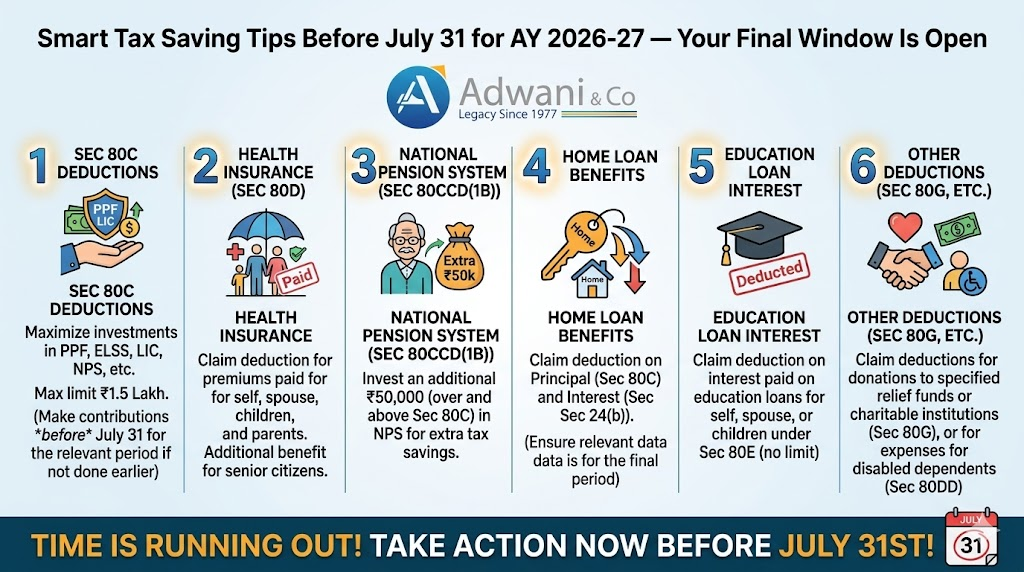
    Tax Saving Tip 2 : Claim Every Deduction Before the July 31 Deadline

    Many taxpayers who opt for the old regime still underclaim deductions not because they’re ineligible, but because documentation is incomplete at the time of filing. Here’s the fullSection 80C deductions checklist for AY 2026-27:

    High-Impact Deductions to Capture Before July 31

    Section 80C : ₹1.5 lakh ceiling (Old Regime only): ELSS mutual funds, PPF, LIC premium, EPF (employee’s share), NSC, 5-year tax-saving FD, children’s tuition fees, home loan principal repayment

    Section 80D : Health Insurance: ₹25,000 for self/spouse/children + ₹50,000 for senior citizen parents. Preventive health check-up expenses of up to ₹5,000 are included within these limits.

    Section 80CCD(1B) : NPS: ₹50,000 additional over and above 80C. For a taxpayer in the 30% bracket, this alone reduces tax by ₹15,600.

    Section 24(b) : Home Loan Interest: Up to ₹2 lakh on a self-occupied property. For let-out property, full interest is deductible (subject to the ₹2 lakh set-off cap).

    HRA Exemption: Calculated as the least of: actual HRA received, rent paid minus 10% of basic salary, or 50%/40% of basic salary (metro/non-metro cities). Ensure rent receipts are ready and landlord’s PAN is available if annual rent exceeds ₹1 lakh.Learn more about our ITR Filing Service to ensure every deduction is accurately captured before the filing deadline.


    Tax Saving Tip 3 : Reconcile AIS and Form 26AS Before Filing ITR

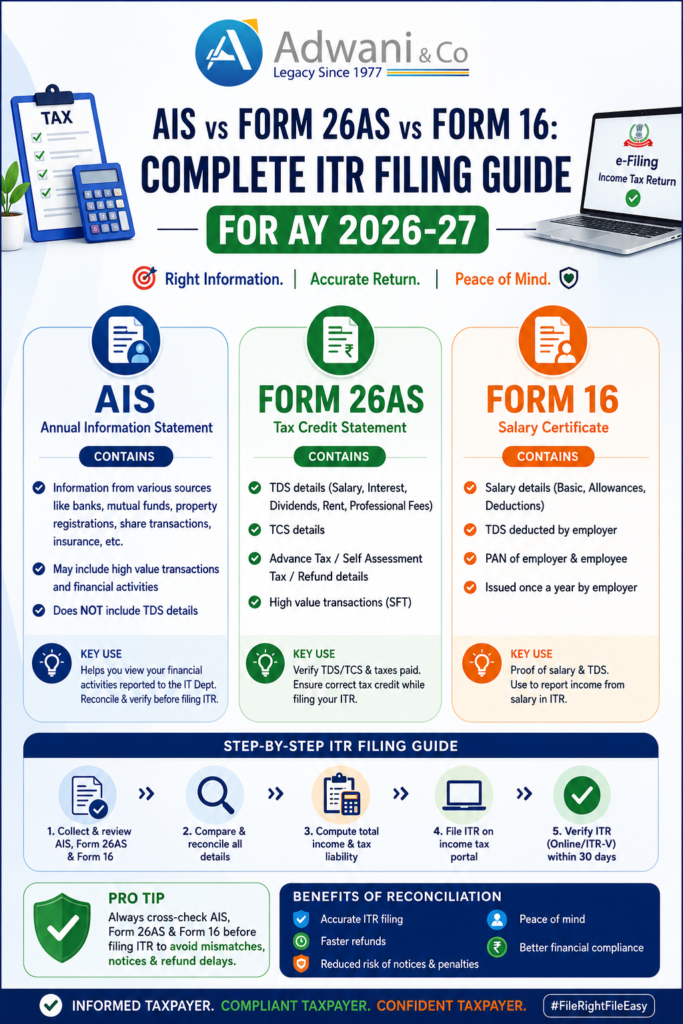
    One of the most impactful and most skipped tax saving actions before July 31 for AY 2026-27 is a thorough pre-filing reconciliation of your AIS (Annual Information Statement) and Form 26AS.

    These documents show what third parties — banks, employers, brokers, mutual funds — have reported to the Income Tax Department against your PAN. Mismatches between your ITR and the AIS cause:

    • Delayed refund processing
    • Defective return notices
    • Demand notices for income you didn’t actually earn (due to PAN errors in the AIS)

    Importantly, TDS already deducted from your interest income, rent received, or capital gains transactions is a prepaid tax. If those credits aren’t correctly claimed in your ITR, you’re effectively overpaying the government and getting nothing in return.

    Dr. Haresh Adwani notes: “Every filing at Adwani and Company begins with a full AIS-Form 26AS review. It’s the foundation. Without it, you’re filing blind.”


    Tax Saving Tip 4 : Capital Gains Reporting: LTCG, STCG & F&O for AY 2026-27

    LTCG and STCG tax on shares and mutual funds for AY 2026-27 has been restructured by the Union Budget 2024 amendments. Understanding the current rates is a critical income tax saving strategy before you file.

    Revised Capital Gains Tax Rates

    Asset TypeHolding PeriodTax Rate (Post-Budget 2024)
    Listed equity / equity MFs< 12 months (STCG)20% flat
    Listed equity / equity MFs≥ 12 months (LTCG > ₹1.25L)12.5% (no indexation)
    Debt mutual funds (post Apr 2023)AnyAs per income slab
    Property / unlisted shares≥ 24 months (LTCG)12.5% (no indexation)

    Practical Example : LTCG Planning:

    A taxpayer sold equity mutual fund units in January 2026 with a long-term capital gain of ₹2,80,000. The first ₹1,25,000 is fully exempt. The remaining ₹1,55,000 is taxed at 12.5%, resulting in a tax liability of ₹19,375 compared to ₹46,500 if mistakenly taxed at 30%.

    F&O Loss Carry Forward : A Time-Sensitive Tax Benefit:

    Losses from Futures & Options trading are treated as non-speculative business losses. These can be set off against other business income and carried forward for up to 8 years — but only if the ITR is filed by July 31. Filing late permanently forfeits this benefit under Section 80 of the Income Tax Act.

    Read our detailed guide on F&O Loss Tax Benefits and Carry Forward


    Tax Saving Tip 5 — Freelancers and Business Owners: Presumptive Taxation for AY 2026-27

    For freelancers, consultants, and small business owners, presumptive taxation under Section 44AD and 44ADA in 2026 remains one of the most powerful legal tax reduction tools available.

    Section 44ADA (for professionals doctors, architects, lawyers, CAs, engineers):

    • Declare 50% of gross receipts as taxable income
    • No requirement to maintain books of accounts (for receipts up to ₹75 lakh)
    • Significantly simplifies ITR filing for freelancers in India 2026

    Section 44AD (for small businesses):

    • Declare 8% of turnover (6% for digital transactions) as income
    • Available for turnovers up to ₹3 crore

    This approach eliminates the complexity of proving individual expenses and reduces effective tax significantly for service professionals. Learn more about our ITR Filing for Freelancers.


    Tax Saving Tip 6 : GST Compliance Before July 31 Reduces Risk and Penalty

    Tax saving isn’t limited to income tax. For business owners and professionals, GSTR-3B filing compliance in 2026 directly impacts cash flow and audit risk.

    The GST Portal now uses AI driven cross-verification to match GSTR-1 against GSTR-3B, flag input tax credit eligibility 2026 mismatches, and identify GSTR-2B reconciliation gaps. Discrepancies between these returns and your income tax filings can trigger both a GST scrutiny notice and an income tax inquiry simultaneously as both systems now share data.

    Key GST actions before July 31:

    • Reconcile GSTR-2B with your purchase register to ensure no ITC mismatch notice exposure
    • Ensure GSTR-3B figures match GSTR-1 for all prior periods
    • Clear any outstanding GST return late fee penalties to maintain clean compliance history
    • Update GST registration records if business address, directors, or turnover category has changed

    Learn more about our GST Compliance Service


    Tax Saving Tip 7 : Advance Tax Planning for FY 2026-27

    If your income includes freelancing fees, business profits, capital gains, rental income, or F&O trading, advance tax compliance for FY 2026-27 is your responsibility and the next due date matters for AY 2027-28 planning.

    InstallmentDue DateCumulative % of Tax
    1st (already passed)June 15, 202615%
    2ndSeptember 15, 202645%
    3rdDecember 15, 202675%
    4thMarch 15, 2027100%

    Taxpayers who underestimate income — especially those with significant capital gains from equity or F&O profits — frequently end up with interest under Sections 234B and 234C. Reviewing your expected FY 2026-27 income after filing the AY 2026-27 ITR is proactive planning.

    Read our Advance Tax Due Dates Guide FY 2026-27


    Key Takeaways : Tax Saving Tips Before July 31 for AY 2026-27

    • July 31, 2026 is the last date to file ITR for AY 2026-27 late filing attracts ₹5,000 penalty under Section 234F
    • ✅ Regime selection (old vs new) must be calculated, not assumed it’s the single biggest tax lever available
    • ✅ Standard deduction of ₹75,000 is available under the new regime for salaried individuals
    • ✅ AIS and Form 26AS reconciliation is mandatory before filing it protects your refund and prevents notices
    • ✅ LTCG on equity above ₹1.25 lakh is taxed at 12.5% — report it correctly in Schedule CG
    • ✅ F&O losses can only be carried forward if ITR is filed by July 31 filing late forfeits this right permanently
    • ✅ Freelancers and professionals can dramatically reduce tax via Section 44ADA presumptive taxation
    • ✅ GST compliance gaps before July 31 can trigger cross-system notices clean both systems together

    Frequently Asked Questions

    Q1. What is the last date to file ITR for AY 2026-27?

    ITR filing last date for AY 2026-27 is July 31, 2026 for individuals, HUFs, and non-audit cases. Filing after this deadline attracts a late fee of up to ₹5,000 under Section 234F, and you permanently lose the right to carry forward certain losses.

    Q2. Which tax regime saves more money in AY 2026-27?

    It depends on your deduction profile. The new regime is advantageous if your deductions are limited. The old regime wins when significant 80C, home loan interest, HRA, 80D, and NPS deductions are available. Always calculate both before making the selection.

    03.Can F&O losses be carried forward if I miss the July 31 deadline?

    No. Under Section 80 of the Income Tax Act, business losses including F&O non-speculative losses can only be carried forward if the return is filed on or before the due date. Missing July 31 permanently forfeits this benefit for FY 2025-26 losses.

    Q4. What happens if there’s a mismatch between AIS and my ITR?

    AIS ITR mismatches can result in defective return notices, delayed refund processing, or demand notices. Always reconcile your AIS and Form 26AS data before filing, and raise a correction request on the AIS portal if you find data errors.

    Q. Can salaried employees and freelancers file ITR themselves?

    Yes, both can file ITR online via the e-filing portal. However, freelancers with presumptive taxation claims, capital gains, or multiple income sources benefit significantly from professional review especially to ensure correct deduction claims and avoid defective return notices.

    Conclusion : Your Tax Saving Window Before July 31 for AY 2026-27 Won’t Wait

    The best time to act on tax saving tips before July 31 for AY 2026-27 was three months ago. The second-best time is today.

    Every element covered in this guide regime selection, deduction maximization, AIS reconciliation, capital gains reporting, GST compliance, and advance tax planning is available to every taxpayer right now. The difference between those who benefit from these provisions and those who don’t is rarely knowledge. It’s action.

    The Income Tax Department has made compliance more transparent and more consequential than ever. Filing with accuracy, on time, with every legitimate deduction claimed isn’t just good practice it’s the most financially rational thing a taxpayer can do before July 31, 2026.

    About the Author
    Dr. Haresh Adwani
    Ph.D. in Commerce | Law Graduate | Managing Partner, Adwani & Co LLP Dr. Haresh Adwani holds a Ph.D. in Commerce and is a qualified Law graduate with over two decades of hands-on experience in GST advisory, direct taxation, and statutory compliance for businesses across

    Legal Disclaimer: This article is published for informational and educational purposes only. Nothing contained herein constitutes legal, financial, or tax advice, nor should it be treated as a substitute for professional consultation tailored to your specific circumstances. Tax laws, rates, and provisions are subject to change; readers are strongly advised to consult a qualified Chartered Accountant or tax advisor before acting on any information in this article.

    All content is original. References to government portals and statutory provisions are paraphrased for educational purposes in compliance with fair use principles. No content has been reproduced from third-party sources.

    Don’t leave money on the table this July 31.

    👉 Connect with Adwani and Company today for expert guidance on tax saving strategies for AY 2026-27. Visit adwaniandco.com or schedule a consultation before the deadline closes.

  • Income Tax Updates AY 2026-27: New ITR Forms Guide

    Income Tax Updates AY 2026-27: New ITR Forms Guide

    Income Tax Updates AY 2026-27
    Income Tax Updates AY 2026-27

    Key Highlights of AY 2026-27

    • New Income Tax Act, 2025 effective from 1 April 2026
    • ITR-1 now allows up to 2 house properties
    • LTCG up to ₹1.25 lakh allowed in ITR-1
    • Aadhaar Enrolment ID no longer valid
    • Form 16 renamed as Form 130
    • Dual mobile numbers and email IDs mandatory
    • New drop-down deduction reporting system

    A New Tax Era Begins Are You Ready?

    If you have been putting off your return planning, here is the signal you needed: the Income Tax Updates AY 2026-27 represent the most comprehensive overhaul of the Indian income tax system in recent memory. From revamped ITR forms to entirely renamed statutory documents, every taxpayer salaried employee, business owner, or professional will feel the impact this season. Understanding these changes now is not just smart; it is essential to avoiding penalties and missed deadlines.

    As per the official communication from the Income Tax Department of India, the department has released the fully revamped ITR forms ITR-1 through ITR-7 under the new Income Tax Act, 2025 and Income Tax Rules, 2026, effective from 1 April 2026. This is not a cosmetic update. The structural changes in compliance, deduction reporting, Aadhaar validation, and capital gain disclosures are significant and being unaware of them could cost you dearly.

    Quick FactThe Income Tax Department has revamped ITR-1 to ITR-7 under a brand-new compliance framework effective from 1 April 2026. Both AY 2026-27 (for past income) and TY 2026-27 (for current compliance) are now managed through the same e-filing portal simultaneously.

    In this detailed guide, Pavan Adwani– Corporate Advisory & Tax Compliance Lead at Adwani & Co LLP, with over two decades of hands-on practice since 2002 breaks down every critical change so you can file with confidence, avoid penalties, and stay fully compliant under the new regime.

    The New Income Tax Framework: Act 2025 & Rules 2026

    The Income Tax Act, 2025 replaces the decades-old Income Tax Act, 1961 in its compliance and procedural architecture. While the substantive tax rates remain broadly similar, the procedural rules governing income tax updates AY 2026-27 filings have been substantially modernised. The new Income Tax Rules, 2026 introduce precision-driven reporting, mandatory digital validation, and a cleaner form architecture.

    According to the Income Tax Department’s official notification, the changes aim to reduce ambiguity in reporting, streamline deduction claims, and improve the accuracy of advance reconciliation between TDS credits and actual income declarations. incometax.gov.in

    With over 22 years of structured, process-oriented advisory experience, Pavan Adwani notes that procedural changes consistently catch taxpayers off-guard. “Many clients understand what they owe but the new rules change how they must report it. One incorrect drop-down selection in deductions, or an outdated Aadhaar format, and your return gets flagged as defective. That triggers notices, delays, and unnecessary stress,” he explains.

    Also Read:

    https://itradvisor.in/blog/itr-1-vs-itr-2-vs-itr-3-vs-itr-4

    Critical ITR Filing Due Dates for Income Tax AY 2026-27

    Missing a due date under the income tax updates AY 2026-27 framework can attract late-filing fees under Section 234F, interest liability, and in some cases, loss of deductions. Mark your calendar with these non-negotiable deadlines:

    31 July 2026

    Salaried individuals, pensioners & non-audit casesITR-1 & ITR-2

    31 August 2026

    Non-audit businesses & professionalsITR-3 & ITR-4

    31 October 2026

    Businesses or professions requiring a tax auditITR-3, ITR-5 & ITR-6

    30 November 2026

    Transfer pricing cases Applicable Assessees

    Pro Tip from Adwani & Co LLPDo not wait until July. Start reconciling your AIS (Annual Information Statement), TDS credits, and capital gain statements now. The new forms require more granular data, and gathering it at the last minute invariably leads to errors and missed deductions.

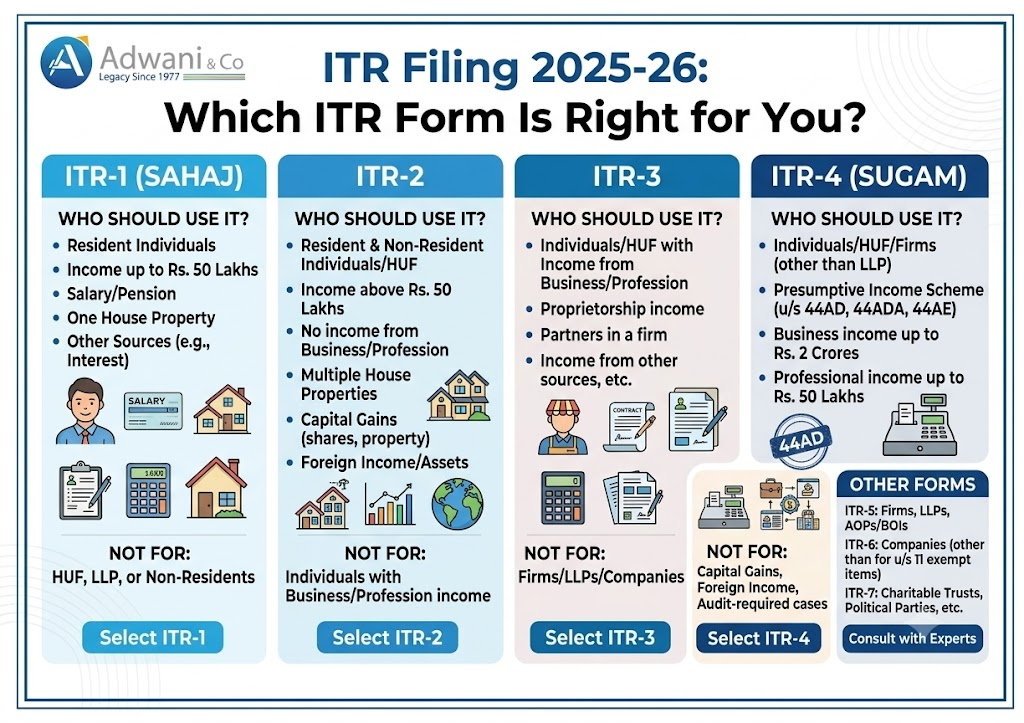
    ITR Forms at a Glance: Which Form Is Right for You?

    One of the most critical aspects of the income tax updates AY 2026-27 is selecting the correct ITR form. Filing the wrong form is treated as a defective return by the department. Here is a comprehensive overview of all seven forms:

    FormSuitable For
    ITR-1 (SAHAJ)Resident Individuals Salary, pension, up to 2 house properties, other sources, LTCG up to ₹1.25 lakh (Section 112A)
    ITR-2Individuals & HUFs Capital gains above limit, multiple HPs, foreign assets or foreign income
    ITR-3Individuals & HUFs Business or profession income including F&O and intraday trading
    ITR-4 (SUGAM)Individuals, HUFs, Firms Presumptive income under Sections 44AD, 44ADA, 44AE up to ₹50 lakh
    ITR-5Firms, LLPs, AOPs Entities other than individuals, HUFs, companies or charitable trusts
    ITR-6Companies All corporate entities not claiming exemption under Section 11
    ITR-7Trusts & Institutions Persons/companies required to furnish returns under Sections 139(4A)/(4B)/(4C)/(4D)

    Key Income Tax Updates in ITR-1 (SAHAJ) & ITR-4 (SUGAM) for AY 2026-27

    Among all the income tax updates AY 2026-27, the changes to the two most commonly used forms ITR-1 and ITR-4 will affect the largest number of taxpayers. Here is a detailed breakdown of what has changed:

    1. LTCG Relief Now Available in ITR-1

    For the first time, taxpayers with Long-Term Capital Gains (LTCG) under Section 112A of up to ₹1.25 lakh can report them directly in ITR-1 (SAHAJ) provided there are no brought-forward or carry-forward losses from previous years. This is a significant simplification that saves lakhs of small investors from filing the more complex ITR-2.Capital Gains Tax Information

    2. Two House Properties Now Permitted in ITR-1

    Previously, owning more than one house property meant moving to ITR-2. Under the new rules, individuals with up to two house properties can continue using the simpler ITR-1 form. This single change makes ITR-1 accessible to a much wider segment of the middle-class taxpayer base.

    3. Drop-Down Deduction Selection No More Free-Text

    Deduction claims under Sections 80C to 80U must now be selected via a mandatory drop-down menu with exact sub-sections. This requires taxpayers to know precisely which sub-section their investment falls under for example, Section 80C(a) for EPF contributions versus 80C(b) for PPF deposits.

    4. Aadhaar Enrolment ID Is No Longer Valid

    A critical compliance point under the income tax updates AY 2026-27: the 28-digit Aadhaar Enrolment ID is no longer accepted on the e-filing portal. Only the 12-digit Aadhaar Number will be accepted. Ensure your Aadhaar is linked to your PAN before filing.

    5. Dual Contact Details Are Now Mandatory

    The new ITR forms require both a primary and a secondary contact two email addresses and two mobile numbers. This is part of the department’s push to improve official communication and reduce undelivered notices.

    Action Checklist Before Filing(1) Confirm your 12-digit Aadhaar is linked to PAN. (2) Identify the exact 80C–80U sub-section for each deduction. (3) Prepare two valid email IDs and mobile numbers. (4) Check your LTCG if under ₹1.25 lakh and no losses, you may use ITR-1. (5) Confirm whether you qualify for ITR-1 with your two house properties.

    Major Renaming of Statutory Forms: Income Tax Rules, 2026

    One of the lesser-known but highly impactful changes in the income tax updates AY 2026-27 is the comprehensive renaming of statutory forms. Many compliance documents that professionals and employers have used for years now carry entirely new form numbers under the Income Tax Rules, 2026. Submitting a document using its old name may cause confusion or rejection in tax proceedings.

    130 New Form – Earlier: Form 16

    Employer Salary TDS Certificate

    168 New Form – Earlier: Form 26AS

    Tax Credit Statement (TDS/TCS)

    121 New Form – Earlier: Form 15G/15H

    Declaration for Non-Deduction of TDS on Interest.

    26 New Form – Earlier: Form 3CA/3CB/3CD

    Unified Tax Audit Report

    141 New Form – Earlier: Forms 26QB/26QC/26QD/26QE

    Property & Rent TDS Reporting

    Pavan Adwani strongly advises all HR teams, employers, and compliance officers to immediately update their internal document templates to reflect the new form numbers. “Using Form 16 instead of Form 130, or Form 26AS instead of Form 168, in a notice reply or regulatory submission can create avoidable complications. Update your templates now not after the notices arrive,” he advises from his two-plus decades of GST and income-tax advisory practice.

    Two Systems, One Portal: AY vs TY – Know the Difference

    A uniquely confusing aspect of the income tax updates AY 2026-27 is that the e-filing portal now simultaneously supports two distinct compliance frameworks. Many taxpayers are unsure which year to select at the time of filing. Here is the clear, practical distinction:

    • AY 2026-27 :- Select this to report income earned during FY 2025-26 (1 April 2025 to 31 March 2026). This is your standard annual income tax return for the past financial year.
    • TY 2026-27 :- Select this for compliance requirements tracking current transactions and ongoing obligations under the new Income Tax Act, 2025, starting from 1 April 2026 onwards.

    Common Mistake AlertSelecting TY 2026-27 when you intend to file your regular annual return will result in a misclassified submission. Always choose AY 2026-27 for reporting your FY 2025-26 income. When in doubt, contact the Adwani & Co LLP team before submitting.

    Practical Example: Choosing the Right ITR Under the New Rules

    To make the income tax updates AY 2026-27 more tangible, consider this real-world scenario that the advisory team at Adwani & Co LLP frequently encounters:

    Meet Rahul – Salaried IT Professional, Pune

    Rahul earns ₹14.5 lakh per annum from salary, owns two residential flats (one self-occupied, one let out), and sold some mutual fund units in January 2026, generating LTCG of ₹92,000 under Section 112A. He has no brought-forward losses.

    Salary Income₹14,50,000
    Rental Income (Flat 2, after standard deduction)₹1,80,000
    LTCG under Section 112A₹92,000
    Section 80C Deductions (EPF + PPF)₹1,50,000
    Standard Deduction (Salaried)₹75,000
    ✅ Recommended Form: ITR-1 (SAHAJ) – qualifies under new AY 2026-27 rules (2 HPs now permitted + LTCG under ₹1.25 lakh)

    Under the pre-2026 rules, Rahul would have been compelled to file ITR-2 due to his two house properties. The new income tax updates AY 2026-27 now allow ITR-1 saving significant time and reducing complexity for millions of taxpayers like him.

    Professional Advisory: What Pavan Adwani Recommends for AY 2026-27

    With over two decades of structured tax advisory experience spanning GST, income-tax consultation, corporate regulatory compliance, and statutory documentation  Pavan Adwani of Adwani & Co LLP offers the following strategic guidance for taxpayers navigating the income tax updates AY 2026-27:

    1. Reconcile Your AIS and TDS Credits Without Delay

    The Annual Information Statement (AIS) available on the e-filing portal now captures a far wider range of transactions including mutual fund redemptions, dividend income, rent receipts, and foreign remittances. Any mismatch between your AIS and your ITR can trigger a scrutiny notice. Pavan Adwani recommends downloading your AIS today and reconciling it against your own records before the filing rush begins.

    2. Verify All Capital Gain Statements from Brokers and AMCs

    The new drop-down mechanism requires precise classification of capital gains by holding period and asset type. Pull your consolidated account statement (CAS) from CDSL or NSDL, and obtain capital gain statements from each mutual fund house separately. AMCs such as CAMS and KFintech provide structured reports that can be directly referenced for ITR preparation.

    3. Maintain Supporting Documentation for Every Deduction Claim

    Given the new mandatory sub-section-level drop-down for 80C–80U deductions, ensure you retain all supporting documents EPF statements, PPF passbooks, LIC premium receipts, home loan certificates, school fee receipts, and medical bills. In any scrutiny proceeding, the burden of proof rests with the taxpayer. Taxpayers can review and download their AIS directly from the official Income Tax portal.

    4. Update PAN–Aadhaar Linking

    If your PAN is not yet linked to your 12-digit Aadhaar, your ITR will be treated as invalid and TDS refunds may be withheld. The e-filing portal will not accept a 28-digit Aadhaar Enrolment ID under any circumstances for AY 2026-27. Verify your linking status at incometax.gov.in before attempting to file. PAN-Aadhaar Linking Portal

    5. Evaluate Whether Presumptive Taxation Applies to Your Business

    If you run a small business or are a professional with gross receipts under ₹50 lakh, ITR-4 (SUGAM) under the presumptive taxation scheme (Sections 44AD/44ADA/44AE) may substantially simplify your compliance burden. Pavan Adwani and his team regularly guide business clients through eligibility evaluation ensuring they are not over-filing or under-utilising available simplifications.

    🏛 Advisory Note from Pavan Adwani“The new rules bring in much-needed procedural precision. But they also shrink the margin for error. Taxpayers who reconcile their AIS early, maintain clear documentation, and work with a structured compliance partner will find this season far smoother than those who rush at the deadline. Our team at Adwani & Co LLP has already begun proactive planning for all our clients for AY 2026-27.”

    Frequently Asked Questions Income Tax Updates AY 2026-27

    1. What are the major income tax updates for AY 2026-27?

    The major income tax updates AY 2026-27 include: revamped ITR forms (ITR-1 to ITR-7) under the Income Tax Act, 2025 and Rules, 2026; LTCG up to ₹1.25 lakh reportable in ITR-1; two house properties now allowed in ITR-1; mandatory drop-down selection for 80C–80U deductions; rejection of 28-digit Aadhaar Enrolment IDs; mandatory dual contact details; and comprehensive renaming of statutory forms for example, Form 16 is now Form 130, and Form 26AS is now Form 168.

    2. What is the last date to file ITR for AY 2026-27?

    For salaried individuals and non-audit cases (ITR-1 and ITR-2): 31 July 2026. Non-audit businesses and professionals (ITR-3 and ITR-4): 31 August 2026. Businesses requiring a tax audit (ITR-3, ITR-5, ITR-6): 31 October 2026. Transfer pricing cases: 30 November 2026.

    3. Can a salaried person with two houses use ITR-1 for AY 2026-27?

    Yes. Under the income tax updates AY 2026-27, individuals with up to two house properties can now file ITR-1 (SAHAJ), provided their other income conditions are met salary or pension income, LTCG under ₹1.25 lakh under Section 112A with no carry-forward losses. This is a key change from prior years where two house properties required ITR-2.

    4. What has Form 26AS been renamed to under the new income tax rules 2026?

    Under the Income Tax Rules, 2026, Form 26AS (Tax Credit Statement) has been renamed Form 168. Similarly: Form 16 is now Form 130, Form 15G/15H is now Form 121, the Tax Audit Report (Form 3CA/3CB/3CD) is now Form 26, and the property/rent TDS forms (26QB/26QC/26QD/26QE) are consolidated as Form 141.

    5. What is the difference between AY 2026-27 and TY 2026-27 on the e-filing portal?

    AY 2026-27 is selected for reporting your income earned during FY 2025-26 (1 April 2025 to 31 March 2026) your standard annual return. TY 2026-27 is for compliance requirements under the new Income Tax Act, 2025, tracking transactions from 1 April 2026 onwards. Most individual taxpayers filing their regular return should select AY 2026-27.

    Conclusion: Plan Early, File Smart, Stay Compliant

    The income tax updates AY 2026-27 are not incremental tweaks they represent a structural transformation of India’s tax compliance framework. From the revamped ITR forms under the Income Tax Act, 2025 and Rules, 2026, to renamed statutory documents, tightened Aadhaar validation requirements, and new capital gain reporting flexibility in ITR-1, every taxpayer faces a meaningfully different filing experience this year.

    The good news is that with the right preparation reconciling your AIS early, selecting the correct ITR form, updating your Aadhaar PAN linkage, and understanding the new form names the process can be entirely manageable. What separates a smooth filing season from a stressful one is almost always preparation and professional support.

    As Pavan Adwani consistently emphasises with clients: “Tax compliance is not about fear it is about being informed, being organised, and having the right partner in your corner. With 22+ years of practice across GST, income-tax, and corporate compliance, our team at Adwani & Co LLP is already at work preparing every client for what AY 2026-27 demands. The earlier you start, the stronger your position.”

    Ready to File with Confidence?

    Get expert guidance on the income tax updates AY 2026-27 from Pavan Adwani and the professional team at Adwani & Co LLP Trusted Advisors. Lasting Value. Pimpri, Pune.Connect with Adwani & Co LLP Today →

    Author

    Pavan Adwani – Corporate Advisory, Tax Compliance & Regulatory Management.

    He is actively involved in advising business entities on corporate compliance, tax management, and regulatory frameworks, with a structured and process-oriented approach.

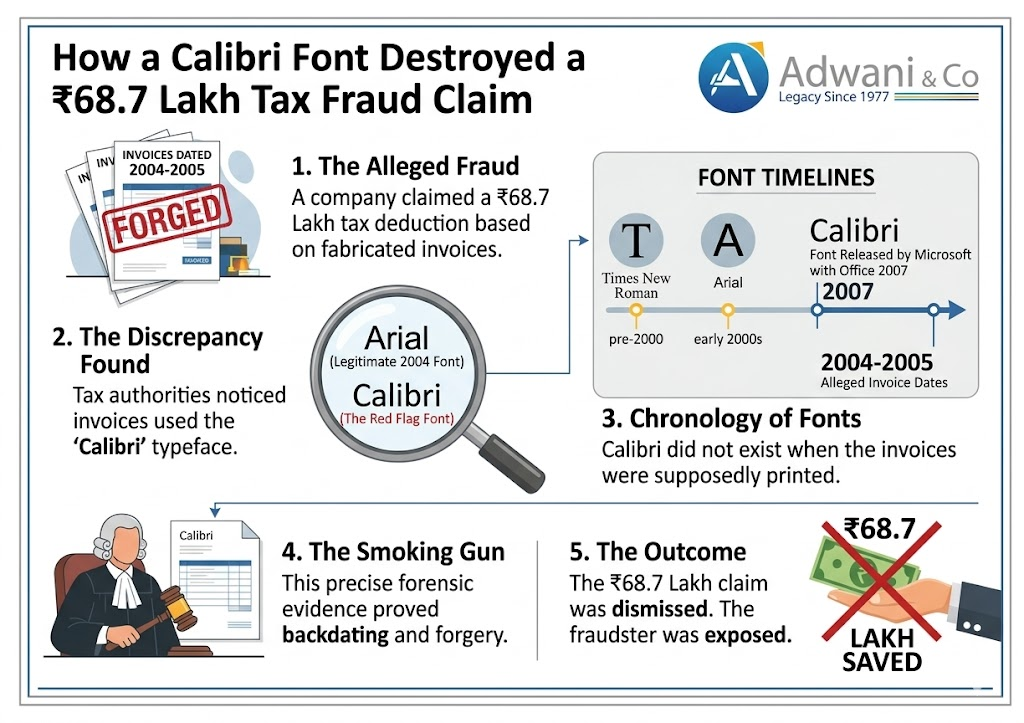
  • How a Calibri Font Destroyed a ₹68.7 Lakh Tax Fraud Claim

    How a Calibri Font Destroyed a ₹68.7 Lakh Tax Fraud Claim

    Dr. Haresh Adwani, May 2026, 9 min read

    A taxpayer walked into the Income Tax Department in Hyderabad believing their paperwork was airtight. They had ₹68.7 lakh in claimed deductions, a pile of improvement bills spanning six years, and a taxable gain reduced to an almost negligible ₹24,774. Everything looked fine until an officer noticed one small, damning detail: the font.

    In what has become a landmark example of how tax fraud detection in India is growing increasingly sophisticated, the Calibri font tax fraud case from Hyderabad is a stark reminder that document authenticity matters more than ever. Whether you are a business owner, a salaried professional, or an NRI dealing with property transactions, this case has lessons that could protect you or expose you.

    At Adwani and Company, led by Dr. Haresh Adwani  a PhD holder in Commerce and a law graduate with deep expertise in direct taxation we have seen firsthand how easily avoidable mistakes can trigger scrutiny. Let us walk you through exactly what happened, why it matters, and what you must do to stay compliant.


    The Calibri Font Tax Fraud Case: What Actually Happened

    The case centers on a property transaction in Hyderabad. A taxpayer sold a residential property for ₹1.4 crore. Under the provisions of the Income Tax Act, 1961, Long-Term Capital Gains (LTCG) on the sale of property held for more than two years are taxable. However, the law also permits deductions for cost of improvement genuine expenditures made to enhance the value of the property.

    The taxpayer submitted a set of improvement bills dated between 2002 and 2008, collectively totaling ₹68.7 lakh. After applying these as deductions against the sale proceeds, the taxable long-term capital gain was reduced to a mere ₹24,774. On paper, this was a legitimate, well-structured claim. In practice, it was a fabrication and an expensive one.

    The Income Tax Department’s scrutiny officer flagged this anachronism. Faced with an undeniable factual inconsistency, the taxpayer withdrew the fraudulent claim and paid the correct tax amount. There was no lengthy litigation the font spoke for itself.


    Understanding Long-Term Capital Gains and Calibri Font Tax Fraud Risks

    To understand the full implications of this Calibri font tax fraud, you need to understand how LTCG deductions work under Indian tax law. According to the Income Tax Department of India, the taxable capital gain on the sale of a long-held asset is calculated as:

    Taxable LTCG = Sale Price (Indexed Cost of Acquisition + Indexed Cost of Improvement)

    The cost of improvement covers genuine renovation, reconstruction, or structural enhancement expenditures that increase the asset’s value. These must be supported by original bills, receipts, and in many cases corroborating evidence such as contractor agreements or building permits.

    As Dr. Haresh Adwani frequently advises clients at Adwani and Company: “The law does not punish genuine claims. It punishes fabricated ones. The problem is that many taxpayers do not preserve original records and then attempt to reconstruct them at the time of sale often with modern tools that inadvertently leave digital fingerprints.”

    Learn more about our Ultimate Financial Modeling to Normalize Business Valuation in India


    Real Numerical Example: How the ₹68.7 Lakh Calibri Fraud Unravelled

    Practical Illustration

    Property Sale Tax Calculation — Fraudulent vs. Legitimate

    ItemFraudulent ClaimActual (After Withdrawal)
    Sale Price of Property₹1,40,00,000₹1,40,00,000
    Indexed Cost of Acquisition₹71,25,226₹71,25,226
    Claimed Improvement Costs₹68,70,000 (fake)₹0
    Taxable Long-Term Capital Gain₹24,774₹68,74,774
    Tax Liability @ 20% (approx.)≈ ₹4,955≈ ₹13,74,955

    Note: Indexation applies per the Cost Inflation Index notified by the Income Tax Department each financial year. Consult a CA for your exact computation.

    The difference in tax liability was staggering nearly ₹13.7 lakh in tax that would have gone unpaid, not counting any penalties or interest under Sections 270A and 234B of the Income Tax Act. This is precisely why the Income Tax Department scrutinizes improvement cost claims so rigorously.


    Why Document Forensics in Tax Fraud Detection Is Growing in India

    The Calibri font tax fraud case is not an isolated incident. It is a window into a much broader trend. India’s tax administration has been investing significantly in advanced analytics, Artificial Intelligence tools, and document forensics as part of the broader digital transformation of the Income Tax Department.

    The department’s data analytics wing powered by integrated systems that link PAN, GST, MCA filings, and bank records can now triangulate inconsistencies that would have gone undetected a decade ago. Metadata embedded in digital documents, font version histories, and even printer calibration patterns have all been used internationally to expose forged records.

    In India, the GST Portal and the Ministry of Corporate Affairs (MCA) maintain interconnected registries. A claimed business expenditure that does not appear in a supplier’s GST return will immediately raise a red flag. Similarly, improvement bills from contractors who were never registered, never filed returns, or ceased to exist years ago are vulnerable to challenge.


    What Forensic Auditors Look for in Suspicious Documents

    • Font anachronisms : as in the Calibri font tax fraud case, fonts postdating the document’s claimed date
    • Metadata mismatches : PDF creation dates that contradict stated document dates
    • Printer and scanner artifacts : inkjet patterns inconsistent with era-appropriate technology
    • Paper quality and ageing : physical documents that show signs of artificial ageing
    • Signature inconsistencies : graphological analysis of handwriting
    • Cross-referencing with GST/TDS records : verifying whether the contractor claimed income from the project

    Expert Insight from Adwani and CompanyAccording toDr. Haresh Adwani, “The single most effective protection against scrutiny is maintaining contemporaneous, original records. Store bills the day you receive them. Photograph physical receipts. Cross-verify with your contractor’s GST returns. An authentic paper trail is your strongest defence.”


    Calibri Font Tax Fraud Lessons for NRIs, Business Owners, and Professionals

    The Calibri font tax fraud case resonates especially loudly for three groups: Non-Resident Indians managing property in India, business owners reconstructing historical expenditure records, and professionals advising clients on capital gains transactions.

    For NRIs: Extra Scrutiny on Property Sales

    NRIs selling property in India are subject to TDS deductions on the buyer’s side, and their capital gains are audited more frequently than resident taxpayers. Fabricating improvement bills is especially risky when the underlying property was acquired decades ago and supporting contractors may no longer be traceable.  Read our detailed guide on NRI Tax Rules: 10 Critical Questions Before Returning to India

    For Business Owners: GST Linked Verification

    Business improvement or renovation costs claimed for commercial properties must now be reconciled against the GST invoices filed by the vendor. If a contractor was unregistered or did not file returns, any bills issued by them become suspect. The Income Tax Department can and does cross-verify these records with the GST portal.

    For CA Firms and Tax Professionals

    At Adwani and Company, our document review process includes timeline verification, metadata checks, and cross-referencing with publicly available GST and MCA records before any improvement cost deduction is claimed on behalf of clients. This is not excessive caution it is professional due diligence.


    How to Legitimately Reduce Long-Term Capital Gains Tax in India

    The good news is that the Income Tax Act provides several legitimate avenues to reduce your LTCG liability — none of which require fabricated bills or font gambles.

    1. Section 54 Exemption: Reinvest the capital gains in a new residential property within two years of sale (or construct within three years). This is one of the most widely used, fully legitimate exemptions available.
    2. Section 54EC Bonds: Invest up to ₹50 lakh in specified bonds (REC, NHAI) within six months of the sale. The invested amount is exempt from LTCG taxation.
    3. Indexation Benefit: Use the government’s published Cost Inflation Index (CII) to inflate your acquisition cost, significantly reducing the computed gain.
    4. Genuine Improvement Costs: Claim genuine, well-documented renovation and improvement expenditures. Original bills, bank payment records, and contractor GST invoices form the backbone of a defensible claim.
    5. Capital Gains Account Scheme: If you cannot immediately reinvest, deposit the gains in a Capital Gains Account with a scheduled bank before the ITR filing deadline.

    ✅ Key TakeawayEvery rupee of tax you save through legitimate means is a rupee the law intended you to keep. Every rupee saved through falsification is a liability that compounds — with interest, penalties, and potential prosecution under Section 276C of the Income Tax Act.


    Calibri Font Tax Fraud and the Broader Message: Records Are Your Shield

    The deeper message of the Calibri font tax fraud case is not about technology. It is about culture. Indian taxpayers and businesses have historically underinvested in record-keeping infrastructure. Physical receipts are lost; digital documents are not backed up; contractor relationships are informal and undocumented.

    As India’s tax administration increasingly converges GST, income tax, TDS, and MCA data into unified analytical systems, the tolerance for informal or reconstructed records is approaching zero. The Income Tax Department has explicitly stated in recent departmental communications that unexplained discrepancies between filed returns and third-party data will trigger automated scrutiny.

    Dr. Haresh Adwani summarizes it plainly: “In 2002, a typing error might have gone unnoticed. In 2026, the tax system has a longer memory than you do and it does not forget fonts.”

    Frequently Asked Questions

    01. What is Calibri font tax fraud case in India?

    The Calibri font tax fraud case refers to a recent incident in Hyderabad where a taxpayer submitted fake property improvement bills dated 2002–2008 to claim ₹68.7 lakh in LTCG deductions. One bill was typed in Calibri (Body) font, which was not publicly available until around 2006, exposing the document as fraudulent.

    02. Can I claim improvement costs to reduce Long Term Capital Gains tax?

    Yes, genuine improvement costs are deductible under the Income Tax Act, 1961. However, you must have original, authentic supporting documents bills, receipts, bank payment records, and GST invoices from the contractor. Fabricated or reconstructed bills are a criminal offence.

    03.How does Income Tax department detect fake bill?

    The department uses multiple methods: document forensics (including font timeline analysis), metadata extraction from digital files, cross-referencing with GST returns, TDS records, MCA filings, and bank transaction data. Advanced analytics tools flag anomalies automatically.

    04. What are the penalties for submitting fake bills to Income Tax Department?

    Penalties can include 200% of the tax evaded under Section 270A (misreporting), interest under Sections 234A/B/C, and criminal prosecution under Section 276C for willful evasion, which can result in imprisonment of up to seven years along with a fine.

    05. How can NRI’s legally save tax on property sales in India

    NRIs can use Section 54 (reinvestment in residential property), Section 54EC (capital gains bonds up to ₹50 lakh), indexation benefits, and genuine documented improvement costs. Consulting a specialist CA firm like Adwani and Company is strongly recommended before filing.

    06.What records should i maintain for property improvement cost?

    Maintain original paper receipts and bills, digital scans with unaltered metadata, bank payment statements or cheque records, contractor agreements, GST invoices from registered vendors, and any municipal permits related to renovation work. Keep these for at least six years from the date of filing the relevant ITR.

    Conclusion

    The Calibri font tax fraud case is a watershed moment in Indian tax enforcement. What began as a seemingly mundane property transaction unravelled because of a microscopic detail a typeface that didn’t exist when a document claimed to have been created. The taxpayer lost ₹68.7 lakh in deductions, faced potential penalties, and perhaps most damagingly lost the benefit of the doubt.

    The lesson is not that the Income Tax Department is infallible or omniscient. The lesson is that authenticity is non-negotiable. Genuine records, maintained at the time of the transaction, remain your most powerful legal protection in any tax dispute.

    India’s tax system is moving toward full digital integration GST, Income Tax, MCA, TDS, and bank data are increasingly speaking to each other in real time. In this environment, a shortcut taken in 2002 can cost you in 2026. A font can sink a ₹68.7 lakh claim.

    About the Author
    Dr. Haresh Adwani
    Ph.D. in Commerce | Law Graduate | Managing Partner, Adwani & Co LLP Dr. Haresh Adwani holds a Ph.D. in Commerce and is a qualified Law graduate with over two decades of hands-on experience in GST advisory, direct taxation, and statutory compliance for businesses across

  • Capital Gains Tax India 2025: Your Complete Guide to Save More and Pay Less

    Capital Gains Tax India 2025: Your Complete Guide to Save More and Pay Less

    capital gains tax India 2025
    capital gains tax India 2025

    Are You Paying More Capital Gains Tax Than You Should?

    You just sold a property. Or perhaps you exited mutual funds after years of patient holding. The money lands in your account and instantly the question follows: how much of this belongs to the government?

    Capital gains tax in India 2025 is one of the most misunderstood areas of personal finance. Thousands of taxpayers overpay every single year, simply because they do not know the updated rules. Others face compliance notices because they assumed rates from two years ago still apply. The truth is, the Union Budget 2024 fundamentally overhauled the entire capital gains framework, and if you have not updated your knowledge, you are either leaving money on the table or under-reporting tax.

    This guide by the experts at Adwani and Company breaks down everything you need to know about capital gains tax in India 2025: the updated rates, revised holding periods, available exemptions, and legal strategies to reduce your tax outgo. Whether you own stocks, real estate, gold, or mutual funds, read this before your next transaction. And if you have already filed or are preparing to file, also read our companion blog: ITR Filing 2026: No Longer Optional at www.adwaniandco.com/blog/itr-filing-2026-no-longer-optional.

    What Is Capital Gains Tax in India 2025?

    Capital gains tax is the tax levied on the profit you earn when you sell a capital asset. A capital asset includes land, buildings, listed shares, equity mutual funds, debt funds, gold, bonds, debentures, and even intellectual property such as patents and trademarks. When you sell any of these at a profit, the resulting gain is taxable in the financial year of transfer, regardless of when you actually receive the cash.

    The Income Tax Department of India classifies capital gains into two broad categories based on how long you held the asset before selling:

    • Short-Term Capital Gains (STCG): Profits earned from assets sold before completing the qualifying minimum holding period.
    • Long-Term Capital Gains (LTCG): Profits from assets held beyond the qualifying period, attracting lower, preferential tax rates designed to encourage long-term investment.

    The most important change of the last two years: all LTCG is now uniformly taxed at 12.5% for most asset classes. This replaced a fragmented, asset-specific structure and marks the most significant simplification of capital gains tax in India in decades.

      Key Takeaway: Capital gains tax in India 2025 is now simpler structurally but demands sharper planning. The rate is uniform. The strategy is personal. 

    LTCG vs STCG: Know Your Holding Periods for Capital Gains Tax India 2025

    Getting the holding period right is the single most important first step in capital gains tax planning India 2025. Misclassifying a long-term gain as short-term or vice versa leads to either excess tax payment or a compliance notice.

    For Listed Equity Shares and Equity-Oriented Mutual Funds:

    • Hold for more than 12 months → Long-Term Capital Gain (LTCG) taxed at 12.5% under Section 112A
    • Sell within 12 months → Short-Term Capital Gain (STCG) taxed at 20% under Section 111A (revised from 15% effective 23 July 2024)

    For Real Estate, Gold, Unlisted Securities, Debt Funds, and Other Assets:

    • Hold for more than 24 months → Long-Term Capital Gain (LTCG) at 12.5%
    • Sell within 24 months → Short-Term Capital Gain (STCG) taxed at your applicable income slab rate

    These rules, effective from 23 July 2024, now apply consistently. As clarified by the Income Tax Department, capital gains are always taxed at special rates outside the regular slab structure, under both the old and new tax regimes.

    Equity investor note: The first ₹1.25 lakh of LTCG from listed equity shares and equity-oriented mutual funds remains tax-free each financial year under Section 112A. Only gains above this threshold attract the 12.5% LTCG rate.

    Capital Gains Tax Rates India 2025 Complete Rate Table

    Asset TypeHolding PeriodClassificationTax Rate
    Listed equity shares / equity mutual funds> 12 monthsLTCG (Sec 112A)12.5% (₹1.25 lakh exempt)
    Listed equity shares / equity mutual funds≤ 12 monthsSTCG (Sec 111A)20%
    Real estate, gold, unlisted shares> 24 monthsLTCG12.5% (no indexation)
    Residential property (bought before 23 Jul 2024)> 24 monthsLTCG (choice)12.5% without indexation OR 20% with indexation
    Real estate, gold, other assets≤ 24 monthsSTCGIncome slab rate
    Debt mutual funds (≤35% equity, bought after 1 Apr 2023)AnySpecial (Sec 50AA)Income slab rate

    Practical Capital Gains Tax Example India 2025

    Example 1: Selling Listed Equity Shares (LTCG with ₹1.25 Lakh Exemption)

    Priya bought 2,000 shares of a listed company in May 2024 at ₹150 each. Total cost: ₹3,00,000. She sold all of them in August 2025 at ₹280 each. Sale value: ₹5,60,000.

    StepCalculationAmount
    Holding PeriodMay 2024 to August 2025 = 15 months> 12 months → LTCG
    Total Capital Gain₹5,60,000 − ₹3,00,000₹2,60,000
    Section 112A ExemptionFirst ₹1,25,000 is tax-free−₹1,25,000
    Taxable LTCG₹2,60,000 − ₹1,25,000₹1,35,000
    LTCG Tax @ 12.5%₹1,35,000 × 12.5%₹16,875
    If sold within 12 months (STCG)₹2,60,000 × 20%₹52,000 (3x higher!)

    This single comparison illustrates why holding equity beyond 12 months is one of the most powerful capital gains tax planning strategies in India 2025.

    Example 2: Property Sale Indexation vs No-Indexation Decision

    Ramesh purchased a residential flat in Mumbai in April 2012 for ₹45 lakh. He sold it in March 2026 for ₹1.85 crore. Since this property was purchased before 23 July 2024, Ramesh can choose between two tax routes:

    OptionCalculationTax Payable
    12.5% LTCG (No Indexation)Gain = ₹1,85,00,000 − ₹45,00,000 = ₹1,40,00,000 × 12.5%₹17,50,000
    20% LTCG (With Indexation)Indexed cost = ₹45L × (376/200) = ₹84.6L; Gain = ₹1,85L − ₹84.6L = ₹1,00.4L × 20%₹20,08,000
    Best Option12.5% without indexation saves ₹2,58,000 in this caseChoose 12.5%

    CII for FY 2025-26 is 376 as notified by CBDT. CII for FY 2012-13 was 200. Always run both calculations before executing a pre-July 2024 property sale. The arithmetic varies with original purchase year and price. Adwani and Company calculates both scenarios for every property client before the transaction date.

    Capital Gains Tax Exemptions India 2025 Sections 54, 54F, 54EC

    The Income Tax Act offers powerful reinvestment-based exemptions that remain fully intact under the 2024 revised framework. These are your most potent legal tools to reduce or eliminate capital gains tax on property India 2025 and other assets.

    Section 54 Reinvestment in Residential Property

    If you sell a residential house and reinvest the capital gain (not the full sale proceeds) into another residential house within 1 year before or 2 years after the sale (or construct within 3 years), the gain is fully or partially exempt. Cap: ₹10 crore per financial year from AY 2024-25. Source: Section 54, Income Tax Act, 1961 as amended.

    Section 54F Sale of Non-Residential Assets into a House

    When you sell any long-term capital asset other than a residential property (gold, shares, commercial property), you can claim exemption by reinvesting the entire sale proceeds (not just the gain) into a new residential house within the specified window. Cap: ₹10 crore from AY 2024-25.

    Section 54EC Capital Gains Bonds

    Invest up to ₹50 lakh of capital gains in specified government-backed bonds (NHAI, REC) within 6 months of the sale date to claim exemption. These bonds have a lock-in of 5 years.

    Capital Gains Account Scheme (CGAS)

    If you cannot reinvest before filing your ITR (due date: 31 July 2026 for individuals for FY 2025-26), deposit the gains in a CGAS account at a scheduled bank before the due date. The amount retains its exemption eligibility and must be reinvested within the prescribed period.

      Important: These exemptions require advance planning before the transaction not after. Timing the reinvestment correctly is where expert guidance is most valuable. 

    Indexation and Capital Gains Tax India 2025 What Changed?

    Indexation was the most valuable shield for real estate investors. It allowed you to inflate your original purchase cost using the Cost Inflation Index (CII), dramatically reducing taxable gains on long-held property.

    • For assets purchased on or after 23 July 2024: Indexation is no longer available. The 12.5% LTCG rate applies without adjustment.
    • For residential property purchased before 23 July 2024: Taxpayers retain the option to choose between 12.5% without indexation OR 20% with indexation whichever results in lower tax.
    • CII for FY 2025-26: 376 (as notified by CBDT, cbdt.gov.in).

    For properties purchased 10–20 years ago at low prices, indexation can still produce a significantly lower tax bill. The math must be done property by property. Adwani and Company runs this calculation for every real estate client.

    Capital Gains Tax on Property India 2025 Special Rules

    Segregation of Gains by Date

    ITR forms now require you to report capital gains separately for transactions completed before and after 23 July 2024, reflecting the two different rate regimes. This is a mandatory compliance requirement for FY 2025-26.

    NRI Property Sellers

    NRIs selling property in India are subject to TDS deduction at source by the buyer. Advance planning and a Form 13 application to the Income Tax Department can significantly reduce withholding amounts. NRIs selling unlisted shares can also adjust sale consideration for currency fluctuation.

    Section 87A Rebate Does NOT Apply to Special Rate Income

    Even if your total income is below ₹12 lakh, the Section 87A rebate cannot be claimed against capital gains taxed at special rates (12.5% or 20%). This catches thousands of first-time filers off guard every year.

    Share Buybacks Now Taxed as Dividend

    From 1 October 2024, proceeds from listed company buybacks are taxed as dividend income in the shareholder’s hands, not as capital gains. The buy cost becomes a capital loss that can be carried forward for up to 8 years.

    How to Save Capital Gains Tax Legally Strategies for India 2025

    Capital gains tax planning in India 2025 is about using provisions that Parliament has enacted to encourage long-term investment. Here are the most effective legal strategies:

    1. Tax-Loss Harvesting Before Year-End

    Short-term capital losses can offset both STCG and LTCG. Long-term capital losses can only offset LTCG. Review your portfolio before 31 March each year and book losses strategically to reduce your net taxable gain.

    2. Harvest the ₹1.25 Lakh Annual LTCG Exemption Every Year

    Every financial year, book up to ₹1.25 lakh of equity LTCG tax-free, then repurchase the same securities to reset your cost basis. Over 10–15 years of consistent application, this strategy alone can save several lakhs in capital gains tax.

    3. Stagger Large Sales Across Two Financial Years

    If you hold a substantial position, selling across two financial years effectively doubles your annual exemption threshold and keeps gains in lower brackets.

    4. Choose the Right Route for Pre-July 2024 Property

    Always compute both the indexation and non-indexation options before signing a property sale agreement. The saving can be significant and cannot be reversed after the transaction.

    5. Reinvest Under Section 54 / 54F / 54EC in Advance

    Identify your reinvestment target before executing the sale, not after. The time windows are strict and missing them forfeits the exemption entirely.

      Want expert guidance on capital gains tax planning India 2025? Connect with Adwani and Company today. Visit www.adwaniandco.com or speak to our team for a personalised tax-saving plan. 

    Capital Gains Tax Filing ITR Forms and Compliance FY 2025-26

    Capital gains must be reported in Schedule CG of your Income Tax Return, with the total auto-populating into Part B. For FY 2025-26 (AY 2026-27), here is what applies:

    • ITR-1 and ITR-4: Can now report LTCG on equity up to ₹1.25 lakh.
    • ITR-2: Required for taxpayers with LTCG from other assets or STCG from any asset.
    • ITR-3: Required if you have business income alongside capital gains.

    The ITR filing last date for non-audit individuals for FY 2025-26 is 31 July 2026. Missing this deadline triggers interest under Section 234A at 1% per month on unpaid tax, plus a late filing fee of up to ₹5,000 under Section 234F.

    Also read: ITR Filing 2026: No Longer Optional Adwani and Company

    Trusted Government Sources:

    • Income Tax Department e-filing portal: www.incometax.gov.in
    • CBDT Circulars and Notifications: www.incometax.gov.in/iec/foportal/help/information/cbdt-notifications

    Conclusion: Take Control of Your Capital Gains Tax in 2025

    Capital gains tax in India 2025 is structurally simpler than before but strategically more demanding. The uniform 12.5% LTCG rate, revised STCG rates, removal of indexation for new assets, capped Section 54 exemptions, and the new ITR reporting requirements all mean that decisions taken at the point of transaction not after determine your tax bill.

    The difference between a well-planned asset sale and a reactive one can easily run into lakhs of rupees. Whether you are a long-term equity investor, a property owner evaluating a sale, or a business owner with diverse assets, structured capital gains tax planning India 2025 is not optional it is financial self-defence.

    Frequently Asked Questions Capital Gains Tax India 2025

    Q1. What is the capital gains tax rate in India for 2025?

    For long-term capital gains (LTCG), the uniform rate is 12.5% for most assets effective from 23 July 2024. For listed equity LTCG above ₹1.25 lakh per year, the rate is 12.5% under Section 112A. Short-term capital gains (STCG) on listed equity is taxed at 20% under Section 111A. STCG on all other assets is taxed at your income slab rate. The new Income Tax Act 2025 does not change these rates but uses revised section numbers from April 2026.

    Q2. How much capital gain is tax-free in India in 2025?

    LTCG up to ₹1.25 lakh per financial year from listed equity shares and equity-oriented mutual funds is fully exempt under Section 112A. For other capital assets (real estate, gold, debt funds), there is no annual exemption, but reinvestment-based exemptions under Sections 54, 54F, and 54EC can significantly reduce or eliminate the tax liability.

    Q3. How to avoid capital gains tax on property sale in India 2025?

    You cannot avoid capital gains tax legally, but you can reduce it significantly through: (1) Reinvesting gains in a new residential property under Section 54 or 54F; (2) Investing up to ₹50 lakh in NHAI/REC bonds under Section 54EC within 6 months of sale; (3) For pre-July 2024 properties, choosing the indexation option if it results in lower tax; (4) Parking gains in a Capital Gains Account Scheme (CGAS) before the ITR deadline to preserve exemption eligibility.

    Q4. Is indexation still available for property in India 2025?

    Indexation is available only for residential property purchased before 23 July 2024. For such properties, taxpayers can choose between 12.5% LTCG without indexation or 20% LTCG with indexation. Always compute both before selling. For property purchased on or after 23 July 2024, only the 12.5% rate without indexation applies.

    Q5. Can capital loss be set off against salary income in India?

    No. Capital losses can only be set off against capital gains, not against salary or other income. Short-term capital loss (STCL) can offset both STCG and LTCG. Long-term capital loss (LTCL) can only offset LTCG. Unabsorbed losses can be carried forward for up to 8 assessment years, but only if the ITR is filed on time.

    Q6. Does Section 87A rebate apply to capital gains tax on shares in 2025?

    No. The Section 87A rebate does not apply to capital gains taxed at special rates, whether at 12.5% (LTCG) or 20% (STCG). Even if your total income is below ₹12 lakh, you must pay capital gains tax on these amounts in full. This is one of the most common surprises for first-time filers.

    Author

    CA Dipesh Gurubakshani is a Chartered Accountant with Adwani & Co LLP, Pune, specialising in income tax audit, direct taxation, and accounting advisory. He supports clients across statutory compliance, financial reporting, and income tax matters with a focus on accuracy, regulatory adherence, and disciplined execution.

  • ITR Filing 2026: Deadlines, Penalties & Smart Tax Saving Guide

    ITR Filing 2026: Deadlines, Penalties & Smart Tax Saving Guide

    Introduction: One Deadline That Affects Every Taxpayer in India

    Every year, millions of Indian taxpayers face the same situation: the last week of July arrives, panic sets in, documents go missing, and a return that could have been filed optimally ends up being filed in a hurry with mistakes, missed deductions, and unnecessary penalties.

    ITR filing for FY 2025-26 (Assessment Year 2026-27) is your annual opportunity to do this right. Not just to meet a compliance obligation, but to claim every deduction you are entitled to, report your income accurately, and build the financial credibility that banks, visa authorities, and financial institutions increasingly rely on.

    This comprehensive guide by Adwani and Company walks you through every dimension of income tax return filing for FY 2025-26 the deadlines, the forms, the rules, the penalties, and the strategies that distinguish a smart, optimized filing from a last-minute scramble.

    *

    Why ITR Filing 2026 Is No Longer Optional

    Filing your income tax return 2026 is not simply about paying tax. It is about building your financial identity, maintaining compliance, and protecting yourself legally. Here is why the ITR filing last date 2026 must be on every taxpayer’s calendar.

    1. Your ITR Is Now Your Financial Identity Document

    Banks, NBFCs, housing finance companies, and visa consulates treat your filed ITR as primary proof of income. Whether you are applying for a home loan, personal loan, car loan, or a US/UK/Schengen visa, a missing or inconsistent ITR history is a direct red flag.

    According to guidelines from the Income Tax Department of India (incometax.gov.in), taxpayers who maintain a consistent filing record with accurate disclosures face significantly lower scrutiny probability.

    2. The Government Now Tracks Most Financial Transactions

    The Annual Information Statement (AIS) collects financial data from multiple sources, including:

    • Banks
    • Mutual funds
    • Stockbrokers
    • Credit card companies
    • Property registrars
    • GST portals

    This means many of your financial transactions are already visible to the Income Tax Department before you file your return.

    Why AIS Reconciliation Matters

    If the income shown in your ITR does not match your AIS data:

    • refund delays may occur
    • notices may be generated
    • additional tax scrutiny may arise

    As Dr. Haresh Adwani explains:

    “AIS mismatches are now one of the most common triggers for scrutiny notices.”As Dr. Haresh Adwani, Managing Partner of Adwani and Company, explains: “If you have even ₹50,000 in unexplained income that appears in the AIS but not in your ITR, you are not evading scrutiny you are inviting it. The AIS-ITR mismatch detection system is fully automated in 2026.”

    3. Mandatory Filing Regardless of Income Level

    Under updated CBDT rules, ITR filing 2026 is legally mandatory even if your income is below the basic exemption limit, if you meet any of these conditions:

    • Deposited more than ₹1 crore in bank accounts during FY 2025-26
    • Spent more than ₹2 lakh on foreign travel
    • Electricity bills exceeded ₹1 lakh in the year
    • Have foreign assets or income of any amount
    • Received TDS/TCS deductions above ₹25,000 (₹50,000 for senior citizens)
    • Business turnover exceeded ₹60 lakh or professional receipts exceeded ₹10 lakh
    • F&O trading losses: carry-forward requires timely ITR filing

    ITR Filing Last Date 2026 Category-Wise Deadlines

    Budget 2026 formally bifurcated the ITR filing deadline 2026 by taxpayer category. Missing your deadline has direct financial consequences this table is critical.

    Taxpayer CategoryITR FormFiling Deadline 2026
    Salaried employees & pensionersITR-1 / ITR-231 July 2026
    Freelancers, consultants (non-audit)ITR-3 / ITR-431 August 2026
    Businesses requiring audit (Section 44AB)ITR-3 / ITR-431 October 2026
    Belated ITR (missed original deadline)All applicable31 December 2026
    Revised ITR for AY 2026-27All applicable31 March 2027
    Updated Return under Section 139(8A)ITR-U31 March 2031
    ⚠ KEY UPDATE: Budget 2026 extended the Updated Return (ITR-U) under Section 139(8A) to 4 years (48 months) giving taxpayers a wider window to correct unreported income without facing full scrutiny.

    Choosing the Right ITR Form for AY 2026-27

    Filing with the wrong ITR form results in a defective return notice forcing you to refile from scratch, often after the deadline. Here is how to choose correctly for ITR filing 2026:

    FormWho Should FileKey Condition
    ITR-1Salaried individuals, one house property, income ≤ ₹50 lakhNo capital gains, no business income
    ITR-2Salary + capital gains, more than one property, NRIsNo business/professional income
    ITR-3Business/professional income, F&O tradersMust maintain books of accounts
    ITR-4Presumptive income under Section 44AD/44ADA/44AETurnover ≤ ₹2 crore (business), ₹75 lakh (professional)

    New Tax Regime vs Old Tax Regime: Which Is Better?

    One of the most important decisions while filing your income tax return for AY 2026-27 is choosing between the new and old tax regimes. You can switch between regimes every year if you are a salaried individual but this choice must be made before filing.

    FactorNew Tax Regime 2026Old Tax Regime
    Basic exemption₹3,00,000₹2,50,000
    Section 80C deductionsNot availableUp to ₹1.5 lakh
    HRA exemptionNot availableClaimable
    Section 80D (Health Insurance)Not availableUp to ₹75,000
    Section 24(b) Home Loan InterestNot available (except let-out property)Up to ₹2 lakh
    Standard deduction₹75,000₹50,000
    Best suited forLower income or minimal investmentsHigh deduction claims

    Dr. Haresh Adwani advises clients that the new tax regime is not automatically beneficial for every taxpayer. Individuals with significant deductions under Section 80C, home loan interest, HRA exemptions, and health insurance premiums often save more under the old regime.Key Tax Saving Investments and Deductions for ITR Filing 2026

    If you opt for the old tax regime, these tax saving investments 2026 can significantly reduce your tax liability. Missing even one can cost thousands.

    Section 80C Deductions 2026 Up to ₹1.5 Lakh

    • Public Provident Fund (PPF) contributions
    • Employee Provident Fund (EPF) employee share
    • National Savings Certificate (NSC)
    • ELSS (Equity Linked Savings Scheme) mutual funds
    • Life insurance premium payments
    • Principal repayment on home loan
    • Sukanya Samriddhi Yojana contributions
    • 5-year fixed deposits with scheduled banks
    • Tuition fees for children (up to 2 children)

    Additional Deductions Beyond Section 80C

    • Section 80D: Health insurance premium ₹25,000 (self/family) + ₹50,000 (senior citizen parents) = ₹75,000 maximum
    • Section 80CCD(1B): NPS additional contribution ₹50,000 over and above 80C limit
    • Section 24(b): Home loan interest up to ₹2 lakh per year on self-occupied property
    • Section 80E: Education loan interest full deduction for up to 8 years
    • Section 80G: Donations to specified funds and charitable organizations
    • Section 80TTA/80TTB: Interest on savings accounts ₹10,000 (general) / ₹50,000 (senior citizens)
    • HRA Exemption: Calculated as minimum of: actual HRA received, 50% or 40% of basic salary, actual rent paid minus 10% of basic

    For a complete review of all available deductions for your specific income profile, Read our detailed guide on Tax Saving Strategies for Salaried Employees 2026.

    Real Example: How ITR Filing 2026 Saved ₹78,500 in Tax

    Rahul Mehta, a 42-year-old software engineer in Pune earning ₹16.8 lakh annually, had self-filed his ITR for five consecutive years claiming only the standard deduction and Section 80C (₹1.5 lakh). When he approached Adwani and Company for ITR filing 2026, Dr. Haresh Adwani’s team conducted a comprehensive deduction audit:

    Deduction / ExemptionPreviously ClaimedCorrectly ClaimedDifference
    Section 80C₹1,50,000₹1,50,000
    Section 80D (Health Insurance self + parents)₹0₹75,000+₹75,000
    HRA Exemption (recalculated correctly)₹60,000₹1,26,000+₹66,000
    Section 80CCD(1B) NPS₹0₹50,000+₹50,000
    Section 80E Education Loan Interest₹0₹42,000+₹42,000
    Section 80TTA Savings Interest₹0₹10,000+₹10,000
    Total Additional Deductions Unlocked  ₹2,43,000
    Result: At the applicable 30% tax slab rate, these additional deductions generated a verified tax saving of ₹78,500 compared to Rahul’s self-filed return. He had been overpaying taxes for five years. Cumulative overpayment: conservatively over ₹3.5 lakh.

    This example shows how professional tax planning can help taxpayers identify deductions they may otherwise miss

    Section 234F Penalty 2026 The Real Cost of Missing the Deadline

    Missing the ITR filing last date 2026 is not just an administrative oversight. Under Section 234F of the Income Tax Act, 1961, the penalties are fixed and unavoidable:

    Total IncomeLate Filing FeeSection 234A Interest
    Below ₹5 lakh₹1,000 (flat)1% per month on tax due
    Above ₹5 lakh₹5,000 (flat)1% per month on tax due
    Example: ₹60,000 tax due, filed 4 months late₹5,000 penalty+₹2,400 interest = ₹7,400 extra cost

    Additionally, if you missed filing capital loss carry-forward from F&O trading or equity transactions, you permanently lose that carry-forward benefit potentially costing lakhs in future tax offsetting opportunities.

    How to File ITR Online 2026 Step-by-Step

    Filing on the Income Tax e-filing portal is straightforward if you follow the right sequence. Rushing without preparation is where errors happen.

    1. Gather documents before you begin: Form 16, Form 26AS, Annual Information Statement (AIS), bank statements (April 2025–March 2026), capital gains statements (CAMS/KFintech), home loan interest certificate, health insurance receipts, investment proofs
    2. Download and review AIS: Log into incometax.gov.in → AIS → download and reconcile every entry. Flag incorrect entries before filing.
    3. Choose correct ITR form: Use the table above filing with the wrong form triggers a defective return notice.
    4. Compare tax regimes: Compute tax liability under both new and old tax regime 2026 before selecting. This single step can save ₹10,000–₹80,000+ for high-deduction taxpayers.
    5. Fill ITR form with AIS-reconciled data: Do not rely solely on Form 16 your AIS may include additional income sources.
    6. E-file and e-verify within 30 days: Use Aadhaar OTP, net banking, or pre-validated bank account. Unverified returns are treated as non-filed.
    7. Track your refund: Check refund status at incometax.gov.in under ‘My Account → Refund/Demand Status’. Early July filers typically see refunds within 15–21 days.

    For advance tax payment 2026: if your estimated tax liability exceeds ₹10,000, you must pay advance tax in four installments (15% by June 15, 45% by September 15, 75% by December 15, 100% by March 15). Shortfall attracts Section 234B and 234C interest

    ITR Filing 2026 for Freelancers, Self-Employed & Small Businesses

    The ITR filing last date 2026 for freelancers is 31 August 2026 a new one-month extension introduced by Budget 2026 for non-audit professional income cases.

    Freelancers and self-employed professionals must pay special attention to:

    • Reporting all income: including cash payments, international client transfers, and platform-based income from apps
    • Section 44ADA presumptive taxation: 50% of gross professional receipts treated as net income for eligible professionals with receipts below ₹75 lakh dramatically simplifying compliance
    • Form 26AS TDS reconciliation: all client TDS deductions under Section 194J must match
    • ITR-3 or ITR-4 selection: depending on whether presumptive scheme is adopted
    • Advance tax: mandatory in four installments if estimated tax liability exceeds ₹10,000
    • GST-ITR consistency: turnover declared in GSTR-3B must align with income declared in ITR

    Small businesses and GST-registered entities should cross-verify their GSTR-3B filing 2026 turnover against ITR income to avoid mismatches. The Income Tax Department cross-references both filings automatically.

    Trusted Government Sources for ITR Filing 2026 Guidance

    For authoritative, up-to-date information on ITR filing 2026, always refer to official government sources:

    Dr. Haresh Adwani and the team at Adwani and Company monitor all CBDT circulars and income tax notifications in real time, ensuring clients always receive advice aligned with current law not last year’s rules.

    Conclusion: File Smart, File Early, File Right in 2026

    Your ITR filing 2026 is far more than an annual compliance box to tick. It is your proof of income to every bank and lender, your credibility document for visa officers across the world, your legal protection against scrutiny notices, and your only route to recovering overpaid taxes and carrying forward investment losses.

    The ITR filing last date 2026 is 31 July for salaried taxpayers and 31 August for freelancers and small businesses. The penalties for delay are real. The cost of an inaccurate return as Rahul Mehta’s story shows can run to ₹78,500 or more in a single year.

    With the new tax regime 2026, extended AIS monitoring, tighter GST-ITR cross-checking, and expanded Updated Return windows, the complexity of income tax return filing 2026 has never been higher. The smartest thing you can do is file early, file accurately, and file with professionals who understand that your ITR is not paperwork it is your financial identity.

    Filing your return correctly can save far more than just penalties it can help you maximize deductions, avoid notices, and build long-term financial credibility.

    Whether you are a salaried employee, freelancer, business owner, investor, or NRI, Adwani and Company can help you file accurately and tax-efficiently.

    Q1. What is the ITR filing last date 2026 for salaried employees?

    The ITR filing last date 2026 for salaried employees is 31 July 2026, as confirmed by the Central Board of Direct Taxes (CBDT). Freelancers and non-audit business filers have until 31 August 2026. If you miss the original deadline, a belated ITR can be filed up to 31 December 2026 with applicable Section 234F late fees.

    Q2. Is ITR filing 2026 mandatory if my income is below the taxable limit?

    Yes, ITR filing 2026 is mandatory even if your income is below the basic exemption limit if you meet any of the CBDT’s specified high-value transaction criteria such as bank deposits exceeding ₹1 crore, foreign travel above ₹2 lakh, electricity bills above ₹1 lakh, or TDS/TCS received above ₹25,000. Additionally, filing is essential to claim refunds, carry forward capital losses, and maintain financial credibility for loans and visas.

    Q3. Which is better for ITR filing 2026 new tax regime or old tax regime?

    The new tax regime 2026 offers lower slab rates but eliminates most deductions including Section 80C, HRA, and home loan interest. The old regime suits taxpayers with significant deduction claims. A comparison must be computed individually for someone claiming ₹3.5 lakh in deductions at a 30% slab, the old regime typically saves ₹70,000–₹1.05 lakh annually. Adwani and Company computes this comparison for every client before filing.

    Q4. What is the Section 234F penalty for late ITR filing 2026?

    Under Section 234F, a flat late filing fee of ₹1,000 applies if total income is below ₹5 lakh, and ₹5,000 if total income exceeds ₹5 lakh. Additionally, Section 234A charges 1% interest per month on any outstanding tax from the original due date. Beyond financial penalties, late filers also permanently lose the ability to carry forward business losses and capital losses.

    Q5. What documents do I need for ITR filing 2026?

    Key documents for ITR filing 2026 include: Form 16 (from all employers), Form 26AS and AIS from the Income Tax portal, bank statements for all accounts (April 2025–March 2026), capital gains statements from mutual funds (CAMS/KFintech) and stockbrokers, home loan interest certificate, health insurance premium receipts, Section 80C investment proofs, rental receipts if claiming HRA, and details of any foreign assets or income.

    Q6. Can I revise my ITR after filing for AY 2026-27?

    Yes. Budget 2026 extended the revised ITR window to 31 March 2027 for AY 2026-27, giving taxpayers an unprecedented correction window. Additionally, the Updated Return under Section 139(8A) is now available for up to 4 years (48 months) from the end of the relevant assessment year, allowing voluntary disclosure of omitted income with a reduced penalty structure.

    Conclusion: File Early, File Right, File With Experts

    ITR filing 2026 is not a task to defer until the last minute. Whether you are a salaried professional, a freelancer, or a business owner, your ITR is the foundation of your financial credibility in the eyes of banks, government authorities, and investment institutions.

    The July 31 and August 31 deadlines for AY 2026-27 are firm. The Income Tax Department of India has made the e-filing infrastructure robust and accessible at incometax.gov.in but the portal still sees massive congestion in the final days of July every year. Filing early gives you faster refunds, time to correct errors, and the peace of mind that comes from knowing you are fully compliant.

    About the Author
    Dr. Haresh Adwani
    Ph.D. in Commerce | Law Graduate | Managing Partner, Adwani & Co LLP Dr. Haresh Adwani holds a Ph.D. in Commerce and is a qualified Law graduate with over two decades of hands-on experience in GST advisory, direct taxation, and statutory compliance for businesses across

    Legal Disclaimer: This blog post is intended for informational and educational purposes only. It does not constitute legal, financial, or tax advice. Tax laws and deadlines are subject to change by the Central Board of Direct Taxes (CBDT) and the Government of India. Readers are advised to consult a qualified Chartered Accountant or tax professional, such as Adwani and Company, before making any tax-related decisions. All content is original. References to government portals (incometax.gov.in, gst.gov.in) are cited under fair use principles for informational accuracy.

  • Income Tax Filing for Salaried Individuals: A Complete Guide for AY 2026-27

    Income Tax Filing for Salaried Individuals: A Complete Guide for AY 2026-27

    Dr. Haresh Adwani, May 2026 13 min Read

    Every year, millions of salaried professionals across India face the same season of anxiety  income tax filing season. Whether you are a first-time filer or a seasoned employee, income tax filing for salaried individuals in Assessment Year 2026-27 comes with updated rules, revised tax slabs, and critical deadlines that you simply cannot afford to ignore.

    Missing a deadline or choosing the wrong tax regime can cost you thousands of rupees in penalties or lost deductions. In this comprehensive guide, Dr. Haresh Adwani a Ph.D. holder in Commerce and a law graduate with deep legal expertise and the team at Adwani and Company break down everything a salaried employee needs to know to file their income tax return (ITR) for AY 2026-27 accurately, confidently, and on time


    What is Income Tax Filing for Salaried Individuals?

    Income tax filing for salaried individuals is the annual process of reporting your total income earned during a financial year to the Income Tax Department of India and paying any taxes due or claiming a refund if excess tax has been deducted at source (TDS). For AY 2026-27, the relevant financial year is FY 2025-26 (April 1, 2025 to March 31, 2026).

    According to the Income Tax Department of India, every individual whose total income exceeds the basic exemption limit or who has TDS deducted is required to file an ITR. For salaried individuals, the applicable form is usually ITR-1 (SAHAJ), provided their total income does not exceed ₹50 lakh and income is from salary, one house property, and other sources.

    Filing your ITR for salaried employees AY 2026-27 is not just a legal obligation it also establishes financial credibility, enables visa applications, and is often required for loans or financial products.

    Learn more about our ITR Filing Services for Salaried Professionals


    Income Tax Slabs for Salaried Individuals AY 2026-27: Old vs New Regime

    One of the most important decisions in income tax filing for salaried individuals is choosing between the Old Tax Regime and the New Tax Regime. The government has made the New Tax Regime the default from FY 2024-25 onwards, but salaried employees can still opt for the Old Regime while filing.

    New Tax Regime : AY 2026-27 Tax Slabs

    • Up to ₹3,00,000 — Nil (0%)
    • ₹3,00,001 to ₹7,00,000 — 5%
    • ₹7,00,001 to ₹10,00,000 — 10%
    • ₹10,00,001 to ₹12,00,000 — 15%
    • ₹12,00,001 to ₹15,00,000 — 20%
    • Above ₹15,00,000 — 30%
    • Rebate u/s 87A: No tax payable if income ≤ ₹7 lakh (under New Regime)
    • Standard Deduction: ₹75,000 available under the New Regime for salaried employees

    Old Tax Regime : Key Tax Slabs

    • Up to ₹2,50,000 — Nil
    • ₹2,50,001 to ₹5,00,000 — 5%
    • ₹5,00,001 to ₹10,00,000 — 20%
    • Above ₹10,00,000 — 30%
    • Allows deductions under Section 80C, 80D, HRA, LTA, etc.

    Dr. Haresh Adwani advises that the best regime depends on your total deductions. If your eligible deductions exceed ₹3.75 lakh, the Old Regime is likely more beneficial. 

    Read our detailed guide on Old vs New Tax Regime: Which is Better for You?

    Documents Required for Income Tax Filing (AY 2026-27)

    Smooth income tax filing for salaried individuals starts with having the right paperwork. The Income Tax Department advises taxpayers to keep all financial documents ready before initiating the filing process. Here is what you need:

    • Form 16 : Issued by your employer; contains salary breakdown and TDS details
    • Form 26AS & AIS : Tax credit statement downloadable from the IT portal; verify TDS, advance tax, and high-value transactions
    • Bank Statements : For interest income and savings account details
    • Investment Proof : PPF, ELSS, LIC, NPS, etc. (for Section 80C claims)
    • Home Loan Certificate : For interest deduction u/s 24(b)
    • Rent Receipts & HRA Proof : If claiming HRA exemption
    • Medical Insurance Premium Receipts : For Section 80D claims
    • PAN & Aadhaar : Mandatory for ITR filing and e-verification

    Official Source: As per the Ministry of Finance and the Income Tax Department, the Annual Information Statement (AIS) now captures comprehensive financial data including stock transactions, mutual fund purchases, and foreign remittances making it critical to cross-verify before filing.


    How to File Income Tax Return Online for Salaried Employees (AY 2026-27)

    Filing your income tax return for salaried individuals online is straightforward if you follow the right steps. The Income Tax Department’s e-filing portal (incometax.gov.in) offers a guided filing experience. Here is a step-by-step breakdown:

    01. Log In to e-Filing Portal

    Visit incometax.gov.in and log in using your PAN and password. New users must register first.

    02. Select the Correct ITR Form

    Salaried individuals with income below ₹50 lakh select ITR-1 (SAHAJ). Others may need ITR2.

    03. Verify Pre-Filled Data

    Cross-check auto-populated salary, TDS, and deduction data against Form 16 and AIS carefully.

    04. Choose Your Tax Regime

    Select Old or New Tax Regime. The system calculates your tax liability for both compare before choosing.

    05. Enter Deductions & Income

    Fill in all income sources, eligible deductions (80C, 80D, HRA, etc.), and verify the computed tax.

    06. Pay Tax & E-Verify

    If tax is due, pay via Challan 280. E-verify using Aadhaar OTP, net banking, or DSC within 30 days.

    Learn more about our Assisted ITR Filing Service — where experts at Adwani and Company handle the entire filing process on your behalf.


    Practical Example: Income Tax Calculation for a Salaried Employee

    To understand income tax filing for salaried individuals practically, here is a real-world illustration for AY 2026-27:

    Case Study: Priya Mehta, Software Engineer, Mumbai | Annual CTC ₹12,00,000

    Income / Deduction HeadOld Regime (₹)New Regime (₹)
    Gross Salary12,00,00012,00,000
    Standard Deduction50,00075,000
    Section 80C (PPF + ELSS)1,50,000Not Applicable
    Section 80D (Health Insurance)25,000Not Applicable
    HRA Exemption96,000Not Applicable
    Taxable Income8,79,00011,25,000
    Total Tax Payable (incl. cess)~₹89,388~₹98,800

    In Priya’s case, the Old Tax Regime saves approximately ₹9,400 more due to her substantial deductions. This is a classic example of why Dr. Haresh Adwani recommends a personalized tax planning consultation before filing your ITR for AY 2026-27.


    Common Deductions Available to Salaried Individuals in AY 2026-27

    Under the Old Regime, income tax filing for salaried individuals can be significantly optimized through strategic use of deductions. Here are the most impactful ones:

    • Section 80C (up to ₹1.5 lakh): PPF, ELSS mutual funds, EPF, LIC premiums, NSC, ULIP, children’s tuition fees, home loan principal repayment
    • Section 80D: Health insurance premium up to ₹25,000 (self + family); ₹50,000 for senior citizen parents
    • HRA Exemption (Section 10[13A]): For salaried employees paying rent; calculated based on salary, rent paid, and city of residence
    • Section 80CCD(1B): Additional ₹50,000 deduction for NPS contributions over and above 80C
    • Section 24(b): Home loan interest deduction up to ₹2 lakh on self-occupied property
    • Leave Travel Allowance (LTA): Exempt for actual travel within India (2 journeys in a block of 4 years)
    • Section 80TTA: Up to ₹10,000 on savings account interest for non-senior citizens

    As per MCA and GST Portal guidelines: Professionals with freelance income in addition to salary must also report it under “Income from Business/Profession” and may need to register under GST if annual freelance turnover exceeds ₹20 lakh. Visit GST Portal →


    How to Claim TDS Refund : Income Tax Filing for Salaried Employees

    One of the most searched topics around income tax filing for salaried individuals is: “How do I get my TDS refund?” If your employer has deducted more tax than your actual liability, the excess amount is refunded by the Income Tax Department after you file your return. Here is how:

    • Verify TDS amounts in Form 26AS and Annual Information Statement (AIS)
    • Ensure your pre-validated bank account is linked on the e-filing portal
    • File your ITR accurately mismatches delay refunds significantly
    • E-verify within 30 days of filing; unverified returns are treated as not filed
    • Track refund status at incometax.gov.in or via the NSDL TIN portal

    Refunds are typically processed within 20–45 days of e-verification if the return is filed without discrepancies, as observed in recent assessments guided by Adwani and Company.

    Read our detailed guide on How to Track Your Income Tax Refund Status Online


    Critical Mistakes to Avoid in Income Tax Filing for Salaried Individuals

    Dr. Haresh Adwani, with years of tax litigation and compliance experience, has identified the most costly errors salaried individuals make during ITR filing for AY 2026-27:

    • Wrong ITR Form Selection: Using ITR-1 when ITR-2 is required (e.g., capital gains income or multiple properties)
    • Not Reporting All Income: Freelance earnings, interest income, rental income, or dividend income are taxable and must be declared
    • Ignoring AIS Mismatches: Discrepancies between your filing and AIS can trigger scrutiny notices from the IT department
    • Not E-Verifying the Return: Filing without e-verification renders the ITR invalid
    • Missing the Deadline: Late filing attracts a penalty of ₹5,000 (or ₹1,000 if income is below ₹5 lakh) under Section 234F
    • Wrong Bank Account Details: Can delay or misdirect your TDS refund

    The deadline for income tax filing for salaried individuals for AY 2026-27 is typically July 31, 2026 (subject to official confirmation by the Income Tax Department). Filing early avoids last-minute portal crashes and processing delays.


    Frequently Asked Questions:

    1. Which ITR form should salaried employees use for AY 2026-27?

    Most salaried employees with income up to ₹50 lakh from salary, one house property, and other sources (excluding lottery/capital gains) should use ITR-1 (SAHAJ). Those with capital gains or more than one house property must use ITR-2.

    3. Is the New Tax Regime better for salaried individuals in AY 2026-27?

    The New Regime is beneficial for individuals with fewer deductions or those earning up to ₹7 lakh (nil tax due to rebate u/s 87A). If you have significant investments under 80C, HRA, home loan interest, or NPS contributions, the Old Regime often results in lower tax outgo. A professional comparison is always advisable.

    4. What is the due date for income tax filing for salaried individuals for AY 2026-27?

    The standard due date for salaried individuals is July 31, 2026, subject to any official extension by the Income Tax Department. Filing before the deadline avoids the penalty under Section 234F and ensures faster processing of any TDS refunds.

    5. Can I file income tax return without Form 16?

    Yes. While Form 16 is the primary document for salaried ITR filing, it is possible to file using your salary slips, bank statements, and Form 26AS if your employer has not issued Form 16. Ensure all TDS reflected in Form 26AS is accurately reported in your return.

    6. What happens if I file my income tax return late?

    Filing a belated return after July 31 attracts a penalty of ₹5,000 under Section 234F (reduced to ₹1,000 if income is below ₹5 lakh). Additionally, you cannot carry forward capital losses, and interest under Sections 234A, 234B, and 234C may apply on outstanding tax dues.

    7. How do I claim my TDS refund after income tax filing?

    File your ITR accurately and e-verify it within 30 days. Ensure your bank account is pre-validated on the income tax portal. Refunds are typically credited within 20–45 days of successful e-verification. You can track the status on incometax.gov.in under the “Refund/Demand Status” section.

    Conclusion:

    Income tax filing for salaried individuals for AY 2026-27 is far more than a compliance checkbox it is a powerful financial tool that, when used correctly, can help you recover excess taxes, build a clean financial record, and make the most of every legitimate deduction available to you. With the co-existence of the Old and New Tax Regimes, updated deduction limits, and increasingly sophisticated IT department scrutiny through AIS and Form 26AS, accuracy and timeliness have never been more important.

    Whether you are a first-time filer wondering how to file ITR online, an experienced salaried professional optimizing deductions, or someone dealing with multiple income sources, the guidance of a qualified Chartered Accountant can save you both money and compliance headaches. Dr. Haresh Adwani and the expert team at Adwani and Company have helped hundreds of salaried individuals navigate the income tax

    Dr. Haresh Adwani , Adwani and Company

    Ph.D. in Commerce · Law Graduate · Chartered Accountant with expertise in income tax, corporate law, GST compliance, and financial advisory. Trusted by hundreds of salaried professionals and businesses across India for audit, tax planning, and regulatory compliance.

  • ITR Filing 2026: No Longer Optional

    ITR Filing 2026: No Longer Optional

    By CA Dipesh Gurubakshani May 2026 10 minutes

    The Moment Most Indian Taxpayers Realise They Got It Wrong

    There is a conversation that plays out in CA offices across India every August. A salaried professional confident, financially responsible, earning well walks in with a stack of bank statements. He has just received a scrutiny notice from the Income Tax Department. His bank flagged a high value credit card payment. His loan application was rejected because his ITR for last year shows income inconsistent with his claimed salary. He missed two deductions worth ₹54,000. And he filed his return in the last three days of July on a portal that was so congested his entries auto-populated incorrectly.

    “I thought ITR filing was just a formality,” he says.

    It is not. It never was. And in 2026, ITR filing has moved so far beyond a routine compliance checkbox that treating it as one is one of the most expensive financial mistakes an Indian taxpayer can make.

    This blog resonated deeply with thousands of Indian professionals expands on a simple but powerful truth: filing your income tax return in 2026 is no longer optional. Not legally, not financially, and not practically.

    Learn more about our IITR Filing 2026: Smart Strategies to Beat the Deadline, Slash Your Tax Bill & Secure Your Future


    Why ITR Filing 2026 Has Fundamentally Changed

    ITR Filing Is Now Your Financial Identity Document

    A decade ago, your ITR was a document you filed because the law said so and perhaps to claim a refund. Today, it is something far more powerful and far more consequential.

    Banks, non-banking financial companies, housing finance institutions, and even private lenders now routinely ask for the last two to three years of filed income tax returns as a primary proof of income. Not salary slips. Not employer letters. Filed ITRs with an acknowledgement number from the Income Tax Department at incometax.gov.in.

    Visa officers at the US, UK, Canadian, and Schengen consulates treat your ITR history as a financial credibility document evidence that you are a tax-compliant individual with a legitimate, verifiable income stream. Embassy rejections linked to missing or inconsistent ITRs are no longer rare.

    Mutual fund and stock broking accounts above certain transaction thresholds now require ITR cross-referencing for KYC purposes. Real estate developers for high-value property transactions ask for it. Even some premium insurance underwriters factor ITR consistency into their risk assessment.


    ITR filing 2026 is no longer a tax document. It is your financial identity.

    The Government Has More Data on You Than You Realise

    The Annual Information Statement (AIS) available on the Income Tax e-filing portal now aggregates data from over 40 different sources simultaneously. Your bank deposits, your mutual fund redemptions, your stock market transactions, your credit card payments above ₹1 lakh per month, your foreign remittances, your property registrations, your dividend income, your savings account interest all of it flows into the AIS automatically.

    The Income Tax Department of India cross-references this data with your filed ITR the moment you submit it. Any mismatch even an apparently minor one can trigger a Section 143(1)(a) adjustment notice or a full Section 143(2) scrutiny assessment.

    As Dr. Haresh Adwani, PhD (Commerce) and Law Graduate, Managing Partner of Adwani and Company, explains to every new client: “The government’s data infrastructure has fundamentally changed the risk calculation for non-filers and incorrect filers. If you have income appearing in the AIS that you have not reported in your ITR, a notice is a mathematical certainty — not a possibility.”

    This is why ITR filing in 2026 demands accuracy and professional care, not a last-minute online self-filing exercise.


    ITR Filing 2026 Deadlines: Know Exactly Where You Stand

    One of the most important changes introduced by Budget 2026 is the formal bifurcation of the ITR filing last date 2026 by taxpayer category. This is no longer a single deadline that applies to everyone.

    Taxpayer CategoryITR FormITR Filing Last Date 2026
    Salaried employees and pensionersITR-1 / ITR-231 July 2026
    Freelancers, consultants, small business (non-audit)ITR-3 / ITR-431 August 2026
    Audit-required businesses under Section 44ABITR-3 / ITR-431 October 2026
    Belated ITR (missed original deadline)All applicable31 December 2026
    Updated Return under Section 139(8A)ITR-U31 March 2031

    Critical upgrade from Budget 2026: The revised ITR window has been extended to 31 March 2027 for AY 2026-27, giving taxpayers who discover errors after filing an unprecedented correction window. Additionally, the Updated Return (ITR-U) under Section 139(8A) has been extended to 4 years (48 months) from the end of the relevant assessment year allowing taxpayers to correct unreported income without facing the full force of a scrutiny proceeding.


    7 Powerful Reasons ITR Filing 2026 Is Non-Negotiable

    1. ITR Filing 2026 Is Legally Mandatory for Most Indians

    The Income Tax Act, 1961, and the Central Board of Direct Taxes (CBDT) have progressively lowered the practical threshold for mandatory filing. Even if your income is below the basic exemption limit of ₹3 lakh under the new tax regime, you are legally required to file an ITR if you meet any one of these conditions:

    • You deposited more than ₹1 crore in bank accounts during the year
    • You spent more than ₹2 lakh on foreign travel
    • Your electricity bills exceeded ₹1 lakh in the year
    • You have foreign assets or foreign income of any amount
    • You received TDS/TCS above ₹25,000 (₹50,000 for senior citizens)
    • Your business turnover exceeded ₹60 lakh or professional receipts exceeded ₹10 lakh

    These thresholds capture a far larger population than most people realise. A retiree with a fixed deposit earning interest plus a foreign trip this year may be legally required to file — regardless of their total income level.

    2. Carry Forward of Losses Requires Timely ITR Filing 2026

    If you made losses in the stock market from F&O trading, intraday transactions, or delivery-based equity those losses can be carried forward for up to 8 years and offset against future gains. But only if your ITR is filed on or before the due date.

    A trader who lost ₹4.5 lakh in F&O trading this year and fails to file by July 31st loses the right to carry forward those losses permanently. In subsequent years when their F&O trades are profitable, they will pay full tax on gains — with no offset available.

    This is one of the most underestimated consequences of late ITR filing 2026.

    Also Read : F&O Trading Taxation in India (2026): Complete & Simple Guide

    3. Your Tax Refund Depends Entirely on a Filed ITR

    The Income Tax Department of India processes refunds only for filed returns. If your employer deducted excess TDS based on projected income that was lower than actual earnings — or if advance tax was paid in excess — the only way to recover that money is through a timely, accurately filed return.

    Early filers in July consistently receive refunds in 15 to 30 days. Late filers who submit in the last week of July or in August face delays of 60 to 90 days due to portal congestion and processing queues.

    4. Visa Applications Demand Clean ITR History

    The UK, USA, Canada, Australia, and most Schengen countries now require 2 to 3 years of filed ITRs as part of the financial documentation for visa applications. Missing returns — or returns that show income inconsistent with your stated bank balance — are among the leading causes of visa rejections for Indian applicants.

    ITR filing 2026 is not just about this year’s taxes. It is about building a three-to-five-year track record of financial credibility that opens international borders.

    5. Home Loan, Car Loan, and Business Loan Approvals

    Every major bank and NBFC in India from SBI and HDFC to Bajaj Finance and Tata Capital asks for ITR acknowledgements as primary income proof in loan applications. Lenders assess loan eligibility based on your net taxable income as declared in your ITR, not your gross salary.

    A professional earning ₹15 lakh but claiming maximum deductions reducing net taxable income to ₹8.5 lakh will have their loan eligibility calculated on the lower figure. This makes professional ITR filing assistance critical you need to balance legitimate tax minimization with maintaining sufficient declared income for borrowing purposes.

    6. Avoid Costly Penalties Under Section 234F

    Missing the ITR filing 2026 deadline is not just an administrative inconvenience. Under Section 234F of the Income Tax Act, late filers pay:

    • ₹1,000 if total income is below ₹5 lakh
    • ₹5,000 if total income exceeds ₹5 lakh

    Additionally, Section 234A charges interest at 1% per month on any outstanding tax liability from the original due date. For someone with ₹50,000 in unpaid tax filing six months late, that is ₹3,000 in interest alone plus the penalty. Combined, these costs routinely run to ₹8,000–₹15,000 for a single delayed return.

    7. Protection Against Scrutiny and Black Money Act Notices

    The Black Money (Undisclosed Foreign Income and Assets) and Imposition of Tax Act, 2015, and the Benami Transactions (Prohibition) Act impose severe penalties including criminal prosecution for undisclosed assets and income. Non-filing creates gaps in your financial record that attract exactly the kind of scrutiny these laws enable.

    A filed, accurate ITR is your best legal defence. It demonstrates voluntary, transparent disclosure the standard that the Income Tax Department consistently rewards with lower scrutiny probability.


    Practical Example

    Priya Nair, a 38year-old architect from Mumbai earning ₹18.5 lakh annually, had filed her own ITR for six consecutive years using an online platform. She claimed Section 80C (₹1.5 lakh) and her employer’s standard deduction and nothing else.

    When she approached Adwani and Company for ITR filing 2026, Dr. Haresh Adwani’s team conducted a comprehensive income and deduction review:

    Deduction / ExemptionPreviously ClaimedCorrectly ClaimedDifference
    Section 80C₹1,50,000₹1,50,000
    Section 80D (Health Insurance — self + parents)₹0₹50,000+₹50,000
    HRA Exemption (correctly computed)₹72,000₹1,44,000+₹72,000
    Section 24(b) — Home Loan Interest₹0₹2,00,000+₹2,00,000
    Professional Development Expenses (under business head)₹0₹48,000+₹48,000
    Total Additional Deductions Unlocked₹3,70,000

    At applicable income tax slab rates, these additional deductions reduced Priya’s taxable income from ₹18.5 lakh to approximately ₹14.8 lakh generating a verified tax saving of ₹67,450 compared to her previous year’s payment.

    She had been overpaying taxes for six years. The cumulative overpayment conservatively estimated exceeded ₹3 lakh.

    This is what expert-assisted ITR filing 2026 delivers: not just compliance, but financial justice.


    How to File ITR Online for AY 2026-27: The Right Way

    Step 1: Gather All Required Documents Before You Begin

    Rushing to the portal without complete documentation is the primary cause of ITR errors. Assemble these before opening the Income Tax e-filing portal:

    • Form 16 (from all employers for FY 2025-26)
    • Form 26AS downloaded from incometax.gov.in
    • Annual Information Statement (AIS) from the e-filing portal
    • Bank statements for all accounts April 2025 to March 2026
    • Mutual fund capital gains statements (CAS from CAMS/KFintech)
    • Stock broker’s capital gains report
    • Home loan interest certificate from lender
    • Investment proof for all Section 80C instruments
    • Health insurance premium receipts (Section 80D)
    • Rental receipts if claiming HRA exemption
    • Details of any foreign assets or foreign income

    Step 2: Choose the Correct ITR Form

    Your Income ProfileCorrect Form
    Salary only, one house, income below ₹50 lakhITR-1
    Salary + capital gains, or more than one propertyITR-2
    Business/professional income, F&O tradingITR-3
    Presumptive income (Section 44AD/44ADA)ITR-4

    Using the wrong form results in a defective return notice — and mandatory refiling.

    Step 3: Reconcile AIS Before Filing

    The most critical pre-filing step in 2026 is AIS reconciliation. Download your AIS, compare every entry against your own records, and raise objections for incorrect entries before filing. Declaring income inconsistent with AIS data is the single biggest trigger for scrutiny.

    Step 4: E-File and E-Verify Within 30 Days

    File on the Income Tax portal at incometax.gov.in and e-verify within 30 days using Aadhaar OTP, net banking, or a pre-validated bank account. A filed but unverified return is legally treated as non-filed.http://incometax.gov.in

    Step 5: Track Your Refund

    After e-verification, track refund status at incometax.gov.in under “My Account → Refund/Demand Status.” File early refunds for early July filers typically process in under 3 weeks.

    ITR Filing 2026 for Freelancers and Self-Employed Professionals

    Freelancers and self-employed professionals in India face a materially different ITR filing 2026 landscape than salaried individuals. Their key obligations include:

    • Reporting all income including cash payments, international client payments in foreign currency, and platform-based income from apps and marketplaces
    • Reconciling income with Form 26AS TDS credits from clients who have deducted TDS under Section 194J
    • Evaluating eligibility for presumptive taxation under Section 44ADA (50% of gross receipts treated as net income for professionals with receipts below ₹75 lakh)
    • Computing and paying advance tax in four installments if estimated tax liability exceeds ₹10,000
    • Filing using ITR-3 or ITR-4 depending on whether presumptive scheme is adopted

    The ITR filing last date 2026 for freelancers using non-audit ITR-3/ITR-4 is 31 August 2026 a new, one-month extension introduced by Budget 2026.


    Why Adwani and Company Is the Trusted Choice for ITR Filing 2026

    Adwani and Company, provides professional ITR filing services that go well beyond data entry and form submission.

    What the Adwani and Company team delivers:

    • Comprehensive AIS and Form 26AS reconciliation before filing
    • Complete deduction review across all applicable sections — 80C through 80U
    • Capital gains computation from stocks, mutual funds, property, and other assets
    • GST-ITR consistency check for business taxpayers
    • Legal interpretation of complex situations HUF planning, NRI taxation, foreign asset disclosure, RNOR status
    • Year-round support: post-filing notices, revised returns, scrutiny assessments, appeals

    As Dr. Haresh Adwani states in every client interaction: “The goal of ITR filing is not just to avoid a notice. It is to ensure every rupee of legally permissible deduction reaches the taxpayer, the return stands up to any level of scrutiny, and the client’s financial record supports every ambition they have whether that is a home loan, a visa, or a business expansion.”

    Thousands of salaried employees, freelancers, business owners, NRIs, and high-net-worth individuals across Pune and India trust Adwani and Company for exactly this standard of work.

    Frequently Asked Questions

    Q1. Why is ITR filing 2026 mandatory even if I have no tax to pay?

    ITR filing in 2026 is legally mandatory if you meet any of the high-value transaction conditions specified by the CBDT regardless of your income level. Additionally, filing is necessary to claim refunds, carry forward losses, apply for loans, and maintain a clean financial record for visa applications and other purposes.

    Q2. What is the ITR filing last date 2026 for salaried employees?

    The ITR filing last date 2026 for salaried individuals and pensioners filing ITR-1 or ITR-2 is 31 July 2026, as confirmed by the Central Board of Direct Taxes (CBDT). Freelancers and non-audit business filers have until 31 August 2026.

    Q3. What documents do I need for ITR filing 2026?

    Key documents include Form 16 from your employer, Form 26AS and AIS from the Income Tax portal, bank statements for all accounts, capital gains statements from mutual funds and brokers, home loan interest certificates, health insurance receipts, and investment proof for Section 80C claims.

    Q4. Can I file a revised ITR after submitting for AY 2026-27?

    Yes. Budget 2026 extended the revised ITR window to 31 March 2027 for AY 2026-27. You can revise your return to correct errors or claim missed deductions within this extended window.

    Q5. What is the penalty for missing the ITR filing 2026 deadline?

    Under Section 234F, a late filing fee of ₹1,000 (income below ₹5 lakh) or ₹5,000 (income above ₹5 lakh) applies. Section 234A charges 1% interest per month on outstanding tax from the due date. You also permanently lose the ability to carry forward business and capital losses.

    Q6. Is ITR filing 2026 necessary for freelancers and consultants?

    Yes. Freelancers, independent consultants, and gig workers must file ITR using ITR-3 or ITR-4 depending on their income structure. Their ITR filing 2026 last date is 31 August 2026 for non-audit cases. They must report all receipts, reconcile TDS credits in Form 26AS, and evaluate presumptive taxation eligibility under Section 44ADA.

    Q7. How can Adwani and Company help with ITR filing 2026 for NRIs?

    Adwani and Company provides comprehensive NRI ITR filing services including capital gains computation on Indian asset sales, NRE/NRO interest taxability, RNOR status tax planning, foreign asset disclosure under Schedule FA, and DTAA benefit claims. Contact Dr. Haresh Adwani’s team for a personalised NRI tax consultation.

    Conclusion:

    Your ITR filing 2026 is the document that proves your income to every lender, every visa officer, every government authority, and every institution that matters to your financial life. It is the record that protects you from scrutiny, unlocks your refunds, preserves your ability to carry forward losses, and establishes your credibility as a financially responsible Indian citizen.

    The deadlines are firm 31 July 2026 for salaried taxpayers, 31 August 2026 for freelancers and small businesses. The penalties for delay are real. The cost of errors is measurable and as Priya Nair’s example shows the cost of filing without expert guidance can run to lakhs of rupees over a career.

    File early. File accurately. File with professionals who understand that your ITR is not paperwork it is your financial identity.


    Author

    CA Dipesh Gurubakshani is a Chartered Accountant with Adwani & Co LLP, Pune, specialising in income tax audit, direct taxation, and accounting advisory. He supports clients across statutory compliance, financial reporting, and income tax matters with a focus on accuracy, regulatory adherence, and disciplined execution.

  • Income Tax Filing for Salaried Individuals: A Complete Guide for AY 2025-26

    Income Tax Filing for Salaried Individuals: A Complete Guide for AY 2025-26

    Every year, millions of salaried employees across India face the same question: “Have I filed my income tax return correctly?” With Assessment Year 2025-26 upon us, navigating new regime defaults, updated standard deductions, and evolving ITR forms makes income tax filing for salaried individuals more consequential than ever. This guide cuts through the complexity giving you everything you need to file accurately, on time, and with complete confidence.


    Why Income Tax Filing for Salaried Individuals Matters More Than Ever

    Many salaried employees assume their employer’s TDS settlement is the end of the story. It is not. Income tax filing for salaried individuals in AY 2025-26 is a legal obligation under Section 139(1) of the Income Tax Act, 1961 if your gross total income exceeds the basic exemption limit. More importantly, filing your ITR unlocks refunds, validates creditworthiness for home loans and visa applications, and protects you from late-filing penalties of up to Rs 5,000 under Section 234F.

    At Adwani and Company  a legacy CA firm serving clients since 1977 — we see thousands of salaried professionals make avoidable mistakes each Assessment Year. Missing an income source, choosing the wrong ITR form, or overlooking eligible deductions costs taxpayers crores of rupees in excess taxes paid or penalties levied.

    In this comprehensive income tax filing guide, Dr. Haresh Adwani  PhD holder in Commerce and qualified law graduate walks you through every step of the AY 2025-26 income tax return process, from choosing the correct ITR form to claiming every deduction legally available to you.


    Understanding AY 2025-26: Key Changes for Income Tax Filing

    The Assessment Year 2025-26 covers income earned in the Previous Year 2024-25 (April 1, 2024 to March 31, 2025). Several significant changes affect income tax filing for salaried individuals this year:

    • New Regime Remains Default: The new tax regime continues as the default under Section 115BAC. You must actively opt for the old regime to claim deductions like 80C, 80D, and HRA.
    • Enhanced Standard Deduction: Under the new tax regime, the standard deduction was increased to Rs 75,000 in Union Budget 2024 (from Rs 50,000). Under the old regime, it remains Rs 50,000.
    • Rebate Under Section 87A: For new regime filers, income up to Rs 7 lakh attracts zero tax liability due to the rebate. This limit remains Rs 5 lakh under the old regime.
    • Annual Information Statement (AIS): The Income Tax Department now captures near-complete financial data through AIS, making it essential to reconcile before filing.

    Which ITR Form is Right for Income Tax Filing for Salaried Individuals?

    Choosing the correct ITR form is one of the most misunderstood aspects of income tax filing for salaried individuals. Filing the wrong form means your return is treated as defective by the department. Here is how ITR forms are categorised for salaried taxpayers in AY 2025-26:

    • ITR-1 (Sahaj): For salaried individuals with total income up to Rs 50 lakh from salary, one house property, and other sources only. Business or capital gains income is NOT permitted.
    • ITR-2: For salaried individuals with capital gains from mutual funds, stocks or property, multiple house properties, or foreign assets and income. This is mandatory if you sold equity shares or redeemed mutual funds in FY 2024-25.
    • ITR-3: Required if you have both salary income and income from business or profession, including freelance or consultancy work.
    • ITR-4 (Sugam): For those opting for presumptive taxation under Sections 44AD, 44ADA, or 44AE along with salary income.

    As Dr. Haresh Adwani advises clients at Adwani and Company: the ITR form is the foundation of your income tax return. An error here invalidates the entire filing. Learn more about our comprehensive income tax filing services to ensure you always start on the right form.


    Essential Documents for Income Tax Filing in AY 2025-26

    Organised documentation is the backbone of stress-free income tax filing for salaried individuals. Collect these before logging into the Income Tax portal:

    • Form 16 Part A and Part B from your employer (issued by July 15, 2025)
    • Form 26AS and Annual Information Statement (AIS) from TRACES portal
    • Salary slips for April 2024 through March 2025
    • Bank statements for all accounts including savings, FD, and RD
    • Investment proofs: ELSS receipts, PPF passbook, LIC premium certificates
    • Home loan interest certificate for Section 24(b) deduction under old regime
    • Rent receipts and employer HRA declaration if claiming House Rent Allowance
    • Medical insurance premium receipts for Section 80D claims
    • Capital gains statements from your stockbroker or mutual fund platform
    • PAN card, Aadhaar card, and pre-validated bank account details

    Old Regime vs New Regime: The Most Critical Decision in Income Tax Filing

    For income tax filing for salaried individuals in AY 2025-26, the regime choice is the single most impactful financial decision. There is no universally correct answer — it depends on your income level, investments, and specific deductions available to you.

    Practical Example: Old Regime vs New Regime (FY 2024-25)

    ParticularsOld Regime (Rs)New Regime (Rs)
    Gross Salary12,00,00012,00,000
    Standard Deduction50,00075,000
    Section 80C (ELSS + PPF)1,50,000Not applicable
    Section 80D (Health Insurance)25,000Not applicable
    HRA Exemption84,000Not applicable
    Net Taxable Income8,91,00011,25,000
    Approximate Tax (incl. 4% cess)Rs 82,524Rs 65,000 approx.

    Key Insight: In this example the new regime results in lower tax despite a higher taxable income, because the slab rates are significantly reduced. However, this balance shifts if you have higher deductions — particularly for those with home loans or large 80C investments.

    Dr. Haresh Adwani’s Rule of Thumb: If your total deductions under the old regime (80C + 80D + HRA + home loan interest) exceed Rs 3.75 lakh for a salary of Rs 12 lakh, the old regime likely benefits you more. Always calculate both before finalising your income tax filing for AY 2025-26.


    Section 80C and Key Deductions: Maximising Income Tax Savings

    Under the old regime, income tax filing for salaried individuals opens the door to a wide range of deductions. These are the cornerstone of strategic income tax planning:

    Section 80C: Up to Rs 1.5 Lakh Deduction

    Section 80C allows deductions for PPF contributions, ELSS mutual fund investments, NSC, 5-year tax-saving FDs, life insurance premiums, ULIP, tuition fees for two children, and home loan principal repayment. This is the most important deduction in income tax filing for salaried individuals and should be fully utilised every year.

    Section 80D: Medical Insurance Deduction

    Premiums paid for health insurance for self, spouse, and children attract a deduction up to Rs 25,000 per year. An additional Rs 25,000 (Rs 50,000 for senior citizen parents) is available for parents’ health insurance. This is a deduction many salaried employees forget to include during income tax filing.

    Section 24(b): Home Loan Interest Deduction

    If you have a home loan, interest paid up to Rs 2 lakh on a self-occupied property is deductible under the old regime. For a let-out property, there is no upper cap on interest deduction, making income tax filing even more advantageous for property investors. Read our detailed guide on home loan tax benefits for salaried individuals for a complete breakdown.

    Section 80TTA and 80TTB: Interest Income Deduction

    Under Section 80TTA, savings bank interest up to Rs 10,000 is exempt. Senior citizens enjoy a higher limit of Rs 50,000 under Section 80TTB, covering both savings account interest and fixed deposit interest. These are commonly overlooked deductions in income tax filing for salaried individuals.


    Step-by-Step: How to File Income Tax Return for Salaried Individuals

    1. Gather All Documents: Collect Form 16, bank statements, investment proofs, and all income statements well before the July 31 deadline.

    2. Verify AIS and Form 26AS: Log into the Income Tax portal. Cross-check your Annual Information Statement for all income, TDS, and high-value transactions.

    3. Choose Your Tax Regime: Calculate tax liability under both old and new regimes. Select the one that results in a lower net tax payment for AY 2025-26.

    4. Select the Correct ITR Form: Based on your income sources ITR-1 for simple salary, ITR-2 for capital gains, ITR-3 for business income alongside salary.

    5. Fill Income and Deductions: Enter salary details from Form 16, compute eligible deductions, reconcile TDS deducted, and verify pre-filled data from AIS.

    6. Pay Self-Assessment Tax: If tax payable exceeds TDS already deducted, pay the balance via Challan 280 at the NSDL portal before submitting your ITR.

    7. File and E-Verify Immediately: Submit your return and e-verify within 30 days using Aadhaar OTP, net banking, or demat account. Unverified returns are invalid.

    8. Track Your Refund: Monitor ITR processing status on the Income Tax portal. Refunds are typically credited


    Common Mistakes in Income Tax Filing for Salaried Individuals

    Drawing from over four decades of practice, Dr. Haresh Adwani and the team at Adwani and Company identify these as the most frequent and costly errors during income tax filing for salaried individuals:

    • Not reporting interest income from savings accounts, fixed deposits, or recurring deposits all taxable under income from other sources
    • Claiming HRA deduction without proper rent receipts or landlord PAN (mandatory if monthly rent exceeds Rs 8,333)
    • Ignoring capital gains from mutual fund redemptions or equity share sales — now visible in AIS and easily cross-checked by the department
    • Overlooking salary from a previous employer when you changed jobs during FY 2024-25 both Form 16 certificates must be consolidated
    • Failing to reconcile Form 26AS with actual TDS deducted, leading to mismatched returns and subsequent notices
    • Choosing the wrong ITR form and receiving a defective return notice requiring revised filing
    • Forgetting to e-verify the return within 30 days of filing, rendering the entire submission invalid
    • Not disclosing foreign assets or RRSP accounts if you are an NRI or returning resident with overseas investments

    Income Tax Department Alert: The Income Tax Department of India has significantly enhanced its data matching capabilities through AIS. Income reported in your ITR is cross-verified against information from banks, mutual funds, registrars, and employers. Discrepancies trigger automated notices under Section 143(1) or scrutiny under Section 143(2). Accurate income tax filing for salaried individuals has never been more important.


    Income Tax Deadlines for AY 2025-26: Key Dates for Salaried Individuals

    Critical Deadlines : Do Not Miss:

    July 15, 2025 : Last date for employers to issue Form 16

    July 31, 2025 : Last date for income tax filing for salaried individuals (non-audit cases) PRIMARY DEADLINE

    October 31, 2025 : Due date for audit cases and partners in firms requiring tax audit

    December 31, 2025 : Last date for belated return filing (with penalty under Section 234F)

    March 31, 2026 : Last date for revised return if corrections are needed after original filing

    A belated income tax return filed after July 31 but before December 31, 2025 attracts a late fee: Rs 1,000 if total income is below Rs 5 lakh, and Rs 5,000 for all others. Additionally, interest under Section 234A applies on the outstanding tax amount from the original due date.


    How Adwani and Company Simplifies Income Tax Filing for Salaried Individuals

    Since 1977, Adwani and Company has guided thousands of salaried professionals, executives, business owners, and NRIs through every aspect of the income tax filing process. Led by Dr. Haresh Adwani — a PhD holder in Commerce and a law graduate with deep legal expertise — the firm brings an unmatched combination of technical tax knowledge and personalised service.

    Our dedicated team for AY 2025-26 income tax filing offers: complete document review, old vs new regime comparison analysis, ITR form selection, deduction optimisation, return preparation, e-filing, and comprehensive post-filing support including handling scrutiny notices and departmental queries. Our practice is registered with the Ministry of Corporate Affairs and maintains full compliance with GST Network regulations for all our clients.


    Conclusion

    Income tax filing for salaried individuals in AY 2025-26 is far more than a compliance formality it is a financial act that shapes your creditworthiness, refund eligibility, investment planning, and long-term wealth. With the dual-regime system firmly in place, enhanced standard deductions, improved AIS reporting, and stringent deadline enforcement, the stakes for getting your income tax filing right have never been higher.

    The core advice remains constant: start early, gather all documents before June, compare both tax regimes carefully, choose the right ITR form, claim every legitimate deduction available under your chosen regime, and e-verify your return immediately after submission. If complexity arises multiple employers, capital gains, foreign assets, or home loan deductions professional guidance is not merely convenient, it is essential for error-free income tax filing.

    Dr. Haresh Adwani and the expert team at Adwani and Company have navigated India’s evolving tax landscape with distinction since 1977. Their depth of knowledge — spanning income tax law, corporate compliance, GST advisory, and financial planning makes Adwani and Company the trusted partner for accurate, timely, and optimised income tax filing for salaried individuals across India.


    Frequently Asked Questions

    Q1. What is the last date for income tax filing for salaried individuals in AY 2025-26?

    The due date for income tax filing for salaried individuals in AY 2025-26 is July 31, 2025. Filing after this date without an extension attracts a late fee under Section 234F of Rs 1,000 (income below Rs 5 lakh) or Rs 5,000 (income above Rs 5 lakh). A belated return can still be filed until December 31, 2025.

    Q2. Which ITR form should I use as a salaried employee for AY 2025-26?

    Most salaried individuals with income below Rs 50 lakh from salary and one house property should file ITR-1 (Sahaj). If you have capital gains from stocks or mutual funds, use ITR-2. If you have freelance or business income in addition to salary, ITR-3 is mandatory. The Income Tax portal offers a guided tool to select the correct form based on your income profile.

    Q3. Can I switch between the old and new tax regime every year during income tax filing?

    es. Salaried individuals without business income have complete flexibility to choose between the old and new tax regimes at the time of filing their income tax return each year. However, if you have business income, switching back to the old regime after opting out is significantly restricted. Inform your employer of your regime preference at the start of each financial year for correct TDS computation.

    Q4. Is income tax filing mandatory even if my employer has already deducted TDS?

    Yes. TDS deducted by your employer does not replace your obligation to file an income tax return. Under Section 139(1), income tax filing for salaried individuals is mandatory if gross income exceeds the basic exemption limit Rs 3 lakh under the new regime and Rs 2.5 lakh under the old regime. Filing is also essential to claim tax refunds, carry forward capital losses, and maintain a clean tax compliance record.

    Q5. What is Form 16 and why is it the most important document for ITR filing?

    Form 16 is a TDS certificate issued by your employer under Section 203 of the Income Tax Act. Part A contains a summary of quarterly TDS deducted and deposited with the government. Part B provides a detailed salary break-up including allowances, perquisites, and deductions declared by you. It is the primary input document for income tax filing for salaried individuals and must be obtained from your employer before filing your ITR.

    Q6. How do I claim an income tax refund for excess TDS deducted?

    If your actual income tax liability is lower than TDS deducted by your employer (for example, due to investments not declared to the employer or a regime switch at filing time), the excess amount will be refunded by the Income Tax Department directly to your registered bank account. Ensure your bank account is pre-validated and linked to your PAN on the portal before filing your income tax return for AY 2025-26.

    Q7. Can I still file my income tax return after the July 31 deadline?

    Yes. A belated income tax return can be filed until December 31, 2025 for AY 2025-26. However, this attracts a late fee under Section 234F (Rs 1,000 to Rs 5,000), interest under Section 234A on unpaid taxes, and the loss of the right to carry forward certain capital losses. A revised return, to correct errors in the original filing, can be submitted until March 31, 2026.

    Dr. Haresh Adwani

    PhD – Commerce | Law Graduate

    Founder and Senior Partner, Adwani and Company. Over 40 years of expertise in income tax, corporate law, GST, and financial advisory.

  • ITR Filing 2026: Beat the Deadline & Save More

    ITR Filing 2026: Beat the Deadline & Save More

    By CA Dipesh Gurubakshani  Updated: May 2026 9 min read

    Introduction:Why ITR Filing 2026 Cannot Wait

    Every year, thousands of Indian taxpayers rush to file their Income Tax Returns in the final days of July —crashing the government portal, making costly errors, and missing legitimate deductions worth lakhs of rupees. “The difference between a smart taxpayer and a stressed taxpayer is preparation and preparation begins the day the financial year ends, not the day the deadline arrives.”

    ITR filing 2026 is not just a compliance formality. It is your single most powerful tool for financial legitimacy enabling faster loan approvals, smoother visa processing, faster refunds, and zero unnecessary scrutiny from the Income Tax Department. For FY 2025-26 (Assessment Year 2026-27), the filing season is open and the clock is ticking.

    This comprehensive guide will walk you through everything you need to know about ITR filing 2026: the correct deadlines by taxpayer category, the right forms to use, common mistakes to avoid, and how Adwani and Company can help you file accurately, on time, and with maximum tax savings.


    ITR Filing 2026 Last Date : Know Your Exact Deadline

    One of the biggest sources of confusion every year is the ITR filing last date 2026. Budget 2026 introduced a landmark change: the deadline is no longer the same for everyone. It now depends on the ITR form you use, your income type, and whether your accounts require a statutory tax audit. incometax.gov.inOne of the biggest sources of confusion every year is the ITR filing last date 2026. Budget 2026 introduced a landmark change: the deadline is no longer the same for everyone. It now depends on the ITR form you use, your income type, and whether your accounts require a statutory tax audit.

    Here is a category-wise breakdown confirmed by the Income Tax Department of India (incometax.gov.in)

    Taxpayer CategoryApplicable ITR FormITR Filing Last Date 2026
    Salaried, pensioners, single house propertyITR-1 / ITR-231 July 2026
    Freelancers, professionals, small business (non-audit)ITR-3 / ITR-431 August 2026
    Businesses requiring statutory tax auditITR-3 / ITR-431 October 2026
    Belated return (missed deadline)All forms31 December 2026
    Updated Return (ITR-U)ITR-U31 March 2031

    Important Note: When logging into incometax.gov.in for AY 2026-27, always select

    Tab 1: Income Tax Act, 1961

    Tab 2 is for Tax Year 2026-27 returns to be filed in 2027. Selecting the wrong tab will invalidate your filing entirely.

    At Adwani and Company, we explain“Knowing which deadline applies to you is step one. Choosing the wrong assumption about your due date can result in avoidable penalties and notices. Always verify your taxpayer category before filing.”


    What Changed in ITR Filing 2026 : Budget 2026 Updates

    Budget 2026 brought meaningful reforms that make ITR filing 2026 more taxpayer-friendly than any previous year. Understanding these changes is essential for every filer.

    Extended Deadline for Freelancers and Small Businesses

    For the first time, non-audit filers using ITR-3 and ITR-4 covering freelancers, consultants, small business owners, and independent professionals have been given an extra month to file. Their ITR filing last date 2026 is now 31 August 2026 instead of 31 July. This change, introduced specifically to reduce last-minute chaos and improve the quality of filings, gives business taxpayers adequate time to close accounts and perform proper reconciliations.

    Revised Return Window Extended to March 31

    One of the most taxpayer-friendly changes of the decade: the window to file a Revised ITR has been extended to 31 March 2027 for AY 2026-27. Previously capped at 31 December, this extension allows taxpayers who discover missed deductions or errors after filing to correct their returns without fear simply by paying a small revision fee. This change strongly reduces involuntary non-compliance.

    Updated Return (ITR-U) Window Extended to 4 Years

    Under Section 139(8A) of the Income Tax Act, 1961, the Updated Return window has been extended to 48 months (4 years) from the end of the relevant assessment year. For AY 2026-27, this means eligible taxpayers can file an ITR-U all the way up to 31 March 2031. This is particularly beneficial for taxpayers who realize they have missed reporting income from investments, freelance work, or capital gains.


    How to File ITR Online for AY 2026-27 : Step-by-Step

    ITR filing online has become progressively simpler, but errors are still common when taxpayers rush. Adwani and Company recommends the following structured approach for smooth ITR filing 2026:

    1. Download Form 26AS and AIS: Log in to incometax.gov.in and download your Annual Information Statement (AIS) and Form 26AS. Cross-verify that all TDS credits, bank interest, and income entries are correct. Any mismatch with your Form 16 must be resolved with your employer or bank before proceeding.

    2. Choose the Correct ITR Form: Using the wrong ITR form leads to defective return notices and rejection. ITR-1 is for salaried individuals earning up to ₹50 lakh from salary, one house property, and interest. ITR-2 covers individuals with capital gains or more than one property. ITR-3 and ITR-4 are for business and professional income.

    3 . Compute Total Income and Deductions: Gather all your income sources salary, rental income, interest, capital gains, freelance income and list all eligible deductions under Section 80C (up to ₹1.5 lakh), Section 80D (health insurance), HRA, and home loan interest. “Most taxpayers leave money on the table simply because they don’t know which deductions they are legally entitled to. A one-hour consultation can save you ₹20,000 to ₹50,000 in taxes.”

    4 . E-File and E-Verify: Complete ITR filing online through the Income Tax Portal (incometax.gov.in) and e-verify within 30 days using Aadhaar OTP, net banking, or by sending a physical ITR-V to CPC Bengaluru. An unfiled e-verification makes your return invalid.

    5. Track Refund Status: After successful filing and e-verification, track your refund status on incometax.gov.in under “My Account → Refund/Demand Status.” Early filers typically receive refunds faster due to lower portal congestion.

    [Learn more about our ITR Filing Services at Adwani and Company]https://www.adwaniandco.com/services/taxation-compliance


    Practical Example

    How Correct ITR Filing 2026 Saved ₹42,000

    Consider Mr. Ramesh Sharma, a 34-year-old software engineer from Pune earning ₹12 lakh per year. In previous years, he filed his own return hastily in the last week of July, claiming only basic 80C deductions.

    This year, guided by Adwani and Company, here is what his tax computation looked like:

    DeductionAmount Saved
    Section 80C (ELSS + PPF)₹1,50,000
    Section 80D (Health Insurance)₹25,000
    HRA Exemption (correct computation)₹84,000
    Home Loan Interest (Section 24b)₹2,00,000
    Total Deductions Claimed₹4,59,000

    By correctly computing his HRA exemption which he had been computing incorrectly for three years and properly claiming home loan interest that he had been ignoring, Ramesh reduced his taxable income from ₹12 lakh to approximately ₹7.41 lakh. At applicable slab rates, this resulted in a tax saving of approximately ₹42,000 compared to his previous year’s filing.

    This is the power of expert assisted ITR filing 2026, as practiced by Dr. Haresh Adwani and his team at Adwani and Company.


    Penalty for Late ITR Filing 2026: What You Risk by Waiting

    The Income Tax Act is clear about the cost of missing the ITR filing last date 2026. Under Section 234F, the following penalties apply:

    • ₹1,000 late filing fee if your total income is below ₹5 lakh
    • ₹5,000 late filing fee if your total income exceeds ₹5 lakh
    • 1% interest per month on outstanding tax dues under Section 234A
    • Loss of ability to carry forward losses from business, capital gains, or other heads — a particularly painful consequence for investors and traders
    • Increased scrutiny risk from the Income Tax Department, including notices and assessments

    The belated ITR filing last date for 2026 is 31 December 2026. Beyond that, the only recourse is the Updated Return (ITR-U) mechanism under Section 139(8A), which carries additional tax costs and cannot be used to claim fresh deductions.

    As the Income Tax Department of India consistently emphasizes, voluntary and timely compliance is the most cost-effective path for every taxpayer.

    Read our detailed guide on Penalty Provisions Under Income Tax Act: https://www.adwaniandco.com/blog/paid-your-taxes-honestly-still-got-an-income-tax-notice-2026-guide


    ITR Filing 2026 for Salaried vs Business Taxpayers : Key Differences

    Understanding the difference in ITR filing obligations between salaried and business taxpayers is critical for compliance under AY 2026-27.

    Salaried Taxpayers (ITR-1 / ITR-2)

    Salaried individuals represent the largest taxpayer category in India. Their income is primarily documented through Form 16 issued by employers, with TDS already deducted and deposited under Section 192. Their ITR filing 2026 due date is 31 July 2026. Key focus areas: correct HRA computation, Section 80C through 80U deductions, capital gains from mutual funds or stocks, and accurate AIS reconciliation.

    Business and Professional Taxpayers (ITR-3 / ITR-4)

    Freelancers, consultants, traders, and small business owners have more complex compliance needs. They must maintain proper books of account, compute business income accurately, reconcile GST returns with income tax filings, and — if turnover exceeds the prescribed threshold under Section 44AB — get a tax audit done before the October deadline. Dr. Haresh Adwani, with his dual expertise in Commerce (PhD) and law, specifically helps business owners navigate this intersection of income tax compliance, GST reconciliation, and legal risk — making Adwani and Company a one-stop solution for complete financial compliance


    Common ITR Filing Mistakes to Avoid in 2026

    Even wellintentioned taxpayers make errors that attract notices or reduce their refunds. Adwani and Company has compiled the most frequently observed mistakes during ITR filing 2026:

    1. Wrong ITR Form : Filing ITR-1 when you have capital gains from mutual funds requires ITR-2. Incorrect form selection results in defective return notices.
    2. Not Reconciling AIS and Form 26AS : Mismatches between your declared income and the government’s data are one of the top triggers for scrutiny.
    3. Missing Bank Interest Income : Interest from savings accounts, fixed deposits, and recurring deposits is fully taxable and must be reported even if TDS has been deducted.
    4. Incorrect HRA Calculation : HRA exemption is computed as the minimum of three values, not simply the full HRA received. Incorrect computation is a common, expensive error.
    5. Not Claiming Eligible Deductions : Many salaried employees are unaware they can claim Section 80TTA (savings interest up to ₹10,000) and Section 80EEA (first-home loan interest benefit).
    6. Skipping E-Verification : A filed but unverified ITR is treated as if it was never filed.

    [Read our detailed guide on How to Avoid Income Tax Notices in India]

    https://www.adwaniandco.com/blog/income-tax-notice-received


    Why Choose Adwani and Company for ITR Filing 2026

    At Adwani and Company, ITR filing 2026 is handled not by generic software but by qualified professionals led by Dr. Haresh Adwani — a PhD holder in Commerce and a law graduate with deep legal knowledge of Indian tax statutes.

    What sets Adwani and Company apart:

    • Complete AIS/Form 26AS reconciliation before filing to eliminate mismatch risk
    • Deduction maximization thorough review of all eligible deductions the client is legally entitled to claim
    • Dual expertise in income tax and GST ensuring your ITR filing is consistent with your GST returns, a critical requirement for business taxpayers
    • Legal interpretation Dr. Haresh Adwani’s law background allows Adwani and Company to advise on legally gray areas such as capital gains classification, HUF planning, and business income structuring
    • Year-round support not just at filing time, but for notices, assessments, appeals, and tax planning

    Thousands of satisfied clients across Pune and India trust Adwani and Company for accurate, timely, and legally compliant ITR filing every year.

    Conclusion:

    ITR filing 2026 is not a task to defer until the last minute. Whether you are a salaried professional, a freelancer, or a business owner, your ITR is the foundation of your financial credibility in the eyes of banks, government authorities, and investment institutions.

    The July 31 and August 31 deadlines for AY 2026-27 are firm. The Income Tax Department of India has made the e-filing infrastructure robust and accessible at incometax.gov.in but the portal still sees massive congestion in the final days of July every year. Filing early gives you faster refunds, time to correct errors, and the peace of mind that comes from knowing you are fully compliant.

    “Tax compliance is not a burden. It is the most powerful financial habit an Indian citizen can build. File correctly, file on time, and let your tax record open doors for you.”

    Frequently Asked Questions

    Q1. What is the last date for ITR filing 2026 for salaried employees?

    The ITR filing last date 2026 for salaried individuals filing ITR-1 or ITR-2 is 31 July 2026, as confirmed by the Central Board of Direct Taxes (CBDT) and the Income Tax Department of India.

    Q2. What happens if I miss the ITR filing 2026 deadline?

    You can file a belated ITR by 31 December 2026 with a late filing fee of ₹1,000 (income below ₹5 lakh) or ₹5,000 (income above ₹5 lakh) under Section 234F, plus applicable interest under Section 234A. Beyond December 31, you must file an Updated Return (ITR-U).

    Q3. Can I file a revised ITR after July 31, 2026?

    Yes. Budget 2026 extended the revised ITR deadline to 31 March 2027 for AY 2026-27. You can revise your original return to correct errors or claim missed deductions by paying a small revision fee.

    Q4. Which ITR form should freelancers and consultants use for AY 2026-27?

    Freelancers and independent professionals should use ITR-3 or ITR-4, depending on whether they are opting for presumptive taxation under Section 44ADA. Their ITR filing 2026 deadline is 31 August 2026 (non-audit cases).

    Q5. Is it mandatory to file an ITR if my employer has already deducted TDS?

    Yes, ITR filing is mandatory if your gross income exceeds the basic exemption limit, regardless of TDS already deducted. Filing also enables refund claims, carry-forward of losses, and financial documentation for loans, visas, and more.

    Q6. What documents do I need for ITR filing 2026?

    Key documents include Form 16 (from employer), Form 26AS (from income tax portal), Annual Information Statement (AIS), bank statements, investment proof for Section 80C, health insurance premium receipts, and home loan interest certificates.

    Q7. Can Adwani and Company file my ITR if I’m an NRI?

    Yes. Adwani and Company assists NRI taxpayers with ITR filing 2026, covering NRI capital gains tax on Indian assets, rental income from Indian properties, and DTAA (Double Taxation Avoidance Agreement) benefits.

    CA Dipesh Gurubakshani  is a Chartered Accountant with Adwani & Co LLP, Pune, specialising in income tax audit, direct taxation, and accounting advisory. He supports clients across statutory compliance, financial reporting, and income tax matters with a focus on accuracy, regulatory adherence, and disciplined execution.

  • Financial Modelling for Cash Flow:The Definitive Business Guide

    Financial Modelling for Cash Flow:The Definitive Business Guide

    Imagine running a business that is profitable on paper — yet struggling to pay salaries at the end of the month. It sounds contradictory, but it is one of the most common crises Indian businesses face. Profit is an accounting concept; cash is reality. And the bridge between the two is financial modelling for cash flow — a discipline that, when done right, gives business owners and CFOs the power to see financial turbulence before it arrives.

    In today’s fast-moving business environment, financial modelling is no longer a luxury reserved for large corporations and investment bankers. Every small business, startup, and mid-size enterprise in India needs a robust cash flow model to make smarter decisions, attract investors, and stay compliant with frameworks set by the Income Tax Department of India and the Ministry of Corporate Affairs (MCA). This guide explains everything you need to know — with practical examples, expert insights from Adwani and Company, and actionable steps you can implement today.

    82%

    of business failures are linked to poor cash flow management

    40%

    increase in investor confidence when a financial model is presented

    3–6xI


    What Is Financial Modelling for Cash Flow?

    Financial modelling for cash flow is the process of building a quantitative representation of a business’s expected cash inflows and outflows over a defined period typically 12 to 36 months. Unlike a simple cash flow statement (which is historical), a financial model is forward-looking. It simulates different scenarios: what happens if a key client delays payment by 60 days? What if raw material costs spike 15%? What if a new product line launches six months late?

    According to the Ministry of Corporate Affairs (MCA), companies registered under the Companies Act, 2013 are expected to maintain accurate financial records and projections as part of good corporate governance. A cash flow model is at the heart of that expectation.

    At Adwani and Company, the approach to financial modelling for cash flow is grounded in three pillars: accuracy of assumptions, transparency of logic, and scenario resilience. This is the philosophy championed by Dr. Haresh Adwani  a PhD holder in Commerce with a background in law whose dual expertise in financial strategy and legal compliance makes his advisory uniquely valuable for Indian businesses navigating complex regulatory environments.


    Why Financial Modelling for Cash Flow Matters in Business Finance

    The phrase “cash is king” is not a cliché it is a survival principle. Many businesses that appear healthy on their Profit & Loss (P&L) statement are dangerously illiquid. A well-constructed financial modelling for cash flow framework serves several critical purposes in business finance:

    1. Early Warning System for Liquidity Crises

    A rolling cash flow model flags potential shortfalls 60 to 90 days in advance, giving business owners the time to act — whether by negotiating extended credit terms with vendors, accelerating receivables collection, or drawing on a working capital facility.

    2. Credibility with Banks and Investors

    Whether you are approaching a bank for a term loan or pitching to a venture capital firm, a detailed cash flow model signals that your business is professionally managed. The Reserve Bank of India guidelines on MSME lending increasingly emphasise cash flow-based assessment over traditional collateral-based models making your financial model a direct tool for accessing better credit.

    3. GST and Tax Planning Alignment

    Integrating your GST outflow cycles into your cash flow model is essential. Many businesses are blindsided by large GST liability payments because they have not accounted for the timing mismatch between revenue recognition and tax payment. The GST Portal provides real-time liability data; incorporating this into your model prevents compliance-driven cash crunches.

    4. Strategic Decision-Making

    Should you hire five engineers this quarter? Can you afford to offer 60-day payment terms to a major new client? Can you invest ₹50 lakh in new equipment without jeopardising payroll? A financial model for cash flow answers these questions with data, not intuition.


    Key Components of a Financial Modelling for Cash Flow Framework

    A professional cash flow model the kind Adwani and Company builds for clients is not a single spreadsheet tab. It is an interconnected system with distinct modules:

    ModuleWhat It CapturesWhy It Matters
    Revenue ProjectionExpected sales by product, geography, or channelDrives all inflow assumptions
    Accounts Receivable (AR) AgingWhen customers actually pay, not when invoices are raisedMost critical variable in cash timing
    Operating ExpensesSalaries, rent, utilities, subscriptionsFixed outflows that define minimum cash requirement
    Tax & GST OutflowsAdvance tax, TDS, GST payable cyclesPrevents compliance-driven cash crises
    Capital Expenditure (CapEx)Asset purchases, infrastructure investmentsLarge one-time outflows that must be planned
    Debt ServiceLoan EMIs, interest paymentsNon-negotiable fixed outflows
    Scenario AnalysisBest case / base case / stress caseTests model resilience under different conditions

    Also Read https://www.adwaniandco.com/blog/financial-modeling-for-business-valuation-normalized-eps-explained-india-guide


    How to Build a Financial Model for Cash Flow: Step-by-Step

    Building an effective financial modelling for cash flow framework requires structured thinking and clean data. Here is the process that Dr. Haresh Adwani and the team at Adwani and Company recommend for Indian businesses:

    1. Gather 24 Months of Historical Data: Collect actual bank statements, invoices, payroll records, and tax payment receipts. The model is only as reliable as the data it is built on. For registered companies, MCA filings and ITR-6 data provide a useful starting baseline.
    2. Define Your Cash Inflow Drivers: Identify all sources of cash: customer payments, loans disbursed, investment inflows, asset sales. For each, define the timing lag — how many days after a sale does cash actually arrive in your bank account?
    3. Map Every Fixed and Variable Outflow: List all cash outflows: salaries, vendor payments, EMIs, GST, advance tax, insurance. Separate fixed costs (which exist regardless of revenue) from variable costs (which scale with activity).
    4. Build the 13-Week Rolling Cash Flow: Start with a short-range weekly model covering 13 weeks. This is the operational heartbeat of your business finance — it tells you exactly when your cash balance will hit critical lows and by how much.
    5. Extend to a 12–36 Month Forecast: Expand the model to a monthly view over 12 to 36 months, incorporating your growth assumptions, planned hirings, and capital expenditure roadmap. This is the model you will present to investors and banks.
    6. Run Scenario and Sensitivity Analysis: Test three scenarios: optimistic (revenue 20% above plan), base (as expected), and stress (revenue 20% below plan, customer payment delay of 30 days). This is where financial modelling for cash flow becomes genuinely powerful and where Adwani and Company adds the most value for clients.
    7. Review and Update Monthly: A financial model is a living document. Compare actuals versus projections each month, identify deviations, and update assumptions accordingly. The Income Tax Department of India expects businesses to maintain consistent, accurate records a well-maintained model supports that compliance.

    Financial Modelling for Cash Flow: A Real World Example

    Case Study: Manufacturing Company in Pune

    A mid-size manufacturing company with annual revenue of ₹8 crore approached Adwani and Company after facing a sudden cash shortfall despite reporting profits of ₹72 lakh for the year.

    When Dr. Haresh Adwani built a detailed financial modelling for cash flow analysis, the root cause became clear:

    • The company offered 90-day payment terms to its top 3 clients (who accounted for 65% of revenue)
    • But vendor payments were due in 30 days
    • GST liability of ~₹9.5 lakh was due on the 20th of each month, regardless of when clients paid
    • Advance tax instalments of ₹18 lakh annually were not modelled into their cash plan

    The model revealed a recurring cash gap of ₹22–28 lakh every quarter during the collection lag period. The solution was a combination of renegotiating payment terms (reducing client terms to 60 days), applying for a ₹30 lakh working capital line, and restructuring the vendor payment schedule.

    Within two quarters, the company’s cash buffer stabilised at ₹18 lakh enough to cover 45 days of operating expenses. Profitability did not change; only the timing management of cash improved. This is the transformative power of professional financial modelling for cash flow.

    Financial Modelling Tools for Cash Flow in Indian Businesses

    The right tool depends on your business size, technical capability, and the complexity of your financial model for cash flow:

    Microsoft Excel / Google Sheets

    For most SMEs, a well-structured Excel model remains the gold standard. It is flexible, universally understood, and easy to share with accountants and bankers. The key is disciplined structure — separate input, calculation, and output sheets — so the model does not become an unmanageable tangle of formulas.

    Zoho Books / Tally Integration

    Businesses already using Tally Prime or Zoho Books can extract live data to feed into their financial model for cash flow, reducing manual data entry errors significantly.

    Dedicated Financial Modelling Software

    Platforms like Finmark, Causal, or Cube are gaining traction among funded startups and mid-size enterprises for their real-time scenario modelling capabilities and investor-friendly dashboards.


    Common Financial Modelling Mistakes That Destroy Cash Flow Accuracy

    Even experienced finance professionals make errors that undermine the reliability of their financial modelling for cash flow. These are the most damaging ones to avoid:

    Confusing Revenue with Cash Receipts

    Recognising ₹1 crore in revenue this month means nothing if none of it has been collected. Always model cash flow based on actual payment collection dates, not invoice dates.

    Ignoring Seasonal Patterns

    Many Indian businesses experience sharp seasonal cash flow swings — retail peaks around Diwali, agriculture-linked businesses spike post-harvest, and B2B companies slow sharply in March as clients freeze budgets for financial year-end. A flat monthly model misses these entirely.

    Not Modelling Tax Outflows

    Advance tax under Section 208 of the Income Tax Act, 1961 requires taxpayers with liability exceeding ₹10,000 to pay in four instalments (June 15, September 15, December 15, and March 15). Missing these in your cash flow model creates painful surprises. The Income Tax Department of India has increasingly automated penalty notices — cash flow planning is your best defence.

    Over-Optimism in Revenue Assumptions

    Hope is not a financial strategy. Build your base case on conservative assumptions, and treat the optimistic scenario as an upside bonus — not the plan.

     Learn more about our Taxation & Compliance Services — ensuring your cash flow model is aligned with India’s advance tax, TDS, and GST payment cycles.


    Financial Modelling for Cash Flow and Business Fundraising

    If you are seeking equity investment, bank funding, or a government MSME scheme, your financial modelling for cash flow is the centrepiece of your pitch. Investors do not just want to see growth they want to see that you understand when cash moves, why it moves, and what you will do when it does not.

    The team at Adwani and Company, led by Dr. Haresh Adwani, has supported hundreds of Indian businesses through fundraising exercises —from seed-stage startups to established family businesses seeking structured debt. In each case, the cash flow model was the difference between a credible pitch and a dismissed one.

    Investors in India whether angel investors, venture capital firms, or private equity funds increasingly look for SEBI-compliant financial disclosures, MCA consistent corporate structuring, and GST-clean businesses. A model that integrates all these elements does not just present numbers; it presents a governance story.


    Conclusion: Financial Modelling for Cash Flow Is a Business Imperative

    Cash flow is the lifeblood of every business. It does not matter how strong your brand is, how talented your team is, or how promising your market is if cash runs dry, the business stops. Financial modelling for cash flow is not an exercise in spreadsheet complexity; it is an exercise in business survival, strategic clarity, and stakeholder confidence.

    When done well, a financial model transforms the way you make decisions. It tells you when to hire and when to hold, when to invest and when to conserve, when to push growth and when to fortify your cash position. It gives you the language investors, banks, and regulators want to see and it gives you the confidence that comes from knowing your numbers, deeply and honestly.

    As Dr. Haresh Adwani often says: “A business without a cash flow model is like a pilot flying without instruments the weather may be clear today, but you won’t see the storm coming until it’s too late.”

    The good news is that professional financial modelling for cash flow is more accessible than ever and the right advisory partner can build, maintain, and update your model as your business evolves.

    Frequently Asked Questions

    1. What is financial modelling in simple terms?

    Financial modelling for cash flow is the process of creating a structured, forward-looking spreadsheet or software model that predicts when money will enter and leave your business. Unlike a profit report, it shows you real-time liquidity the actual cash available in your bank account at any future point in time. For Indian businesses, it typically covers 13 weeks in detail and 12 to 36 months at a higher level.

    2. Why do Indian business fail despite being profitable?

    The most common reason is a timing mismatch between when revenue is earned and when cash is actually received. A business can show ₹50 lakh in profit for a quarter while having zero cash to pay salaries because its clients pay 90 days after invoice. Financial modelling for cash flow reveals and solves this gap before it becomes a crisis.

    3. How does financial modelling help with GST and tax planning?

    By integrating GST payment due dates (typically the 20th of each month) and advance tax instalments (June, September, December, March) directly into your cash flow model, you can ensure the business always has liquidity set aside for these obligations. Many businesses are caught off-guard by tax outflows; a model eliminates that surprise entirely. Adwani and Company specifically builds tax cycle alignment into every financial model it creates for clients.

    4. What is 13-week (or quarterly) rolling cash flow model and do I need one?

    A 13-week (or quarterly) rolling cash flow model is a week-by-week forecast of cash inflows and outflows for the next three months. It is the operational backbone of business finance. Banks and investors often request it during due diligence. For businesses facing rapid growth, seasonal swings, or debt obligations, a 13-week model is not optional it is essential.

    5. How much does professional financial modelling cost in India?

    The cost of a professionally built financial model varies based on business complexity, the number of revenue lines, and the level of scenario analysis required. At Adwani and Company, financial modelling services are offered as part of the Virtual CFO package or as standalone engagements — ensuring businesses of all sizes can access institutional-quality financial planning without needing a full-time CFO.

    6. Can financial modelling improve my chances of getting a bank loan?

    Absolutely. Banks in India particularly under the RBI’s updated MSME lending guidelines increasingly assess creditworthiness based on projected cash flows rather than collateral alone. A well-prepared financial model demonstrating healthy debt service coverage ratios (DSCR) and positive operating cash flow can significantly strengthen a loan application.

    7. What are the most important cash flow ratios for business finance?

    The three most critical ratios for business finance are:
    (1) Operating Cash Flow Ratio — operating cash flow divided by current liabilities, indicating short-term liquidity;
    (2) Cash Flow Margin — operating cash flow as a percentage of revenue, showing how efficiently the business converts sales into cash; and (3) Debt Service Coverage Ratio (DSCR) — net operating income divided by total debt service, which banks use to assess repayment capacity. A DSCR above 1.25x is generally considered healthy by Indian lenders.

    About the Author
    Dr. Haresh Adwani
    Ph.D. in Commerce | Law Graduate | Managing Partner, Adwani & Co LLP Dr. Haresh Adwani holds a Ph.D. in Commerce and is a qualified Law graduate with over two decades of hands-on experience in GST advisory, direct taxation, and statutory compliance for businesses across Pune and Maharashtra. As Managing Partner of Adwani & Co LLP a firm established in 1977 by Advocate N. T. Adwani Dr. Adwani has guided hundreds of
    SMEs, startups, and corporates through India’s evolving tax landscape. He is a recognised advisor on GST compliance, company formation, and Virtual CFO services, and regularly
    contributes to professional seminars and industry forums in Pune.