Every March, millions of Indian taxpayers do something that quietly costs them their financial future. They rush to exhaust their Section 80C limit not because the investment makes sense but because the tax deadline is looming. Sound familiar? If yes, this article is the most important thing you’ll read this ITR season.
The Section 80C Trap Most Indians Still Fall Into
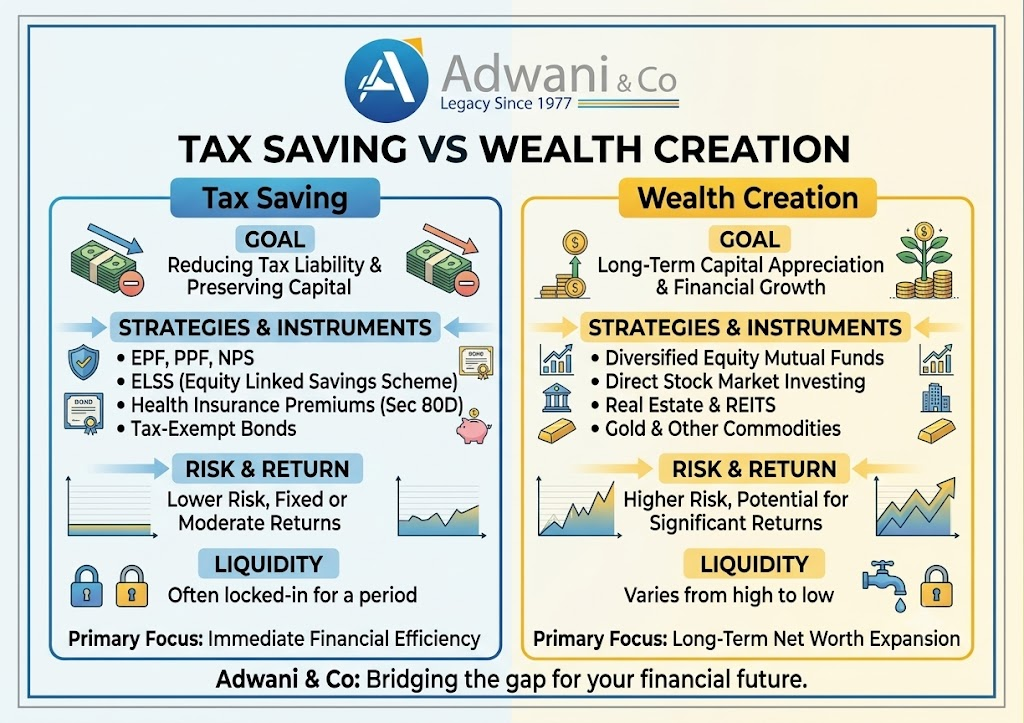
For decades, the default advice in Indian households has been simple: invest ₹1.5 lakh under Section 80C, save tax, repeat next year. So people poured money into:
LIC endowment policies with 4–5% effective returns
Tax-saving Fixed Deposits locked for 5 years at modest interest rates
ELSS mutual funds often the smartest option in this category
PPF, NSC, and other government-backed schemes
None of these are bad products. But here is the critical question that most taxpayers never ask: Would I still invest in this if there was no tax benefit?
Common Tax-Saving Mistake to Avoid
Investing money you cannot afford to lock up just to claim a Section 80C deduction
Buying high-premium insurance policies primarily as a tax-saving tool not as a life cover need
Ignoring the new tax regime calculator before deciding on 80C investments for AY 2026-27
Treating tax planning as a once-a-year March activity instead of a year-round wealth strategy
How the New Tax Regime Is Changing the Tax Saving vs Wealth Creation Conversation
The Income Tax Department‘s push towards the New Tax Regime especially after Budget 2024 raised the standard deduction to ₹75,000 and the rebate limit to ₹12 lakh under Section 87A has fundamentally changed the math. For many salaried taxpayers, the new regime now offers a lower effective tax liability without making any additional 80C investments.
What does this mean in practice? If you switch to the new tax regime, you lose the Section 80C deduction benefit. Suddenly, the LIC policy you bought ‘for tax saving’ loses its primary justification. The 5-year tax-saving FD you locked ₹1.5 lakh into does it still make sense at current interest rates compared to liquid mutual funds?
Key Insight: Old vs New Tax Regime Checklist (AY 2026-27)
Compare your total deductions (80C, 80D, HRA, home loan) against the new regime’s flat rebate
If your deductions total less than ₹3–4 lakh, the new regime likely offers lower tax outgo
Under the new regime, prioritise investments for returns not tax deductions
Use Form 10-IEA to switch regimes if needed consult a tax professional before deciding
From Tax Saving to Wealth Creation: A Mindset Shift India Needs
What’s interesting about this ITR season and something that tax professionals like Dr. Haresh Adwani, founder of Adwani & Co LLP, have been observing closely is that taxpayer conversations are evolving. More people are now asking about long-term mutual fund investments, equity market participation, retirement planning, and financial independence rather than just which Section 80C product to buy before March 31.
This is a deeply positive shift. Because the goal of good financial planning has never been just to save tax it has always been to build real, lasting wealth.
Smart Investing Framework: 3 Questions to Ask Before Every Investment Decision
1. Does This Investment Align With My Financial Goals?
Whether you’re investing in ELSS mutual funds for tax saving and long-term equity growth, or choosing between the old vs new tax regime for AY 2026-27, every rupee you invest should have a purpose beyond tax reduction. Define your goals: retirement corpus, children’s education, or home purchase.
2. Do I Understand the Risk-Return Profile?
ELSS funds carry market risk but deliver equity-linked returns over 3+ years. PPF is risk-free but long-term and illiquid. A tax-saving FD gives certainty but often underperforms inflation. Understand what you’re signing up for not just the tax receipt you’ll get.
3. Would This Investment Make Sense Without the Tax Benefit?
This is the single most powerful question in personal finance. If the answer is no if you wouldn’t invest in that product without the 80C benefit it’s a sign the investment is serving the tax planner in you, not the wealth creator in you.
Q: Is Section 80C investment still worth it under the new tax regime for AY 2026-27?
A: Under the new tax regime, Section 80C deductions are not available. If you opt for the new regime, invest in products based on returns and goals not tax benefits.
Q: Which is better for wealth creation in India ELSS mutual funds or equity mutual funds?
A: ELSS offers tax saving plus equity returns with a 3-year lock-in. Plain equity mutual funds offer more flexibility and often better wealth creation for long-term investors beyond 80C
Q: How do I decide between the old vs new tax regime for smart tax planning in 2026-27?
A: Calculate your total eligible deductions (80C, 80D, HRA, home loan interest). If they exceed ₹3–3.5 lakh, the old regime likely saves more tax; otherwise, the new regime wins.
Q: What is the difference between tax planning and financial planning for Indian taxpayers?
A: Tax planning minimises your current tax outgo; financial planning builds your long-term net worth. Good investing requires both but wealth creation goals should always lead the strategy.
Q: Can I invest in LTCG-friendly assets like equity mutual funds and still save tax in India?
A: Yes. Long-term capital gains (LTCG) on equity mutual funds up to ₹1.25 lakh per year are tax-free under Section 112A. Beyond that, gains are taxed at 12.5% still one of the most tax-efficient ways to build wealth
Conclusion:The Goal Is Not Just to Save Tax : It’s Wealth Creation
India’s taxation landscape has shifted. The new tax regime, revised LTCG rules post-Budget 2024, and increasing awareness of mutual funds and equity investing mean that the old template of ‘invest ₹1.5 lakh in 80C products and forget it’ is no longer sufficient or even optimal for many taxpayers.
The question every Indian investor must honestly answer this financial year is not ‘How do I exhaust my 80C limit?’ but rather ‘Am I investing in a way that will make me financially free — with or without a tax benefit?’
Good tax planning is important. But it should serve your wealth creation goals not the other way around. The Income Tax Department’s own resources at incometaxindia.gov.in and SEBI’s investor education portal both emphasise the importance of informed, goal-based investing over reactive tax-saving.
About the Author Dr. Haresh Adwani Ph.D. in Commerce | Law Graduate | Managing Partner, Adwani & Co LLP Dr. Haresh Adwani holds a Ph.D. in Commerce and is a qualified Law graduate with over two decades of hands-on experience in GST advisory, direct taxation, and statutory compliance for businesses across Pune and Maharashtra. As Managing Partner of Adwani & Co LLP a firm established in 1977 by Advocate N. T. Adwani Dr. Adwani has guided hundreds of SMEs, startups, and corporates through India’s evolving tax landscape. He is a recognised advisor on GST compliance, company formation, and Virtual CFO services, and regularly contributes to professional seminars and industry forums in Pune.
Disclaimer
This article is intended for general informational purposes only and does not constitute professional tax, financial, or legal advice. While every effort has been made to ensure accuracy as of the date of publication, tax laws, forms, and procedures are subject to change. Readers should consult a qualified chartered accountant or tax professional before making decisions based on this content. Adwani and Company accepts no liability for actions taken solely on the basis of this article.
You have just closed a Series A round. Investors valued your company at $8 million. Your legal counsel says it’s time to set up an ESOP pool for the team. And then someone in the room says: “The company is valued at $8 million with 800,000 shares so the ESOP exercise price is $10 per share, right?”
Wrong. And this particular misconception that a business valuation and an ESOP 409A valuation are the same exercise is one of the most consequential errors founders and early-stage finance teams make. In the US, getting it wrong can trigger IRS penalties under Section 409A for every employee who receives a stock option grant. In India, it leads to incorrect Ind AS 102 disclosures and potential SEBI ESOP compliance issues.
The two valuations look similar on the surface. They both involve valuing a company. But they answer different questions, use different analytical processes, and produce different outputs and confusing one for the other is not just a technical error, it is a regulatory risk.
The Core Distinction: What Question Is the Valuation Answering?
Start with purpose. Every valuation begins with a question. The answer to that question and the methodology chosen must follow from it.
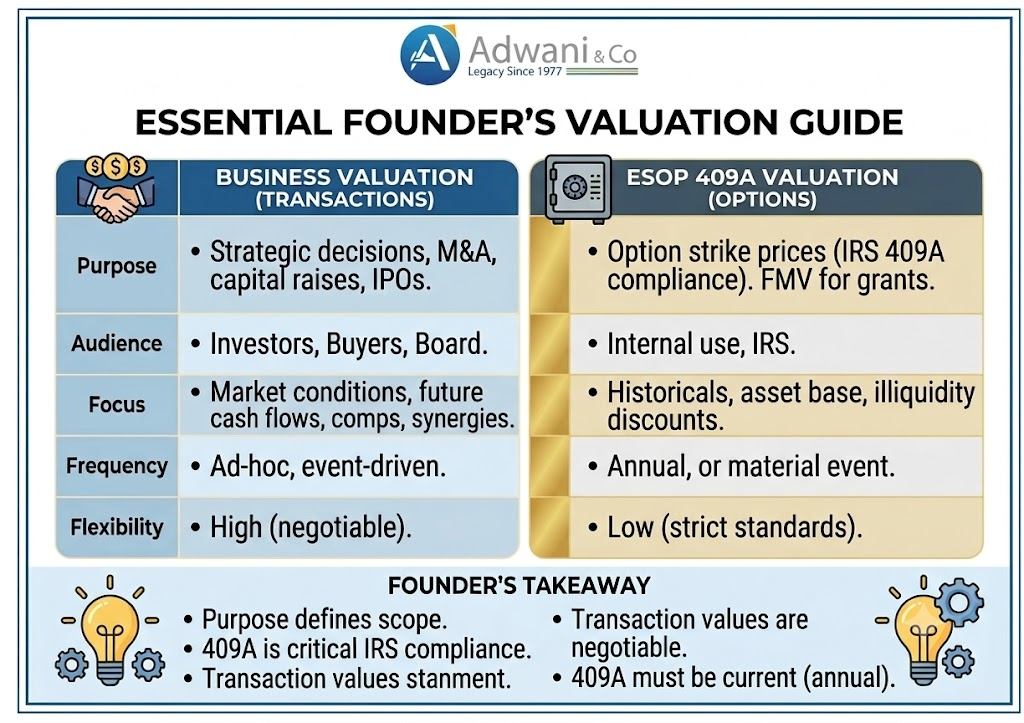
A business valuation asks: what is this company worth as a whole, today, to a rational buyer, investor, or shareholder?
An ESOP 409A valuation asks something narrower: what is one common share of this company worth today, specifically so that employee stock options can be granted at the correct exercise price?
These are not the same question. And because they are not the same question, they cannot produce the same answer particularly in a startup with multiple share classes, investor preferences, and a complex capitalisation table.
Business Valuation: Determining What the Company Is Worth
A business valuation establishes the aggregate value of the company its enterprise value or total equity value across all share classes. It is the starting point for informed decision-making in:
Fundraising rounds : providing the valuation basis against which investors subscribe for shares
Mergers and acquisitions : establishing a reference price for negotiation and due diligence
Strategic investments and secondary transactions
Regulatory filings under SEBI, RBI/FEMA, or MCA where a formal valuation certificate is required
Shareholder buy-sell agreements and restructuring
Common Business Valuation Methodologies
The three primary approaches recognised under US GAAP, IFRS, and Indian accounting standards are:
Discounted Cash Flow (DCF) : Projects future free cash flows and discounts them to present value at a risk-adjusted rate. Best suited for companies with visible, forecastable cash generation.
Market Approach : Values the business using comparable public company trading multiples (EV/Revenue, EV/EBITDA) or precedent M&A transaction multiples from the same sector.
Asset Approach : Derives value from the net realisable value of assets, most applicable to holding companies, asset-heavy businesses, or very early-stage ventures with minimal revenue.
The output is a single number the enterprise value or equity value of the company. It applies to the business as a whole and does not, by itself, tell you the value of any individual share class.
ESOP 409A Valuation: Determining What One Common Share Is Worth
An ESOP 409A valuation builds on the business valuation but then goes several steps further. The additional work is necessary because, in most venture-backed start ups, not all shares are created equal.
Investors who participated in your Series A received preferred shares. Those preferred shares typically come with contractual protections that common shares do not carry liquidation preferences (often 1x or 2x), participation rights, anti-dilution provisions, and conversion features. These protections mean that, in any exit scenario, preferred shareholders receive their invested capital back (and sometimes more) before common shareholders receive anything.
This economic reality creates a systematic gap between the value of a preferred share and the value of a common share. In a $8 million company with, say, $3 million of liquidation preference held by Series A investors, common shareholders do not have a claim on the full $8 million they have a claim on what remains after the preferred waterfall is satisfied.
Treating the fundraise price per share as the ESOP exercise price ignores this gap entirely and overvalues common shares in a way that makes stock options economically worthless for employees, who would need the company to dramatically outperform before their options have any value.
The ESOP 409A Valuation Process: Four Analytical Steps
How the FMV of Common Shares Is Determined
Step 1 : Business Valuation: Establish the company’s total equity value using DCF, market comparables, or the asset approach. This is the starting enterprise value.
Step 2 : Cap Table Analysis: Map every share class founders’ equity, Series A/B preferred, convertible notes, warrants, existing ESOP pool. Identify the specific rights attached to each class: liquidation preferences, participation, anti-dilution, conversion ratios.
Step 3 : Option Pricing Model (OPM): Treat each share class as a call option on the company’s total value. Use the OPM to model how the total equity value would be distributed across share classes under various exit scenarios accounting for the preferred waterfall before common shareholders receive value.
Step 4 : Black-Scholes Model (BSM): Apply the Black-Scholes formula to estimate the fair value of individual stock options. Inputs include the common share FMV derived from Step 3 (the stock price input), the proposed exercise price, expected time to expiry, implied volatility, and the risk-free rate. Output: The Fair Market Value of one common share the price at which ESOP options must be granted to comply with IRS Section 409A (US) or Ind AS 102 (India).
The resulting common share FMV is typically lower than the preferred share price from the most recent funding round. This is not aggressive or conservative it is accurate. It reflects the economic reality of where common shareholders stand in the exit waterfall relative to preferred investors.
Business Valuation vs ESOP 409A Valuation: At a Glance
Factor
Business Valuation
ESOP / 409A Valuation
Core Question
What is the whole company worth?
What is one common share worth for stock option grants?
Setting ESOP exercise price per IRS Section 409A / Ind AS 102
Methods
DCF, Market Comparables, Asset Approach
Business valuation → Cap Table → OPM → Black-Scholes (BSM)
Output
Enterprise value or total equity value
Fair Market Value (FMV) of common shares
Share Class Scope
All share classes
Common shares specifically (after waterfall allocation)
Regulatory Basis
SEBI / AICPA / IFRS 13 / US GAAP
IRS Section 409A (US) | IFRS 2 / Ind AS 102 (India)
Typical Timing
Event-driven (fundraise, M&A, restructuring)
Annual or before each new ESOP grant round
Why This Distinction Matters for Founders and Finance Teams
The stakes are real on both sides of the border.
In the United States
IRS Section 409A requires that non-qualified stock options be granted at no less than the FMV of the underlying stock on the grant date. The FMV must be determined by a qualified independent appraisal conducted within the past 12 months, or by another IRS-approved method. Granting options below FMV even inadvertently creates immediate ordinary income tax liability for the employee in the year of grant, plus an additional 20% excise tax penalty, plus applicable interest. The employer can also face reporting obligations and penalties.
In India
Ind AS 102 (Share-Based Payment) requires companies to measure and expense the fair value of share-based awards at the grant date. For listed entities and companies in the preparatory phase for listing, SEBI’s ESOP regulations also prescribe specific valuation requirements. Getting the grant price wrong leads to incorrect financial statement disclosures and potential SEBI scrutiny.
As CA Manish notes from cross-border advisory engagements: “The most common mistake we see is founders equating their fundraise valuation with their ESOP pricing. The fundraise tells you what an investor was willing to pay for preferred shares with full protections. It tells you very little about what a common share is worth on a standalone basis and that difference is exactly what the 409A process is designed to calculate.”
Key Takeaways
A business valuation and an ESOP 409A valuation answer different questions and serve different purposes they are not interchangeable.
Business valuation determines total company value; ESOP 409A valuation determines the Fair Market Value of common shares for stock option grant purposes.
Preferred shares carry superior economic rights liquidation preferences, participation, anti-dilution that systematically make them more valuable than common shares. The 409A process accounts for this.
The Option Pricing Model (OPM) allocates company value across share classes by modelling the preferred waterfall. The Black-Scholes Model then values the stock options themselves.
IRS Section 409A (US) and Ind AS 102 / SEBI regulations (India) both require that options be granted at FMV making an accurate, defensible 409A analysis non-negotiable for compliant ESOP programmes.
The 409A valuation should be refreshed annually and before each new ESOP grant round, or whenever a material event (funding round, acquisition discussion) occurs.
Frequently Asked Questions
Q: What is the difference between a business valuation and a 409A valuation?
A: A business valuation determines the total worth of the company used for fundraising, M&A, or shareholder transactions. A 409A valuation is a more specific exercise that determines the Fair Market Value of common shares alone, for the purpose of setting the correct exercise price on employee stock option grants under IRS Section 409A
Q: What is the Black-Scholes Model and how is it used in ESOP valuation?
A: The Black-Scholes Model (BSM) is a mathematical formula used to estimate the fair value of a stock option. In ESOP valuations, it takes the common share FMV (derived from the OPM), the exercise price, expected time to expiry, implied volatility of the underlying stock, and the risk-free interest rate as inputs. The output is the fair value per option used for financial statement disclosure under IFRS 2 / Ind AS 102 and for IRS Section 409A compliance.
Q: Why is the ESOP exercise price typically lower than the Series A or Series B price per share?
A: Series A/B investors purchase preferred shares, which carry liquidation preferences and other protections that rank ahead of common shareholders in any exit scenario. After modelling the cap table waterfall using the Option Pricing Model, the resulting Fair Market Value of common shares which have no such protections is ordinarily lower than the price paid by preferred investors.
Q: Does Section 409A apply to India-incorporated startups?
A: Section 409A is US-specific. India-incorporated companies follow Ind AS 102 (Share-Based Payment) for accounting and SEBI ESOP regulations for compliance. However, startups with US investors, dual-structure entities (an Indian operating company with a US holding company), or those planning a US listing need to satisfy both frameworks making professional valuation support across both jurisdictions essential.
Q: How often should a company conduct a 409A valuation?
A: The IRS requires a fresh 409A valuation at least once per year, or before each new option grant if more than 12 months have elapsed since the last appraisal. A new 409A is also required after any material event a significant funding round, a change in business trajectory, or a pending sale or merger process.
Conclusion:
Business valuation and ESOP 409A valuation are related but distinct disciplines. One tells you what the company is worth. The other tells you what one common share is worth taking into account the economic realities of your cap table, the rights of different shareholder classes, and the specific regulatory framework governing employee equity compensation.
For founders scaling their teams and building equity compensation programmes, getting this right is not a luxury. It is a compliance requirement, an employee trust issue, and increasingly, a diligence item for future investors who will examine your ESOP programme as part of any financing round or acquisition.
The valuation model matters. But understanding why you are doing the valuation and which output you actually need matters more.
Author CA. Manish R. Mata Practising In India (Ex – PwC), At Adwani & Co LLP leads the International Accounting & Tax Support vertical, delivering structured execution assistance to US CPA firms and overseas businesses.
Disclaimer
Adwani & Co LLP is a multi-disciplinary professional services platform. The blogs shared are for educational and informational purposes only and are intended to promote awareness around finance, accounting, taxation, reporting, and business advisory topics. Nothing contained herein should be construed as solicitation or advertisement of professional services. Where professional services are required under applicable laws or regulations, such services are rendered in accordance with relevant professional and regulatory requirements. The content has been reviewed for technical accuracy by professionals associated with Adwani & Co LLP.
Need Business Valuation, 409A, or ESOP Advisory Support?
If your business is building an ESOP programme, preparing for a funding round, or needs accurate valuation support across Indian or US regulatory frameworks, the team at Adwani & Co LLP would be happy to connect. We bring together financial modeling expertise, international accounting knowledge, and cross-border regulatory experience to support your equity and growth objectives.
Your truck has been stopped. The GST inspector reviews every document. The tax invoice is valid. The e-way bill is current. The goods match the description exactly. No quantity discrepancy. No classification mismatch.
And then: “These goods are worth ₹10 lakh. You have invoiced them at ₹5 lakh. I am detaining the consignment.” Can a GST officer legally do this? The answer under Indian GST law is nuanced, consequential, and widely misunderstood.
GST transit detention has become one of the most contested areas of indirect tax enforcement in India. Businesses face enormous disruption when goods are detained mid-journey halted trucks, storage costs, delayed deliveries, unhappy buyers, and potential penalty demands. Yet not all detentions are legally equal. The law draws a sharp line between a genuine GST valuation dispute and deliberate tax evasion, and understanding that line is essential for every business that moves goods under the GST framework.
In this authoritative guide, Dr. Haresh Adwani, PhD in Commerce and law graduate, and senior partner at Adwani & Co LLP, Pune, unpacks the legal framework governing GST goods detained during transit, the officer’s powers, the taxpayer’s rights, and the correct remedy for each situation.
What Is GST Transit Detention? Understanding Section 68 and Rule 138B
Under the GST law, the movement of goods above a specified value must be accompanied by an e-way bill. The CGST Act and CGST Rules empower designated officers to intercept any conveyance carrying taxable goods to verify the correctness of the e-way bill and the accompanying invoice. This power is conferred by Section 68 of the CGST Act, 2017, and operationalised through Rule 138B of the CGST Rules.
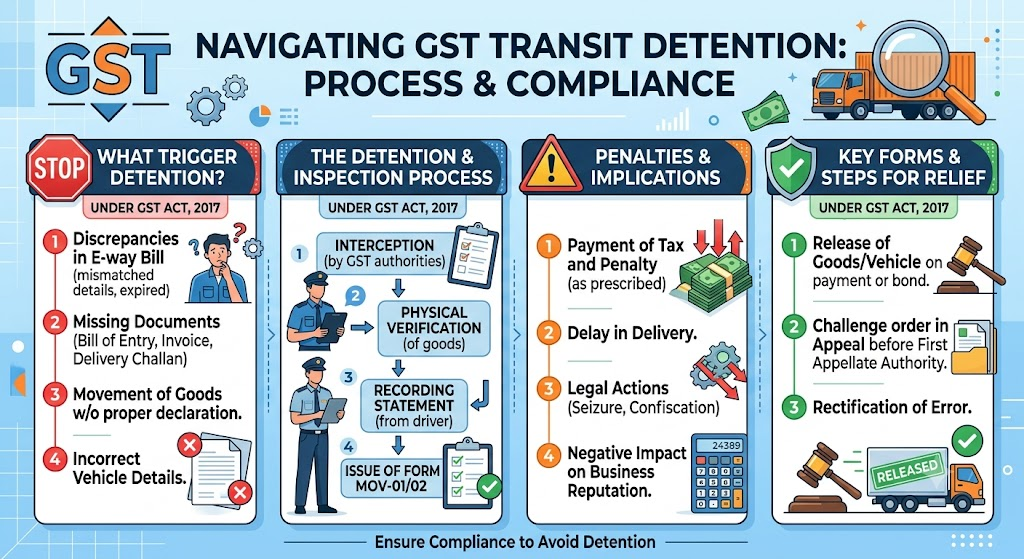
When goods are intercepted, the officer is empowered to inspect the documents and the physical consignment. If the officer finds a discrepancy or believes there is one the goods may be detained under Section 129 of the CGST Act, pending payment of applicable tax and penalty, or pending adjudication.
The critical statutory boundary here is this: the officer’s mandate under Section 68 is to verify the legality of the movement of goods. The provision does not confer powers to determine the commercial or market valuation of the goods being transported. That is a separate function governed by a separate statutory framework entirely.
Learn more about our GST Advisory Services to understand how Adwani & Co LLP supports businesses during transit inspections and departmental proceedings.
GST Valuation Dispute vs Tax Evasion: The Critical Legal Distinction
This is the question at the heart of every contested GST transit detention involving invoice value: is a low invoice price automatically evidence of tax evasion?
The answer is no — and the law is clear on why.
GST Valuation Is Governed by Section 15 of the CGST Act
Section 15 of the CGST Act, 2017 establishes that the value of a taxable supply is ordinarily the transaction value the price actually paid or payable provided the supplier and recipient are not related parties and the price is the sole consideration for the supply. The CGST Valuation Rules (Rules 27 to 35 of the CGST Rules, 2017) provide additional methods for determining value when the transaction value is not acceptable.
Crucially, challenging the transaction value under Section 15 requires evidence, adjudication, and a structured legal process. It requires the department to examine pricing agreements, cost structures, market comparisons, commercial context, and the relationship between buyer and seller. None of these can be meaningfully evaluated at a transit checkpoint in real time.
As Dr. Haresh Adwani explains: “A valuation dispute is a matter of law and evidence. The roadside is not the courtroom. GST transit detention on the sole ground that an invoice price ‘appears low’ without corroborating evidence of fraud is ordinarily not legally sustainable.”
What Constitutes Tax Evasion During Transit?
The distinction sharpens when we look at what actually constitutes actionable tax evasion during the movement of goods. The following circumstances would support legal detention and further proceedings:
Physical goods do not match the invoice description different product, grade, or quantity
The e-way bill has expired, does not cover the goods, or contains materially incorrect particulars
Intelligence reports or contemporaneous evidence suggest fake invoices or circular trading
The consignment is accompanied by two sets of invoices one for the officer, one for the actual transaction
Physical inspection reveals goods that are entirely different from what is declared
In these situations, the officer’s powers under Section 129 and, in more serious cases, Section 130 for confiscation are squarely applicable. GST transit detention is legally defensible where it is backed by specific, documented evidence of fraud or deliberate misdeclaration not by a subjective assessment of whether the price seems right.
Numerical Example: Valuation Dispute vs Tax Evasion in GST Transit
To make this concrete, consider the following side-by-side comparison the type of analysis the Adwani & Co LLP team regularly prepares when advising clients facing transit disputes
Factor
Scenario A: Valuation Dispute
Scenario B: Tax Evasion
Invoice Value
₹5 lakh (genuine price)
₹5 lakh (actual value ₹10 lakh)
Documentation
Valid invoice, valid e-way bill, goods match
Fake invoices, goods mismatch, double billing
Officer’s Grounds
Suspects price is below market no evidence
Intelligence report, physical discrepancy
Correct Legal Path
Adjudication under Section 15 CGST + Valuation Rules
Detention under Section 129; proceedings under Section 130
GST Transit Detention?
Not ordinarily sustainable on valuation alone
Legally sustainable with corroborating evidence
In Scenario A, the business has a legitimate commercial reason for the price perhaps a long-term supply agreement, a bulk discount, or an intra-group pricing policy. In Scenario B, the price suppression is a cover for tax evasion and is supported by concrete evidence. Only Scenario B justifies GST transit detention. Scenario A requires a proper adjudication process and the taxpayer retains the right to contest the demand.
GST Transit Detention Under Section 129: Taxpayer Rights and Remedies
If your goods are detained under Section 129 of the CGST Act, understanding your rights is the first step to an effective response. Dr. Haresh Adwani, who has guided numerous businesses through GST transit disputes and departmental proceedings, identifies the following non-negotiable rights for detained taxpayers:
1. Right to a Written Detention Order
The officer must issue a written order specifying the grounds for GST transit detention. Verbal instructions are not sufficient. Do not allow goods to be detained without a written order in hand.
2. Right to Pay Under Protest to Secure Release
Under Section 129(1) of the CGST Act, the owner or transporter may pay the applicable tax and penalty to secure the release of detained goods. Critically, payment under protest does not amount to an admission of liability. The taxpayer retains the right to contest the demand through the appeals mechanism.
3. Right to Appeal
If the officer’s detention order is challenged, the matter proceeds to adjudication. Appeals lie before the Appellate Authority under Section 107 of the CGST Act. Decisions of the Appellate Authority may be further challenged before the GST Appellate Tribunal and, thereafter, before the High Court.
4. Right to Legal Representation
Taxpayers are entitled to be represented by a qualified professional a Chartered Accountant, Cost Accountant, or Advocate at all stages of detention proceedings. Engaging experienced GST counsel at the earliest stage significantly improves outcomes.
How Adwani & Co LLP Handles GST Transit Detention Cases
At Adwani & Co LLP, a Pune-based firm founded in 1977 and led by Dr. Haresh Adwani, we have advised businesses ranging from manufacturing units and commodity traders to e-commerce sellers and pharmaceutical distributors on GST transit matters. Our approach is systematic:
Immediate assessment of the detention order to identify whether grounds are legally tenable
Preparation of a response brief within 24–48 hours citing applicable GST valuation provisions, CBIC circulars, and judicial precedents
Decision analysis on whether to pay under protest for quick release or contest the detention order
Filing of replies before the adjudicating authority with documentary evidence pricing policies, purchase agreements, prior transaction history
Representation before the Appellate Authority and High Court where required
The GST Portal (gst.gov.in) and the Central Board of Indirect Taxes and Customs (cbic.gov.in) have issued multiple circulars clarifying the scope of officer powers during transit inspections. Staying current with this guidance is essential and it is part of what Adwani & Co LLP brings to every client engagement.Learn more about our GST Compliance Services for Businesses to see how we help companies build robust compliance frameworks that reduce the risk of transit disputes before they arise.
Proactive Steps to Protect Your Business from GST Transit Detention
The most effective strategy against GST transit detention is preparation. As Dr. Haresh Adwani consistently advises clients: the checkpoint is not the place to start building your defence. Build it before the truck leaves the warehouse.
Maintain a written pricing policy document especially if you sell below MRP, offer bulk discounts, or supply to related parties
For related-party transactions, comply with GST Valuation Rules 28 to 33 and maintain contemporaneous documentation of the pricing basis
Generate e-way bills accurately covering full value, correct HSN code, and complete vehicle/transporter details
Train warehouse and logistics staff on their rights if goods are intercepted: demand written orders, do not move goods without documentation
Retain a GST advisor who can be reached immediately if goods are detained the first few hours of a detention often determine the outcome
Q: Can GST officers detain goods during transit solely because the invoice price appears low?
A: Not ordinarily. A mere difference between invoice value and perceived market value without corroborating evidence of fraud or misdeclaration is insufficient grounds for GST transit detention. Valuation disputes must be resolved through adjudication under Section 15 of the CGST Act, not at a transit checkpoint.
Q: What is Section 129 of the CGST Act and how does it apply to detained goods?
A: Section 129 of the CGST Act governs the detention, seizure, and release of goods and conveyances in transit. It allows the owner or transporter to secure release by paying applicable tax and penalty. The section also provides for adjudication if the taxpayer disputes the detention.
Q: What documents must a transporter carry to avoid GST transit detention?
A: A transporter must carry a valid tax invoice (or delivery challan, as applicable), a valid and current e-way bill covering the full value and correct description of goods, and vehicle details matching the e-way bill. Any discrepancy between documents and physical goods significantly increases detention risk.
Q: Is paying the GST demand at the transit checkpoint an admission of tax evasion?
A: No. Payment made under Section 129 to secure the release of detained goods does not constitute an admission of liability. The taxpayer retains the right to contest the underlying demand through the GST appeals process, starting with the Appellate Authority under Section 107 of the CGST Act.
Q: What is the difference between Section 129 and Section 130 of the CGST Act in transit cases?
A: Section 129 deals with detention and release of goods upon payment of tax and penalty. Section 130 deals with confiscation a more severe outcome applicable when goods are found to be liable for confiscation (e.g., used in deliberate tax evasion). Confiscation under Section 130 follows from non-payment or continued dispute after Section 129 proceedings.
Conclusion:
GST transit detention sits at the intersection of taxpayer rights and enforcement authority and it is an area where legal clarity matters enormously. The law has drawn a clear distinction: a valuation dispute requires evidence, adjudication, and due process. It is not a ground for roadside detention on the basis of a price that ‘looks suspicious’. Tax evasion, on the other hand supported by concrete evidence of fake invoices, misdeclaration, or circular trading is fully actionable under Sections 129 and 130 of the CGST Act.
For businesses, the message is equally clear. Proactive compliance accurate e-way bills, documented pricing policies, trained logistics staff, and immediate access to qualified legal and tax counsel is the strongest shield against unjustified GST transit detention.
Dr. Haresh Adwani summarises it well: “The law protects legitimate commerce and punishes deliberate fraud. Businesses that operate transparently and document their pricing decisions have little to fear from transit inspections. Those who use documentation as a cover for evasion should expect consequences.”
CA Dipesh Gurubakshani is a Chartered Accountant with Adwani & Co LLP, Pune, specialising in income tax audit, direct taxation, and accounting advisory. He supports clients across statutory compliance, financial reporting, and income tax matters with a focus on accuracy, regulatory adherence, and disciplined execution.
Legal Disclaimer:This article is published for informational and educational purposes only. Nothing contained herein constitutes legal, financial, or tax advice, nor should it be treated as a substitute for professional consultation tailored to your specific circumstances. Tax laws, rates, and provisions are subject to change; readers are strongly advised to consult a qualified Chartered Accountant or tax advisor before acting on any information in this article.
All content is original. References to government portals and statutory provisions are paraphrased for educational purposes in compliance with fair use principles. No content hasbeen reproduced from third-party sources
Facing a GST Transit Detention or Valuation Dispute?
Adwani & Co LLP has been advising businesses on GST compliance, transit disputes, and departmental proceedings since 1977. Our team combines deep technical expertise with practical litigation experience to protect your business and resolve disputes efficiently.Connect with Adwani & Co LLP today adwaniandco.com
You paid off a large credit card bill. Life moved on. Then, months later, an income tax notice landed in your inbox or worse, on the Income Tax Portal. Your first instinct might be panic. Your second might be denial. But the truth is: this situation is far more common than most people realise, and it is almost always manageable provided you understand why it happened and how to respond correctly.
Credit card income tax notices are not arbitrary. They follow a precise, rule-based reporting system that the Income Tax Department has been running for years. The good news is that if your spending is genuinely funded by legitimate, declared income, there is nothing to fear. The process is about documentation and explanation not accusation.
Why Does the Income Tax Department Track Your Credit Card Spending?
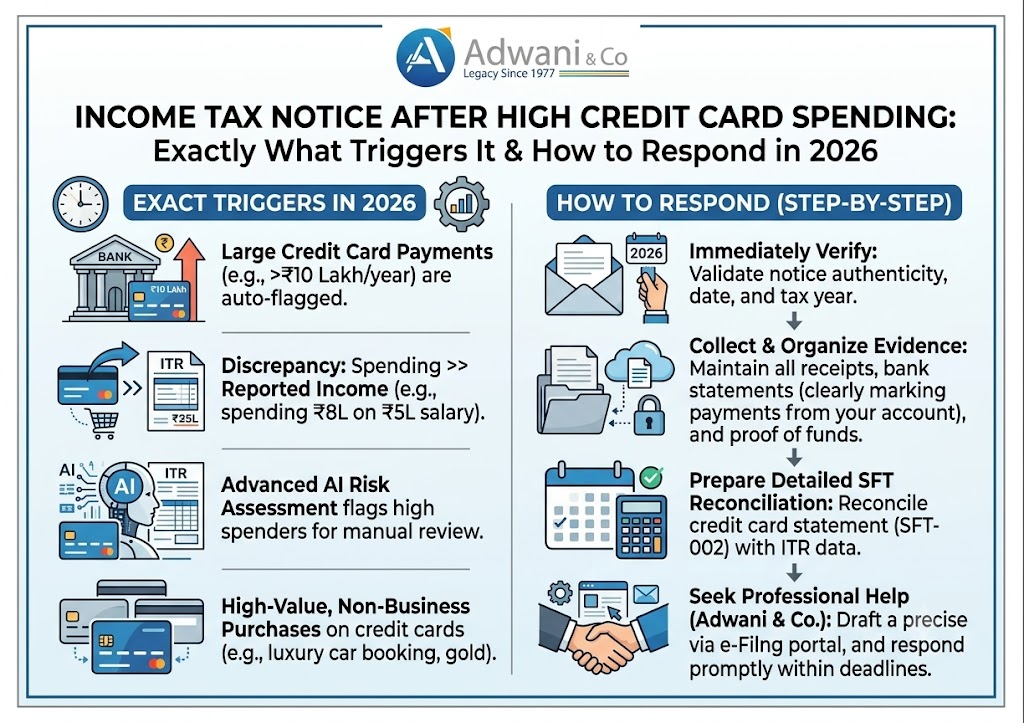
Under Rule 114E of the Income Tax Rules, 1962, banks and credit card companies are legally required to submit a Statement of Financial Transactions (SFT) to the Income Tax Department each year. This reporting captures high-value transactions across multiple financial categories including credit card payments.
Specifically, banks report credit card bill payments that meet either of these thresholds:
Payment of ₹1 lakh or more in cash against a credit card bill in a single month
Total credit card bill payments of ₹10 lakh or more in a financial year (by any mode online, NEFT, cheque, or cash)
Once reported, this data flows directly into your Annual Information Statement (AIS) on the Income Tax Portal. When the AIS data and your filed ITR don’t align when the spending pattern suggests a lifestyle that your declared income cannot support the system flags it for income tax scrutiny.
What Is an Annual Information Statement (AIS)? The AIS is a comprehensive tax passbook available on the Income Tax Portal (incometax.gov.in). It aggregates financial data about you from banks, mutual funds, registrars, and other reporting entities under Rule 114E. Checking your AIS before filing ITR is now considered a critical compliance step and any mismatch between your AIS and ITR can directly trigger a notice.
The Real Trigger: Income vs. Lifestyle Mismatch
Here is the core issue that most taxpayers miss. It is rarely the credit card spending itself that triggers a notice. It is the gap between the spending and the income you declared.
If you declared a net income of ₹8 lakh in your ITR but your credit card statements show annual spends of ₹15 lakh the Income Tax Department’s AI-powered systems will notice the inconsistency. This mismatch high-value spends relative to reported income is the primary trigger for credit card income tax scrutiny in 2026.
As Dr. Haresh Adwani of Adwani & Co LLP frequently highlights in client education sessions: the Income Tax Department today does not rely solely on manual checks. Faceless assessment tools powered by data analytics now cross-reference SFT filings, AIS entries, and ITR data automatically and flag outliers with remarkable precision.
High-Risk Transaction Thresholds at a Glance Credit card payment ≥ ₹10L/year: Reported under Rule 114E. Cash payment against CC bill ≥ ₹1L/month: Also reported. Savings account cash deposits ≥ ₹10L/year: Reported. Current account cash deposits ≥ ₹1 crore/year: Reported. All of this data lands in your AIS and is visible to the Income Tax Department.
Income Tax Notice Thresholds: What Gets Reported Under Rule 114E
Transaction Type
Threshold / Mode
What Happens
Credit card bill payment ≥ ₹1 lakh/month
Cash mode
Reported under Rule 114E SFT
Credit card bill payment ≥ ₹10 lakh/year
Any mode
Reported under Rule 114E SFT
Cash deposit in savings account
≥ ₹10 lakh/year
Auto-reported by bank
Cash deposit in current account
≥ ₹1 crore/year
Auto-reported by bank
High-value spend vs. declared income mismatch
Any amount
AI-flagged for scrutiny / notice
Types of Notices You May Receive for Credit Card Spending
Section 133(6) : Request for Information
This is the most common type notice received on Credit Card Spending. The Assessing Officer requests information or documents to verify a specific transaction or pattern. It is not a demand it is a query. Respond within the given time limit with supporting documents.
Section 148 : Reassessment Notice
If the income tax officer believes income has escaped assessment meaning you earned money that was not declared a reassessment notice may be issued under Section 148. This carries a defined income tax notice time limit: generally up to 3 years from the end of the assessment year for under-reported income up to ₹50 lakh, and up to 10 years for escaped income of ₹50 lakh or more.
Section 143(2) : Scrutiny Notice
If your ITR has been selected for detailed scrutiny, you will receive a notice under Section 143(2). Credit card income tax scrutiny under this section requires you to explain specific high-value transactions and submit documentation supporting your income claims.
How to Respond to an Income Tax Notice for Credit Card Spending
The response strategy depends on the notice type, but some principles apply universally:
Do not ignore the notice : there are strict timelines and penalties for non-response
Log in to the Income Tax Portal (incometax.gov.in) and check your AIS to understand exactly what was reported
Gather credit card statements, bank statements, and salary slips or business income proofs for the relevant period
Match the reported SFT amount with your actual payments sometimes figures are misreported or duplicated
If the credit card spending was from savings accumulated over prior years, prepare documentation showing those savings
If it was from gifts, inheritance, or exempt income, have written records in place
Draft a factual, document-supported reply avoid vague responses
The Income Tax Department’s faceless assessment scheme processes most notices without face-to-face interaction. Every word and document in your response matters. A well-prepared reply often closes the matter at the information-request stage itself.
✅ Key Takeaways
Rule 114E & SFT Reporting
Banks and card issuers report credit card payments ≥ ₹10 lakh/year (or ₹1L/month in cash) to the Income Tax Department under Statement of Financial Transactions.
Your AIS Reflects It All
Every high-value transaction appears in your Annual Information Statement (AIS) on the Income Tax Portal. Check it before filing your ITR.
Notice ≠ Guilt
Receiving an income tax notice for credit card spending is not an accusation — it is a request for explanation. Respond calmly with documentation.
Mismatch Triggers Scrutiny
The real risk is not the spend itself but the gap between your declared income and your lifestyle expenses visible through SFT data and AIS.
Faceless Assessment Is Real
The Income Tax Department uses AI-powered systems to flag high-value spends. Unexplained credit card bills can trigger faceless assessment proceedings.
Frequently Asked Questions
Q1. What is the credit card limit that triggers an income tax notice in India?
Under Rule 114E, credit card bill payments totalling ₹10 lakh or more in a financial year are reported to the Income Tax Department. Cash payments of ₹1 lakh or more in a single month are also reported separately.
Q2. What is Rule 114E and how does it relate to credit card income tax scrutiny?
Rule 114E of the Income Tax Rules mandates that banks submit a Statement of Financial Transactions (SFT) covering high-value credit card payments. This data populates your AIS and can trigger scrutiny if it is inconsistent with your declared income.
Q3. Can I get an income tax notice even if I paid my credit card bill from savings?
Yes. The notice is triggered by the reported SFT data, not your source of payment. In your response, you simply need to show that the spending was funded by legitimate savings or income with documentary proof.
Q4. How much time do I have to respond to an income tax notice for credit card spending?
The income tax notice will specify a response deadline typically 15 to 30 days. Missing this deadline can result in ex-parte assessment or penalty. Always respond within the given timeframe.
Q5. Will the Income Tax Department also track UPI and WhatsApp payments in 2026?
UPI payments below ₹10 lakh annually are currently not subject to mandatory SFT reporting. However, large or unusual UPI patterns, especially those linked to business income, can still be flagged through AI-based analysis of financial data across platforms.
Conclusion:
Receiving an income tax notice for credit card spending is alarming but it is not the end of the road. The Indian tax system, now powered by AI-driven scrutiny and comprehensive AIS data, is designed to ensure alignment between lifestyle and declared income. If that alignment exists in your case, a well-prepared, timely response will resolve the matter.
The best long-term protection is not to spend less it is to file accurately, check your AIS before every ITR submission, and ensure your income declarations reflect your actual financial life. In the age of faceless assessments and Rule 114E SFT reporting, compliance is the only sustainable strategy.
About the Author Nidhi Adwani is the Human Resources Manager at Adwani & Co. She is a Law Graduate and holds an MBA in Human Resources. She manages recruitment, employee engagement, team development, workplace culture, and the firm’s social media and content activities. Passionate about people and organizational growth, she also contributes articles for ITRAdvisor and Adwani & Co. Her writing focuses on HR practices, leadership, workplace engagement, and professional development, offering practical insights for professionals and businesses.
Legal Disclaimer:This article is published for informational and educational purposes only. Nothing contained herein constitutes legal, financial, or tax advice, nor should it be treated as a substitute for professional consultation tailored to your specific circumstances. Tax laws, rates, and provisions are subject to change; readers are strongly advised to consult a qualified Chartered Accountant or tax advisor before acting on any information in this article.
All content is original. References to government portals and statutory provisions are paraphrased for educational purposes in compliance with fair use principles. No content hasbeen reproduced from third-party sources
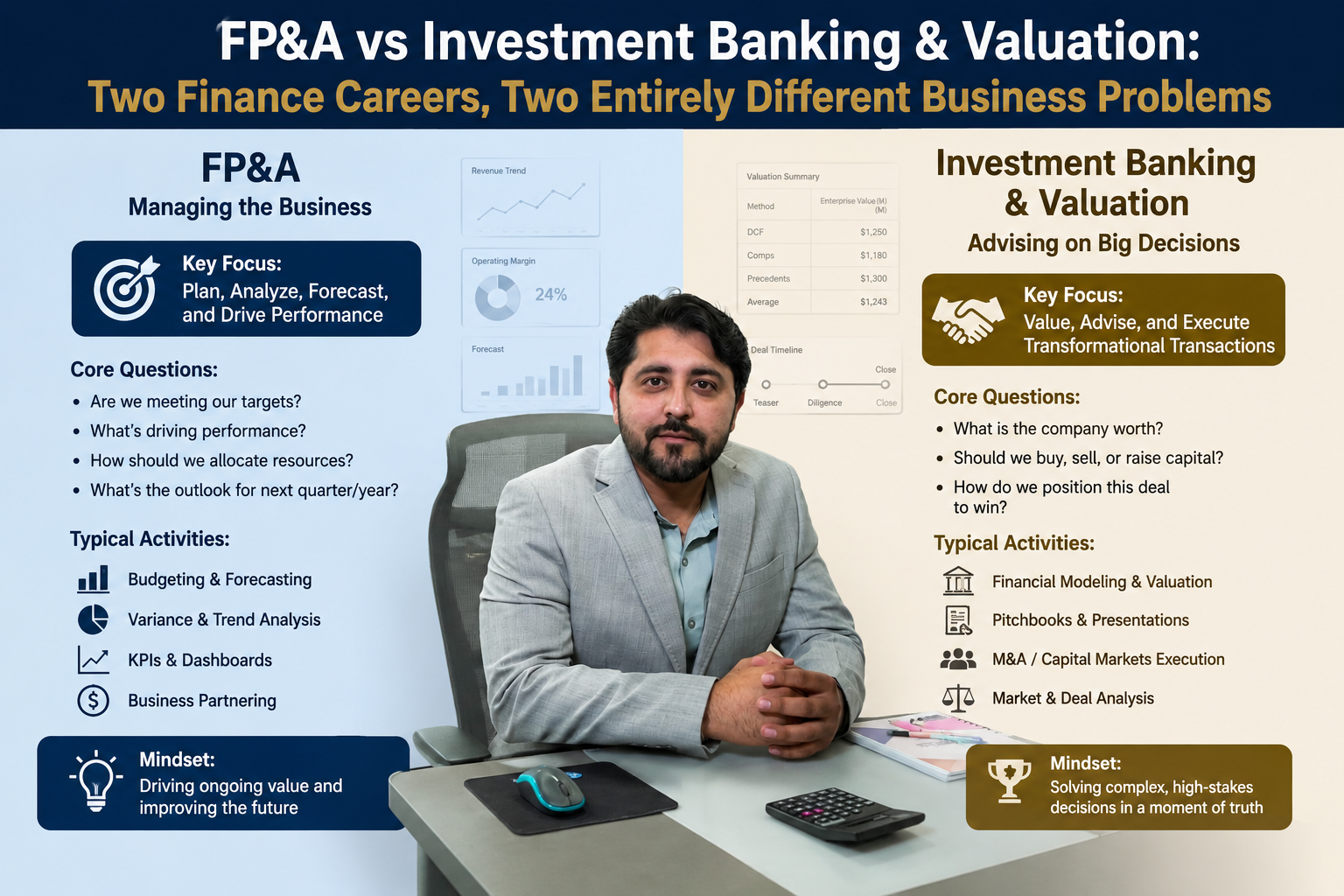
Every year, thousands of finance graduates and young professionals list FP&A, Investment Banking, or Valuation on their career wishlist often without a clear understanding of what each actually does inside a business. They are all ‘finance roles’. They all involve spreadsheets, financial models, and business numbers. But the problems they solve, the audiences they serve, and the decisions they support are fundamentally different. Conflating them is one of the most common misconceptions in early finance careers and it matters far more than most people realise.
Why the Confusion Exists and Why It Matters
Finance as a field is broad. Whether you work in FP&A at a mid-size manufacturing company, in an investment banking division advising on an acquisition, or in a boutique valuation practice preparing a DCF model for a private equity transaction you are working with financial statements, projections, and business performance data. The tools overlap. The terminology overlaps. The confusion is understandable.
But the objectives and therefore the career paths, skills required, and daily realities could not be more different. Understanding this distinction early is essential for any finance professional who wants to build a focused, high-impact career in either domain.
Common Misconception Finance Professionals Should Avoid
Assuming FP&A and Investment Banking require the same core skills they don’t
Believing that valuation work is just ‘advanced budgeting’ it operates at an entirely different strategic level
Thinking that strong Excel skills alone prepare you equally for both domains
Underestimating how differently these roles interact with business leadership vs. external stakeholders
What FP&A Actually Does: Performance Intelligence for Management
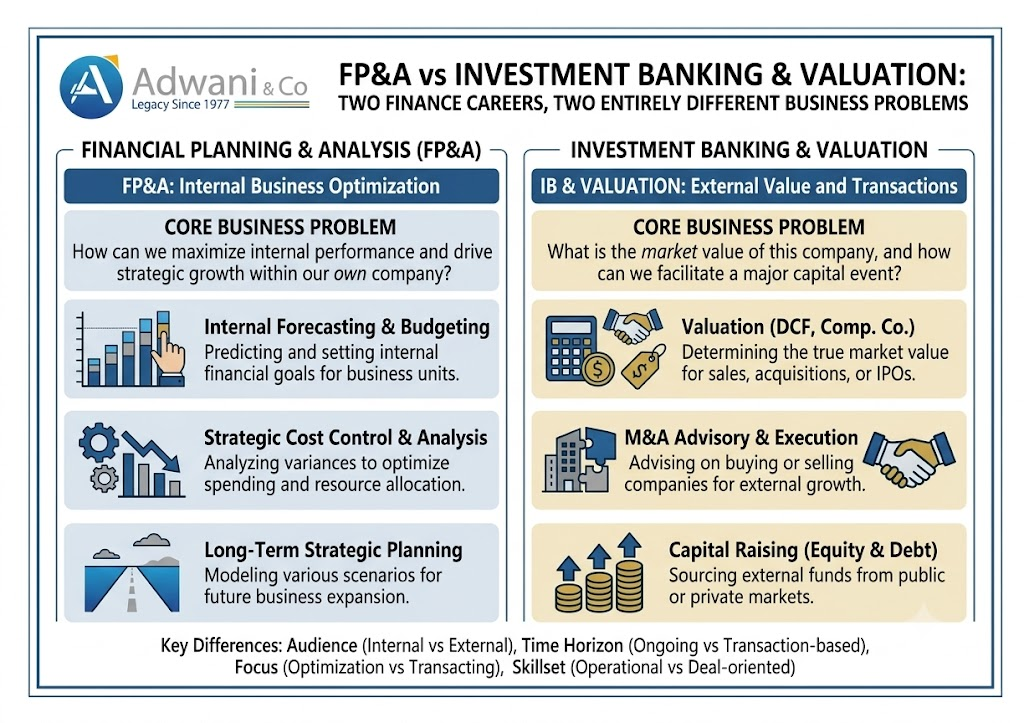
Financial Planning & Analysis (FP&A) is the engine of internal financial intelligence inside a business. Its job is to help management understand where the business stands, why performance deviated from plan, and what actions can improve outcomes going forward. FP&A professionals work closely with business unit heads, operations teams, and the CFO to provide the financial visibility that drives day-to-day and quarter-to-quarter decisions.
In practice, FP&A covers
Annual budgeting and rolling forecasts translating strategy into financial targets
Variance analysis explaining why actual results differ from budget or prior period
KPI monitoring and management dashboards giving leadership real-time visibility into business health
Scenario and sensitivity analysis modelling the financial impact of operational choices
MIS reporting packaging financial data into actionable monthly management packs
Cost driver analysis identifying what is actually moving profitability up or down
The questions FP&A answers are operational and managerial: Are we meeting our revenue targets? Why did margins fall this quarter? Which product line is underperforming? What should we do differently next month? These are questions that internal management needs answered quickly, accurately, and consistently.
What Investment Banking & Valuation Actually Does: Value Determination for Strategic Decisions
Investment Banking and Valuation operate at a completely different level not operational, but strategic and transactional. Where FP&A helps management run the business better today, Investment Banking and Valuation helps stakeholders determine what the business or an asset within it is actually worth, and whether a strategic financial decision (an acquisition, a fundraise, a divestiture, a merger) makes financial sense.
This domain covers:
Business valuation using DCF analysis, precedent transactions, and comparable company multiples
Mergers & Acquisitions (M&A) advisory financial due diligence, deal structuring, and negotiation support
Financial Due Diligence (FDD) deep-dive review of a target company’s financial health before acquisition
Fairness opinions independent assessment of whether a transaction price is financially equitable
Buy-side and sell-side advisory advising on the financial merits of a transaction from either party’s perspective
Capital structure and strategic allocation decisions evaluating how capital should be deployed for maximum value creation
The questions Investment Banking and Valuation answers are strategic and transactional: What is this company worth? Should we acquire this target at this price? What multiple is the market applying to businesses like ours? How should this deal be structured for optimal stakeholder returns? These answers matter not to internal management but to boards, investors, acquirers, regulators, and capital market participants.
FP&A vs Investment Banking & Valuation: A Direct Comparison
The table below captures the structural differences between these two critical finance disciplines:
Dimension
FP&A
Investment Banking & Valuation
Core Purpose
Improve operational and financial performance of the business
Determine fair value; support M&A, fundraising, and strategic capital decisions
Financial modelling, DCF, LBO, comparable company analysis, due diligence
AI Relevance
AI uses FP&A reasoning to evaluate operational and budget data
AI uses IB/valuation logic to assess DCF assumptions and deal structures
A Simple Way to Remember the Difference
CA Manish, Head Consultant for International Accounting and Financial Modeling at Adwani & Co LLP, puts it this way: FP&A helps management improve the performance of the business. Investment Banking and Valuation helps stakeholders determine the value of the business and make strategic investment decisions.
One is inward-facing and operational. The other is outward-facing and transactional. Both are essential. But they exist to answer entirely different questions for entirely different audiences.
Think of it this way: FP&A is what a CFO uses to run the month-end close meeting. Investment Banking and Valuation is what a board uses to evaluate an acquisition proposal. The CFO may sit in both rooms — but the finance function serving each conversation is structurally different.
The Emerging Dimension: AI Is Making Both Disciplines More Important
One of the more interesting developments in modern finance — and something CA Manish has directly observed in his work with international clients — is the growing role of AI in financial analysis and evaluation. As AI tools become embedded in financial workflows, both FP&A and Investment Banking/Valuation reasoning are being used to train, validate, and evaluate AI model outputs.
An AI model reviewing a budget variance report needs FP&A-style reasoning to assess whether the variance explanation is operationally coherent. An AI model reviewing a DCF valuation or M&A proposal needs Investment Banking and Valuation expertise to assess whether the assumptions are commercially reasonable and whether the deal structure makes strategic sense.
This means that deep domain expertise in both disciplines is becoming more valuable — not less — as AI handles more of the mechanical data processing. Finance professionals who understand the ‘why’ behind both FP&A and valuation will be better positioned to work alongside AI tools, review AI outputs, and apply human judgment where it matters most.
Which Domain Is Right for You?
Choose FP&A if you:
Enjoy working closely with operational teams and business leadership
Want to understand what drives business performance at a granular level
Prefer a role where your work directly influences internal decisions month after month
Are interested in budgeting, forecasting, MIS, and management reporting
Want to develop into a CFO or finance business partner role
Choose Investment Banking & Valuation if you:
Want to work on high-stakes strategic transactions — M&A, fundraising, exits
Are drawn to financial modeling, DCF analysis, and valuation frameworks
Prefer project-based work with defined transaction timelines
Want to advise stakeholders on business value and strategic capital decisions
Are interested in a career trajectory toward private equity, M&A advisory, or transaction services
Key Takeaways
FP&A and Investment Banking/Valuation both belong to finance but they solve completely different business problems for completely different audiences
FP&A is internally focused: it helps management understand, monitor, and improve business performance through budgeting, forecasting, and variance analysis
Investment Banking & Valuation is externally focused: it helps stakeholders determine business value and make strategic M&A, fundraising, and investment decisions
The core deliverables differ: FP&A produces MIS packs, KPI dashboards, and variance reports; IB/Valuation produces DCF models, fairness opinions, and M&A advisory
AI is making both disciplines more important AI tools need FP&A and valuation expertise to be properly validated and reviewed
Finance professionals benefit from understanding both disciplines, even if they specialise in one — this cross-domain awareness improves analytical judgment significantly
Frequently Asked Questions
Q: What is the main difference between FP&A and Investment Banking in finance?
A: FP&A focuses on internal management reporting, budgeting, and business performance improvement. Investment Banking focuses on business valuation, M&A advisory, and strategic capital allocation for external stakeholders like investors and boards.
Q: What does an FP&A professional do on a day-to-day basis?
A: FP&A professionals prepare budget vs actual reports, build financial forecasts, analyse cost and revenue variances, create KPI dashboards, and produce MIS packs that help management make better operational decisions each month.
Q: What finance skills are needed for Investment Banking and Valuation?
A: Core skills include DCF modelling, comparable company analysis, LBO modelling, financial due diligence, M&A deal structuring, and the ability to assess business value from multiple analytical frameworks often under significant time pressure.
Q: Can FP&A and Valuation skills be developed simultaneously?
A: Yes, and professionals with cross-domain skills are increasingly valuable. FP&A provides deep business performance context; Valuation provides strategic and transactional perspective. Together, they create a well-rounded finance professional.
Q: How is AI changing FP&A and Investment Banking roles in finance?
A: AI is automating much of the data processing in both domains, but human expertise is still essential to validate AI outputs, apply commercial judgment, and interpret financial results in business context making deep domain knowledge more important than ever.
Conclusion:
The finance domain is not monolithic. FP&A and Investment Banking & Valuation are two of its most important disciplines — but they exist to answer fundamentally different questions, serve fundamentally different audiences, and create fundamentally different types of business value.
For aspiring finance professionals, the most important first step is understanding which type of problem you want to solve. Do you want to help a management team run its business better every month? That is FP&A. Do you want to help a board decide whether to acquire a company or how to value a business for a fundraising round? That is Investment Banking and Valuation.
Both paths are intellectually demanding, commercially rewarding, and increasingly shaped by AI adoption. The professionals who will thrive in both are those who develop not just technical finance skills, but the judgment to know which analytical framework fits which business question.
Author CA. Manish R. Mata Practising In India (Ex – PwC), At Adwani & Co LLP leads the International Accounting & Tax Support vertical, delivering structured execution assistance to US CPA firms and overseas businesses.
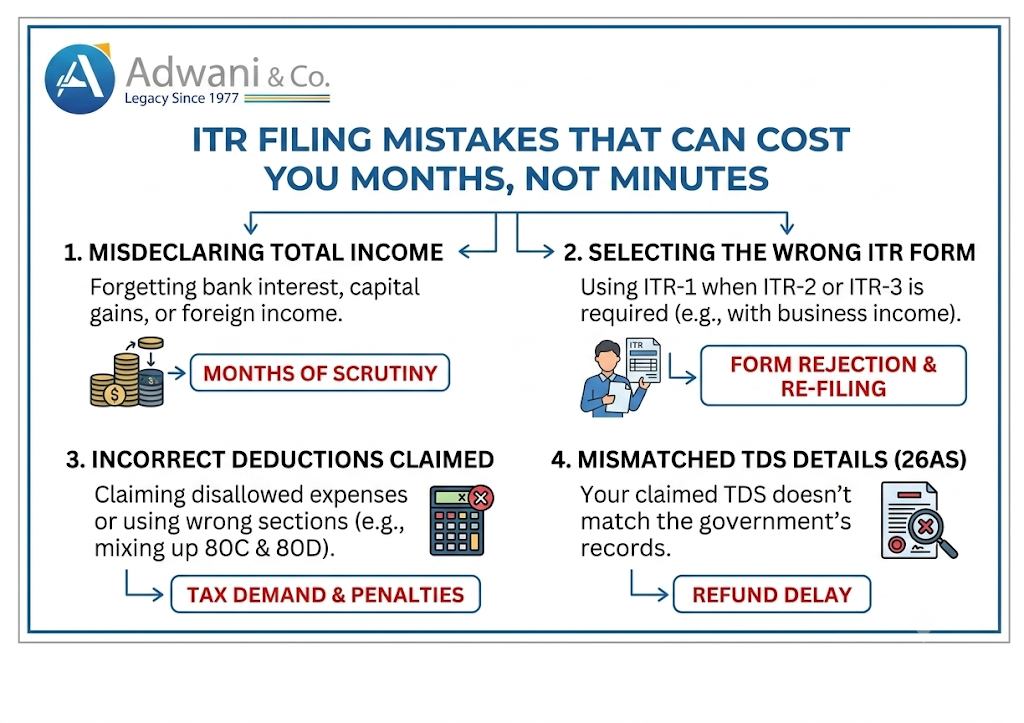
Filing an income tax return can take fifteen minutes. Fixing one of the common ITR filing mistakes hidden inside that return can take fifteen months. That gap between how quickly a return gets filed and how long a single error can take to resolve is where most taxpayers get caught off guard. A return that is “filed successfully” is not the same as a return that is filed correctly, and the difference between the two often shows up only after a notice lands in your inbox.
Why ITR Filing Mistakes Are More Common Than You Think
Most people assume that once the income tax portal accepts a return and generates an acknowledgement, the job is done. In reality, acceptance only confirms that the form was submitted in the correct format not that every figure in it is accurate or complete. This is exactly where ITR filing mistakes slip through unnoticed, sometimes for months.
A return can sail through the initial filing stage and still carry an error serious enough to trigger scrutiny later. The income tax system today is far more interconnected than it used to be, cross-checking your return against your Annual Information Statement (AIS), Form 26AS, bank reporting, and data from other government sources. A mismatch that may have gone unnoticed a few years ago is now far more likely to be flagged.
A Real Case: How One ITR Filing Mistake Spiraled Into Months of Follow-Up
Consider a case our team reviewed recently. A taxpayer believed everything was in order the return had been filed, the acknowledgement was generated, and there was no reason to expect a problem. The issue was simple on the surface: income from one source had not been reported correctly.
The return was accepted initially. But weeks later, a notice was issued. Interest on the unpaid liability kept accumulating. The expected refund was withheld. What should have taken a few minutes to correct at the filing stage instead turned into months of back-and-forth, with the taxpayer submitting multiple explanations and clarifications before the matter could be closed.
This is not an isolated story. It is one of the most common patterns we see, and it illustrates why ITR filing mistakes deserve far more attention than they typically receive before the “Submit” button is clicked.
The Most Common ITR Filing Mistakes Taxpayers Make
Understanding where errors typically occur is the first step toward avoiding them. Based on patterns observed across hundreds of filings, these are the ITR filing mistakes that appear most frequently:
1. Underreported or Unreported Income
Interest from savings accounts, fixed deposits, freelance income, or income from a secondary employer is often left out — not deliberately, but simply because it was overlooked. Since this income is usually already visible in your AIS or Form 26AS, omitting it is one of the fastest ways to attract a notice.
2. Selecting the Wrong ITR Form
Choosing between ITR-1, ITR-2, ITR-3, or ITR-4 depends on your sources of income, residential status, and whether you hold capital assets or foreign income. Filing under the wrong form is a structural ITR filing mistake that can render the return defective.
3. Mismatch Between Return and AIS/Form 26AS
The income tax department’s systems automatically compare what you declare against what is reported by banks, employers, and other deductors. Even a small discrepancy between your return and your AIS can be enough to trigger a system-generated query.
4. Unsupported or Incorrect Deductions
Claiming deductions under sections like 80C, 80D, or 80G without valid supporting documentation is a frequent and easily avoidable error. If a deduction cannot be substantiated later, it can result in disallowance along with interest.
5. Missing Capital Gains or Foreign Asset Disclosures
Sale of mutual funds, shares, or property must be reported with proper computation, even if the resulting tax is minimal. Similarly, foreign bank accounts, foreign income, or overseas assets carry mandatory disclosure requirements that are frequently missed, particularly by first-time filers.
Submit
A few extra minutes of review before filing can prevent most ITR filing mistakes from happening in the first place. Before you submit your return, check the following:
Is all your income reported including interest, freelance earnings, and any secondary income?
Have you selected the correct ITR form based on your income sources and residential status?
Are your deductions backed by valid documents you can produce if asked?
Does your return match the figures in your AIS and Form 26AS?
Have you disclosed capital gains, foreign assets, or other reportable income, if applicable?
Filing an Income Tax Return is not just about submitting a form. It is about submitting the right information, in the right form, supported by the right documentation.
Why ITR Filing Mistakes Lead to Notices, Interest, and Penalties
The income tax authorities increasingly rely on automated data matching to identify inconsistencies between filed returns and information already available to them. Updates and compliance guidance published through the official Income Tax Department portal make clear that the AIS and Form 26AS are central to this verification process, which means even small ITR filing mistakes are increasingly likely to be detected rather than overlooked.
Once a mismatch is flagged, the consequences typically unfold in stages: a system-generated notice is issued, interest begins accruing on any shortfall in tax paid, and in cases involving high-value discrepancies, the matter can escalate toward a formal tax demand. For taxpayers with significant income or transactions, the financial exposure from unresolved ITR filing mistakes can run into substantial amounts depending on the nature and scale of the discrepancy.
This is precisely why proactive review rather than reactive correction is the more sustainable approach to tax compliance.
As Dr. Haresh Adwani often points out to clients, the cost of a thirty-minute review before filing is almost always lower than the cost of resolving a notice after the fact.
How Adwani and Company Helps You Avoid ITR Filing Mistakes
Avoiding ITR filing mistakes consistently requires more than just software that auto-fills a form. It requires a professional review that understands how income, deductions, capital gains, and disclosures interact within the law. At Adwani and Company, returns are reviewed against your AIS, Form 26AS, and supporting documents before filing, not after a notice arrives.
Dr. Haresh Adwani, who holds a Ph.D. in Commerce and is also a law graduate, leads this approach by combining technical taxation knowledge with legal interpretation a combination that matters when a return involves nuanced questions around capital gains classification, clubbing provisions, or disclosure requirements. This dual expertise is particularly valuable when an ITR filing mistake has already triggered departmental correspondence and requires a legally sound, well-documented response.
For salaried individuals, freelancers, and business owners alike, the firm’s review process is built around the same five checks outlined above, applied systematically rather than left to last-minute judgment. Learn more about our ITR Filing Services
Under Ministry of Corporate Affairs and GST Portal frameworks, regulatory data increasingly flows between systems, reinforcing why consistency across all your filings not just your income tax return matters more than ever for taxpayers and business owners.
Dr. Haresh Adwani’s guidance has helped many clients catch ITR filing mistakes before submission rather than after a notice, which remains the most cost-effective way to stay compliant.
Frequently Asked Questions
What are the most common ITR filing mistakes that lead to a notice?
The most frequent causes are unreported interest income, mismatches between your return and your AIS or Form 26AS, incorrect ITR form selection, unsupported deductions, and missing capital gains or foreign asset disclosures.
Can a small ITR filing mistake really result in a tax notice?
Yes. Since income tax systems cross-verify returns against AIS, Form 26AS, and third-party reporting, even a small unreported amount can trigger an automated mismatch notice.
How do I check if my ITR matches my AIS and Form 26AS?
You can download your AIS and Form 26AS from the income tax e-filing portal and compare each entry against the income and TDS figures reported in your return before submission.
What happens if I already filed my return with a mistake?
Depending on the stage of filing, you may be able to file a revised return before the applicable deadline. If a notice has already been issued, a documented and professionally drafted response is typically required.
Which ITR form should I use to avoid filing mistakes?
The correct form depends on your income sources, residential status, and whether you have capital gains, business income, or foreign assets. Using the wrong form is itself considered a filing defect.
Can Adwani and Company help if I have already received an income tax notice?
Yes. The firm reviews the notice, reconciles it against your AIS, Form 26AS, and supporting documents, and helps prepare a structured response within the applicable deadline.
Conclusion: Don’t Let a Small Mistake Become a Long Problem
Filing your return quickly feels efficient — right up until an ITR filing mistake turns into a notice, a withheld refund, or months of correspondence over an amount that could have been reported correctly the first time. The taxpayers who avoid this outcome are not necessarily the ones with the simplest returns; they are the ones who review before they submit.
A few extra minutes spent checking your income, your form selection, your deductions, and your AIS reconciliation today can save months, or even years, of unnecessary stress tomorrow.
Get Your ITR Reviewed Before You File If you are unsure whether your return has been reported correctly, a quick professional review today can help avoid a much bigger problem later. Connect with Adwani and Company for a thorough pre-filing review, or reach out if you have already received a notice and need expert guidance on how to respond.
About the Author Dr. Haresh Adwani Ph.D. in Commerce | Law Graduate | Managing Partner, Adwani & Co LLP Dr. Haresh Adwani holds a Ph.D. in Commerce and is a qualified Law graduate with over two decades of hands-on experience in GST advisory, direct taxation, and statutory compliance for businesses across Pune and Maharashtra. As Managing Partner of Adwani & Co LLP a firm established in 1977 by Advocate N. T. Adwani Dr. Adwani has guided hundreds of SMEs, startups, and corporates through India’s evolving tax landscape. He is a recognised advisor on GST compliance, company formation, and Virtual CFO services, and regularly contributes to professional seminars and industry forums in Pune.
Disclaimer
This article is intended for general informational purposes only and does not constitute professional tax, financial, or legal advice. While every effort has been made to ensure accuracy as of the date of publication, tax laws, forms, and procedures are subject to change. Readers should consult a qualified chartered accountant or tax professional before making decisions based on this content. Adwani and Company accepts no liability for actions taken solely on the basis of this article.
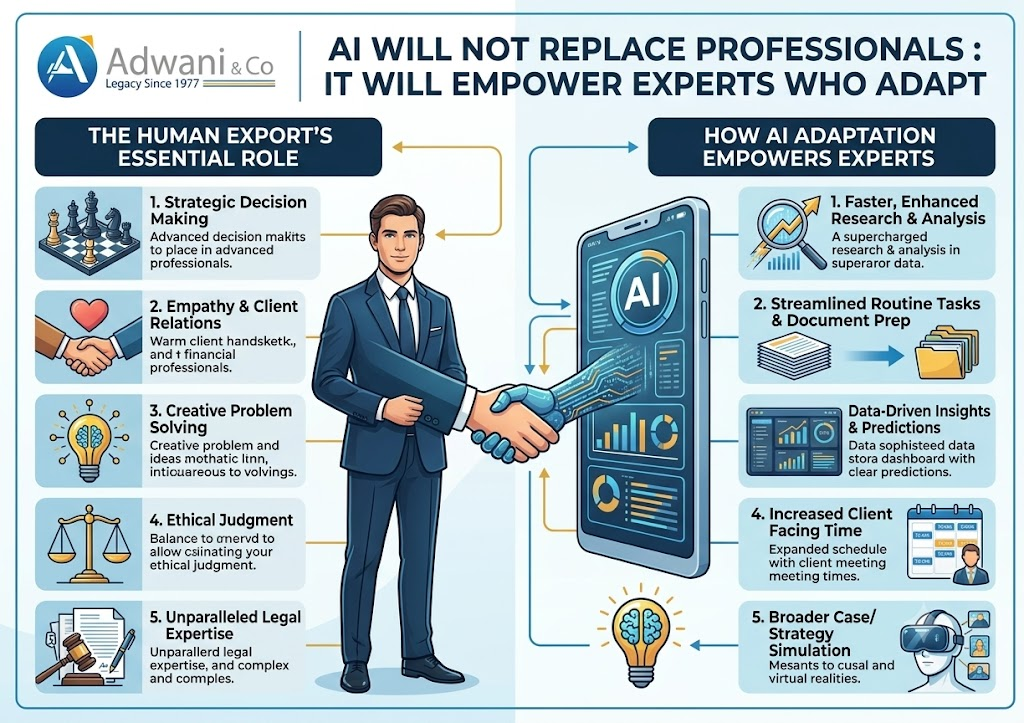
It is the most common question in boardrooms, CA chambers, law firms, and finance departments across India and globally. And while the anxiety is understandable, most professionals are asking the wrong question or at least framing it incorrectly.
The more productive question is: How do I position myself to work with AI rather than be displaced by it?
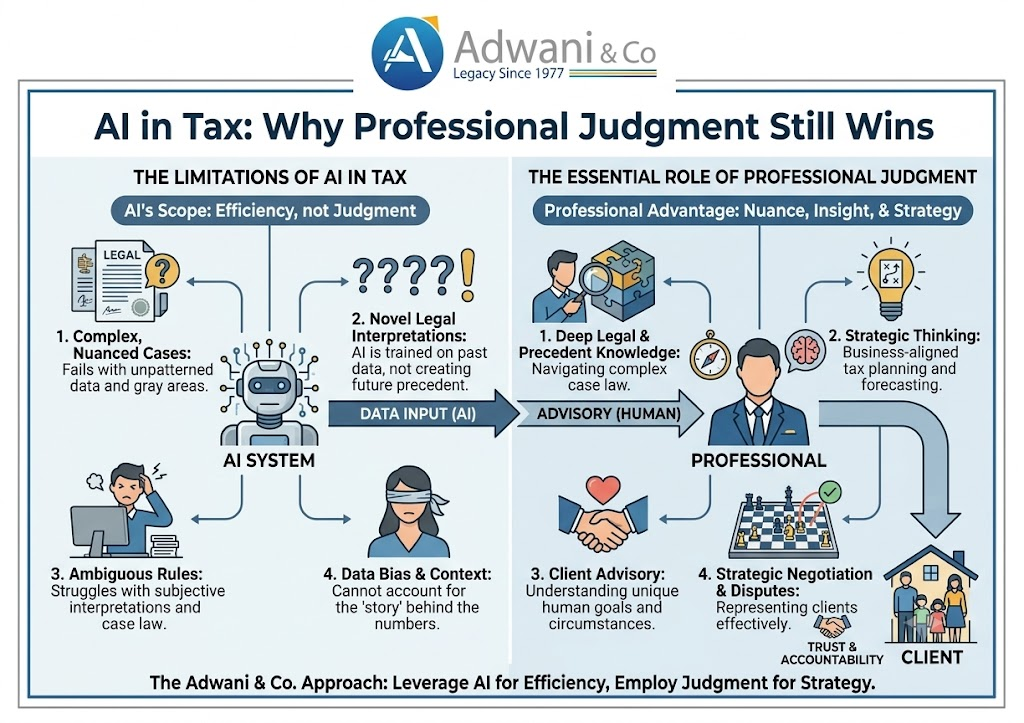
Having been personally involved in training and evaluating Agentic AI models across Indian taxation, US tax compliance, and financial analysis, I can tell you the professionals who will thrive in an AI-driven world are those who bring something no machine can generate on its own: real-world judgment, domain depth, and contextual experience.
What AI Actually Needs to Function
Here is something that often surprises people outside the technology space: AI models, no matter how sophisticated, do not learn from textbooks alone.
Effective AI systems in professional domains are trained on real-world decision-making. They need to understand industry-specific exceptions, regulatory nuances, client scenarios, workflow logic, and professional judgment none of which can be sourced from generic online data alone.
This is precisely where experienced professionals become irreplaceable.
When a large language model is being trained or evaluated for tax advisory, it needs inputs like:
How a Chartered Accountant thinks through an ITR filing involving multiple income heads
Why a particular FEMA compliance treatment applies in one cross-border scenario but not another
How a financial analyst structures a DCF model under real client constraints
What red flags a seasoned auditor spots in a set of books
These are not answers you find in a compliance manual. They emerge from years of professional practice. And currently, that expertise is in significant demand not despite AI, but because of it.
The Emerging Opportunity: Domain Experts as AI Trainers and Evaluators
The AI industry is entering a phase where the quality of domain-specific training data is becoming the key competitive differentiator.
Building a tax AI for Indian professionals requires Indian tax professionals. Building a financial modeling assistant for global finance teams requires experienced FP&A practitioners and valuation experts. The people who have spent years doing this work are exactly who AI developers need in the room.
What This Looks Like in Practice
Professionals with deep domain expertise are being engaged to:
Review and annotate AI-generated outputs for technical accuracy
Develop scenario libraries based on real client cases
Evaluate model responses for compliance, judgment quality, and practical reliability
Train AI systems to handle edge cases, exceptions, and regulatory ambiguity
Build quality benchmarks for AI tools operating in high-stakes advisory settings
These are roles that did not exist five years ago. They require precisely the skills that experienced CAs, tax professionals, lawyers, financial analysts, and industry specialists have spent their careers building.
Which Professionals Are Best Positioned?
Across multiple AI evaluation projects, a clear pattern has emerged: the professionals who bring the most value are those with hands-on, applied expertise rather than purely theoretical credentials.
Professionals particularly well-placed to contribute to AI training and evaluation include:
Chartered Accountants and Tax Professionals with multi-year client advisory experience
Financial Analysts and FP&A practitioners familiar with real-world modeling constraints
Auditors and forensic accountants who can identify anomalies and exceptions
Legal professionals with regulatory and cross-jurisdictional expertise
Industry specialists in healthcare, engineering, manufacturing, and supply chains
NRI and cross-border advisory experts who navigate FEMA, US tax, and double taxation treaties
The common thread? All of these professionals have built something that AI still lacks: the ability to apply judgment in ambiguous, real-world situations.
How Professionals Should Prepare Right Now
The window for professionals to position themselves advantageously in an AI-augmented world is open — but it will not remain so indefinitely. Here is what I would suggest to any professional navigating this transition:
1. Double Down on Core Domain Expertise
AI amplifies expertise it does not substitute for the absence of it. The deeper your knowledge of your professional domain, the more valuable you become as an AI collaborator, trainer, or evaluator. Continuing professional development, advanced certifications, and specialized practice areas all strengthen your position.
2. Understand How AI Systems Are Built
You do not need to become a data scientist or software engineer. But a working understanding of how AI models are trained, how prompts are structured, and how outputs are evaluated gives you a meaningful advantage. This literacy is increasingly available through professional bodies, online courses, and industry events.
3. Articulate Your Practical Experience Clearly
The value AI developers are looking for is not just credentials — it is the specific, real-world scenarios you have worked through. A CA who can describe exactly how they analyzed a complex transfer pricing case, or how they resolved a GST reconciliation issue under audit pressure, is offering something genuinely useful to AI training efforts.
4. Position Yourself as an AI Collaborator
The professionals who will lead in the next decade are those who use AI tools effectively while providing the oversight, judgment, and accountability that clients and regulators will always require. Cultivating this positioning publicly through writing, speaking, or advisory work is a strategic advantage.
The Adwani & Co LLP Perspective
At Adwani & Co LLP, we are actively navigating this intersection between deep professional expertise and emerging AI capabilities. Our work across Indian taxation, international accounting, financial modeling, and cross-border advisory has always been grounded in practical experience which is precisely what the AI economy values.
As CA Manish observes from ongoing AI model evaluation projects: the professionals most sought after by AI developers are not those with the broadest knowledge, but those with the deepest applied judgment in specific domains. The future of professional work is not about competing with AI it is about making AI more useful, more accurate, and more trustworthy by contributing what only experienced humans can provide.
If your firm or practice is thinking about how AI adoption intersects with your advisory workflows, client service delivery, or financial reporting processes, this is a conversation worth having now.
Key Takeaways
AI systems require real-world professional expertise for training, evaluation, and quality control creating new opportunities for experienced practitioners.
Domain knowledge in areas like Indian taxation, US accounting, financial modeling, and cross-border advisory is in active demand for AI development projects.
The professionals most likely to be displaced by AI are those who do not engage with it; those who help build and evaluate AI systems are gaining a first-mover advantage.
Building deeper domain expertise, understanding AI fundamentals, and positioning yourself as an AI-capable advisor are the three most impactful steps professionals can take right now.
Judgment, contextual reasoning, and professional accountability remain human advantages that AI cannot replicate in high-stakes advisory settings
AI is unlikely to replace CAs entirely, particularly those working in complex advisory, international taxation, and strategic reporting. Routine compliance tasks may be increasingly automated, but the judgment-intensive aspects of CA practice cross-border structuring, audit interpretation, business advisory require human expertise. CAs who actively engage with AI tools and contribute to AI training projects are likely to see expanded opportunities rather than displacement.
2.How are professionals involved in training AI models?
Professionals contribute to AI model training through activities such as reviewing and annotating AI-generated outputs, providing expert feedback on model responses, developing scenario libraries based on real client cases, and setting quality benchmarks for AI tools in their domain. These roles are often contract-based engagements with AI development companies and research labs.
3.What skills should finance professionals develop to stay relevant in an AI-driven world?
Beyond maintaining strong core domain expertise, finance professionals should develop familiarity with AI tools used in their field (such as AI-assisted financial modeling or automated bookkeeping review), an understanding of prompt engineering basics, and the ability to critically evaluate AI-generated financial analysis for accuracy and compliance. Communication skills and client advisory judgment remain irreplaceable differentiators.
4.Is there demand for Indian CA and tax professionals in global AI projects?
Yes. Indian taxation, FEMA compliance, cross-border advisory, and international accounting are specialized domains where trained AI models require inputs from qualified Indian professionals. CA Manish has been directly involved in multiple AI evaluation projects across Indian and US tax domains, reflecting the growing global demand for this expertise.
5.How can Adwani & Co LLP help businesses navigate AI adoption in finance?
Adwani & Co LLP provides advisory support at the intersection of traditional finance expertise and emerging AI-augmented workflows. From financial reporting and virtual CFO services to international accounting and FP&A, our team helps businesses build systems that are both AI-ready and professionally robust. Connect with us to explore how your financial operations can evolve with confidence.
Conclusion
The fear that AI will eliminate professional jobs is understandable — but it is driven more by uncertainty than by a clear-eyed assessment of how AI actually works. The reality emerging from live AI development projects is that experienced professionals are not being replaced. They are being recruited.
The professionals who combine deep domain expertise with a genuine understanding of AI capabilities — and the willingness to contribute to shaping those capabilities — will find themselves at the center of the most significant professional transformation in a generation.
Now is not the time to wait and see. Now is the time to go deeper in your domain, engage with AI honestly, and position your expertise where it will be valued most.
Work With Professionals Who Understand AI
Adwani & Co LLP combines deep domain expertise in Indian taxation, international accounting, financial modeling, and cross-border advisory now increasingly integrated with AI-assisted workflows. Whether you are a founder, a finance team, or a professional looking to future-proof your role, our team is here to help. 📧info@adwaniandco.com | 🌐 www.adwaniandco.com | 🌐 www.itradvisor.inConnect with us for international accounting, financial modeling, virtual CFO, and AI-integrated advisory support.
Explore Our Related Services
Learn more about our Virtual CFO & Strategic Finance Advisory adwaniandco.com/virtual-cfo
Learn about our Indian & US Tax Support for Startups and SMEs itradvisor.in
Disclaimer
Adwani & Co LLP is a multi-disciplinary professional services platform. The blogs shared are for educational and informational purposes only and are intended to promote awareness around finance, accounting, taxation, reporting, and business advisory topics. Nothing contained herein should be construed as solicitation or advertisement of professional services. Where professional services are required under applicable laws or regulations, such services are rendered in accordance with relevant professional and regulatory requirements. The content has been reviewed for technical accuracy by professionals associated with Adwani & Co LLP.
Everyone is asking whether AI can prepare tax returns. Almost nobody is asking the more important question: who will defend the tax position behind them?
That single question who defends the reasoning, not just the numbers is quietly reshaping the future of tax compliance across India and globally. And for businesses, founders, and professionals navigating the increasingly scrutinised landscape of income tax, GST compliance, and cross-border taxation in 2026, it is the question that matters most.
AI in tax return preparation is already impressive. It extracts data from documents, populates schedules, identifies missing information, and generates draft returns in minutes. The Income Tax Department’s own AIS (Annual Information Statement) system and the GST Portal now integrate AI-driven analytics to detect mismatches before a return even reaches a scrutiny desk. In that environment, a technically accurate return is just the starting point not the finish line.
The real risk in modern tax compliance is not a calculation error. It is a reasoning error. And reasoning errors are exactly where AI in tax professional judgment gaps show up most sharply.
AI in Tax Compliance: What It Does Well in 2026
To be fair to the technology, AI is genuinely transforming the mechanics of tax compliance. What previously took hours of manual data entry now happens in minutes. For routine income tax return filing, GST return preparation, and reconciliation tasks, AI-assisted tools have meaningfully improved speed and reduced data-entry errors.
The capabilities that AI brings to tax compliance include:
Extracting structured data from invoices, bank statements, Form 16, and TDS certificates
Pre-populating ITR forms based on AIS and Form 26AS data available on the Income Tax Department portal
Identifying gaps between GSTR-1 and GSTR-3B or flagging GSTR-2B mismatches before filing
Generating draft tax computations with standard deduction and exemption claims
Flagging potential income tax notice triggers based on patterns in prior filings
These are genuine productivity gains. A CA firm that uses AI tools intelligently can serve more clients, reduce routine errors, and spend less time on administrative work.
But productivity is not the same as judgment. And in taxation especially for businesses managing GST compliance 2026, handling cross-border transactions, or responding to income tax notices judgment is where the real risk lives.
Why AI in Tax Return Preparation Is Not Enough on Its Own
Consider a straightforward scenario.
A business files its ITR. The numbers are correct. Every document is available. The return passes all system validation checks. Yet three critical questions remain unanswered:
The Questions AI Cannot Answer for You
→ Is the taxpayer actually eligible for the benefit claimed?
→ Does a restriction or limitation provision apply under the Income Tax Act?
→ Is there a more advantageous tax position available that has not been explored?
→ What assumptions underlie the computation, and can they withstand scrutiny?
→ If the Income Tax Department issues a notice, can the position be professionally defended?
These are not edge cases. They represent the core of professional tax advisory and they are precisely where AI in tax professional judgment gaps become expensive.
The Income Tax Department and CBDT have significantly increased their use of data analytics and AI-driven scrutiny. Cross-referencing of ITR data with AIS, TDS data, MCA filings, GST turnover, and banking transactions is now routine. As per guidance available through the Income Tax Department portal, cases are increasingly selected for scrutiny based on risk-scoring models that evaluate the consistency and commercial logic of reported positions not just the arithmetic.
In that environment, a return that is numerically correct but logically indefensible is not a safe return. It is a delayed problem.
A Real-World Tax Risk Example: Where AI Missed and Judgment Mattered
Practical Example A proprietary trading firm with an annual turnover of ₹3.2 crore used an AI-assisted platform to prepare and file its ITR-3 for AY 2025-26. The AI correctly: • Computed speculative and non-speculative business income separately • Applied the correct tax rates • Populated all required schedules What the AI did not evaluate: • Whether certain derivatives transactions qualified as speculative or non-speculative under Section 43(5) of the Income Tax Act a distinction that affects set-off of losses • Whether the firm’s expenses claimed as business deductions met the ‘wholly and exclusively for business’ test • Whether turnover disclosed in the ITR was consistent with GST returns and bank statements, given the firm also had an NBFC registration Result: An income tax notice was issued under Section 143(2) querying the loss set-off and expense claims. A CA reviewing the return before filing would have identified these risk points and either restructured the position or documented the reasoning making the notice either avoidable or significantly easier to defend.
This is not a rare situation. It is representative of exactly the kind of reasoning error that automated tax preparation cannot prevent because preventing it requires judgment about facts, law, and professional risk, not just calculation.
AI vs. Professional Judgment in Tax: A Practical Comparison
What AI Handles Well in Tax Compliance
Where Professional Judgment in Tax Is Required
Extracting data from Form 16, TDS certificates, AIS
Evaluating whether all income sources are correctly characterised
Populating ITR schedules based on available data
Deciding which ITR form is appropriate given the taxpayer’s income profile
Identifying GSTR-1 vs GSTR-3B mismatches
Determining the legal significance of the mismatch and how to resolve it
Flagging excess ITC claims against GSTR-2B
Advising whether to reverse ITC, dispute the claim, or pursue vendor rectification
Generating draft tax computations
Reviewing whether deductions, exemptions, and set-offs are correctly applied
Detecting variance from prior-year filings
Explaining the variance and assessing whether it creates scrutiny risk
Preparing income tax notice response templates
Drafting a legally sound reply that addresses the actual notice ground
Professional Judgment in Tax: What It Actually Means
The phrase is used frequently in professional circles, but it has a concrete meaning in the context of AI in tax compliance.
Interpreting Provisions:Not Just Applying Them
The Income Tax Act, 1961, and the GST law contain thousands of provisions. Many are straightforward. Some are ambiguous, subject to judicial interpretation, or apply differently depending on facts. An AI system applies the provision as trained. A professional interprets it in context.
Dr. Haresh Adwani, a PhD holder in Commerce and a law graduate, regularly applies this dual lens at Adwani and Company evaluating tax positions not only through a finance lens but through the legal framework that governs their validity.
Evaluating Whether Assumptions Are Commercially Defensible
Every tax return carries assumptions about the nature of transactions, the classification of income, the eligibility for benefits. AI generates those assumptions from patterns. A professional evaluates whether they hold up to scrutiny in a specific business context.
Managing Risk Across the Compliance Lifecycle
Tax risk does not end at filing. It extends to assessments, scrutiny, notices, and appeals. Professional judgment in tax includes structuring positions that can be defended through the full lifecycle of compliance not just at the point of return preparation.
As AI-driven scrutiny by the Income Tax Department and GST authorities becomes more sophisticated, the cost of an indefensible position rises. This is the core dynamic reshaping what tax professionals are paid to do.
AI in Tax and the Income Tax Notice Risk
One of the most practical implications of AI in tax compliance for businesses and individuals is the income tax notice risk.
Under Section 143(2), Section 148, and other scrutiny provisions, the Income Tax Department can issue notices based on risk-scoring that increasingly relies on cross-database analytics. The parameters include:
Significant variation between ITR-reported income and AIS data
Mismatch between GST turnover and income tax turnover
High-value transactions without corresponding income disclosure
Unusual deduction or exemption claims relative to prior years
Discrepancies between MCA-reported financials and tax filings
An AI-prepared return can tick all the validation checkboxes and still contain the exact kind of inconsistency that triggers one of these notices—because the inconsistency is in the reasoning, not the arithmetic.
This is where Adwani and Company‘s approach to tax advisory adds measurable value. The firm’s review process, guided by Dr. Haresh Adwani‘s academic grounding in Commerce and legal knowledge, evaluates both the technical accuracy and the commercial defensibility of every significant tax position before filing.
Everything said about income tax applies equally and in some ways more acutely to GST compliance in 2026.
AI tools can prepare GSTR-3B, match GSTR-2B for input tax credit reconciliation, and flag vendor-level discrepancies. But the judgment questions in GST compliance are substantial:
Is a particular supply correctly classified, and has the right GST rate been applied?
Does a transaction qualify for input tax credit eligibility, or does a restriction under Section 17(5) apply?
Is an export zero-rated correctly, or does a condition remain unsatisfied?
When a GST notice arrives questioning ITC claims, is the response legally adequate?
According to compliance advisories and updates available on the GST Portal (gst.gov.in) and cross-referenced with MCA (mca.gov.in) data, authorities are increasingly scrutinising the commercial rationale of transactions—not just their documentation.
A business with ₹80 lakh in ITC claims but a vendor base that shows irregular GSTR-1 filing is not just a documentation risk. It is a legal risk that requires professional assessment and, where necessary, a structured response strategy.
The Most Valuable Tax Skills in an AI-Enabled World
The LinkedIn post that inspired this article asked a pointed question: what will be the most valuable skill in an AI-enabled tax world?
Based on work across diverse client engagements at Adwani and Company, here is a grounded answer:
High-Value Tax Skills for the AI Era 1. Analytical Review of AI Outputs ability to critically evaluate AI-generated computations, identify reasoning gaps, and flag positions that look correct but carry hidden risk 2. Regulatory Interpretation applying the Income Tax Act, GST law, FEMA, and related frameworks to specific facts in a way that produces a defensible position 3. Risk Communication translating technical tax risk into commercially actionable language for founders, CFOs, and business owners 4. Notice and Litigation Management structuring responses to income tax notices, GST scrutiny, and assessment proceedings with legal and factual rigour 5. Cross-Border Tax Judgment advising on NRI taxation, transfer pricing, DTAA benefits, and FEMA compliance in situations where AI outputs are least reliable
These are not replaceable skills. They are enhanced by AI but their value lies precisely in the human judgment that AI cannot replicate.
Key Takeaways
Summary • AI in tax return preparation handles the mechanical and computational layer well data extraction, schedule population, reconciliation flagging. • The gap between an AI-prepared return and a professionally reviewed one lies in reasoning: assumptions, eligibility, risk assessment, and defensibility. • As the Income Tax Department and GST authorities increase AI-driven scrutiny, the cost of indefensible tax positions is rising. • Professional judgment in tax covers interpretation, commercial context, risk management, and accountability across the full compliance lifecycle. • The future of tax practice is not AI replacing professionals it is AI handling scale while professionals provide the judgment that determines outcome. • For any significant tax position, cross-border transaction, notice response, or restructuring, professional review is not a legacy stepit is the critical step.
Frequently Asked Questions:
1. Can AI tools file income tax returns accurately without a CA reviewing them?
For straightforward salary-based returns with limited income sources, AI tools perform adequately. For business income, capital gains, multiple income sources, or any position that carries interpretation risk—such as deduction eligibility or income characterisation—professional review before filing is strongly recommended. An accurate calculation is not the same as a defensible position.
2. What is the biggest risk in AI-generated tax computations?
The biggest risk is not arithmetic—it is assumption. AI systems apply rules as trained, without evaluating whether those rules apply to the specific facts of a taxpayer’s situation. Where eligibility conditions, limitations, or judgment-based classifications are involved, the AI output may be technically formatted but commercially or legally incorrect.
3. How does the Income Tax Department use AI to scrutinise returns?
The Income Tax Department and CBDT increasingly use risk-scoring systems that cross-reference ITR data with AIS, TDS records, GST turnover, MCA filings, and banking data. Returns are selected for scrutiny based on inconsistency and risk indicators—not just arithmetic errors. A return that is numerically correct but logically inconsistent across data sources can still attract a Section 143(2) notice.
4. What should a business do when it receives an income tax notice?
First, read the notice carefully to identify the specific ground being raised—whether it concerns turnover mismatch, deduction claims, or unreported income. Second, do not respond without professional guidance; an incomplete or poorly structured reply can escalate the matter. Third, engage a qualified CA firm to assess the position and draft a legally adequate response. Adwani and Company provides structured income tax notice reply support across all major notice types.
5. Is professional judgment still needed for GST compliance if I use accounting software?
Yes. Accounting software and AI tools improve GST return preparation speed and reduce data entry errors. They do not evaluate whether your ITC claims are legally valid, whether your GST rate classifications are correct, or whether a vendor-mismatch creates a legal exposure requiring action. GST compliance in 2026 requires both good systems and professional advisory—especially for businesses with complex transactions or ITC-heavy operations.
6. What makes Adwani and Company different from a standard CA firm for tax advisory?
Adwani and Company brings a multi-disciplinary approach to tax advisory. Dr. Haresh Adwani combines a PhD in Commerce with a law degree, allowing the firm to evaluate tax positions through both a financial accounting lens and a legal framework. This is particularly valuable in situations where the tax question involves statutory interpretation, litigation risk, or cross-jurisdictional complexity.
7. How can small businesses use AI in tax without taking on excessive risk?
Small businesses can use AI tools for routine compliance tasks—return preparation, reconciliation, and data organisation—while ensuring that any significant position (deduction claims, ITC eligibility, income characterisation) is reviewed by a qualified professional before filing. Treating AI output as a first draft subject to professional review is the practical approach that balances efficiency with risk management.
Conclusion: Professional Judgment in Tax Is the New Competitive Advantage
AI is not a threat to the tax profession. It is a clarification of what the tax profession is actually for.
When AI handles the mechanical layer data extraction, schedule population, reconciliation flagging what remains is the professional judgment layer: interpretation, risk evaluation, position defence, and client advisory. That layer has always been where the real value sits. AI just makes it more visible.
The future tax professional, as the LinkedIn post that inspired this article noted, will spend less time preparing returns and more time validating assumptions, challenging conclusions, and managing risk. In the context of India’s increasingly analytics-driven tax administration where the Income Tax Department, CBDT, and GST authorities cross-reference multiple data sources in real time that shift is not optional. It is already underway.
For businesses and individuals who want to stay ahead of that curve, the right question is not ‘can AI prepare my return?’ It is ‘who is reviewing the reasoning behind it?’
Connect With Adwani and Company If you want expert guidance on income tax compliance, GST advisory, tax notice responses, or cross-border taxation, connect with Adwani and Company today. Dr. Haresh Adwani and the team bring the combination of deep tax expertise and legal knowledge that complex tax positions require whether you are a founder filing business income, a company managing GST scrutiny, or an NRI with cross-border tax obligations. → Learn more about our Income Tax Advisory Services → Explore our GST Compliance and Notice Reply Support → Read about our Virtual CFO and Financial Reporting Services Website: adwaniandco.com
CA Dipesh Gurubakshani is a Chartered Accountant with Adwani & Co LLP, Pune, specialising in income tax audit, direct taxation, and accounting advisory. He supports clients across statutory compliance, financial reporting, and income tax matters with a focus on accuracy, regulatory adherence, and disciplined ex
Legal Disclaimer:This blog post is intended for informational and educational purposes only. It does not constitute legal, financial, or tax advice. Tax laws and deadlines are subject to change by the Central Board of Direct Taxes (CBDT) and the Government of India. Readers are advised to consult a qualified Chartered Accountant or tax professional, such as Adwani and Company, before making any tax-related decisions. All content is original. References to government portals (incometax.gov.in, gst.gov.in) are cited under fair use principles for informational accuracy.
The model was technically perfect. The business was heading toward a cash crisis.
That sentence captures something that gets overlooked far too often in financial planning. A spreadsheet can balance to the last cent, carry every formula correctly, and project a healthy profit while the business it represents is quietly running out of cash. The issue is almost never the math. It is the assumptions sitting behind the math.
This is a reality that surfaces repeatedly when reviewing financial models, FP&A projections, and business planning documents across industries and geographies. The formulas are rarely the problem. The assumptions about when customers pay, how margins hold under pressure, and what working capital actually looks like in motion are where the real risk lives.
The Business Planning Model That Looked Right : And Wasn’t
Revenue Growth: 25% YoY ✓ Realistic target
Gross Margins: Stable ✓ Well-modelled
Cash Flow: Positive ✓ Projected green
Formulas: All correct ✓ No errors found
One assumption changed everything:
Customers paying: 45–60 days late
Suppliers due: Within 15 days Working Capital Gap: $1.2 million invisible in the model.
The $1.2 Million Gap That No Formula Would Catch
Consider a business planning model the kind prepared for investor review, internal planning, or board presentation that shows all the right signals: 25% year-on-year revenue growth, stable margins, positive cash flow projections, and zero formula errors. On paper, it is a credible, well-structured model.
But buried in the payment timing assumptions is a mismatch that the model never surfaces. Customers are taking 45 to 60 days to settle invoices. Suppliers expect payment within 15 days. That is a 30 to 45 day cash conversion gap and at the revenue volumes being projected, it translates to a working capital shortfall of nearly $1.2 million.
The business is profitable. The model is accurate. And yet, without intervention, the company will face a liquidity crisis at precisely the moment its revenue growth is accelerating. This is what happens when financial model assumptions are not stress-tested against operating reality.
Why Assumptions Drive Model Outcomes : Not Formulas
There is a tendency, especially among founders and non-finance business leaders, to treat a financial model as primarily a technical exercise: build the structure, link the cells, check the formulas. If the spreadsheet calculates without errors, the model is assumed to be sound.
But financial modeling particularly FP&A modeling and business planning is fundamentally an exercise in judgment, not arithmetic. The formulas execute whatever logic you give them. The question is whether the logic reflects what the business actually does.
Three categories of assumptions carry the most risk in any business model:
1. Revenue Assumptions: Is the Growth Rate Grounded in Reality?
A 25% revenue growth projection is neither aggressive nor conservative in isolation it depends entirely on the assumptions underneath it. Is that growth coming from existing customers expanding, new customer acquisition, or a pipeline that has not yet converted? Is it weighted toward a single large contract or distributed across a customer base? Is pricing holding or is it declining to win volume?
Revenue assumptions that are disconnected from pipeline data, customer behavior, and market conditions are the most common source of model optimism. They project a trajectory that sales and operations cannot realistically support.
2. Working Capital Assumptions: What Does Cash Timing Actually Look Like?
Working capital is where most business models lose their grip on reality. The mechanics are straightforward Days Sales Outstanding (DSO), Days Payable Outstanding (DPO), and Days Inventory Outstanding (DIO) together define the cash conversion cycle. But getting these assumptions right requires looking beyond industry benchmarks to the actual payment behaviours of the specific customers and suppliers in the business.
A model that assumes DSO of 30 days for a business where customers routinely pay at 60 days will project working capital needs that are half of what the business actually requires. That gap invisible in the model shows up as a cash shortfall in operations, often at the worst possible time: during a growth phase when cash consumption is already elevated.
3. Margin Assumptions: Will Margins Hold When the Business Scales?
Stable margins in a financial model are a projection, not a guarantee. In practice, gross margins compress as businesses scale for several reasons: input costs increase, pricing becomes more competitive, volume growth requires additional delivery capacity, or the product mix shifts toward lower-margin offerings. A model that holds margins flat at current levels without a clear operational reason to do so is assuming away one of the most common sources of profitability risk.
The Five Questions That Separate Analysis from Arithmetic
When reviewing a financial model or FP&A projection, the structured review process typically works through five core questions. These questions are not about checking formulas they are about stress-testing the assumptions against commercial reality:
Working through these questions transforms the review from a technical check into what it should be: a business judgment exercise. The model becomes a tool for understanding the business, not just recording projections about it.
When Models and Reality Diverge: A Framework for Assumption Review
One of the consistent findings across financial model reviews is that the gap between model output and operational reality is rarely random. It tends to cluster around a few well-defined failure points. Understanding these points helps finance teams, founders, and advisors build more commercially grounded models from the outset.
Common Assumption Failures DSO lower than actual customer behaviour Margin stability assumed without basis Headcount costs phased too optimistically Cap Ex timing misaligned with operations Revenue recognized before cash is received Supplier terms not matched to actual DPO
What Sound Assumptions Look Like DSO benchmarked against actual AR aging Margins stress-tested at lower price points Hiring plan tied to operational milestones Cap Ex schedule cross-referenced with ops Revenue phased with cash receipt timing Payment terms built from supplier contracts
The discipline of assumption documentation explicitly stating what each key assumption is, where it comes from, and what happens if it moves by 10–20% is what separates a model built for decision-making from one built for presentation. Under US GAAP and IFRS reporting frameworks, the emphasis on substance over form is precisely this: financial information should reflect economic reality, not just technical compliance.
FP&A, AI Workflows, and the Irreplaceable Role of Commercial Judgment
Finance teams are increasingly working alongside AI-driven analytical tools, automated reporting workflows, and integrated FP&A platforms. These systems can process large datasets, identify variances, and surface anomalies faster than any manual review. But they operate on the assumptions they are given. They calculate with speed and precision whatever the model has been told to calculate.
The working capital gap in the scenario above would not be flagged by an automated system if the payment timing assumption was entered as 30 days instead of the 45 to 60 days that customers actually take. The system has no way to know the assumption is wrong. Only a reviewer with commercial context who has seen how businesses in this sector actually behave can identify the mismatch.
As CA Manish Mata observes from cross-border engagements at Adwani & Co LLP: “The models I review that require the most intervention are not the ones with broken formulas. They are the ones where every formula works perfectly, but the assumptions were set to show what the business hoped would happen rather than what is operationally likely. That gap is where financial analysis earns its value.”
What This Means for Founders, Finance Teams, and CPA Firms
Whether you are building a financial model for fundraising, preparing a board-level FP&A deck, or reviewing a client’s business planning projections, the practical implication is the same: the assumptions deserve as much scrutiny as the structure.
A few disciplines that make a tangible difference in practice:
Document every key assumption explicitly. If it is not written down, it cannot be challenged or refined.
Build a sensitivity table. Showing what happens to net profit and cash if DSO moves from 30 to 60 days, or if margins compress by 5%, gives decision-makers the context they need.
Reconcile assumptions against operational data. AR aging reports, supplier payment records, and historical margin trends should directly inform the model not industry benchmarks alone.
Separate revenue recognition from cash timing. Under both IFRS 15 and US GAAP ASC 606, revenue is recognized when performance obligations are met but cash collection timing can diverge significantly. Models should reflect both.
Revisit assumptions quarterly. Business conditions change. A model built on assumptions that were reasonable six months ago may no longer reflect operating reality today.
Key Takeaways
A financially accurate model can still misrepresent reality if the underlying assumptions are not commercially grounded.
Working capital assumptions DSO, DPO, and the cash conversion cycle are the most common source of hidden risk in business planning models.
A 25% revenue growth projection means very little without understanding the pipeline, pricing, and operational capacity behind it.
Stress-testing assumptions (not just checking formulas) is what transforms a model into a genuine decision-making tool.
AI-driven workflows and automated FP&A systems are only as reliable as the assumptions fed into them.
The most valuable finance work is not spreadsheet construction it is the commercial judgment applied to the assumptions that determine what the spreadsheet calculates.
Frequently Asked Questions
1.What are financial model assumptions and why do they matter?
Financial model assumptions are the inputs — growth rates, payment timelines, margin percentages, cost behaviors — that determine what a model projects. They matter because even a technically perfect model produces misleading outputs if the assumptions are disconnected from commercial reality. In practice, assumption quality determines forecast reliability far more than formula accuracy does.
2.What is a working capital gap in a financial model?
A working capital gap occurs when the timing of cash outflows (paying suppliers, meeting payroll, servicing debt) runs ahead of cash inflows (collecting from customers). A financial model can project profitability accurately while missing this gap entirely if it uses idealized payment timing rather than actual customer and supplier behavior. The result is a business that is profitable on paper but cash-constrained in practice.
3.How should FP&A teams stress-test financial model assumptions?
Effective stress-testing typically involves building sensitivity tables that show how key outputs (net profit, cash balance, EBITDA) change when one or two critical assumptions move. Scenarios to test include slower revenue growth, margin compression of 5 to 10 percentage points, extended customer payment cycles, and capex overruns. The goal is not to predict the worst case but to understand the range of outcomes the business could realistically face.
4.Why do financial models often look better than the actual business performs?
The most common reason is assumption optimism — the tendency to model the scenario the business hopes will happen rather than the scenario that is operationally most likely. This shows up as revenue growth that outpaces pipeline reality, margins that hold flat despite scaling pressures, and working capital assumptions that ignore how customers actually pay. Addressing this requires deliberate assumption documentation and regular reconciliation against actual financial data.
5.What is the role of analytical review in financial modeling?
Analytical review is the process of interrogating whether financial data — modeled or actual — makes commercial sense. It involves comparing ratios, trends, and relationships across periods and against industry benchmarks, then asking why deviations exist. In financial modeling, analytical review is the discipline that catches assumption-driven errors before they translate into flawed business decisions or misleading investor presentations.
Conclusion
The gap between a technically accurate financial model and a commercially grounded one is almost always found in the assumptions. Revenue projections that do not reflect pipeline reality, working capital assumptions that ignore actual payment behaviours, margins held flat despite operational pressure these are the places where models quietly diverge from the businesses they are meant to represent.
That divergence is not a failure of Excel. It is a failure of the analytical discipline applied before the spreadsheet is opened: the discipline of asking hard questions about what the business actually does, how cash actually moves, and whether the projections describe a plausible future or a convenient one.
Financial modeling, at its best, is structured commercial judgment made visible. The formulas execute the logic. The assumptions determine whether that logic reflects reality. Getting the assumptions right is not a technical task it is the most important analytical work in the entire process.
Looking to build stronger financial visibility for your business? The team at Adwani & Co LLP supports founders, SMEs, and accounting firms with: → Financial Modeling & FP&A Support → Virtual CFO & Management Reporting → P&L Review & Analytical Financial Services → International Accounting & Cross-Border Advisory → QuickBooks / Xero Bookkeeping & Cleanup To learn more, connect with Adwani & Co LLP at adwaniandco.com
Author CA. Manish R. Mata Practising In India (Ex PwC), At Adwani & Co LLP leads the International Accounting & Tax Support vertical, delivering structured execution assistance to US CPA firms and overseas businesses.
Disclaimer
Adwani & Co LLP is a multi-disciplinary professional services platform. The blogs shared are for educational and informational purposes only and are intended to promote awareness around finance, accounting, taxation, reporting, and business advisory topics. Nothing contained herein should be construed as solicitation or advertisement of professional services. Where professional services are required under applicable laws or regulations, such services are rendered in accordance with relevant professional and regulatory requirements. The content has been reviewed for technical accuracy by professionals associated with Adwani & Co LLP.
One document arrives in your inbox. Thousands of tax filing mistakes follow.
That document is Form 16. Every salaried employee in India receives it from their employer once the financial year ends and almost every year, lakhs of taxpayers make the same critical error: they treat Form 16 as the complete picture, file their Income Tax Return (ITR) based on it alone, and unknowingly leave out income that the Income Tax Department already knows about.
The result? Tax notices, demand letters, and avoidable penalties.
According to the Income Tax Department of India, every taxpayer is individually responsible for disclosing all sources of income even those not reflected in their salary certificate. Form 16 for income tax filing is a powerful starting point, but it is only the beginning.
In this guide, tax experts at Adwani and Companyled by Dr. Haresh Adwani, PhD in Commerce and a law graduate with extensive legal knowledge break down everything you need to know about Form 16, what it covers, what it misses, and how to use it correctly for a clean, accurate ITR filing in AY 2026-27.
What Is Form 16 for income tax filing and Why Does It Matter for Income Tax Filing?
Form 16 is a TDS Certificate issued by your employer under Section 203 of the Income Tax Act, 1961. It serves as a formal record of:
Your total salary paid during the financial year
Tax Deducted at Source (TDS) on your salary by the employer
Deductions claimed under Chapter VI-A (80C, 80D, HRA, etc.)
Tax deposited with the Central Government on your behalf
The document is divided into two critical parts that every taxpayer must understand before proceeding with Form 16 income tax return filing:
Form 16 Part A
Form 16 Part B
Employer details, PAN, TAN
Detailed salary breakup
TDS amount deposited with government
Allowances: HRA, LTA, Special
Quarter-wise TDS deposition summary
Exemptions claimed under Section 10
Generated via TRACES portal (CBDT)
Deductions under Chapter VI-A (80C, 80D, etc.)
Mandatory for all salaried employees
Taxable income computation
The Most Dangerous Misconception About Form 16 for Income Tax Filing
Here is the single most dangerous assumption salaried professionals make every year:
“My employer gave me Form 16. My taxes are sorted. I just upload it and I’m done.”
This assumption is incorrect and it costs taxpayers money, time, and stress every filing season.
Form 16 only captures income your employer paid you and the TDS they deducted on it. It does not cover income you earned independently throughout the year. The Income Tax Department receives data from multiple sources banks, mutual fund registrars, stockbrokers, SEBI-registered entities through the Annual Information Statement (AIS) and Form 26AS. If you omit income that already appears in the AIS, a mismatch notice under Section 143(1) becomes almost inevitable.
As Dr. Haresh Adwani of Adwani and Company explains: “Every year we see clients who receive notices for income they forgot to declare not because they were dishonest, but because they simply assumed Form 16 covered everything. It does not. A complete ITR demands a complete disclosure of all income.”
Income Sources Not Covered in Form 16 for Income Tax Filing
The following income categories are commonly missed by salaried taxpayers who rely solely on Form 16 for income tax filing. You must disclose all of these separately in your ITR:
1. Interest Income from Savings Accounts and Fixed Deposits
Banks and post offices report interest paid to the Income Tax Department. Interest income from savings accounts beyond ₹10,000 per year is taxable (Section 80TTA provides a deduction up to ₹10,000 for savings interest). Fixed deposit interest is fully taxable at your slab rate. Many taxpayers forget to add FD interest and banks already report it to the AIS.
Practical Example: Mr. Suresh earns ₹12 lakh salary. His Form 16 shows ₹1,08,000 TDS. But he also has ₹85,000 interest from three FDs across two banks. He files ITR without adding FD interest. The AIS shows the FD interest. He receives a Section 143(1) demand of ₹26,350 plus interest under Sections 234A/B. A simple ₹85,000 omission costs him over ₹26,000 in taxes and penalties.
2. Capital Gains from Shares and Mutual Funds
If you sold equity shares, equity mutual funds, debt funds, or debt mutual funds during FY 2025-26, the capital gains must be reported. This is among the most frequently missed disclosures:
#
Asset Type
Tax Treatment
1
Equity shares / Equity MFs held > 12 months
LTCG taxable above ₹1.25 lakh at 12.5% (post-Budget 2024)
2
Equity shares / Equity MFs held < 12 months
STCG at 20%
3
Debt mutual funds (all holding periods)
Taxable at slab rate as per FY 2023-24 amendment
4
Unlisted shares held > 24 months
LTCG at 12.5% without indexation
5
Unlisted shares held < 24 months
Taxable at slab rate
The Central Board of Direct Taxes (CBDT) receives transaction data from depositories (CDSL, NSDL) and registrar and transfer agents (CAMS, KFintech). Your gains are visible to the department even if your employer is unaware.
3. Rental Income from Property
If you own and rent out residential or commercial property, the rental income — after deducting a standard 30% on net annual value and home loan interest — must be declared under Income from House Property. Form 16 does not touch this income. Many salaried employees who rent out a second property forget this entirely.
4. Income from Previous Employers
If you changed jobs during FY 2025-26, you will receive multiple Form 16s — one from each employer. Both salaries must be totalled and reported. A common mistake: employees let the new employer compute TDS based only on current employer income, leading to shortfall in tax payment and a demand notice at the time of ITR processing.
5. Freelance, Consultancy, or Business Income
Any income earned through freelancing, content creation, part-time consulting, or online platforms (Upwork, Fiverr, YouTube monetization, Instagram collaborations) is taxable as Income from Business or Profession or Income from Other Sources, depending on regularity and scale. Salaried professionals who moonlight often forget that this income sits outside their Form 16 entirely.
6. Gifts and Other Income
Gifts received from non-relatives exceeding ₹50,000 in a financial year are taxable under Section 56(2)(x). Lottery winnings, game show prizes, and online gaming winnings now face a flat 30% TDS under Section 194BA. All must be declared.
How to Cross-Check Form 16 Against AIS and Form 26AS Before Filing
Before you submit your Form 16 income tax return filing, always cross-check your Form 16 against two government documents:
Annual Information Statement (AIS): Available on the Income Tax e-filing portal. Shows all income reported to the department across 50+ transaction categories.
Form 26AS: The traditional TDS/TCS credit statement. Cross-check that all TDS deducted by your employer matches Form 26AS discrepancies can cause credit denial.
If you find income in the AIS that is not in your Form 16 interest, dividends, mutual fund redemptions, property purchases include all of it in your ITR. Deliberately omitting AIS-reflected income attracts penalties under Section 270A, which can be up to 200% of the tax evaded in cases of under-reporting.
The team at Adwani and Company routinely reconciles AIS data with Form 16 for clients before filing a step that prevents the majority of notices they would otherwise receive.
Choosing the Right ITR Form When Filing With Form 16
Not everyone with a Form 16 should file ITR-1. The form you use depends on your total income profile, not just your salary:
Sr. No.
ITR Form
Who Should Use It
1
ITR-1 (Sahaj)
Salary + one house property + other sources (interest). Total income up to ₹50 lakh. No capital gains.
2
ITR-2
Salary + capital gains + more than one property + foreign assets or income. Total income any amount.
3
ITR-3
Salary + business/profession income (freelancers, consultants with regular clients).
4
ITR-4 (Sugam)
Presumptive income (Section 44ADA for professionals). Total income up to ₹50 lakh.
Filing the wrong ITR form such as using ITR-1 when you have capital gains is treated as a defective return under Section 139(9). The department will issue a notice asking you to re-file in the correct form, which adds unnecessary compliance burden. Dr. Haresh Adwani, with his background in commerce and law, emphasises that correct form selection is as important as accurate income disclosure.
Old vs New Tax Regime: What Form 16 Tells You and What It Does Not
Your employer deducts TDS based on the tax regime you chose at the start of the financial year. Form 16 will reflect deductions accordingly. However, at the time of filing, you can switch your regime subject to conditions:
Old Tax Regime
New Tax Regime (Default from FY 2023-24)
Allows deductions: 80C, 80D, HRA, LTA, home loan interest
No most deductions (except NPS, standard deduction)
Better for those with high investments + home loans
Better for those with fewer deductions
Must be opted in at time of filing for non-business income
Default regime; applies unless you opt out
Higher tax rates at lower slabs
Lower slab rates across all income levels
If your employer deducted TDS under the new regime but you have significant 80C/80D investments and home loan interest, switching to the old regime at the time of filing may result in a tax refund. Adwani and Company helps clients run a quick regime comparison before filing to ensure they do not overpay by defaulting to the employer-chosen regime.
Key Takeaways: Form 16 and Income Tax Filing Checklist
Before You File: Complete Form 16 Tax Filing Checklist Download Form 16 Part A and Part B from your employerLog in to incometax.gov.in and download your AIS and Form 26ASList ALL income sources: salary, FD interest, capital gains, rent, freelance, giftsCollect Form 16A / Broker statements / Mutual fund redemption statementsIf you changed jobs, collect Form 16 from all employersRun a regime comparison (old vs new) to optimise tax outflowSelect the correct ITR form based on your complete income profileFile before July 31, 2026 to avoid Section 234F late filing fee (₹1,000–₹5,000)
Frequently Asked Questions
Q1. Can I file my income tax return using only Form 16?
Technically, Form 16 provides the data you need to file ITR-1 if your only income is salary from one employer with no capital gains. However, if you have any other income — interest, dividends, capital gains, rental income, freelance — you must collect and add those details separately. Relying solely on Form 16 without verifying the AIS is the most common cause of mismatch notices.
Q2. What is the difference between Form 16 Part A and Part B?
Form 16 Part A is generated by the employer through the TRACES portal and contains TDS amounts deposited with the government, quarter-wise. Form 16 Part B is prepared by the employer and contains the detailed salary breakup, exemptions claimed, and deductions allowed. Both parts are required for a complete and accurate ITR filing.
Q3. I changed jobs mid-year. How do I handle Form 16 from two employers?
You will receive two Form 16s — one from your old employer and one from your new employer. Add both salary figures and file ITR-2 or ITR-1 as applicable. Importantly, declare the income from your previous employer to your current employer at the start of your new job so that TDS is calculated on the combined income. Failing to do this leads to a tax shortfall and a demand at ITR processing time.
Q6. What happens if my AIS shows income that I do not recognise?
Log in to incometax.gov.in and raise a feedback on the AIS to mark the transaction as incorrect or not relating to you. However, do not ignore it. Filing an ITR that contradicts unresolved AIS entries can trigger a scrutiny assessment. Consult a CA to evaluate the right course of action.
Q7. What is the penalty for filing ITR late after receiving Form 16?
Under Section 234F, a late filing fee of ₹1,000 applies if total income is up to ₹5 lakh, and ₹5,000 if total income exceeds ₹5 lakh. Additionally, interest under Sections 234A, 234B, and 234C applies on any outstanding tax liability. The due date for most salaried taxpayers for AY 2026-27 is July 31, 2026.
Conclusion:
Every July, millions of Indian salaried employees file their income tax returns with the best of intentions and many still receive demand notices months later. Not because they were dishonest, but because they stopped at Form 16 when the filing process required them to go further.
Form 16 for income tax filing is the foundation the salary certificate that tells you what your employer paid you and what TDS was deducted. But the Income Tax Department sees far more: your FD interest, your mutual fund gains, your stock trades, your rental income. The AIS aggregates it all. Your ITR must match.
A thorough, compliant ITR is not complicated it requires organisation, awareness, and ideally, professional guidance. At Adwani and Company, Dr. Haresh Adwani and the CA team have guided hundreds of salaried professionals through exactly this process: ensuring that their Form 16 data, their AIS income, their investments, and their gains are all correctly disclosed in a clean, penalty-free return.
Tax season does not have to be stressful. With the right advisor, your Form 16 income tax return filing becomes straightforward and accurate filed once, filed correctly, filed with confidence.
Founder and Senior Partner, Adwani and Company. Over 40 years of expertise in income tax, corporate law, GST, and financial advisory.
Legal Disclaimer:This article is published for informational and educational purposes only. Nothing contained herein constitutes legal, financial, or tax advice, nor should it be treated as a substitute for professional consultation tailored to your specific circumstances. Tax laws, rates, and provisions are subject to change; readers are strongly advised to consult a qualified Chartered Accountant or tax advisor before acting on any information in this article.
All content is original. References to government portals and statutory provisions are paraphrased for educational purposes in compliance with fair use principles. No content hasbeen reproduced from third-party sources