Income Tax Reopening Notice
Common Mistakes in Income Tax Reopening Cases
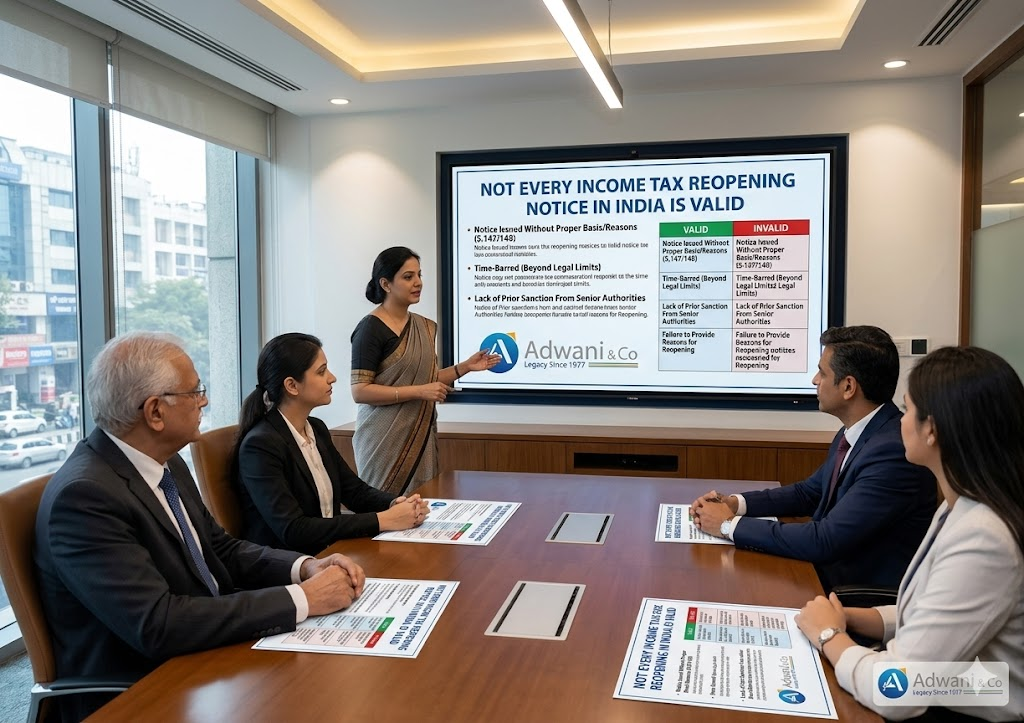
Not every income tax reopening notice in India is legally valid. Your name in someone else’s papers is not enough proof. Know your rights before you reply to anything.
Thousands of income tax reopening notices in India are issued without proper evidence. Find out why your notice may not be valid and what you must do before you respond.
The Important Thing Most People Miss
Not forged. Not fake. Genuinely official, genuinely issued by the tax department and still not valid.
Just because a notice comes on official letterhead with a stamp and formal legal language does not automatically mean it has been issued correctly or that it is legally strong. Many people assume that if something comes from a government department, it must be right, but that is not always the case. A notice should be backed by proper process, clear reasoning, and solid evidence not just data or assumptions.
In reality, there are situations where notices are issued based on incomplete information, system-generated data, or without proper verification. However, most people feel nervous when they receive such a notice and believe they should accept it without questioning, thinking that raising doubts might create trouble. This mindset can lead to unnecessary stress and even wrong responses. The truth is, questioning a notice is not wrong or risky it is a sensible and important step. Before reacting, one should understand the reason behind the notice, check whether there is actual evidence, and confirm whether the correct procedure has been followed. Taking a moment to evaluate instead of blindly accepting can make a big difference and help avoid unnecessary complications.
https://adwaniandco.com/blog/are-you-paying-gst-on-inpatient-medicines-unnecessarily
Why You Might Receive Such a Notice
Many times, such notices are sent for very basic reasons. It could be because your name appears in someone else’s records, or some transaction is reported somewhere in the system, or your PAN gets flagged in certain data. That’s all it takes. In many cases, there is no detailed checking done before sending the notice, and no proper verification of whether the information is correct or complete. The system simply picks up data and triggers a notice. So, what you are receiving is often based only on raw information, not on confirmed facts or proper investigation.
For a reopening notice to be legally valid, there must be actual, specific, credible information that directly relates to your income suggesting that income which should have been taxed in your hands was not declared or was under-declared. A name match is not that. A data connection to someone else’s transaction is not that. Your PAN appearing somewhere in a third party’s records is not that.The law is clear on this. Courts across India have said it repeatedly.
The information must relate specifically to you, it must be tangible and credible, and it must genuinely suggest that your income escaped taxation not merely that your name appeared somewhere in the system.If the notice sent to you does not meet this standard and many do not it is legally vulnerable from the moment it was issued.
How Income Tax Reopening Notices Are Generated Today
To understand why such notices are becoming so common, it helps to know what is actually happening in the background. Today, the income tax department uses advanced data systems that collect information from many different sources like bank records, property details, GST filings, TDS entries, share transactions, and even foreign payments.
All this data is matched and checked automatically. Whenever the system finds your name or PAN linked to any transaction, it simply flags it. In many cases, this flag directly leads to a notice being issued, without a proper review of your individual situation. There is often no detailed checking, no careful study of facts, and no clear confirmation that any income has actually escaped tax.
The process becomes more automatic than thoughtful data comes in, the system flags something, and a notice is sent. This is why many reopening notices today are based on weak grounds. It is not always intentional, but it happens because of how the system works. However, the law expects much more than this.
Before reopening a case, there should be a proper reason backed by real evidence, not just a system alert or your name appearing somewhere. There must be a clear belief that some income has not been taxed correctly. If this basic requirement is missing, and the notice is issued only because of system-generated data without proper application of mind, then such a notice can be questioned and challenged, and it may not stand legally.
The law says there must be a genuine, considered, evidence-backed reason to believe formed by a human being who has personally examined the information and independently concluded that income specific to you has escaped taxation.
When that standard is not met when the notice is the product of an automated process rather than a genuine individual review the notice is legally on shaky ground. It can be questioned. It can be challenged. And in many cases, when properly examined, it does not hold up.
The Mistake Most People Make When They Receive a Income Tax Reopening Notice
Let us be honest about something.
When an income tax reopening notice arrives, most people do not think clearly. And that is completely understandable. A government notice official, formal, carrying legal language and deadlines triggers something instinctive in almost everyone. A sense of urgency. A sense of being in trouble. A sense that you need to do something right now.
That feeling is natural. But acting on that feeling without stopping to think that is where the real damage begins.
Over the years, we have seen the same patterns play out again and again. Taxpayers who received notices and handled them in ways that hurt them not because they did anything wrong with their taxes, but because they did not know how to handle the notice itself.
These are the most common mistakes. And understanding them may be the most valuable thing you read today.
Section 148: What You Should Know Before You Respond
Section 148 is a provision under the Income Tax law that allows the department to reopen your past tax return
This means that if the department believes that some income was not properly reported or taxed earlier, they can send you a notice under Section 148 and ask you to file the return again for that year.
Before sending such a notice, the department is supposed to have a valid reason. There should be some information or material which suggests that income has actually escaped tax. It should not be based on guesswork or just because your name appeared somewhere.
A notice is just a starting point.
It is not a final decision.
So next time you receive one:
Don’t panic.
Don’t assume.
Understand first, then act.
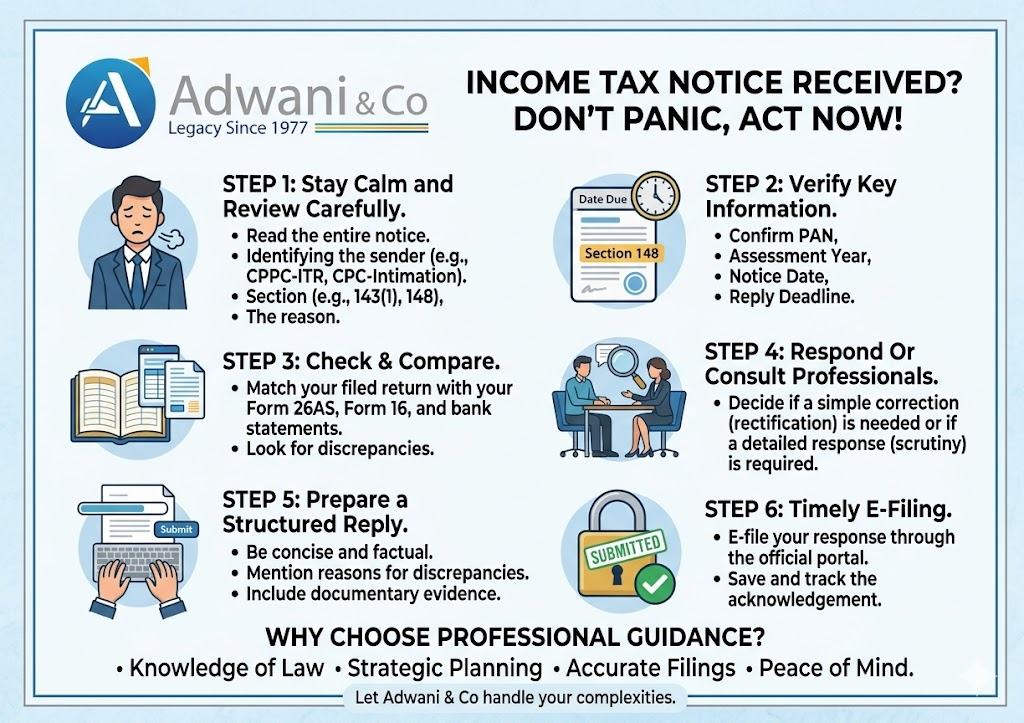
What To Do When You Receive an Income Tax Reopening Notice
1.Do Not Panic, Panic makes you reactive.
2.Read the Notice Carefully Every Word
3. Check the Assessment Year and the Section
4. Verify Whether the Notice Is Within the Time Limit
5. Ask What Reasons Were Recorded for Issuing This Notice
6. Go Back and Review Your Past Return and Documents
7. Identify What the Actual Issue Really Is
8. Prepare a Proper and Structured Response
When in doubt and sometimes even when you are not in doubt take advice. It is almost always the smartest investment you can make at this stage.
1.Is every income tax reopening notice valid in India?
A: No. Not every income tax reopening notice issued in India is legally valid. A notice must be based on specific, credible evidence that income has escaped taxation. If it is issued only because your name appeared in someone else’s records or based on a system-generated data flag without proper verification or independent review by the Assessing Officer it may not meet the legal standard required under Section 147 of the Income Tax Act and can be challenged.
2.What should I do first when I receive an income tax notice in India?
A: The first thing you should do is not panic and not reply immediately. Read the notice carefully, identify which section it has been issued under, check the assessment year it relates to, verify whether the Section 148A procedure was followed, and confirm whether it is within the applicable time limit. Only after this initial review should you decide whether to respond or challenge the notice.
3.Can I challenge an income tax reopening notice in India?
A: Yes. You have the legal right to challenge an income tax reopening notice in India if it does not meet the required legal standard. Grounds for challenge include the Section 148A procedure not being followed, the notice being issued beyond the permissible time limit, the information cited being vague or based entirely on third-party data, and the Assessing Officer failing to apply independent judgment. Many such notices have been successfully quashed by courts across India.
4.What is Section 148A and why does it matter?
A: Section 148A was introduced by the Finance Act of 2021 and created a mandatory pre-notice procedure that must be followed before any Section 148 reopening notice can be validly issued. It requires the Assessing Officer to conduct an inquiry, issue a show cause notice to the taxpayer, give the taxpayer an opportunity to respond, and then pass a reasoned speaking order. If any of these steps are skipped, the Section 148 notice that follows may be procedurally invalid.
5.What is the time limit for issuing an income tax reopening notice in India?
A: In most cases, the Income Tax Department can reopen an assessment only within three years from the end of the relevant assessment year. Beyond three years and up to ten years is permitted only where the income alleged to have escaped assessment is rupees fifty lakhs or more and the department has specific tangible evidence. A notice issued beyond the applicable time limit is time-barred and can be challenged on that ground alone.
About the Author
Dr. Haresh Adwani
Ph.D. in Commerce | Law Graduate | Managing Partner, Adwani & Co LLP Dr. Haresh Adwani holds a Ph.D. in Commerce and is a qualified Law graduate with over two decades of hands-on experience in GST advisory, direct taxation, and statutory compliance for businesses across Pune and Maharashtra has guided hundreds of SMEs, startups, and corporates through India’s evolving tax landscape. He is a recognised advisor on GST compliance, company formation, and Virtual CFO services, and regularly contributes to professional seminars and industry forums in Pune.
DISCLAIMER
This blog is intended for informational and educational purposes only. It does not constitute legal, financial, or professional tax advice. Tax laws and provisions under the Income Tax Act, 1961, are subject to amendment; figures and deadlines mentioned are based on information available as of the date of publication. Readers are strongly advised to consult a qualified Chartered Accountant or tax professional before taking any action based on this content. Adwani and Company and Dr. Haresh Adwani shall not be held liable for any decisions made on the basis of information provided herein. Always refer to official sources at incometax.gov.in and cbdt.gov.in for the latest and authoritative information.