Author: Dr. Haresh Adwani

  • STT Hike 2024: How Rising Transaction Costs Are Quietly Cutting Your Trading Profits

    STT Hike 2024: How Rising Transaction Costs Are Quietly Cutting Your Trading Profits

    By Dr. Haresh Adwani, PhD (Commerce), Law Graduate, Adwani and Company
    You haven’t changed a single line of your trading strategy. Your win rate looks fine on paper. Yet something feels off  your actual take-home profits are quietly shrinking. If this resonates with you, you are not alone, and the culprit may not be the market. The STT hike on trading profits introduced in the Union Budget 2024 is one of the most underreported yet financially significant changes affecting Indian F&O traders and equity investors today.

    In this guide, Dr. Haresh Adwani of Adwani and Company walks you through exactly what changed, why it matters far more than most traders realise, and what smart money is already doing to adapt for STT calculation with latest rates,examplees,and tips to understand your real post trading discruption

    +150%

    Futures STT hike (0.02% → 0.05%)

    +50%

    Options STT hike (0.10% → 0.15%)

    20%

    Interest deduction cap on dividends

    Capital Gains

    Buybacks now taxed as CG, not dividend

    What Is the STT Hike on Trading Profits and Why Should You Care?


    Securities Transaction Tax (STT) is a small percentage levy charged on every buy or sell transaction on Indian stock exchanges. It is collected at source by the exchange and remitted directly to the government. According to the Income Tax Department of India, STT was introduced under Chapter VII of the Finance (No. 2) Act, 2004, to bring transparency to equity markets and reduce tax evasion.

    The Union Budget 2024 revised STT rates significantly. The STT hike on trading profits affects two critical segments:

    SegmentOld STT RateNew STT Rate% Increase
    Futures (Sell side)0.0125%0.02%+60%
    Futures (on turnover)0.02%0.05%+150%
    Options (on premium)0.10%0.15%+50%

    For a casual investor making a handful of trades per month, this might seem trivial. For an active F&O trader executing dozens of trades per day, the STT hike impact on trading costs is anything but small.

    Key insight: STT is charged on the notional value of futures contracts and on the option premium  not just your profit. That means you pay STT whether the trade made money or not.


    Practical Example: How the STT Hike Drains F&O Trading Profits


    Real Numerical ExampleScenario: An active Nifty Futures trader executes 10 round trips per day, with an average notional value of ₹15,00,000 per trade (1 lot Nifty Futures ~ ₹15 lakh notional).

    Old STT per lot (sell side @ 0.02%): ₹15,00,000 × 0.02% = ₹300

    New STT per lot (sell side @ 0.05%): ₹15,00,000 × 0.05% = ₹750

    Extra STT per trade: ₹450

    10 round trips/day × ₹450 × 22 trading days: = ₹99,000 extra per month

    That is nearly ₹1.2 lakh in additional tax outgo per year from a single lot, trading conservatively. Scale this to a professional trader running multiple lots and strategies, and the STT hike on trading profits can easily erode ₹5–20 lakh annually.

    This is the number that most traders miss when they review their P&L. As Dr. Haresh Adwani, with deep legal expertise in taxation, consistently advises clients: “Your gross returns are vanity. Your post-cost, post-tax returns are reality.”

    Learn more about calculating your real post-tax trading returns.

    https://www.adwaniandco.com/blog/share-trading-tax-business-income-or-capital-gains-2026

    How Smart Traders Are Adapting Their Strategy After the STT Hike


    The STT hike on trading profits is not a reason to exit the market. It is a reason to trade smarter. Here is what experienced traders and institutions are already doing:Factoring STT into minimum profit targets: Instead of targeting ₹500 per trade, smart traders now set net targets after accounting for STT, brokerage, GST, and SEBI fees.

    • Reducing overtrading: More trades do not mean more profit. Post-STT hike, fewer, higher-conviction trades often produce better net P&L.
    • Position sizing discipline: Larger positions magnify STT costs. Traders are now more disciplined about lot sizes relative to expected profit.
    • Using spread strategies efficiently: Multi-leg strategies that reduce net premium exposure also reduce absolute STT outgo.
    • Annual tax-loss harvesting: Working with a CA to book and set off losses before year-end to reduce the tax impact on profitable trades.

    As Dr. Haresh Adwani frames it for clients at Adwani and Company: “Edge in trading is no longer just about entry and exit. In 2024 and beyond, it is equally about controlling costs and managing tax leakage. The traders who understand this will survive long-term. The rest will slowly bleed.”

    Government Compliance: What Every Trader Must Know


    The Ministry of Corporate Affairs (MCA) and the Income Tax Department have been systematically tightening compliance requirements for active market participants. Key compliance checkpoints include:

    • F&O trading turnover must be computed correctly for tax audit applicability under Section 44AB of the Income Tax Act.
    • Losses in F&O trading require filing ITR-3, not ITR-2. Incorrect ITR form can result in scrutiny or penalty.
    • GST registration may be required if your brokerage income or trading-as-business turnover exceeds the threshold.
    • STT paid is eligible for a rebate against your income tax liability in certain cases a benefit many traders miss.

    The Income Tax Department of India regularly updates guidelines for speculative and non-speculative business income treatment of F&O profits and losses (incometax.gov.in). Staying updated with these is critical.

    Read our detailed guide on ITR filing for F&O traders →https://www.adwaniandco.com/blog/fo-trading-taxation-in-india-2026-complete-simple-guide


    Conclusion: The STT Hike Is a Behaviour Filter – Adapt Now


    The STT hike on trading profits is not just a tax revision. It is the government’s way of filtering casual, high-frequency speculation from disciplined, informed trading. The traders and investors who understand this shift, adapt their cost structures, and plan their taxes proactively will continue to build wealth. Those who ignore it will see their edge slowly eroded not by bad trades, but by invisible costs. As Dr. Haresh Adwani,  always emphasises to clients at Adwani and Company: “In the new tax environment, your CA is as important to your portfolio as your broker.” The most

    successful investors combine market skill with tax intelligence  and that combination is exactly what Adwani and Company delivers.

    For further reference on official STT rates and compliance requirements, visit the Income Tax Department’s official portal at incometax.gov.in and the GST portal at gst.gov.in.

    Is your trading strategy accounting for the new STT hike?


    If you are trading F&O or investing actively and haven’t reviewed your real post-tax returns, now is the time. Connect with Adwani and Company  led by Dr. Haresh Adwani, PhD (Commerce) and Law Graduate  for personalised tax planning, ITR filing for traders, and compliance guidance that protects your profits.

    Frequently Asked Questions


    1. What is the STT hike on futures trading and when did it take effect?

    The Securities Transaction Tax on futures was revised in Union Budget 2024, effective from October 1, 2024. The rate on the sell side of futures contracts increased from 0.02% to 0.05% of the notional value  a 150% increase. This significantly increases the trading cost for active futures traders and directly impacts net trading profits.

    2. How does the STT hike affect options traders specifically?

    For options, the STT on the sell side increased from 0.10% to 0.15% of the option premium. For high-frequency options traders and those employing multi-leg strategies (straddles, spreads), this hike on trading costs is compounded across every leg of each strategy and across every expiry traded.

    3. Can I claim STT as a deduction in my income tax return

    Yes, in certain cases. If you are treating your trading as a business (non-speculative income in case of F&O), STT paid can be treated as a business expense and deducted from your gross trading income. However, if you are reporting F&O profits as capital gains (which is not the correct treatment per IT guidelines), the deduction rules differ. Consult a CA for accurate treatment specific to your profile.

    4. Will the STT hike on trading affect long-term equity investors?

    For long-term buy-and-hold investors, the direct STT impact is minimal since transactions are infrequent. However, the related changes  such as buybacks being taxed as capital gains and the 20% cap on dividend interest deduction  do affect equity investors’ post-tax returns

    5. Is redemption of Sovereign Gold Bonds (SGBs) always tax-free?

    No. Tax-free redemption at maturity is available only to original subscribers who purchased directly from the RBI during the issuance window and hold until the 8-year maturity date. If you bought SGBs from the secondary market (stock exchange), your redemption proceeds are subject to capital gains tax.

    6. How should I adjust my F&O trading strategy to manage the STT hike impact?

    Key adjustments include: recalibrating minimum profit targets to account for higher transaction costs, reducing unnecessary trades, employing tighter position sizing, using spread strategies to reduce net premium and thus absolute STT, and working with a qualified CA to optimise tax-loss harvesting and annual filings.

    7. Which ITR form should F&O traders use to report income?

    F&O income and loss must be reported under ITR-3 as business income (non-speculative). Filing under ITR-2 as capital gains is incorrect and can attract scrutiny. If total turnover exceeds ₹1 crore (or ₹10 crore in certain cases with cash turnover limits), a tax audit under Section 44AB is mandatory.

    Dr. Haresh Adwani holds a PhD in Commerce and brings over 20 years of expertise in GST compliance, income tax advisory, FEMA, and corporate law. Services include GST audit, ITR filing, GST appeal representation, notice response, NRI taxation, and FEMA compliance.

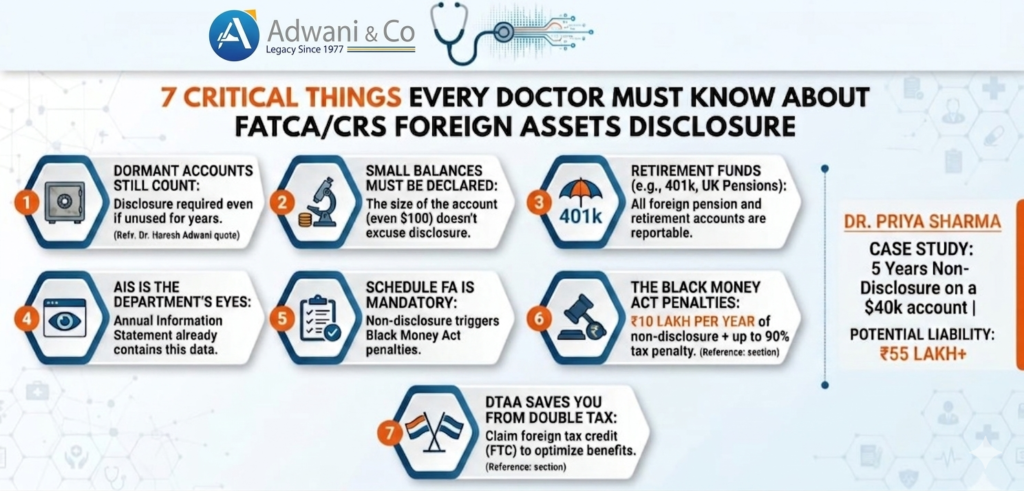
  • FATCA CRS Foreign Assets Disclosure: 7 Critical Things Every Doctor Must Know

    FATCA CRS Foreign Assets Disclosure: 7 Critical Things Every Doctor Must Know

    FATCA CRS Foreign Assets Disclosure
    FATCA CRS Foreign Assets Disclosure

    A Doctor. A Foreign Account. A Notice That Changed Everything.

    A Doctor. A Foreign Account. A Notice That Changed Everything.

    A doctor maintained a foreign savings account for years. It was opened during his fellowship abroad, kept active for convenience — occasional deposits, minor interest income, nothing extravagant. He never declared it in his Income Tax Return because, frankly, he did not think it mattered.

    Then a notice arrived from the Income Tax Department.

    The department already knew about the account. The balance. The interest earned. The transactions. All of it.

    How? Through the silent, relentless data-sharing machinery of FATCA CRS foreign assets disclosure frameworks that have fundamentally changed how foreign asset reporting works across 120+ countries.

    This is not a hypothetical story. Dr. Haresh Adwani, Partner of Adwani and Company, has personally guided numerous doctors and professionals through exactly this situation. And the pattern is almost always the same: a well-meaning professional, an undisclosed foreign account, and a notice that triggers panic.

    As Dr. Haresh Adwani puts it: “I personally know doctors who had no idea their foreign savings accounts were visible to the Indian tax department. They maintained them for years without declaration. And then the notices came.”

    This blog is your comprehensive guide to understanding FATCA CRS foreign assets disclosure, why it matters especially for doctors, and how to ensure you are fully compliant before the department comes knocking.

    What Is FATCA CRS Foreign Assets Disclosure?

    FATCA CRS Foreign Assets Disclosure: The FATCA Framework Explained

    FATCA was originally enacted by the United States in 2010 to combat tax evasion by US persons holding accounts abroad. However, its impact has been global. Under FATCA, foreign financial institutions (FFIs) worldwide are required to report information about accounts held by tax residents of partner countries including India.

    India signed an Inter-Governmental Agreement (IGA) with the US on 9 July 2015, with the implementing Rules (114F to 114H) notified on 7 August 2015 and the agreement coming into force on 31 August 2015, making Indian financial institutions subject to FATCA reporting requirements from that date. But more importantly for Indian taxpayers, this agreement also works in reverse — foreign financial institutions report Indian residents’ account information to the Indian tax authorities.

    CRS: The Common Reporting Standard

    While FATCA is US-centric, the Common Reporting Standard (CRS) is a global framework developed by the Organisation for Economic Co-operation and Development (OECD). Under CRS:

    • Over 120 jurisdictions have committed to automatically exchanging financial account information
    • Financial institutions identify accounts held by foreign tax residents
    • Account information is reported to the local tax authority, which then shares it with the account holder’s home country

    India adopted CRS in 2017 under Rule 114F to 114H of the Income Tax Rules.

    What Information Gets Exchanged Under FATCA CRS Foreign Assets Disclosure?

    The scope of information sharing is comprehensive:

    • Account holder identity: Name, address, tax identification number (PAN)
    • Account balance: Year-end balance or value
    • Interest income: Gross interest credited during the year
    • Dividend income: Dividends received during the year
    • Sales proceeds: Gross proceeds from sale of financial assets
    • Other income: Any other income credited to the account

    This means the Income Tax Department potentially has access to your foreign account details before you even file your return. This is the reality of modern FATCA CRS foreign assets disclosure — and ignoring it is no longer an option.

    Also Read:

    https://www.adwaniandco.com/blog/role-of-hr-in-a-ca-firm

    Why Doctors Are Particularly Vulnerable to FATCA CRS Foreign Assets Disclosure Issues

    The Medical Professional’s Global Footprint

    Doctors, more than almost any other professional group, have legitimate reasons for maintaining foreign financial connections:

    • Medical fellowships abroad: Many Indian doctors spend 2–5 years training in the US, UK, Australia, or other countries, opening bank accounts during their stay. These accounts often remain open long after they return to India.
    • Conference travel and honorariums: International medical conferences sometimes pay honorariums or reimbursements into foreign accounts.
    • Investments made during overseas training: Some doctors invest in mutual funds, retirement accounts (like 401(k) in the US or pension funds in the UK), or even property during their time abroad.
    • NRI to Resident status transition: Doctors who return to India after extended overseas practice often retain NRE/NRO accounts or foreign accounts that need different tax treatment once residential status changes.
    • Collaborative research funding: International research grants may be channeled through foreign institutional accounts where the doctor has beneficial ownership.
    • Inheritance: Some doctors inherit foreign assets from family members settled abroad.

    The problem is not having these accounts or assets. The problem is not disclosing them in the Indian ITR which triggers FATCA CRS foreign assets disclosure compliance failures.

    The Common Misconception About FATCA CRS Foreign Assets Disclosure

    Most doctors Dr. Haresh Adwani encounters share a common misconception: “The account is dormant / the balance is small / I do not use it anymore so it does not need to be declared.”

    This is incorrect.

    Under Indian tax law, every foreign asset must be disclosed in Schedule FA of your ITR, regardless of:

    • Whether the account is active or dormant
    • The balance amount (even zero-balance accounts with potential opening during the year)
    • Whether any income was earned
    • Whether the income was received in India or abroad

    Schedule FA: The Mandatory Foreign Assets Declaration

    What Is Schedule FA?

    Schedule FA (Foreign Assets and Foreign Income) is a section in the Indian Income Tax Return where taxpayers must declare all foreign assets and income. It applies to individuals who are Resident and Ordinarily Resident (ROR) in India.

    What Must Be Disclosed in Schedule FA?

    The disclosure requirements are extensive:

    • Foreign bank accounts: Every account, including dormant ones, with details of the bank name, country, account number, peak balance during the year, and closing balance
    • Foreign financial accounts: Investment accounts, custodial accounts, insurance products with cash value
    • Foreign immovable property: Property owned abroad, with purchase details, country, total investment, and income derived
    • Foreign equity or debt interest: Shares, debentures, or any other interest in a foreign entity, with name of entity, country, nature of interest, and total investment
    • Foreign trusts: Beneficial interest as trustee, beneficiary, or settler in any foreign trust
    • Any other foreign asset: Any other capital asset held outside India
    • Foreign income: All sources including salary, interest, dividends, rental income, and capital gains

    5 Key Points Most Doctors Miss About FATCA CRS Foreign Assets Disclosure

    1. Dormant accounts count. Even if you have not used the account in years, if it exists and has a balance (even $100), it must be declared.
    2. Retirement accounts abroad count. Your US 401(k) or UK pension fund needs to be disclosed in Schedule FA.
    3. Income received in India from foreign sources counts. If a foreign entity pays you a consulting fee and deposits it in your Indian bank account, it is still foreign income that needs proper classification.
    4. Jointly held accounts count. If you are a joint holder on a family member’s foreign account, your interest may need to be disclosed.
    5. Signing authority matters. Even if you do not own the account but have signing authority on it, disclosure obligations may apply.

    The Black Money Act: Severe Consequences for Non-Compliance

    What Is the Black Money Act?

    The Black Money (Undisclosed Foreign Income and Assets) and Imposition of Tax Act, 2015 commonly called the Black Money Act was specifically enacted to deal with undisclosed foreign assets and income. It is one of the most stringent tax laws in India.

    Penalties Under the Black Money Act

    • Undisclosed foreign income: Tax at 30% flat rate (no slab benefit) + penalty of 90% of the tax amount (effective rate: approximately 120% of the undisclosed income)
    • Failure to disclose foreign assets in Schedule FA: Penalty of ₹10 lakh per assessment year of non-disclosure
    • Willful attempt to evade tax on foreign income: Rigorous imprisonment of 3–10 years + fine

    These penalties are in addition to regular income tax liability. And unlike regular tax proceedings, the Black Money Act penalties are not easily negotiable or reducible.

    A Real-World Example of FATCA CRS Foreign Assets Disclosure Penalties

    Dr. Priya Sharma (name changed for privacy) maintained a bank account in the United States with an average balance of $40,000 (approximately ₹33 lakh). The account earned interest of $800 per year. She never disclosed the account or the interest income in her ITR for 5 years.g FATCA CRS foreign assets disclosure is not just important it is financially critical.

    When the information reached the Indian tax department through FATCA:

    Liability HeadAmount
    Penalty for non-disclosure of foreign asset₹10 lakh × 5 years = ₹50 lakh
    Tax on undisclosed interest income30% of total interest over 5 years
    Additional penaltyUp to 90% of the tax amount
    Total potential liability₹55 lakh+

    This is precisely why understanding FATCA CRS foreign assets disclosure is not just important it is financially critical.

    How the Income Tax Department Uses FATCA CRS Data

    The FATCA CRS Foreign Assets Disclosure Data Pipeline

    Here is how the information flows:

    1. Foreign financial institution identifies an account held by an Indian tax resident
    2. Foreign tax authority collects this data from institutions in its jurisdiction
    3. Data is transmitted to the Indian Income Tax Department through automatic exchange
    4. The department matches this data against the taxpayer’s filed ITR
    5. If there is a mismatch an asset not declared, income not reported a notice is generated

    According to the Income Tax Department, India has been actively receiving and processing FATCA/CRS data since 2017, and the matching algorithms have become increasingly sophisticated.

    The AIS Connection

    Your Annual Information Statement (AIS) now includes foreign asset and income information received through FATCA/CRS. Before filing your ITR, you can check your AIS to see what the department already knows about your foreign financial life.

    Dr. Haresh Adwani strongly recommends this as a first step for all clients with any foreign connections: “Check your AIS before you file. If the department already has the information, there is no point in not disclosing it. Voluntary compliance is always the less painful path.


    The FEMA Angle: Double Jeopardy for Non-Compliance

    It is important to note that FATCA CRS foreign assets disclosure failures do not just create income tax problems. They can also trigger issues under the Foreign Exchange Management Act (FEMA), administered by the Reserve Bank of India.

    If you are a resident Indian holding foreign assets without proper RBI authorization, you may face:

    • Penalties under FEMA for unauthorized holding of foreign assets
    • Compounding proceedings before the RBI
    • Scrutiny of the original source of funds used to acquire the foreign asset

    The Income Tax Department and RBI have information-sharing mechanisms, which means a tax notice can snowball into a FEMA investigation and vice versa.

    This dual regulatory framework makes it even more critical for doctors to ensure full FATCA CRS foreign assets disclosure compliance across both regimes.n assets disclosure compliance across both regimes.


    What Should You Do Right Now?

    Step 1: Audit Your Foreign Financial Footprint

    Make a comprehensive list of every foreign financial relationship you have or have ever had:

    • Bank accounts (active and dormant)
    • Investment accounts
    • Retirement/pension accounts
    • Property ownership
    • Signing authority on any account
    • Beneficial interest in foreign entities

    Step 2: Check Your Past ITRs

    Review your filed returns for the last 5–6 years. Did you fill out Schedule FA? Were all foreign assets disclosed? Was foreign income properly reported?

    If you filed through a CA or tax preparer, ask them specifically whether Schedule FA was completed.

    Step 3: Download Your AIS and TIS

    Your Annual Information Statement (AIS) and Taxpayer Information Summary (TIS) on the Income Tax e-filing portal may already contain information received through FATCA/CRS. Check whether foreign account data appears there.

    Step 4: Consider Voluntary FATCA CRS Foreign Assets Disclosure

    If you discover that your foreign assets were not disclosed in past returns, the voluntary disclosure route is always the less painful path. While penalties may still apply, proactive disclosure demonstrates good faith and can significantly reduce the severity of consequences.

    Dr. Haresh Adwani advises: “Voluntary disclosure, done correctly and timely, is always better than waiting for a notice. The department is far more lenient with taxpayers who come forward than with those who are caught.”

    Step 5: Engage a Specialist

    Foreign asset taxation sits at the intersection of Indian tax law, international treaties, FEMA regulations, and country-specific tax rules. This is not a DIY exercise. Engage a Chartered Accountant with specific experience in international taxation and FATCA/CRS compliance.

    At Adwani and Company, we have a dedicated practice for NRI taxation and foreign asset compliance.

    Key DTAA Benefits You Might Be Missing {#dtaa}

    What Is DTAA?

    India has signed Double Taxation Avoidance Agreements (DTAA) with over 90 countries. These agreements ensure that the same income is not taxed twice — once in the country where it is earned, and again in India.

    How DTAA Applies to FATCA CRS Foreign Assets Disclosure

    If you earn interest on a US bank account, for example:

    • The US may withhold tax at 15% (under the India-US DTAA)
    • You must declare this income in your Indian ITR
    • You can claim tax credit for the US tax paid under Section 90/91
    • Your effective Indian tax on this income is reduced by the foreign tax credit

    Many taxpayers miss this benefit, ending up paying double tax — or worse, not declaring the income at all because they assume tax has already been paid abroad. Proper FATCA CRS foreign assets disclosure includes optimizing your DTAA benefits.


    Real-World Resolution: How Adwani and Company Helps

    The Situation: A surgeon who returned to India in 2018 after a 6-year practice in the UK. He retained a UK bank account with £25,000 and a small pension fund. He filed Indian ITRs since 2018 but never completed Schedule FA. In 2024, he received a notice from the Income Tax Department referencing CRS data.

    Our Approach:

    1. Comprehensive review of all foreign accounts and their history
    2. Reconciliation of foreign income with Indian tax filings for each year
    3. Preparation of revised returns with complete Schedule FA disclosure
    4. Drafting a detailed response to the income tax notice explaining the oversight and demonstrating good faith
    5. Liaison with the Assessing Officer to settle the matter at the assessment stage
    6. FEMA compliance review to ensure RBI requirements were also met

    The Outcome: The matter was resolved with minimal penalties. No prosecution. No extended investigation. The key factor? Proactive, professional, and transparent engagement with the department..

    Conclusion: FATCA CRS Foreign Assets Disclosure Is a Legal Necessity

    The world has changed. Financial borders have dissolved — not for money, but for information. With FATCA and CRS, your foreign accounts are no longer your private secret. They are data points in a global network that connects over 120 countries, and the Indian Income Tax Department is an active participant in this network.

    For doctors and professionals with foreign assets, the message is clear: FATCA CRS foreign assets disclosure is not optional, not a formality, and not something to be deferred. It is a legal obligation with severe consequences for non-compliance.

    But here is the silver lining voluntary compliance, done correctly, is the less painful path. It protects you from penalties, prosecution, and the stress of responding to a notice you were not prepared for.

    As Dr. Haresh Adwani consistently advises: “The department often knows before you file. The question is not whether to disclose it is whether you disclose on your terms or on theirs.”

    If you have foreign assets, accounts, or income that need to be properly disclosed, connect with Adwani and Company today. Our team has deep expertise in international tax compliance, FATCA/CRS reporting, and Black Money Act advisory. We will ensure your disclosures are accurate, complete, and strategically optimized.

    Your expertise saves lives. Let ours protect your financial well-being.

    Do not wait for the notice. Take control of your FATCA CRS foreign assets disclosure compliance today with Adwani and Company.

    “This blog is for informational purposes only and does not constitute legal or tax advice. Please consult a qualified professional for advice specific to your situation.”

    1. What is FATCA CRS foreign assets disclosure?

    refers to the mandatory reporting and declaration of foreign financial accounts and assets under the Foreign Account Tax Compliance Act (FATCA) and Common Reporting Standard (CRS). Indian taxpayers must declare all foreign assets in Schedule FA of their ITR.

    2. Do I need to disclose a dormant foreign bank account in my ITR?

    tax law, every foreign bank account — whether active, dormant, or even zero-balance — must be disclosed in Schedule FA if you are a Resident and Ordinarily Resident (ROR) in India.

    3. What is the penalty for not disclosing foreign assets in India?

    Act, 2015, non-disclosure of foreign assets attracts a penalty of ₹10 lakh per assessment year. Additional penalties of up to 90% of the tax amount and imprisonment of 3–10 years may also apply.

    4. How does the Income Tax Department know about my foreign accounts?

    FATCA and CRS, over 120 countries automatically share financial account information with India. Your foreign bank reports your account details to its local tax authority, which then transmits it to the Indian Income Tax Department

    5. Can I file a revised return to disclose previously undisclosed foreign assets?

    can file a revised or updated return to correct past omissions within the prescribed time limits. Voluntary FATCA CRS foreign assets disclosure is always viewed more favorably than forced disclosure after a notice. Consult Adwani and Company for guidance.

    6. Are foreign retirement accounts like 401(k) reportable in India?

    Yes. Foreign retirement accounts, pension funds, and similar instruments are reportable under Schedule FA. The income treatment may vary based on the specific DTAA provisions between India and the relevant country.

    7. How can Dr. Haresh Adwani help with FATCA CRS foreign assets disclosure?

    Haresh Adwani and the team at Adwani and Company provide end-to-end support for FATCA CRS foreign assets disclosure — from asset mapping and AIS verification to Schedule FA preparation, DTAA benefit optimization, and notice response. Contact us today.

    Author

    Dr. Haresh Adwani PhD (Commerce)  •  Adwani & Company, Pune Dr. Haresh Adwani holds a PhD in Commerce and brings over 20 years of expertise in GST compliance, income tax advisory, FEMA, and corporate law. He is one of Pune’s most trusted Chartered Accountants for GST litigation, demand notice resolution, appeal management, and tax planning for businesses and individuals. Services include GST audit, ITR filing, GST appeal representation, notice response, NRI taxation, and FEMA compliance.
  • GST Appeal Pre-Deposit: APL 01 Field Now Editable After April 2026 Portal Fix

    GST Appeal Pre-Deposit: APL 01 Field Now Editable After April 2026 Portal Fix

    GST appeal pre-deposit
    GST appeal pre-deposit

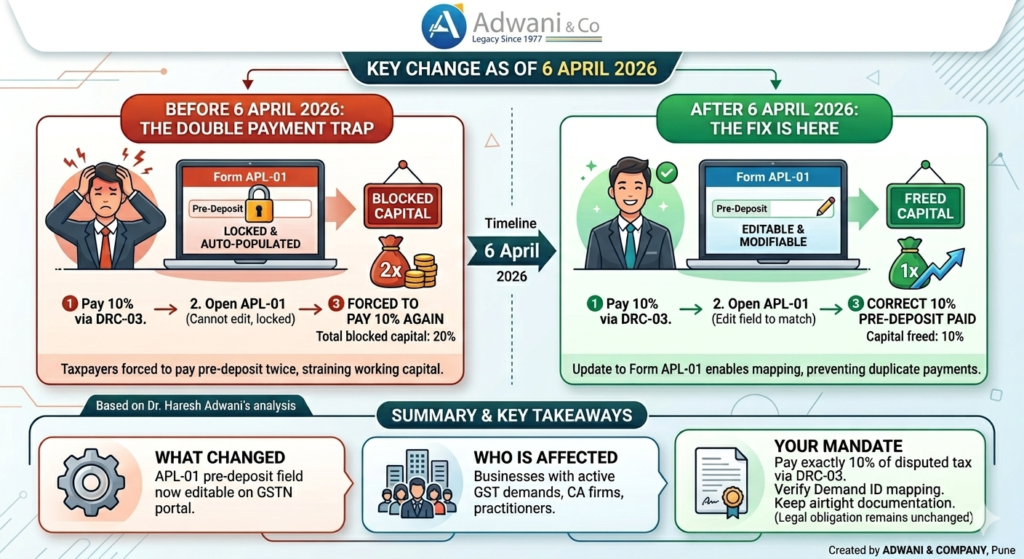
    The Double Payment Trap: GST Appeal Pre-Deposit Paid Twice.The GST appeal pre-deposit process in India has a critical flaw and GSTN finally fixed it on 6 April 2026. Here is what happened and what you need to do now.Last week, a manufacturing client from Pune called me in a panic. He had already paid ₹10 lakhs as GST appeal pre-deposit through DRC-03 correctly, by the book. But when he opened APL-01 to file the appeal, the portal was demanding ₹10 lakhs again. He thought he had made an error. He hadn’t. The GST portal had a critical bug and it was affecting hundreds of businesses just like his.

    Imagine this. You have already paid your GST appeal pre-deposit through DRC-03. You followed the rules. You paid the correct 10% of the disputed tax demand. Then you open Form APL-01 to file your GST appeal and the portal ignores your payment entirely.

    It auto-populates a fresh 10% liability, locks the pre-deposit field, and demands you pay again. You have done nothing wrong. But the system is treating your valid payment as if it never happened and blocking your appeal unless you pay a second time.

      This Was Not a Rare Edge Case This was happening to hundreds of businesses across India filing GST appeals after paying pre-deposits through DRC-03. The portal mismatch was causing real financial and legal consequences including blocked ITC, delayed appeals, and unnecessary working capital stress.

    As I highlighted in a recent LinkedIn post, this exact situation was encountered with a client last month creating unnecessary delays, back-and-forth with the portal, and significant stress.

    The good news: GSTN fixed this on 6 April 2026. The pre-deposit field in Form APL-01 is now editable. But before you breathe easy, there are critical details you need to understand about the fix, the legal requirements that remain unchanged, and the correct filing process going forward.

    Also Read:

    https://www.adwaniandco.com/blog/essential-guide-to-upskilling-in-taxation-5-pillars-for-smart-ca-professionals

    What Is the GST Appeal Pre-Deposit and Why Does It Matter?

    Under Section 107 of the CGST Act, 2017, when a taxpayer disagrees with a GST demand order and wants to file an appeal before the Appellate Authority, they must mandatorily deposit 10% of the disputed tax amount as a pre-deposit. This amount is paid upfront as a security before the appeal is even admitted.

    According to guidelines issued by the Central Board of Indirect Taxes and Customs (CBIC), this GST appeal pre-deposit must be made before or at the time of filing Form APL-01 the official appeal form submitted to the First Appellate Authority.

    GST Appeal Pre-Deposit Key FactsDetail
    Governing SectionSection 107, CGST Act 2017
    Pre-Deposit Amount10% of disputed tax (not penalty/interest)
    Form for Pre-DepositDRC-03 (voluntary payment)
    Form for Filing AppealAPL-01 (First Appellate Authority)
    Portal Fix Effective Date6 April 2026
    Legal Requirement StatusUNCHANGED Still Mandatory

    How the GST Portal Was Forcing Businesses to Pay Their Pre-Deposit Twice

    The problem arose from a disconnect between two GST portal systems the DRC-03 voluntary payment mechanism and the APL-01 appeal filing system. Here is the exact sequence of what was going wrong:

    Stage 1: Correct Payment Made via DRC-03

    A taxpayer receives a GST demand order. They calculate 10% of the disputed amount as the GST appeal pre-deposit and pay it correctly using Form DRC-03 the designated voluntary payment form under GST. They receive an ARN (Application Reference Number) confirming payment.

    Stage 2: Portal Ignores the DRC-03 Payment in APL-01

    When the same taxpayer opens Form APL-01 to file the appeal, the system does not map the DRC-03 payment to the relevant demand ID. Instead, the portal independently calculates 10% as a fresh liability, auto-populates this figure in the pre-deposit field, and locks it so the taxpayer cannot edit it.

    Stage 3: Forced into Double Payment or Appeal Abandonment

      The Impossible Choice Option A: Pay the pre-deposit again block double the required working capital, with no certainty of refund timeline.  Option B: Don’t pay and risk missing the appeal window entirely, leaving the original GST demand unchallenged and enforceable.

    For businesses with large demands running into lakhs or crores this portal error was causing serious cash flow crises and compliance failures. The GST portal had, in effect, made the GST appeal pre-deposit process dysfunctional for businesses who correctly paid via DRC-03 first.

    The April 6 Fix: GST Appeal Pre-Deposit Field Now Editable

    Effective 6 April 2026, GSTN deployed a targeted fix to Form APL-01.

      What Changed The pre-deposit amount field in Form APL-01 is now EDITABLE. Taxpayers can modify the auto-populated figure to match the actual amount already paid through DRC-03, instead of being forced into the system-calculated value.
    ScenarioBefore April 6, 2026After April 6, 2026
    Pre-deposit field in APL-01Locked Auto-populated onlyEditable Can match DRC-03
    DRC-03 payment mappingNot mapped to demand IDCan be reflected manually
    Double payment riskHigh Forced in many casesResolved
    Working capital impactDoubled unnecessarilyOnly 10% required as intended

    Real-World Example: How This Fix Saves a Business ₹10 Lakhs in Blocked Capital

    PRACTICAL EXAMPLE   Manufacturing Business, Pune GST Demand: ₹1 Crore  |  Pre-Deposit Required: ₹10 Lakhs Before April 6, 2026 (The Problem): Business pays ₹10 lakhs via DRC-03. Opens APL-01. Portal auto-calculates fresh ₹10 lakh liability, locks the field. To file the appeal, the business must pay another ₹10 lakhs total ₹20 lakhs blocked against a ₹1 crore demand. After April 6, 2026 (The Fix): Business pays ₹10 lakhs via DRC-03. Opens APL-01. Edits the pre-deposit field to show ₹10 lakhs (matching DRC-03 payment). Appeal filed. No duplicate payment. Only ₹10 lakhs blocked as legally required.   Working Capital Freed Up Immediately: ₹10,00,000  |  For businesses with crore-level demands, this saving is transformational.

    Who Is Most Affected by This GST Appeal Pre-Deposit Update?

    This update is directly and immediately relevant to the following categories of taxpayers:

    Businesses Under Active GST Demand Orders: If you have received a GST assessment order, adjudication order, or rectification order and plan to challenge it you must understand the updated APL-01 process before you file.

    Businesses That Already Paid via DRC-03: If you paid your GST appeal pre-deposit through DRC-03 before 6 April 2026 and have not yet filed APL-01 the editable field now allows you to correctly reflect that payment when you file.

    Businesses with High-Value GST Demands: For demands above ₹50 lakhs, the earlier double-payment issue was creating significant working capital pressure. This fix directly addresses that problem.

    CA Firms and GST Practitioners: The APL-01 filing workflow has changed. All client communication and filing procedures for GST appeals should be updated to reflect the April 2026 editable field change.

    What the Legal Requirement Still Says: The Portal Fix Changes Nothing Legally

    Here is the most critical point one that Dr. Haresh Adwani specifically emphasised. The portal fix does not change the legal requirement for the GST appeal pre-deposit.

    The obligation under Section 107 of the CGST Act remains fully intact. The Appellate Authority will still:

    • Verify that the correct 10% pre-deposit has been paid against the demand
    • Cross-check the DRC-03 payment details against the correct demand ID
    • Review the completeness and accuracy of the payment documentation
    • Flag any discrepancy between the amount stated in APL-01 and actual payment records
    • Reject or delay appeals where documentation does not support the pre-deposit claim
    ℹ  Important Reminder from Adwani & Company The GSTN portal change simplifies the technical filing process. It does not reduce your legal obligation. Proper reconciliation between your DRC-03 payment and your APL-01 filing supported by complete documentation is still essential for every GST appeal pre-deposit.

    Conclusion: The Portal Is Fixed But Your Documentation Must Be Airtight

    The GSTN fix to Form APL-01 effective 6 April 2026 is one of those quiet but consequential portal updates that carries significant real-world impact. It ends the double-payment trap that was forcing businesses to block double the legally required amount just to exercise their right to appeal a GST demand.

    However, as Dr. Haresh Adwani of Adwani and Company consistently emphasises: portal changes simplify processes, but they do not replace professional diligence. The Appellate Authority will continue to verify every GST appeal pre-deposit submission. Correct DRC-03 mapping, complete documentation, and accurate reconciliation remain the determining factors between a smoothly admitted appeal and a costly, delayed one.

    Filing a GST Appeal? Don’t Leave It to Chance. If you have received a GST demand notice, are planning to file an appeal, or are unsure whether your pre-deposit has been correctly mapped connect with Adwani and Company today. Dr. Haresh Adwani and our GST litigation team will review your case before you submit.

    1. What is the GST appeal pre-deposit requirement under Section 107?

    Under Section 107 of the CGST Act, 2017, a taxpayer filing an appeal before the First Appellate Authority must mandatorily pay 10% of the disputed tax amount as a pre-deposit before the appeal is admitted. This applies specifically to the disputed tax portion not to penalty or interest components.

    2. Can I pay the GST appeal pre-deposit through DRC-03?

    Yes. Form DRC-03 is the accepted method for making the GST appeal pre-deposit voluntarily. After the GSTN fix effective 6 April 2026, the APL-01 portal now allows you to edit the pre-deposit field to reflect the exact amount paid via DRC-03.

    3. What exactly changed in Form APL-01 on April 6, 2026?

    Prior to April 6, 2026, the pre-deposit field in Form APL-01 was locked. Effective 6 April 2026, GSTN made the pre-deposit field editable. Taxpayers can now manually modify the amount to reflect the actual payment made through DRC-03, eliminating the double-payment problem entirely.

    4. Will the Appellate Authority accept my DRC-03 payment as a valid pre-deposit?

    Yes, provided the DRC-03 payment is correctly mapped to the relevant demand ID and fully documented. The Appellate Authority will still verify the pre-deposit the portal fix changes the filing process, not the legal scrutiny of the payment.

    5. What happens if the DRC-03 payment is not mapped to the correct demand ID?

    If the payment is not correctly mapped, the Appellate Authority may treat the pre-deposit as insufficient or absent which can result in the appeal being rejected or delayed. Always verify the demand ID on your DRC-03 receipt before filing APL-01.

    6. Can I get a refund of the GST appeal pre-deposit if I win the appeal?

    Yes. If the appeal is decided in your favour and the demand is set aside or reduced, the pre-deposit amount is refundable. The refund process requires a separate refund application on the GST portal.

    7. Do I need a CA to file a GST appeal and manage the pre-deposit process?

    While there is no strict legal mandate, the complexity of the process including pre-deposit calculation, DRC-03 mapping, APL-01 documentation, and appellate proceedings makes professional CA assistance strongly advisable. Adwani and Company has handled hundreds of GST appeal cases successfully.

    Author:

    Dr. Haresh Adwani PhD (Commerce)  •  Adwani & Company, Pune Dr. Haresh Adwani holds a PhD in Commerce and brings over 20 years of expertise in GST compliance, income tax advisory, FEMA, and corporate law. Services include GST audit, ITR filing, GST appeal representation, notice response, NRI taxation, and FEMA compliance.

    Legal Disclaimer: This article is published for informational and educational purposes only. Nothing contained herein constitutes legal, financial, or tax advice, nor should it be treated as a substitute for professional consultation tailored to your specific circumstances. Tax laws, rates, and provisions are subject to change; readers are strongly advised to consult a qualified Chartered Accountant or tax advisor before acting on any information in this article.

  • The 120: Day Rule That Is Silently Taxing Thousands of NRIs in India

    The 120: Day Rule That Is Silently Taxing Thousands of NRIs in India

    The Dangerous Myth Many NRIs Still Believe

    “I live outside India, so I am an NRI. My foreign income is safe.”

    This belief simple, logical-sounding, and widely held is wrong for a growing number of NRIs. And the consequences of getting this wrong are not a minor inconvenience. They can fundamentally change how your entire global income is taxed, expose previously protected foreign accounts to Indian disclosure requirements, and trigger tax liabilities you had no idea were coming.

    Dr. Haresh Adwani of Adwani & Company regularly encounters NRI clients who discover their residential status has shifted not because they moved back to India, but because they visited more frequently than they tracked. A wedding here. A family emergency there. A few extra weeks that felt harmless. And then the days added up past a number that changed everything: 120.

    According to the Income Tax Department of India, a specific amendment introduced via the Finance Act 2020 tightened the rules for determining NRI status for individuals with significant Indian income. Understanding this rule is now essential for every NRI who visits India regularly not just those planning to return permanently.

    The Core Risk

    If you have Indian income exceeding ₹15 lakh and spend 120 days or more in India in a financial year while also having stayed 365+ days cumulatively over the previous four years India may tax you as a resident, including on your foreign income.

    The 120-Day Rule That Is Silently Taxing Thousands of NRIs in India
    The 120-Day Rule That Is Silently Taxing Thousands of NRIs in India

    The 120-Day NRI Tax Rule Explained

    The standard rule most NRIs know is the 182 day rule: if you spend fewer than 182 days in India in a financial year, you are classified as a Non Resident Indian and your foreign income is not taxable in India. This rule still applies but with an important and often overlooked exception introduced by the Finance Act 2020.

    Under the amended provisions of Section 6 of the Income Tax Act, 1961, a person who is a citizen of India or a Person of Indian Origin (PIO) is treated as a resident of India if all three of the following conditions are simultaneously met:


    The Three-Condition Test Section 6, Income Tax Act 1961

    1. Indian Income Threshold: Your total income from Indian sources including salary from Indian employers, rental income from property in India, interest from NRO accounts, or dividends from Indian companies exceeds ₹15 lakh in the relevant financial year.

    2. Current Year Stay: You stayed in India for 120 days or more during that financial year (April 1 to March 31), regardless of whether the stays were continuous or spread across multiple visits.

    3. Cumulative Stay: You stayed in India for a cumulative total of 365 days or more over the four financial years immediately preceding the relevant year.

    This rule was specifically introduced to address cases where high-income individuals were spending substantial time in India while claiming NRI status to shield their foreign income from Indian tax. The 15 lakh threshold ensures it does not affect NRIs with limited Indian income, but for NRIs with property, investments, or employment connections in India generating significant returns, this rule is highly relevant.

    Also Read:

    https://www.adwaniandco.com/blog/financial-modeling-for-business-valuation-normalized-eps-explained-india-guide


    How 120 Days Add Up Without You Noticing

    120 days is not a lot. It is approximately four months. And for an NRI who has family, property, or business interests in India, four months across a year is entirely conceivable even without any intention to stay long-term.

    Here is how a typical NRI’s year might look without conscious tracking:

    December to January

    Annual family visit over the holiday season. Stayed a bit longer to attend a cousin’s wedding.38 days

    March to April

    Parent’s health issue. Flew down urgently, managed medical matters, returned after recovery.28 days · Running total: 66

    June

    Brief trip to handle property matters and meet the family lawyer. Extended slightly for a puja.18 days · Running total: 84

    October to November

    Diwali visit. Stayed on for sibling’s anniversary function and a school reunion.40 days · Total: 124 days ⚠ Limit crossed

    In the above scenario, no single trip looks excessive. But the cumulative total of 124 days combined with Indian rental or investment income exceeding ₹15 lakh may be enough to trigger the residency test. Most NRIs in this situation do not discover the problem until they receive an Income Tax notice or an AIS (Annual Information Statement) query from the tax department.


    What Changes When You Lose NRI Status Under the 120-Day Rule

    The moment India classifies you as a tax resident even temporarily the scope of your taxable income expands dramatically. India’s tax jurisdiction now potentially extends to:

    Income TypeBefore (as NRI)After (as Resident)
    Indian salary or rental incomeTaxable in IndiaTaxable in India
    Foreign salary / employment incomeNot TaxableFully Taxable
    Interest from foreign bank accountsNot TaxableFully Taxable
    Rent from property outside IndiaNot TaxableFully Taxable
    Capital gains from foreign stocksNot TaxableFully Taxable
    Dividends from global investmentsNot TaxableFully Taxable
    Foreign assets disclosure required?Not RequiredMandatory in ITR

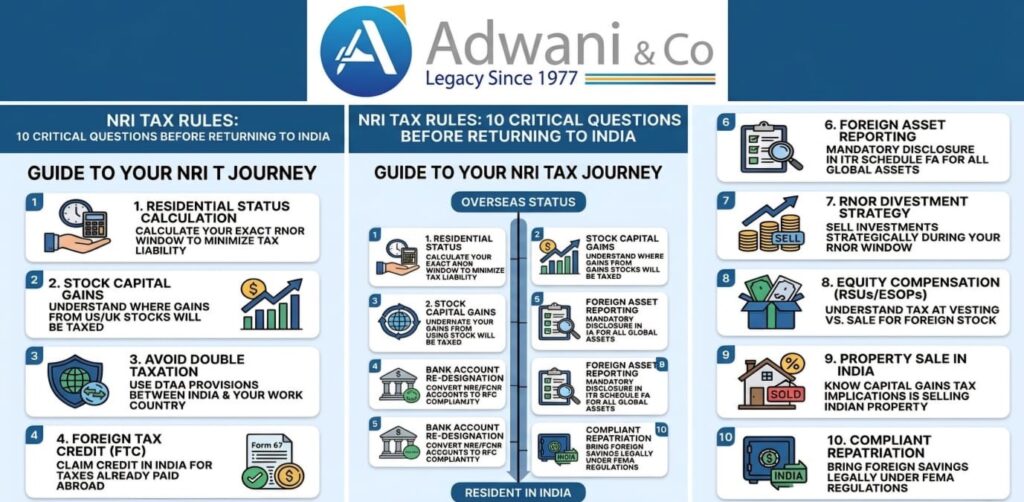
    Beyond the income tax dimension, the change in residency status also triggers FEMA obligations. Foreign bank accounts that were perfectly legal as an NRI must now be reconsidered. NRE account operations as a resident are a FEMA violation. The Reserve Bank of India requires specific account re-designations that many NRIs are unaware of.

    FEMA Alert

    Operating an NRE (Non-Resident External) bank account after your residential status changes to Resident is a violation of FEMA regulations. Re-designation to an RFC (Resident Foreign Currency) account is mandatory and must happen promptly. Learn more about FEMA Compliance for NRIs at Adwani & Company.


    RNOR Status: The Safety Net You May Still Have

    There is some good news. Even if your residential status does shift from NRI to Resident, you may not immediately become an ROR (Resident and Ordinarily Resident). Depending on your prior years of NRI status, you may qualify for RNOR Resident but Not Ordinarily Resident.

    RNOR is a transitional status that continues to protect your foreign income from Indian taxation for a limited period typically two to three financial years. A person qualifies as RNOR if they have been non-resident in India in at least 9 of the 10 financial years preceding the relevant year, or have stayed in India for 729 days or fewer in the 7 preceding financial years.

    The RNOR Advantage

    During RNOR status, income earned outside India that is not received or deemed to arise in India remains outside India’s tax net. This protection window if you qualify gives you time to restructure investments, repatriate funds, and plan asset liquidation before full ROR status applies. Identifying and using this window is a core part of Dr. Haresh Adwani’s NRI tax advisory practice.


    Real Example: How One NRI Was Caught Off Guard

    Priya K., Finance Professional London to Repeated India Visits

    Priya worked in London for 9 years. She owned two flats in Mumbai generating a combined rental income of 22 lakh per year. She visited India frequently a December family trip, an April medical visit for her mother, a July trip for property matters, and a Diwali trip in November. Total India stay for the financial year: 131 days.

    Priya had no plans to return to India permanently. She considered herself a straightforward NRI. She had never counted her days.

    What Happened: With Indian rental income of ₹22 lakh (above 15 lakh threshold), 131 India days in the year, and cumulative stays well above 365 days in the preceding four years, all three conditions under Section 6 were satisfied. Priya was reclassified as a Resident for that financial year. Her UK salary, London savings account interest, and gains from UK equity funds previously untouched by Indian tax became taxable in India. Her NRE account operation during that period was also flagged as a FEMA concern.

    Lesson: Indian income above ₹15 lakh + 120+ India days = a combination you must actively monitor every financial year not just when planning a permanent return.


    Two Critical Things to Check Before March 31 Every Year

    You do not need to overhaul your life to manage this risk. But you do need to be proactive. Dr. Haresh Adwani recommends every NRI with significant Indian income complete two simple checks before March 31 of each financial year:

    1. Count your India days precisely. Add up every day you were physically present in India between April 1 and the current date. Include partial days. Compare against the 120-day threshold. If you are approaching it, plan your departure accordingly.

    2. Review your Indian income for the year. Total up all income from Indian sources rent, NRO interest, dividends from Indian shares, salary from Indian employers. If this exceeds ₹15 lakh and you are near 120 India days, the risk is real.

    Also Check Your Cumulative Stay

    Even if this year’s India stay is below 120 days, check your cumulative India days across the previous four financial years. If you are approaching or have crossed 365 cumulative days over that period, your buffer for the current year is already reduced. Tracking this four year rolling total is an important part of ongoing NRI residency status management.

    Read our detailed guide on NRI Residential Status and Day-Count Management — A Practical Guide for year-by-year tracking strategies.


    Conclusion: 120 Days Is Not Just a Number It Is a Tax Turning Point

    The 120-day NRI tax rule is not obscure fine print. It is an active provision in the Income Tax Act that has real consequences for any NRI with meaningful Indian income and regular visits home. The mistake most people make is not wilful it is simply a lack of awareness. Nobody warns you at the airport. No bank sends you a reminder. The days accumulate quietly, and the tax implications arrive months later via a notice or during ITR filing.

    The solution is equally simple: awareness and tracking. Know which rule applies to you 182 days or 120 days based on your Indian income level. Track your India days carefully across every financial year. Check the four-year cumulative total annually. And if you are approaching either threshold, plan the calendar accordingly or consult a qualified NRI tax advisor before year-end.

    As Dr. Haresh Adwani consistently advises NRI clients: one hour of planning before March 31 can prevent one year of tax complications after it. Do not let 120 days become the most expensive number in your financial life.

    Frequently Asked Questions

    1. Does the-day rules apply to all NRIs or only those with high Indian income

    The 120 day rule applies specifically to NRIs whose total Indian income exceeds 15 lakh in the relevant financial year. If your Indian income is below ₹15 lakh, the standard 182 day rule continues to apply. However, ₹15 lakh is not a high threshold it is approximately ₹1.25 lakh per month. Many NRIs with property generating rental income, NRO fixed deposits, or dividend income from Indian investments can easily cross this level. It is worth calculating your Indian income annually to know which rule applies to you in any given year.

    2. Are days in Transit through indian airports counted toward the 120 days?

    Generally, days spent in India in transit where you do not leave the international transit area of the airport are not counted as days of presence in India. However, if you exit the airport and enter Indian territory, even briefly, that day counts. With the increasing prevalence of stopovers and long haul connections through Indian airports, NRIs should be cautious. If in doubt, it is safer to route connecting flights through airports outside India or to keep international transit strictly within the airport’s transit zone. This is a detail worth clarifying with a qualified NRI tax advisor for your specific travel pattern.

    3. If i become a resident due to the 120-days rule, do i loose NRI status permanently?

    No. Residential status in India is determined year by year, based on physical presence in each financial year. If you become a resident in one financial year due to the 120 day rule, but in the following year you stay below the applicable threshold (182 days under the standard rule, or 120 days if the three-condition test again applies), you can revert to NRI status for that next year. However, the years in which you were classified as resident will be counted in the rolling four year cumulative stay calculation. This is why tracking your stay carefully each year is important a single year of resident status can have multi year implications for the cumulative stay count.

    4. what happens to my NRE account if i am classified as resident under the 120-day rule?

    Under FEMA regulations, NRE accounts are meant exclusively for Non Resident Indians. If your residential status changes to Resident even for one financial year under the 120day rule your NRE account must be re-designated to an RFC (Resident Foreign Currency) account or a regular resident savings account. Failure to do so is a FEMA violation. The interest income earned on NRE accounts is tax exempt as long as you maintain NRI status. Once you become a resident, NRE interest becomes taxable. The NRO account, on the other hand, is the appropriate account for residents with Indian source income. Proactive account management is essential, and Adwani & Company guides NRI clients through this process.

    5. can RNOR status protected my foreign income even if I am reclassified as resident?

    Possibly, but it depends on your specific history. RNOR (Resident but Not Ordinarily Resident) status is available if you qualify under the conditions in Section 6(6) of the Income Tax Act specifically, if you have been non-resident in India in 9 of the 10 immediately preceding financial years. If you qualify as RNOR rather than full ROR, your foreign income that is not received in India remains outside India’s tax net. This is an important distinction it means the transition from NRI to Resident does not automatically make all your foreign income taxable if RNOR applies. Dr. Haresh Adwani can assess your specific years of NRI history to determine whether RNOR protection applies.

    6. Do i need to disclose foreign bank accounts if I become resident for just one year?

    Yes. For the financial year in which you are classified as Resident and Ordinarily Resident (ROR), you are required to disclose all foreign bank accounts and assets in Schedule FA of your Income Tax Return. If you qualify as RNOR rather than ROR, the disclosure obligations are less extensive but still exist for assets with Indian connections. Non disclosure under the Black Money Act can attract penalties of 90% of the undisclosed amount plus 30% tax, regardless of whether the non-disclosure was intentional. Voluntary disclosure, guided by a qualified NRI tax advisor, is always the safest approach.

    7. I have rental Income from Two indian Properties totalling Rs.18Lakh.How may days can i safely stay in india?

    Since your Indian income exceeds ₹15 lakh, the 120-day rule applies to you rather than the standard 182-day rule. This means you must ensure your India stay does not reach or exceed 120 days in any financial year, provided your cumulative India stay over the preceding four years has crossed or is approaching 365 days. If the cumulative four year stay has not yet reached 365 days, you have more flexibility but it is worth tracking carefully as this total will grow over time. The practical safe limit, to maintain a comfortable buffer, is typically 100 to 105 days per year if both conditions are close to being met. Consulting Dr. Haresh Adwani at Adwani & Company for a personalised residency status assessment is strongly advisable given your income level.

    Author

    Dr. Haresh Adwani

    PhD (Commerce) · Adwani & Company, Pune

    Dr. Haresh Adwani is a PhD holder in Commerce with over 20 years of experience in NRI taxation, FEMA compliance, international financial advisory, and tax notice resolution. He is one of Pune’s most trusted NRI tax advisors, specialising in residential status assessment, DTAA planning, and cross-border compliance for professionals returning from the US, UK, UAE, Canada, and Australia.

    Legal Disclaimer: This article is published for informational and educational purposes only. Nothing contained herein constitutes legal, financial, or tax advice, nor should it be treated as a substitute for professional consultation tailored to your specific circumstances. Tax laws, rates, and provisions are subject to change; readers are strongly advised to consult a qualified Chartered Accountant or tax advisor before acting on any information in this article.

    All content is original. References to government portals and statutory provisions are paraphrased for educational purposes in compliance with fair use principles. No content has been reproduced from third-party sources

  • ITR Filing Below ₹2.5 Lakh: Is It Mandatory? Complete 2026 Guide

    ITR Filing Below ₹2.5 Lakh: Is It Mandatory? Complete 2026 Guide

    The Story Nobody Talks About

    Last month, a stressed client walked into our tax consulting office. His voice trembled as he explained his predicament: “Sir, mere income toh ₹2.5 lakh se bhi kam hai. Maine socha tha filing ki zaroorat nahi. Toh notice kyun aaya?” This conversation happens across India every single day.

    In conference rooms, small offices, and home meetings the misconception is so widespread that the Income Tax Department receives thousands of queries on this exact issue every filing season.

    The Truth Most People Miss Income tax return filing is not just about reporting your income. It is about your entire financial footprint. And if that footprint does not align with your reported income, the system will flag you regardless of how low your earnings actually are.

    Is ITR Filing Below ₹2.5 Lakh Mandatory in India?

    No, ITR filing is not mandatory if your income is below ₹2.5 lakh, but it becomes compulsory under specific conditions like high-value transactions, TDS deductions, or foreign travel.. Under the Income Tax Act, 1961, filing an ITR is not strictly mandatory if your gross total income falls below the basic exemption limit of ₹2.5 lakh (for individuals below 60 years). However, the law prescribes

    several conditions under which filing becomes compulsory regardless of income level. The Income Tax Department of India has also evolved from a simple income-based system to a comprehensive

    financial activity tracking system, using tools like the Annual Information Statement (AIS) and data feeds from banks, mutual funds, and customs authorities.


    You Must File ITR Even Below ₹2.5 Lakh If:

    • TDS or TCS has been deducted on your salary, bank interest, or any other income and you wish to claim a refund
    • High-value bank transactions exist in your account cash deposits exceeding ₹10 lakh, credit card spends above ₹1 lakh, or fund transfers that are significantly higher than your declared income
    • Foreign travel expenses above ₹2 lakh in a year have been incurred (as tracked through forex transactions and immigration records maintained by the Bureau of Immigration, India)
    • You own foreign assets or have received foreign income in any form
    • Electricity consumption exceeds ₹1 lakh in a year (per notified thresholds)
    • Business or professional income exists ITR filing is generally required irrespective of profit level
    • Deposits in current accounts exceed ₹50 lakh during the year
    • Deposits in savings accounts exceed ₹10 lakh in aggregate during the year

    Why Filing Voluntarily Still Makes Sense

    Even when not legally mandatory, filing your ITR provides significant practical benefits:

    • Maintains a clean, verifiable financial record
    • Prevents unnecessary notices or scrutiny from the department
    • Acts as proof of income for loans, home rentals, and visa applications
    • Allows you to carry forward capital losses for future tax offset
    • Required for claiming refunds on any TDS already deducted.

    Also Read:

    201https://www.adwaniandco.com/blog/form-26a-and-tds-default-relief-under-section-201


    ITR Filing Below ₹2.5 Lakh: Real Case Study of Tax Notice

    Let us break down the actual situation that prompted this article. A client with reported income of ₹2.3 lakh received a notice under Section 142(1) of the Income Tax Act, 1961, requiring him to explain transaction discrepancies. Three specific factors triggered the automated flag:

    Trigger 1: High Bank Account Activity

    The client’s bank account showed nearly ₹48 lakh in annual transactions regular deposits, large withdrawals, transfers to multiple beneficiaries, and occasional foreign remittances. The Income Tax Department receives bank transaction data through the Financial Intelligence Unit (FIU-IND) and cross-references it with your ITR filing via the AIS portal (incometax.gov.in). A ₹46 lakh gap between bank activity and declared income is an automatic red flag.

    Trigger 2: International Travel Records

    The client’s passport showed two international trips. Foreign exchange transactions are reported to the department by authorised dealers (banks and forex providers) under the Foreign Exchange Management Act (FEMA). Combined with low declared income, the department’s automated system raised questions about the source of travel funds. Note: Travel records in India are maintained by the Bureau of Immigration under the Ministry of Home Affairs not by any US agency.

    Trigger 3: Unmatched TDS Entries in AIS

    The client had ₹0.8 lakh in TDS entries (from bank interest, salary, and investments) sitting in the Annual Information Statement (AIS) with no corresponding ITR filed. The AIS consolidates all TDS/TCS data from employers, banks, and financial institutions. Unmatched TDS entries are the single biggest trigger for automated scrutiny notices in India today.

    The Numbers That Triggered the Notice

    Financial ActivityAmountStatus
    Reported Annual Income₹2.3 lakhDeclared in return
    Bank Account Deposits (Annual)₹48 lakhNot declared as income
    International Travel (2 trips)₹3.5 lakhNo documented source
    TDS Entries in AIS₹0.8 lakhUnmatched to ITR
    Investment Activity₹5.2 lakhNo source documentation
    Total Financial Activity₹60 lakh+Major discrepancy — ₹58L gap
    Key Lesson The Income Tax Department’s automated system does not ask “Is this person a criminal?” It asks “Does this financial story make sense?” In this case, a ₹58 lakh gap between activity and declared income made it clearly not make sense.

    Why ITR Filing Below ₹2.5 Lakh Gets Scrutinized by AIS & CASS

    India’s tax compliance infrastructure has undergone a silent revolution over the past decade. The department has moved from manual assessment to data-driven automated scrutiny. Here is how your financial footprint is tracked:

    1. Annual Information Statement (AIS)

    The AIS is available on the official Income Tax portal and consolidates data from 40+ sources including banks, mutual funds, registrars, stock exchanges, and more. It shows every financial transaction linked to your PAN. You can view your own AIS at any time and should do so before filing.

    2. Statement of Financial Transactions (SFT)

    Banks, mutual fund houses, registrars, and other specified entities are legally required under Section 285BA of the Income Tax Act to report high-value transactions to the department. This data flows directly into your AIS.

    3. Financial Intelligence Unit (FIU-IND)

    All cash transactions above ₹10 lakh and suspicious transactions are reported by banks to FIU-IND, which shares this data with the Income Tax Department for cross-verification.

    4. CBDT’s Automated Risk Profiling

    The Central Board of Direct Taxes (CBDT) uses a Computer Aided Scrutiny Selection (CASS) system that automatically identifies mismatches between your AIS data and your filed ITR (or absence of ITR). Cases with significant discrepancies are auto-selected for scrutiny or notice issuance without any human intervention.


    How to Do ITR Filing Below ₹2.5 Lakh (Step-by-Step Guide)

    Even if your income is below the taxable threshold, here is how to file correctly:

    • Step 1: Log in to the Income Tax e-filing portal using your PAN and Aadhaar-linked mobile OTP
    • Step 2: Download and review your AIS and TIS (Taxpayer Information Summary) under ‘Annual Information Statement’
    • Step 3: Select the appropriate ITR form ITR-1 (Sahaj) for salaried individuals with income up to ₹50 lakh; ITR-4 for small business/professional income
    • Step 4: Pre-fill your return using Form 26AS and AIS data, then verify all TDS entries match your records
    • Step 5: Declare all income sources salary, interest, capital gains, freelance income even if below the taxable limit
    • Step 6: Submit and e-verify using Aadhaar OTP, Net Banking, or Digital Signature Certificate (DSC). The filing deadline for AY 2025-26 is 31 July 2025 for non-audit cases
    Important Deadline The ITR filing deadline for Assessment Year 2025-26 (Financial Year 2024-25) is 31 July 2025 for individuals not subject to audit. A late filing fee of up to ₹5,000 applies under Section 234F if filed after the due date.

    Penalties for Ignoring ITR Filing Below ₹2.5 Lakh

    Failing to file when required or filing with incorrect information can result in the following consequences:

    • Late filing fee (Sec 234F): ₹1,000 if income is below ₹5 lakh; ₹5,000 for others
    • Interest on tax dues (Sec 234A): 1% per month on any outstanding tax liability
    • Notice under Section 142(1): Requires you to produce accounts, statements, and explanations for all transactions
    • Best Judgement Assessment (Sec 144): The Assessing Officer may assess your income based on available information if you fail to comply
    • Prosecution (Sec 276CC): Wilful failure to file can attract imprisonment of 3 months to 2 years in cases involving significant tax evasion

    1. Is it mandatory to file ITR if income is below ₹2.5 lakh in 2026?

    No, ITR filing is not always mandatory if your gross total income is below ₹2.5 lakh. However, it becomes legally required if you have TDS deductions you wish to claim as refund, high-value bank transactions (above ₹10 lakh deposits), foreign travel expenses above ₹2 lakh, foreign assets, or business/professional income. Voluntary filing is strongly advisable in all other cases.

    2. What happens if I do not file ITR despite having reportable financial activity?

    You may receive a notice under Section 142(1) or 148A of the Income Tax Act requiring you to explain your transactions. You also forfeit the right to claim any TDS refund, and risk penalties under Section 234F, interest under 234A, and in extreme cases, prosecution under Section 276CC. Additionally, obtaining loans, visas, or government tenders becomes difficult without ITR proof

    3. Can I receive an income tax notice even if my income is very low?

    Yes. The Income Tax Department’s automated system (CASS) does not consider income level alone. It compares your AIS data which includes all bank transactions, investments, foreign travel, and TDS entries against your filed return or the absence of one. Any significant mismatch automatically triggers a notice, regardless of your actual income.

    4. How much bank transaction is permissible without filing ITR?

    There is no officially ‘safe’ limit. However, cash deposits above ₹10 lakh in a savings account, or above ₹50 lakh in a current account in a financial year are mandatorily reported to the Income Tax Department by your bank. If your reported income cannot explain these transactions, filing an ITR with explanations is strongly advised.

    5. Why is ITR filing important even if I have zero tax liability?

    Filing ITR even with no tax payable helps you: (a) claim refunds on any TDS deducted, (b) maintain financial credibility for loan and visa applications, (c) establish a documented financial history, (d) carry forward capital losses to future years, and (e) avoid notices triggered by AIS data mismatches.

    Author

    Dr. Haresh Adwani,  | Adwani & Company Dr. Haresh Adwani is a PHD Holder In commerce with  20 years of experience in income tax compliance, NRI taxation, international financial advisory, and tax notice resolution.
    Services: ITR filing • Tax notice resolution • AIS reconciliation • NRI taxation • Financial footprint analysis • Penalty reduction & negotiation Schedule a consultation: Adwani & Company  Where compliance meets clarity.

    Legal Disclaimer: This article is published for informational and educational purposes only. Nothing contained herein constitutes legal, financial, or tax advice, nor should it be treated as a substitute for professional consultation tailored to your specific circumstances. Tax laws, rates, and provisions are subject to change; readers are strongly advised to consult a qualified Chartered Accountant or tax advisor before acting on any information in this article.

    All content is original. References to government portals and statutory provisions are paraphrased for educational purposes in compliance with fair use principles. No content has been reproduced from third-party sources

  • Paid Your Taxes Honestly Still Got an Income Tax Notice? (2026 Guide)  Here’s Why

    Paid Your Taxes Honestly Still Got an Income Tax Notice? (2026 Guide) Here’s Why

    Dr. Haresh Adwani May 2026 12 min read

    Everything looks completely fine your books are in order, you filed your income tax return (ITR) on time, and business is running smoothly. Then, one morning, an income tax notice India arrives in your inbox. That familiar dread kicks in. What went wrong? Am I in trouble? What do I do next?

    You are not alone. Thousands of businesses and individuals receive income tax notices in India every year and a significant number of them are not the result of deliberate tax evasion. Many arise from minor data mismatches, incomplete documentation, or automated system flags triggered by the Income Tax Department’s AI driven scrutiny tools.

    The good news: an income tax notice India 2026 is not a verdict. It is a question. And with the right guidance, you can answer it confidently, professionally, and without drama.

    This guide walks you through everything you need to know about income tax notices India why they happen, what the different types mean, how to respond to an income tax notice, and how working with an experienced CA firm like Adwani and Company can protect your financial future.

    Why Income Tax Notices India Are Increasing in 2026

    The Income Tax Department of India has undergone a dramatic technological transformation over the past few years. The introduction of the new Income tax Act, 2025 (effective April 1, 2026) and the notified Income Tax Rules, 2026 have significantly strengthened the government’s compliance machinery.

    According to the Income Tax Department’s official portal (incometaxindia.gov.in) and public advisories, the department now cross-verifies taxpayer data from multiple sources simultaneously, including:

    • Income Tax Returns (ITR) filed for FY 2025-26
    • TDS and TCS data submitted by employers and businesses
    • GST Portal records and GSTR filings
    • MCA (Ministry of Corporate Affairs) company filings
    • Bank transaction data and high-value financial statements
    • Social media spending patterns flagged against declared income
    • E-way bills and e-invoice records

    When any of these data points contradict each other, an automated flag is raised and that flag can trigger an income tax scrutiny notice under Section 143(2), a reassessment notice under Section 148, or a demand notice under Section 156, among others.

    As per updates from the Income Tax Department India and compliance advisories published under the Income tax Rules 2026, the department now uses sophisticated Computer Assisted Scrutiny Selection (CASS) systems to identify ITRs with statistical anomalies, making income tax compliance India more critical than ever before.


    Common Types of Income Tax Notices in India You Must Know

    Not all income tax notices India carry the same weight. Understanding which type of income tax notice you have received is the first and most important step.

    1. Section 143(1) Intimation Notice

    This is the most common notice and is largely automated. Issued after initial processing of your ITR filing 2026, it may flag arithmetic errors, TDS mismatches, or minor adjustments. In most cases, it requires a simple correction or no action at all.

    2. Section 143(2) Scrutiny Notice

    This is a more serious income tax scrutiny notice. The assessing officer wants to examine specific aspects of your return in detail. As per Section 143(2), this notice can only be issued within three months from the end of the financial year in which the return was filed.

    Example: If you filed your ITR on July 31, 2025, for FY 2024-25, an income tax scrutiny notice under Section 143(2) can be issued only until June 30, 2026. Beyond that, the notice is time-barred.

    3. Section 148 Reassessment Notice

    When the Income Tax Department believes income has escaped assessment, it may issue a notice under Section 148 to reopen completed assessments. This is often called an income tax reassessment notice, and the time limits are strictly governed under the Income-tax Act, 2025.

    4. Section 156 Demand Notice

    If the department determines a tax liability after assessment, it issues a demand notice under Section 156. A penalty of up to ₹10,000 under Section 272A can apply for failure to respond to certain notices within the stipulated timeframe.

    5. Section 142(1) Inquiry Notice

    Before completing an assessment, the assessing officer may ask for additional information or documents through this income tax inquiry notice. Prompt and accurate responses are essential to avoid escalation.


    PRACTICAL EXAMPLE

    A mid-sized trading business in Pune files its ITR for FY 2024-25 showing annual turnover of ₹1.80 crore. However, the GST Portal reflects GSTR-1 turnover of ₹2.05 crore for the same period. The e-way bill system shows goods movement worth ₹2.15 crore. The Income Tax Department’s automated system flags a discrepancy of ₹25 lakh between the ITR and GST data. An income tax scrutiny notice under Section 143(2) is issued not because the business evaded tax, but because the numbers don’t align across systems. A proper income tax notice reply, backed by reconciliation statements and supporting documents, is what resolves this situation.

    This is exactly the kind of scenario Dr. Haresh Adwani PhD in Commerce, law graduate, and founder of Adwani and Company has been warning clients about for years. In his experience advising businesses across Maharashtra and beyond, the majority of income tax notices India arise not from fraud but from data inconsistencies that proper compliance systems could have prevented.


    How to Respond to Income Tax Notice India: A Step by Step Guide

    Receiving an income tax notice India can feel overwhelming. But a structured, professional response is what separates a resolved case from an escalated one. Here is the approach recommended by experienced tax professionals:

    Step 1 : Read the Notice Completely and Carefully

    Identify the section under which the income tax notice is issued, the assessment year in question, the deadline for response, and the specific issue or mismatch being raised. Do not assume what the notice is about read every word.

    Step 2 : Do Not Ignore It

    Ignoring an income tax notice India is never a safe strategy. Failure to respond within the prescribed time can result in ex-parte assessments, penalties under Section 272A, and additional scrutiny. Even if you believe the notice is incorrect, a formal income tax notice reply must be filed.

    Step 3 : Gather All Relevant Documents

    Collect ITR acknowledgements, Form 26AS, AIS (Annual Information Statement), bank statements, GST returns, invoices, TDS certificates, and any other documentation relevant to the period under scrutiny.

    Step 4 :Reconcile the Data

    Compare your ITR figures against Form 26AS, AIS, GST data, and bank records. Identify where the mismatch exists and build a factual explanation supported by documents.

    Step 5 : Draft a Legally Sound Income Tax Notice Reply

    Your income tax notice reply must be factual, legally precise, and supported by evidence. Emotional or vague responses rarely help. If the matter involves complex legal interpretation which many income tax assessment notices do professional assistance is not optional; it is essential. Learn more about our Income Tax Notice Reply Services at Adwani and Company.

    Step 6 : Respond Through the Official E-Filing Portal

    All responses to income tax notices India must be filed through the official Income Tax e filing portal at incometaxindia.gov.in. Maintain digital acknowledgements of every submission for future reference.

    Income Tax Notice India 2026: Why Expert Guidance Matters

    The new Income Tax Rules, 2026 have introduced stricter disclosure requirements, more granular scrutiny parameters, and enhanced cross-border tax provisions. For businesses and individuals navigating this landscape, professional expertise is not a luxury it is a necessity. Dr. Haresh Adwani brings a rare combination of academic rigour and practical expertise to income tax compliance and notice management. Holding a PhD in Commerce and a law degree, Dr. Haresh Adwani understands the financial, legal, and procedural dimensions of income tax proceedings with equal depth. This multidisciplinary perspective is exactly what taxpayers need when facing complex income tax scrutiny notices or reassessment proceedings.

    At Adwani and Company, the team provides end-to-end support for clients receiving income tax notices India, covering everything from initial notice analysis and document reconciliation to drafting professional income tax notice replies and representing clients before assessing officers.

    Whether you are a salaried professional, a business owner, or an NRI with Indian income, Adwani and Company offers the structured, strategic approach that income tax matters demand.

    Read our detailed guide on Income Tax Return Filing and Compliance for businesses and individuals.

    Key Income Tax Changes in 2026 That Could Trigger a Notice

    The Income tax Act, 2025 and Income Tax Rules, 2026 have introduced several changes that increase the probability of income tax notices India for businesses and individuals who are not aware of the new compliance requirements:

    • New Form 124 replaces Form 12BB for HRA and investment declarations incorrect transitional filings may trigger discrepancies.
    • Enhanced perquisite valuation rules for employer-provided benefits such as accommodation, cars, and insurance.
    • Stricter TDS compliance with updated section references under the Income-tax Act, 2025 using old section numbers (e.g., Section 194C) for new transactions may cause filing errors.
    • Significant Economic Presence (SEP) threshold of 2 crore or 3 lakh users for digital businesses, with new scrutiny implications.
    • Mandatory PAN disclosure for landlords when annual rent exceeds 1 lakh, with explicit relationship disclosure requirements.
    • New audit trail requirements for stock exchanges relevant for investors and high net worth individuals.

    Businesses that continue operating under pre2026 compliance assumptions are at higher risk of receiving income tax notices India in the coming months. A proactive compliance review is strongly recommended.


    Income Tax Notice India 2026: What Small Businesses Must Do Now

    Small business owners often operate under the misconception that income tax scrutiny is reserved for large corporations. That belief is outdated. With AI based CASS systems and integrated data verification across GST, MCA, and banking records, no taxpayer falls completely under the radar.

    Here is what small businesses must prioritize to avoid income tax notices India:

    • File ITR 2026 accurately and on time do not leave discrepancies between income declared and financial statements
    • Reconcile turnover declared in income tax return with GST Portal data every quarter
    • Ensure TDS deductions under the new Income-tax Act, 2025 framework are accurately filed
    • Maintain proper invoicing records and banking documentation for all high-value transactions
    • Verify that all financial data submitted to MCA aligns with income tax return data
    • Conduct an Annual Information Statement (AIS) review before filing ITR to identify pre-existing discrepancies

    As Dr. Haresh Adwani often advises clients: the best income tax notice reply is the one you never have to write because proactive compliance prevented the notice from being issued in the first place.

    Learn more about our Business Tax Compliance Services for small and medium enterprises.


    AIS, Form 26AS, and Income Tax Notice India: The Hidden Connection

    Many taxpayers who receive income tax notices India are surprised to discover that the trigger was information already available on the Income Tax Department’s own portal — and that they never reviewed it before filing their return.

    The Annual Information Statement (AIS) and Form 26AS are the Income Tax Department’s comprehensive databases of financial transactions linked to your PAN. They include:

    • Salary income reported by employers
    • Interest income from savings accounts and fixed deposits
    • Dividend income from shares and mutual funds
    • High-value purchase and sale transactions in real estate and securities
    • Foreign remittances and international transactions
    • GST turnover data

    If the figures in your ITR do not match what appears in your AIS, the system is designed to flag it automatically. Reviewing and reconciling your AIS before filing your income tax return 2026 is one of the most effective ways to prevent an income tax scrutiny notice.

    For official guidance, visit the Income Tax Department India portal or the Ministry of Corporate Affairs for business-related compliance updates.


    Conclusion:

    An income tax notice India is not the end of the road. In most cases, it is the beginning of a conversation between you and the Income Tax Department a conversation that, with the right preparation and professional support, can end cleanly and quickly.

    The year 2026 marks a significant turning point in India’s tax compliance environment. With the Income tax Act, 2025 and Income Tax Rules, 2026 now in full effect, businesses and individuals face a more scrutinised tax landscape than ever before. Data cross-verification is automated, discrepancies are flagged in real time, and the margin for error has narrowed considerably.

    The professionals and businesses that will thrive in this environment are those who treat income tax compliance as a continuous, proactive discipline not a once a year filing exercise. They review their AIS before filing. They reconcile GST and income tax data regularly. They maintain robust documentation. And when an income tax notice India does arrive, they respond swiftly and professionally.

    Working with an experienced, multidisciplinary CA firm is the most reliable way to achieve this standard of compliance and notice preparedness.

    1. What is an income tax notice India and why did I receive one?

    An income tax notice India is a formal communication from the Income Tax Department asking you to clarify, confirm, or provide documentation for specific aspects of your filed return. Common reasons include data mismatches between your ITR and AIS/Form 26AS, unusual financial transactions, TDS discrepancies, or failure to report certain income. Receiving a notice does not automatically mean you owe additional tax.

    2. How do I respond to an income tax notice India 2026?

    Log into the official Income Tax e-filing portal at incometaxindia.gov.in, navigate to ‘Pending Actions,’ and respond within the prescribed deadline. Your income tax notice reply should be factual, supported by documentation, and — for complex cases — drafted with professional assistance from a qualified CA firm.

    3. What happens if I ignore an income tax scrutiny notice?

    Ignoring an income tax scrutiny notice can lead to ex-parte assessment under Section 144, where the assessing officer decides the case based only on the department’s information. This frequently results in higher demand, additional penalties, and potential legal proceedings. Never ignore an income tax notice India, regardless of how minor it appears.

    4. What is the time limit for responding to an income tax assessment notice?

    Time limits vary by notice type. Section 143(1) intimations typically require response within 30 days. Section 143(2) scrutiny notices have timelines specified in the notice itself. Always check the deadline stated in the notice and respond before it — late responses may be treated as non-compliance.

    5. Can income tax notices India be avoided with proper compliance?

    While no compliance system provides 100% immunity from notices, maintaining accurate records, reconciling AIS and GST data before ITR filing, using correct TDS sections under the Income-tax Act 2025, and engaging a professional CA firm like Adwani and Company for periodic compliance reviews significantly reduces income tax notice risk.

    6. How does the Income Tax Department India detect unreported income in 2026?

    The Income Tax Department now uses AI-based CASS systems that cross-verify data from GST returns, bank transactions, MCA filings, e-way bills, TDS records, and even high-value lifestyle expenditures visible in financial data. Any significant inconsistency between these sources can automatically trigger an income tax scrutiny notice, even if your ITR appears complete.

    About the Author
    Dr. Haresh Adwani
    Ph.D. in Commerce | Law Graduate | Managing Partner, Adwani & Co LLP Dr. Haresh Adwani holds a Ph.D. in Commerce and is a qualified Law graduate with over two decades of hands-on experience in GST advisory, direct taxation, and statutory compliance for businesses across Pune and Maharashtra. As Managing Partner of Adwani & Co LLP a firm established in 1977 by Advocate N. T. Adwani Dr. Adwani has guided hundreds of
    SMEs, startups, and corporates through India’s evolving tax landscape. He is a recognised advisor on GST compliance, company formation, and Virtual CFO services, and regularly
    contributes to professional seminars and industry forums in Pune.

    Legal Disclaimer: This article is published for informational and educational purposes only. Nothing contained herein constitutes legal, financial, or tax advice, nor should it be treated as a substitute for professional consultation tailored to your specific circumstances. Tax laws, rates, and provisions are subject to change; readers are strongly advised to consult a qualified Chartered Accountant or tax advisor before acting on any information in this article.

    All content is original. References to government portals and statutory provisions are paraphrased for educational purposes in compliance with fair use principles. No content has been reproduced from third-party sources

  • Section 153C Notice: 5 Critical Steps to Protect Your Rights

    Section 153C Notice: 5 Critical Steps to Protect Your Rights

    Section 153C Notice

    Notice Under Section 153C: What to Do if Your Name is in Someone Else’s Papers. Protect your rights and challenge wrongful tax demands with Adwani & Co.

    When tax authorities find your name in a third party’s documents during a search, the law draws a sharp line between what is permissible and what is not. Most taxpayers and even some officers get this wrong.


    The Notice That Arrives Out of Nowhere

    Imagine opening your mailbox one ordinary morning to find an income tax notice. The search was not on you. No officer visited your home. No documents were seized from your premises. Yet there it is a notice proposing a significant addition to your income, based on papers found at someone else’s address.

    This is not a rare scenario. It happens frequently across India, and it leaves taxpayers confused, anxious, and often vulnerable to wrongful demands. The good news? The law is clear if you know where to look.

    Key insight: Just because your name appears in a document does not mean an income tax addition against you is legally valid. The section under which proceedings are initiated matters enormously.

    Also Read

    https://www.adwaniandco.com/blog/income-tax-reopening-notice-invalid-india


    Understanding Section 153C vs 153A

    The Income Tax Act, 1961 lays down two distinct legal pathways when a search or seizure operation takes place. Confusing one for the other is not merely a paperwork error it can invalidate the entire proceeding.

    Section 153A

    Search on YOU

    Applies when income tax authorities conduct a search directly on your premises. Any addition made must be supported by incriminating material found at your location. Not from elsewhere from your address.

    Section 153C

    Documents found elsewhere

    Applies when documents or assets belonging to you, or referring to you, are found during a search at a third party’s premises. A strict legal process, including a satisfaction note, must be followed before you can be assessed.

    The distinction is not technical hair-splitting. It is the foundation of a fair assessment. When the wrong section is applied, the entire addition is built on a procedurally defective foundation and courts have consistently held that such additions cannot stand.

    Don’t panic over a Section 153C notice. Follow these 5 critical steps to protect your rights and challenge wrongful tax additions with expert advice.


    5 Critical Steps to Take Immediately

    1. Identify the Section: Verify if the notice is under Section 153A or 153C. If no search occurred at your premises, 153A is likely invalid.
    2. Verify the Satisfaction Note: Ensure the Assessing Officer recorded a formal “satisfaction note” before proceeding.
    3. Inspect the Evidence: Demand to see the “incriminating material.” Remember, casual mentions in loose papers are often not enough.
    4. Check for Procedural Errors: In tax law, procedure is substance. A wrong section means the entire addition could be deleted.
    5. Consult a Professional: Engage a qualified tax advocate or CA at Adwani & Co to draft a technically sound response.

    What Went Wrong in ACIT vs Neena Jain (ITAT Delhi, 2026)

    This recently decided case before the Income Tax Appellate Tribunal, Delhi, is a textbook example of procedural overreach and how the law protects taxpayers when authorities step outside their legal bounds.

    Case Study

    ACIT vs Neena Jain   ITAT Delhi, 2026

    A search and seizure operation was conducted but on third parties, not on the assessee.

    During that search, loose papers and handwritten cash entries were discovered that allegedly mentioned Neena Jain’s name.

    The department initiated proceedings against her under Section 153A the section that applies only when a search is conducted on the taxpayer herself.

    No incriminating material was found from the assessee’s own premises. The entire case rested on third party documents.

    The mandatory procedure under Section 153C including a formal satisfaction note from the Assessing Officer was not followed.

    The ITAT held that the addition was entirely unsustainable. The wrong section had been invoked, there was no incriminating material against the assessee, and the entire addition was deleted.


    Why Loose Papers Are Not Enough

    Tax law does not operate on suspicion or inference alone. Loose papers found at a third party’s premises a diary, a note, a printed ledger entry are not automatically evidence against the person named in them. The courts have repeatedly emphasised that the word “incriminating” is key.

    Incriminating material means evidence that directly implicates the assessee not hearsay, not casual mentions, not unverified entries in someone else’s records. For an addition to survive legal scrutiny, there must be a direct and demonstrable link between the document and the assessee’s undisclosed income.

    What counts as incriminating material? Documents, assets, or entries that directly and specifically indicate the taxpayer’s undisclosed income or unexplained investment and which were found during a valid search of their own premises.


    The Three Questions Every Taxpayer Must Ask

    Before filing a reply to any income tax notice arising from a search whether on you or on someone else take a step back and ask these three questions systematically. The answers could determine whether any addition against you survives at all.

    Is the correct section being applied? 

    If the search was not on your premises, the department must proceed under Section 153C, not 153A. Any notice issued under the wrong section is procedurally invalid from the outset.

    Is there direct incriminating material against you? 

    The tax department must point to specific documents or assets found from your premises that establish undisclosed income. A mere mention of your name elsewhere is not sufficient.

    Has the mandatory procedure been followed? 

    Under Section 153C, the Assessing Officer of the searched person must record a satisfaction note establishing that the documents belong to or pertain to you. Without this, the proceeding has no legal basis.


    The Broader Lesson Procedure Is Substance in Tax Law

    In many areas of life, procedure is secondary to outcome. In Indian income tax law, it is the opposite. A procedural error by the department invoking the wrong section, failing to record a satisfaction note, relying on documents not found from the correct premises is not a minor lapse that can be cured later. It is a fundamental defect that vitiates the entire assessment.

    This is why experienced tax practitioners scrutinise the procedural foundation of every assessment order, not just the quantum of the addition. An addition of any amount, no matter how large, can be deleted if the legal basis for initiating proceedings was flawed.

    The Neena Jain case reinforces a principle that courts have upheld consistently: an assessee cannot be penalised simply because their name surfaced in someone else’s records. The law demands more and it is right to do so.

    Remember: Tax cases are not decided solely on what documents exist. They are decided on how those documents were obtained, whose premises they came from, and whether the correct legal process was followed at every step.


    Notice Under Section 153C:What to Do If You Receive Such a Notice

    Receiving a notice is not a verdict. It is the beginning of a legal process one in which you have rights, safeguards, and remedies. Here is a practical approach:

    First, do not respond in panic. Read the notice carefully, identify the section under which it is issued, and note the assessment year and the search date. Second, obtain the documents on which the department is relying. You have a right to inspect the material used against you. Third, verify whether a satisfaction note exists under Section 153C. If it does not, that is a strong procedural ground in your favour.

    Most importantly, consult a qualified tax advocate or chartered accountant with experience in search assessments. The nuances of Sections 153A and 153C are well-litigated but fact-specific. Professional guidance tailored to your situation is essential.

    1.I received a tax notice after a search on someone else.What shouls I do first?

    Do not panic and do not respond immediately without analysing the notice carefully. Here are the first three steps you should take:
    1. Identify the section: Check whether the notice is issued under Section 153A or Section 153C. If the search was not on your premises, Section 153A cannot validly apply.
    2. Verify the satisfaction note: Ask your tax advisor to confirm whether the Assessing Officer recorded a valid satisfaction note as required under Section 153C.
    3. Check the evidence: Find out exactly which documents the department is relying on and whether they constitute genuine incriminating material found from your premises.

    2.How many years can the income tax department reopen under Section 153A

    Under Section 153A, the income tax department can reopen assessments for six assessment years immediately preceding the year of search. In cases where the undisclosed income exceeds Rs. 50 lakhs, the department can go back up to ten assessment years.
    However, this power applies only when a valid search has been conducted on the assessee’s own premises, and only when incriminating material is found for the relevant years. For years where no incriminating material is found, additions to completed assessments are not permissible as confirmed by the Supreme Court.


    About the Author
    Dr. Haresh Adwani
    Ph.D. in Commerce | Law Graduate | Managing Partner, Adwani & Co LLP Dr. Haresh Adwani holds a Ph.D. in Commerce and is a qualified Law graduate with over two decades of hands-on experience in GST advisory, direct taxation, and statutory compliance for businesses across Pune and Maharashtra has guided hundreds of SMEs, startups, and corporates through India’s evolving tax landscape. He is a recognised advisor on GST compliance, company formation, and Virtual CFO services, and regularly contributes to professional seminars and industry forums in Pune.
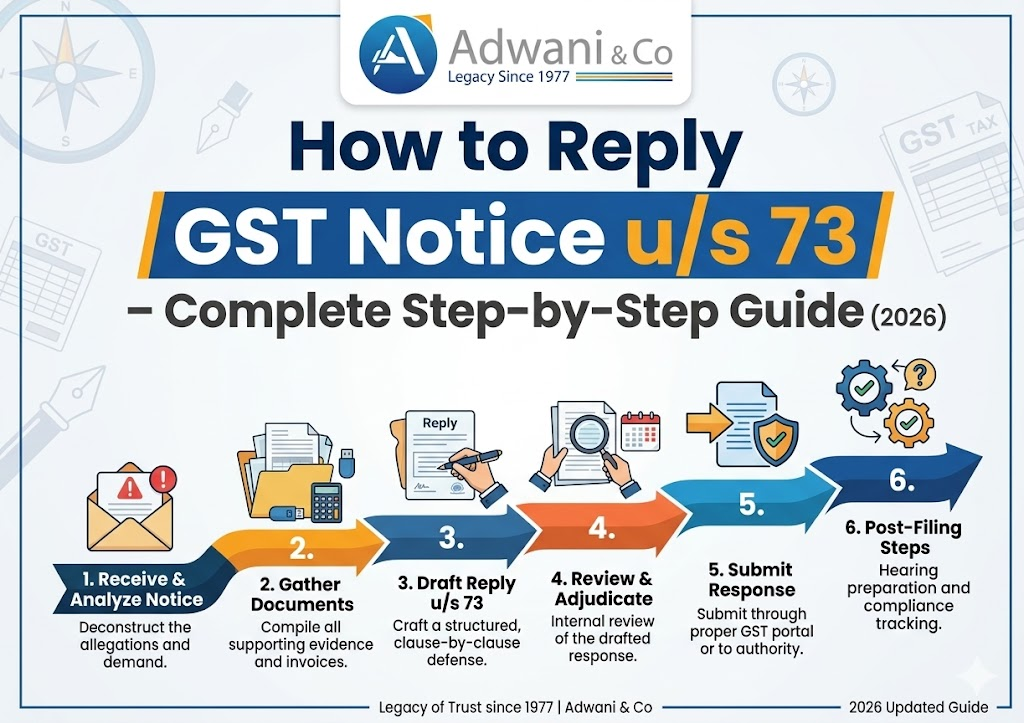
    DISCLAIMER

    This blog is intended for informational and educational purposes only. It does not constitute legal, financial, or professional tax advice. Tax laws and provisions under the Income Tax Act, 1961, are subject to amendment; figures and deadlines mentioned are based on information available as of the date of publication. Readers are strongly advised to consult a qualified Chartered Accountant or tax professional before taking any action based on this content. Adwani and Company and Dr. Haresh Adwani shall not be held liable for any decisions made on the basis of information provided herein. Always refer to official sources at incometax.gov.in and cbdt.gov.in for the latest and authoritative information.

  • Not Every Income Tax Reopening Notice in India Is Valid

    Not Every Income Tax Reopening Notice in India Is Valid

    Income Tax Reopening Notice

    Common Mistakes in Income Tax Reopening Cases

    Not every income tax reopening notice in India is legally valid. Your name in someone else’s papers is not enough proof. Know your rights before you reply to anything.

    Thousands of income tax reopening notices in India are issued without proper evidence. Find out why your notice may not be valid  and what you must do before you respond.


    The Important Thing Most People Miss

    Not forged. Not fake. Genuinely official, genuinely issued by the tax department  and still not valid.

    Just because a notice comes on official letterhead with a stamp and formal legal language does not automatically mean it has been issued correctly or that it is legally strong. Many people assume that if something comes from a government department, it must be right, but that is not always the case. A notice should be backed by proper process, clear reasoning, and solid evidence not just data or assumptions.

    In reality, there are situations where notices are issued based on incomplete information, system-generated data, or without proper verification. However, most people feel nervous when they receive such a notice and believe they should accept it without questioning, thinking that raising doubts might create trouble. This mindset can lead to unnecessary stress and even wrong responses. The truth is, questioning a notice is not wrong or risky it is a sensible and important step. Before reacting, one should understand the reason behind the notice, check whether there is actual evidence, and confirm whether the correct procedure has been followed. Taking a moment to evaluate instead of blindly accepting can make a big difference and help avoid unnecessary complications.

    Also Read

    https://adwaniandco.com/blog/are-you-paying-gst-on-inpatient-medicines-unnecessarily


    Why You Might Receive Such a Notice

    Many times, such notices are sent for very basic reasons. It could be because your name appears in someone else’s records, or some transaction is reported somewhere in the system, or your PAN gets flagged in certain data. That’s all it takes. In many cases, there is no detailed checking done before sending the notice, and no proper verification of whether the information is correct or complete. The system simply picks up data and triggers a notice. So, what you are receiving is often based only on raw information, not on confirmed facts or proper investigation.

    For a reopening notice to be legally valid, there must be actual, specific, credible information that directly relates to your income suggesting that income which should have been taxed in your hands was not declared or was under-declared. A name match is not that. A data connection to someone else’s transaction is not that. Your PAN appearing somewhere in a third party’s records is not that.The law is clear on this. Courts across India have said it repeatedly.

    The information must relate specifically to you, it must be tangible and credible, and it must genuinely suggest that your income escaped taxation not merely that your name appeared somewhere in the system.If the notice sent to you does not meet this standard and many do not it is legally vulnerable from the moment it was issued.


    How Income Tax Reopening Notices Are Generated Today

    To understand why such notices are becoming so common, it helps to know what is actually happening in the background. Today, the income tax department uses advanced data systems that collect information from many different sources like bank records, property details, GST filings, TDS entries, share transactions, and even foreign payments.

    All this data is matched and checked automatically. Whenever the system finds your name or PAN linked to any transaction, it simply flags it. In many cases, this flag directly leads to a notice being issued, without a proper review of your individual situation. There is often no detailed checking, no careful study of facts, and no clear confirmation that any income has actually escaped tax.

    The process becomes more automatic than thoughtful data comes in, the system flags something, and a notice is sent. This is why many reopening notices today are based on weak grounds. It is not always intentional, but it happens because of how the system works. However, the law expects much more than this.

    Before reopening a case, there should be a proper reason backed by real evidence, not just a system alert or your name appearing somewhere. There must be a clear belief that some income has not been taxed correctly. If this basic requirement is missing, and the notice is issued only because of system-generated data without proper application of mind, then such a notice can be questioned and challenged, and it may not stand legally.

    The law says there must be a genuine, considered, evidence-backed reason to believe formed by a human being who has personally examined the information and independently concluded that income specific to you has escaped taxation.

    When that standard is not met when the notice is the product of an automated process rather than a genuine individual review the notice is legally on shaky ground. It can be questioned. It can be challenged. And in many cases, when properly examined, it does not hold up.


    The Mistake Most People Make When They Receive a Income Tax Reopening Notice

    Let us be honest about something.

    When an income tax reopening notice arrives, most people do not think clearly. And that is completely understandable. A government notice  official, formal, carrying legal language and deadlines  triggers something instinctive in almost everyone. A sense of urgency. A sense of being in trouble. A sense that you need to do something right now.

    That feeling is natural. But acting on that feeling without stopping to think  that is where the real damage begins.

    Over the years, we have seen the same patterns play out again and again. Taxpayers who received notices and handled them in ways that hurt them  not because they did anything wrong with their taxes, but because they did not know how to handle the notice itself.

    These are the most common mistakes. And understanding them may be the most valuable thing you read today.


    Section 148: What You Should Know Before You Respond

    Section 148 is a provision under the Income Tax law that allows the department to reopen your past tax return

    This means that if the department believes that some income was not properly reported or taxed earlier, they can send you a notice under Section 148 and ask you to file the return again for that year.

    Before sending such a notice, the department is supposed to have a valid reason. There should be some information or material which suggests that income has actually escaped tax. It should not be based on guesswork or just because your name appeared somewhere.

    A notice is just a starting point.
    It is not a final decision.

    So next time you receive one:

    Don’t panic.
    Don’t assume.
    Understand first, then act.


    What To Do When You Receive an Income Tax Reopening Notice

    1.Do Not Panic, Panic makes you reactive.

    2.Read the Notice Carefully Every Word

    3. Check the Assessment Year and the Section

    4. Verify Whether the Notice Is Within the Time Limit

    5. Ask What Reasons Were Recorded for Issuing This Notice

    6. Go Back and Review Your Past Return and Documents

    7. Identify What the Actual Issue Really Is

    8. Prepare a Proper and Structured Response

    When in doubt  and sometimes even when you are not in doubt  take advice. It is almost always the smartest investment you can make at this stage.

    1.Is every income tax reopening notice valid in India?

    A: No. Not every income tax reopening notice issued in India is legally valid. A notice must be based on specific, credible evidence that income has escaped taxation. If it is issued only because your name appeared in someone else’s records or based on a system-generated data flag without proper verification or independent review by the Assessing Officer it may not meet the legal standard required under Section 147 of the Income Tax Act and can be challenged.

    2.What should I do first when I receive an income tax notice in India?

    A: The first thing you should do is not panic and not reply immediately. Read the notice carefully, identify which section it has been issued under, check the assessment year it relates to, verify whether the Section 148A procedure was followed, and confirm whether it is within the applicable time limit. Only after this initial review should you decide whether to respond or challenge the notice.

    3.Can I challenge an income tax reopening notice in India?

    A: Yes. You have the legal right to challenge an income tax reopening notice in India if it does not meet the required legal standard. Grounds for challenge include the Section 148A procedure not being followed, the notice being issued beyond the permissible time limit, the information cited being vague or based entirely on third-party data, and the Assessing Officer failing to apply independent judgment. Many such notices have been successfully quashed by courts across India.

    4.What is Section 148A and why does it matter?

    A: Section 148A was introduced by the Finance Act of 2021 and created a mandatory pre-notice procedure that must be followed before any Section 148 reopening notice can be validly issued. It requires the Assessing Officer to conduct an inquiry, issue a show cause notice to the taxpayer, give the taxpayer an opportunity to respond, and then pass a reasoned speaking order. If any of these steps are skipped, the Section 148 notice that follows may be procedurally invalid.

    5.What is the time limit for issuing an income tax reopening notice in India?

    A: In most cases, the Income Tax Department can reopen an assessment only within three years from the end of the relevant assessment year. Beyond three years and up to ten years is permitted only where the income alleged to have escaped assessment is rupees fifty lakhs or more and the department has specific tangible evidence. A notice issued beyond the applicable time limit is time-barred and can be challenged on that ground alone.

    About the Author
    Dr. Haresh Adwani
    Ph.D. in Commerce | Law Graduate | Managing Partner, Adwani & Co LLP Dr. Haresh Adwani holds a Ph.D. in Commerce and is a qualified Law graduate with over two decades of hands-on experience in GST advisory, direct taxation, and statutory compliance for businesses across Pune and Maharashtra has guided hundreds of SMEs, startups, and corporates through India’s evolving tax landscape. He is a recognised advisor on GST compliance, company formation, and Virtual CFO services, and regularly contributes to professional seminars and industry forums in Pune.

    DISCLAIMER

    This blog is intended for informational and educational purposes only. It does not constitute legal, financial, or professional tax advice. Tax laws and provisions under the Income Tax Act, 1961, are subject to amendment; figures and deadlines mentioned are based on information available as of the date of publication. Readers are strongly advised to consult a qualified Chartered Accountant or tax professional before taking any action based on this content. Adwani and Company and Dr. Haresh Adwani shall not be held liable for any decisions made on the basis of information provided herein. Always refer to official sources at incometax.gov.in and cbdt.gov.in for the latest and authoritative information.

  • Are You Paying GST on Inpatient Medicines Unnecessarily?

    Are You Paying GST on Inpatient Medicines Unnecessarily?

    GST on Inpatient Medicines

    The Billing Format Error Most Hospitals Make

    There is a mistake happening quietly inside hundreds of hospitals and nursing homes across India right now.

    It is not a calculation error. It is not a missing document. It is not even a wrong rate applied.

    It is a formatting decision one that most billing teams made years ago without realising it had a direct GST consequence and it is costing healthcare providers real money, every single day.


    What the Law Actually Says

    The GST framework in India treats healthcare supply as a composite service when it is delivered to an admitted (in-patient) individual. Under this principle consistently upheld by the Authority for Advance Rulings (AAR) in Tamil Nadu, Kerala and Karnataka the following position has been firmly established:

    Medicines and consumables supplied to in-patients, billed as part of a single consolidated treatment invoice → Fully exempt from GST.

    The same medicines, raised on a separate standalone invoice → Taxable.

    This is not a loophole. It is not a grey area. It is the intended design of the exemption. The law recognises that in-patient treatment is a bundled, continuous healthcare service and that medicines, consumables, diagnostics and room charges are all components of that single service.

    The exemption, however, only holds when the billing structure reflects that reality.

    The moment you unbundle the moment medicines go on a separate invoice you step outside the composite supply framework. And GST applies.


    Also Read

    https://adwaniandco.com/blog/fo-trading-taxation-in-india-2026-complete-simple-guide


    The Three Gaps Most Healthcare Providers Are Sitting On

    Gap 1: Separate Invoices for In-Patient Medicines

    This is the most common and most expensive gap. If your billing software is raising a distinct invoice for pharmacy items even for admitted patients you are almost certainly paying GST you do not owe.

    The fix is not a legal battle. It is a billing structure review.

    Ex:-Ramesh is admitted. All charges on one bill. Hospital saves GST. Patient saves money.

    Gap 2: Room Rent Above ₹5,000 Per Day

    Room rent for in-patients is exempt from GST up to ₹5,000 per day. Beyond that threshold, GST applies and most hospital billing systems are not configured to flag this automatically.

    If your hospital has premium or single-occupancy rooms priced above ₹5,000 per day, this is a live exposure. It is also an area that gets scrutinised during GST audits.

    Ex:-Same Ramesh. Same medicines. But pharmacy gave a separate bill. Now GST comes in.

    Gap 3: Out-Patient Medicines No Bundling Protection

    It is important to be clear here: the composite supply exemption only applies to in-patients. Medicines dispensed to out-patients  even through the hospital’s own pharmacy do not benefit from the bundling protection. They are taxable as a supply of goods, regardless of the clinical context.

    Many hospitals assume the exemption extends to their OPD pharmacy. It does not. If your OPD dispensing is not being taxed correctly, that is a separate compliance gap worth addressing.

    A nursing home spending ₹15 lakhs monthly on inpatient medicines, billed separately, could be paying ₹1.8 to ₹2.7 lakhs in avoidable GST every year simply because of invoice format.

    Example:

    Seema visits doctor, gets medicine from hospital pharmacy and goes home. She was never admitted. No bundling protection. GST applies always.


    Why This Is Happening And Why It Stays Hidden

    This is not a situation most hospitals discover through a notice or an audit. It surfaces only when someone looks at the billing structure specifically through a GST lens.

    Billing systems are typically designed for clinical and operational efficiency. They are built to generate bills quickly, track inventory and satisfy insurance formats. GST compliance is often an afterthought or worse, it was configured once during implementation and has not been reviewed since. The result is that the exemption erodes silently. Not in a courtroom. Not in a demand notice. Inside the invoicing system, on every bill, every day.


    What a Billing Structure Review Actually Looks Like

    Identifying and closing these gaps does not require a lengthy engagement or a complete system overhaul.

    In most cases, it involves:

    • Reviewing how your billing software currently segregates medicine and treatment charges for in-patients
    • Confirming whether your room categories are mapped correctly against the ₹5,000 threshold
    • Checking how OPD pharmacy transactions are being classified and taxed
    • Aligning your invoice format with the composite supply position established in AAR rulings

    The legal protection is already there. The question is whether your billing structure is positioned to use it.


    A Note on the AAR Rulings

    The Authority for Advance Rulings is not a random opinion. It is a formal statutory mechanism through which taxpayers obtain binding clarifications on GST positions.

    The rulings from Tamil Nadu, Kerala and Karnataka on composite hospital billing have been consistent in their direction: when in-patient care is billed as a unified service, the GST exemption for healthcare services extends to the medicines and consumables included in that bill.

    These rulings do not create new law. They confirm what the law already provides. But they also make the billing format requirement explicit which is precisely why format matters as much as substance here.

    1.Are medicines given to admitted patients exempt from GST in India?

    Yes but only if they are billed as part of a single composite treatment invoice. If medicines are raised on a separate pharmacy bill, GST applies even for admitted patients

    2. What is composite supply in GST for hospitals?

    Composite supply means all services and goods given to an admitted patient medicines, room, doctor fees, equipment are bundled into ONE single bill. The government then treats it as a healthcare service and gives full GST exemption.

    3.Does GST apply on room rent in hospitals?

    Room rent up to ₹5,000 per day is fully exempt from GST. If your hospital charges more than ₹5,000 per day for a room GST applies on the entire room rent amount.

    4.Is GST applicable on OPD medicines in hospitals?

    Yes. Out-patient medicines are always taxable under GST regardless of whether they come from the hospital’s own pharmacy. The GST exemption only covers admitted (in-patient) treatment.

    5.What are AAR rulings and why do they matter for hospitals?

    AAR stands for Authority for Advance Rulings. It is an official government body that gives binding legal clarifications on GST questions. AAR rulings from Tamil Nadu, Kerala and Karnataka have clearly confirmed that composite hospital billing qualifies for full GST exemption making these rulings very important for healthcare providers.

    Author

    Dr. Haresh Adwani

    PhD (Commerce) · Adwani & Company, Pune

    Dr. Haresh Adwani is a PhD holder in Commerce with over 20 years of experience in NRI taxation, FEMA compliance, international financial advisory, and tax notice resolution. He is one of Pune’s most trusted NRI tax advisors, specialising in residential status assessment, DTAA planning, and cross-border compliance for professionals returning from the US, UK, UAE, Canada, and Australia.

    Legal Disclaimer: This article is published for informational and educational purposes only. Nothing contained herein constitutes legal, financial, or tax advice, nor should it be treated as a substitute for professional consultation tailored to your specific circumstances. Tax laws, rates, and provisions are subject to change; readers are strongly advised to consult a qualified Chartered Accountant or tax advisor before acting on any information in this article.

    All content is original. References to government portals and statutory provisions are paraphrased for educational purposes in compliance with fair use principles. No content has been reproduced from third-party sources

  • Income Tax Notice Received?

    Income Tax Notice Received?

     Income Tax Notice : Common Mistakes That Turn Small Issues into Big Problem

    Everything looks fine… until an Income Tax notice changes everything.

    In practice, most tax issues don’t arise because of wrong intent.

    They arise because of casual handling.


    Income Tax Notice

    An Income Tax notice is basically a message from the tax department asking you to check or clarify something about your return. It doesn’t always mean you’ve done something wrong sometimes it’s just a reminder, a correction, or a request for extra details.

    Getting a notice from the Income Tax department can feel alarming but it’s usually not as scary as it sounds.

    The key thing to remember: a notice is not a punishment. It’s a conversation the department wants to have with you just in writing


    Common Mistakes Taxpayers Make

    In many cases, the problem begins with small lapses:

    1. Ignoring a Notice for a Few Days

    One of the biggest mistakes taxpayers make is assuming that a notice can wait. Many people think, “I’ll deal with it later” or “It’s probably not urgent very Income Tax notice comes with a deadline. Miss it, and what was originally a simple question from the department can turn into a formal proceeding. Most people who’ve been through this say the same thing

    “I wish I had just replied sooner.” A few extra days of delay can change the tone of the entire proceeding. What starts as a routine query can start feeling like an interrogation, simply because the other side stopped getting answers. Don’t let that happen.

    2. Filing a Reply Without Proper Explanation

    Another common error is rushing through the reply. Taxpayers often submit a quick response without carefully explaining the issue or attaching supporting documents. While this may feel like “getting it off your plate,” it usually backfires. Since proceedings are faceless and document driven, the officer relies entirely on what you submit. Your transaction may be perfectly clean but if your explanation isn’t clear, it won’t look that way. One vague reply can turn a one-time query into a back-and forth that goes on for months.

    3. Not Keeping Proper Records of Your Transactions

    Poor record-keeping is a silent but serious mistake. When transactions aren’t backed by proper documentation invoices, bank statements, agreements even genuine entries can appear suspicious. During scrutiny, the burden of proof lies on the taxpayer. If you can’t produce clear records, the authorities may assume inconsistencies or non-compliance. This often results in unnecessary disputes, penalties, or adjustments that could have been avoided with organized documentation.

    Also Read : GST Show Cause Notices: Why ‘Others’ Isn’t Enough | Adwani & Co LLP


    Why Income Tax Notices Are Issued

    • Mismatch in income details : When the income you report doesn’t match with records in Form 26AS, AIS, or TIS.
    • Errors in filing : Wrong ITR form, missing details, or calculation mistakes.
    • High-value transactions : Large cash deposits, property deals, or big spends that don’t align with declared income.
    • Incorrect claims : Deductions or exemptions claimed without proper proof.
    • Non-disclosure of income : Forgetting to report rental income, interest, freelance earnings, or foreign income.
    • Late or non-filing of returns : Missing deadlines or not filing at all.

    When the Situation Changes

    Planning stops

    Pressure builds

    When an Income Tax notice moves from routine to scrutiny, the entire atmosphere changes. What once felt like a simple compliance task suddenly becomes a source of stress. Planning, which should guide your response, often takes a back seat as anxiety builds. Instead of calmly addressing the issue, taxpayers slip into damage control mode rushing to reply, scrambling for documents, and second guessing every step. The problem is that this reactive approach rarely helps.

    A matter that could have been resolved with a clear explanation and timely submission now stretches into a prolonged process, filled with repeated queries, clarifications, and mounting pressure. What started as a small oversight becomes a stressful ordeal, not because the case was inherently complicated, but because the response wasn’t handled with the structure and clarity it required.

    The Reality of Today’s Tax Proceedings

    In the past, dealing with Income Tax notices often meant visiting the tax office, meeting an officer, and explaining your side in person. Today, that has completely changed. Proceedings are now faceless and entirely document-driven. This means there is no opportunity to sit across the table and clarify things verbally. Your case is judged only on the papers, records, and explanations you submit online.That shift makes clarity and structure more important than ever.

    A casual or incomplete reply can easily be misunderstood because there’s no chance to explain it face-to -face. On the other hand, a well-organized response with proper documentation and a clear explanation can close the matter quickly. In this new system, your submission is your only voice. If it’s strong, precise, and logical, it speaks for you. If it’s weak or vague, even a simple issue can get complicated.


    What Actually Makes the Difference

    • Timely Response: Submitting your reply within the given deadline shows seriousness and prevents escalation.
    • Structured Explanation: A clear, logical, and well organized reply helps the officer understand your case easily.
    • Complete Documentation: Supporting documents that match your explanation strengthen your position.
    • Avoiding Delays or Vague Replies: Late, incomplete, or generic responses often create confusion and lead to repeated queries.
    • Quality Over Quantity: It’s not about how much you submit, but how clearly and accurately you present it.
    • Key Insight: Most cases don’t fail because the taxpayer’s position was weak they fail because the response was weak.

    How to Handle an Income Tax Notice Properly

    To avoid unnecessary complications:

    • Reply On Time Every Time This isn’t something to put off until tomorrow. Every notice has a deadline, and even a short delay can turn a simple matter into something far more complicated. Treat the deadline like a bill payment miss it, and things get harder.
    • Attach complete and accurate documentation Don’t leave gaps. Attach all relevant proofs bank statements, invoices, agreements, or any supporting records. The stronger your documentation, the smoother the resolution.
    • Don’t Send a Vague Reply Writing details will be provided later” is one of the worst things you can do. It signals that you’re either unprepared or avoiding the question neither of which helps your case. Be specific, be direct, and address exactly what’s being asked..
    • Ensure your explanation is clear and logically presented Think of your reply as telling a story. Organize it step by step so the officer can easily follow your reasoning. A structured response shows professionalism and builds trust.
    • Seek professional guidance when required If the notice involves complex transactions or large amounts, don’t hesitate to consult a tax professional. Expert advice can save you from costly mistakes and unnecessary stress.

    The notice isn’t the problem. How you respond to it is

    Handle notices smartly, and they’ll never handle you

    1.Does receiving an Income Tax notice mean I’ve done something wrong?

    Not necessarily. Many notices are simply requests for clarification or correction. They don’t always indicate fraud or wrongdoing.

    2.What should I do first when I receive a notice?

     Read the notice carefully, understand what it is asking, and note the deadline. Don’t panic most issues can be resolved with a clear and timely response.

    3.What documents should I keep ready to avoid problems?

     Maintain bank statements, invoices, property documents, investment proofs, and any records of major transactions. Organized documentation makes replies easier.

    4.Can I reply to a notice myself or do I need a professional?

    For simple clarifications, you can reply yourself. But for complex cases involving large transactions or scrutiny, it’s wise to consult a tax professional.

    5.Where can I check the status of my notice?

    You can log in to the Income Tax e-filing portal and track the notice under the “e-Proceedings” or “Pending Actions” section

    Conclusion: Income Tax Notice India : Knowledge Is Your Best Defence

    An income tax notice India is not the end of the road. In most cases, it is the beginning of a conversation between you and the Income Tax Department a conversation that, with the right preparation and professional support, can end cleanly and quickly.

    The year 2026 marks a significant turning point in India’s tax compliance environment. With the Income-tax Act, 2025 and Income Tax Rules, 2026 now in full effect, businesses and individuals face a more scrutinised tax landscape than ever before. Data cross-verification is automated, discrepancies are flagged in real time, and the margin for error has narrowed considerably.

    The professionals and businesses that will thrive in this environment are those who treat income tax compliance as a continuous, proactive discipline not a once-a-year filing exercise. They review their AIS before filing. They reconcile GST and income tax data regularly. They maintain robust documentation. And when an income tax notice India does arrive, they respond swiftly and professionally.

    About the Author
    Dr. Haresh Adwani
    Ph.D. in Commerce | Law Graduate | Managing Partner, Adwani & Co LLP Dr. Haresh Adwani holds a Ph.D. in Commerce and is a qualified Law graduate with over two decades of hands-on experience in GST advisory, direct taxation, and statutory compliance for businesses across Pune and Maharashtra. As Managing Partner of Adwani & Co LLP a firm established in 1977 by Advocate N. T. Adwani. Dr. Adwani has guided hundreds of
    SMEs, startups, and corporates through India’s evolving tax landscape. He is a recognised advisor on GST compliance, company formation, and Virtual CFO services, and regularly
    contributes to professional seminars and industry forums in Pune.
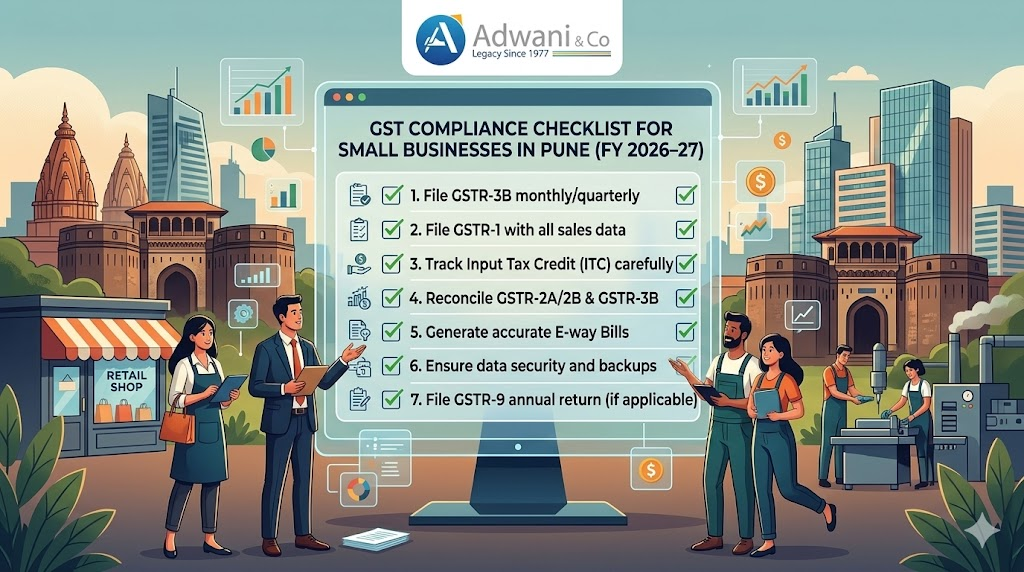
    Disclaimer

    This article is for informational purposes only and does not constitute financial, legal, or professional advice. Every business’s financial position is unique, and readers should consult a qualified chartered accountant or financial advisor before making decisions based on this content.