
CA Manish Mata April 2026 10 min read
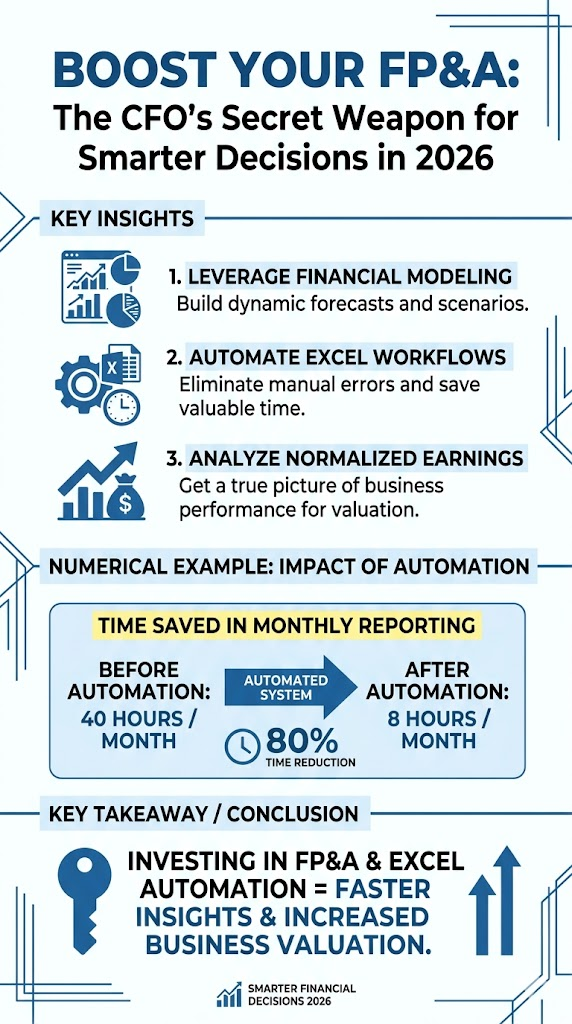
It’s quarter-end. Your CFO needs a three-scenario revenue forecast by tomorrow morning. Your finance team is buried in spreadsheets, copying data from one tab to another, double-checking formulas at midnight. Sound familiar? This is the reality for thousands of Indian businesses in 2026 — and it is entirely avoidable.
The game-changer is FP&A (Financial Planning & Analysis) and Excel automation. For modern CFOs and finance leaders in India, this combination has stopped being a “nice to have” and become an absolute competitive necessity. Whether you run a growing startup, a mid-sized manufacturing firm, or a large enterprise, your ability to plan, forecast, and analyze financial data intelligently will determine whether you lead or lag.
At Adwani and Company, we work with businesses across India to implement framework of FP&A and Excel automation workflows that save time, reduce errors, and give CFOs the clarity they need to make bold decisions. “The CFO who automates today will strategize tomorrow. The CFO who doesn’t will still be building pivot tables.”
What Is FP&A and Why Does It Matter for CFOs in India?
FP&A — Financial Planning and Analysis is the discipline that sits at the heart of every well-run finance function. It brings together budgeting, forecasting, variance analysis, and financial modeling to give leadership a forward-looking picture of the business. Unlike traditional accounting (which looks backward), FP&A looks ahead.
For Indian CFOs navigating a dynamic environment with updated income tax regulations under the Income Tax Act 2025, shifting GST compliance requirements, and MCA reporting obligations FP&A provides the analytical backbone to stay ahead of both opportunities and risks.
The three pillars of effective FP&A are:
- Budgeting: Coordinating annual and rolling budgets across departments aligned with business strategy.
- Forecasting: Updating financial projections based on real business performance, not just static assumptions.
- Analysis: Identifying variances, trends, and actionable insights to guide CFO decision making.
Excel Automation: Transforming FP&A from Manual to Intelligent
Despite the rise of dedicated FP&A software, Microsoft Excel remains the dominant tool in Indian finance teams and for good reason. It is flexible, widely understood, and deeply integrated into how finance professionals work. The problem isn’t Excel itself; it’s how most teams use it: manually.
Excel automation through macros, VBA scripts, Power Query, Power Pivot, and dynamic array formulas turns Excel from a static spreadsheet into a live financial intelligence engine. Here is what automation actually looks like in practice:
1. Automated Data Consolidation
Instead of manually copying data from ERP systems, bank statements, and CRM reports into a master spreadsheet, Power Query pulls and refreshes data from multiple sources at the click of a button. A business that previously spent 3 days consolidating monthly MIS data now completes it in under 2 hours.
2. Dynamic Financial Models
FP&A models built with structured Excel formulas (INDEX/MATCH, XLOOKUP, dynamic arrays) update automatically when assumptions change. A CFO can run a best-case, base-case, and worst-case scenario simultaneously without creating three separate files.
3. Automated Reporting Dashboards
Using Power Pivot and pivot charts, finance teams can build self-updating dashboards that surface KPIs like gross margin, working capital, EBITDA, and cash runway
Real-World Example: FP&A and Excel automation in Action
A mid-sized manufacturing company in Pune was spending approximately 80 hours per month on manual financial reporting across 12 departments. After implementing an automated FP&A model in Excel with Power Query pulling data from their ERP, VBA scripts formatting reports, and a live dashboard for the CFO their monthly reporting cycle dropped to just 14 hours. That is a saving of 66 hours per month, freeing up the finance team for strategic analysis rather than data entry. The CFO was now able to present scenario forecasts in board meetings instead of static backward-looking reports.
How FP&A and Excel Automation Sharpen CFO Decision-Making
The role of the CFO in Indian organisations has evolved dramatically. According to guidance from the Ministry of Corporate Affairs (MCA), CFOs of listed companies carry statutory responsibilities that go beyond financial reporting — including compliance with the Companies Act, 2013, and oversight of internal controls. This regulatory weight means CFOs cannot afford to waste time on manual processes.
Here is how FP&A and Excel automation directly improves CFO decision quality:
- Faster Scenario Analysis: Model the financial impact of a new product line, a pricing change, or a hiring plan within minutes, not days.
- Improved Cash Flow Visibility: Rolling 13-week cash flow forecasts updated automatically help CFOs avoid liquidity crunches before they happen.
- Accurate Tax Planning: With the new Income Tax Act 2025 changes and updated TDS rates for FY 2026-27, tax modelling within FP&A ensures no surprises at year-end.
- GST Compliance Integration: Automating GSTR-3B and GSTR-1 reconciliation within financial models reduces errors and ensures timely filing.
- Board-Ready Reporting: Automated variance analysis and commentary generation mean the CFO walks into board meetings with insights, not just numbers.
FP&A Must Include Tax Planning: Income Tax Act 2025 Implications
One of the most significant recent developments affecting Indian CFOs is the Income Tax Act 2025, which introduces a consolidated framework replacing several provisions of the Income Tax Act, 1961. According to the Income Tax Department of India, the revised Act focuses on simplification of tax computation, updated definitions of taxable income, and streamlined return filing. CFOs need to ensure their FP&A models incorporate these changes from April 2026.
Key FP&A and Excel automation considerations under the updated tax framework include:
- New Tax Regime Slabs for FY 2026-27: Ensuring salary cost models reflect revised TDS rates under Section 192 for all employees.
- Capital Gains Tax Integration: Post-2026 changes to LTCG and STCG rates on equities and mutual funds must be reflected in investment planning models.
- TDS on Rent and Professional Fees: FP&A models must auto-calculate TDS obligations under Sections 194I and 194J to avoid deduction defaults.
Also Read https://www.adwaniandco.com/blog/old-vs-new-tax-regime
This is exactly where working with a qualified CA firm like Adwani and Company becomes invaluable. They bridge the technical FP&A and Excel automation world with the regulatory compliance framework that Indian CFOs must navigate. Learn more about our Tax Planning Services. https://www.adwaniandco.com/services/taxation-compliance
GST Compliance Automation: Making FP&A GST-Ready
Under the GST framework administered by the GSTN (GST Network) portal, businesses must file multiple returns monthly and annually — GSTR-1, GSTR-3B, GSTR-9, and more. For CFOs managing large vendor bases and complex ITC (Input Tax Credit) positions, manual reconciliation is not just time-consuming — it is risky.
Embedding GST automation within an FP&A model means:
- Real-time ITC Reconciliation: Matching purchase invoices against GSTR-2B automatically, flagging mismatches before filing.
- GST Liability Projections: Forecasting monthly GST outflows as part of cash flow planning rather than treating them as a surprise.
- Late Fee Monitoring: Automating due date tracking for GSTR-3B and other returns to avoid penalties.
For businesses unsure about GST registration requirements or ITC eligibility in 2026, read our detailed guide on GST Compliance for Indian Businesses crafted by our expert team at Adwani and Company.
Building an FP&A Model in Excel: A Practical Framework
If you want to build a robust FP&A and Excel automation model in Excel that would satisfy even the most demanding CFO, follow this proven structure developed and tested by the advisory team at Adwani and Company:
- Assumptions: All key drivers live here revenue growth rates, headcount, tax rates, inflation. This single tab controls the entire model.
- Income Statement: Driven entirely by formulas linked to assumptions. No hardcoded values.
- Balance Sheet: Auto-calculated from the income statement, with working capital schedules plugged in.
- Cash Flow: Indirect method cash flow statement that ties to the balance sheet. Includes a 13-week rolling cash forecast.
- Scenarios: Three scenarios (bear, base, bull) driven by a dropdown that switches assumption sets instantly.
- Dashboard: KPI cards, waterfall charts, and trend graphs that update automatically. Board ready at any moment.
Power Query handles data ingestion. VBA handles report formatting. The CFO gets a single source of financial truth that is always current.
Why CFOs Should Work With a CA Firm for FP&A Design
While Excel skills are learnable, financial model design is not just a technical exercise it is a regulatory and strategic one. A model that ignores TDS implications, misstates deferred tax, or misclassifies capital vs. revenue expenditure will produce misleading outputs regardless of how elegant its formulas are.
This is where Adwani and Company adds irreplaceable value. Under the leadership of Dr. Haresh Adwani a PhD holder in Commerce with a strong foundation in Indian commercial law —our firm combines FP&A consulting with tax compliance expertise. We don’t just build models; we build models that are legally sound, audit-ready, and aligned with current Indian regulations including the Income Tax Act 2025, GST law, and MCA requirements.
Our FP&A advisory services for CFOs include:
- Custom Excel automation model design and implementation
- Integration of tax planning (income tax, TDS, capital gains) into financial models
- GST liability forecasting and ITC reconciliation automation
- Board and investor reporting dashboards
- Financial model audit and error-proofing
Learn more about our CFO Advisory and FP&A Services and discover how Adwani and Company can transform your finance function.
Conclusion
In 2026, the finance function is no longer defined by who can produce the most accurate historical report. It is defined by who can produce the most insightful forward-looking analysis fast, accurately, and in alignment with India’s evolving regulatory environment.
FP&A and Excel automation are not just efficiency tools. They are strategic levers. They give CFOs the bandwidth to move from number-crunching to value creation advising the board on acquisitions, guiding pricing strategy, and modelling tax-efficient capital structures.
But getting the most from FP&A requires more than Excel skills. It requires understanding the Income Tax Act 2025, GST compliance, MCA reporting, and how all of these intersect with business performance. That intersection is exactly where the team at Adwani and Company operate every day helping Indian businesses build finance functions that are intelligent, compliant, and future-ready.
1. What is FP&A and why do Indian CFOs need it in 2026?
FP&A Financial Planning and Analysis is the function responsible for budgeting, forecasting, and strategic financial analysis. In 2026, with updated tax regimes, new ITR forms, and increased regulatory scrutiny, Indian CFOs need FP&A to make proactive, data-driven decisions rather than reactive ones.
2. How does Excel automation improve FP&A processes?
Excel automation (using Power Query, VBA, dynamic arrays, and Power Pivot) eliminates manual data entry, speeds up report generation, reduces formula errors, and enables real-time scenario analysis dramatically increasing the productivity and accuracy of finance teams.
3. Can FP&A models include GST and income tax calculations?
Yes, and they should. A well-built FP&A model integrates TDS calculations under the new tax regime, GST liability projections, ITC reconciliation, and capital gains tax implications giving the CFO a true after-tax view of business performance.
4. What is the difference between FP&A and traditional accounting?
Traditional accounting (managed under statutory audit requirements and the Companies Act) looks backward recording what happened. FP&A and Excel automation looks forward projecting what will happen and why, enabling better strategic decisions.
5. How does Adwani and Company help with FP&A and Excel automation?
Adwani and Company offers end-to-end FP&A advisory from designing Excel automation models to integrating income tax and GST compliance into financial planning frameworks. Led by Dr. Haresh Adwani, our team brings both financial modelling expertise and deep regulatory knowledge to every engagement. Connect with us today.
6. Is Excel still relevant for FP&A or should businesses use dedicated software?
For most Indian SMEs and mid-market businesses, well-automated Excel remains the most practical FP&A tool. Dedicated FP&A software becomes relevant at larger scale. The key is automation removing manual work and adding intelligence to how Excel is used.
7. How do I start building an FP&A model for my business?
Start with a clean assumptions tab, then build your income statement, balance sheet, and cash flow using formulas linked to those assumptions. Add scenario functionality and a dashboard. If you need expert guidance, Adwani and Company can design and implement a custom FP&A and Excel automation model for your business from scratch.
Author
CA. Manish R. Mata Practising In India (Ex – PwC), At Adwani & Co LLP leads the International Accounting & Tax Support vertical, delivering structured execution assistance to US CPA firms and overseas businesses.
Leave a Reply