Blog

  • Income Tax Notice Received?

    Income Tax Notice Received?

     Income Tax Notice : Common Mistakes That Turn Small Issues into Big Problem

    Everything looks fine… until an Income Tax notice changes everything.

    In practice, most tax issues don’t arise because of wrong intent.

    They arise because of casual handling.


    Income Tax Notice

    An Income Tax notice is basically a message from the tax department asking you to check or clarify something about your return. It doesn’t always mean you’ve done something wrong sometimes it’s just a reminder, a correction, or a request for extra details.

    Getting a notice from the Income Tax department can feel alarming but it’s usually not as scary as it sounds.

    The key thing to remember: a notice is not a punishment. It’s a conversation the department wants to have with you just in writing


    Common Mistakes Taxpayers Make

    In many cases, the problem begins with small lapses:

    1. Ignoring a Notice for a Few Days

    One of the biggest mistakes taxpayers make is assuming that a notice can wait. Many people think, “I’ll deal with it later” or “It’s probably not urgent very Income Tax notice comes with a deadline. Miss it, and what was originally a simple question from the department can turn into a formal proceeding. Most people who’ve been through this say the same thing

    “I wish I had just replied sooner.” A few extra days of delay can change the tone of the entire proceeding. What starts as a routine query can start feeling like an interrogation, simply because the other side stopped getting answers. Don’t let that happen.

    2. Filing a Reply Without Proper Explanation

    Another common error is rushing through the reply. Taxpayers often submit a quick response without carefully explaining the issue or attaching supporting documents. While this may feel like “getting it off your plate,” it usually backfires. Since proceedings are faceless and document driven, the officer relies entirely on what you submit. Your transaction may be perfectly clean but if your explanation isn’t clear, it won’t look that way. One vague reply can turn a one-time query into a back-and forth that goes on for months.

    3. Not Keeping Proper Records of Your Transactions

    Poor record-keeping is a silent but serious mistake. When transactions aren’t backed by proper documentation invoices, bank statements, agreements even genuine entries can appear suspicious. During scrutiny, the burden of proof lies on the taxpayer. If you can’t produce clear records, the authorities may assume inconsistencies or non-compliance. This often results in unnecessary disputes, penalties, or adjustments that could have been avoided with organized documentation.

    Also Read : GST Show Cause Notices: Why ‘Others’ Isn’t Enough | Adwani & Co LLP


    Why Income Tax Notices Are Issued

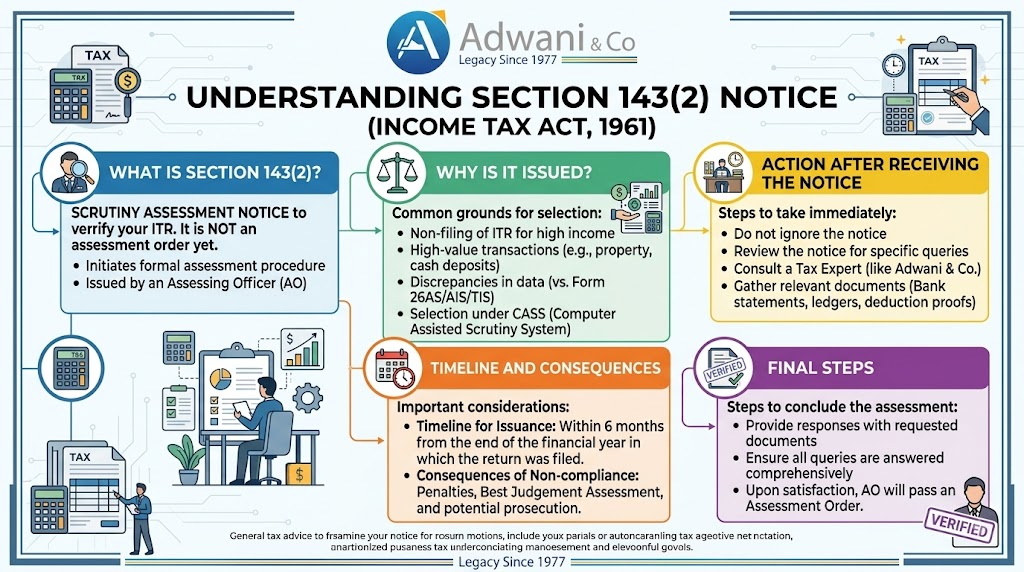
    • Mismatch in income details : When the income you report doesn’t match with records in Form 26AS, AIS, or TIS.
    • Errors in filing : Wrong ITR form, missing details, or calculation mistakes.
    • High-value transactions : Large cash deposits, property deals, or big spends that don’t align with declared income.
    • Incorrect claims : Deductions or exemptions claimed without proper proof.
    • Non-disclosure of income : Forgetting to report rental income, interest, freelance earnings, or foreign income.
    • Late or non-filing of returns : Missing deadlines or not filing at all.

    When the Situation Changes

    Planning stops

    Pressure builds

    When an Income Tax notice moves from routine to scrutiny, the entire atmosphere changes. What once felt like a simple compliance task suddenly becomes a source of stress. Planning, which should guide your response, often takes a back seat as anxiety builds. Instead of calmly addressing the issue, taxpayers slip into damage control mode rushing to reply, scrambling for documents, and second guessing every step. The problem is that this reactive approach rarely helps.

    A matter that could have been resolved with a clear explanation and timely submission now stretches into a prolonged process, filled with repeated queries, clarifications, and mounting pressure. What started as a small oversight becomes a stressful ordeal, not because the case was inherently complicated, but because the response wasn’t handled with the structure and clarity it required.

    The Reality of Today’s Tax Proceedings

    In the past, dealing with Income Tax notices often meant visiting the tax office, meeting an officer, and explaining your side in person. Today, that has completely changed. Proceedings are now faceless and entirely document-driven. This means there is no opportunity to sit across the table and clarify things verbally. Your case is judged only on the papers, records, and explanations you submit online.That shift makes clarity and structure more important than ever.

    A casual or incomplete reply can easily be misunderstood because there’s no chance to explain it face-to -face. On the other hand, a well-organized response with proper documentation and a clear explanation can close the matter quickly. In this new system, your submission is your only voice. If it’s strong, precise, and logical, it speaks for you. If it’s weak or vague, even a simple issue can get complicated.


    What Actually Makes the Difference

    • Timely Response: Submitting your reply within the given deadline shows seriousness and prevents escalation.
    • Structured Explanation: A clear, logical, and well organized reply helps the officer understand your case easily.
    • Complete Documentation: Supporting documents that match your explanation strengthen your position.
    • Avoiding Delays or Vague Replies: Late, incomplete, or generic responses often create confusion and lead to repeated queries.
    • Quality Over Quantity: It’s not about how much you submit, but how clearly and accurately you present it.
    • Key Insight: Most cases don’t fail because the taxpayer’s position was weak they fail because the response was weak.

    How to Handle an Income Tax Notice Properly

    To avoid unnecessary complications:

    • Reply On Time Every Time This isn’t something to put off until tomorrow. Every notice has a deadline, and even a short delay can turn a simple matter into something far more complicated. Treat the deadline like a bill payment miss it, and things get harder.
    • Attach complete and accurate documentation Don’t leave gaps. Attach all relevant proofs bank statements, invoices, agreements, or any supporting records. The stronger your documentation, the smoother the resolution.
    • Don’t Send a Vague Reply Writing details will be provided later” is one of the worst things you can do. It signals that you’re either unprepared or avoiding the question neither of which helps your case. Be specific, be direct, and address exactly what’s being asked..
    • Ensure your explanation is clear and logically presented Think of your reply as telling a story. Organize it step by step so the officer can easily follow your reasoning. A structured response shows professionalism and builds trust.
    • Seek professional guidance when required If the notice involves complex transactions or large amounts, don’t hesitate to consult a tax professional. Expert advice can save you from costly mistakes and unnecessary stress.

    The notice isn’t the problem. How you respond to it is

    Handle notices smartly, and they’ll never handle you

    1.Does receiving an Income Tax notice mean I’ve done something wrong?

    Not necessarily. Many notices are simply requests for clarification or correction. They don’t always indicate fraud or wrongdoing.

    2.What should I do first when I receive a notice?

     Read the notice carefully, understand what it is asking, and note the deadline. Don’t panic most issues can be resolved with a clear and timely response.

    3.What documents should I keep ready to avoid problems?

     Maintain bank statements, invoices, property documents, investment proofs, and any records of major transactions. Organized documentation makes replies easier.

    4.Can I reply to a notice myself or do I need a professional?

    For simple clarifications, you can reply yourself. But for complex cases involving large transactions or scrutiny, it’s wise to consult a tax professional.

    5.Where can I check the status of my notice?

    You can log in to the Income Tax e-filing portal and track the notice under the “e-Proceedings” or “Pending Actions” section

    Conclusion: Income Tax Notice India : Knowledge Is Your Best Defence

    An income tax notice India is not the end of the road. In most cases, it is the beginning of a conversation between you and the Income Tax Department a conversation that, with the right preparation and professional support, can end cleanly and quickly.

    The year 2026 marks a significant turning point in India’s tax compliance environment. With the Income-tax Act, 2025 and Income Tax Rules, 2026 now in full effect, businesses and individuals face a more scrutinised tax landscape than ever before. Data cross-verification is automated, discrepancies are flagged in real time, and the margin for error has narrowed considerably.

    The professionals and businesses that will thrive in this environment are those who treat income tax compliance as a continuous, proactive discipline not a once-a-year filing exercise. They review their AIS before filing. They reconcile GST and income tax data regularly. They maintain robust documentation. And when an income tax notice India does arrive, they respond swiftly and professionally.

    About the Author
    Dr. Haresh Adwani
    Ph.D. in Commerce | Law Graduate | Managing Partner, Adwani & Co LLP Dr. Haresh Adwani holds a Ph.D. in Commerce and is a qualified Law graduate with over two decades of hands-on experience in GST advisory, direct taxation, and statutory compliance for businesses across Pune and Maharashtra. As Managing Partner of Adwani & Co LLP a firm established in 1977 by Advocate N. T. Adwani. Dr. Adwani has guided hundreds of
    SMEs, startups, and corporates through India’s evolving tax landscape. He is a recognised advisor on GST compliance, company formation, and Virtual CFO services, and regularly
    contributes to professional seminars and industry forums in Pune.

    Disclaimer

    This article is for informational purposes only and does not constitute financial, legal, or professional advice. Every business’s financial position is unique, and readers should consult a qualified chartered accountant or financial advisor before making decisions based on this content.

  • GST Show Cause Notices: Why ‘Others’ Isn’t Enough

    GST Show Cause Notices: Why ‘Others’ Isn’t Enough

    GST Show Cause Notices

    In recent times, we have been noticing a pattern in certain GST proceedings that raises an important practical concern for taxpayers and professionals alike.

    Show cause notices proposing cancellation of GST registration are occasionally issued where the stated reason is simply

    “Others.”

    A Show Cause Notice is not just a formality ignoring or mishandling it can have serious consequences for your business.  In the context of GST law, it is the foundational document that initiates a proceeding that may ultimately result in the cancellation of a taxpayer’s registration a consequence that can effectively shut down business operations.

    When a GST authority issues an Show Cause Notice  Stating “Others” as the reason without specifying the actual ground of concern it creates a fundamental procedural defect. A taxpayer receiving such a notice is left with no clear understanding of what has triggered the action, what specific provision is alleged to have been violated, or what evidence or documents may be relevant to the enquiry.

    Now, enforcement and scrutiny are an integral part of any tax administration, and rightly so. However, the effectiveness of such proceedings often depends on how clearly the issue is communicated to the taxpayer.

    Because when the grounds themselves are not clearly articulated, the compliance process becomes inherently uncertain.

    GST Show Cause Notices

    Consider the position of the taxpayer in such situations.

    A notice is received.

    • The reason mentioned is “Others”
    • The taxpayer is asked to appear or submit documents
    • The response window is typically short

    You are given a short window to respond, sometimes just a few working days, yet you have no idea what specific issue has triggered the notice, which regulation you may have allegedly violated, or what documents are actually relevant to the matter. This is precisely the situation many GST-registered taxpayers find themselves in today expected to respond urgently, but without the basic information needed to respond meaningfully.

    Yet the specific allegation or concern remains undefined.

    However, the notice does not specify the exact concern or allegation.

    This creates immediate confusion. The taxpayer is left wondering:

    • What issue is being questioned?
    • Which transactions or filings are under scrutiny?
    • What documents should be submitted?

    In such cases, the taxpayer is forced to respond based on assumptions rather than facts. Compliance becomes a guessing exercise instead of a structured and informed reply to a defined issue.

    Also Read : GST Composition Scheme: A Complete Guide for Small Businesses | Adwani & Co LLP

    Compliance then becomes less about addressing a defined issue and more about anticipating what the issue might be.

    In one matter we recently came across:

    • The notice did not specify the precise grounds
    • The taxpayer was asked to present supporting records
    • The response timeline created urgency, but without clarity on the underlying concern

    Situations like these naturally raise a broader question.

    Can effective compliance truly function without clear communication of the issue involved?

    A fair and efficient tax framework is not defined only by enforcement.

    It is equally shaped by clarity, transparency, and reasoned communication.


    When notices clearly outline the basis of concern

    • Taxpayers can provide focused explanations

    • Authorities receive more relevant responses

    • Proceedings tend to move toward resolution more efficiently

    Perhaps the larger discussion for the professional community is this:

    Should notices that initiate serious consequences; such as cancellation of registration be expected to clearly articulate the grounds involved?

    Because in matters of compliance, clarity is not merely procedural.

    Why Clarity in GST Notices is Essential:

    A well-functioning tax system is not defined solely by enforcement measures. It is equally shaped by clarity, transparency, and effective communication.


    When GST notices clearly articulate the issue involved

    • Taxpayers can provide precise and relevant explanations
    • Authorities receive focused and useful responses
    • The resolution process becomes faster and more efficient
    • Unnecessary litigation can be avoided

    It is fundamental to fairness.

    What does it mean if my GST notice shows the reason as “Others”?

    It usually indicates that the tax authority has not specified a clear ground for issuing the notice. This can create uncertainty for the taxpayer, as the exact concern is not communicated.

    Can my GST registration be cancelled if the reason is just “Others”?

    Technically, cancellation proceedings can be initiated, but without a defined reason, the notice may lack transparency. Taxpayers should still respond and seek clarification.

    How should I respond to a GST notice that mentions “Others”?

    You should acknowledge the notice, submit available records, and request the authority to specify the grounds. This ensures your response is documented and shows good faith compliance.

    What if I simply ignore the notice since the reason is unclear?

    Ignoring the notice is the worst course of action. If you do not respond within the given timeline, the officer may pass an ex parte order cancelling your registration without hearing your side. Always respond even if your response is to formally object to the vagueness of the notice itself.

    What legal remedy do I have if my registration is cancelled on the basis of a vague notice?

    You can file a revocation application under Section 30 of the CGST Act within the prescribed timeline. If that does not resolve the matter, you can approach the High Court by filing a Writ Petition under Article 226 of the Constitution, challenging the cancellation order as arbitrary and violative of natural justice.

    Conclusion: Income Tax Notice India : Knowledge Is Your Best Defence

    An income tax notice India is not the end of the road. In most cases, it is the beginning of a conversation between you and the Income Tax Department a conversation that, with the right preparation and professional support, can end cleanly and quickly.

    The year 2026 marks a significant turning point in India’s tax compliance environment. With the Income-tax Act, 2025 and Income Tax Rules, 2026 now in full effect, businesses and individuals face a more scrutinised tax landscape than ever before. Data cross-verification is automated, discrepancies are flagged in real time, and the margin for error has narrowed considerably.

    The professionals and businesses that will thrive in this environment are those who treat income tax compliance as a continuous, proactive discipline not a once-a-year filing exercise. They review their AIS before filing. They reconcile GST and income tax data regularly. They maintain robust documentation. And when an income tax notice India does arrive, they respond swiftly and professionally.

    Disclaimer

    This article has been prepared by Adwani & Co LLP for general informational and educational purposes only. It does not constitute professional tax, legal, or financial advice and should not be relied upon as a substitute for consultation with a qualified chartered accountant. Readers should seek independent professional advice from Adwani & Co LLP before acting on any information contained herein, based on their specific facts and circumstances.

  • GST Composition Scheme: A Complete Guide for Small Businesses

    GST Composition Scheme: A Complete Guide for Small Businesses

    GST Composition Scheme

    Running a small business in India is no easy task. Between managing customers, handling suppliers, and keeping track of finances, compliance with tax laws often feels like an added burden. That’s where theGoods and Services Tax (GST) comes in a unified tax system designed to simplify indirect taxation.

    But even GST can feel complicated for small traders and entrepreneurs who don’t have the resources to maintain detailed records or hire full-time accountants.

    To address this challenge, the government introduced the GST Composition Scheme. instead of calculating taxes at multiple rates, filing monthly returns, and claiming input credits, you pay a fixed percentage of your turnover and file simplified returns. This scheme is not only a relief for small businesses but also a way to encourage voluntary compliance and bring more enterprises into the formal economy.


    Overview

    The GST Composition Scheme is essentially a simplified tax regime designed for small taxpayers. It allows eligible businesses to pay GST at a fixed lower rate on their turnover, instead of the standard rates that range from 5% to 28%.

    Here’s why it matters:

    Ease of compliance: Small businesses often struggle with the complex GST framework. The composition scheme reduces this burden by requiring fewer returns and simpler record keeping.

    Predictable tax liability: Instead of worrying about varying tax rates on different goods and services, businesses pay a flat percentage of turnover.

    Encouragement for small enterprises: By lowering compliance costs, the scheme motivates small traders and manufacturers to register under GST rather than operate informally.

    Government’s objective: The scheme is part of India’s broader push to formalize the economy, widen the tax base, and ensure that even micro and small businesses contribute to GST in a manageable way.

    However, the scheme has some limitations. Businesses opting for it cannot claim Input Tax Credit (ITC), cannot supply goods or services outside their state, and must operate within specified turnover limits. This makes it ideal for local businesses with modest operations, but less suitable for enterprises planning rapid expansion or interstate trade.


    Applicability for Registration

    The Composition Scheme applies to specific categories of taxpayers:

    Eligible Businesses

    • Manufacturers (except manufacturers of ice cream, pan masala, tobacco).
    • Traders (dealers in goods).
    • Restaurants (not serving alcohol).
    • Service Providers (under Section 10(2A), with turnover up to ₹50 lakh).

    Not Eligible

    • Businesses making interstate supply of goods/services.
    • Businesses supplying goods through ecommerce operators.
    • Businesses dealing in nontaxable goods (like alcohol, petroleum products).
    • Casual taxable persons and nonresident taxable person
    • Manufacturers of restricted goods (ice cream, pan masala, tobacco).

    Also Read : Medical Tourism in India: Regulatory, FEMA and GST Framework | Adwani & Co LLP

    Registration under GST Composition Scheme

    • Eligible taxpayers must apply via GST portal using Form GST CMP 02.
    • Registration is voluntary but once opted, the taxpayer must comply with scheme rules.
    • Businesses must declare their choice at the beginning of the financial year.
    • Stock Declaration (Form GST CMP03)
    • Bill of Supply Instead of Tax Invoice

    Mandatory Display

    At every place of business, a signboard must be displayed stating: “Composition Taxable Person under GST.

    Exit from Scheme

    If turnover exceeds the prescribed limit, the taxpayer must shift to the regular GST Composition scheme immediately.

    Voluntary withdrawal is also allowed by filing an intimation on the GST portal.

    Turnover Limits : The Criteria

    The turnover limit is the most important eligibility condition for opting into the GST Composition Scheme. It defines the maximum annual sales a business can have while still enjoying the benefits of simplified tax compliance.

    • ₹1.5 crore → For most states in India.
    • ₹75 lakhs → For special category states (like Arunachal Pradesh, Manipur, Meghalaya, Mizoram, Nagaland, Sikkim, Tripura, Uttarakhand).
    • ₹50 lakhs → For service providers under Section 10(2A).

    If a business crosses these limits during the financial year, it must exit the GST composition scheme and shift to the regular GST regime immediately.


    Why Turnover Limits Matter

    Turnover limits are not just numbers they determine whether a business can enjoy the simplicity of composition levy or must comply with the full GST framework. Let’s break it down by business role:

    1. Manufacturers

    • Eligible up to ₹1.5 crore turnover (₹75 lakhs in special states).
    • Pay 1% of turnover as tax.
    • For small-scale manufacturers (like local furniture makers or textile units), this limit allows them to avoid complex ITC calculations.
    • But if they expand and cross the limit, they must shift to regular GST, which means higher compliance and monthly filings.

    2. Traders (Dealers in Goods)

    • Eligible up to ₹1.5 crore turnover (₹75 lakhs in special states).
    • Pay 1% of turnover as tax.
    • For shopkeepers, wholesalers, and local traders, this limit is crucial. It allows them to keep compliance simple while focusing on sales.
    • Once turnover grows beyond the threshold, they must adopt regular GST, which may require professional accounting support.

    3. Restaurants (Not Serving Alcohol)

    • Eligible up to ₹1.5 crore turnover (₹75 lakhs in special states).
    • Pay 5% of turnover as tax.
    • For small eateries, cafés, and local restaurants, this scheme is attractive because they don’t need to calculate ITC on food ingredients.
    • However, if they expand into chains or cross the turnover limit, they must move to regular GST.

    4. Service Providers (Section 10(2A))

    • Eligible up to ₹50 lakh turnover.
    • Pay 6% of turnover as tax.
    • This applies to small service providers like consultants, repair shops, or local agencies.
    • The lower limit reflects the government’s cautious approach, since services often involve interstate clients.
    •  If turnover crosses ₹50 lakh, the business must shift to regular GST. This means monthly filings and ITC compliance sings.

    Aggregate Turnover : The Fine Print

    • Turnover is calculated as aggregate turnover under one PAN, across all states.
    • It includes:
      • Taxable supplies
      • Exempt supplies
      • Exports
      • Interstate supplies
    • It excludes:
      • GST and cess amounts.
    • This means if a business has multiple branches, the combined turnover is considered, not just one branch.

    Example: “A trader has ₹60 lakhs taxable turnover and ₹30 lakh exempt turnover. His aggregate turnover is ₹90 lakhs, which is used to check eligibility not just the ₹60 lakh taxable part.”


    Turnover Limits for Specified States

    The GST law recognizes certain states as special category states because of their unique economic conditions, smaller markets, and geographical challenges. For these states, the turnover limit for opting into the Composition Scheme is lower than the general limit.

    • General Limit (Most States): ₹1.5 crore
    • Special Category States Limit: ₹75 lakh

    List of Special Category States

    The following states fall under the specified category with the reduced limit of ₹75 lakhs:

    • Arunachal Pradesh
    • Manipur
    • Meghalaya
    • Mizoram
    • Nagaland
    • Sikkim
    • Tripura
    • Uttarakhand

    Why the Limit is Lower

    • These states have smaller business ecosystems compared to larger states like Maharashtra or Karnataka.
    • The reduced limit ensures that only truly small businesses benefit from simplified compliance.
    • It also helps the government maintain better tax control in regions where interstate trade is limited but local businesses are numerous.
    • Specified states have a reduced turnover limit of ₹75 lakhs for manufacturers, traders, and restaurants.
    • Service providers everywhere have a ₹50 lakh limit.

    What happens if your turnover crosses the limit mid year?

    From the date your turnover crosses the limit, you must:

    • Switch to the regular GST scheme.
    • Start issuing tax invoices instead of Bills of Supply.
    • Begin filing monthly/quarterly returns under the normal GST rules.
    1. Law does not allows ypu a grace period to stay in composition until the F.y ends
    2. Immediate exit in Mandatory
    3. For turnover beyond ₹1.5 crore, you pay regular GST from the date of crossing.
    4. File CMP‑04 (intimation of withdrawal).
    5. Start filing GSTR‑1 and GSTR‑3B under the regular scheme.

    Act of Assets in GST Composition Scheme

    When a business opts for the GST Composition Scheme, its treatment of assets (like machinery, furniture, vehicles, computers, etc.) is different compared to regular GST taxpayers.

    No Input Tax Credit (ITC) on Assets

    • If you purchase assets (say, machinery for manufacturing), the GST you pay on those purchases cannot be claimed back under the composition scheme.
    • In the regular GST system, businesses can claim ITC and reduce their tax liability. But composition taxpayers lose this benefit.

    Assets Remain Part of Business

    • Even though ITC is not available, the assets are still recorded and used in the business.
    • They form part of the balance sheet and depreciation can be claimed under income tax laws, but not under GST.

    Stock Declaration Requirement

    • When opting into composition, businesses must declare their stock and assets using Form CMP‑03.
    • This ensures transparency, since ITC on those assets will not be carried forward.

    Asset Acceptance Rules

    Asset acceptance” here refers to how GST law treats assets when a business moves into or out of the composition scheme.

    • On Entering Composition Scheme
      1. Any ITC previously claimed on assets must be reversed.

      2. Businesses must accept that they cannot use ITC on future purchases of assets.
    • On Exiting Composition Scheme
      1. If turnover exceeds the limit and the business shifts to regular GST, ITC on existing assets can be claimed prospectively.This means the business regains the benefit of ITC once it moves out of composition.
    • Capital-Intensive Businesses
      1. For businesses that rely heavily on assets (like manufacturing plants), composition may not be ideal because they lose ITC benefits.

      2.For small traders or restaurants with fewer assets, composition is more practical.

    Tax Rates in the Composition Scheme

    • Manufacturers & Traders: The 1% of Turnover  

    It keeps compliance simple for local shopkeepers and small producers.

    • Restaurants: The 5% Of Turnover

    balances affordability with revenue collection.

    • Service Providers: The 6% of Turnover

    it allows small firms (consultants, repair shops, agencies) to avoid monthly filings and ITC complexities. Applies to small service firms with turnover less than ₹50 lakhs.


    Why Tax Rates Are Really Matters

    1. Simplification of Compliance
    2. Predictability of Tax Liability
    3. Encouragement for Small Businesses
    4. No ITC Benefit
    5. Sector-Specific Relief

    Important Legal Sections

    Section 10 Composition Levy

    • This section is the foundation of the Composition Scheme.
    • Provides the legal framework for eligibility, turnover limits, tax rates, and restrictions.

    Section 10(1)

    • States that a registered person whose aggregate turnover in the preceding financial year did not exceed the prescribed limit may opt to pay tax under the composition scheme.
    • In simple terms: this clause defines who can join the scheme based on turnover.

    Section 10(2A)

    • Special Services For a small service providers ,with turnover up to ₹50 lakh to opt for composition levy.
    • Tax rate applicable: 6% of turnover.
    •  It widened the scope of the scheme beyond traders and manufacturers.

    Section 2(a) Aggregate Turnover

    • Defines aggregate turnover as the total value of:
      • Taxable supplies
      • Exempt supplies
      • Exports
      • Interstate supplies
    • Calculated on a PAN basis, across all states.
    • Excludes GST and cess.

    GST Filling Under Composition Sheme

    1. CMP 08 (Quarterly Statement & Payment)

    • Purpose: To declare turnover and pay tax for the quarter.
    • Form Type: Statement‑cum‑challan (acts as both return and payment form).
    • Contents: Outward supplies, inward supplies, and self‑assessed tax liability.
    • Where to File: GST portal → Services → Returns → CMP‑08.
    • Payment: Tax is paid directly through this form.

    2. GSTR‑4 (Annual Return)

    • Purpose: To provide a consolidated summary of turnover and tax paid during the year.
    • Contents: Details of outward supplies, inward supplies, and tax liability already discharged via CMP‑08.
    • Where to File: GST portal → Services → Returns → Annual Return → GSTR‑4.

    Due Dates

    • CMP‑08 (Quarterly)

    18th of the month following the quarter (e.g., for Apr–Jun quarter, due by 18th July).

    • GSTR-4(Annually)

    30th April following the financial year.

    What is the GST Composition Scheme and why was it introduced?

    The Composition Scheme is a simplified tax system under GST designed for small taxpayers. It allows them to pay tax at a fixed percentage of turnover instead of following the regular GST rules, reducing compliance burden.

    Who is eligible to opt for the GST Composition Scheme?

    Manufacturers and traders with turnover up to ₹1.5 crore (₹75 lakhs in special category states).

    Restaurants (not serving alcohol) with turnover up to ₹1.5 crore.

    Service providers with turnover up to ₹50 lakhs (under Section 10(2A)).

    What are the tax rates under the GST Composition scheme?

    1% of turnover for manufacturers and traders.

    5% of turnover for restaurants (not serving alcohol).

    6% of turnover for service providers (≤ ₹50 lakh turnover).

    What returns need to be filed under the GST Composition Scheme?

    CMP 08: Quarterly statement and payment, due by the 18th of the month following each quarter.

    GSTR 4: Annual return, due by 30th April after the financial year.

    Can GST Composition dealers claim Input Tax Credit (ITC) or make interstate sales?

    No. Composition dealers cannot claim ITC on purchases, and they are not allowed to make interstate supplies or sell through e‑commerce platforms.

    About Author: Archana Dahibhate

    Archana Dahibhate is a finance professional at Adwani & Co LLP, specializing in taxation, accounting, and regulatory compliance. She is passionate about simplifying complex tax and business concepts into practical insights that help businesses and individuals make informed decisions. Through her articles, she shares reliable, up-to-date guidance on taxation, GST, and financial compliance.

    Disclaimer

    This article is intended for general informational and educational purposes only and does not constitute legal, financial, or professional tax advice. While every effort has been made to ensure accuracy based on publicly available information from the Income Tax Department as of the date of publication, tax laws and their interpretation are subject to change. Readers should consult a qualified chartered accountant or tax professional, such as the team at Adwani and Company, before making any decisions based on this content.

  • Medical Tourism in India: Regulatory, FEMA and GST Framework

    Medical Tourism in India: Regulatory, FEMA and GST Framework

    Introduction

    India has emerged as one of the leading destinations for international medical treatment due to its combination of highly skilled doctors, advanced hospital infrastructure and comparatively lower treatment costs.

    Patients from regions such as the Middle East, Africa, South Asia and Central Asia increasingly travel to India for specialised treatments including oncology, cardiac surgery, orthopaedics and organ transplantation.

    Recognising the economic potential of this sector, the Government of India has taken several policy initiatives to strengthen India’s position as a global healthcare destination. Key initiatives include the “Heal in India” programme, development of medical tourism infrastructure and improvements in visa facilitation for international patients.


    Government Policy Measures to Promote Medical Tourism

    India’s position in global medical tourism is built on a genuinely compelling proposition: treatment costs that are 60 to 80 percent lower than OECD country rates, combined with internationally accredited hospitals and surgeons trained at global institutions. A cardiac bypass surgery that costs USD 100,000 in the United States can be performed at world-class Indian hospitals for as little as USD 5,000.

    Patients from Bangladesh, the Middle East, Africa, Central Asia, and increasingly from developed markets such as the UK and Canada, are choosing India for oncology, cardiac surgery, orthopaedics, organ transplants, fertility treatments, and robotic surgeries. As of 2026, NABH has accredited over 1,299 Indian hospitals using more than 600 safety parameters, and several major hospital groups hold Joint Commission International (JCI) accreditation placing them among the most trusted medical institutions in the world.

    • India’s medical tourism market: USD 12.32 billion in 2026, growing to USD 22.11 billion by 2031
    • Foreign medical tourist arrivals: 644,387 in 2024 (Ministry of Tourism data)
    • e-Medical Visa now available to nationals of 171 countries
    • JCI and NABH accredited hospitals across major metro and tier-2 cities
    • Union Budget 2026–27: Five regional medical tourism hubs proposed

    The Heal in India initiative positions India not just as a destination for cost-driven medical care, but as a global brand for quality, safety, and comprehensive patient experience. However, for every international patient that steps into an Indian hospital, a chain of financial, regulatory, and compliance obligations is triggered that requires expert navigation.

    Medical Tourism Infrastructure in India
    India’s healthcare infrastructure continues to attract international patients

    (b) Development of Medical Tourism Hubs

    Recent policy announcements have proposed the creation of regional medical tourism hubs through collaboration between government and private healthcare institutions.

    These hubs are expected to integrate:

    • Tertiary care hospitals
    • Diagnostic centers
    • Rehabilitation facilities
    • Wellness and AYUSH centers
    • International patient facilitation services

    The objective is to create a structured ecosystem for international patients.

    (c) Simplification of Medical Visa Regime

    The Government has introduced Medical Visa (M-Visa) and Medical Attendant Visa (MX-Visa) categories to facilitate travel of international patients and their attendants.

    Key features include:

    • Expedited visa processing
    • Multiple entry options for follow-up treatment
    • Extension facility depending on treatment duration

    These measures significantly improve international patient access to Indian healthcare institutions.


    FEMA Framework for Medical Tourism

    Cross-border healthcare services involve foreign exchange transactions and therefore fall under the regulatory framework of the Foreign Exchange Management Act (FEMA), 1999. Relevant regulations are administered by the Reserve Bank of India (RBI).

    (a) Treatment of Healthcare Services as Export of Services

    When a foreign patient travels to India and receives treatment from an Indian hospital, the service is generally treated as export of healthcare services, provided payment is received in convertible foreign exchange.

    Export of services is governed by:

    • FEMA (Current Account Transactions) Rules
    • RBI Master Directions on Export of Services

    Hospitals receiving foreign exchange must route the transaction through Authorised Dealer (AD) banks.

    (b) Permitted Modes of Payment

    Hospitals may receive payments from international patients through:

    • Foreign inward remittance through banking channels
    • International credit or debit cards
    • Payment through authorised forex intermediaries
    • Advance remittances for scheduled medical procedures

    Proper documentation must be maintained including:

    • Patient identity records
    • Treatment invoices
    • Proof of foreign exchange receipt

    (c) Foreign Currency Accounts

    Hospitals dealing with international patients may maintain foreign currency accounts subject to FEMA regulations and approval of authorised banks for operational convenience.

    These accounts help manage:

    • International insurance payments
    • Advance treatment deposits
    • Refunds or adjustments for overseas patients

    (d) Payments to International Medical Facilitators

    Many hospitals engage international medical tourism facilitators or referral agents who assist foreign patients in accessing Indian healthcare services.

    Payments to such facilitators involve:

    • Outward remittances under FEMA
    • Compliance with RBI regulations on foreign payments
    • Documentation supporting the service agreement

    Such transactions must be routed through authorised banks with appropriate purpose codes.


    GST Implications on Medical Tourism

    Under the Goods and Services Tax framework, healthcare services provided by clinical establishments are generally exempt from GST.

    Healthcare services include:

    • Diagnosis
    • Treatment
    • Surgery
    • Care for illness, injury or deformity

    Therefore, treatment provided to foreign patients in India typically remains GST exempt, provided it qualifies as healthcare service under GST law.

    However, certain services associated with medical tourism may attract GST, including:

    • Accommodation arrangements
    • Medical facilitation services
    • Consultancy services by intermediaries

    Hospitals must ensure proper classification of services to determine GST applicability.


    Economic Impact of Medical Tourism

    Medical tourism contributes significantly to the Indian economy through:

    • Foreign exchange inflows
    • Employment generation in healthcare and allied sectors
    • Expansion of hospital infrastructure
    • Growth in hospitality, travel and logistics sectors

    The sector is expected to experience significant growth as India continues to strengthen its healthcare ecosystem and global reputation for specialised treatment.


    Role of Compliance and Financial Advisory

    As medical tourism expands, hospitals increasingly face complex regulatory requirements relating to:

    • FEMA compliance
    • Cross-border payment documentation
    • Tax treatment of international services
    • Contractual arrangements with global medical facilitators

    Professional advisory services play an important role in ensuring that healthcare institutions comply with regulatory frameworks while efficiently managing international healthcare operations.

    1. What FEMA rules apply when an Indian hospital receives payment from a foreign patient?

    When an Indian hospital receives foreign currency payment from an international patient, it qualifies as export of services under FEMA. Payments must be received through Authorised Dealer banks, reported with correct purpose codes, and supported by patient and invoice documentation. RBI Master Directions on export of services govern the detailed requirements.

    2.Do Indian hospitals need to deduct TDS when paying foreign medical facilitators?

    Yes. Payments made by Indian hospitals to non-resident medical tourism facilitators are subject to withholding tax under Section 195 of the Income Tax Act. The applicable tax rate depends on domestic law or the DTAA between India and the facilitator’s country of residence. Proper TDS deduction, deposit, and Form 15CA/15CB compliance is required.

    3.Can a medical tourism facilitator company in India receive foreign currency income?

    Yes. An Indian medical tourism facilitator company can receive referral and facilitation fees in foreign currency from international patients or foreign referral agents. Such income must be received through authorised banking channels under FEMA, reported as business income for income tax purposes, and subjected to GST if the company is registered under GST. Proper documentation and FEMA purpose codes must be maintained.

    4.. How can a CA firm help hospitals with medical tourism India compliance?

    A qualified CA firm can assist hospitals with FEMA transaction structuring, GST classification and return filing, TDS on foreign payments, MCA annual compliance, income tax return preparation, and advisory on transfer pricing for international facilitator arrangements. Firms like Adwani and Company, with expertise in cross-border financial compliance and legal advisory, are specifically positioned to handle the multi-dimensional compliance needs of the medical tourism sector.

    Conclusion

    India’s healthcare sector is progressively integrating with the global medical ecosystem. Government initiatives, improved regulatory frameworks and internationally respected medical professionals position India strongly in the global medical tourism landscape. With continued policy support and compliance frameworks, Indian doctors and healthcare institutions are well placed to strengthen India’s reputation as a trusted destination for international medical treatment.

    About the Author
    Dr. Haresh Adwani
    Ph.D. in Commerce | Law Graduate | Managing Partner, Adwani & Co LLP Dr. Haresh Adwani holds a Ph.D. in Commerce and is a qualified Law graduate with over two decades of hands-on experience in GST advisory, direct taxation, and statutory compliance for businesses across Pune and Maharashtra. As Managing Partner of Adwani & Co LLP Dr. Adwani has guided hundreds of SMEs, startups, and corporates through India’s evolving tax landscape. He is a recognised advisor on GST compliance, company formation, and Virtual CFO services, and regularly contributes to professional seminars and industry forums in Pune.

    DISCLAIMER

    This blog is intended for informational and educational purposes only. It does not constitute legal, financial, or professional tax advice. Tax laws and provisions under the Income Tax Act, 1961, are subject to amendment; figures and deadlines mentioned are based on information available as of the date of publication. Readers are strongly advised to consult a qualified Chartered Accountant or tax professional before taking any action based on this content. Adwani and Company and Dr. Haresh Adwani shall not be held liable for any decisions made on the basis of information provided herein. Always refer to official sources at incometax.gov.in and cbdt.gov.in for the latest and authoritative information.

  • What Cricket’s Champions Trophy Win Teaches Us About GST Compliance

    What Cricket’s Champions Trophy Win Teaches Us About GST Compliance

    India lifted the Champions Trophy. Millions celebrated. But beyond the stadium roar, there is a lesson every CFO and business owner should carry back to their boardroom.

    Cricket at the highest level is not won by talent alone. It is won by consistency, preparation, and an unwavering discipline to follow the process — even when no one is watching. Sound familiar? It should. Because that is exactly what GST compliance demands of your business.

    At Adwani & Co LLP — a practice built on structured taxation and compliance discipline since 1977 — we have seen this truth play out across hundreds of businesses over five decades.

    The Match was Won Before It Began

    Champions do not rise to the occasion. They fall to the level of their preparation.

    India’s victory was months in the making. Strategists studied opponents. Players trained their specific roles. The team built systems that could perform under pressure.

    Your GST compliance works the same way. The business that sails through a GST audit did not get lucky — they prepared. They reconciled every month. They tracked every invoice. They built a system. The business that receives a GST notice and scrambles? They waited for match day to prepare.

    Consistency in GST Compliance
    Just like cricket, GST compliance requires consistent preparation and discipline

    Lesson 1: Consistency Over Brilliance

    India did not win the Champions Trophy with one brilliant innings. They won it through consistent performance across every match.

    The biggest myth in GST compliance is that one big year-end exercise is enough. It is not.

    What actually protects your business:

    • Reconciling GSTR-2B with your books every single month — not once a year
    • Matching your outward supplies in GSTR-1 with your actual sales register monthly
    • Ensuring vendor invoices are uploaded before you claim Input Tax Credit
    • Filing GSTR-3B on time, every time — because late fees compound quickly

    One missed month creates a cascading problem. Consistent compliance creates a clean audit trail.

    Lesson 2: Know the Rules of the Game

    Every Indian cricketer knows the Duckworth-Lewis-Stern method, the power play restrictions, and the no-ball rules. Ignorance of the rules in cricket — and in GST — is never a defence.

    Here are the rules many business owners do not know until it is too late:

    • Input Tax Credit on blocked categories (Section 17(5)) cannot be claimed — even if your vendor charges GST on food, personal vehicle use, or club memberships
    • Reverse Charge Mechanism (RCM) applies when you purchase from unregistered vendors, use freight services, or subscribe to foreign SaaS platforms — you pay GST directly to the government
    • E-invoicing is mandatory above certain turnover thresholds — failure to comply invalidates your ITC claims in the buyer’s hands
    • Place of supply rules for services determine whether you pay IGST or CGST/SGST — getting this wrong triggers mismatches and notices

    Knowledge of these rules is not optional. It is the foundation of every GST strategy we build for our clients.

    Lesson 3: Your Team’s Roles Must Be Clear

    India’s Champions Trophy squad succeeded because every player knew their role. Rohit Sharma’s job was different from Jasprit Bumrah’s. Both were essential.

    In your finance and compliance function, role clarity is equally critical:

    • Who is responsible for collecting vendor invoices before the 2B cut-off?
    • Who reconciles GSTR-1 vs the sales ledger each month?
    • Who reviews RCM applicability when a new vendor is onboarded?
    • Who tracks upcoming GST amendments and circulars?

    If the answer to any of the above is ‘I am not sure’, that is a gap in your compliance team’s fielding. And gaps get exploited — by the tax department, not a cricket opponent.

    Lesson 4: Records Are Your Replay Technology

    Modern cricket uses DRS — Decision Review System — where every delivery is recorded and can be reviewed in slow motion. Technology creates accountability.

    In GST, your records are your DRS. The tax department can scrutinise your returns for up to three years from the due date of the annual return.

    What must be maintained:

    • All tax invoices, debit notes, and credit notes — both issued and received
    • GSTR-1, GSTR-3B, and GSTR-2B for every return period
    • E-way bills and e-invoices for all applicable transactions
    • Reconciliation statements prepared at the time of filing — not reconstructed later
    • HSN-wise sales summaries for GSTR-9 annual return

    FY 2022-23 records must be maintained until at least December 2026. Most businesses do not realise this until they receive a notice asking for documentation from three years ago.

    Lesson 5: Get Expert Coaching

    No international cricket team competes without specialist coaches — batting coaches, bowling coaches, fielding coaches, and strategic analysts.

    Yet many businesses with turnovers of ₹10 crore and above try to manage GST compliance through a general accountant or internal bookkeeper without specialist indirect tax oversight.

    The cost of non-compliance is not just the penalty. It is the management time lost, the reputational risk of a GST audit, the disruption to vendor relationships when ITC mismatches are discovered, and the interest on late payments that accrues silently. Specialist advisory is not an expense. It is the fielding coach who prevents the boundary.

    The Adwani & Co LLP Approach

    Since 1977, we have built our practice on one belief: that compliance is not a burden — it is a competitive advantage.

    Businesses that maintain clean GST records:

    • Access working capital faster through timely ITC refunds
    • Build credibility with lenders, investors, and large enterprise clients
    • Avoid the disruption and cost of GST audits and scrutiny proceedings
    • Are acquisition-ready and due-diligence ready at any point

    Our Indirect Taxation practice, led by Prafullata Khandagale, delivers structured GST compliance, ITC optimisation, RCM advisory, and GSTR-9 filing support to businesses across sectors.

    Your Next Step

    India’s victory was celebrated for one evening. The preparation for the next tournament began the very next morning.

    Your GST compliance works the same way. The best time to build a structured process was at the start of the financial year. The second best time is today.