Author: CA Dipesh Gurubakshani

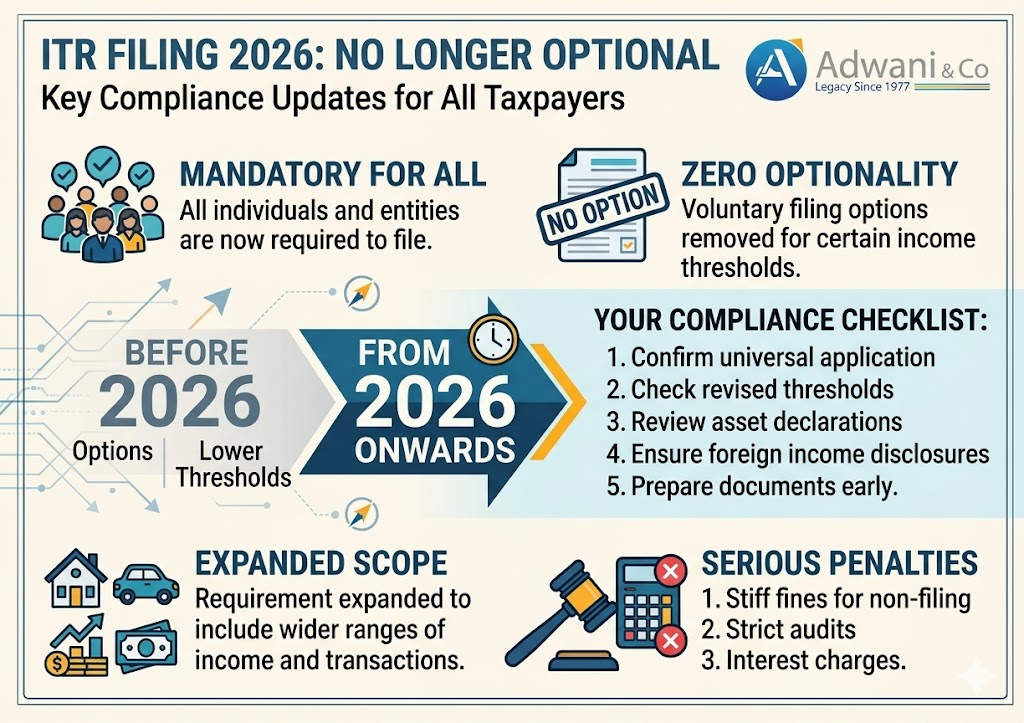
  • ITR Filing 2026: No Longer Optional

    ITR Filing 2026: No Longer Optional

    By CA Dipesh Gurubakshani May 2026 10 minutes

    The Moment Most Indian Taxpayers Realise They Got It Wrong

    There is a conversation that plays out in CA offices across India every August. A salaried professional confident, financially responsible, earning well walks in with a stack of bank statements. He has just received a scrutiny notice from the Income Tax Department. His bank flagged a high value credit card payment. His loan application was rejected because his ITR for last year shows income inconsistent with his claimed salary. He missed two deductions worth ₹54,000. And he filed his return in the last three days of July on a portal that was so congested his entries auto-populated incorrectly.

    “I thought ITR filing was just a formality,” he says.

    It is not. It never was. And in 2026, ITR filing has moved so far beyond a routine compliance checkbox that treating it as one is one of the most expensive financial mistakes an Indian taxpayer can make.

    This blog resonated deeply with thousands of Indian professionals expands on a simple but powerful truth: filing your income tax return in 2026 is no longer optional. Not legally, not financially, and not practically.

    Learn more about our IITR Filing 2026: Smart Strategies to Beat the Deadline, Slash Your Tax Bill & Secure Your Future


    Why ITR Filing 2026 Has Fundamentally Changed

    ITR Filing Is Now Your Financial Identity Document

    A decade ago, your ITR was a document you filed because the law said so and perhaps to claim a refund. Today, it is something far more powerful and far more consequential.

    Banks, non-banking financial companies, housing finance institutions, and even private lenders now routinely ask for the last two to three years of filed income tax returns as a primary proof of income. Not salary slips. Not employer letters. Filed ITRs with an acknowledgement number from the Income Tax Department at incometax.gov.in.

    Visa officers at the US, UK, Canadian, and Schengen consulates treat your ITR history as a financial credibility document evidence that you are a tax-compliant individual with a legitimate, verifiable income stream. Embassy rejections linked to missing or inconsistent ITRs are no longer rare.

    Mutual fund and stock broking accounts above certain transaction thresholds now require ITR cross-referencing for KYC purposes. Real estate developers for high-value property transactions ask for it. Even some premium insurance underwriters factor ITR consistency into their risk assessment.


    ITR filing 2026 is no longer a tax document. It is your financial identity.

    The Government Has More Data on You Than You Realise

    The Annual Information Statement (AIS) available on the Income Tax e-filing portal now aggregates data from over 40 different sources simultaneously. Your bank deposits, your mutual fund redemptions, your stock market transactions, your credit card payments above ₹1 lakh per month, your foreign remittances, your property registrations, your dividend income, your savings account interest all of it flows into the AIS automatically.

    The Income Tax Department of India cross-references this data with your filed ITR the moment you submit it. Any mismatch even an apparently minor one can trigger a Section 143(1)(a) adjustment notice or a full Section 143(2) scrutiny assessment.

    As Dr. Haresh Adwani, PhD (Commerce) and Law Graduate, Managing Partner of Adwani and Company, explains to every new client: “The government’s data infrastructure has fundamentally changed the risk calculation for non-filers and incorrect filers. If you have income appearing in the AIS that you have not reported in your ITR, a notice is a mathematical certainty — not a possibility.”

    This is why ITR filing in 2026 demands accuracy and professional care, not a last-minute online self-filing exercise.


    ITR Filing 2026 Deadlines: Know Exactly Where You Stand

    One of the most important changes introduced by Budget 2026 is the formal bifurcation of the ITR filing last date 2026 by taxpayer category. This is no longer a single deadline that applies to everyone.

    Taxpayer CategoryITR FormITR Filing Last Date 2026
    Salaried employees and pensionersITR-1 / ITR-231 July 2026
    Freelancers, consultants, small business (non-audit)ITR-3 / ITR-431 August 2026
    Audit-required businesses under Section 44ABITR-3 / ITR-431 October 2026
    Belated ITR (missed original deadline)All applicable31 December 2026
    Updated Return under Section 139(8A)ITR-U31 March 2031

    Critical upgrade from Budget 2026: The revised ITR window has been extended to 31 March 2027 for AY 2026-27, giving taxpayers who discover errors after filing an unprecedented correction window. Additionally, the Updated Return (ITR-U) under Section 139(8A) has been extended to 4 years (48 months) from the end of the relevant assessment year allowing taxpayers to correct unreported income without facing the full force of a scrutiny proceeding.


    7 Powerful Reasons ITR Filing 2026 Is Non-Negotiable

    1. ITR Filing 2026 Is Legally Mandatory for Most Indians

    The Income Tax Act, 1961, and the Central Board of Direct Taxes (CBDT) have progressively lowered the practical threshold for mandatory filing. Even if your income is below the basic exemption limit of ₹3 lakh under the new tax regime, you are legally required to file an ITR if you meet any one of these conditions:

    • You deposited more than ₹1 crore in bank accounts during the year
    • You spent more than ₹2 lakh on foreign travel
    • Your electricity bills exceeded ₹1 lakh in the year
    • You have foreign assets or foreign income of any amount
    • You received TDS/TCS above ₹25,000 (₹50,000 for senior citizens)
    • Your business turnover exceeded ₹60 lakh or professional receipts exceeded ₹10 lakh

    These thresholds capture a far larger population than most people realise. A retiree with a fixed deposit earning interest plus a foreign trip this year may be legally required to file — regardless of their total income level.

    2. Carry Forward of Losses Requires Timely ITR Filing 2026

    If you made losses in the stock market from F&O trading, intraday transactions, or delivery-based equity those losses can be carried forward for up to 8 years and offset against future gains. But only if your ITR is filed on or before the due date.

    A trader who lost ₹4.5 lakh in F&O trading this year and fails to file by July 31st loses the right to carry forward those losses permanently. In subsequent years when their F&O trades are profitable, they will pay full tax on gains — with no offset available.

    This is one of the most underestimated consequences of late ITR filing 2026.

    Also Read : F&O Trading Taxation in India (2026): Complete & Simple Guide

    3. Your Tax Refund Depends Entirely on a Filed ITR

    The Income Tax Department of India processes refunds only for filed returns. If your employer deducted excess TDS based on projected income that was lower than actual earnings — or if advance tax was paid in excess — the only way to recover that money is through a timely, accurately filed return.

    Early filers in July consistently receive refunds in 15 to 30 days. Late filers who submit in the last week of July or in August face delays of 60 to 90 days due to portal congestion and processing queues.

    4. Visa Applications Demand Clean ITR History

    The UK, USA, Canada, Australia, and most Schengen countries now require 2 to 3 years of filed ITRs as part of the financial documentation for visa applications. Missing returns — or returns that show income inconsistent with your stated bank balance — are among the leading causes of visa rejections for Indian applicants.

    ITR filing 2026 is not just about this year’s taxes. It is about building a three-to-five-year track record of financial credibility that opens international borders.

    5. Home Loan, Car Loan, and Business Loan Approvals

    Every major bank and NBFC in India from SBI and HDFC to Bajaj Finance and Tata Capital asks for ITR acknowledgements as primary income proof in loan applications. Lenders assess loan eligibility based on your net taxable income as declared in your ITR, not your gross salary.

    A professional earning ₹15 lakh but claiming maximum deductions reducing net taxable income to ₹8.5 lakh will have their loan eligibility calculated on the lower figure. This makes professional ITR filing assistance critical you need to balance legitimate tax minimization with maintaining sufficient declared income for borrowing purposes.

    6. Avoid Costly Penalties Under Section 234F

    Missing the ITR filing 2026 deadline is not just an administrative inconvenience. Under Section 234F of the Income Tax Act, late filers pay:

    • ₹1,000 if total income is below ₹5 lakh
    • ₹5,000 if total income exceeds ₹5 lakh

    Additionally, Section 234A charges interest at 1% per month on any outstanding tax liability from the original due date. For someone with ₹50,000 in unpaid tax filing six months late, that is ₹3,000 in interest alone plus the penalty. Combined, these costs routinely run to ₹8,000–₹15,000 for a single delayed return.

    7. Protection Against Scrutiny and Black Money Act Notices

    The Black Money (Undisclosed Foreign Income and Assets) and Imposition of Tax Act, 2015, and the Benami Transactions (Prohibition) Act impose severe penalties including criminal prosecution for undisclosed assets and income. Non-filing creates gaps in your financial record that attract exactly the kind of scrutiny these laws enable.

    A filed, accurate ITR is your best legal defence. It demonstrates voluntary, transparent disclosure the standard that the Income Tax Department consistently rewards with lower scrutiny probability.


    Practical Example

    Priya Nair, a 38year-old architect from Mumbai earning ₹18.5 lakh annually, had filed her own ITR for six consecutive years using an online platform. She claimed Section 80C (₹1.5 lakh) and her employer’s standard deduction and nothing else.

    When she approached Adwani and Company for ITR filing 2026, Dr. Haresh Adwani’s team conducted a comprehensive income and deduction review:

    Deduction / ExemptionPreviously ClaimedCorrectly ClaimedDifference
    Section 80C₹1,50,000₹1,50,000
    Section 80D (Health Insurance — self + parents)₹0₹50,000+₹50,000
    HRA Exemption (correctly computed)₹72,000₹1,44,000+₹72,000
    Section 24(b) — Home Loan Interest₹0₹2,00,000+₹2,00,000
    Professional Development Expenses (under business head)₹0₹48,000+₹48,000
    Total Additional Deductions Unlocked₹3,70,000

    At applicable income tax slab rates, these additional deductions reduced Priya’s taxable income from ₹18.5 lakh to approximately ₹14.8 lakh generating a verified tax saving of ₹67,450 compared to her previous year’s payment.

    She had been overpaying taxes for six years. The cumulative overpayment conservatively estimated exceeded ₹3 lakh.

    This is what expert-assisted ITR filing 2026 delivers: not just compliance, but financial justice.


    How to File ITR Online for AY 2026-27: The Right Way

    Step 1: Gather All Required Documents Before You Begin

    Rushing to the portal without complete documentation is the primary cause of ITR errors. Assemble these before opening the Income Tax e-filing portal:

    • Form 16 (from all employers for FY 2025-26)
    • Form 26AS downloaded from incometax.gov.in
    • Annual Information Statement (AIS) from the e-filing portal
    • Bank statements for all accounts April 2025 to March 2026
    • Mutual fund capital gains statements (CAS from CAMS/KFintech)
    • Stock broker’s capital gains report
    • Home loan interest certificate from lender
    • Investment proof for all Section 80C instruments
    • Health insurance premium receipts (Section 80D)
    • Rental receipts if claiming HRA exemption
    • Details of any foreign assets or foreign income

    Step 2: Choose the Correct ITR Form

    Your Income ProfileCorrect Form
    Salary only, one house, income below ₹50 lakhITR-1
    Salary + capital gains, or more than one propertyITR-2
    Business/professional income, F&O tradingITR-3
    Presumptive income (Section 44AD/44ADA)ITR-4

    Using the wrong form results in a defective return notice — and mandatory refiling.

    Step 3: Reconcile AIS Before Filing

    The most critical pre-filing step in 2026 is AIS reconciliation. Download your AIS, compare every entry against your own records, and raise objections for incorrect entries before filing. Declaring income inconsistent with AIS data is the single biggest trigger for scrutiny.

    Step 4: E-File and E-Verify Within 30 Days

    File on the Income Tax portal at incometax.gov.in and e-verify within 30 days using Aadhaar OTP, net banking, or a pre-validated bank account. A filed but unverified return is legally treated as non-filed.http://incometax.gov.in

    Step 5: Track Your Refund

    After e-verification, track refund status at incometax.gov.in under “My Account → Refund/Demand Status.” File early refunds for early July filers typically process in under 3 weeks.

    ITR Filing 2026 for Freelancers and Self-Employed Professionals

    Freelancers and self-employed professionals in India face a materially different ITR filing 2026 landscape than salaried individuals. Their key obligations include:

    • Reporting all income including cash payments, international client payments in foreign currency, and platform-based income from apps and marketplaces
    • Reconciling income with Form 26AS TDS credits from clients who have deducted TDS under Section 194J
    • Evaluating eligibility for presumptive taxation under Section 44ADA (50% of gross receipts treated as net income for professionals with receipts below ₹75 lakh)
    • Computing and paying advance tax in four installments if estimated tax liability exceeds ₹10,000
    • Filing using ITR-3 or ITR-4 depending on whether presumptive scheme is adopted

    The ITR filing last date 2026 for freelancers using non-audit ITR-3/ITR-4 is 31 August 2026 a new, one-month extension introduced by Budget 2026.


    Why Adwani and Company Is the Trusted Choice for ITR Filing 2026

    Adwani and Company, provides professional ITR filing services that go well beyond data entry and form submission.

    What the Adwani and Company team delivers:

    • Comprehensive AIS and Form 26AS reconciliation before filing
    • Complete deduction review across all applicable sections — 80C through 80U
    • Capital gains computation from stocks, mutual funds, property, and other assets
    • GST-ITR consistency check for business taxpayers
    • Legal interpretation of complex situations HUF planning, NRI taxation, foreign asset disclosure, RNOR status
    • Year-round support: post-filing notices, revised returns, scrutiny assessments, appeals

    As Dr. Haresh Adwani states in every client interaction: “The goal of ITR filing is not just to avoid a notice. It is to ensure every rupee of legally permissible deduction reaches the taxpayer, the return stands up to any level of scrutiny, and the client’s financial record supports every ambition they have whether that is a home loan, a visa, or a business expansion.”

    Thousands of salaried employees, freelancers, business owners, NRIs, and high-net-worth individuals across Pune and India trust Adwani and Company for exactly this standard of work.

    Frequently Asked Questions

    Q1. Why is ITR filing 2026 mandatory even if I have no tax to pay?

    ITR filing in 2026 is legally mandatory if you meet any of the high-value transaction conditions specified by the CBDT regardless of your income level. Additionally, filing is necessary to claim refunds, carry forward losses, apply for loans, and maintain a clean financial record for visa applications and other purposes.

    Q2. What is the ITR filing last date 2026 for salaried employees?

    The ITR filing last date 2026 for salaried individuals and pensioners filing ITR-1 or ITR-2 is 31 July 2026, as confirmed by the Central Board of Direct Taxes (CBDT). Freelancers and non-audit business filers have until 31 August 2026.

    Q3. What documents do I need for ITR filing 2026?

    Key documents include Form 16 from your employer, Form 26AS and AIS from the Income Tax portal, bank statements for all accounts, capital gains statements from mutual funds and brokers, home loan interest certificates, health insurance receipts, and investment proof for Section 80C claims.

    Q4. Can I file a revised ITR after submitting for AY 2026-27?

    Yes. Budget 2026 extended the revised ITR window to 31 March 2027 for AY 2026-27. You can revise your return to correct errors or claim missed deductions within this extended window.

    Q5. What is the penalty for missing the ITR filing 2026 deadline?

    Under Section 234F, a late filing fee of ₹1,000 (income below ₹5 lakh) or ₹5,000 (income above ₹5 lakh) applies. Section 234A charges 1% interest per month on outstanding tax from the due date. You also permanently lose the ability to carry forward business and capital losses.

    Q6. Is ITR filing 2026 necessary for freelancers and consultants?

    Yes. Freelancers, independent consultants, and gig workers must file ITR using ITR-3 or ITR-4 depending on their income structure. Their ITR filing 2026 last date is 31 August 2026 for non-audit cases. They must report all receipts, reconcile TDS credits in Form 26AS, and evaluate presumptive taxation eligibility under Section 44ADA.

    Q7. How can Adwani and Company help with ITR filing 2026 for NRIs?

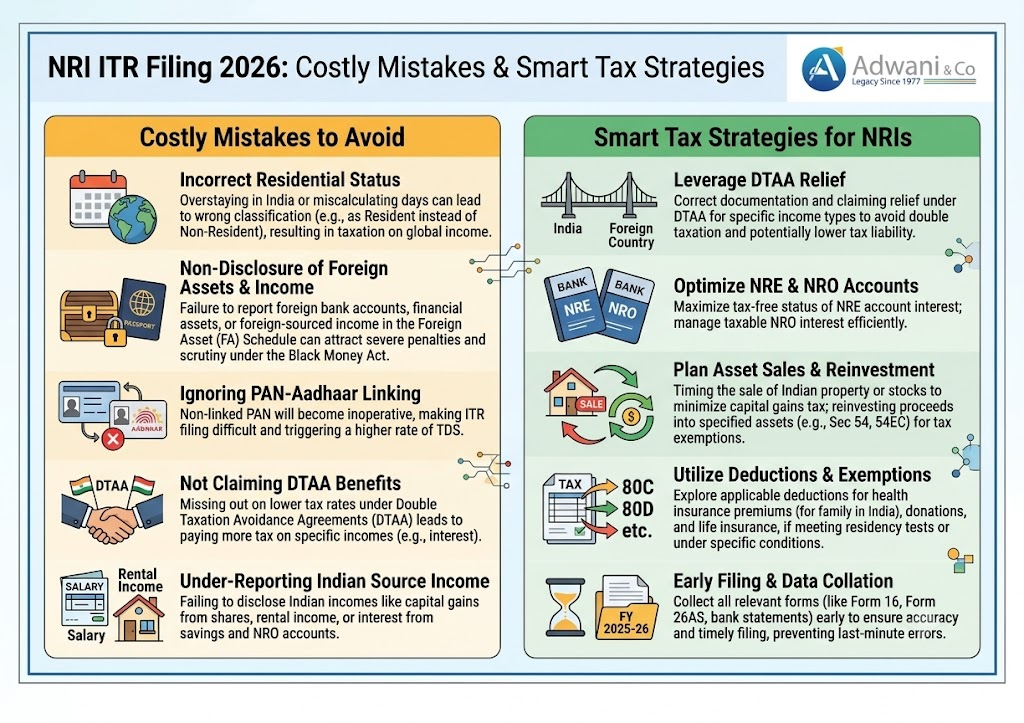
    Adwani and Company provides comprehensive NRI ITR filing services including capital gains computation on Indian asset sales, NRE/NRO interest taxability, RNOR status tax planning, foreign asset disclosure under Schedule FA, and DTAA benefit claims. Contact Dr. Haresh Adwani’s team for a personalised NRI tax consultation.

    Conclusion:

    Your ITR filing 2026 is the document that proves your income to every lender, every visa officer, every government authority, and every institution that matters to your financial life. It is the record that protects you from scrutiny, unlocks your refunds, preserves your ability to carry forward losses, and establishes your credibility as a financially responsible Indian citizen.

    The deadlines are firm 31 July 2026 for salaried taxpayers, 31 August 2026 for freelancers and small businesses. The penalties for delay are real. The cost of errors is measurable and as Priya Nair’s example shows the cost of filing without expert guidance can run to lakhs of rupees over a career.

    File early. File accurately. File with professionals who understand that your ITR is not paperwork it is your financial identity.


    Author

    CA Dipesh Gurubakshani is a Chartered Accountant with Adwani & Co LLP, Pune, specialising in income tax audit, direct taxation, and accounting advisory. He supports clients across statutory compliance, financial reporting, and income tax matters with a focus on accuracy, regulatory adherence, and disciplined execution.

  • ITR Filing 2026: Beat the Deadline & Save More

    ITR Filing 2026: Beat the Deadline & Save More

    By CA Dipesh Gurubakshani  Updated: May 2026 9 min read

    Introduction:Why ITR Filing 2026 Cannot Wait

    Every year, thousands of Indian taxpayers rush to file their Income Tax Returns in the final days of July —crashing the government portal, making costly errors, and missing legitimate deductions worth lakhs of rupees. “The difference between a smart taxpayer and a stressed taxpayer is preparation and preparation begins the day the financial year ends, not the day the deadline arrives.”

    ITR filing 2026 is not just a compliance formality. It is your single most powerful tool for financial legitimacy enabling faster loan approvals, smoother visa processing, faster refunds, and zero unnecessary scrutiny from the Income Tax Department. For FY 2025-26 (Assessment Year 2026-27), the filing season is open and the clock is ticking.

    This comprehensive guide will walk you through everything you need to know about ITR filing 2026: the correct deadlines by taxpayer category, the right forms to use, common mistakes to avoid, and how Adwani and Company can help you file accurately, on time, and with maximum tax savings.


    ITR Filing 2026 Last Date : Know Your Exact Deadline

    One of the biggest sources of confusion every year is the ITR filing last date 2026. Budget 2026 introduced a landmark change: the deadline is no longer the same for everyone. It now depends on the ITR form you use, your income type, and whether your accounts require a statutory tax audit. incometax.gov.inOne of the biggest sources of confusion every year is the ITR filing last date 2026. Budget 2026 introduced a landmark change: the deadline is no longer the same for everyone. It now depends on the ITR form you use, your income type, and whether your accounts require a statutory tax audit.

    Here is a category-wise breakdown confirmed by the Income Tax Department of India (incometax.gov.in)

    Taxpayer CategoryApplicable ITR FormITR Filing Last Date 2026
    Salaried, pensioners, single house propertyITR-1 / ITR-231 July 2026
    Freelancers, professionals, small business (non-audit)ITR-3 / ITR-431 August 2026
    Businesses requiring statutory tax auditITR-3 / ITR-431 October 2026
    Belated return (missed deadline)All forms31 December 2026
    Updated Return (ITR-U)ITR-U31 March 2031

    Important Note: When logging into incometax.gov.in for AY 2026-27, always select

    Tab 1: Income Tax Act, 1961

    Tab 2 is for Tax Year 2026-27 returns to be filed in 2027. Selecting the wrong tab will invalidate your filing entirely.

    At Adwani and Company, we explain“Knowing which deadline applies to you is step one. Choosing the wrong assumption about your due date can result in avoidable penalties and notices. Always verify your taxpayer category before filing.”


    What Changed in ITR Filing 2026 : Budget 2026 Updates

    Budget 2026 brought meaningful reforms that make ITR filing 2026 more taxpayer-friendly than any previous year. Understanding these changes is essential for every filer.

    Extended Deadline for Freelancers and Small Businesses

    For the first time, non-audit filers using ITR-3 and ITR-4 covering freelancers, consultants, small business owners, and independent professionals have been given an extra month to file. Their ITR filing last date 2026 is now 31 August 2026 instead of 31 July. This change, introduced specifically to reduce last-minute chaos and improve the quality of filings, gives business taxpayers adequate time to close accounts and perform proper reconciliations.

    Revised Return Window Extended to March 31

    One of the most taxpayer-friendly changes of the decade: the window to file a Revised ITR has been extended to 31 March 2027 for AY 2026-27. Previously capped at 31 December, this extension allows taxpayers who discover missed deductions or errors after filing to correct their returns without fear simply by paying a small revision fee. This change strongly reduces involuntary non-compliance.

    Updated Return (ITR-U) Window Extended to 4 Years

    Under Section 139(8A) of the Income Tax Act, 1961, the Updated Return window has been extended to 48 months (4 years) from the end of the relevant assessment year. For AY 2026-27, this means eligible taxpayers can file an ITR-U all the way up to 31 March 2031. This is particularly beneficial for taxpayers who realize they have missed reporting income from investments, freelance work, or capital gains.


    How to File ITR Online for AY 2026-27 : Step-by-Step

    ITR filing online has become progressively simpler, but errors are still common when taxpayers rush. Adwani and Company recommends the following structured approach for smooth ITR filing 2026:

    1. Download Form 26AS and AIS: Log in to incometax.gov.in and download your Annual Information Statement (AIS) and Form 26AS. Cross-verify that all TDS credits, bank interest, and income entries are correct. Any mismatch with your Form 16 must be resolved with your employer or bank before proceeding.

    2. Choose the Correct ITR Form: Using the wrong ITR form leads to defective return notices and rejection. ITR-1 is for salaried individuals earning up to ₹50 lakh from salary, one house property, and interest. ITR-2 covers individuals with capital gains or more than one property. ITR-3 and ITR-4 are for business and professional income.

    3 . Compute Total Income and Deductions: Gather all your income sources salary, rental income, interest, capital gains, freelance income and list all eligible deductions under Section 80C (up to ₹1.5 lakh), Section 80D (health insurance), HRA, and home loan interest. “Most taxpayers leave money on the table simply because they don’t know which deductions they are legally entitled to. A one-hour consultation can save you ₹20,000 to ₹50,000 in taxes.”

    4 . E-File and E-Verify: Complete ITR filing online through the Income Tax Portal (incometax.gov.in) and e-verify within 30 days using Aadhaar OTP, net banking, or by sending a physical ITR-V to CPC Bengaluru. An unfiled e-verification makes your return invalid.

    5. Track Refund Status: After successful filing and e-verification, track your refund status on incometax.gov.in under “My Account → Refund/Demand Status.” Early filers typically receive refunds faster due to lower portal congestion.

    [Learn more about our ITR Filing Services at Adwani and Company]https://www.adwaniandco.com/services/taxation-compliance


    Practical Example

    How Correct ITR Filing 2026 Saved ₹42,000

    Consider Mr. Ramesh Sharma, a 34-year-old software engineer from Pune earning ₹12 lakh per year. In previous years, he filed his own return hastily in the last week of July, claiming only basic 80C deductions.

    This year, guided by Adwani and Company, here is what his tax computation looked like:

    DeductionAmount Saved
    Section 80C (ELSS + PPF)₹1,50,000
    Section 80D (Health Insurance)₹25,000
    HRA Exemption (correct computation)₹84,000
    Home Loan Interest (Section 24b)₹2,00,000
    Total Deductions Claimed₹4,59,000

    By correctly computing his HRA exemption which he had been computing incorrectly for three years and properly claiming home loan interest that he had been ignoring, Ramesh reduced his taxable income from ₹12 lakh to approximately ₹7.41 lakh. At applicable slab rates, this resulted in a tax saving of approximately ₹42,000 compared to his previous year’s filing.

    This is the power of expert assisted ITR filing 2026, as practiced by Dr. Haresh Adwani and his team at Adwani and Company.


    Penalty for Late ITR Filing 2026: What You Risk by Waiting

    The Income Tax Act is clear about the cost of missing the ITR filing last date 2026. Under Section 234F, the following penalties apply:

    • ₹1,000 late filing fee if your total income is below ₹5 lakh
    • ₹5,000 late filing fee if your total income exceeds ₹5 lakh
    • 1% interest per month on outstanding tax dues under Section 234A
    • Loss of ability to carry forward losses from business, capital gains, or other heads — a particularly painful consequence for investors and traders
    • Increased scrutiny risk from the Income Tax Department, including notices and assessments

    The belated ITR filing last date for 2026 is 31 December 2026. Beyond that, the only recourse is the Updated Return (ITR-U) mechanism under Section 139(8A), which carries additional tax costs and cannot be used to claim fresh deductions.

    As the Income Tax Department of India consistently emphasizes, voluntary and timely compliance is the most cost-effective path for every taxpayer.

    Read our detailed guide on Penalty Provisions Under Income Tax Act: https://www.adwaniandco.com/blog/paid-your-taxes-honestly-still-got-an-income-tax-notice-2026-guide


    ITR Filing 2026 for Salaried vs Business Taxpayers : Key Differences

    Understanding the difference in ITR filing obligations between salaried and business taxpayers is critical for compliance under AY 2026-27.

    Salaried Taxpayers (ITR-1 / ITR-2)

    Salaried individuals represent the largest taxpayer category in India. Their income is primarily documented through Form 16 issued by employers, with TDS already deducted and deposited under Section 192. Their ITR filing 2026 due date is 31 July 2026. Key focus areas: correct HRA computation, Section 80C through 80U deductions, capital gains from mutual funds or stocks, and accurate AIS reconciliation.

    Business and Professional Taxpayers (ITR-3 / ITR-4)

    Freelancers, consultants, traders, and small business owners have more complex compliance needs. They must maintain proper books of account, compute business income accurately, reconcile GST returns with income tax filings, and — if turnover exceeds the prescribed threshold under Section 44AB — get a tax audit done before the October deadline. Dr. Haresh Adwani, with his dual expertise in Commerce (PhD) and law, specifically helps business owners navigate this intersection of income tax compliance, GST reconciliation, and legal risk — making Adwani and Company a one-stop solution for complete financial compliance


    Common ITR Filing Mistakes to Avoid in 2026

    Even wellintentioned taxpayers make errors that attract notices or reduce their refunds. Adwani and Company has compiled the most frequently observed mistakes during ITR filing 2026:

    1. Wrong ITR Form : Filing ITR-1 when you have capital gains from mutual funds requires ITR-2. Incorrect form selection results in defective return notices.
    2. Not Reconciling AIS and Form 26AS : Mismatches between your declared income and the government’s data are one of the top triggers for scrutiny.
    3. Missing Bank Interest Income : Interest from savings accounts, fixed deposits, and recurring deposits is fully taxable and must be reported even if TDS has been deducted.
    4. Incorrect HRA Calculation : HRA exemption is computed as the minimum of three values, not simply the full HRA received. Incorrect computation is a common, expensive error.
    5. Not Claiming Eligible Deductions : Many salaried employees are unaware they can claim Section 80TTA (savings interest up to ₹10,000) and Section 80EEA (first-home loan interest benefit).
    6. Skipping E-Verification : A filed but unverified ITR is treated as if it was never filed.

    [Read our detailed guide on How to Avoid Income Tax Notices in India]

    https://www.adwaniandco.com/blog/income-tax-notice-received


    Why Choose Adwani and Company for ITR Filing 2026

    At Adwani and Company, ITR filing 2026 is handled not by generic software but by qualified professionals led by Dr. Haresh Adwani — a PhD holder in Commerce and a law graduate with deep legal knowledge of Indian tax statutes.

    What sets Adwani and Company apart:

    • Complete AIS/Form 26AS reconciliation before filing to eliminate mismatch risk
    • Deduction maximization thorough review of all eligible deductions the client is legally entitled to claim
    • Dual expertise in income tax and GST ensuring your ITR filing is consistent with your GST returns, a critical requirement for business taxpayers
    • Legal interpretation Dr. Haresh Adwani’s law background allows Adwani and Company to advise on legally gray areas such as capital gains classification, HUF planning, and business income structuring
    • Year-round support not just at filing time, but for notices, assessments, appeals, and tax planning

    Thousands of satisfied clients across Pune and India trust Adwani and Company for accurate, timely, and legally compliant ITR filing every year.

    Conclusion:

    ITR filing 2026 is not a task to defer until the last minute. Whether you are a salaried professional, a freelancer, or a business owner, your ITR is the foundation of your financial credibility in the eyes of banks, government authorities, and investment institutions.

    The July 31 and August 31 deadlines for AY 2026-27 are firm. The Income Tax Department of India has made the e-filing infrastructure robust and accessible at incometax.gov.in but the portal still sees massive congestion in the final days of July every year. Filing early gives you faster refunds, time to correct errors, and the peace of mind that comes from knowing you are fully compliant.

    “Tax compliance is not a burden. It is the most powerful financial habit an Indian citizen can build. File correctly, file on time, and let your tax record open doors for you.”

    Frequently Asked Questions

    Q1. What is the last date for ITR filing 2026 for salaried employees?

    The ITR filing last date 2026 for salaried individuals filing ITR-1 or ITR-2 is 31 July 2026, as confirmed by the Central Board of Direct Taxes (CBDT) and the Income Tax Department of India.

    Q2. What happens if I miss the ITR filing 2026 deadline?

    You can file a belated ITR by 31 December 2026 with a late filing fee of ₹1,000 (income below ₹5 lakh) or ₹5,000 (income above ₹5 lakh) under Section 234F, plus applicable interest under Section 234A. Beyond December 31, you must file an Updated Return (ITR-U).

    Q3. Can I file a revised ITR after July 31, 2026?

    Yes. Budget 2026 extended the revised ITR deadline to 31 March 2027 for AY 2026-27. You can revise your original return to correct errors or claim missed deductions by paying a small revision fee.

    Q4. Which ITR form should freelancers and consultants use for AY 2026-27?

    Freelancers and independent professionals should use ITR-3 or ITR-4, depending on whether they are opting for presumptive taxation under Section 44ADA. Their ITR filing 2026 deadline is 31 August 2026 (non-audit cases).

    Q5. Is it mandatory to file an ITR if my employer has already deducted TDS?

    Yes, ITR filing is mandatory if your gross income exceeds the basic exemption limit, regardless of TDS already deducted. Filing also enables refund claims, carry-forward of losses, and financial documentation for loans, visas, and more.

    Q6. What documents do I need for ITR filing 2026?

    Key documents include Form 16 (from employer), Form 26AS (from income tax portal), Annual Information Statement (AIS), bank statements, investment proof for Section 80C, health insurance premium receipts, and home loan interest certificates.

    Q7. Can Adwani and Company file my ITR if I’m an NRI?

    Yes. Adwani and Company assists NRI taxpayers with ITR filing 2026, covering NRI capital gains tax on Indian assets, rental income from Indian properties, and DTAA (Double Taxation Avoidance Agreement) benefits.

    CA Dipesh Gurubakshani  is a Chartered Accountant with Adwani & Co LLP, Pune, specialising in income tax audit, direct taxation, and accounting advisory. He supports clients across statutory compliance, financial reporting, and income tax matters with a focus on accuracy, regulatory adherence, and disciplined execution.

  • Hidden Loan Costs Indians Must Know Before Borrowing

    Hidden Loan Costs Indians Must Know Before Borrowing

    By CA Dipesh Gurubakshani Updated: May 2026 9 min read

    The bank advertised your loan at 6%. But when the first EMI hit your account, the numbers didn’t add up. You weren’t wrong — the bank was. Understanding hidden loan costs is not optional anymore. It can save you lakhs of rupees over the life of a loan.

    Millions of Indian borrowers sign loan agreements every year without fully understanding what they are committing to. The advertised interest rate — whether it’s 6%, 8.5%, or 12% — is rarely the true cost of borrowing. Hidden loan costs, undisclosed fees, and misleading marketing practices leave borrowers paying significantly more than they ever anticipated. This guide, brought to you by Adwani and Company, breaks down every layer of the hidden loan costs that lenders conveniently leave out of their brochures.


    Why Hidden Loan Costs Are the Biggest Financial Trap

    When a lender advertises a “6% home loan” or a “10% personal loan,” they are typically quoting a nominal interest rate — not the Annual Percentage Rate (APR) or the effective cost of credit. This distinction is critical, and most borrowers don’t know it exists.

    Hidden loan costs are charges added on top of the stated interest rate that inflate the true cost of your loan. These can include processing fees, administrative charges, insurance premiums bundled without consent, prepayment penalties, late payment fees, and documentation charges. When you add these up over a 15 or 20-year home loan, the difference between the advertised rate and what you actually pay can run into lakhs — sometimes even tens of lakhs.

    According to the Reserve Bank of India (RBI), lenders are required to disclose the Annual Percentage Rate (APR) transparently. Yet, in practice, these disclosures are often buried in fine print, disclosed only at the time of disbursement, or communicated in ways that most borrowers cannot interpret without professional help.

    “A loan is not just what you borrow — it is everything you will pay back, including what was never clearly disclosed.”


    The Most Common Hidden Loan Costs in India

    To fully grasp the hidden loan costs embedded in your borrowing agreement, you need to know exactly what to look for. Here are the most prevalent charges:

    1. Processing Fees

    Processing fees are typically charged as a percentage of the loan amount — usually between 0.5% and 2%. On a ₹50 lakh home loan, a 1% processing fee means you pay ₹50,000 before your loan even begins. This hidden loan cost is non-refundable, even if your loan application is rejected after payment.

    2. Insurance Premiums — Bundled Without Full Transparency

    Many lenders bundle life insurance or loan protection insurance with your loan and include the premium in the loan amount itself. This increases your principal — and therefore your interest outgo — for the entire loan tenure. The borrower often isn’t clearly told that this is optional. This is one of the most insidious hidden loan costs in the Indian banking system.

    3. Prepayment and Foreclosure Penalties

    If you come into money and want to repay your loan early, many lenders — especially those offering fixed-rate loans — charge a prepayment penalty of 2% to 4% on the outstanding amount. The RBI has banned foreclosure charges on floating-rate home loans for individual borrowers, but this protection does not apply to all loan types. Always verify this before signing.

    4. Documentation and Legal Charges

    Legal verification fees, stamp duty on loan agreements, CERSAI registration charges, and document handling fees are frequently not disclosed upfront. These can add ₹10,000 to ₹30,000 to the cost of a home loan — small percentages that silently inflate the true borrowing cost.

    5. MCLR vs. Repo Rate — When the Benchmark Matters

    Home loans linked to MCLR (Marginal Cost of Funds Based Lending Rate) reset less frequently than those linked to the RBI Repo Rate. If interest rates fall, borrowers on MCLR-linked loans benefit much later than those on repo-linked products. This is a structural hidden loan cost that many borrowers discover only years into their tenure.

    6. Goods and Services Tax (GST) on Loan Services

    Processing fees, prepayment charges, and many loan-related services attract 18% GST as per the GST Portal guidelines. This is rarely highlighted in loan advertisements and adds to the effective borrowing cost. Learn more about GST compliance for financial transactions on our resources page.


    A Real Example: The ₹50 Lakh Home Loan That Wasn’t 8%

    Illustrative Example — Home Loan Cost Breakdown

    A borrower takes a ₹50 lakh home loan for 20 years at an advertised rate of 8%. Here’s what the actual cost looks like when hidden loan costs are included:

    ₹50L

    Loan Amount

    8%

    Advertised Rate (Nominal)

    ₹1,00,000

    Processing Fee (2%)

    ₹42,000

    Insurance Premium (bundled)

    ₹22,000

    Legal + Documentation Fees

    ~9.3%

    Effective APR (Approx.)

    The total upfront hidden loan costs alone amount to over ₹1.64 lakh — more than 3% of the loan amount — before the borrower receives a single rupee. Over 20 years of EMIs, the true cost diverges significantly from what was advertised.

    This is precisely why consistently we advise clients to request a full APR disclosure and amortization schedule from lenders before signing any loan document. A difference of even 1% in effective interest rate on a ₹50 lakh loan over 20 years translates to over ₹8 lakh in additional outgo.

    Also Read: https://www.adwaniandco.com/blog/gst-show-cause-notices


    What Indian Law Says About Disclosing Hidden Loan Costs

    The regulatory framework in India is clear, even if enforcement is imperfect. The RBI’s Fair Practices Code mandates that all lenders — banks, NBFCs, and housing finance companies — must:

    • Provide a clear loan agreement with all charges stated before disbursement
    • Disclose the APR (Annualised Percentage Rate) in the loan sanction letter
    • Not alter loan terms unilaterally without the borrower’s written consent
    • Not levy foreclosure charges on floating-rate home loans to individual borrowers

    Additionally, the Ministry of Corporate Affairs (MCA) regulates the corporate governance of lending institutions, and violations of transparent disclosure norms can be reported to the RBI’s Banking Ombudsman Scheme. If you believe you have been misled about hidden loan costs, you have legal recourse.

    Read our detailed guide on your rights as a borrower under RBI guidelines to understand how to protect yourself legally.

    Did you know? Under Section 17 of the Consumer Protection Act, 2019, misleading advertisements — including those that obscure the true cost of a loan — can constitute an unfair trade practice and are actionable before Consumer Disputes Redressal Commissions.


    How to Calculate the True Cost of Your Loan

    There are two metrics every informed borrower should demand from their lender before signing:

    1. Annual Percentage Rate (APR)

    APR is the most accurate measure of the true cost of a loan. It includes the nominal interest rate plus all fees, charges, and costs associated with the loan, expressed as an annualized percentage. Always compare loans using APR — not the headline interest rate. A loan at 8% nominal with 2% processing fees can have an APR closer to 9.5% in the first year.

    2. Total Interest Outgo Over Tenure

    Ask your lender for the complete amortization schedule. This document shows you month-by-month how much of each EMI goes toward principal versus interest. For a ₹50 lakh loan at 8% over 20 years, the total interest alone amounts to approximately ₹50 lakh — you effectively pay back double the loan amount before counting any hidden loan costs.

    At Adwani and Company, we regularly assists clients in interpreting amortization schedules, comparing loan offers across multiple lenders, and negotiating better terms particularly for home loans, business loans, and education loans. Learn more about our loan advisory and financial planning services.


    5 Proven Strategies to Avoid Hidden Loan Costs

    1. Always demand the APR in writing — not just the nominal rate — before submitting any loan application
    2. Read every line of the sanction letter before accepting. The sanction letter is a legal document and binds you to its terms
    3. Opt out of bundled insurance unless you have independently verified its value and cost — it is almost always optional
    4. Check if your lender has a floating or fixed rate and understand what happens when the RBI changes the repo rate
    5. Consult a qualified CA before signing — professional review of loan documents can prevent expensive mistakes that last decades

    The Digital Age of Lending and New Hidden Loan Costs

    The rise of fintech lending, Buy Now Pay Later (BNPL) platforms, and instant digital loans has introduced an entirely new category of hidden loan costs. Many digital lenders advertise “0% interest” loans but recover their margins through flat processing fees, convenience charges, and mandatory subscription plans. A ₹10,000 BNPL loan with a ₹400 “convenience fee” and ₹200 monthly “account management fee” carries an effective annual cost well above 70%.

    Digital borrowers are particularly vulnerable because the application process is fast, paperwork is minimal, and borrowers rarely pause to examine the effective cost. The rule is the same regardless of the channel: demand full cost disclosure before borrowing.

    The Income Tax Department also takes note of loan-related costs processing fees on business loans are deductible under Section 37(1) of the Income Tax Act as a business expense. If you are a business borrower, understanding and properly documenting these hidden loan costs can reduce your tax liability. Read our detailed guide on business loan tax deductions in India.


    Conclusion: Know What You Borrow : Not Just What You Sign

    The gap between the loan that was advertised and the loan that was delivered is not an accident. Hidden loan costs are a systematic feature of how lending is marketed in India. Understanding them is not just financially prudent — it is an act of self-protection in a system that favors informed borrowers.

    The advertised rate is the entry point of a conversation. The APR, the amortization schedule, the insurance disclosure, the prepayment clause, the GST on fees — these are the substance of the deal. Before you commit to a loan that will follow you for 10, 15, or 20 years, make sure you are reading the full document, not just the headline number.

    a borrower who understands the hidden loan costs in their agreement is never truly trapped by them.


    Frequently Asked Questions

    01. What is the difference between the advertised loan interest rate and the actual cost of the loan?

    The advertised rate is the nominal interest rate usually the base rate applied to your principal. The actual cost of a loan includes processing fees, insurance, documentation charges, GST on fees, and other charges, all of which inflate the effective rate. The Annual Percentage Rate (APR) captures all these hidden loan costs and is the most reliable figure for comparison.

    02. Are banks in India required to disclose all loan charges upfront?

    Yes. Under the RBI’s Fair Practices Code, banks and NBFCs are required to disclose all charges and the APR in the loan sanction letter before disbursement. However, compliance varies, and borrowers must proactively ask for full cost disclosures rather than relying on what is volunteered.

    03. Can I negotiate processing fees and other hidden loan costs with my bank?

    Absolutely. Processing fees, documentation charges, and even prepayment penalty clauses are often negotiable especially for high-value loans or existing relationship customers. A Chartered Accountant or financial advisor can help you negotiate better loan terms before signing.

    04. What is a prepayment penalty and when does it apply?

    A prepayment penalty is a charge levied when you repay your loan before the agreed tenure. For floating-rate home loans to individual borrowers, the RBI has prohibited foreclosure charges. However, fixed-rate loans, business loans, and many personal loans may still carry prepayment penalties of 2%–4% of the outstanding balance. Always verify this before signing.

    05. How do hidden loan costs affect my EMI?

    In most cases, hidden loan costs like insurance premiums are added to the loan principal, which directly increases your EMI. Processing fees and GST are typically deducted upfront from the disbursed amount, meaning you receive less money than the sanctioned loan amount but pay EMIs on the full amount.

    06. Can I file a complaint if I was not informed about hidden loan costs?

    Yes. You can file a complaint with the RBI Banking Ombudsman if a regulated lender fails to disclose charges as required. Under the Consumer Protection Act, 2019, non-disclosure of material facts in a financial product can also constitute an unfair trade practice, actionable before Consumer Commissions.

    07. Are processing fees on a business loan tax deductible?

    Yes. Under Section 37(1) of the Income Tax Act, 1961, processing fees and other loan-related charges for business loans are allowable as a deductible business expense, provided they are incurred wholly and exclusively for business purposes and are properly documented. Consult a CA for proper treatment in your books of accounts.

    About the Author

    CA Dipesh Gurubakshani is a Chartered Accountant with Adwani & Co LLP, Pune, specialising in income tax audit, direct taxation, and accounting advisory. He supports clients across statutory compliance, financial reporting, and income tax matters with a focus on accuracy, regulatory adherence, and disciplined execution.

  • Old vs New Tax Regime2025: Stop Guessing, Start Calculating

    Old vs New Tax Regime2025: Stop Guessing, Start Calculating

    Old vs New Tax Regime

    The one financial decision most salaried Indians get wrong every single year.  

    Every year, crores of Indian taxpayers file their returns and every year, a significant portion of them quietly leave money on the table. Not because they chose the wrong investments. Not because they missed a deadline (though that happens too). But because they made one seemingly simple decision without running the numbers: choosing between the old vs new tax regime.

    With the rollout of the Income Tax Act, 2025, this choice has never carried more financial weight. The new regime offers lower headline tax rates, while the old regime rewards those who invest strategically and claim deductions. Neither is universally “better.” Your best option depends entirely on your numbers your income, your investments, your HRA, your home loan. This guide gives you everything you need to make that call with confidence.


    What is the Old vs New Tax Regime?

    India currently operates two parallel personal income tax systems, and every taxpayer must elect one at the time of filing or, in the case of salaried employees, communicate their preference to their employer at the start of the financial year.

    According to the Income Tax Department of India, the old tax regime allows taxpayers to claim a wide range of deductions and exemptions HRA, standard deduction, LTA, Section 80C (up to ₹1.5 lakh), 80D for health insurance, home loan interest under Section 24(b), and much more. These deductions directly reduce your taxable income, which means the effective tax you pay can be significantly lower than the published slab rates suggest.

    The new tax regime, significantly restructured in Budget 2023 and further refined under the Income Tax Act, 2025, offers lower slab rates but eliminates most deductions. The government has made it the default option meaning if you do nothing, you are automatically placed in the new regime. The new regime is designed to simplify compliance and is especially attractive for those who do not have significant deductions.

    Income SlabOld Regime RateNew Regime Rate (2025)
    Up to ₹3,00,000NilNil
    ₹3,00,001 – ₹7,00,0005%5%
    ₹7,00,001 – ₹10,00,00020%10%
    ₹10,00,001 – ₹12,00,00030%15%
    ₹12,00,001 – ₹15,00,00030%20%
    Above ₹15,00,00030%30%

    On the surface, the new regime looks attractive. But tax slabs alone don’t tell the full story. Your effective tax rate what you actually pay after deductions can be dramatically different.


    Key Deductions: What You Give Up in the New Tax Regime

    Understanding the old vs new tax regime comparison is impossible without understanding what deductions the new regime removes. Here is what salaried taxpayers commonly lose access to when they opt for the new regime:

    • HRA (House Rent Allowance): One of the most powerful deductions for metro and urban workers. Not available in the new regime.
    • Section 80C (₹1.5 lakh limit): Covers PPF, ELSS, LIC premiums, EPF, home loan principal repayment, and more. Not available in the new regime.
    • Section 80D: Deduction for health insurance premiums for self and family. Not available in the new regime.
    • Home loan interest (Section 24b): Up to ₹2 lakh deduction on interest for self-occupied property. Not available in the new regime.
    • LTA (Leave Travel Allowance): Not available in the new regime.

    What is available in the new regime? 

    The standard deduction of ₹75,000 for salaried individuals (revised in 2024) and the employer’s NPS contribution (up to 14% of basic salary under Section 80CCD (2) remain eligible in the new regime. These are important benefits often overlooked by taxpayers.


    Old vs New Tax Regime: A Real-World Numerical Example

    Practical Example

    Case: Ravi, Salaried Employee Gross Income ₹15,00,000

    Ravi earns ₹15 lakh per year. He pays rent in Mumbai, has an active PPF and ELSS investment, and pays health insurance premiums for his family. Here is how the two regimes compare for him:

    ItemOld RegimeNew Regime
    Gross Income₹15,00,000₹15,00,000
    Standard Deduction−₹50,000−₹75,000
    HRA Exemption−₹1,80,000Not Applicable
    Section 80C−₹1,50,000Not Applicable
    Section 80D−₹25,000Not Applicable
    Home Loan Interest (24b)−₹1,00,000Not Applicable
    Net Taxable Income₹9,95,000₹14,25,000
    Approximate Tax (incl. cess)~₹1,34,000~₹1,85,000

    In this scenario, Ravi saves approximately ₹51,000 more by choosing the old regime. Tax savings are illustrative and will vary with actual figures.

    This is the math most taxpayers never do. As Dr. Haresh Adwani, founder of Adwani and Company, consistently points out during consultations: “The regime that looks cheaper at the slab level often turns out to be more expensive at the effective tax level once you factor in the deductions a disciplined investor claims.

    Also Read:


    Which Regime is Better at Different Income Levels?

    The old vs new tax regime debate does not have a universal answer. But there are useful income-based patterns that emerge from detailed tax calculations:

    Income up to ₹12.75 lakh: The new regime, combined with the standard deduction of ₹75,000 and a tax rebate under Section 87A (up to ₹60,000 in the new regime for FY 2025-26), can result in zero tax liability. This makes the new regime extremely compelling for this income band especially if the taxpayer does not have significant deductions.

    Income around ₹15 lakh: This is the battleground. If you have HRA, 80C investments, and a home loan the old regime almost certainly wins. If you have minimal deductions, the new regime may be marginally better or comparable.

    Income above ₹20 lakh: The lower slab rates in the new regime start to overpower the benefit of deductions for many taxpayers, especially those without a home loan. The new regime often gains the advantage here but this must be calculated individually.


    Critical Mistakes to Avoid When Choosing Your Tax Regime

    Mistake 1: Not informing your employer on time

    If you are a salaried employee and you wish to opt for the old regime, you must inform your employer before the start of the financial year (typically before April 1). Failing to do so means your employer will deduct TDS under the new regime by default. This can result in lower in-hand salary throughout the year and an unexpected tax liability or a refund headache at the time of filing. As the Income Tax Department guidance clearly outlines, the responsibility of intimating regime choice lies with the employee.

    Mistake 2: Comparing regimes based on slabs alone

    A large number of taxpayers make regime decisions based on rate comparisons without plugging in their actual deductions. Running both scenarios through an income tax calculator or better, consulting a CA takes minutes and can save tens of thousands of rupees annually. Dr. Haresh Adwani, with his expertise spanning commerce, law, and taxation, emphasizes that personalised tax planning not generalized assumptions is what protects your income.

    Mistake 3: Business income taxpayers assuming unlimited regime switches

    Unlike salaried individuals who can switch regimes every year, taxpayers with business or professional income (who file under ITR-3 or ITR-4) can switch from the new regime to the old regime only once. After that, if they switch back to the new regime, they cannot return to the old regime again. This rule, as outlined in Section 115BAC of the Income Tax Act, is frequently misunderstood and can result in irreversible decisions.

    Mistake 4: Ignoring NPS employer contribution in the new regime

    Section 80CCD (2) allows a deduction for the employer’s contribution to the National Pension System up to 14% of basic salary in the new regime (10% in the old regime for private sector employees). Many employees miss negotiating this benefit with their employer. It is one of the most valuable, legitimate tax tools available in the new regime, and Adwani and Company frequently helps clients restructure their CTC to maximise this benefit.

    Old vs New Tax Regime for Business Owners and Freelancers

    Self-employed individuals, freelancers, and business owners face a different landscape than salaried employees. The ability to claim business expenses, depreciation, and set off losses makes the old regime more nuanced for this group. However, the presumptive taxation scheme under Section 44AD (for businesses up to ₹3 crore turnover) and 44ADA (for professionals) is compatible with the new regime offering simplicity without the burden of maintaining detailed books purely for deduction purposes.

    The GST Portal and MCA (Ministry of Corporate Affairs) registrations don’t directly impact your income tax regime choice but your business structure (proprietorship vs LLP vs private limited) significantly affects how income is taxed. For incorporated entities, regime choice applies to individual promoters on their personal income, not to the company’s corporate terms


    How to Calculate and Decide: A Practical Framework

    A simple five-step process for every taxpayer before the financial year begins:

    1. List your expected gross income for the year salary, rent, capital gains, business income.
    2. List all deductions you will legitimately claim HRA, 80C, 80D, home loan interest, NPS.
    3. Calculate your net taxable income under both regimes use the Income Tax Department’s online calculator or a CA-prepared spreadsheet.
    4. Apply the applicable slab rates to each and compute the final tax including surcharge and 4% cess.
    5. Choose the lower outcome and communicate it to your employer or record it in your ITR before the deadline.

    This process takes less than 30 minutes with a professional’s guidance, yet it directly determines how much of your hard-earned income stays in your pocket.


    Authority Reference: 

    The Income Tax Department’s official tax calculator at the incometax.gov.in portal allows taxpayers to compare their liability under both regimes using actual income and deduction inputs. It is updated for each assessment year and is the most reliable starting point for the comparison.


    Conclusion: Stop Following Others, Start Calculating

    The old vs new tax regime debate is not a matter of opinion it is a matter of arithmetic. And yet, year after year, taxpayers choose their regime the same way they pick a restaurant: by seeing what their colleagues are having.

    Your tax planning is personal. Your income is unique. Your deductions are different from your neighbour’s. The regime that saves your colleague ₹40,000 might cost you ₹60,000 and vice versa. The Income Tax Act, 2025 has given taxpayers more structure and clarity, but the decision still requires you to sit down with actual numbers and make a deliberate, informed choice.

    As Dr. Haresh Adwani has guided hundreds of clients over the years: “Tax saving is not about which regime old vs new looks better in a presentation. It is about which regime performs better with your specific income, your specific investments, and your specific life situation.”

    Don’t leave money on the table. Don’t wait until March. Start now, calculate both old vs new regimes, and make the right decision for your financial future.

    1. Which is better old vs new tax regime in 2025?

    There is no universally better regime. The old regime benefits those with significant deductions like HRA, 80C, and home loans. The new regime works better for those with minimal investments or income up to ₹12.75 lakh. Always calculate both before choosing.

    2. Can I switch between old vs new tax regime every year?

    Salaried individuals can switch regimes every financial year. However, taxpayers with business or professional income can switch from new to old only once; after reverting to new, they cannot switch back to old.

    3. Is HRA exempt in the new tax regime?

    No. House Rent Allowance (HRA) exemption is not available under the new tax regime. This is one of the most significant reasons why the old regime may be better for salaried employees living on rent in cities.

    4. What deductions are available in the new tax regime?

    The new regime allows the standard deduction of ₹75,000 (for salaried employees), employer’s NPS contribution under Section 80CCD(2), and a few other limited exemptions. Most major deductions (80C, 80D, HRA, 24b) are not available.

    5. Is income up to ₹12 lakh tax-free in the new regime?

    Under the new tax regime for FY 2025–26, taxpayers with income up to ₹12 lakh (and ₹12.75 lakh for salaried individuals after the ₹75,000 standard deduction) may have zero tax liability due to the revised Section 87A rebate. Consult a CA to confirm your specific eligibility.

    6. What happens if I don’t inform my employer about my regime choice?

    If you don’t inform your employer, TDS will be deducted under the new regime (the default). This could result in excess TDS (requiring refund) or insufficient TDS (resulting in a year-end demand) depending on which regime would have been optimal for you.

    7. Should I consult a CA for regime selection?

    Yes especially if your income exceeds ₹10 lakh, if you have business income, if you have a home loan or rental income, or if you are self-employed. A qualified CA like those at Adwani and Company can run a precise comparison and help you structure your income tax planning for maximum savings.

    About the Author

    CA Dipesh Gurubakshani is a Chartered Accountant with Adwani & Co LLP, Pune, specialising in income tax audit, direct taxation, and accounting advisory. He supports clients across statutory compliance, financial reporting, and income tax matters with a focus on accuracy, regulatory adherence, and disciplined execution.

  • Section 80GGC Deduction Disallowance: ITAT Rules That Suspicion Is Not Enough,  A Guide for Indian Taxpayers

    Section 80GGC Deduction Disallowance: ITAT Rules That Suspicion Is Not Enough, A Guide for Indian Taxpayers

    Every year, thousands of honest Indian taxpayers find their legitimate deductions disallowed not because of anything wrong they did, but because someone else they transacted with came under scrutiny. A recent ITAT ruling has drawn a firm legal line: suspicion, however compelling, cannot substitute for evidence when it comes to Section 80GGC tax deduction disallowance.

    This ruling matters for anyone who has claimed or plans to claim a deduction for donations made to a registered political party under Section 80GGC of the Income-Tax Act, 1961. At Adwani & Co LLP, we have successfully applied this legal principle to defend clients against wrongful disallowances. Here is everything you need to understand to protect your tax position.

    Also Read:

    https://www.adwaniandco.com/blog/share-trading-tax-business-income-or-capital-gains-2026

    What Is Section 80GGC and Who Can Claim It?

    Section 80GGC of the Income-Tax Act, 1961 allows individual taxpayers not companies to claim a 100% deduction for donations made to:

    The rationale is straightforward: the government incentivises transparent, traceable political funding over unaccounted cash donations. Accordingly, cash donations are explicitly excluded only payments via banking channels (NEFT, RTGS, cheque, online transfer) qualify.

    Importantly, Section 80GGC remains available under both the old and new tax regimes in 2026, making it one of the few deductions that provides value regardless of which regime you choose.

    Key Eligibility Conditions for Section 80GGC Payment must be via banking channel (no cash). Recipient must be a registered political party or electoral trust. Deduction amount = 100% of donation (no cap). Must be declared in your ITR filing through the income tax portal

    The ITAT Ruling on Section 80GGC Disallowance: What Happened?

    The ruling at the centre of this article arose from a case where the Income Tax Department disallowed a taxpayer’s Section 80GGC deduction of ₹2,00,000 not because anything was wrong with the taxpayer’s own conduct, but because the recipient political party was under a general investigation for financial irregularities.

    Case ElementDetails
    Deduction Claimed₹2,00,000 under Section 80GGC (political donation)
    Assessment YearAY 2024-25
    Mode of PaymentNEFT bank transfer full banking trail maintained
    Documentation HeldOfficial receipt from political party + ITR declaration
    Department’s Basis for DisallowanceGeneral investigation of recipient political party
    ITAT OutcomeDisallowance DELETED. Deduction fully restored to taxpayer.

    Why Did the Department Disallow the Deduction and Why Was It Wrong?

    The Income Tax Officer’s reasoning followed a pattern we see frequently in post-investigation assessments:

    • Guilt by association: Because the recipient party was under investigation for unrelated financial irregularities, the officer argued that all donations to it should be disallowed regardless of the individual donor’s conduct.
    • Reliance on general investigation reports: The officer relied on broad findings about the organisation rather than any evidence specific to this taxpayer’s transaction.
    • Precautionary over-reach: The department effectively penalised a fully compliant taxpayer for another entity’s alleged wrongdoing.
    The Fatal Gap in the Department’s Case The Income Tax Department could not answer one simple question: How is this specific taxpayer’s bank-documented ₹2,00,000 donation connected to the organization’s alleged irregularities? The answer: it was not. And that gap the absence of any specific nexus proved legally fatal to the disallowance.

    ITAT’s Four Key Observations That Set the Precedent

    The Tribunal made four decisive observations that now serve as the legal foundation for defending Section 80GGC deductions and indeed, all deduction disallowances based on third-party investigations:

    Observation 1: No Evidence of Fund Return

    The ITAT found that the department provided no evidence that the donated funds were returned to the taxpayer in any form, or that the taxpayer received any irregular benefit. A clean outward banking transfer with no corresponding inward receipt is powerful documentation of a genuine donation.

    Observation 2: No Direct Nexus Established

    This is the cornerstone of the ruling. The Tribunal held that no direct nexus no specific, demonstrable link was established between this taxpayer’s individual donation and the alleged irregular transactions of the recipient organisation. The fact of donating to an investigated organisation does not implicate the donor unless the department can prove a specific connection.

    Observation 3: No Assessee-Specific Material on Record

    The ITAT emphasised that the department had general investigation files but nothing specifically implicating this taxpayer’s transaction. This principle applies broadly in any tax audit, reassessment, or deduction disallowance, the department must bring assessee-specific material on record, not just general investigative conclusions.

    Observation 4: Violation of Natural Justice

    The taxpayer was never given the opportunity to review or contest the investigative findings that formed the basis of the disallowance. This denial of the right to cross-examine is a standalone procedural ground for overturning an assessment independent of the substantive merits of the case.

    ITAT Verdict: Deduction Fully Restored All four observations led the Tribunal to delete the disallowance in its entirety. The taxpayer’s Section 80GGC deduction of ₹2,00,000 was restored. This ruling is precedent-setting for similar tax deduction disallowance cases across India particularly where investigation of a third party is used as the basis for penalising an unrelated, compliant taxpayer.

    The Nexus Requirement: When Is Disallowance Justified vs Not?

    ‘Nexus’ a direct, logical connection between a taxpayer’s specific action and the allegation against them is the legal bridge that must exist before any deduction can be disallowed or income added. Without nexus, the department’s action is arbitrary and legally indefensible.

    Strong nexus disallowance generally justified:

    • A taxpayer receives kickbacks from a supplier they also claimed as a deductible expense (direct benefit from the wrongdoing)
    • A company claims deductions for services that were demonstrably never rendered (direct false claim)
    • A director channels funds through a shell entity and reclaims them as income (direct round-tripping)

    Weak or absent nexus disallowance generally NOT justified:

    • A person donates to a political party that subsequently faces investigation (the donor’s conduct was entirely separate)
    • A vendor you paid legitimately is under audit your purchase transaction was compliant and properly documented
    • Your investment fund manager faces fraud charges after you made a routine, compliant investment

    The ITAT ruling makes clear: you cannot be penalised for a recipient’s conduct unless the department proves your transaction was itself improper.

    Your Due Process Rights in Assessment and Audit Proceedings

    The ITAT’s emphasis on natural justice is critically important for any taxpayer facing an income tax assessment, audit, or reassessment. You have statutory rights to:

    • Receive specific, written notice of all allegations against you not vague references to third-party investigative findings
    • Review the actual documents, reports, and evidence the Assessing Officer relies upon
    • Submit a written defence and present oral arguments before the assessment is finalised
    • Challenge investigative reports and cross-examine the evidence base
    • Appeal to the Commissioner (Appeals), ITAT, High Court, and Supreme Court if rights are violated

    As Dr. Haresh Adwani notes: “When the department skips due process, they hand the taxpayer additional grounds to overturn the assessment regardless of the substantive merits.” Procedural violations are often easier to argue and faster to resolve than substantive disputes.

    Practical Example: How Adwani & Co LLP Defended a Section 80GGC Claim

    Case Study – Dr. Ramesh Kulkarni, Pune Scenario: Dr. Ramesh Kulkarni donated ₹1,50,000 to a registered political party in FY 2024-25 via NEFT transfer and claimed the Section 80GGC deduction. In 2026, the party faced an Election Commission inquiry. The Income Tax Officer issued a notice proposing to disallow the deduction based on the inquiry.  Adwani & Co LLP’s Response: We filed a detailed objection citing the ITAT ruling and established: (1) the NEFT transfer showed a clean outward payment with no fund return; (2) no nexus existed between the EC inquiry and Dr. Kulkarni’s individual donation; (3) a proper receipt and ITR declaration were in place; (4) no assessee-specific material was produced by the officer.  Outcome: The disallowance was withdrawn at the objection stage itself the matter never proceeded to ITAT.

    What to Do If Your Section 80GGC Deduction Has Been Disallowed

    If you have received a notice proposing to disallow your Section 80GGC deduction based on investigation of the recipient organisation, take these steps immediately:

    • Do not ignore the notice. Respond within the specified time silence is treated as acceptance.
    • Request a written nexus explanation. Ask the officer to specify exactly what connects your transaction to the alleged irregularity.
    • Compile your documentation: bank statement showing the NEFT/cheque transfer, official party receipt, ITR declaration, and any correspondence with the party.
    • Engage a CA experienced in tax appellate work. ITAT proceedings require precise legal arguments a generic response rarely suffices.

    How Adwani & Co LLP Defends Against Wrongful Disallowance

    Adwani & Co LLP, under CA Dipesh Gurubakshani and the broader leadership of Dr. Haresh Adwani, provides a structured, evidence-driven defence against wrongful tax deduction disallowance:

    • Nexus analysis: We immediately test whether the department’s allegations establish any specific connection to your transaction. No nexus means immediate challenge at the assessment stage, before the matter even reaches ITAT.
    • Due process verification: We verify whether you received proper notice, access to evidence, and fair hearing. Procedural violations are standalone grounds for reversal.
    • ITAT precedent leverage: We cite directly relevant ITAT rulings and High Court decisions to demonstrate that the department’s approach is legally unsustainable.
    • Documentation fortification: We ensure your evidence file is complete banking records, official receipts, ITR declarations, and a comprehensive factual narrative.
    • Layered appellate strategy: Whether before the Commissioner (Appeals), ITAT, or High Court, we build arguments combining factual, legal, and procedural grounds.

    Conclusion: Your Good-Faith Compliance Is Legally Protected

    The ITAT’s ruling on Section 80GGC tax deduction disallowance establishes a principle that should reassure every honest taxpayer: suspicion cannot replace evidence. The Income Tax Department cannot disallow your legitimately documented, bank-transferred political donation simply because the recipient organization is under scrutiny. Your transaction stands independently assessed on its own merits, protected by the nexus requirement and your due process rights.

    Proper banking documentation, accurate ITR reporting, and genuine transactional intent are a taxpayer’s strongest legal armour. If your deductions have been disallowed on flimsy grounds, you have solid legal recourse and Adwani & Co LLP is here to exercise it on your behalf.

    Frequently Asked Questions -Section 80GGC and ITAT Ruling

    1.Can my Section 80GGC deduction be disallowed because the recipient party is under investigation?

    No. Based on the ITAT ruling, the department must prove that your specific donation was improper. The recipient organization being investigated is not sufficient a direct nexus to your individual transaction must be established.

    2.What evidence do I need to protect my Section 80GGC deduction?

    You need: (1) bank statement showing the NEFT or cheque transfer, (2) official receipt from the political party, (3) ITR filing declaring the donation, and (4) any acknowledgment from the party. Cash donations do not qualify.

    3.What should I do if my deduction was disallowed due to general investigation findings?

    Immediately request written specifics from the officer on what nexus connects the investigation to your transaction. If no nexus is established, file a detailed objection or appeal citing this ITAT precedent. Contact Adwani & Co LLP for guidance.

    4.Can I be reassessed based on investigation findings alone?

    A reassessment notice can reference investigation findings, but it must cite issues specific to your assessment and establish nexus with your transactions. A generic reference to organizational findings without assessee-specific material can be challenged as legally invalid.

    5.What are my rights to cross-examination in an income tax assessment?

    You have the right to receive written details of all allegations, review all evidence the officer relies on, submit written and oral defences, and challenge investigative reports. Denial of these rights is a procedural violation that independently grounds a reversal.
     

    6.Is Section 80GGC available under the new tax regime in 2026?

    Yes. Section 80GGC is one of the very few deductions available under both the old and new tax regimes, making it especially valuable. Ensure the donation meets the banking channel and receipt requirements to withstand scrutiny.

    7.Does this ITAT ruling apply to other deductions disallowed due to third-party investigations?

    Yes. The nexus principle applies broadly. In any assessment where deductions or expenses are disallowed based on a third-party investigation without assessee-specific evidence, the same legal framework protects you.

    About the Author

    CA Dipesh Gurubakshani is a Chartered Accountant with Adwani & Co LLP, Pune, specialising in income tax audit, direct taxation, and accounting advisory. He supports clients across statutory compliance, financial reporting, and income tax matters with a focus on accuracy, regulatory adherence, and disciplined execution.

  • Share Trading Tax: Business Income or Capital Gains 2026?

    Share Trading Tax: Business Income or Capital Gains 2026?

    Share Trading Tax
    Share Trading Tax

    1. The ₹12 Lakh Question Every Share Trader Is Asking

    Every tax season, a particular question circulates in trading groups, WhatsApp chats, and CA waiting rooms across India. In FY 2025–26 (AY 2026–27), with the new tax regime firmly in place and the ₹12 lakh rebate under Section 87A making headlines, that question has reached a fever pitch:

    “If my total income is below ₹12 lakhs, can I show my share trading profits as Business Income to bring my taxable income below the rebate threshold and pay zero tax?”

    It sounds clever. It sounds like a legal loophole. But according to Indian tax law and the consistent position taken by the Income Tax Department the share trading tax treatment is not a matter of personal convenience. It is a matter of legal classification governed by well-settled principles.

    At Adwani and Company, one of Pune’s most trusted CA firms, we deal with exactly this share trading tax classification question every single week. Dr. Haresh Adwani, has guided hundreds of investors and active traders through the maze of share trading tax rules. This blog is your definitive guide to understanding how your share market profits are legally classified and what you absolutely must not get wrong in your ITR.

    Also Read:

    https://www.adwaniandco.com/blog/business-growth-strategy

    2. What the Income Tax Act Actually Says About Share Trading Tax

    Let us start with the single most important truth in this entire debate: there is no specific section in the Income Tax Act, 1961 that categorically declares share trading income must always be Business Income. Equally, no provision forces every investor to treat profits as Capital Gains.

    The share trading tax classification depends on applying principles drawn from three key provisions:

    SectionProvisionRelevance to Share Trading Tax
    Section 2(13)Definition of BusinessIncludes any trade, commerce, or adventure in the nature of trade. Courts have interpreted this broadly to cover frequent share trading.
    Section 28Profits and Gains from Business or ProfessionGoverns taxation of profits from any business carried on by the assessee applicable when trading is the primary activity.
    Section 45Capital GainsAny profit from transfer of a capital asset is taxable here the natural classification for long-term investors holding shares as investments.

    The Income Tax Department does not automatically assign you a category. The classification of share trading tax whether as Business Income or Capital Gains is entirely fact-specific. It depends on who you are, how you trade, why you trade, and how you maintain your books of account.

    Reference: Income Tax Department of India incometaxindia.gov.in

    3. Business Income vs Capital Gains: The Real Legal Test

    Courts and the Income Tax Department have consistently held that the real test in determining share trading tax treatment is a simple but powerful question: Are you an investor or a trader?

    This is not a question you can answer arbitrarily based on what saves you tax. As Dr. Haresh Adwani explains to clients at Adwani and Company:

    “The answer to whether your share trading income is Business Income or Capital Gains must emerge from the facts of your situation not from whichever classification happens to reduce your tax liability.”   Dr. Haresh Adwani, Adwani and Company

    Indian courts, including various High Courts and the Hon’ble Supreme Court, have developed a well-settled body of case law around this distinction. The intention of the taxpayer at the time of entering a transaction is a central factor but intention must always be corroborated by actual conduct and documentary evidence.

    4. Key Factors That Determine Share Trading Tax Classification

    The Assessing Officer (AO), during a scrutiny assessment under Section 143(3), applies a multi-factor test to determine whether your share trading income should be taxed as Business Income or Capital Gains. Here are the five factors the Income Tax Department consistently examines:

    FactorWhat the AO ExaminesInvestor SignalTrader Signal
    Frequency & VolumeHow many trades and how often?Few trades per yearHundreds of trades per month
    Holding PeriodHow long were shares held?Months to yearsDays to weeks
    IntentionWhy were shares purchased?Dividend & long-term growthProfit from price movement
    Source of FundsOwn money or borrowed?Own savings / surplus fundsMargin / broker funding
    Books of AccountHow shares recorded?Shown as ‘Investments’Shown as ‘Stock-in-trade’

    These factors are never applied in isolation. The AO looks at the totality of facts. A taxpayer who holds shares for 8 months but trades daily in other stocks, or uses borrowed funds for some and own funds for others, will face a more nuanced and often unfavorable classification if records are not maintained carefully.

    Learn more about our income tax filings and classification advisory services at Adwani and Company.

    5. CBDT Circular 6/2016: What It Really Permits for Share Trading Tax

    The Central Board of Direct Taxes (CBDT) issued Circular No. 6/2016 specifically to address the share trading tax classification issue for listed shares. This circular is frequently cited and even more frequently misunderstood.

    What CBDT Circular 6/2016 actually says: For listed shares and securities, the taxpayer’s consistent stand investor or trader may be accepted by the Assessing Officer, provided the stand is supported by facts and has been maintained over time.   It does NOT create an open, free choice to switch classifications whenever it is tax-advantageous.

    The operative word in that circular is consistent. Dr. Haresh Adwani specifically cautions clients at Adwani and Company: if you have been classifying your share profits as Capital Gains for years, suddenly switching to Business Income in FY 2025–26 because the ₹12 lakh rebate makes it attractive is precisely the kind of inconsistency that flags a case for scrutiny.

    The Income Tax Department has made this position clear through multiple assessment orders: income classification is not a menu from which taxpayers pick the most favorable option each year. The share trading tax treatment you choose must reflect your actual investment or trading behavior and it must be consistent.

    Reference: CBDT Circular No. 6/2016 Income Tax Department of India

    6. Real Example: Two Traders, Two Very Different Share Trading Tax Outcomes

    To make the share trading tax classification concrete, consider this practical example from FY 2025–26:

    ProfileTrader A (Active Trader)Trader B (Long-Term Investor)
    Activity200+ trades/month, all held under 30 days15 trades/year, average holding 14 months
    Source of FundsMargin funding from brokerOwn savings
    Books of AccountShares recorded as stock-in-tradeShares recorded as investments
    Profit (FY 2025-26)₹9 lakh₹9 lakh
    Correct ClassificationBusiness Income (slab rate)Long-Term Capital Gains @ 12.5%
    Tax Payable (approx.)Taxable at applicable slab in new regimeTaxed @ 12.5% after ₹1.25L exemption
    Can claim ₹12L rebate?Yes if total income is below ₹12LNo LTCG under 112A is excluded from 87A rebate
    Can Trader A claim LTCG?No AO will reclassify during scrutiny if Trader A triesN/A

    This example illustrates the critical point: both traders earn the same profit ₹9 lakh. But their share trading tax treatment is entirely different, and neither can simply choose the other’s classification because it saves tax. The facts determine the outcome, not the taxpayer’s preference.

    Key insight for FY 2025–26: Even if your share trading income qualifies as Business Income and your total income is below ₹12 lakhs, the Section 87A rebate only applies if the income is taxable at slab rates not at special rates. F&O and intraday business income may qualify. Ensure proper ITR filing with a CA to confirm eligibility.

    7. Which ITR Form Should Share Traders File?

    One of the most Googled share trading tax questions in India is: ‘Which ITR form should I use for share market income?’ The answer depends directly on your income classification:

    ITR FormWho Should Use ItApplicable Income Type
    ITR-2Investors with capital gains only (no business income)LTCG, STCG from listed/unlisted shares, mutual funds
    ITR-3Traders with business income (F&O, intraday, or high-frequency delivery trading)Speculative & non-speculative business income, plus capital gains
    ITR-4 (Sugam)Not applicable for share tradingPresumptive business income under Section 44AD cannot be used for F&O or share trading

    Important: Filing the wrong ITR form for example, using ITR-2 when you should have filed ITR-3 is a defective return. The Income Tax Department may issue a notice under Section 139(9) asking you to rectify it. A defective return, if not corrected within the prescribed time, is treated as if no return was filed at all.

    Read our detailed guide on ITR form selection for share traders and investors.

    8. Intraday and F&O: Where They Stand in Share Trading Tax

    For two very common types of share market activity, the Income Tax Act leaves no room for classification debate:

    ActivityTax ClassificationGoverning SectionSet-off of Losses
    Intraday Trading (same-day, no delivery)Speculative Business IncomeSection 43(5)Only against speculative profits (4-year carry-forward)
    F&O Trading (Futures & Options)Non-Speculative Business IncomeSection 28Against all heads except salary (8-year carry-forward)
    Short-Term Capital Gains (held < 12 months)STCG @ 20%Section 111AAgainst STCG / LTCG only
    Long-Term Capital Gains (held > 12 months)LTCG @ 12.5%Section 112AAgainst LTCG only; ₹1.25L annual exemption

    As Dr. Haresh Adwani notes: “For intraday and F&O, there is no classification debate the law is settled. The complexity and the risk arises with delivery-based equity trades, where facts and intention govern the share trading tax outcome. This is where most taxpayers and many non-specialist accountants get it wrong.”

    9. Why Reclassifying Share Trading Income for Tax Saving Is Risky

    The Income Tax Department has been consistently expanding its data analytics capabilities. In FY 2025–26, the department cross-references data from stock exchanges, depositories (CDSL/NSDL), SEBI, and broker-furnished Annual Information Statements (AIS) and Statements of Financial Transactions (SFT) to identify high-frequency traders who may be misclassifying income.

    When a taxpayer who has executed hundreds of transactions during the year then classifies all gains as long-term capital gains specifically to claim the ₹12 lakh rebate this inconsistency surfaces in the system. Such cases are flagged for scrutiny assessment under Section 143(3), and the Assessing Officer may:

    1. Re-examine the nature, frequency, and volume of all trades during the year.
    2. Reclassify the share trading income from Capital Gains to Business Income.
    3. Deny the LTCG exemption and 12.5% preferential rate entirely.
    4. Raise a demand for additional tax, plus interest under Sections 234B and 234C.
    5. Levy a penalty under Section 270A for under-reporting of income ranging from 50% to 200% of the tax evaded.
    A real cost calculation: If ₹5 lakhs in share trading income was misclassified to save ₹65,000 in tax, and the AO reclassifies it, the resulting demand could be: ₹65,000 (tax) + ₹15,000 (interest) + ₹32,500–65,000 (penalty) = up to ₹1,45,000 in total outgo more than double the original ‘saving’. The share trading tax shortcut costs more.

    The Adwani and Company team has represented multiple clients in scrutiny assessments arising from exactly this scenario. The financial cost and the stress of a wrongly filed return far exceeds any tax saved through incorrect share trading tax classification.

    Learn more about our tax scrutiny assessment representation services at Adwani and Company.

    10. Share Trading Tax Rates at a Glance (FY 2025–26)

    Type of IncomeSectionTax RateSection 87A Rebate Eligible?Key Notes
    Long-Term Capital Gains (LTCG) on listed equity112A12.5%No₹1.25 lakh annual exemption applies
    Short-Term Capital Gains (STCG) on listed equity111A20%NoHeld under 12 months; post-Budget 2024 revision
    Speculative Business Income (Intraday)43(5)Slab rateYes (if total income ≤ ₹12L)Losses set off only vs speculative income
    Non-Speculative Business Income (F&O)28Slab rateYes (if total income ≤ ₹12L)Losses set off vs all heads except salary
    LTCG Exemption112ANil up to ₹1.25LN/AFirst ₹1.25 lakh of LTCG is tax-free per year
    Critical clarification Section 87A rebate and share trading tax (FY 2025–26): As per the Finance Act 2024 and subsequent CBDT clarifications, the ₹12 lakh rebate under Section 87A in the new tax regime is NOT available against special-rate incomes including LTCG under Section 112A and STCG under Section 111A. This point changes the entire tax-saving math for share investors.   Slab-rate business income (F&O / intraday) may qualify for the rebate if total income is below ₹12 lakhs. But even this requires accurate ITR-3 filing and expert review.

    Conclusion: Correct Share Trading Tax Classification Is the Only Safe Path

    The share market may reward bold bets but the Income Tax Department rewards consistency, accuracy, and documentation. The share trading tax treatment you choose must reflect the reality of your trading activity. It cannot be an annual arithmetic exercise designed to minimize liability.

    The ₹12 lakh rebate under the new tax regime is a genuine benefit for eligible taxpayers. But attempting to engineer your share trading tax classification to fall within that threshold against the actual facts of your trading behavior is a risk the Income Tax Department is fully equipped to detect, examine, and penalize.

    As Dr. Haresh Adwani often reminds clients: “Your share market profit may be correct. Make sure your share trading tax treatment is too.”

    The right approach is to understand your classification honestly, document it consistently year after year, file your return in the correct ITR form, and consult a qualified Chartered Accountant who knows both the letter and the spirit of Indian tax law.

    Get Expert Share Trading Tax Guidance Adwani and Company Confused about how your share market profits should be classified? Whether you are a long-term investor, active delivery trader, intraday trader, or F&O participant Adwani and Company offers personaliszed, legally sound share trading tax advisory tailored to your exact situation.   Dr. Haresh Adwani and CA Dipesh Gurubakshani have helped hundreds of traders and investors across India navigate ITR filing, income classification, scrutiny assessments, and tax planning with confidence.   Connect with Adwani and Company today: Website: www.adwaniandco.com Based in Pune | Serving clients Pan-India.

    FAQs: Share Trading Tax Classification in India (FY 2025–26)

    Q1. Can I choose whether my share trading income is Business Income or Capital Gains?

    Not freely. While CBDT Circular 6/2016 gives some flexibility for listed shares, your classification must be consistent, fact-supported, and cannot be changed solely to reduce tax liability. The Assessing Officer retains the authority to examine and reclassify. Adwani and Company recommends documenting your investment intent clearly from the start of each financial year.

    Q2. Is intraday trading always taxable as Business Income under share trading tax rules?

    Yes. Under Section 43(5) of the Income Tax Act, intraday trading buying and selling shares on the same day without delivery is always classified as Speculative Business Income. This is non-negotiable. Losses from intraday trading can only be set off against speculative profits, not against other heads of income.

    Q3. Is the ₹12 lakh rebate under Section 87A available on LTCG from shares?

    No. The Section 87A rebate (up to ₹12 lakhs under the new tax regime) is not available against long-term capital gains taxable under Section 112A or short-term capital gains under Section 111A. These are taxed at special rates, and the rebate explicitly does not apply. This is one of the most common share trading tax misconceptions, and acting on it can result in a defective or incorrect return.

    Q4. How is F&O trading income taxed in India?

    Futures and Options trading income is classified as Non-Speculative Business Income under Section 28. It is taxed at the applicable slab rate under whichever tax regime the taxpayer has chosen. F&O losses can be set off against all heads of income except salary in the same year, and carried forward for up to 8 years.

    Q5. Which ITR form should I file for share trading income?

    Use ITR-2 if you have only capital gains (no business income). Use ITR-3 if you have F&O income, intraday trading income, or delivery-based trading income classified as business income. Filing ITR-4 for share trading income is incorrect ITR-4 is for presumptive income under Section 44AD, which explicitly excludes speculative and F&O income.

    About the Author

    CA Dipesh Gurubakshani

    Chartered Accountant | Adwani and Company, Pune CA Dipesh Gurubakshani is a Chartered Accountant with professional expertise in audit, direct taxation, and accounting advisory services. He supports clients across statutory compliance, financial reporting, and income-tax matters with a strong focus on accuracy, regulatory adherence, and practical guidance for investors and traders.

  • Capital Gains Exemption: Asset vs Gain View Explained (2026)

    Capital Gains Exemption: Asset vs Gain View Explained (2026)

    Capital Gains Exemption: Asset vs Gain View Explained (2026)
    Capital Gains Exemption: Asset vs Gain View Explained (2026)

    Capital Gains Exemption: Why One Word Change in 2025 Can Alter Your Entire Tax Position.

    In the world of Indian tax law, precision is everything. A single word sometimes even a comma — can redefine your entire tax liability. If you have ever claimed a capital gains exemption on the sale of property, business assets, or investments, you already know that the language of the law matters just as much as the numbers on your return.

    But here is something most taxpayers, and even many professionals, are not paying close enough attention to: the proposed Income Tax Bill, 2025, quietly changes one critical phrase that could reshape how capital gains exemption eligibility is determined across India.

    The shift? From “Long-Term Capital Asset” to “Long-Term Capital Gain.”

    At first glance, it looks like a cosmetic edit. In practice, it could trigger disputes, change eligibility, and force a complete rethinking of how depreciable assets, real estate holdings, and business investments are treated at the time of sale.

    At Adwani and Company, led by Dr. Haresh Adwani, we have been studying the proposed bill closely. In this blog, we break down exactly what this change means, why it matters, and how you should prepare — whether you are a CA student, a tax practitioner, or a business owner planning your next asset sale.

    Also Read:

    https://www.adwaniandco.com/blog/form-16-explained


    Understanding the Core of Capital Gains Exemption in India

    Before we dive into the 2025 changes, let us establish a solid foundation.

    When you sell a capital asset whether it is land, a building, shares, or machinery the profit you earn is called a capital gain. Depending on how long you held the asset, this gain is classified as either short-term or long-term. And this classification determines whether you can claim a capital gains exemption under provisions like Section 54, 54EC, 54F, and others under the Income Tax Act, 1961.

    Here is the traditional framework:

    • Short-Term Capital Asset: Held for less than 24 months (or 12/36 months depending on asset type).
    • Long-Term Capital Asset: Held beyond the specified period.

    If the asset qualifies as long-term, you may be eligible for various capital gains exemption benefits — provided you meet the reinvestment and procedural conditions.

    Simple enough, right? Not always.


    The Section 50 Complication: When Holding Period Does Not Matter

    This is where things get interesting, and where many taxpayers and even experienced professionals stumble.

    Imagine you own a piece of machinery used in your business. You purchased it eight years ago. By any normal measure, it is a long-term capital asset. You sell it today at a profit.

    Logically, you would expect this to be treated as a long-term capital gain, making you eligible for capital gains exemption.

    But the law says otherwise.

    What Section 50 Actually Does

    Under Section 50 of the Income Tax Act, when you sell a depreciable asset an asset on which you have been claiming depreciation the gain is always treated as a short-term capital gain, regardless of how long you held it.

    This means:

    • You held the asset for 8 years → Still short-term gain.
    • You held the asset for 20 years → Still short-term gain.
    • The asset is clearly long-term by holding period → The gain is still deemed short-term.

    This legal fiction has been a source of confusion and litigation for decades. The asset is long-term, but the gain is short-term. And your eligibility for capital gains exemption depends on which one the law prioritises.

    As Dr. Haresh Adwani often explains to clients at Adwani and Company: “Section 50 is one of the most misunderstood provisions in Indian tax law. The holding period gives you a false sense of security. What matters is how the gain is characterised.”


    The Traditional View: Focus on the Asset

    Historically, the language of exemption sections like Section 54, 54EC, and 54F used the phrase “long-term capital asset.”

    This meant the eligibility test was tied to the nature of the asset, not the nature of the gain.

    Under this interpretation, some taxpayers and practitioners argued:

    • The asset is long-term by holding period.
    • Section 50 only deems the gain as short-term for computation purposes.
    • The asset itself remains long-term.
    • Therefore, capital gains exemption should still be available.

    This “asset view” found support in certain tribunal decisions and was a popular planning strategy particularly for businesses selling old depreciable assets like buildings, vehicles, and plant and machinery.

    However, this interpretation was not universally accepted, and it led to frequent disputes with assessing officers who took the opposite position.


    The 2025 Shift: Focus Moves to the Gain

    Now, here is the critical development.

    Under the proposed Income Tax Bill, 2025, the wording in key exemption provisions is being changed. Instead of referring to a “long-term capital asset,” the new language refers to a “long-term capital gain.”

    Read that again. The test is no longer about the asset. It is about the gain.

    Why This One Word Changes Everything for Capital Gains Exemption

    Let us revisit our earlier example:

    • You sell a depreciable asset held for 8 years.
    • Under Section 50, the gain is deemed short-term.
    • Under the old law, you could argue the asset is long-term → exemption possible.
    • Under the new law, the gain is short-term → exemption may not be available.

    This is not a theoretical distinction. It has real financial consequences.

    Consider a manufacturing business selling an old factory building:

    ParameterOld LawProposed 2025 Bill
    Asset holding period15 years (long-term)15 years (long-term)
    Depreciation claimedYesYes
    Gain classification (Sec 50)Short-term gainShort-term gain
    Exemption test language“Long-term capital asset”“Long-term capital gain”
    Exemption eligibility argumentAsset is long-term → possibly eligibleGain is short-term → likely ineligible

    The financial impact? On a sale generating ₹2 crore in capital gains, losing capital gains exemption eligibility could mean an additional tax outflow of ₹30–40 lakh or more, depending on the applicable rate and surcharge.


    A Practical Example: How This Plays Out in Real Life

    Let us work through a detailed numerical example.

    Scenario: Mr. Rajesh, a Delhi-based manufacturer, sells a factory building in March 2026.

    • Original cost (2010): ₹80 lakh
    • Written Down Value (WDV) as of sale date: ₹18 lakh (after years of depreciation)
    • Sale price: ₹2.50 crore

    Under Section 50: Capital gain = Sale price − WDV = ₹2,50,00,000 − ₹18,00,000 = ₹2,32,00,000

    This entire amount is treated as short-term capital gain under Section 50, despite 16 years of holding.

    Under old law (asset view): Rajesh could argue the asset is long-term and explore exemption under Section 54 (if reinvesting in residential property) or other applicable sections.

    Under the proposed 2025 bill (gain view): The gain is short-term. The exemption test now looks at the nature of the gain. Rajesh may not be eligible for capital gains exemption at all.

    Tax impact: At the short-term capital gains tax rate applicable to his income slab (say 30% plus surcharge and cess), Rajesh could face a tax liability exceeding ₹75 lakh on this single transaction — with no exemption route available.

    This is exactly the kind of scenario where professional guidance becomes non-negotiable. At Adwani and Company, Dr. Haresh Adwani and his team regularly advise businesses on structuring asset sales to minimise such exposures before they become irreversible.

    What This Means for Taxpayers and Professionals

    For Business Owners

    If you own depreciable assets — factories, office buildings, vehicles, plant and machinery — and you are planning a sale in the next few years, you need to reassess your tax position under the proposed framework. The capital gains exemption strategies that worked earlier may no longer be available.

    For CA Students and Practitioners

    This is a conceptual shift you must understand deeply. Exam questions and professional scenarios will increasingly test whether you can distinguish between the “asset view” and the “gain view.” More importantly, clients will expect you to know the difference.

    For Tax Litigators

    Expect a new wave of disputes. Taxpayers who have already planned transactions based on the asset view may find themselves in conflict with revenue authorities applying the gain view. Historical tribunal decisions supporting the asset view may lose relevance under the new statutory language.


    How to Prepare for the Capital Gains Exemption Changes

    Here are actionable steps recommended by the advisory team at Adwani and Company:

    1. Review pending asset sales: If you are planning to sell depreciable assets, evaluate whether completing the sale before the new bill takes effect could preserve your exemption eligibility.
    2. Restructure holdings: In some cases, transferring assets out of the depreciation block before sale (where legally permissible) may alter the tax treatment. This requires careful professional analysis.
    3. Document your position: If you choose to claim capital gains exemption under the current law, ensure your documentation and legal reasoning are watertight.
    4. Stay updated: The proposed bill is still under discussion. Track amendments, committee recommendations, and final enacted language. The Income Tax Department portal and the Ministry of Finance are your primary sources.
    5. Seek expert advice: This is not a do-it-yourself situation. The interplay between Section 50, exemption provisions, and the new bill’s language requires specialist interpretation.

    The Bigger Lesson: In Tax, Every Word Counts

    This entire discussion reinforces a fundamental truth about Indian tax law: the exact words in the statute matter more than assumptions or common sense.

    As Dr. Haresh Adwani frequently reminds his team: “Tax planning is not about finding loopholes. It is about reading the law more carefully than anyone else in the room.”

    The shift from “long-term capital asset” to “long-term capital gain” is a masterclass in legislative precision. One word changes the eligibility test. One word changes your tax liability. One word can mean the difference between a ₹0 tax bill and a ₹75 lakh tax bill.

    Conclusion: Do Not Let One Word Cost You Lakhs

    The proposed shift from “long-term capital asset” to “long-term capital gain” in the Income Tax Bill, 2025, is not a minor drafting change. It is a fundamental reorientation of how capital gains exemption eligibility will be determined for millions of Indian taxpayers.

    Whether you are a business owner planning an asset sale, a CA student preparing for exams, or a practitioner advising clients, this is a development you cannot afford to overlook. The distinction between the asset view and the gain view will define tax outcomes worth crores of rupees in the years ahead.

    Tax law rewards those who read carefully and plan proactively. It penalises those who assume yesterday’s rules still apply.

    If you want expert guidance on capital gains exemption, asset sale planning, or any aspect of the proposed Income Tax Bill 2025, connect with Adwani and Company today. Led by Dr. Haresh Adwani, our team delivers the precise, strategic advice that protects your wealth and keeps you ahead of the law.

    Schedule a consultation with Adwani and Company →

    Frequently Asked Questions About Capital Gains Exemption

    1. What is capital gains exemption under Indian tax law?

    Capital gains exemption refers to provisions under the Income Tax Act (such as Sections 54, 54EC, 54F) that allow taxpayers to reduce or eliminate tax on capital gains by reinvesting the proceeds in specified assets within prescribed timelines.

    2. How does Section 50 affect capital gains exemption eligibility?

    Section 50 deems the gain on sale of depreciable assets as short-term, regardless of holding period. This can affect eligibility for capital gains exemption, especially under the proposed 2025 bill where the test shifts to the nature of the gain.

    3. What is the difference between the asset view and the gain view for capital gains exemption?

    The asset view focuses on whether the asset itself qualifies as long-term. The gain view focuses on whether the resulting capital gain is classified as long-term. The proposed Income Tax Bill, 2025, appears to shift the test toward the gain view.

    4. Will the Income Tax Bill 2025 remove capital gains exemption for depreciable assets?

    While the bill does not explicitly remove exemptions, the change in wording from “long-term capital asset” to “long-term capital gain” may make it significantly harder to claim capital gains exemption on depreciable assets where the gain is deemed short-term under Section 50.

    5. How can I protect my capital gains exemption eligibility before the 2025 changes?

    Review your asset portfolio, consider timing your sales strategically, and consult a qualified tax professional. Firms like Adwani and Company can help you evaluate your options under both the current and proposed law.

    6. Where can I read the proposed Income Tax Bill 2026?

    The proposed bill and related documents are available on the Income Tax Department’s official portal and the Ministry of Finance website.

    7. Does capital gains exemption apply to all types of assets?

    No. Each exemption section has specific conditions regarding the type of asset sold, the type of asset purchased, the timeline for reinvestment, and the amount eligible. Professional guidance is essential to determine applicability.

    Author

    CA.Dipesh Gurubakshani. He is a Chartered Accountant with professional experience in audit, direct taxation, and accounting advisory services. supports clients across statutory compliance, financial reporting, and income-tax related matters, with a strong focus on accuracy, regulatory adherence, and disciplined execution.

  • Form 16 Guide:Complete 2026 Guide for Salaried Employees

    Form 16 Guide:Complete 2026 Guide for Salaried Employees

    Form 16
    Form 16

    Key Takeaways

    • Form 16 is a TDS certificate legally required under Section 203, Income Tax Act, if your employer deducted any tax on your salary.
    • Deadline: June 15, 2026. Your employer must issue Form 16 by this date or face ₹100/day penalty.
    • Form 16 has two parts: Part A (TRACES TDS certificate) and Part B (salary breakdown). Both are critical for ITR filing.
    • Cross-check Form 16 against Form 26AS to catch discrepancies. Wrong PAN on Form 16 means lost TDS credit.
    • You can file ITR without Form 16 using salary slips + Form 26AS, but Form 16 makes filing faster and reduces errors.

    What is Form 16? Learn everything about Form 16 its parts, importance, due date, how to download it, and how to use it to file your income tax return in 2026. Simple guide by Adwani & Co LLP.


    Every year, around the time income tax returns are due, one document becomes the most searched, most asked-about, and honestly most misunderstood piece of paper in the life of a salaried employee in India.

    That document is Form 16.

    If you’ve ever wondered what Form 16 actually is, why your employer gives it to you, what all those numbers inside it mean, or how to use it to file your income tax return you’re in the right place.

    This guide breaks it all down. No jargon. No confusion. Just a clear, honest explanation of everything you need to know about Form 16 in 2026.

    Also Read:

    https://www.adwaniandco.com/blog/fatca-crs-foreign-assets-disclosure-doctors


    What Is Form 16?

    Form 16 is a TDS certificate issued by your employer. TDS stands for Tax Deducted at Source which means your employer deducts income tax from your salary every month before paying you, and deposits that tax directly with the government on the official Income Tax Portal.

    Form 16 is proof of that. It tells you and the Income Tax Department exactly how much salary you earned and how much tax was deducted from it during the financial year.

    Think of it as your employer’s official statement saying: “Here’s what we paid this employee, here’s what we deducted as tax, and here’s what we deposited with the government.”

    Under Section 203 of the Income Tax Act, every employer who deducts TDS on salary is legally required to issue Form 16 to their employees.


    Who Gets Form 16?

    Not every salaried employee automatically gets Form 16. Here’s the rule:

    SituationDo You Get Form 16?
    Your salary is above the basic exemption limit and TDS was deductedYes employer must issue Form 16
    Your salary is below the exemption limit and no TDS was deductedTechnically not mandatory, but many employers still issue it
    You switched jobs during the yearYou get Form 16 from each employer separately
    You worked on contract / as a freelancerYou get Form 16A, not Form 16 (different document)

    The basic exemption limit for FY 2025–26 is ₹2.5 lakh under the old tax regime and ₹3 lakh under the new tax regime. If your income exceeds this and your employer has deducted TDS you will receive Form 16.


    When Does Your Employer Issue Form 16?

    By law, Form 16 must be issued by 15th June of the year following the financial year.

    Financial YearForm 16 Deadline
    FY 2025-26 (Apr 2025 – Mar 2026)June 15, 2026

    So if you’re filing your ITR for FY 2025–26, your employer must give you Form 16 by 15th June 2026. Most employers issue it a few weeks earlier, especially in large organizations.

    If your employer hasn’t issued Form 16 by 15th June, they can face a penalty of ₹100 per day under Section 272A(2)(g) of the Income Tax Act. So you have every right to follow up and ask for it.


    The Two Parts of Form 16 – Explained Simply

    This is where most people get confused. Form 16 is not one document it has two distinct parts: Part A and Part B. Both are important. Both serve a different purpose.

    Form 16 Part A The TDS Summary

    Part A is generated directly by the TRACES portal (the Income Tax Department’s TDS system). Your employer downloads it from there and issues it to you. This is why Part A has a TRACES watermark and a unique certificate number.

    Part A is generated from the official TRACES portal

    Part A tells you:

    Information in Part AWhat It Means
    Employer’s name, address, and TANDetails of who deducted your TDS
    Your name, address, and PANConfirms it’s your certificate
    Assessment YearThe year for which tax was deducted (e.g., AY 2026–27)
    Period of employmentThe months during which you worked with this employer
    Summary of TDS deducted and depositedQuarter-wise breakdown of how much tax was deducted and deposited

    One critical check: Make sure your PAN number on Form 16 Part A is correct. If the PAN is wrong, the TDS credit won’t show up in your Form 26AS and you won’t be able to claim credit for the tax deducted.

    Form 16 Part B – Your Salary Breakdown

    Part B is prepared by your employer (not downloaded from TRACES). It is a detailed statement of your salary and the various deductions applied under the Income Tax Act before arriving at your taxable income.

    Part B typically includes:

    Component in Part BWhat It Covers
    Gross salaryTotal CTC components basic, HRA, allowances, bonuses, etc.
    Exempt allowancesHRA exemption, LTA exemption, standard deduction (₹50,000)
    Net taxable salaryGross salary minus exempt allowances
    Deductions under Chapter VI-ASection 80C (PF, LIC, ELSS, PPF), 80D (health insurance), 80G (donations), etc.
    Total taxable incomeAfter all deductions
    Tax computedBased on applicable tax slab
    Rebate under Section 87AIf applicable (income below ₹5 lakh / ₹7 lakh under new regime)
    TDS deductedFinal tax deducted from salary

    Part B is essentially a ready-made income tax computation done by your employer. When you sit down to file your ITR, most of the numbers you need are right here.

    The Real Story: Why Form 16 Verification Matters

    Rajesh Kumar, 32, IT Professional, ₹18 lakh salary

    Rajesh received Form 16 in June 2025 and immediately filed his ITR using Part B numbers without verification. Three months later: Section 143(2) notice arrived. The issue? His employer had wrongly calculated HRA exemption in Form 16 Part B (₹4 lakh claimed vs ₹2.5 lakh eligible based on actual rent paid).

    Consequence: Additional tax of ₹65,000 + 20% penalty + interest charges + 18 months of correspondence.

    Our Solution: We filed detailed response with rent receipts and landlord’s PAN, requested closure under Settlement scheme. Result: Penalty waived, only ₹40,000 additional tax finally paid.Key Learning: Never use Form 16 blindly. Verify Part B calculations against salary slips. HRA, allowances, and deductions must match reality


    Form 16 vs Form 16A vs Form 16B – What’s the Difference?

    This confuses a lot of people. Let’s clear it up once and for all:

    DocumentIssued ByFor What IncomeWho Receives It
    Form 16EmployerSalary incomeSalaried employees
    Form 16ABanks, companies, othersNon-salary income (FD interest, professional fees, rent, etc.)Anyone on whom TDS is deducted for non-salary income
    Form 16BProperty buyerSale of immovable propertyProperty seller

    If you have a salary job and also earn FD interest, you’ll receive both Form 16 (from your employer) and Form 16A (from your bank). Both need to be considered when filing your ITR.


    How to Download Form 16 Step by Step

    As an employee, you typically receive Form 16 directly from your employer either physically or via email. But if you need to verify it or download it yourself, here’s how:

    For employees through TRACES:

    1. Visit traces.gov.in
    2. Log in as a taxpayer using your PAN and password
    3. Go to Downloads → Form 16
    4. Select the relevant assessment year
    5. Download Form 16 Part A

    Note: Only Part A is available on TRACES for individual employees. Part B is issued by the employer and is not available on the portal.

    Pro tip: Always cross-check your Form 16 data with your Form 26AS and Annual Information Statement (AIS) on the Income Tax portal. If there are mismatches, resolve them before filing your ITR mismatches are one of the most common triggers for income tax notices.


    How to Use Form 16 to File Your Income Tax Return (ITR)

    This is the part that really matters. Here’s a simple step-by-step guide to using Form 16 for ITR filing:

    Step 1 – Collect All Your Form 16s

    If you changed jobs during the year, collect Form 16 from each employer. You need all of them the income and TDS from each period needs to be combined.

    Step 2 – Check Form 26AS and AIS

    Log into incometax.gov.in, go to your account, and download your Form 26AS and AIS. These show all income and TDS details as recorded by the IT Department. Match them with your Form 16 they should align. Any mismatch needs to be sorted out before you proceed.

    Step 3 – Choose the Right ITR Form

    Your SituationITR Form to Use
    Salaried income + one house property + savings interestITR-1 (Sahaj)
    Salaried income + capital gains (stocks, mutual funds)ITR-2
    Business income in addition to salaryITR-3
    Salaried employee with presumptive business incomeITR-4

    For most salaried employees, ITR-1 is the right form.

    Step 4 – Enter Income Details from Part B

    Using Form 16 Part B, fill in:

    • Gross salary
    • Exempt allowances (HRA, LTA, standard deduction)
    • Net taxable salary
    • Deductions under Chapter VI-A (80C, 80D, etc.)
    • Total taxable income

    Step 5- Verify TDS Credit from Part A

    From Form 16 Part A, confirm the TDS amount that was deducted and deposited. This will appear as a credit in your tax calculation reducing your final tax liability.

    Step 6- Calculate and Pay Any Balance Tax

    If your total tax liability exceeds the TDS already deducted, you need to pay the balance as Self Assessment Tax before filing. If TDS exceeds your liability, you’ll get a refund after filing.

    Step 7- File and Verify Your ITR

    Submit your return on the Income Tax portal and complete e-verification within 30 days using Aadhaar OTP, net banking, or by sending a signed ITR-V to the CPC, Bangalore.


    What If You Don’t Receive Form 16?

    This happens more than you’d think especially with small employers or if you’ve left a company on bad terms. Here’s what you can do:

    SituationWhat to Do
    Employer hasn’t issued Form 16 by 15th JuneFormally request it in writing / email
    Employer refuses or is unresponsiveFile a complaint on the TRACES portal or with your jurisdictional income tax officer
    You lost your Form 16Ask HR for a duplicate; Part A can be re-downloaded from TRACES
    Can you file ITR without Form 16?Yes use your salary slips, Form 26AS, and AIS to reconstruct the data

    Filing your ITR without Form 16 is possible but more effort-intensive. You’ll need your monthly payslips, bank statements, and the TDS data from Form 26AS to piece everything together.


    Important Things to Check on Your Form 16

    Before you use Form 16 for anything cross-check these details carefully:

    What to CheckWhy It Matters
    Your PAN numberWrong PAN = TDS credit not reflected in your account
    Employer’s TANIncorrect TAN means TDS deposit may not be traceable
    Assessment YearEnsure it’s the correct year (AY 2026–27 for FY 2025–26)
    Period of employmentEspecially important if you joined or left mid-year
    HRA exemption calculationVerify it matches your actual rent paid and city of residence
    80C deductionsCheck that all your investments (PF, LIC, ELSS, etc.) are correctly reflected
    TDS amountMust match what’s shown in Form 26AS any mismatch needs resolution

    Common Form 16 Mistakes and How to Avoid Them

    1. Not collecting Form 16 from all employers If you changed jobs, you need Form 16 from every employer you worked with that year. Missing one means under-reporting income which can lead to a notice.

    2. Blindly copying Form 16 data without checking AIS The Annual Information Statement captures income from all sources including freelance work, capital gains, and rental income. Cross-check before filing.

    3. Claiming HRA exemption without proper documentation Just because your employer has given HRA exemption in Form 16 doesn’t mean you’re automatically safe. If you’re ever asked, you need rent receipts and landlord’s PAN (for rent above ₹1 lakh per year).

    4. Ignoring the new tax regime option In 2026, the new tax regime is the default. Your employer may have calculated TDS under the new regime. But you can still choose the old regime while filing if it’s more beneficial for you especially if you have significant 80C investments. The comparison is worth doing every year.

    5. Not verifying Form 16 against salary slips Sometimes perquisites or bonuses are included in gross salary on Form 16 but an employee doesn’t notice. Always match Form 16 Part B numbers against your monthly payslips.


    Form 16 and the New Tax Regime in 2026

    With the new tax regime now being the default for most taxpayers, Form 16 in 2026 may look a little different from what you’re used to. Under the new regime:

    FeatureOld Tax RegimeNew Tax Regime
    Standard Deduction₹50,000₹75,000 (enhanced from FY 2024–25)
    HRA ExemptionAvailableNot available
    80C DeductionsAvailableNot available
    80D (Health Insurance)AvailableNot available
    Tax SlabsHigher rates with exemptionsLower rates, no exemptions
    Default RegimeNoYes (from FY 2023–24 onwards)

    If your employer is deducting TDS under the new regime but you want to switch to the old regime while filing you can do that at the time of ITR filing. The Form 16 will still be valid; you’ll simply recalculate your tax under the old regime.

    Deciding which regime is better for you depends entirely on your income level and how much you invest in tax-saving instruments. A tax advisor can run the numbers in minutes and save you thousands.


    Penalties Related to Form 16

    OffencePenalty
    Employer fails to issue Form 16 by 15th June₹100 per day of default under Section 272A(2)(g)
    Employer issues Form 16 with incorrect informationLiable for penalties under Section 271H
    Employee files ITR with incorrect income (due to ignoring Form 16 data)Interest, penalty, and possible scrutiny notice
    TDS deducted but not deposited by employerEmployee can still claim credit if shown in Form 26AS; employer faces heavy penalties

    Frequently Asked Questions (FAQs)

    Q1. What is Form 16 and why is it important?

    Form 16 is a TDS certificate issued by your employer showing your total salary earned and tax deducted during the financial year. It is the primary document used for filing your income tax return as a salaried employee.

    Q2. What is the due date for Form 16 in 2026?

    Employers must issue Form 16 by 15th June 2026 for the financial year 2025–26.

    Q3. What is the difference between Form 16 Part A and Part B?

    Part A is a TRACES-generated TDS summary showing tax deducted and deposited quarter-wise. Part B is employer-prepared and shows the detailed salary breakup and deductions used to compute taxable income.

    Q4. Can I file ITR without Form 16?

    Yes. You can use your salary slips, bank statements, Form 26AS, and AIS to file your ITR even without Form 16. However, Form 16 makes the process much easier and reduces the risk of errors.

    Q5. What if my Form 16 shows wrong information?

    Contact your employer’s HR or payroll department immediately. If Part A has errors, they need to revise the TDS return on TRACES. If Part B has errors, they need to issue a corrected certificate.

    About the Author

    CA Dipesh Gurubakshni specializes in Income Tax Compliance and Individual Tax Planning at Adwani & Co LLP, he has guided salaried professionals through ITR filing, tax notice resolution, and Form 16 discrepancies.

  • Credit Card Income Tax Notice: Essential Guide to Avoid Penalties

    Credit Card Income Tax Notice: Essential Guide to Avoid Penalties

    Credit Card Income Tax Notice
    Credit Card Income Tax Notice

    A Swipe Today, a Notice Tomorrow?

    Imagine this scenario. You have paid ₹12 lakh towards your credit card bills throughout the financial year. Your declared income? Just ₹6 lakh. You have never evaded tax intentionally. Your family uses your card. Friends occasionally swipe and repay. Business and personal expenses are all tangled up on a single plastic card.

    Sounds familiar, doesn’t it?

    Now here is the part most people miss. The Income Tax Department does not see each individual swipe. They do not know whether you bought groceries, booked a flight, or paid a hospital bill. What they see is one consolidated number: total credit card payments of ₹12,00,000. And when that number does not match your declared income, it raises a red flag that can lead to a credit card payments income tax notice.

    At Adwani and Company (https://www.adwaniandco.com/), we have seen this situation unfold more times than we can count. Professionals, salaried individuals, small business owners all caught off guard by a simple mismatch between their spending and their reported income. This blog will walk you through exactly how the Income Tax Department tracks your credit card payments, what Section 69C means for you, and how you can protect yourself from unnecessary scrutiny.

    As CA Dipesh Gurubakshani recently highlighted in a powerful insight: “It is not about how much you spend. It is about how well you can explain it.” This single line captures the reality that millions of credit card holders in India need to understand before it is too late.Understanding how a credit card income tax notice works is the first step toward protecting yourself from unnecessary scrutiny.

    Also Read:

    https://www.adwaniandco.com/blog/gst-appeal-pre-deposit-apl-01-fix-april-2026

    How the Income Tax Department Tracks Your Credit Card Payments

    The SFT Reporting Mechanism Under Rule 114E

    If you think your credit card payments are a private matter between you and your bank, think again. Under Rule 114E of the Income Tax Rules, financial institutions including banks and credit card companies are required to file a Statement of Financial Transactions (SFT) with the Income Tax Department.

    Here is the critical threshold: if your total credit card payments exceed ₹10 lakh in a single financial year, your bank is legally obligated to report this to the department. This information is then reflected in your Annual Information Statement (AIS), which the Income Tax Department uses to cross-verify your filed returns.

    According to the Income Tax Department of India (https://www.incometax.gov.in), the AIS is a comprehensive statement that contains details of all financial transactions carried out by a taxpayer during the year. It includes information about savings account interest, dividends, securities transactions, property purchases and yes, credit card payments.

    The takeaway? Every rupee you pay towards your credit card is being watched. Not in a sinister way, but through a data-driven compliance framework designed to identify discrepancies.

    What Exactly Gets Reported?

    Let us be specific. The SFT report for credit card payments includes:

    • Aggregate credit card bill payments made during the financial year.
    • Cash payments exceeding ₹1 lakh against credit card bills.
    • Any single transaction exceeding ₹10 lakh in credit card payments.

    This means even if no single transaction was large, if the cumulative payments cross the threshold, it gets flagged. And this is precisely where the mismatch between income and credit card payments income tax notice issues begin.

    Your Annual Information Statement Reveals Everything

    Since the introduction of the Annual Information Statement (AIS), taxpayers can now see exactly what the government sees. Your AIS, accessible through the Income Tax e-filing portal, displays:

    • Total credit card payments made during the year
    • High-value cash deposits
    • Mutual fund and stock transactions
    • Property purchases
    • Foreign remittances

    When your credit card payments and income tax return show a glaring mismatch, the system automatically flags your profile. This is not a manual process it is algorithm-driven, and it is getting smarter every year.

    Why a Credit Card Payments Income Tax Notice Gets Triggered

    The Simple Math the Tax Department Uses

    The logic is straightforward. If your declared income is ₹6 lakh but your credit card payments total ₹12 lakh, the department has a legitimate question: Where did the remaining ₹6 lakh come from?

    You might have perfectly valid explanations:

    • Your spouse or parents used your card and reimbursed you
    • A friend swiped for a purchase and transferred money back
    • Business expenses were routed through your personal card
    • You used savings from previous years

    But here is the problem valid explanations need valid documentation. Without proper records, you are left scrambling to prove the source of funds after receiving a credit card payments income tax notice.

    SituationTax ImpactAction
    Payments > ₹10 lakhReported in AIS (SFT)Track yearly usage
    Spending > IncomeNotice riskReconcile & justify source
    Third-party usageTreated as your expenseKeep bank proof
    No explanationTax under Sec 69C (~78%)Maintain documentation

    Here’s a real-world case of a credit card income tax notice

    Let us share a practical example that we frequently encounter at Adwani and Company.

    Mr. Sharma (name changed for privacy) is a mid-level IT professional in Pune.

    • Annual salary income declared: ₹8,50,000
    • Total credit card payments in FY: ₹14,20,000
    • Cash deposits in savings account: ₹2,50,000
    • Mutual fund investments: ₹1,80,000

    Now look at this from the tax department’s perspective:

    • Income: ₹8.5 lakh
    • Total outflows (credit card + investments + deposits): ₹18.5 lakh

    Where did the extra ₹10 lakh come from?

    Mr. Sharma’s wife, a homemaker, frequently used his credit card for household purchases, children’s tuition fees, and online shopping. His parents, who lived with him, occasionally used the card for medical expenses. His brother had repaid ₹3 lakh for a shared vacation.

    Mr. Sharma received a notice under Section 69C asking him to explain the source of funds for his credit card payments. Because he had maintained no records of reimbursements from family members and had no paper trail showing the flow of funds, what should have been a simple clarification turned into a stressful, months-long process.

    At Adwani and Company, our team helped Mr. Sharma compile bank statements, family member declarations, and a detailed reconciliation of every major transaction. The case was eventually resolved but it could have been entirely avoided with proper planning.

    Understanding Section 69C: Unexplained Expenditure and Your Credit Card

    What Is Section 69C?

    Section 69C of the Income Tax Act, 1961 deals with unexplained expenditure. If the Assessing Officer finds that a taxpayer has incurred expenditure that is not satisfactorily explained, and the source of such expenditure is not disclosed, the amount may be deemed as income and taxed accordingly.

    In the context of credit card payments, this means:

    • If your total credit card payments significantly exceed your declared income
    • And you cannot explain the source of those funds
    • the excess amount can be treated as your income and taxed at the applicable rate60% flat tax + 25% surcharge + 4% cess, resulting in an effective rate of 78% under Section 115BBE.

    Let us put this in perspective with numbers:

    If ₹5 lakh of your credit card spending is deemed unexplained under Section 69C, you could face a tax demand of approximately ₹3,90,000 (effective rate of 78%) on ₹5 lakh deemed as unexplained income — and this can go even higher if penalty under Section 271AAC is also levied) on money you may have already spent and possibly did not even owe tax on, had you documented it properly.

    How Section 69C Applies to Your Credit Card Payments Income Tax Notice

    The section does not require the department to prove that you earned undisclosed income. The burden of proof shifts to you, the taxpayer. You must demonstrate:

    1. Source of funds Where did the money come from?
    2. Nature of transactions What were the payments for?
    3. Reimbursement proof If someone else used your card, can you prove it?

    This is a significant legal burden, and it is one that catches many taxpayers unprepared. This is precisely why Dr. Haresh Adwani consistently reminds clients: “Section 69C does not punish spending. It punishes the inability to explain spending. Documentation is your shield.”

    For a deeper understanding of how tax provisions affect your finances, explore our tax advisory services at Adwani and Company (https://www.adwaniandco.com/).

    A credit card income tax notice under Section 69C can result in your unexplained spending being taxed at 60% plus surcharge.

    Common Scenarios That Lead to a Credit Card Payments Income Tax Notice

    1. Family Members Using Your Credit Card

    This is perhaps the most common scenario in Indian households. Your card, your liability but the spending is collective. The problem? Banks report the payment in your name, and the tax department associates it with your income.

    Solution: Maintain a simple monthly log of who spent what. Ask family members to transfer their share to your account via bank transfer (not cash) so there is a clear trail.

    2. Friends Swiping and Repaying Later

    We have all been there a group dinner, a vacation booking, a last-minute purchase. You swipe, they repay. But if the repayment is in cash or through informal channels, there is no documentary evidence.

    Solution: Always insist on bank transfers for repayments. A simple UPI transfer creates a timestamped, traceable record.

    3. Mixing Business and Personal Expenses

    Small business owners and freelancers are particularly vulnerable. When business expenses like client entertainment, travel, or supplies are charged to a personal credit card, the lines get blurred.

    Solution: Maintain separate credit cards for business and personal use. If that is not possible, keep a detailed spreadsheet categorizing each transaction. At Adwani and Company, we recommend this as a non-negotiable best practice for all our business clients.

    4. Reward-Chasing and Card Churning

    Many financially savvy individuals route all payments rent, insurance premiums, mutual fund SIPs through credit cards to maximize reward points. While there is nothing illegal about this, it inflates the total payment figure reported under SFT.

    Solution: Ensure your ITR accurately reflects all sources of income, including savings and investments, that justify the total outflow.

    5. EMI Conversions on High-Value Purchases

    High-value purchases converted to EMIs still reflect as lump-sum payments in SFT reporting. A ₹2 lakh laptop purchase on EMI appears as a ₹2 lakh credit card payment even though you are paying it in monthly installments.

    Solution: Keep purchase receipts and EMI conversion confirmation emails as supporting documentation.

    Each of these everyday situations can quietly build up the spending gap that eventually triggers a credit card income tax notice from the department.

    How to Protect Yourself from a Credit Card Payments Income Tax Notice

    Step 1: Track Your Annual Credit Card Payments

    This sounds obvious, but most people do not do it. At the start of every financial year, set up a simple tracker a spreadsheet, an app, or even a diary to log your monthly credit card payments. If you are approaching ₹10 lakh, be extra mindful about documentation.

    Step 2: Check Your Annual Information Statement (AIS)

    The AIS is available on the Income Tax e-Filing Portal (https://www.incometax.gov.in). Review it before filing your return. If the credit card payment figure does not match your records, investigate the discrepancy before the department does.

    Step 3: Maintain Documentation for Third-Party Usage

    If anyone else uses your credit card, create a paper trail. Bank transfers, written acknowledgements, or even email confirmations can serve as evidence.

    Step 4: Reconcile Income and Expenditure Before Filing

    Before filing your ITR, do a basic reconciliation. Does your total expenditure (including credit card payments, EMIs, rent, and cash withdrawals) align with your declared income plus savings? If there is a gap, identify and document the source.

    Step 5: Separate Business and Personal Cards

    If you are a freelancer, consultant, or business owner, this is non-negotiable. Use a dedicated card for business expenses and another for personal spending. This clean separation makes it infinitely easier to justify your credit card payments income tax filings.

    Step 6: Declare All Sources of Income

    If you have income from freelancing, capital gains, rental income, or any other source declare it. An undeclared ₹2 lakh freelancing income might be exactly the gap that turns your credit card spending into “unexplained expenditure.”

    Step 7: Consult a CA Before the Notice Arrives

    Proactive consultation is always less expensive than reactive damage control. At Adwani and Company (https://www.adwaniandco.com/), we conduct pre-filing reviews specifically designed to identify potential red flags in your financial profile including credit card spending patterns.The best way to avoid a credit card income tax notice is to maintain proper documentation of every third-party card usage.

    What to Do If You Have Already Received a Credit Card Payments Income Tax Notice

    If a notice under Section 142(1), 148, or any assessment-related provision has already arrived due to your credit card spending, here is your action plan:

    1. Do not panic, but do not ignore it. Every notice has a response deadline. Missing it escalates the situation.
    2. Gather all supporting documents bank statements, credit card statements, UPI transaction records, reimbursement proofs, and employer certificates.
    3. Prepare a detailed reconciliation showing the source of every major payment.
    4. Engage a qualified Chartered Accountant who has experience handling income tax scrutiny cases. The response needs to be precise, professional, and legally sound.

    Dr. Haresh Adwani and his team at Adwani and Company have successfully represented hundreds of clients in assessment proceedings. “A well-drafted response, backed by solid documentation, resolves most cases at the first stage itself,” he notes.

    The Bigger Picture: India’s Expanding Financial Surveillance

    The government’s ability to track financial transactions has grown exponentially in recent years. Between SFT reporting, AIS, the Faceless Assessment Scheme, Project Insight, and data analytics, the Income Tax Department now has a 360-degree view of your financial life.

    Credit card payments are just one piece of the puzzle. The department cross-references your:

    • Bank deposits and withdrawals
    • Property registrations
    • Mutual fund and equity transactions
    • Foreign remittances
    • GST filings (for businesses)

    Conclusion: Do Not Let Your Credit Card Become a Tax Liability

    Your credit card is a financial tool convenient, rewarding, and essential in today’s digital economy. But every payment you make creates a data point in the tax department’s vast surveillance network. The days of flying under the radar are long gone.

    A credit card payments income tax notice is not a criminal accusation it is a request for explanation. But an unprepared response can snowball into penalties, interest, and prolonged assessments.Remember, a credit card income tax notice is not a criminal charge but an unprepared response can lead to serious financial consequences.

    The solution is simple: track, document, and reconcile. And when in doubt, seek professional guidance.

    If you want expert guidance on credit card tax compliance, income tax notices, or financial planning, connect with Adwani and Company today (https://www.adwaniandco.com/). With decades of experience and a team led by seasoned professionals including CA Dipesh Gurubakshani and Dr. Haresh Adwani, we ensure your finances are always compliant, transparent, and optimized.

    Reach out to us today  because the best time to prepare is before the notice arrives.

    Now let us answer the most commonly searched questions about credit card income tax notice on Google.

    1. Can I receive a credit card payments income tax notice?

    Yes, absolutely. If your total credit card payments exceed ₹10 lakh in a financial year and are reported under SFT (Rule 114E), the Income Tax Department can issue a notice if there is a mismatch with your declared income.

    2. What is the SFT limit for credit card payments?

    Banks must report credit card payments exceeding ₹10 lakh in aggregate during a financial year. Additionally, cash payments exceeding ₹1 lakh against credit card bills are also reported.

    3. What happens under Section 69C if I cannot explain my credit card spending?

    Under Section 69C, unexplained expenditure can be treated as your income and taxed at 60% plus surcharge and cess under Section 115BBE. This can result in significant tax liability, interest, and penalties.

    4. Does using a credit card for someone else’s purchase create tax problems?

    It can, if you do not maintain proper documentation. Since the card is in your name, the payment is attributed to you. Always keep proof of reimbursement through bank transfers.

    5. How can I check if my credit card payments are reported in AIS?

    Log in to the Income Tax e-Filing Portal (https://www.incometax.gov.in), navigate to the AIS section, and review the SFT data. Your credit card payment details will be listed there.

    6. Is it necessary to declare credit card payments in my ITR?

    While you do not declare credit card payments directly in your ITR, your income declaration must be consistent with your overall spending. If total payments exceed your income, you should be prepared to explain the source.

    7. How can Adwani and Company help me with a credit card income tax notice?

    At Adwani and Company (https://www.adwaniandco.com/), we specialize in income tax compliance, notice responses, and tax planning. Our team can help you reconcile your credit card payments, prepare documentation, and respond effectively to any notice

    Author

    CA.Dipesh Gurubakshani. He is a Chartered Accountant with professional experience in audit, direct taxation, and accounting advisory services.

  • Form 26A and TDS Default: Relief Under Section 201 and Its Limits

    Form 26A and TDS Default: Relief Under Section 201 and Its Limits

    A client called me last year with a familiar problem. His business had made professional payments across two financial years without deducting TDS. Nobody had caught it at the time. The issue only surfaced during his tax audit and by then, interest had already been building for months.

    His first question was simple: “Can Form 26A fix this?”

    The honest answer is: partly. Form 26A is a genuine and meaningful relief mechanism. But it does not resolve everything, and businesses that assume it does often find themselves with an unexpected interest burden.

    Form 26A helps a payer avoid being treated as an assesse in default under Section 201 if the payee has filed their return, included the income, and paid taxes. However, it does not eliminate interest under Section 201(1A) or guarantee expense allowability under Section 40(a)(ia).

    Here is what Form 26A actually does and where it stops.

    What Is Form 26A and What Does It Do in a TDS Default Situation?

    When a payer fails to deduct TDS on a payment, the Income Tax Department typically treats that payer as an assessee-in-default under Section 201(1). This is not a minor label. It carries real consequences: disallowance of the expense under Section 40(a)(ia), interest liability under Section 201(1A), and a formal default on your record.

    The proviso to Section 201(1) offers a conditional path out. A payer will not be treated as an assessee-in-default despite failing to deduct TDS if all three of the following conditions are met on the payee’s side:

    1. The payee (a resident) has filed their return of income under Section 139.
    2. The payee has included this specific income in that return.
    3. The payee has paid the tax due on this income.

    If all three are satisfied, a Chartered Accountant certifies these facts in Form 26A. Once submitted, the payer escapes the assessee-in-default classification under Section 201(1).

    That is meaningful relief. But many businesses stop reading here and that is precisely where the problem starts.

    In a typical Form 26A TDS default case, understanding these limitations is critical to avoid further tax exposure.


    Also read:

    https://www.adwaniandco.com/blog/paid-your-taxes-honestly-still-got-an-income-tax-notice-2026-guide

    Limitations of Form 26A in TDS Default Cases

    Understanding the limits of Form 26A is just as important as knowing what it provides. Here are the four key boundaries businesses and their advisors must be aware of.

    Limit 1 Relief Is Not Automatic

    Form 26A must be formally obtained and submitted. Simply knowing you may be eligible does not protect you. The default remains on record until the form is actually furnished through the proper procedure. Acting on it early matters.

    Limit 2 Interest Under Section 201(1A) Still Applies

    New subsection to be inserted within the existing “Interest Liability Under Section 201(1A)” section.


    What the Interest Actually Costs

    Understanding that interest applies is one thing. Knowing the rate is what makes the risk real.

    Section 201(1A) prescribes two distinct rates depending on the nature of the default:

    • Failure to deduct TDS at all: Interest at 1% per month (or part of a month) on the amount of tax that should have been deducted, running from the date TDS was required to be deducted to the date the payee files their return of income.
    • TDS deducted but not remitted to the government: Interest at 1.5% per month (or part of a month) on the amount deducted, running from the date of deduction to the date of actual payment.

    Both rates may appear modest in isolation, but they compound against time and against the full tax amount not just the delayed portion. In a case where TDS was required in, say, April of a financial year and the payee only files their return fourteen months later in June of the following year, the interest calculation covers that entire period. At 1% per month, that is already a 14% charge on the TDS amount, before any penalties are considered.

    The interest under Section 201(1A) is treated by law as a compensatory charge not a penalty  for the period during which the government was denied timely access to the tax. This characterisation was affirmed by the Supreme Court in Hindustan Coca-Cola Beverages Pvt. Ltd. v. CIT (2007) 293 ITR 226 (SC), where the Court made clear that even where the payee has paid the underlying tax and the payer is not treated as an assessee-in-default, the compensatory interest still runs its course. It does not disappear simply because the substantive default has been regularised through Form 26A.

    For businesses reviewing their books after a TDS audit finding, this calculation is usually the first number their CA should work out because it tells you exactly what is at stake before you even begin the Form 26A process.

    Limit 3 Disallowance Under Section 40(a)(ia) Is a Separate Question

    Form 26A only addresses Section 201(1). Whether your expense is actually allowed as a deduction is governed by Section 40(a)(ia), which has its own conditions and its own logic.

    Here is how Section 40(a)(ia) operates. When a payer fails to deduct TDS on payments such as professional fees, contract payments, rent, commission, interest, or royalties made to a resident, the law restricts the deduction of that expense in the year of default. The current restriction  reduced from 100% to 30% by the Finance Act 2014, effective from Assessment Year 2015-16  means that 30% of the gross payment can be disallowed and added back to taxable income. For a business making substantial payments without TDS, this can translate into a meaningful increase in tax liability, not just a compliance note.

    The critical link between Form 26A and Section 40(a)(ia) lies in the second proviso to that section, read with the first proviso to Section 201(1). If Form 26A conditions are satisfied payee has filed a return, included the income, and paid taxes  then the payer is deemed to have deducted and paid the TDS on the date the payee filed their return of income. As a result, the disallowance under Section 40(a)(ia) does not apply for that year.

    But this only works if Form 26A is filed. If the form is not furnished  even where the payee has genuinely paid taxes  the payer cannot claim this relief automatically. The deemed-payment fiction under the second proviso is triggered only by the act of furnishing the form through the prescribed process.

    Two situations where the expense remains at risk despite a payee having paid taxes:

    • Form 26A is not filed before the assessment is concluded. Courts and the CBDT have consistently taken the position that Form 26A must be furnished before the assessment proceedings are finalised. Filing it after an assessment order is passed may not provide retrospective protection.
    • The payee is a non-resident. Section 40(a)(ia) covers payments to residents. For payments to non-residents, the relevant provision is Section 40(a)(i), and neither Form 26A nor the proviso to Section 201(1) applies in the same way. (This is addressed separately below under the non-resident limitation.)

    The practical takeaway: Form 26A and expense allowability under Section 40(a)(ia) are related but distinct outcomes. Getting the form in place, accurately and on time, is what connects the payee’s compliance to the payer’s tax relief. Without it, the payee having paid taxes is a fact  but one that the payer cannot use in their own assessment.

    Limit 4 The CA Certification Must Be Rigorous

    The Chartered Accountant issuing Form 26A must independently verify all three payee conditions: that the return was filed, that this income was included, and that tax was paid. If this verification is done carelessly or without proper documentary checks, the certification itself can be challenged creating fresh risk rather than resolving the existing one.

    Limit 5 Form 26A Does Not Apply to Non-Resident Payees

    The proviso to Section 201(1) which enables Form 26A relief applies only where the payee is a resident of India. The statute is explicit on this point. If a business makes a payment to a non-resident whether a foreign company, NRI, or overseas service provider without deducting TDS under the applicable section (most commonly Section 195), Form 26A cannot be used to seek relief.

    For non resident payments, the TDS obligation has a different character altogether. The government’s collection mechanism for non-resident income depends substantially on withholding at source because once funds leave India, enforcement becomes significantly more complex. Courts have reinforced this view. In matters involving payments to non-residents without deduction under Section 195, tribunals have consistently declined to extend the Form 26A protection, even where the non-resident has filed a return and paid taxes in India.

    Businesses operating in cross-border vendor relationships, making royalty or technical service payments overseas, or buying immovable property from NRIs need to be aware that this relief simply does not extend to their situation. The exposure under Section 201(1) in a non-resident default remains unresolved by Form 26A, and the path to remediation if one exists lies in different provisions, including DTAA applicability, lower deduction certificates under Section 197, or representations to the Assessing Officer under Section 195(2) and (3).

    If your business makes both resident and non-resident payments, a compliance review should treat these as two distinct categories with different risk profiles and different available remedies.

    Form 26A and TDS Default: Relief Under Section 201
    Form 26A and TDS Default: Relief Under Section 201

    Interest Liability Under Section 201(1A) in TDS Default Cases

    Many businesses assume that once Form 26A is obtained, the TDS default is fully resolved. That assumption is incorrect, and the consequences of getting this wrong can be significant.

    Interest under Section 201(1A) is not a penalty. It is treated by law as a compensatory charge for the period during which the government was deprived of timely tax collection. The interest runs from the date on which TDS was required to be deducted to the date on which the payee actually files their return of income. This is the case even if the payee has correctly disclosed the income and paid all taxes.

    In practice, there is almost always a time gap. A payment may be made during the financial year, but the payee’s return is typically filed months later sometimes beyond the due date. During this entire period, interest accrues without interruption.

    The real problem arises because TDS defaults are rarely identified immediately. In most cases including my client’s situation the issue surfaces during a statutory audit, tax audit, or income tax scrutiny. By that point, a substantial period has already passed. What started as a minor compliance lapse has become meaningful financial exposure, purely because of time.

    The practical advice here is straightforward: act early. If you suspect a TDS default may exist in your books, get a structured compliance review done before it surfaces in a scrutiny notice. The earlier the detection, the lower the interest exposure.


    Judicial and CBDT Context: Why the Law Landed Here:

    The Form 26A mechanism did not emerge from a vacuum. It was the legislature’s codification of a principle that courts had already been applying — that once the government has received its tax from the payee, the payer should not be subjected to double jeopardy merely for the failure to withhold it.

    The Supreme Court in Hindustan Coca-Cola Beverages Pvt. Ltd. v. CIT (2007) 293 ITR 226 (SC) laid the conceptual groundwork. The Court held that if the payee has paid tax on the income received, treating the payer as an assessee-in-default for failure to deduct results in the government recovering the same tax twice. CBDT Circular No. 275/201/95-IT(B) dated 29th January 1997 had already taken a similar position administratively. The Finance Act 2012 formalised this logic by inserting the first proviso to Section 201(1) and, through Notification No. 37/2012, prescribing Rule 31ACB and Form 26A.

    What the Supreme Court also made clear — and what CBDT Circular No. 11/2017 subsequently addressed — is that interest under Section 201(1A) occupies a different space. The Court characterised it as compensatory rather than penal: it is the price the payer pays for having denied the government access to the withheld amount during the intervening period. This distinction matters because it means the interest survives even the most complete Form 26A filing. Courts do not treat the two — assessee-in-default status and interest liability — as a single outcome that Form 26A resolves together.

    CBDT Circular No. 11/2017 also introduced a narrow relief for interest waiver in specific cases of TDS default under Section 201(1A)(i) for example, where a deductor acted on a jurisdictional High Court order that was subsequently reversed, or in cases involving non-residents where the DTAA was misapplied in good faith. These waivers require an application to the concerned CCIT or DGIT and are granted in exceptional circumstances, not as a matter of routine. Businesses in genuinely ambiguous positions may want to explore whether their facts qualify under these guidelines —but should not assume the waiver as a given.

    The overall judicial trajectory is consistent: courts protect bona fide payers from double taxation but do not relieve them of the time-value cost of delayed withholding. Form 26A gives you the former. It cannot give you the latter.


    How Form 26A Is Filed: The TRACES Process in Practice

    The blog so far has focused on what Form 26A does and where it stops. But a business that has identified a TDS default and wants to act on it has one immediate practical question: how does this actually get done?

    Form 26A is filed electronically through the TRACES portal (tdscpc.gov.in), the government’s TDS reconciliation and correction platform. The process is dual-step, involving both the deductor and the Chartered Accountant separately.

    Step 1 : The Deductor Initiates the Request

    The deductor logs into TRACES and raises a request for Form 26A based on the PAN of the payee for whom relief is being sought. The system auto-populates transactions from the deductor’s filed TDS returns where non-deduction or short-deduction is reflected. The deductor identifies the specific transactions, generates the annexure in the prescribed format, and submits it digitally either using a Digital Signature Certificate (DSC) or through Electronic Verification Code (EVC). The form then moves to a status of “Sent to E-Filing.”

    Step 2 : The Chartered Accountant Certifies

    The assigned CA receives the request in their Income Tax e-Filing portal login under Worklist → For Your Action. Before certifying, the CA must independently verify the three conditions that the law requires: that the payee has filed their return under Section 139, that the specific income paid by the deductor is included in that return, and that the tax due on the declared income has been paid. This verification must be based on actual examination of the payee’s return, acknowledgement, Form 26AS, and tax payment records — not merely on representations made by the payee or the deductor.

    The CA fills in the payee’s return filing details — date of filing, acknowledgement number, ITR form type, declared income, tax payable, and tax paid — and submits the certificate in the prescribed Annexure A format, using their own DSC.

    Step 3 : The Deductor Finalises Submission

    Once the CA submits, the deductor logs back into the e-Filing portal and submits Form 26A using DSC or EVC. TRACES then processes the form and recalculates the TDS default position. If accepted, the deductor’s status changes from assessee-in-default to relieved, and TRACES recomputes the interest under Section 201(1A) for the applicable period.


    What the CA Must Actually Verify

    Rule 31ACB of the Income Tax Rules, 1962, which prescribes Form 26A, requires that the CA examine the relevant accounts, documents, and records of the payee — not merely accept verbal confirmation. In practice, this means obtaining and retaining copies of:

    • The payee’s ITR acknowledgement for the relevant assessment year
    • The payee’s tax computation showing the disputed income was included
    • Evidence of tax payment (Challan / Form 26AS / AIS)
    • The deductor’s TDS return showing the transaction in question

    A certification that is done without this documentation is not merely careless it is professionally exposed, and could be challenged during assessment, converting a resolved matter into an active dispute.


    Conclusion .

    Form 26A is useful in a TDS default scenario, but it is not a complete solution.

    Form 26A is a useful and legally sound mechanism. When used correctly, with proper CA verification, it provides genuine protection against the assessee-in-default label under Section 201(1).

    But it is not a complete fix. Interest under Section 201(1A) still runs. Expense disallowance under Section 40(a)(ia) is a separate question. And the certification itself carries responsibility it must be done with proper documentary verification, not as a formality.

    If your business has missed TDS deductions or if you are not entirely sure whether you have a structured compliance review before scrutiny is always the better path. Catching the issue early limits the damage; discovering it during a notice limits your options.

    Frequently Asked Questions

    1. What is Form 26A in TDS?

    Form 26A is a certificate issued by a Chartered Accountant confirming that the payee has included the relevant income in their return of income and paid the applicable taxes. When furnished properly, it allows the payer to claim relief from being treated as an assessee-in-default under Section 201(1) of the Income Tax Act. (Learn more about TDS defaults and compliance https://www.adwaniandco.com/services

    2. Does Form 26A completely remove TDS liability?

    No. Form 26A only removes the assessee-in-default classification under Section 201(1), subject to all three payee conditions being met. Interest liability under Section 201(1A) still applies, and the question of expense disallowance under Section 40(a)(ia) is an entirely separate matter.

    3. Is interest payable even after filing Form 26A?

    Yes. Interest under Section 201(1A) continues to apply and is calculated from the date TDS was originally required to be deducted to the date the payee files their return of income. Form 26A does not eliminate this interest.

    4. When should Form 26A be filed?

    Form 26A should be filed once it is confirmed that the payee has filed their return of income, included the relevant income in that return, and paid the tax due. The sooner this is done after a default is identified, the better as delay increases interest exposure.

    5. What happens if Form 26A is not filed?

    Without Form 26A, the payer remains classified as an assessee-in-default under Section 201(1). This can result in a tax demand, interest under Section 201(1A), and potential disallowance of the expense under Section 40(a)(ia). The default also stays on formal record, which can complicate future assessments.