Tag: TaxPlanningIndia

  • Old vs New Tax Regime2025: Stop Guessing, Start Calculating

    Old vs New Tax Regime2025: Stop Guessing, Start Calculating

    Old vs New Tax Regime

    The one financial decision most salaried Indians get wrong every single year.  

    Every year, crores of Indian taxpayers file their returns and every year, a significant portion of them quietly leave money on the table. Not because they chose the wrong investments. Not because they missed a deadline (though that happens too). But because they made one seemingly simple decision without running the numbers: choosing between the old vs new tax regime.

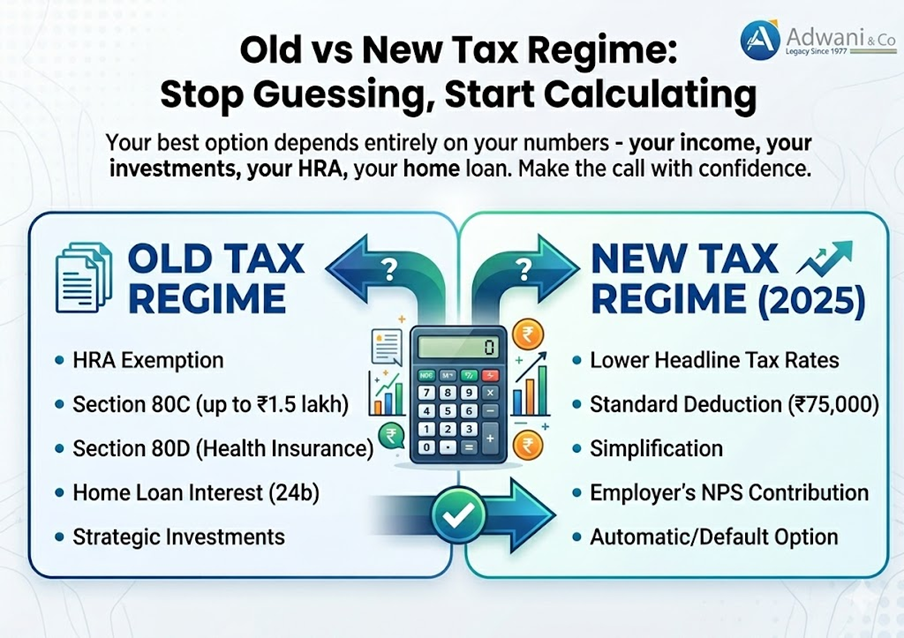
    With the rollout of the Income Tax Act, 2025, this choice has never carried more financial weight. The new regime offers lower headline tax rates, while the old regime rewards those who invest strategically and claim deductions. Neither is universally “better.” Your best option depends entirely on your numbers your income, your investments, your HRA, your home loan. This guide gives you everything you need to make that call with confidence.


    What is the Old vs New Tax Regime?

    India currently operates two parallel personal income tax systems, and every taxpayer must elect one at the time of filing or, in the case of salaried employees, communicate their preference to their employer at the start of the financial year.

    According to the Income Tax Department of India, the old tax regime allows taxpayers to claim a wide range of deductions and exemptions HRA, standard deduction, LTA, Section 80C (up to ₹1.5 lakh), 80D for health insurance, home loan interest under Section 24(b), and much more. These deductions directly reduce your taxable income, which means the effective tax you pay can be significantly lower than the published slab rates suggest.

    The new tax regime, significantly restructured in Budget 2023 and further refined under the Income Tax Act, 2025, offers lower slab rates but eliminates most deductions. The government has made it the default option meaning if you do nothing, you are automatically placed in the new regime. The new regime is designed to simplify compliance and is especially attractive for those who do not have significant deductions.

    Income SlabOld Regime RateNew Regime Rate (2025)
    Up to ₹3,00,000NilNil
    ₹3,00,001 – ₹7,00,0005%5%
    ₹7,00,001 – ₹10,00,00020%10%
    ₹10,00,001 – ₹12,00,00030%15%
    ₹12,00,001 – ₹15,00,00030%20%
    Above ₹15,00,00030%30%

    On the surface, the new regime looks attractive. But tax slabs alone don’t tell the full story. Your effective tax rate what you actually pay after deductions can be dramatically different.


    Key Deductions: What You Give Up in the New Tax Regime

    Understanding the old vs new tax regime comparison is impossible without understanding what deductions the new regime removes. Here is what salaried taxpayers commonly lose access to when they opt for the new regime:

    • HRA (House Rent Allowance): One of the most powerful deductions for metro and urban workers. Not available in the new regime.
    • Section 80C (₹1.5 lakh limit): Covers PPF, ELSS, LIC premiums, EPF, home loan principal repayment, and more. Not available in the new regime.
    • Section 80D: Deduction for health insurance premiums for self and family. Not available in the new regime.
    • Home loan interest (Section 24b): Up to ₹2 lakh deduction on interest for self-occupied property. Not available in the new regime.
    • LTA (Leave Travel Allowance): Not available in the new regime.

    What is available in the new regime? 

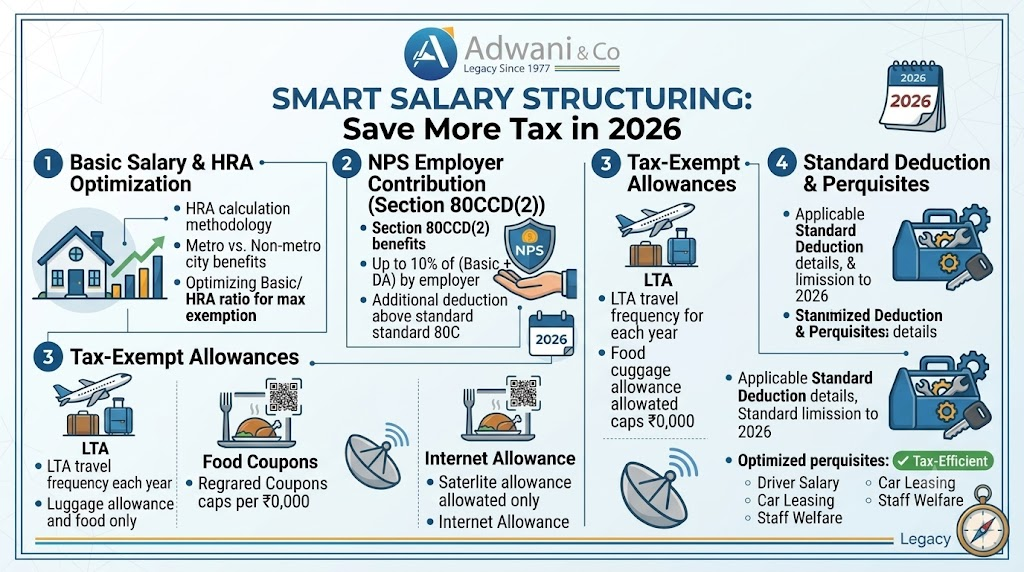
    The standard deduction of ₹75,000 for salaried individuals (revised in 2024) and the employer’s NPS contribution (up to 14% of basic salary under Section 80CCD (2) remain eligible in the new regime. These are important benefits often overlooked by taxpayers.


    Old vs New Tax Regime: A Real-World Numerical Example

    Practical Example

    Case: Ravi, Salaried Employee Gross Income ₹15,00,000

    Ravi earns ₹15 lakh per year. He pays rent in Mumbai, has an active PPF and ELSS investment, and pays health insurance premiums for his family. Here is how the two regimes compare for him:

    ItemOld RegimeNew Regime
    Gross Income₹15,00,000₹15,00,000
    Standard Deduction−₹50,000−₹75,000
    HRA Exemption−₹1,80,000Not Applicable
    Section 80C−₹1,50,000Not Applicable
    Section 80D−₹25,000Not Applicable
    Home Loan Interest (24b)−₹1,00,000Not Applicable
    Net Taxable Income₹9,95,000₹14,25,000
    Approximate Tax (incl. cess)~₹1,34,000~₹1,85,000

    In this scenario, Ravi saves approximately ₹51,000 more by choosing the old regime. Tax savings are illustrative and will vary with actual figures.

    This is the math most taxpayers never do. As Dr. Haresh Adwani, founder of Adwani and Company, consistently points out during consultations: “The regime that looks cheaper at the slab level often turns out to be more expensive at the effective tax level once you factor in the deductions a disciplined investor claims.

    Also Read:


    Which Regime is Better at Different Income Levels?

    The old vs new tax regime debate does not have a universal answer. But there are useful income-based patterns that emerge from detailed tax calculations:

    Income up to ₹12.75 lakh: The new regime, combined with the standard deduction of ₹75,000 and a tax rebate under Section 87A (up to ₹60,000 in the new regime for FY 2025-26), can result in zero tax liability. This makes the new regime extremely compelling for this income band especially if the taxpayer does not have significant deductions.

    Income around ₹15 lakh: This is the battleground. If you have HRA, 80C investments, and a home loan the old regime almost certainly wins. If you have minimal deductions, the new regime may be marginally better or comparable.

    Income above ₹20 lakh: The lower slab rates in the new regime start to overpower the benefit of deductions for many taxpayers, especially those without a home loan. The new regime often gains the advantage here but this must be calculated individually.


    Critical Mistakes to Avoid When Choosing Your Tax Regime

    Mistake 1: Not informing your employer on time

    If you are a salaried employee and you wish to opt for the old regime, you must inform your employer before the start of the financial year (typically before April 1). Failing to do so means your employer will deduct TDS under the new regime by default. This can result in lower in-hand salary throughout the year and an unexpected tax liability or a refund headache at the time of filing. As the Income Tax Department guidance clearly outlines, the responsibility of intimating regime choice lies with the employee.

    Mistake 2: Comparing regimes based on slabs alone

    A large number of taxpayers make regime decisions based on rate comparisons without plugging in their actual deductions. Running both scenarios through an income tax calculator or better, consulting a CA takes minutes and can save tens of thousands of rupees annually. Dr. Haresh Adwani, with his expertise spanning commerce, law, and taxation, emphasizes that personalised tax planning not generalized assumptions is what protects your income.

    Mistake 3: Business income taxpayers assuming unlimited regime switches

    Unlike salaried individuals who can switch regimes every year, taxpayers with business or professional income (who file under ITR-3 or ITR-4) can switch from the new regime to the old regime only once. After that, if they switch back to the new regime, they cannot return to the old regime again. This rule, as outlined in Section 115BAC of the Income Tax Act, is frequently misunderstood and can result in irreversible decisions.

    Mistake 4: Ignoring NPS employer contribution in the new regime

    Section 80CCD (2) allows a deduction for the employer’s contribution to the National Pension System up to 14% of basic salary in the new regime (10% in the old regime for private sector employees). Many employees miss negotiating this benefit with their employer. It is one of the most valuable, legitimate tax tools available in the new regime, and Adwani and Company frequently helps clients restructure their CTC to maximise this benefit.

    Old vs New Tax Regime for Business Owners and Freelancers

    Self-employed individuals, freelancers, and business owners face a different landscape than salaried employees. The ability to claim business expenses, depreciation, and set off losses makes the old regime more nuanced for this group. However, the presumptive taxation scheme under Section 44AD (for businesses up to ₹3 crore turnover) and 44ADA (for professionals) is compatible with the new regime offering simplicity without the burden of maintaining detailed books purely for deduction purposes.

    The GST Portal and MCA (Ministry of Corporate Affairs) registrations don’t directly impact your income tax regime choice but your business structure (proprietorship vs LLP vs private limited) significantly affects how income is taxed. For incorporated entities, regime choice applies to individual promoters on their personal income, not to the company’s corporate terms


    How to Calculate and Decide: A Practical Framework

    A simple five-step process for every taxpayer before the financial year begins:

    1. List your expected gross income for the year salary, rent, capital gains, business income.
    2. List all deductions you will legitimately claim HRA, 80C, 80D, home loan interest, NPS.
    3. Calculate your net taxable income under both regimes use the Income Tax Department’s online calculator or a CA-prepared spreadsheet.
    4. Apply the applicable slab rates to each and compute the final tax including surcharge and 4% cess.
    5. Choose the lower outcome and communicate it to your employer or record it in your ITR before the deadline.

    This process takes less than 30 minutes with a professional’s guidance, yet it directly determines how much of your hard-earned income stays in your pocket.


    Authority Reference: 

    The Income Tax Department’s official tax calculator at the incometax.gov.in portal allows taxpayers to compare their liability under both regimes using actual income and deduction inputs. It is updated for each assessment year and is the most reliable starting point for the comparison.


    Conclusion: Stop Following Others, Start Calculating

    The old vs new tax regime debate is not a matter of opinion it is a matter of arithmetic. And yet, year after year, taxpayers choose their regime the same way they pick a restaurant: by seeing what their colleagues are having.

    Your tax planning is personal. Your income is unique. Your deductions are different from your neighbour’s. The regime that saves your colleague ₹40,000 might cost you ₹60,000 and vice versa. The Income Tax Act, 2025 has given taxpayers more structure and clarity, but the decision still requires you to sit down with actual numbers and make a deliberate, informed choice.

    As Dr. Haresh Adwani has guided hundreds of clients over the years: “Tax saving is not about which regime old vs new looks better in a presentation. It is about which regime performs better with your specific income, your specific investments, and your specific life situation.”

    Don’t leave money on the table. Don’t wait until March. Start now, calculate both old vs new regimes, and make the right decision for your financial future.

    1. Which is better old vs new tax regime in 2025?

    There is no universally better regime. The old regime benefits those with significant deductions like HRA, 80C, and home loans. The new regime works better for those with minimal investments or income up to ₹12.75 lakh. Always calculate both before choosing.

    2. Can I switch between old vs new tax regime every year?

    Salaried individuals can switch regimes every financial year. However, taxpayers with business or professional income can switch from new to old only once; after reverting to new, they cannot switch back to old.

    3. Is HRA exempt in the new tax regime?

    No. House Rent Allowance (HRA) exemption is not available under the new tax regime. This is one of the most significant reasons why the old regime may be better for salaried employees living on rent in cities.

    4. What deductions are available in the new tax regime?

    The new regime allows the standard deduction of ₹75,000 (for salaried employees), employer’s NPS contribution under Section 80CCD(2), and a few other limited exemptions. Most major deductions (80C, 80D, HRA, 24b) are not available.

    5. Is income up to ₹12 lakh tax-free in the new regime?

    Under the new tax regime for FY 2025–26, taxpayers with income up to ₹12 lakh (and ₹12.75 lakh for salaried individuals after the ₹75,000 standard deduction) may have zero tax liability due to the revised Section 87A rebate. Consult a CA to confirm your specific eligibility.

    6. What happens if I don’t inform my employer about my regime choice?

    If you don’t inform your employer, TDS will be deducted under the new regime (the default). This could result in excess TDS (requiring refund) or insufficient TDS (resulting in a year-end demand) depending on which regime would have been optimal for you.

    7. Should I consult a CA for regime selection?

    Yes especially if your income exceeds ₹10 lakh, if you have business income, if you have a home loan or rental income, or if you are self-employed. A qualified CA like those at Adwani and Company can run a precise comparison and help you structure your income tax planning for maximum savings.

    About the Author

    CA Dipesh Gurubakshani is a Chartered Accountant with Adwani & Co LLP, Pune, specialising in income tax audit, direct taxation, and accounting advisory. He supports clients across statutory compliance, financial reporting, and income tax matters with a focus on accuracy, regulatory adherence, and disciplined execution.

  • Form 26A and TDS Default: Relief Under Section 201 and Its Limits

    Form 26A and TDS Default: Relief Under Section 201 and Its Limits

    A client called me last year with a familiar problem. His business had made professional payments across two financial years without deducting TDS. Nobody had caught it at the time. The issue only surfaced during his tax audit and by then, interest had already been building for months.

    His first question was simple: “Can Form 26A fix this?”

    The honest answer is: partly. Form 26A is a genuine and meaningful relief mechanism. But it does not resolve everything, and businesses that assume it does often find themselves with an unexpected interest burden.

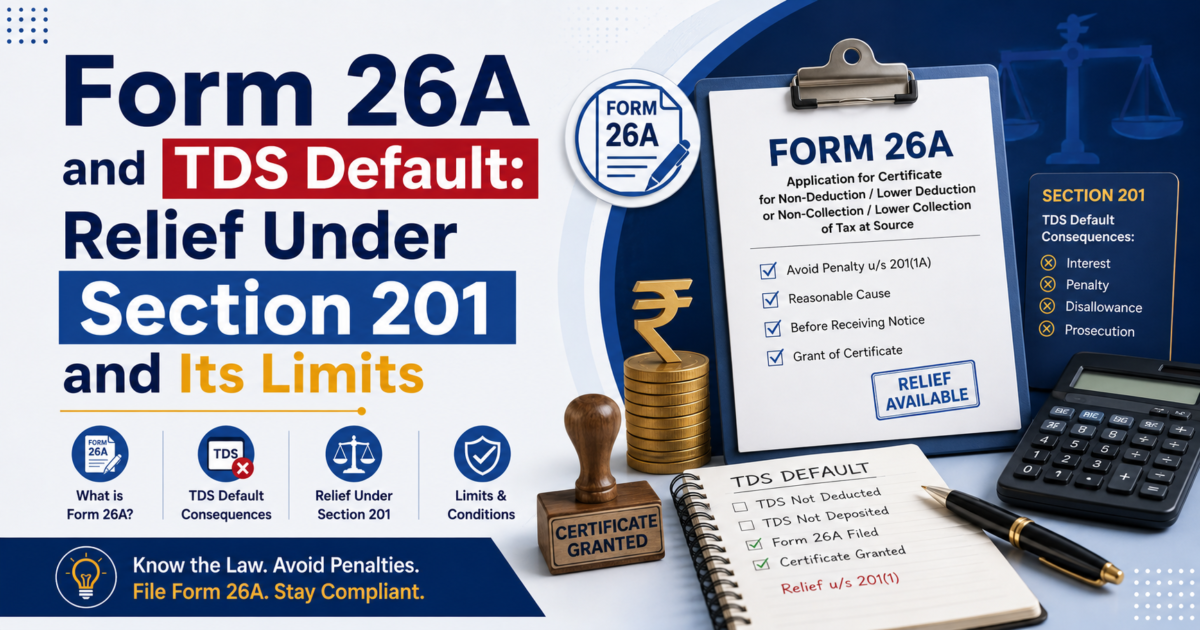
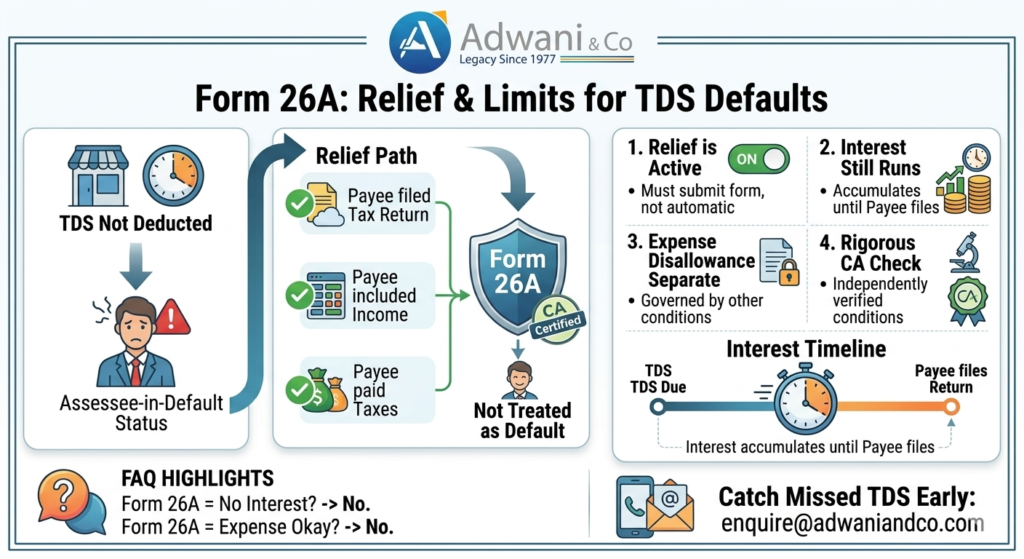
    Form 26A helps a payer avoid being treated as an assesse in default under Section 201 if the payee has filed their return, included the income, and paid taxes. However, it does not eliminate interest under Section 201(1A) or guarantee expense allowability under Section 40(a)(ia).

    Here is what Form 26A actually does and where it stops.

    What Is Form 26A and What Does It Do in a TDS Default Situation?

    When a payer fails to deduct TDS on a payment, the Income Tax Department typically treats that payer as an assessee-in-default under Section 201(1). This is not a minor label. It carries real consequences: disallowance of the expense under Section 40(a)(ia), interest liability under Section 201(1A), and a formal default on your record.

    The proviso to Section 201(1) offers a conditional path out. A payer will not be treated as an assessee-in-default despite failing to deduct TDS if all three of the following conditions are met on the payee’s side:

    1. The payee (a resident) has filed their return of income under Section 139.
    2. The payee has included this specific income in that return.
    3. The payee has paid the tax due on this income.

    If all three are satisfied, a Chartered Accountant certifies these facts in Form 26A. Once submitted, the payer escapes the assessee-in-default classification under Section 201(1).

    That is meaningful relief. But many businesses stop reading here and that is precisely where the problem starts.

    In a typical Form 26A TDS default case, understanding these limitations is critical to avoid further tax exposure.


    Also read:

    https://www.adwaniandco.com/blog/paid-your-taxes-honestly-still-got-an-income-tax-notice-2026-guide

    Limitations of Form 26A in TDS Default Cases

    Understanding the limits of Form 26A is just as important as knowing what it provides. Here are the four key boundaries businesses and their advisors must be aware of.

    Limit 1 Relief Is Not Automatic

    Form 26A must be formally obtained and submitted. Simply knowing you may be eligible does not protect you. The default remains on record until the form is actually furnished through the proper procedure. Acting on it early matters.

    Limit 2 Interest Under Section 201(1A) Still Applies

    New subsection to be inserted within the existing “Interest Liability Under Section 201(1A)” section.


    What the Interest Actually Costs

    Understanding that interest applies is one thing. Knowing the rate is what makes the risk real.

    Section 201(1A) prescribes two distinct rates depending on the nature of the default:

    • Failure to deduct TDS at all: Interest at 1% per month (or part of a month) on the amount of tax that should have been deducted, running from the date TDS was required to be deducted to the date the payee files their return of income.
    • TDS deducted but not remitted to the government: Interest at 1.5% per month (or part of a month) on the amount deducted, running from the date of deduction to the date of actual payment.

    Both rates may appear modest in isolation, but they compound against time and against the full tax amount not just the delayed portion. In a case where TDS was required in, say, April of a financial year and the payee only files their return fourteen months later in June of the following year, the interest calculation covers that entire period. At 1% per month, that is already a 14% charge on the TDS amount, before any penalties are considered.

    The interest under Section 201(1A) is treated by law as a compensatory charge not a penalty  for the period during which the government was denied timely access to the tax. This characterisation was affirmed by the Supreme Court in Hindustan Coca-Cola Beverages Pvt. Ltd. v. CIT (2007) 293 ITR 226 (SC), where the Court made clear that even where the payee has paid the underlying tax and the payer is not treated as an assessee-in-default, the compensatory interest still runs its course. It does not disappear simply because the substantive default has been regularised through Form 26A.

    For businesses reviewing their books after a TDS audit finding, this calculation is usually the first number their CA should work out because it tells you exactly what is at stake before you even begin the Form 26A process.

    Limit 3 Disallowance Under Section 40(a)(ia) Is a Separate Question

    Form 26A only addresses Section 201(1). Whether your expense is actually allowed as a deduction is governed by Section 40(a)(ia), which has its own conditions and its own logic.

    Here is how Section 40(a)(ia) operates. When a payer fails to deduct TDS on payments such as professional fees, contract payments, rent, commission, interest, or royalties made to a resident, the law restricts the deduction of that expense in the year of default. The current restriction  reduced from 100% to 30% by the Finance Act 2014, effective from Assessment Year 2015-16  means that 30% of the gross payment can be disallowed and added back to taxable income. For a business making substantial payments without TDS, this can translate into a meaningful increase in tax liability, not just a compliance note.

    The critical link between Form 26A and Section 40(a)(ia) lies in the second proviso to that section, read with the first proviso to Section 201(1). If Form 26A conditions are satisfied payee has filed a return, included the income, and paid taxes  then the payer is deemed to have deducted and paid the TDS on the date the payee filed their return of income. As a result, the disallowance under Section 40(a)(ia) does not apply for that year.

    But this only works if Form 26A is filed. If the form is not furnished  even where the payee has genuinely paid taxes  the payer cannot claim this relief automatically. The deemed-payment fiction under the second proviso is triggered only by the act of furnishing the form through the prescribed process.

    Two situations where the expense remains at risk despite a payee having paid taxes:

    • Form 26A is not filed before the assessment is concluded. Courts and the CBDT have consistently taken the position that Form 26A must be furnished before the assessment proceedings are finalised. Filing it after an assessment order is passed may not provide retrospective protection.
    • The payee is a non-resident. Section 40(a)(ia) covers payments to residents. For payments to non-residents, the relevant provision is Section 40(a)(i), and neither Form 26A nor the proviso to Section 201(1) applies in the same way. (This is addressed separately below under the non-resident limitation.)

    The practical takeaway: Form 26A and expense allowability under Section 40(a)(ia) are related but distinct outcomes. Getting the form in place, accurately and on time, is what connects the payee’s compliance to the payer’s tax relief. Without it, the payee having paid taxes is a fact  but one that the payer cannot use in their own assessment.

    Limit 4 The CA Certification Must Be Rigorous

    The Chartered Accountant issuing Form 26A must independently verify all three payee conditions: that the return was filed, that this income was included, and that tax was paid. If this verification is done carelessly or without proper documentary checks, the certification itself can be challenged creating fresh risk rather than resolving the existing one.

    Limit 5 Form 26A Does Not Apply to Non-Resident Payees

    The proviso to Section 201(1) which enables Form 26A relief applies only where the payee is a resident of India. The statute is explicit on this point. If a business makes a payment to a non-resident whether a foreign company, NRI, or overseas service provider without deducting TDS under the applicable section (most commonly Section 195), Form 26A cannot be used to seek relief.

    For non resident payments, the TDS obligation has a different character altogether. The government’s collection mechanism for non-resident income depends substantially on withholding at source because once funds leave India, enforcement becomes significantly more complex. Courts have reinforced this view. In matters involving payments to non-residents without deduction under Section 195, tribunals have consistently declined to extend the Form 26A protection, even where the non-resident has filed a return and paid taxes in India.

    Businesses operating in cross-border vendor relationships, making royalty or technical service payments overseas, or buying immovable property from NRIs need to be aware that this relief simply does not extend to their situation. The exposure under Section 201(1) in a non-resident default remains unresolved by Form 26A, and the path to remediation if one exists lies in different provisions, including DTAA applicability, lower deduction certificates under Section 197, or representations to the Assessing Officer under Section 195(2) and (3).

    If your business makes both resident and non-resident payments, a compliance review should treat these as two distinct categories with different risk profiles and different available remedies.

    Form 26A and TDS Default: Relief Under Section 201
    Form 26A and TDS Default: Relief Under Section 201

    Interest Liability Under Section 201(1A) in TDS Default Cases

    Many businesses assume that once Form 26A is obtained, the TDS default is fully resolved. That assumption is incorrect, and the consequences of getting this wrong can be significant.

    Interest under Section 201(1A) is not a penalty. It is treated by law as a compensatory charge for the period during which the government was deprived of timely tax collection. The interest runs from the date on which TDS was required to be deducted to the date on which the payee actually files their return of income. This is the case even if the payee has correctly disclosed the income and paid all taxes.

    In practice, there is almost always a time gap. A payment may be made during the financial year, but the payee’s return is typically filed months later sometimes beyond the due date. During this entire period, interest accrues without interruption.

    The real problem arises because TDS defaults are rarely identified immediately. In most cases including my client’s situation the issue surfaces during a statutory audit, tax audit, or income tax scrutiny. By that point, a substantial period has already passed. What started as a minor compliance lapse has become meaningful financial exposure, purely because of time.

    The practical advice here is straightforward: act early. If you suspect a TDS default may exist in your books, get a structured compliance review done before it surfaces in a scrutiny notice. The earlier the detection, the lower the interest exposure.


    Judicial and CBDT Context: Why the Law Landed Here:

    The Form 26A mechanism did not emerge from a vacuum. It was the legislature’s codification of a principle that courts had already been applying — that once the government has received its tax from the payee, the payer should not be subjected to double jeopardy merely for the failure to withhold it.

    The Supreme Court in Hindustan Coca-Cola Beverages Pvt. Ltd. v. CIT (2007) 293 ITR 226 (SC) laid the conceptual groundwork. The Court held that if the payee has paid tax on the income received, treating the payer as an assessee-in-default for failure to deduct results in the government recovering the same tax twice. CBDT Circular No. 275/201/95-IT(B) dated 29th January 1997 had already taken a similar position administratively. The Finance Act 2012 formalised this logic by inserting the first proviso to Section 201(1) and, through Notification No. 37/2012, prescribing Rule 31ACB and Form 26A.

    What the Supreme Court also made clear — and what CBDT Circular No. 11/2017 subsequently addressed — is that interest under Section 201(1A) occupies a different space. The Court characterised it as compensatory rather than penal: it is the price the payer pays for having denied the government access to the withheld amount during the intervening period. This distinction matters because it means the interest survives even the most complete Form 26A filing. Courts do not treat the two — assessee-in-default status and interest liability — as a single outcome that Form 26A resolves together.

    CBDT Circular No. 11/2017 also introduced a narrow relief for interest waiver in specific cases of TDS default under Section 201(1A)(i) for example, where a deductor acted on a jurisdictional High Court order that was subsequently reversed, or in cases involving non-residents where the DTAA was misapplied in good faith. These waivers require an application to the concerned CCIT or DGIT and are granted in exceptional circumstances, not as a matter of routine. Businesses in genuinely ambiguous positions may want to explore whether their facts qualify under these guidelines —but should not assume the waiver as a given.

    The overall judicial trajectory is consistent: courts protect bona fide payers from double taxation but do not relieve them of the time-value cost of delayed withholding. Form 26A gives you the former. It cannot give you the latter.


    How Form 26A Is Filed: The TRACES Process in Practice

    The blog so far has focused on what Form 26A does and where it stops. But a business that has identified a TDS default and wants to act on it has one immediate practical question: how does this actually get done?

    Form 26A is filed electronically through the TRACES portal (tdscpc.gov.in), the government’s TDS reconciliation and correction platform. The process is dual-step, involving both the deductor and the Chartered Accountant separately.

    Step 1 : The Deductor Initiates the Request

    The deductor logs into TRACES and raises a request for Form 26A based on the PAN of the payee for whom relief is being sought. The system auto-populates transactions from the deductor’s filed TDS returns where non-deduction or short-deduction is reflected. The deductor identifies the specific transactions, generates the annexure in the prescribed format, and submits it digitally either using a Digital Signature Certificate (DSC) or through Electronic Verification Code (EVC). The form then moves to a status of “Sent to E-Filing.”

    Step 2 : The Chartered Accountant Certifies

    The assigned CA receives the request in their Income Tax e-Filing portal login under Worklist → For Your Action. Before certifying, the CA must independently verify the three conditions that the law requires: that the payee has filed their return under Section 139, that the specific income paid by the deductor is included in that return, and that the tax due on the declared income has been paid. This verification must be based on actual examination of the payee’s return, acknowledgement, Form 26AS, and tax payment records — not merely on representations made by the payee or the deductor.

    The CA fills in the payee’s return filing details — date of filing, acknowledgement number, ITR form type, declared income, tax payable, and tax paid — and submits the certificate in the prescribed Annexure A format, using their own DSC.

    Step 3 : The Deductor Finalises Submission

    Once the CA submits, the deductor logs back into the e-Filing portal and submits Form 26A using DSC or EVC. TRACES then processes the form and recalculates the TDS default position. If accepted, the deductor’s status changes from assessee-in-default to relieved, and TRACES recomputes the interest under Section 201(1A) for the applicable period.


    What the CA Must Actually Verify

    Rule 31ACB of the Income Tax Rules, 1962, which prescribes Form 26A, requires that the CA examine the relevant accounts, documents, and records of the payee — not merely accept verbal confirmation. In practice, this means obtaining and retaining copies of:

    • The payee’s ITR acknowledgement for the relevant assessment year
    • The payee’s tax computation showing the disputed income was included
    • Evidence of tax payment (Challan / Form 26AS / AIS)
    • The deductor’s TDS return showing the transaction in question

    A certification that is done without this documentation is not merely careless it is professionally exposed, and could be challenged during assessment, converting a resolved matter into an active dispute.


    Conclusion .

    Form 26A is useful in a TDS default scenario, but it is not a complete solution.

    Form 26A is a useful and legally sound mechanism. When used correctly, with proper CA verification, it provides genuine protection against the assessee-in-default label under Section 201(1).

    But it is not a complete fix. Interest under Section 201(1A) still runs. Expense disallowance under Section 40(a)(ia) is a separate question. And the certification itself carries responsibility it must be done with proper documentary verification, not as a formality.

    If your business has missed TDS deductions or if you are not entirely sure whether you have a structured compliance review before scrutiny is always the better path. Catching the issue early limits the damage; discovering it during a notice limits your options.

    Frequently Asked Questions

    1. What is Form 26A in TDS?

    Form 26A is a certificate issued by a Chartered Accountant confirming that the payee has included the relevant income in their return of income and paid the applicable taxes. When furnished properly, it allows the payer to claim relief from being treated as an assessee-in-default under Section 201(1) of the Income Tax Act. (Learn more about TDS defaults and compliance https://www.adwaniandco.com/services

    2. Does Form 26A completely remove TDS liability?

    No. Form 26A only removes the assessee-in-default classification under Section 201(1), subject to all three payee conditions being met. Interest liability under Section 201(1A) still applies, and the question of expense disallowance under Section 40(a)(ia) is an entirely separate matter.

    3. Is interest payable even after filing Form 26A?

    Yes. Interest under Section 201(1A) continues to apply and is calculated from the date TDS was originally required to be deducted to the date the payee files their return of income. Form 26A does not eliminate this interest.

    4. When should Form 26A be filed?

    Form 26A should be filed once it is confirmed that the payee has filed their return of income, included the relevant income in that return, and paid the tax due. The sooner this is done after a default is identified, the better as delay increases interest exposure.

    5. What happens if Form 26A is not filed?

    Without Form 26A, the payer remains classified as an assessee-in-default under Section 201(1). This can result in a tax demand, interest under Section 201(1A), and potential disallowance of the expense under Section 40(a)(ia). The default also stays on formal record, which can complicate future assessments.