Tag: Tax Planning India

  • FATCA CRS Foreign Assets Disclosure: 7 Critical Things Every Doctor Must Know

    FATCA CRS Foreign Assets Disclosure: 7 Critical Things Every Doctor Must Know

    FATCA CRS Foreign Assets Disclosure
    FATCA CRS Foreign Assets Disclosure

    A Doctor. A Foreign Account. A Notice That Changed Everything.

    A Doctor. A Foreign Account. A Notice That Changed Everything.

    A doctor maintained a foreign savings account for years. It was opened during his fellowship abroad, kept active for convenience — occasional deposits, minor interest income, nothing extravagant. He never declared it in his Income Tax Return because, frankly, he did not think it mattered.

    Then a notice arrived from the Income Tax Department.

    The department already knew about the account. The balance. The interest earned. The transactions. All of it.

    How? Through the silent, relentless data-sharing machinery of FATCA CRS foreign assets disclosure frameworks that have fundamentally changed how foreign asset reporting works across 120+ countries.

    This is not a hypothetical story. Dr. Haresh Adwani, Partner of Adwani and Company, has personally guided numerous doctors and professionals through exactly this situation. And the pattern is almost always the same: a well-meaning professional, an undisclosed foreign account, and a notice that triggers panic.

    As Dr. Haresh Adwani puts it: “I personally know doctors who had no idea their foreign savings accounts were visible to the Indian tax department. They maintained them for years without declaration. And then the notices came.”

    This blog is your comprehensive guide to understanding FATCA CRS foreign assets disclosure, why it matters especially for doctors, and how to ensure you are fully compliant before the department comes knocking.

    What Is FATCA CRS Foreign Assets Disclosure?

    FATCA CRS Foreign Assets Disclosure: The FATCA Framework Explained

    FATCA was originally enacted by the United States in 2010 to combat tax evasion by US persons holding accounts abroad. However, its impact has been global. Under FATCA, foreign financial institutions (FFIs) worldwide are required to report information about accounts held by tax residents of partner countries including India.

    India signed an Inter-Governmental Agreement (IGA) with the US on 9 July 2015, with the implementing Rules (114F to 114H) notified on 7 August 2015 and the agreement coming into force on 31 August 2015, making Indian financial institutions subject to FATCA reporting requirements from that date. But more importantly for Indian taxpayers, this agreement also works in reverse — foreign financial institutions report Indian residents’ account information to the Indian tax authorities.

    CRS: The Common Reporting Standard

    While FATCA is US-centric, the Common Reporting Standard (CRS) is a global framework developed by the Organisation for Economic Co-operation and Development (OECD). Under CRS:

    • Over 120 jurisdictions have committed to automatically exchanging financial account information
    • Financial institutions identify accounts held by foreign tax residents
    • Account information is reported to the local tax authority, which then shares it with the account holder’s home country

    India adopted CRS in 2017 under Rule 114F to 114H of the Income Tax Rules.

    What Information Gets Exchanged Under FATCA CRS Foreign Assets Disclosure?

    The scope of information sharing is comprehensive:

    • Account holder identity: Name, address, tax identification number (PAN)
    • Account balance: Year-end balance or value
    • Interest income: Gross interest credited during the year
    • Dividend income: Dividends received during the year
    • Sales proceeds: Gross proceeds from sale of financial assets
    • Other income: Any other income credited to the account

    This means the Income Tax Department potentially has access to your foreign account details before you even file your return. This is the reality of modern FATCA CRS foreign assets disclosure — and ignoring it is no longer an option.

    Also Read:

    https://www.adwaniandco.com/blog/role-of-hr-in-a-ca-firm

    Why Doctors Are Particularly Vulnerable to FATCA CRS Foreign Assets Disclosure Issues

    The Medical Professional’s Global Footprint

    Doctors, more than almost any other professional group, have legitimate reasons for maintaining foreign financial connections:

    • Medical fellowships abroad: Many Indian doctors spend 2–5 years training in the US, UK, Australia, or other countries, opening bank accounts during their stay. These accounts often remain open long after they return to India.
    • Conference travel and honorariums: International medical conferences sometimes pay honorariums or reimbursements into foreign accounts.
    • Investments made during overseas training: Some doctors invest in mutual funds, retirement accounts (like 401(k) in the US or pension funds in the UK), or even property during their time abroad.
    • NRI to Resident status transition: Doctors who return to India after extended overseas practice often retain NRE/NRO accounts or foreign accounts that need different tax treatment once residential status changes.
    • Collaborative research funding: International research grants may be channeled through foreign institutional accounts where the doctor has beneficial ownership.
    • Inheritance: Some doctors inherit foreign assets from family members settled abroad.

    The problem is not having these accounts or assets. The problem is not disclosing them in the Indian ITR which triggers FATCA CRS foreign assets disclosure compliance failures.

    The Common Misconception About FATCA CRS Foreign Assets Disclosure

    Most doctors Dr. Haresh Adwani encounters share a common misconception: “The account is dormant / the balance is small / I do not use it anymore so it does not need to be declared.”

    This is incorrect.

    Under Indian tax law, every foreign asset must be disclosed in Schedule FA of your ITR, regardless of:

    • Whether the account is active or dormant
    • The balance amount (even zero-balance accounts with potential opening during the year)
    • Whether any income was earned
    • Whether the income was received in India or abroad

    Schedule FA: The Mandatory Foreign Assets Declaration

    What Is Schedule FA?

    Schedule FA (Foreign Assets and Foreign Income) is a section in the Indian Income Tax Return where taxpayers must declare all foreign assets and income. It applies to individuals who are Resident and Ordinarily Resident (ROR) in India.

    What Must Be Disclosed in Schedule FA?

    The disclosure requirements are extensive:

    • Foreign bank accounts: Every account, including dormant ones, with details of the bank name, country, account number, peak balance during the year, and closing balance
    • Foreign financial accounts: Investment accounts, custodial accounts, insurance products with cash value
    • Foreign immovable property: Property owned abroad, with purchase details, country, total investment, and income derived
    • Foreign equity or debt interest: Shares, debentures, or any other interest in a foreign entity, with name of entity, country, nature of interest, and total investment
    • Foreign trusts: Beneficial interest as trustee, beneficiary, or settler in any foreign trust
    • Any other foreign asset: Any other capital asset held outside India
    • Foreign income: All sources including salary, interest, dividends, rental income, and capital gains

    5 Key Points Most Doctors Miss About FATCA CRS Foreign Assets Disclosure

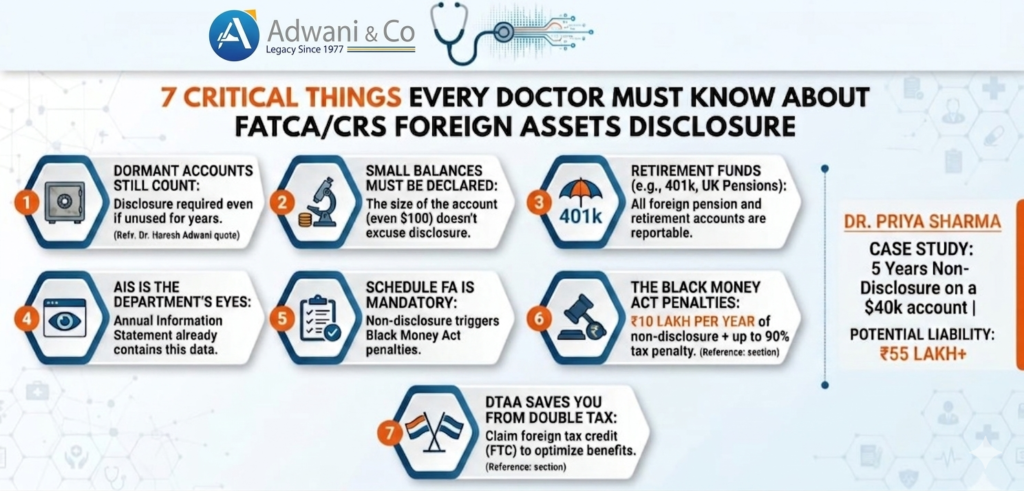
    1. Dormant accounts count. Even if you have not used the account in years, if it exists and has a balance (even $100), it must be declared.
    2. Retirement accounts abroad count. Your US 401(k) or UK pension fund needs to be disclosed in Schedule FA.
    3. Income received in India from foreign sources counts. If a foreign entity pays you a consulting fee and deposits it in your Indian bank account, it is still foreign income that needs proper classification.
    4. Jointly held accounts count. If you are a joint holder on a family member’s foreign account, your interest may need to be disclosed.
    5. Signing authority matters. Even if you do not own the account but have signing authority on it, disclosure obligations may apply.

    The Black Money Act: Severe Consequences for Non-Compliance

    What Is the Black Money Act?

    The Black Money (Undisclosed Foreign Income and Assets) and Imposition of Tax Act, 2015 commonly called the Black Money Act was specifically enacted to deal with undisclosed foreign assets and income. It is one of the most stringent tax laws in India.

    Penalties Under the Black Money Act

    • Undisclosed foreign income: Tax at 30% flat rate (no slab benefit) + penalty of 90% of the tax amount (effective rate: approximately 120% of the undisclosed income)
    • Failure to disclose foreign assets in Schedule FA: Penalty of ₹10 lakh per assessment year of non-disclosure
    • Willful attempt to evade tax on foreign income: Rigorous imprisonment of 3–10 years + fine

    These penalties are in addition to regular income tax liability. And unlike regular tax proceedings, the Black Money Act penalties are not easily negotiable or reducible.

    A Real-World Example of FATCA CRS Foreign Assets Disclosure Penalties

    Dr. Priya Sharma (name changed for privacy) maintained a bank account in the United States with an average balance of $40,000 (approximately ₹33 lakh). The account earned interest of $800 per year. She never disclosed the account or the interest income in her ITR for 5 years.g FATCA CRS foreign assets disclosure is not just important it is financially critical.

    When the information reached the Indian tax department through FATCA:

    Liability HeadAmount
    Penalty for non-disclosure of foreign asset₹10 lakh × 5 years = ₹50 lakh
    Tax on undisclosed interest income30% of total interest over 5 years
    Additional penaltyUp to 90% of the tax amount
    Total potential liability₹55 lakh+

    This is precisely why understanding FATCA CRS foreign assets disclosure is not just important it is financially critical.

    How the Income Tax Department Uses FATCA CRS Data

    The FATCA CRS Foreign Assets Disclosure Data Pipeline

    Here is how the information flows:

    1. Foreign financial institution identifies an account held by an Indian tax resident
    2. Foreign tax authority collects this data from institutions in its jurisdiction
    3. Data is transmitted to the Indian Income Tax Department through automatic exchange
    4. The department matches this data against the taxpayer’s filed ITR
    5. If there is a mismatch an asset not declared, income not reported a notice is generated

    According to the Income Tax Department, India has been actively receiving and processing FATCA/CRS data since 2017, and the matching algorithms have become increasingly sophisticated.

    The AIS Connection

    Your Annual Information Statement (AIS) now includes foreign asset and income information received through FATCA/CRS. Before filing your ITR, you can check your AIS to see what the department already knows about your foreign financial life.

    Dr. Haresh Adwani strongly recommends this as a first step for all clients with any foreign connections: “Check your AIS before you file. If the department already has the information, there is no point in not disclosing it. Voluntary compliance is always the less painful path.


    The FEMA Angle: Double Jeopardy for Non-Compliance

    It is important to note that FATCA CRS foreign assets disclosure failures do not just create income tax problems. They can also trigger issues under the Foreign Exchange Management Act (FEMA), administered by the Reserve Bank of India.

    If you are a resident Indian holding foreign assets without proper RBI authorization, you may face:

    • Penalties under FEMA for unauthorized holding of foreign assets
    • Compounding proceedings before the RBI
    • Scrutiny of the original source of funds used to acquire the foreign asset

    The Income Tax Department and RBI have information-sharing mechanisms, which means a tax notice can snowball into a FEMA investigation and vice versa.

    This dual regulatory framework makes it even more critical for doctors to ensure full FATCA CRS foreign assets disclosure compliance across both regimes.n assets disclosure compliance across both regimes.


    What Should You Do Right Now?

    Step 1: Audit Your Foreign Financial Footprint

    Make a comprehensive list of every foreign financial relationship you have or have ever had:

    • Bank accounts (active and dormant)
    • Investment accounts
    • Retirement/pension accounts
    • Property ownership
    • Signing authority on any account
    • Beneficial interest in foreign entities

    Step 2: Check Your Past ITRs

    Review your filed returns for the last 5–6 years. Did you fill out Schedule FA? Were all foreign assets disclosed? Was foreign income properly reported?

    If you filed through a CA or tax preparer, ask them specifically whether Schedule FA was completed.

    Step 3: Download Your AIS and TIS

    Your Annual Information Statement (AIS) and Taxpayer Information Summary (TIS) on the Income Tax e-filing portal may already contain information received through FATCA/CRS. Check whether foreign account data appears there.

    Step 4: Consider Voluntary FATCA CRS Foreign Assets Disclosure

    If you discover that your foreign assets were not disclosed in past returns, the voluntary disclosure route is always the less painful path. While penalties may still apply, proactive disclosure demonstrates good faith and can significantly reduce the severity of consequences.

    Dr. Haresh Adwani advises: “Voluntary disclosure, done correctly and timely, is always better than waiting for a notice. The department is far more lenient with taxpayers who come forward than with those who are caught.”

    Step 5: Engage a Specialist

    Foreign asset taxation sits at the intersection of Indian tax law, international treaties, FEMA regulations, and country-specific tax rules. This is not a DIY exercise. Engage a Chartered Accountant with specific experience in international taxation and FATCA/CRS compliance.

    At Adwani and Company, we have a dedicated practice for NRI taxation and foreign asset compliance.

    Key DTAA Benefits You Might Be Missing {#dtaa}

    What Is DTAA?

    India has signed Double Taxation Avoidance Agreements (DTAA) with over 90 countries. These agreements ensure that the same income is not taxed twice — once in the country where it is earned, and again in India.

    How DTAA Applies to FATCA CRS Foreign Assets Disclosure

    If you earn interest on a US bank account, for example:

    • The US may withhold tax at 15% (under the India-US DTAA)
    • You must declare this income in your Indian ITR
    • You can claim tax credit for the US tax paid under Section 90/91
    • Your effective Indian tax on this income is reduced by the foreign tax credit

    Many taxpayers miss this benefit, ending up paying double tax — or worse, not declaring the income at all because they assume tax has already been paid abroad. Proper FATCA CRS foreign assets disclosure includes optimizing your DTAA benefits.


    Real-World Resolution: How Adwani and Company Helps

    The Situation: A surgeon who returned to India in 2018 after a 6-year practice in the UK. He retained a UK bank account with £25,000 and a small pension fund. He filed Indian ITRs since 2018 but never completed Schedule FA. In 2024, he received a notice from the Income Tax Department referencing CRS data.

    Our Approach:

    1. Comprehensive review of all foreign accounts and their history
    2. Reconciliation of foreign income with Indian tax filings for each year
    3. Preparation of revised returns with complete Schedule FA disclosure
    4. Drafting a detailed response to the income tax notice explaining the oversight and demonstrating good faith
    5. Liaison with the Assessing Officer to settle the matter at the assessment stage
    6. FEMA compliance review to ensure RBI requirements were also met

    The Outcome: The matter was resolved with minimal penalties. No prosecution. No extended investigation. The key factor? Proactive, professional, and transparent engagement with the department..

    Conclusion: FATCA CRS Foreign Assets Disclosure Is a Legal Necessity

    The world has changed. Financial borders have dissolved — not for money, but for information. With FATCA and CRS, your foreign accounts are no longer your private secret. They are data points in a global network that connects over 120 countries, and the Indian Income Tax Department is an active participant in this network.

    For doctors and professionals with foreign assets, the message is clear: FATCA CRS foreign assets disclosure is not optional, not a formality, and not something to be deferred. It is a legal obligation with severe consequences for non-compliance.

    But here is the silver lining voluntary compliance, done correctly, is the less painful path. It protects you from penalties, prosecution, and the stress of responding to a notice you were not prepared for.

    As Dr. Haresh Adwani consistently advises: “The department often knows before you file. The question is not whether to disclose it is whether you disclose on your terms or on theirs.”

    If you have foreign assets, accounts, or income that need to be properly disclosed, connect with Adwani and Company today. Our team has deep expertise in international tax compliance, FATCA/CRS reporting, and Black Money Act advisory. We will ensure your disclosures are accurate, complete, and strategically optimized.

    Your expertise saves lives. Let ours protect your financial well-being.

    Do not wait for the notice. Take control of your FATCA CRS foreign assets disclosure compliance today with Adwani and Company.

    “This blog is for informational purposes only and does not constitute legal or tax advice. Please consult a qualified professional for advice specific to your situation.”

    1. What is FATCA CRS foreign assets disclosure?

    refers to the mandatory reporting and declaration of foreign financial accounts and assets under the Foreign Account Tax Compliance Act (FATCA) and Common Reporting Standard (CRS). Indian taxpayers must declare all foreign assets in Schedule FA of their ITR.

    2. Do I need to disclose a dormant foreign bank account in my ITR?

    tax law, every foreign bank account — whether active, dormant, or even zero-balance — must be disclosed in Schedule FA if you are a Resident and Ordinarily Resident (ROR) in India.

    3. What is the penalty for not disclosing foreign assets in India?

    Act, 2015, non-disclosure of foreign assets attracts a penalty of ₹10 lakh per assessment year. Additional penalties of up to 90% of the tax amount and imprisonment of 3–10 years may also apply.

    4. How does the Income Tax Department know about my foreign accounts?

    FATCA and CRS, over 120 countries automatically share financial account information with India. Your foreign bank reports your account details to its local tax authority, which then transmits it to the Indian Income Tax Department

    5. Can I file a revised return to disclose previously undisclosed foreign assets?

    can file a revised or updated return to correct past omissions within the prescribed time limits. Voluntary FATCA CRS foreign assets disclosure is always viewed more favorably than forced disclosure after a notice. Consult Adwani and Company for guidance.

    6. Are foreign retirement accounts like 401(k) reportable in India?

    Yes. Foreign retirement accounts, pension funds, and similar instruments are reportable under Schedule FA. The income treatment may vary based on the specific DTAA provisions between India and the relevant country.

    7. How can Dr. Haresh Adwani help with FATCA CRS foreign assets disclosure?

    Haresh Adwani and the team at Adwani and Company provide end-to-end support for FATCA CRS foreign assets disclosure — from asset mapping and AIS verification to Schedule FA preparation, DTAA benefit optimization, and notice response. Contact us today.

    Author

    Dr. Haresh Adwani PhD (Commerce)  •  Adwani & Company, Pune Dr. Haresh Adwani holds a PhD in Commerce and brings over 20 years of expertise in GST compliance, income tax advisory, FEMA, and corporate law. He is one of Pune’s most trusted Chartered Accountants for GST litigation, demand notice resolution, appeal management, and tax planning for businesses and individuals. Services include GST audit, ITR filing, GST appeal representation, notice response, NRI taxation, and FEMA compliance.
  • Essential Guide to Upskilling in Taxation: 5 Pillars for Smart CA Professionals

    Essential Guide to Upskilling in Taxation: 5 Pillars for Smart CA Professionals

    “In taxation, the professional who stops learning today becomes the professional who gives wrong advice tomorrow.”

    Essential Guide to Upskilling in Taxation: 5 Pillars for Smart CA Professionals
    Essential Guide to Upskilling in Taxation: 5 Pillars for Smart CA Professionals

    Upskilling in taxation is not a one-time checkbox for CA professionals it is a non-negotiable, continuous discipline. If you work in taxation as a Chartered Accountant, tax consultant, HR professional, or finance manager, you already know that GST rates change, Income Tax provisions get amended, and new CBDT circulars arrive on a Monday morning with immediate effect. The professional who relies solely on knowledge from their CA exams or a seminar three years ago is operating with an outdated map in a city that has been rebuilt.

    This is the philosophy at the core of Adwani and Company, one of India’s trusted CA firms, where Dr. Hareh Adwani has championed continuous taxation learning for over a decade. As Dr. Adwani often says: “Knowledge in taxation has an expiry date. Upskilling is how you stay relevant.”

    Why Upskilling in Taxation Is No Longer Optional

    India’s tax landscape is among the most dynamic in the world. Since the landmark GST rollout in 2017, there have been hundreds of notifications, circulars, and amendments. The Income Tax Department regularly revises filing norms, introduces new forms, and updates compliance timelines. The GST Portal itself undergoes technical and regulatory overhauls that directly impact how professionals file returns and respond to notices. Upskilling in taxation bridges the gap between what you once knew and what is currently applicable and in today’s environment, that gap widens faster than ever.

    Also Read:

    https://www.adwaniandco.com/blog/nri-tax-rules-10-critical-questions-before-returning-to-india

    The 5 Pillars of Upskilling in Taxation

    At Adwani and Company, Dr. Hareh Adwani has identified five core areas where upskilling in taxation must be focused and structured not ad hoc or reactive.

    1. Staying current with law changes

    Regular tracking of amendments in GST, Income Tax Act, Customs, and allied tax laws is the foundation of any serious taxation upskilling effort. This means reading CBDT and CBIC notifications as they are issued, understanding their practical impact, and updating internal processes accordingly. The Ministry of Corporate Affairs (MCA) also periodically revises compliance norms, making cross-law awareness essential.

    2. Understanding practical application in taxation upskilling

    Law reading alone is insufficient. A professional truly excels at continuous taxation learning when they can interpret how a new provision translates to real client situations whether it’s a manufacturing firm’s input tax credit reversal or a startup’s TDS obligations on ESOP payouts. Bridging theory and application is where competent upskilling in taxation delivers the most value.

    3. Building analytical and advisory thinking

    The shift from pure compliance to advisory is where upskilling in taxation truly delivers business value. As Dr. Hareh Adwani puts it: “Clients don’t just need someone to file returns they need a trusted advisor who can see around corners.” Analytical thinking, nurtured through case studies and scenario planning, is the vehicle for that shift.

    4. Leveraging technology in taxation upskilling

    AI-enabled reconciliation tools, automated notice management systems, and real-time GST data analytics are now mainstream. A professional committed to upskilling in taxation must be comfortable not just with the law, but with the technology platforms that implement it. Digital fluency is now inseparable from tax competency.

    5. Learning from experience and peers

    Internal case discussions, cross-team knowledge sharing, and peer review of complex tax positions are underrated but powerful upskilling mechanisms. At Adwani and Company, structured internal sessions where team members present recent cases have become a cornerstone of the firm’s ongoing taxation learning culture.

    What Continuous Upskilling in Taxation Really Looks Like

    There is a common misconception that continuous learning in taxation means attending webinars or subscribing to a newsletter. In practice, a genuine upskilling framework at the organizational level includes weekly law update briefings (20-minute internal sessions covering new notifications and tribunal decisions), monthly deep-dives into one complex topic through case studies, quarterly external training via ICAI or CPE providers, annual skill assessments to identify knowledge gaps, and technology training cycles whenever new portal features or automation tools are adopted. This structure is not theoretical Adwani and Company has implemented it precisely this way, with measurable results in client satisfaction, reduced compliance errors, and team retention.

    Elements of a Strong Taxation Learning Framework

    • Weekly law update briefings  20-minute internal sessions covering new notifications, circulars, and tribunal decisions.
    • Monthly deep-dives  One complex topic per month, explored through case studies and hypotheticals (e.g., “How do the new ITC reversal rules affect mixed supply businesses?”).
    • Quarterly external training  Structured programs from ICAI, industry bodies, or recognized CPE providers.
    • Annual skill assessments  Self-assessments or peer reviews to identify knowledge gaps and guide individual development plans.
    • Technology training cycles  Hands-on sessions whenever new portal features, compliance software updates, or automation tools are adopted.

    This is not theoretical. Adwani and Company has implemented precisely this structure, and the results in terms of client satisfaction, reduced compliance errors, and team retention have been measurable and significant.

    The HR Role in Building a Taxation Upskilling Culture

    Upskilling in taxation cannot happen in a vacuum it requires deliberate organizational design. HR plays a decisive role in designing regular technical training calendars aligned with the tax compliance cycle, creating platforms for knowledge sharing, encouraging cross-functional dialogue between tax and advisory teams, and supporting employees during peak-pressure periods like March year-end or GST annual return season. Most importantly, HR must promote a culture where asking questions is celebrated as intellectual curiosity, not penalized as ignorance. As Dr. Hareh Adwani has noted: “When people feel safe asking questions, the quality of work improves. Fear of looking uninformed is the enemy of upskilling.”

    HR Actions That Drive Taxation Upskilling

    • Designing regular technical training calendars aligned with the tax compliance cycle.
    • Creating platforms for knowledge sharing from internal wikis to structured debrief meetings.
    • Encouraging cross-functional dialogue between tax, audit, and advisory teams.
    • Supporting employees during peak-pressure periods (March year-end, GST annual return season) with guidance rather than adding workload.
    • Promoting a culture where asking questions is celebrated as intellectual curiosity, not penalized as ignorance.
    • As Dr. Hareh Adwani has noted in firm-wide communications: “When people feel safe asking questions, the quality of the work improves. Fear of looking uninformed is the enemy of upskilling.” This mindset, embedded in the culture of Adwani and Company, is what separates high-performing tax firms from average ones.

    ·        


    Real-World Cost of Not Upskilling in Taxation

    Consider a mid-sized manufacturing company whose internal tax team was unaware of the October 2023 CBIC circular clarifying the reversal of ITC on capital goods proportionately used for exempt supplies. The team filed GST returns without making the required reversal. When a GST audit was triggered, the company faced a demand of ₹18.4 lakh including interest and penalty for FY 2022-23 alone. Had their team participated in even one structured upskilling in taxation session covering that circular, the error would have been caught before filing. The cost of that single knowledge gap exceeded what a full year’s professional development program would have cost.

    How Technology Is Reshaping Upskilling in Taxation

    Upskilling in taxation today is inseparable from technology literacy. The GST Portal’s GSTR-2B reconciliation mechanism, the new Annual Information Statement (AIS) on the Income Tax portal, and MCA’s V3 portal all require tax professionals to be digitally fluent not just legally aware. Online learning platforms, micro-certification courses, and ICAI’s e-learning modules have made continuous taxation learning more accessible than ever. The barrier to upskilling is no longer access to content it is the discipline to prioritize it consistently.

    Government Sources Essential for Upskilling in Taxation

    Key Official Sources to Follow

    • Income Tax Department  Circulars, press releases, new ITR forms, and CBDT orders are published here first. Bookmarking this is non-negotiable.
    • GST Portal: Notifications, clarifications, and portal update advisories. The GSTN regularly publishes user advisories that contain critical compliance intelligence.
    • MCA Portal : For professionals advising companies, MCA’s circulars on company law, LLP regulations, and compliance deadlines are essential reading.
    • ITAT and High Court judgments: Case law shapes how provisions are interpreted in practice. Tracking key judicial decisions is a hallmark of an upskilled taxation professional.
    • At Adwani and Company, the team maintains curated trackers of government portal updates, ensuring that no significant change goes unnoticed or unaddressed in client work.

           The Organizational Payoff of Investing in Taxation Upskilling

    • The firms that invest seriously in upskilling in taxation do not just build more knowledgeable teams. They build competitive advantages that compound over time. They deliver fewer errors. Their professionals give more confident, proactive advice. Their clients stay longer, trust deeper, and refer more. Their teams experience lower burnout because competence breeds confidence, and confidence reduces anxiety in high-pressure situations.
    • This is what Dr. Hareh Adwani has built at Adwani and Company not a firm that waits for the next regulation to react, but one that anticipates change, upskills proactively, and delivers accordingly. Continuous taxation learning is not a cost on the P&L of a professional firm. It is the investment that protects and grows every other line on it.

    Conclusion: Upskilling in Taxation Is a Professional Commitment

    The professionals and firms that thrive in India’s evolving tax environment are not those with the most degrees or the longest experience they are those with the discipline to keep learning. Upskilling in taxation is not a seminar you attend once a year. It is a structured, conscious, and continuous commitment to staying current, thinking analytically, and serving clients with the highest standard of accuracy and insight.

    Dr. Hareh Adwani and the team at Adwani and Company have made this commitment the foundation of the firm’s identity. Success, as they demonstrate every day, does not come from what you already know. It comes from your willingness to keep learning consistently, consciously, and continuously.

    Frequently Asked Questions on Upskilling in Taxation

    1. What does upskilling in taxation mean for CA professionals?

    For CA professionals, upskilling in taxation means continuously updating knowledge of GST, Income Tax, and allied laws through structured training, practical case study reviews, technology literacy, and analytical skill development not just occasional seminar attendance.

    2. How often should a tax professional upskill?

    Given the frequency of amendments and notifications in India’s tax system, meaningful upskilling in taxation should happen monthly at a minimum with weekly awareness updates for active practitioners managing client compliance.

    3. What are the best sources for taxation continuous learning in India?

    The Income Tax Department portal, GST Portal, MCA website, ICAI e-learning modules, and curated legal databases like TaxSutra or TaxMann are the most reliable sources for authoritative taxation upskilling content.

    4. How can a CA firm build a taxation upskilling culture?

    By designing structured internal training programs, encouraging knowledge-sharing sessions, tracking government notifications systematically, and creating a safe environment where team members can ask questions and learn from complex client cases as practiced at Adwani and Company.

    5. What is the role of HR in supporting upskilling in taxation?

    HR professionals in CA firms play a critical role in designing training calendars, enabling cross-functional learning platforms, providing support during peak compliance seasons, and building a culture where continuous taxation learning is valued and rewarded.

    6. Does upskilling in taxation include technology training?

    Absolutely. Modern taxation upskilling must include proficiency in the GST Portal, Income Tax AIS/TIS, MCA V3, and practice management and automation tools. Technology literacy is now inseparable from tax competency.

    7. What happens if a tax professional does not upskill regularly?

    Outdated tax knowledge leads to compliance errors, missed credits or deductions, incorrect advice, penalty exposure for clients, and erosion of professional credibility. As illustrated in our example, a single knowledge gap can cost multiples of what an upskilling program would have required.

    Author

    Dr. Haresh Adwani

    PhD (Commerce) · Adwani & Company, Pune

    Dr. Haresh Adwani is a PhD holder in Commerce with over 20 years of experience in NRI taxation, FEMA compliance, international financial advisory, and tax notice resolution. He is one of Pune’s most trusted NRI tax advisors, specialising in residential status assessment, DTAA planning, and cross-border compliance for professionals returning from the US, UK, UAE, Canada, and Australia.

    Ready to Upskill or Work with Tax Experts?

    Whether you’re looking to strengthen your firm’s taxation learning culture or need expert advisory support for complex tax matters, Adwani and Company brings the experience and commitment to get it right.