By Dr. Haresh Adwani, PhD (Commerce), Law Graduate, Adwani and Company
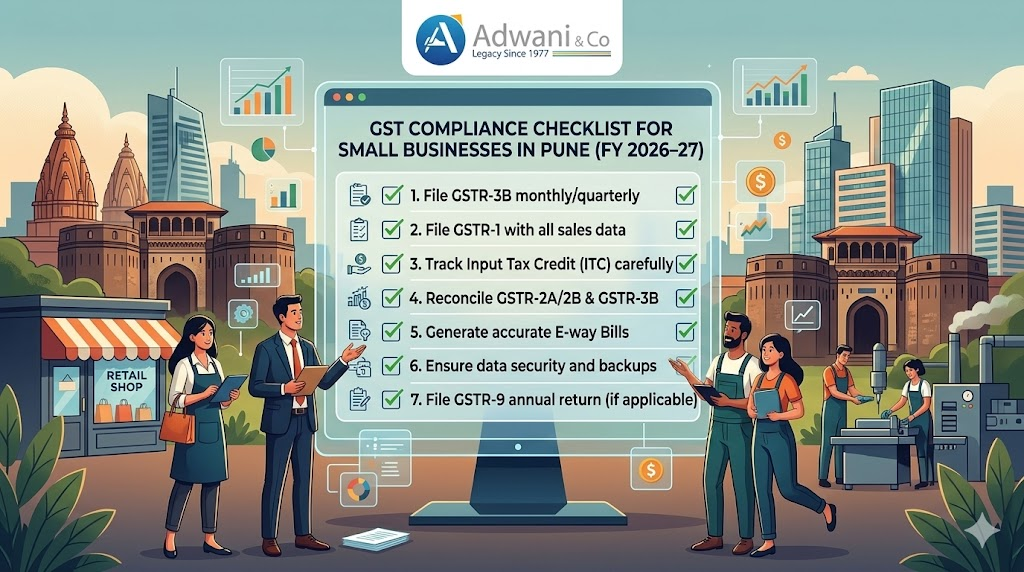
Small businesses in Pune with annual turnover above ₹40 lakh (₹20 lakh for services) must register under GST and file GSTR-1 by the 11th and GSTR-3B by the 20th of every month. Key annual obligations include GSTR-9 by 31 December and timely ITC reconciliation. Missing deadlines triggers ₹50/day late fees plus 18% interest on unpaid tax.
Why GST Compliance Matters for Pune’s Small Businesses
Pune is one of Maharashtra’s fastest-growing business hubs, home to thousands of MSMEs, startups, and trading firms. Whether you run a manufacturing unit in Pimpri-Chinchwad, a
services firm in Baner, or a retail shop in Shivajinagar GST compliance directly affects your cash flow, vendor relationships, and legal standing.
From 1 January 2026, the GST portal enforces stricter validations. Returns older than three years are permanently blocked. Incorrect filings are flagged within days. The cost of non- GST compliance is no longer just a fine it can freeze your ITC, block your e-way bill generation and damage your reputation with buyers.
Important: Under the new GST compliance rules effective January 2026, businesses cannot file returns more than three years past their original due date. Any pending Input Tax Credit is permanently lost after that window.
Step 1: Who Must Register for GST in Pune?
GST registration is mandatory for any business in Pune that crosses these thresholds:
▸ Goods suppliers: Annual turnover exceeding ₹40 lakh
▸ Service providers: Annual turnover exceeding ₹20 lakh
▸ E-commerce sellers: Mandatory registration regardless of turnover
▸ Businesses with interstate supply: Mandatory regardless of turnover
▸ Reverse Charge Mechanism (RCM) applicants: Mandatory regardless of turnover
Registration is free and done online at the GST portal (www.gst.gov.in). From 2026, the portal verifies bank account details during registration ensure your business account is
active and linked before applying.
Step 2: The GST Filing Calendar — Every Deadline You Must Know
Missing even one filing deadline has cascading consequences. Use this calendar to set reminders for every key date:
| Return / Action | Deadline |
| GSTR-1 (Sales invoices upload) | 11th of every month |
| GSTR-2B | (ITC reconciliation) Download by 14th of every month |
| GSTR-3B | (Monthly tax payment) 20th of every month |
| PMT-06 (QRMP quarterly filers) | 25th of month following each quarter |
| GSTR-9 (Annual return) | 31st December of following FY |
| GSTR-9C (Reconciliation, if turnover > ₹5 cr) | 31st December of following FY |
| ITC Reversal ITC-03 (if switching to Composition) | 30 May 2026 |
| QRMP Scheme selection for FY 2026–27 | 30 April 2026 |
Pro Tip: QRMP (Quarterly Return Monthly Payment) scheme is available for businesses with turnover below ₹5 crore. It allows quarterly GSTR-1 and GSTR-3B filing but requires monthly tax deposit via PMT-06.
Step 3: Your Monthly GST Compliance Checklist
By the 14th of Each Month
▸ Download GSTR-2B from the GST portal
▸ Identify missing invoices and ITC discrepancies: Reconcile GSTR-2B against your purchase register
▸ Their failure to file GSTR-1 blocks your ITC: Follow up with non-compliant suppliers
By the 20th of Each Month
▸ File GSTR-3B and pay all outstanding GST
▸ Unmatched ITC claims trigger notices and reversals: Claim only ITC appearing in
GSTR-2B
▸ Legal services, GTA, director remuneration, and certain imports attract Reverse Charge: Pay RCM tax if applicable
▸ Accept valid invoices, reject invalid ones: Check IMS portal
Step 4: Annual GST Compliance — What Pune Businesses Must Do
Reset Invoice Numbering : Due: 1 April Each Year
Every GST registered business must start a fresh invoice number series from 1 April 2026.Invoice numbers must be unique within each financial year per GSTIN. Continuing the old series creates reconciliation errors during audits.
File GSTR-9 : Due: 31 December 2026 (for FY 2025–26)
GSTR-9 is the annual return summarising all monthly/quarterly filings for the year. Businesses with turnover above ₹5 crore must also file GSTR-9C, a reconciliation statement certified by a Chartered Accountant. Late filing after 31 December attracts automatic late fees from 1 January.
ITC Reconciliation :Critical Before September 2026
Any Input Tax Credit for FY 2025–26 purchases that is not claimed by the due date of the September 2026 GSTR-3B return is permanently lost. This is one of the most common and
expensive mistakes made by small businesses in Pune. Reconcile your purchase register against GSTR-2B every month do not leave it to the year-end.
Step 5: Should Your Pune Business Opt for the GST Composition
If your annual turnover is below ₹1.5 crore (₹75 lakh for service providers), the GST Composition Scheme may significantly reduce your compliance burden.
| Feature | Regular vs Composition Scheme |
| Return frequency | Monthly vs Quarterly |
| Tax rate | Standard GST rate vs Flat 1–5% on turnover |
| ITC eligibility | Available vs Not available |
| Opt-in deadline | — vs 31 March each year (Form CMP-02) |
| Suitable fo | Businesses with high ITC vs Small retailers, restaurants, traders |
Note: Under the Composition Scheme, you cannot charge GST from your customers or issue a tax invoice. You must issue a Bill of Supply instead.
Step 6: Penalties for Non-GST Compliance : Real Numbers
Understanding the financial cost of non-compliance helps prioritise timely filing. Here are the
actual penalties under GST law in 2026:
▸ GSTR-3B late fee: ₹50 per day (₹25 CGST + ₹25 SGST) for businesses with tax
liability, capped at ₹5,000 or 0.25% of annual turnover (whichever is higher)
▸ Nil return late fee: ₹20 per day (₹10 CGST + ₹10 SGST)
▸ Interest on unpaid tax: 18% per annum from the due date
▸ Section 73 penalty (non-fraud): 10% of tax due or ₹10,000 (whichever is higher)
▸ Section 74 penalty (fraud): 100% of tax evaded
▸ E-way bill blockage: Failure to file GSTR-3B can block e-way bill generation, halting all goods movement
Real example:
A ₹200 filing fee unpaid for 200 days can accumulate to ₹20,000 with
late fees and interest more than 100x the original amount.
Read More
https://www.adwaniandco.com/blog/gst-show-cause-notices
Step 7: 6 Common GST Compliance Mistakes by Pune Small Businesses (And How to Avoid Them)
▸ Even if there are no transactions in a month, a nil GSTR-1 and GSTR 3B must
be filed. Missing nil returns accumulates late fees.: Not filing nil returns
▸ Claiming ITC without supplier uploading their GSTR1 leads to reversals and
notices.: Not reconciling ITC monthly
▸ Incorrect classification causes tax rate mismatches and audit notices. Update
your masters at the start of every financial year.: Wrong HSN/SAC codes
▸ Services like legal fees, goods transport (GTA), and director salaries attract
reverse charge. Many small businesses miss this.: Ignoring RCM obligations
▸ (Internal note only, remove before publishing): Blocking AI crawlers
inadvertently via Cloudflare
▸ From January 2026, unverified bank accounts can trigger automatic GST
registration suspension.: Not updating bank details on GST portal
▸ GST returns older than 3 years are permanently blocked. If you have any pending old returns, file them immediately: Missing the 3 year time bar
Frequently Asked Questions
Q1. What is the GST registration threshold for a small business in Pune?
Businesses in Pune supplying goods must register if annual turnover exceeds ₹40 lakh.
Service providers must register at ₹20 lakh. Certain categories such as e-commerce
sellers, businesses making interstate supplies, and those liable under the Reverse Charge
Mechanism must register regardless of turnover.
Q2. How often does a small business in Pune need to file GST returns?
Monthly filers must submit GSTR-1 by the 11th and GSTR3B by the 20th of each month.
Businesses with turnover below ₹5 crore can opt for the QRMP scheme and file quarterly
returns, but must deposit tax monthly via PMT-06. The annual return GSTR9 is due by 31
December each year.
Q3. What is the late fee for missing a GSTR-3B deadline?
The late fee is ₹50 per day (₹25 CGST + ₹25 SGST) for businesses with tax liability, capped
at ₹5,000 or 0.25% of annual turnover whichever is higher. For nil return filers, the fee is
₹20 per day. Interest on unpaid tax is charged at 18% per annum from the original due date.
Q4. Is the GST Composition Scheme suitable for my Pune business?
The Composition Scheme suits small traders, retailers, and manufacturers with turnover up
to ₹1.5 crore (₹75 lakh for service providers) who do not have significant input tax credit to
claim. It offers quarterly filing and flat tax rates but disallows ITC and collection of GST from
customers. You must opt in by 31 March each year using Form CMP-02.
Q5. What happens if my supplier does not file their GSTR-1?
If your supplier fails to upload invoices in their GST-1, those invoices will not appear in your
GSTR2B. You cannot legally claim ITC on those invoices until they appear. Regularly follow
up with non compliant suppliers or consider switching to GST compliant vendors to protect
your working capital.
Q6. Do I need to file GST returns even if I have no business in a month?
Yes. Even if there are zero transactions in a month, you must file a nil GSTR-1 and nil
GSTR-3B before the respective deadlines. Missing nil returns attracts late fees of ₹20 per
day and can eventually lead to GST registration suspension.
Q7. What is the e-invoicing threshold in 2026?
Businesses with Aggregate Annual Turnover (AATO) exceeding 10 crore must generate e-
invoices through the Invoice Registration Portal (IRP) within 30 days of the invoice date. IRN
generation is blocked beyond the 30 day window. Below 10 crore, e-invoicing is optional
but recommended for accuracy.
Q8. How can Adwani & Co help with GST compliance in Pune?
Adwani & Co LLP provides end-to-end GST compliance services for small and medium
businesses in Pune, including monthly GSTR1 and GSTR3B filing, ITC reconciliation,
annual return preparation, GST registration, Composition Scheme advisory, andrepresentation before GST authorities.
About the Author
Dr. Haresh Adwani
Ph.D. in Commerce | Law Graduate | Managing Partner, Adwani & Co LLP Dr. Haresh Adwani holds a Ph.D. in Commerce and is a qualified Law graduate with over two decades of hands-on experience in GST advisory, direct taxation, and statutory compliance for businesses across Pune and Maharashtra.