
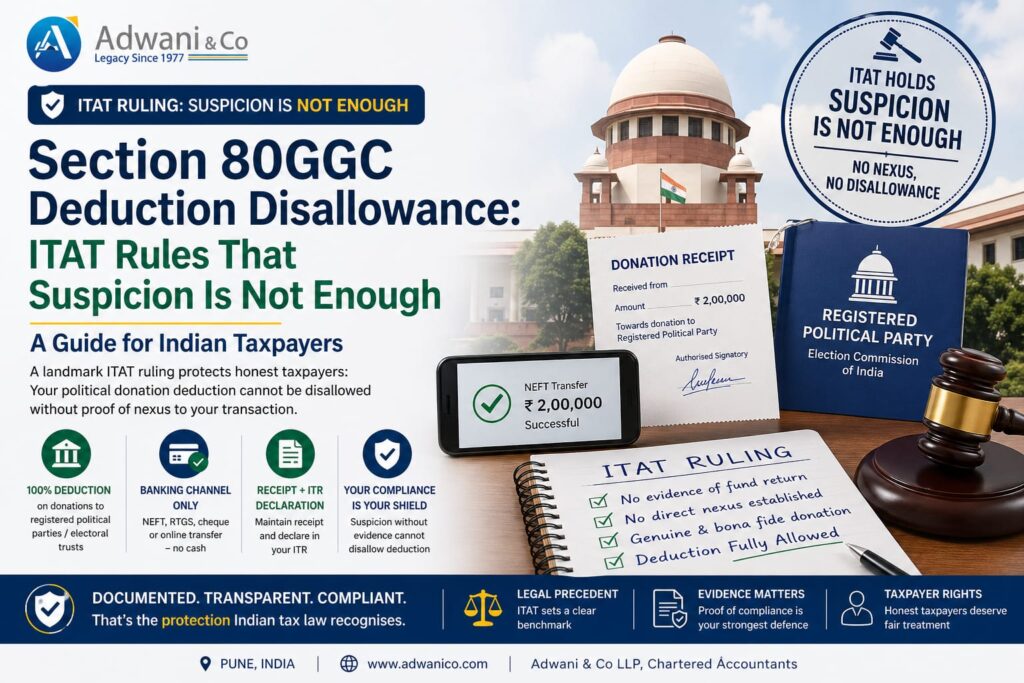
Every year, thousands of honest Indian taxpayers find their legitimate deductions disallowed not because of anything wrong they did, but because someone else they transacted with came under scrutiny. A recent ITAT ruling has drawn a firm legal line: suspicion, however compelling, cannot substitute for evidence when it comes to Section 80GGC tax deduction disallowance.
This ruling matters for anyone who has claimed or plans to claim a deduction for donations made to a registered political party under Section 80GGC of the Income-Tax Act, 1961. At Adwani & Co LLP, we have successfully applied this legal principle to defend clients against wrongful disallowances. Here is everything you need to understand to protect your tax position.
Also Read:
https://www.adwaniandco.com/blog/share-trading-tax-business-income-or-capital-gains-2026
What Is Section 80GGC and Who Can Claim It?
Section 80GGC of the Income-Tax Act, 1961 allows individual taxpayers not companies to claim a 100% deduction for donations made to:
- Registered political parties recognised by the Election Commission of India, or
- Electoral trusts set up as specified under the law
The rationale is straightforward: the government incentivises transparent, traceable political funding over unaccounted cash donations. Accordingly, cash donations are explicitly excluded only payments via banking channels (NEFT, RTGS, cheque, online transfer) qualify.
Importantly, Section 80GGC remains available under both the old and new tax regimes in 2026, making it one of the few deductions that provides value regardless of which regime you choose.
| Key Eligibility Conditions for Section 80GGC Payment must be via banking channel (no cash). Recipient must be a registered political party or electoral trust. Deduction amount = 100% of donation (no cap). Must be declared in your ITR filing through the income tax portal |
The ITAT Ruling on Section 80GGC Disallowance: What Happened?
The ruling at the centre of this article arose from a case where the Income Tax Department disallowed a taxpayer’s Section 80GGC deduction of ₹2,00,000 not because anything was wrong with the taxpayer’s own conduct, but because the recipient political party was under a general investigation for financial irregularities.
| Case Element | Details |
| Deduction Claimed | ₹2,00,000 under Section 80GGC (political donation) |
| Assessment Year | AY 2024-25 |
| Mode of Payment | NEFT bank transfer full banking trail maintained |
| Documentation Held | Official receipt from political party + ITR declaration |
| Department’s Basis for Disallowance | General investigation of recipient political party |
| ITAT Outcome | Disallowance DELETED. Deduction fully restored to taxpayer. |
Why Did the Department Disallow the Deduction and Why Was It Wrong?
The Income Tax Officer’s reasoning followed a pattern we see frequently in post-investigation assessments:
- Guilt by association: Because the recipient party was under investigation for unrelated financial irregularities, the officer argued that all donations to it should be disallowed regardless of the individual donor’s conduct.
- Reliance on general investigation reports: The officer relied on broad findings about the organisation rather than any evidence specific to this taxpayer’s transaction.
- Precautionary over-reach: The department effectively penalised a fully compliant taxpayer for another entity’s alleged wrongdoing.
| The Fatal Gap in the Department’s Case The Income Tax Department could not answer one simple question: How is this specific taxpayer’s bank-documented ₹2,00,000 donation connected to the organization’s alleged irregularities? The answer: it was not. And that gap the absence of any specific nexus proved legally fatal to the disallowance. |
ITAT’s Four Key Observations That Set the Precedent
The Tribunal made four decisive observations that now serve as the legal foundation for defending Section 80GGC deductions and indeed, all deduction disallowances based on third-party investigations:
Observation 1: No Evidence of Fund Return
The ITAT found that the department provided no evidence that the donated funds were returned to the taxpayer in any form, or that the taxpayer received any irregular benefit. A clean outward banking transfer with no corresponding inward receipt is powerful documentation of a genuine donation.
Observation 2: No Direct Nexus Established
This is the cornerstone of the ruling. The Tribunal held that no direct nexus no specific, demonstrable link was established between this taxpayer’s individual donation and the alleged irregular transactions of the recipient organisation. The fact of donating to an investigated organisation does not implicate the donor unless the department can prove a specific connection.
Observation 3: No Assessee-Specific Material on Record
The ITAT emphasised that the department had general investigation files but nothing specifically implicating this taxpayer’s transaction. This principle applies broadly in any tax audit, reassessment, or deduction disallowance, the department must bring assessee-specific material on record, not just general investigative conclusions.
Observation 4: Violation of Natural Justice
The taxpayer was never given the opportunity to review or contest the investigative findings that formed the basis of the disallowance. This denial of the right to cross-examine is a standalone procedural ground for overturning an assessment independent of the substantive merits of the case.
| ITAT Verdict: Deduction Fully Restored All four observations led the Tribunal to delete the disallowance in its entirety. The taxpayer’s Section 80GGC deduction of ₹2,00,000 was restored. This ruling is precedent-setting for similar tax deduction disallowance cases across India particularly where investigation of a third party is used as the basis for penalising an unrelated, compliant taxpayer. |
The Nexus Requirement: When Is Disallowance Justified vs Not?
‘Nexus’ a direct, logical connection between a taxpayer’s specific action and the allegation against them is the legal bridge that must exist before any deduction can be disallowed or income added. Without nexus, the department’s action is arbitrary and legally indefensible.
Strong nexus disallowance generally justified:
- A taxpayer receives kickbacks from a supplier they also claimed as a deductible expense (direct benefit from the wrongdoing)
- A company claims deductions for services that were demonstrably never rendered (direct false claim)
- A director channels funds through a shell entity and reclaims them as income (direct round-tripping)
Weak or absent nexus disallowance generally NOT justified:
- A person donates to a political party that subsequently faces investigation (the donor’s conduct was entirely separate)
- A vendor you paid legitimately is under audit your purchase transaction was compliant and properly documented
- Your investment fund manager faces fraud charges after you made a routine, compliant investment
The ITAT ruling makes clear: you cannot be penalised for a recipient’s conduct unless the department proves your transaction was itself improper.
Your Due Process Rights in Assessment and Audit Proceedings
The ITAT’s emphasis on natural justice is critically important for any taxpayer facing an income tax assessment, audit, or reassessment. You have statutory rights to:
- Receive specific, written notice of all allegations against you not vague references to third-party investigative findings
- Review the actual documents, reports, and evidence the Assessing Officer relies upon
- Submit a written defence and present oral arguments before the assessment is finalised
- Challenge investigative reports and cross-examine the evidence base
- Appeal to the Commissioner (Appeals), ITAT, High Court, and Supreme Court if rights are violated
As Dr. Haresh Adwani notes: “When the department skips due process, they hand the taxpayer additional grounds to overturn the assessment regardless of the substantive merits.” Procedural violations are often easier to argue and faster to resolve than substantive disputes.
Practical Example: How Adwani & Co LLP Defended a Section 80GGC Claim
| Case Study – Dr. Ramesh Kulkarni, Pune Scenario: Dr. Ramesh Kulkarni donated ₹1,50,000 to a registered political party in FY 2024-25 via NEFT transfer and claimed the Section 80GGC deduction. In 2026, the party faced an Election Commission inquiry. The Income Tax Officer issued a notice proposing to disallow the deduction based on the inquiry. Adwani & Co LLP’s Response: We filed a detailed objection citing the ITAT ruling and established: (1) the NEFT transfer showed a clean outward payment with no fund return; (2) no nexus existed between the EC inquiry and Dr. Kulkarni’s individual donation; (3) a proper receipt and ITR declaration were in place; (4) no assessee-specific material was produced by the officer. Outcome: The disallowance was withdrawn at the objection stage itself the matter never proceeded to ITAT. |
What to Do If Your Section 80GGC Deduction Has Been Disallowed
If you have received a notice proposing to disallow your Section 80GGC deduction based on investigation of the recipient organisation, take these steps immediately:
- Do not ignore the notice. Respond within the specified time silence is treated as acceptance.
- Request a written nexus explanation. Ask the officer to specify exactly what connects your transaction to the alleged irregularity.
- Compile your documentation: bank statement showing the NEFT/cheque transfer, official party receipt, ITR declaration, and any correspondence with the party.
- Engage a CA experienced in tax appellate work. ITAT proceedings require precise legal arguments a generic response rarely suffices.
How Adwani & Co LLP Defends Against Wrongful Disallowance
Adwani & Co LLP, under CA Dipesh Gurubakshani and the broader leadership of Dr. Haresh Adwani, provides a structured, evidence-driven defence against wrongful tax deduction disallowance:
- Nexus analysis: We immediately test whether the department’s allegations establish any specific connection to your transaction. No nexus means immediate challenge at the assessment stage, before the matter even reaches ITAT.
- Due process verification: We verify whether you received proper notice, access to evidence, and fair hearing. Procedural violations are standalone grounds for reversal.
- ITAT precedent leverage: We cite directly relevant ITAT rulings and High Court decisions to demonstrate that the department’s approach is legally unsustainable.
- Documentation fortification: We ensure your evidence file is complete banking records, official receipts, ITR declarations, and a comprehensive factual narrative.
- Layered appellate strategy: Whether before the Commissioner (Appeals), ITAT, or High Court, we build arguments combining factual, legal, and procedural grounds.
Conclusion: Your Good-Faith Compliance Is Legally Protected
The ITAT’s ruling on Section 80GGC tax deduction disallowance establishes a principle that should reassure every honest taxpayer: suspicion cannot replace evidence. The Income Tax Department cannot disallow your legitimately documented, bank-transferred political donation simply because the recipient organization is under scrutiny. Your transaction stands independently assessed on its own merits, protected by the nexus requirement and your due process rights.
Proper banking documentation, accurate ITR reporting, and genuine transactional intent are a taxpayer’s strongest legal armour. If your deductions have been disallowed on flimsy grounds, you have solid legal recourse and Adwani & Co LLP is here to exercise it on your behalf.
Frequently Asked Questions -Section 80GGC and ITAT Ruling
1.Can my Section 80GGC deduction be disallowed because the recipient party is under investigation?
No. Based on the ITAT ruling, the department must prove that your specific donation was improper. The recipient organization being investigated is not sufficient a direct nexus to your individual transaction must be established.
2.What evidence do I need to protect my Section 80GGC deduction?
You need: (1) bank statement showing the NEFT or cheque transfer, (2) official receipt from the political party, (3) ITR filing declaring the donation, and (4) any acknowledgment from the party. Cash donations do not qualify.
3.What should I do if my deduction was disallowed due to general investigation findings?
Immediately request written specifics from the officer on what nexus connects the investigation to your transaction. If no nexus is established, file a detailed objection or appeal citing this ITAT precedent. Contact Adwani & Co LLP for guidance.
4.Can I be reassessed based on investigation findings alone?
A reassessment notice can reference investigation findings, but it must cite issues specific to your assessment and establish nexus with your transactions. A generic reference to organizational findings without assessee-specific material can be challenged as legally invalid.
5.What are my rights to cross-examination in an income tax assessment?
You have the right to receive written details of all allegations, review all evidence the officer relies on, submit written and oral defences, and challenge investigative reports. Denial of these rights is a procedural violation that independently grounds a reversal.
6.Is Section 80GGC available under the new tax regime in 2026?
Yes. Section 80GGC is one of the very few deductions available under both the old and new tax regimes, making it especially valuable. Ensure the donation meets the banking channel and receipt requirements to withstand scrutiny.
7.Does this ITAT ruling apply to other deductions disallowed due to third-party investigations?
Yes. The nexus principle applies broadly. In any assessment where deductions or expenses are disallowed based on a third-party investigation without assessee-specific evidence, the same legal framework protects you.
About the Author
CA Dipesh Gurubakshani is a Chartered Accountant with Adwani & Co LLP, Pune, specialising in income tax audit, direct taxation, and accounting advisory. He supports clients across statutory compliance, financial reporting, and income tax matters with a focus on accuracy, regulatory adherence, and disciplined execution.