Tag: NRI tax planning India

  • NRI Tax Rules: 10 Critical Questions Before Returning to India

    NRI Tax Rules: 10 Critical Questions Before Returning to India

    NRI Tax Rules: 10 Critical Questions Before Returning to India
    NRI Tax Rules: 10 Critical Questions Before Returning to India

    Why NRI Tax Planning Before Returning to India Matters

    Every year, thousands of Non-Resident Indians working in the United States, Canada, United Kingdom, UAE, Australia, and other countries make the decision to return home. For many, it is driven by family, career opportunities, or simply the desire to reconnect with their roots. But what often comes as a surprise sometimes a very expensive one is how dramatically their tax situation changes the moment they step back on Indian soil for good.

    According to guidelines issued by the Income Tax Department of India, your residential status determines the scope of your tax liability. As an NRI, you are taxed only on income earned or received in India. The moment your status changes to Resident, however, India gains the right to tax your global income including income from foreign bank accounts, rental earnings from property abroad, dividends from US or UK stocks, and money you earn from global investments.

    This is why NRI tax planning before the return journey is not just advisable it is essential. Dr. Haresh Adwani of Adwani & Company has guided hundreds of returning NRIs through this transition, and consistently observes that those who plan ahead save significantly more, comply cleanly, and avoid stressful tax notices later.

    Important Alert

    Many NRIs believe their foreign income is permanently outside India’s tax net. This is incorrect once you become a tax resident. The planning window particularly your RNOR period is limited and time-sensitive.


    NRI Tax Rules: When Do You Become Resident, RNOR, or ROR?

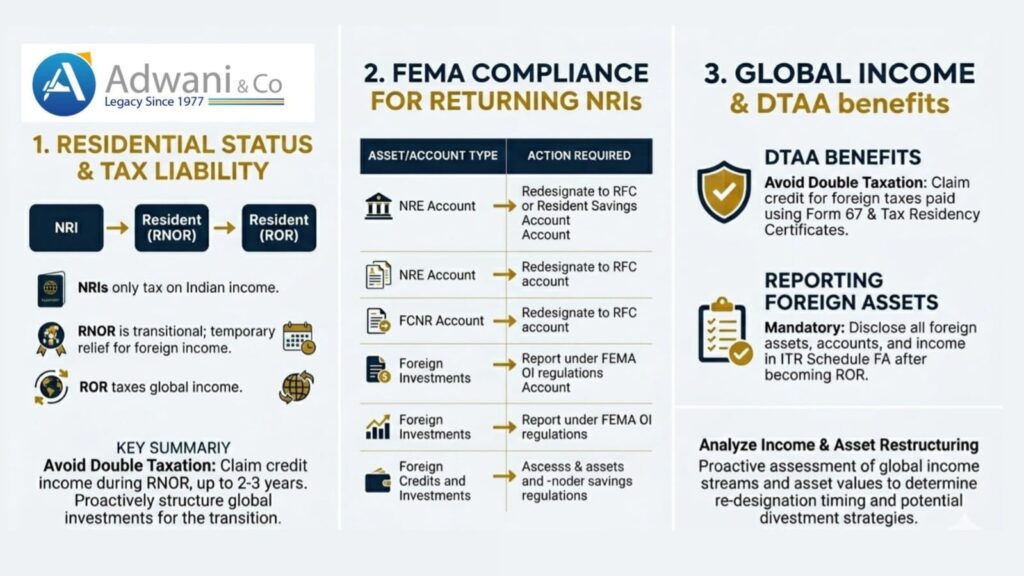
    Understanding your residential status is the very first step in NRI tax planning in India. The Income Tax Act, 1961 defines three categories of residential status for individuals:

    StatusWhat It MeansIndian Tax on Foreign Income?
    NRI (Non-Resident Indian)Stays less than 182 days in India in a year (general rule)Not Taxable
    RNOR (Resident but Not Ordinarily Resident)Transitional status for returning NRIs; limited foreign tax exposurePartially Exempt
    ROR (Resident and Ordinarily Resident)Full tax resident; all global income taxable in IndiaFully Taxable

    The RNOR status is arguably the most valuable tool available to a returning NRI — but it is available only for a limited period, typically two to three financial years after returning, depending on your prior NRI history. During this window, your foreign income remains outside India’s tax net, giving you critical time to restructure investments and repatriate funds in a tax-efficient manner.

    Dr. Haresh Adwani strongly advises every returning professional to calculate their RNOR window as the very first step, ideally six to twelve months before the planned return date.

    Also Read:

    https://www.adwaniandco.com/blog/the-120-day-rule-that-is-silently-taxing-thousands-of-nris-in-india


    The 120-Day Rule That Silently Traps NRIs

    Here is a less-known but critically important provision in India’s NRI tax rules that catches many people completely off guard. Most NRIs believe that as long as they live outside India, their NRI status is protected. But there is a specific rule, introduced via the Finance Act 2020, that can strip your NRI status even if you live abroad.

    If the following three conditions are all true, you may be classified as a tax resident of India even though you live abroad:

    The Three-Condition Rule

    1. Your income from India exceeds ₹15 lakh in the financial year
    2. You stayed in India for 120 days or more in that financial year
    3. You stayed in India for 365 days or more cumulatively over the previous four financial years

    120 days sounds like a lot. But consider this you come for a wedding in December, stay through January. You visit again in April for a family function. You attend a relative’s medical emergency in August. Without consciously tracking, you may have crossed the 120-day threshold without even realising it. And if your Indian income salary from an Indian employer, rent from property, or dividend from Indian shares exceeds ₹15 lakh, India’s tax jurisdiction now extends to your global income.

    This is not a hypothetical risk. At Adwani & Company, we have advised clients who received income tax notices specifically because of this provision. The solution is straightforward track your travel days carefully and consult a qualified NRI tax advisor well before the end of each financial year (March 31).


    10 NRI Tax Questions You Cannot Afford to Ignore

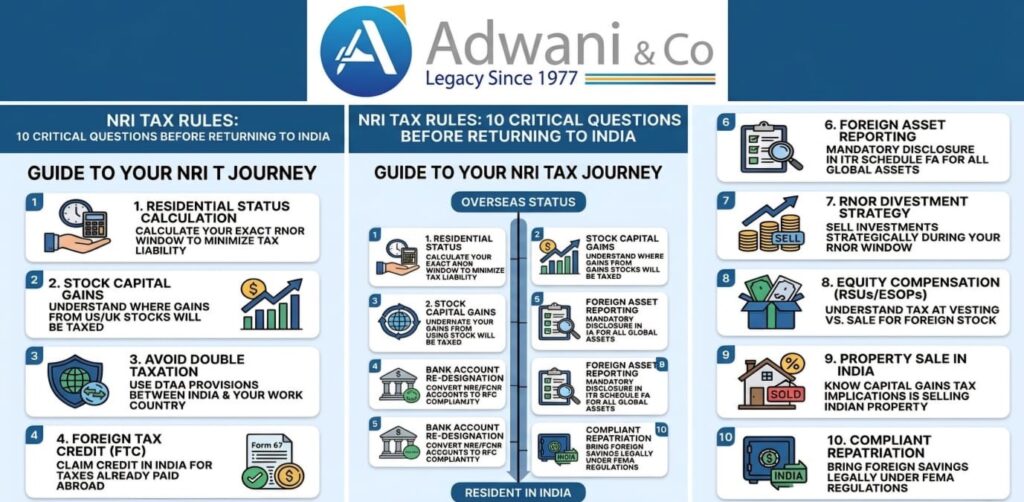
    Based on years of advising professionals returning from the US, UK, UAE, Canada, Singapore, and Australia, Dr. Haresh Adwani has compiled the ten most important NRI tax questions that arise during the return transition. Each of these has significant financial implications if not addressed in advance.

    1. When exactly will I become Resident, RNOR, or ROR in India? 

    Your status depends on your physical presence over multiple financial years. Calculating this accurately determines your tax liability strategy.

    2. If I sell my US or UK stocks after returning, where will the capital gains be taxed?

     Gains on foreign stocks can be taxed in both India and the country where the assets are held, unless DTAA provisions apply. Selling while still RNOR can make a significant difference.

    3. How can I avoid double taxation between India and my country of work? 

    India has Double Taxation Avoidance Agreements (DTAA) with over 90 countries. Understanding which provisions apply to your income type is crucial.

    4. Can I claim Foreign Tax Credit (FTC) in India for taxes already paid abroad? 

    Yes, under Rule 128 of the Income Tax Rules, you can claim credit for foreign taxes paid. However, the process requires Form 67 and specific documentation.

    5. What happens to my foreign bank accounts and investments once I become a resident?

     Your NRE and FCNR accounts must be re-designated to RFC (Resident Foreign Currency) accounts. Failure to do so is a FEMA violation with serious penalties.

    6. Do I need to report foreign assets in my Indian income tax return? 

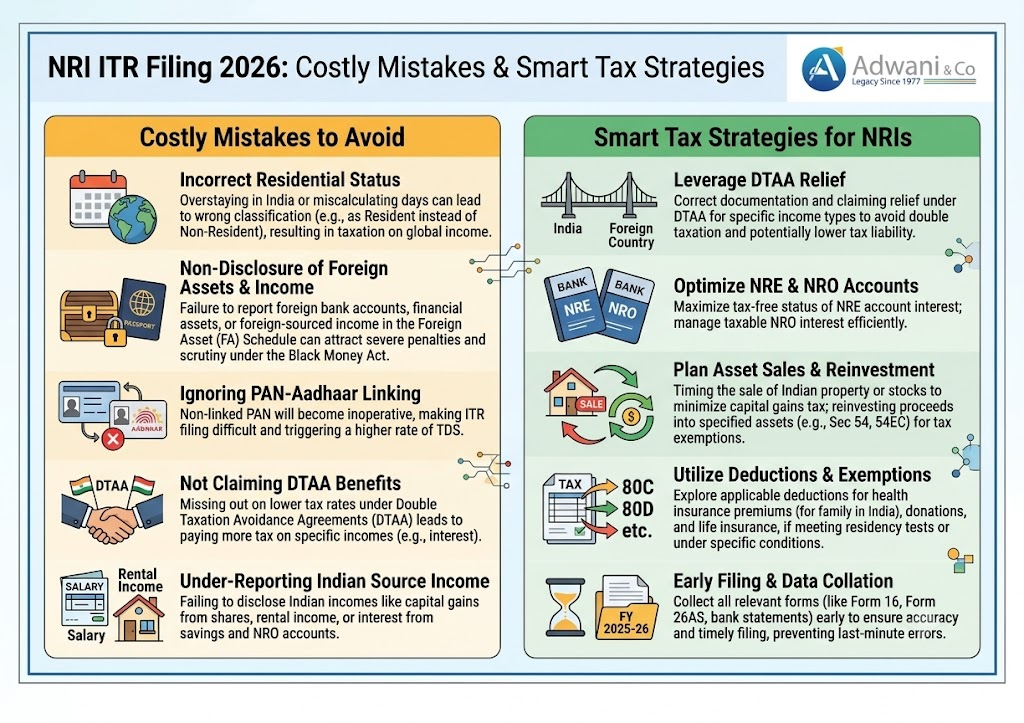
    Absolutely. Once you become a full Resident (ROR), you must disclose all foreign assets, accounts, and income in Schedule FA of your ITR. Non-disclosure attracts severe penalties under the Black Money Act.

    7. Should I sell some investments while I am still RNOR rather than waiting until ROR? 

    In many cases, yes. Since foreign income is not taxable during the RNOR period, strategic divestment of foreign assets during this window can produce significant tax savings.

    8. How are RSUs, ESOPs, and stock compensation from foreign employers taxed in India? 

    This is complex. RSUs may be taxed both when they vest (as salary income) and when sold (as capital gains). DTAA provisions and the nature of your resident status at both events determine the outcome.

    9. What are the tax implications if I sell property in India after returning? 

    The tax treatment depends on the holding period, whether you are RNOR or ROR at time of sale, and available exemptions under Section 54 or 54EC of the Income Tax Act.

    10. How can I bring my foreign savings to India in a legal and efficient way? 

    FEMA governs the repatriation of foreign funds. The RFC account and LRS (Liberalised Remittance Scheme) framework provides structured pathways to bring money in compliantly.


    Real-World Example: IT Professional Returning from the US

    Rajesh S., Software Engineer San Francisco to Pune

    Rajesh worked in the US for 14 years on an H-1B visa and decided to return to India in July 2025. He had accumulated USD 280,000 in a US brokerage account (mostly tech stocks with significant unrealised gains), USD 95,000 in a 401(k) retirement account, and owned a property in Pune generating ₹18 lakh annual rent.

    Without Planning: Had Rajesh returned and immediately converted his NRE account, sold his US stocks after becoming ROR, he would have faced Indian capital gains tax on the full appreciation potentially ₹40–50 lakh in additional tax liability, plus mandatory disclosure of all foreign assets.

    With Planning via Adwani & Company: By calculating his RNOR window (approximately 2 financial years), Rajesh sold his US stocks strategically during that period when foreign income was not taxable in India. His NRE and FCNR accounts were re-designated to RFC accounts in time. Form 67 was filed correctly to claim US tax credit. Penalty exposure was eliminated entirely.


    FEMA Compliance for Returning NRIs: What You Must Do

    The Foreign Exchange Management Act (FEMA) governs how Indian residents including returning NRIs manage their foreign currency assets, bank accounts, and international transactions. Violations under FEMA are taken seriously by the Enforcement Directorate and can attract penalties many times the value of the transaction involved.

    As per Reserve Bank of India (RBI) guidelines, the following changes must be made immediately upon returning to India as a resident:

    Account/Asset TypeAction RequiredDeadline
    NRE (Non-Resident External) AccountRe-designate to RFC or Resident Savings AccountImmediately upon change of status
    FCNR (Foreign Currency NR) AccountRe-designate to RFC accountAt maturity or immediately
    NRO (Non-Resident Ordinary) AccountRe-designate to ordinary resident savings accountImmediately upon change of status
    Foreign Bank AccountsDeclare in ITR Schedule FA; permitted to retain under FEMAAnnual ITR filing deadline
    Foreign InvestmentsDeclare and report under FEMA OI regulationsAnnual reporting cycle

    Dr. Haresh Adwani advises every returning NRI to consult an authorised FEMA practitioner as a first step not after they have returned, but three to six months before the anticipated return date. This provides time to restructure accounts, repatriate funds, and file necessary declarations without rushing.

    Learn more about our NRI FEMA Compliance Services at Adwani & Company.


    Pre-Return NRI Tax Planning Checklist

    If you are planning to return to India within the next six to eighteen months, use this checklist to ensure you enter the transition fully prepared:

    • Calculate your RNOR eligibility window based on your exact NRI years — this is your most valuable planning asset
    • Identify all foreign assets: stocks, mutual funds, retirement accounts (401k, IRA, pension), bank accounts, and property
    • Evaluate which assets to sell before returning versus during the RNOR window versus after becoming ROR
    • Check whether DTAA provisions between India and your country of residence apply to your income types
    • Arrange re-designation of NRE, FCNR, and NRO accounts to RFC before or immediately upon return
    • Obtain Form 67 documentation for claiming Foreign Tax Credit on income taxed abroad
    • Ensure your ITR includes Schedule FA for all foreign assets once you attain ROR status
    • Consult a qualified NRI tax advisor ideally one registered with ICAI and experienced in international tax

    Read our detailed guide on NRI Taxation and FEMA Compliance — A Complete Handbook for deeper coverage of each checklist item.


    DTAA Benefits: How Returning NRIs Can Avoid Double Taxation

    One of the most powerful tools available to a returning NRI is the Double Taxation Avoidance Agreement (DTAA). India has signed DTAAs with over 90 countries including the United States, United Kingdom, UAE, Canada, Australia, Singapore, and Germany. These agreements ensure that the same income is not taxed twice once in the country where it is earned and again in India.

    However, DTAA benefits are not automatic. You must actively claim them, file the correct forms, and provide the necessary documentation including Tax Residency Certificates (TRC) and Form 10F. The specific provisions vary significantly by country and income type. For instance, the India-US DTAA has specific provisions for employment income, dividends, and capital gains each with different conditions and rates.

    DTAA Quick Tip

    For NRIs returning from the UAE, note that the India-UAE DTAA was renegotiated and updated. The provisions affecting salary income and capital gains have changed. Ensure you are referencing the most current treaty text, or consult Adwani & Company for up-to-date guidance specific to your income profile.


    Conclusion: Your Return to India Deserves a Well-Crafted Tax Strategy

    Returning to India after years abroad is an emotionally significant and practically complex decision. The financial implications spanning NRI tax rules, RNOR status planning, FEMA compliance, DTAA benefits, and foreign asset disclosure require careful attention and expert guidance well before the moving date.

    The good news is that with proper NRI tax planning, the transition can be managed smoothly. The RNOR window is a legitimate and powerful tool. DTAA provisions can significantly reduce your tax burden. FEMA compliance, when handled proactively, is straightforward. The 120-day rule, once you are aware of it, is entirely manageable.

    The critical factor is timing. Tax planning done before the return preserves options. Tax planning attempted after the return or worse, after a notice from the Income Tax Department is reactive, expensive, and stressful. As Dr. Haresh Adwani consistently advises clients: the best time to plan your return tax strategy is at least six to twelve months before you board that flight home.

    Frequently Asked Questions:

    1. What is RNOR statusand how does it benifit a returning NRI?

    RNOR stands for Resident but Not Ordinarily Resident. It is a transitional tax status available to returning NRIs for a limited period typically two to three financial years after returning, depending on the number of years they were NRI. During the RNOR period, India does not tax income that is earned outside India and not received in India. This makes the RNOR window a critical opportunity to restructure foreign investments and repatriate funds tax-efficiently. Calculating your exact RNOR window is the most important first step in any returning NRI tax planning exercise.

    2. Do i need to report my foreign bank accounts after returning to india?

    Yes. Once you attain ROR (Resident and Ordinarily Resident) status, you are required to disclose all foreign bank accounts, financial assets, and income from foreign sources in Schedule FA (Foreign Assets) of your Income Tax Return. Non-disclosure is treated as a violation under the Black Money (Undisclosed Foreign Income and Assets) and Imposition of Tax Act, 2015, which prescribes severe penalties including a flat 30% tax plus a 90% penalty on undisclosed amounts. Proactive disclosure and professional guidance from a qualified NRI tax advisor is strongly recommended.

    3. How are RSUs and ESOPs from a US employer taxed when i return to india?

    RSUs (Restricted Stock Units) and ESOPs (Employee Stock Option Plans) granted by foreign employers are taxed at two points first at vesting (treated as perquisite or salary income) and again at sale (capital gains). If you are RNOR when the shares vest, there may be no Indian tax at vesting for foreign-source income. However, gains on sale after becoming ROR are fully taxable in India. The India-US DTAA may provide relief on employment income. Given the complexity, consulting a specialist NRI tax advisor who handles cross-border equity compensation is highly advisable.

    4. can keep my NRE account after returning to india?

    No. Under FEMA regulations, once your residential status changes to Resident Indian, your NRE (Non-Resident External) account must be re-designated to a Resident Foreign Currency (RFC) account or a regular resident savings account. Continuing to operate an NRE account after becoming a resident is a FEMA violation and can attract penalties under the Enforcement Directorate. The re-designation must happen promptly upon change in status. Similarly, FCNR accounts must be re-designated to RFC accounts at maturity.

    5.Is the 120-day rule applicable to all NRIs only thoes with high indian income?

    The 120-day rule applies specifically to NRIs whose Indian income exceeds ₹15 lakh in the relevant financial year. If your Indian income is below this threshold, the standard 182-day rule applies for determining NRI status. However, if your Indian income from sources such as rent, salary from Indian companies, or interest from NRO accounts exceeds ₹15 lakh, then staying 120 days or more in India in a financial year, combined with a cumulative stay of 365 days in the previous four years, can make you a resident for tax purposes. Tracking your India travel days carefully is essential if you have significant Indian income.

    6.what is best time to sell foreign stock-before returning or after returning

    The timing of foreign asset liquidation is one of the highest-impact NRI tax planning decisions. Selling before returning (when you are still an NRI) means the gains are taxed only in the country where the asset is held not India. Selling during the RNOR window means the gains from foreign sources are not taxable in India under current provisions. Selling after becoming ROR means full Indian capital gains tax applies. The optimal strategy depends on the specific country, the type of asset, applicable DTAA provisions, and your income profile. Dr. Haresh Adwani and the team at Adwani & Company specialise in creating personalised divestment plans for returning NRIs.

    7. How do i claim Foreign Tax Credit(FTC) in india?

    Foreign Tax Credit in India is governed by Rule 128 of the Income Tax Rules, 1962. To claim FTC, you must file Form 67 on the income tax e-filing portal before the due date of your return. You will need documentation including a tax payment certificate or withholding statement from the foreign country confirming the taxes paid. The credit is available against the Indian tax payable on the same income, up to the Indian tax liability on that income. FTC cannot create a refund it can only reduce your Indian tax to zero on the relevant income. Missing the Form 67 deadline means losing the credit entirely.

    Author

    CA. Manish R. Mata Practising In India (Ex – PwC),  At Adwani & Co LLP leads the International Accounting & Tax Support vertical, delivering structured execution assistance to US CPA firms and overseas businesses.

  • The 120: Day Rule That Is Silently Taxing Thousands of NRIs in India

    The 120: Day Rule That Is Silently Taxing Thousands of NRIs in India

    The Dangerous Myth Many NRIs Still Believe

    “I live outside India, so I am an NRI. My foreign income is safe.”

    This belief simple, logical-sounding, and widely held is wrong for a growing number of NRIs. And the consequences of getting this wrong are not a minor inconvenience. They can fundamentally change how your entire global income is taxed, expose previously protected foreign accounts to Indian disclosure requirements, and trigger tax liabilities you had no idea were coming.

    Dr. Haresh Adwani of Adwani & Company regularly encounters NRI clients who discover their residential status has shifted not because they moved back to India, but because they visited more frequently than they tracked. A wedding here. A family emergency there. A few extra weeks that felt harmless. And then the days added up past a number that changed everything: 120.

    According to the Income Tax Department of India, a specific amendment introduced via the Finance Act 2020 tightened the rules for determining NRI status for individuals with significant Indian income. Understanding this rule is now essential for every NRI who visits India regularly not just those planning to return permanently.

    The Core Risk

    If you have Indian income exceeding ₹15 lakh and spend 120 days or more in India in a financial year while also having stayed 365+ days cumulatively over the previous four years India may tax you as a resident, including on your foreign income.

    The 120-Day Rule That Is Silently Taxing Thousands of NRIs in India
    The 120-Day Rule That Is Silently Taxing Thousands of NRIs in India

    The 120-Day NRI Tax Rule Explained

    The standard rule most NRIs know is the 182 day rule: if you spend fewer than 182 days in India in a financial year, you are classified as a Non Resident Indian and your foreign income is not taxable in India. This rule still applies but with an important and often overlooked exception introduced by the Finance Act 2020.

    Under the amended provisions of Section 6 of the Income Tax Act, 1961, a person who is a citizen of India or a Person of Indian Origin (PIO) is treated as a resident of India if all three of the following conditions are simultaneously met:


    The Three-Condition Test Section 6, Income Tax Act 1961

    1. Indian Income Threshold: Your total income from Indian sources including salary from Indian employers, rental income from property in India, interest from NRO accounts, or dividends from Indian companies exceeds ₹15 lakh in the relevant financial year.

    2. Current Year Stay: You stayed in India for 120 days or more during that financial year (April 1 to March 31), regardless of whether the stays were continuous or spread across multiple visits.

    3. Cumulative Stay: You stayed in India for a cumulative total of 365 days or more over the four financial years immediately preceding the relevant year.

    This rule was specifically introduced to address cases where high-income individuals were spending substantial time in India while claiming NRI status to shield their foreign income from Indian tax. The 15 lakh threshold ensures it does not affect NRIs with limited Indian income, but for NRIs with property, investments, or employment connections in India generating significant returns, this rule is highly relevant.

    Also Read:

    https://www.adwaniandco.com/blog/financial-modeling-for-business-valuation-normalized-eps-explained-india-guide


    How 120 Days Add Up Without You Noticing

    120 days is not a lot. It is approximately four months. And for an NRI who has family, property, or business interests in India, four months across a year is entirely conceivable even without any intention to stay long-term.

    Here is how a typical NRI’s year might look without conscious tracking:

    December to January

    Annual family visit over the holiday season. Stayed a bit longer to attend a cousin’s wedding.38 days

    March to April

    Parent’s health issue. Flew down urgently, managed medical matters, returned after recovery.28 days · Running total: 66

    June

    Brief trip to handle property matters and meet the family lawyer. Extended slightly for a puja.18 days · Running total: 84

    October to November

    Diwali visit. Stayed on for sibling’s anniversary function and a school reunion.40 days · Total: 124 days ⚠ Limit crossed

    In the above scenario, no single trip looks excessive. But the cumulative total of 124 days combined with Indian rental or investment income exceeding ₹15 lakh may be enough to trigger the residency test. Most NRIs in this situation do not discover the problem until they receive an Income Tax notice or an AIS (Annual Information Statement) query from the tax department.


    What Changes When You Lose NRI Status Under the 120-Day Rule

    The moment India classifies you as a tax resident even temporarily the scope of your taxable income expands dramatically. India’s tax jurisdiction now potentially extends to:

    Income TypeBefore (as NRI)After (as Resident)
    Indian salary or rental incomeTaxable in IndiaTaxable in India
    Foreign salary / employment incomeNot TaxableFully Taxable
    Interest from foreign bank accountsNot TaxableFully Taxable
    Rent from property outside IndiaNot TaxableFully Taxable
    Capital gains from foreign stocksNot TaxableFully Taxable
    Dividends from global investmentsNot TaxableFully Taxable
    Foreign assets disclosure required?Not RequiredMandatory in ITR

    Beyond the income tax dimension, the change in residency status also triggers FEMA obligations. Foreign bank accounts that were perfectly legal as an NRI must now be reconsidered. NRE account operations as a resident are a FEMA violation. The Reserve Bank of India requires specific account re-designations that many NRIs are unaware of.

    FEMA Alert

    Operating an NRE (Non-Resident External) bank account after your residential status changes to Resident is a violation of FEMA regulations. Re-designation to an RFC (Resident Foreign Currency) account is mandatory and must happen promptly. Learn more about FEMA Compliance for NRIs at Adwani & Company.


    RNOR Status: The Safety Net You May Still Have

    There is some good news. Even if your residential status does shift from NRI to Resident, you may not immediately become an ROR (Resident and Ordinarily Resident). Depending on your prior years of NRI status, you may qualify for RNOR Resident but Not Ordinarily Resident.

    RNOR is a transitional status that continues to protect your foreign income from Indian taxation for a limited period typically two to three financial years. A person qualifies as RNOR if they have been non-resident in India in at least 9 of the 10 financial years preceding the relevant year, or have stayed in India for 729 days or fewer in the 7 preceding financial years.

    The RNOR Advantage

    During RNOR status, income earned outside India that is not received or deemed to arise in India remains outside India’s tax net. This protection window if you qualify gives you time to restructure investments, repatriate funds, and plan asset liquidation before full ROR status applies. Identifying and using this window is a core part of Dr. Haresh Adwani’s NRI tax advisory practice.


    Real Example: How One NRI Was Caught Off Guard

    Priya K., Finance Professional London to Repeated India Visits

    Priya worked in London for 9 years. She owned two flats in Mumbai generating a combined rental income of 22 lakh per year. She visited India frequently a December family trip, an April medical visit for her mother, a July trip for property matters, and a Diwali trip in November. Total India stay for the financial year: 131 days.

    Priya had no plans to return to India permanently. She considered herself a straightforward NRI. She had never counted her days.

    What Happened: With Indian rental income of ₹22 lakh (above 15 lakh threshold), 131 India days in the year, and cumulative stays well above 365 days in the preceding four years, all three conditions under Section 6 were satisfied. Priya was reclassified as a Resident for that financial year. Her UK salary, London savings account interest, and gains from UK equity funds previously untouched by Indian tax became taxable in India. Her NRE account operation during that period was also flagged as a FEMA concern.

    Lesson: Indian income above ₹15 lakh + 120+ India days = a combination you must actively monitor every financial year not just when planning a permanent return.


    Two Critical Things to Check Before March 31 Every Year

    You do not need to overhaul your life to manage this risk. But you do need to be proactive. Dr. Haresh Adwani recommends every NRI with significant Indian income complete two simple checks before March 31 of each financial year:

    1. Count your India days precisely. Add up every day you were physically present in India between April 1 and the current date. Include partial days. Compare against the 120-day threshold. If you are approaching it, plan your departure accordingly.

    2. Review your Indian income for the year. Total up all income from Indian sources rent, NRO interest, dividends from Indian shares, salary from Indian employers. If this exceeds ₹15 lakh and you are near 120 India days, the risk is real.

    Also Check Your Cumulative Stay

    Even if this year’s India stay is below 120 days, check your cumulative India days across the previous four financial years. If you are approaching or have crossed 365 cumulative days over that period, your buffer for the current year is already reduced. Tracking this four year rolling total is an important part of ongoing NRI residency status management.

    Read our detailed guide on NRI Residential Status and Day-Count Management — A Practical Guide for year-by-year tracking strategies.


    Conclusion: 120 Days Is Not Just a Number It Is a Tax Turning Point

    The 120-day NRI tax rule is not obscure fine print. It is an active provision in the Income Tax Act that has real consequences for any NRI with meaningful Indian income and regular visits home. The mistake most people make is not wilful it is simply a lack of awareness. Nobody warns you at the airport. No bank sends you a reminder. The days accumulate quietly, and the tax implications arrive months later via a notice or during ITR filing.

    The solution is equally simple: awareness and tracking. Know which rule applies to you 182 days or 120 days based on your Indian income level. Track your India days carefully across every financial year. Check the four-year cumulative total annually. And if you are approaching either threshold, plan the calendar accordingly or consult a qualified NRI tax advisor before year-end.

    As Dr. Haresh Adwani consistently advises NRI clients: one hour of planning before March 31 can prevent one year of tax complications after it. Do not let 120 days become the most expensive number in your financial life.

    Frequently Asked Questions

    1. Does the-day rules apply to all NRIs or only those with high Indian income

    The 120 day rule applies specifically to NRIs whose total Indian income exceeds 15 lakh in the relevant financial year. If your Indian income is below ₹15 lakh, the standard 182 day rule continues to apply. However, ₹15 lakh is not a high threshold it is approximately ₹1.25 lakh per month. Many NRIs with property generating rental income, NRO fixed deposits, or dividend income from Indian investments can easily cross this level. It is worth calculating your Indian income annually to know which rule applies to you in any given year.

    2. Are days in Transit through indian airports counted toward the 120 days?

    Generally, days spent in India in transit where you do not leave the international transit area of the airport are not counted as days of presence in India. However, if you exit the airport and enter Indian territory, even briefly, that day counts. With the increasing prevalence of stopovers and long haul connections through Indian airports, NRIs should be cautious. If in doubt, it is safer to route connecting flights through airports outside India or to keep international transit strictly within the airport’s transit zone. This is a detail worth clarifying with a qualified NRI tax advisor for your specific travel pattern.

    3. If i become a resident due to the 120-days rule, do i loose NRI status permanently?

    No. Residential status in India is determined year by year, based on physical presence in each financial year. If you become a resident in one financial year due to the 120 day rule, but in the following year you stay below the applicable threshold (182 days under the standard rule, or 120 days if the three-condition test again applies), you can revert to NRI status for that next year. However, the years in which you were classified as resident will be counted in the rolling four year cumulative stay calculation. This is why tracking your stay carefully each year is important a single year of resident status can have multi year implications for the cumulative stay count.

    4. what happens to my NRE account if i am classified as resident under the 120-day rule?

    Under FEMA regulations, NRE accounts are meant exclusively for Non Resident Indians. If your residential status changes to Resident even for one financial year under the 120day rule your NRE account must be re-designated to an RFC (Resident Foreign Currency) account or a regular resident savings account. Failure to do so is a FEMA violation. The interest income earned on NRE accounts is tax exempt as long as you maintain NRI status. Once you become a resident, NRE interest becomes taxable. The NRO account, on the other hand, is the appropriate account for residents with Indian source income. Proactive account management is essential, and Adwani & Company guides NRI clients through this process.

    5. can RNOR status protected my foreign income even if I am reclassified as resident?

    Possibly, but it depends on your specific history. RNOR (Resident but Not Ordinarily Resident) status is available if you qualify under the conditions in Section 6(6) of the Income Tax Act specifically, if you have been non-resident in India in 9 of the 10 immediately preceding financial years. If you qualify as RNOR rather than full ROR, your foreign income that is not received in India remains outside India’s tax net. This is an important distinction it means the transition from NRI to Resident does not automatically make all your foreign income taxable if RNOR applies. Dr. Haresh Adwani can assess your specific years of NRI history to determine whether RNOR protection applies.

    6. Do i need to disclose foreign bank accounts if I become resident for just one year?

    Yes. For the financial year in which you are classified as Resident and Ordinarily Resident (ROR), you are required to disclose all foreign bank accounts and assets in Schedule FA of your Income Tax Return. If you qualify as RNOR rather than ROR, the disclosure obligations are less extensive but still exist for assets with Indian connections. Non disclosure under the Black Money Act can attract penalties of 90% of the undisclosed amount plus 30% tax, regardless of whether the non-disclosure was intentional. Voluntary disclosure, guided by a qualified NRI tax advisor, is always the safest approach.

    7. I have rental Income from Two indian Properties totalling Rs.18Lakh.How may days can i safely stay in india?

    Since your Indian income exceeds ₹15 lakh, the 120-day rule applies to you rather than the standard 182-day rule. This means you must ensure your India stay does not reach or exceed 120 days in any financial year, provided your cumulative India stay over the preceding four years has crossed or is approaching 365 days. If the cumulative four year stay has not yet reached 365 days, you have more flexibility but it is worth tracking carefully as this total will grow over time. The practical safe limit, to maintain a comfortable buffer, is typically 100 to 105 days per year if both conditions are close to being met. Consulting Dr. Haresh Adwani at Adwani & Company for a personalised residency status assessment is strongly advisable given your income level.

    Author

    Dr. Haresh Adwani

    PhD (Commerce) · Adwani & Company, Pune

    Dr. Haresh Adwani is a PhD holder in Commerce with over 20 years of experience in NRI taxation, FEMA compliance, international financial advisory, and tax notice resolution. He is one of Pune’s most trusted NRI tax advisors, specialising in residential status assessment, DTAA planning, and cross-border compliance for professionals returning from the US, UK, UAE, Canada, and Australia.