
Tag: NRI income tax India

  • NRI ITR Filing India: Are You Overpaying Tax?

    NRI ITR Filing India: Are You Overpaying Tax?

    NRI ITR Filing India

    Thousands of Non-Resident Indians pay more tax to the Indian government than the law actually requires, and most never find out until years later, when a refund window has quietly closed. The mistake is rarely dishonesty. It is usually a single, widely repeated assumption: “I live abroad, so I don’t need to file an Income Tax Return in India.”

    That belief costs NRIs real money every single year, and NRI ITR filing is precisely the step that stands between an NRI and a refund that is legitimately theirs.
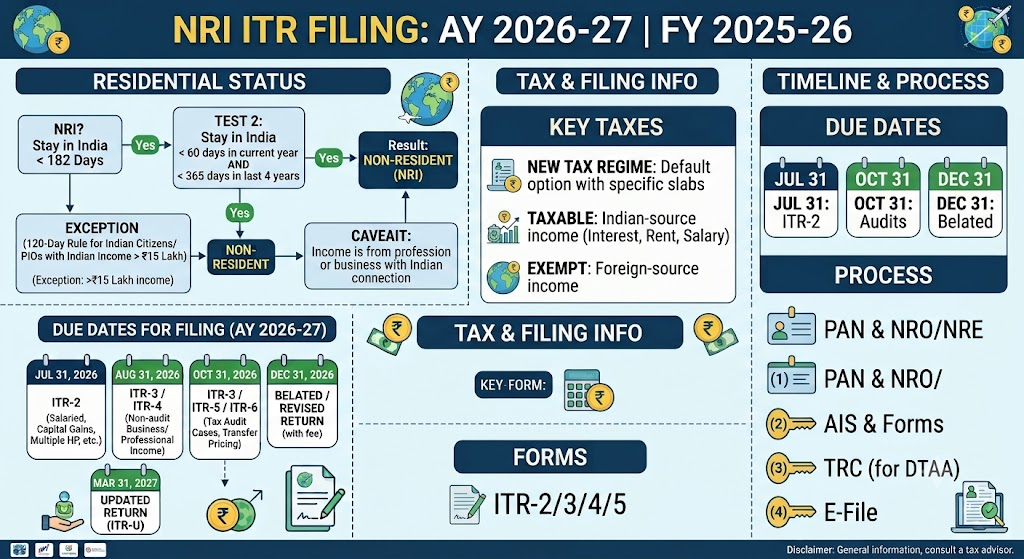
    At Adwani & Company, a chartered accountancy practice that has advised clients on Indian tax and regulatory matters for nearly five decades, the questions from NRI clients rarely sound like “do I owe tax.” They sound like: TDS has already been deducted, so do I still need to file? I sold a property in India, can I get a refund of excess TDS? Is interest on my NRO account taxable? Does moving money between my NRE and NRO accounts create a tax event?

    This blog answers those questions directly, using the rules applicable for FY 2025-26 (AY 2026-27), and explains why NRI ITR filing is often the single most valuable compliance step an NRI can take before the filing season rush begins.


    Do You Really Need NRI ITR Filing? Rethinking the Myth

    The residency-based assumption that non-residents are exempt from Indian tax filing is only half true, and the half that is missing matters. Residential status under the Income Tax Act determines how your income is taxed, not whether your India-sourced income is taxed at all. An NRI’s foreign salary, foreign business income, and foreign investment returns stay outside India’s tax net. But income that arises in India rent, capital gains, interest, dividends remains taxable in India regardless of where you live, and once that income crosses the basic exemption threshold, NRI ITR filing becomes a legal obligation, not an optional courtesy.


    When NRI ITR Filing Becomes Mandatory in FY 2025-26

    For NRIs, filing an Income Tax Return in India is compulsory once total India-sourced income exceeds the basic exemption limit for the relevant year ₹2.5 lakh under the old tax regime, or the higher threshold available under the new regime. Even below that limit, NRI ITR filing is strongly advisable in three common situations: when tax has already been deducted at source and a refund is due,

    when the NRI needs proof of filing for a future loan or visa application, or when the NRI wants to carry forward capital losses to offset future gains. Because most NRI income sources rent, NRO interest, capital gains attract deduction of tax at source at fairly steep rates, the second scenario applies to a large share of NRIs even when they assume otherwise.


    Rental Income, TDS, and Property Sale: The Real Triggers

    Rental income earned from an Indian property is fully taxable in India for an NRI, and tenants are required to deduct TDS before paying rent, typically at 30%. Since the actual tax liability at slab rates is usually lower than the flat TDS rate, NRI ITR filing is the only route to recover that difference as a refund.

    Property sale creates a similar, and often larger, gap. When an NRI sells property in India, the buyer must deduct TDS on the transaction under the provisions governing payments to non-residents, and this deduction is calculated on the full sale value rather than on the actual capital gain unless a lower-deduction certificate has been obtained in advance.

    This means an NRI can have a substantial amount of money locked up with the Income Tax Department for months, simply because TDS was deducted on the gross consideration instead of the taxable gain. NRI ITR filing is what unlocks that excess deduction and brings it back as a refund.


    NRO Interest and NRE-NRO Transfers: What the Law Says

    Interest earned on an NRE (Non-Resident External) account is exempt from Indian tax, provided FEMA conditions are met. Interest earned on an NRO (Non-Resident Ordinary) account, however, is fully taxable in India at applicable slab rates, and banks typically deduct TDS at 30% on this interest — again, usually higher than the NRI’s actual tax liability, and again, a reason NRI ITR filing often results in money coming back rather than going out.

    As for moving funds between accounts, a straightforward transfer from an NRE account to an NRO account, or vice versa, is not itself a taxable event. What matters is the underlying income: if the funds being transferred originated from taxable Indian income, that income remains taxable regardless of which account it eventually sits in.

    Learn more about our NRI Taxation Advisory Services for a structured review of your account-level tax exposure.

    Read our detailed guide on NRI ITR Filing 2026: Costly Mistakes & Smart Tax Strategies


    Deductions and Reliefs NRIs Can Still Claim

    NRIs are not excluded from Chapter VI-A deductions altogether. Section 80C deductions remain available for eligible investments such as life insurance premiums and children’s tuition fees, though certain resident-only instruments like PPF are not open to NRIs. Section 80D deductions for health insurance premiums paid for self, spouse, and dependents also remain available.

    NRIs investing in the National Pension System can claim deductions under Section 80CCD. Where India has signed a Double Taxation Avoidance Agreement with the NRI’s country of residence and India now has such agreements with over ninety countries NRI ITR filing is also the mechanism through which DTAA relief is formally claimed, preventing the same income from being taxed twice.

    Practical Example An NRI earns ₹9 lakh in interest from an NRO fixed deposit. The bank deducts TDS at 30% (₹2.7 lakh). If actual tax liability at slab rates works out to roughly ₹90,000, the NRI has overpaid by ₹1.8 lakh. Without NRI ITR filing, that amount stays with the Income Tax Department. With a correctly filed return, it is refunded directly to a pre-validated Indian bank account.


    Documents Required for NRI ITR Filing

    A smooth NRI ITR filing exercise generally requires the following:

    • PAN and passport copies confirming NRI status
    • Form 26AS and the Annual Information Statement, downloaded from the Income Tax Department’s e-filing portal
    • NRE and NRO bank interest certificates
    • TDS certificates for rent or property sale
    • Housing loan interest certificate, where applicable
    • Capital gains statements for any property or securities sold
    • A Tax Residency Certificate from the country of residence, where DTAA relief is being claimed

    Read our detailed guide on Capital Gains Tax Planning for NRIs for a deeper look at property and securities transactions.

    Why Professional Guidance Matters

    NRI taxation sits at the intersection of the Income Tax Act, FEMA regulations, and, in many cases, treaty law a combination that rarely rewards a do-it-yourself approach. Dr. Haresh Adwani, who holds a PhD in Commerce and is also a law graduate, brings this combination of taxation and legal expertise to NRI clients at Adwani & Company, helping structure filings so that refunds are claimed correctly the first time and future property transactions, loans, or repatriation of funds are not complicated by earlier compliance gaps. Under

    Dr. Haresh Adwani’s guidance, the firm’s NRI practice focuses on getting the residential-status determination right at the outset, since almost every downstream tax question depends on that single classification. For businesses and individuals verifying company-level filings alongside personal NRI returns, cross-checking data available through the Ministry of Corporate Affairs portal is also good practice, since inconsistencies across different regulatory filings can attract scrutiny.

    1.Do I need to file an ITR in India if I only earn rental income?

    Yes, if that rental income exceeds the basic exemption limit, NRI ITR filing is mandatory. Even below that limit, filing is advisable to claim a refund of TDS deducted by the tenant.

    2.TDS has already been deducted on my income. Do I still need to file a return?

    Yes. TDS deduction does not close your compliance obligation. NRI ITR filing is how you reconcile the tax actually deducted against your real liability and claim any excess as a refund.

    3.I sold a property in India. Can I claim a refund of excess TDS?

    In most cases, yes. Since TDS on an NRI’s property sale is usually calculated on the gross sale value rather than the actual capital gain, NRI ITR filing is typically required to recover the difference.

    4.Is interest on my NRO account taxable in India?

    Yes, NRO account interest is fully taxable at applicable slab rates, unlike NRE account interest, which is exempt.

    5.Does transferring money between my NRE and NRO accounts create a tax liability?

    The transfer itself is not taxable; what matters is whether the underlying funds represent taxable Indian income.

    6.Will NRI ITR filing help with future property purchases or loans in India?

    Yes. A consistent filing history strengthens documentation for future property transactions, loan applications, and fund repatriation.

    Conclusion: File Before the Rush Begins

    NRI ITR filing is not a formality reserved for those who “owe” the government money. For most NRIs with rental income, NRO interest, or a recent property sale, it is the route to a refund that would otherwise sit unclaimed. A few weeks of preparation gathering TDS certificates, reconciling Form 26AS, checking DTAA eligibility can save months of follow-up and a genuinely avoidable tax outflow. Dr. Haresh Adwani and the team at Adwani & Company have guided NRI clients through exactly this process for decades, and the firm’s structured approach means your India tax position is reviewed well before the deadline crunch. If you want expert guidance on NRI ITR filing, connect with Adwani and Company today and get clarity on your compliance position before the filing rush begins.

    About the Author
    Dr. Haresh Adwani
    Ph.D. in Commerce | Law Graduate | Managing Partner, Adwani & Co LLP Dr. Haresh Adwani holds a Ph.D. in Commerce and is a qualified Law graduate with over two decades of hands-on experience in GST advisory, direct taxation, and statutory compliance for businesses across Pune and Maharashtra has guided hundreds of SMEs, startups, and corporates through India’s evolving tax landscape. He is a recognised advisor on GST compliance, company formation, and Virtual CFO services, and regularly contributes to professional seminars and industry forums in Pune.

    Don’t risk a defective return notice. Connect with Adwani and Company today for expert ITR filing guidance tailored to your income profile for AY 2026-27.


    Disclaimer: This article is published for informational and educational purposes only. It does not constitute legal, financial, or professional tax advice. Tax laws are subject to change; readers are advised to consult a qualified Chartered Accountant or tax professional for advice specific to their circumstances. Content has been prepared with reference to provisions of the Income Tax Act, 1961 and publicly available CBDT guidelines.


  • The 120: Day Rule That Is Silently Taxing Thousands of NRIs in India

    The 120: Day Rule That Is Silently Taxing Thousands of NRIs in India

    The Dangerous Myth Many NRIs Still Believe

    “I live outside India, so I am an NRI. My foreign income is safe.”

    This belief simple, logical-sounding, and widely held is wrong for a growing number of NRIs. And the consequences of getting this wrong are not a minor inconvenience. They can fundamentally change how your entire global income is taxed, expose previously protected foreign accounts to Indian disclosure requirements, and trigger tax liabilities you had no idea were coming.

    Dr. Haresh Adwani of Adwani & Company regularly encounters NRI clients who discover their residential status has shifted not because they moved back to India, but because they visited more frequently than they tracked. A wedding here. A family emergency there. A few extra weeks that felt harmless. And then the days added up past a number that changed everything: 120.

    According to the Income Tax Department of India, a specific amendment introduced via the Finance Act 2020 tightened the rules for determining NRI status for individuals with significant Indian income. Understanding this rule is now essential for every NRI who visits India regularly not just those planning to return permanently.

    The Core Risk

    If you have Indian income exceeding ₹15 lakh and spend 120 days or more in India in a financial year while also having stayed 365+ days cumulatively over the previous four years India may tax you as a resident, including on your foreign income.

    The 120-Day Rule That Is Silently Taxing Thousands of NRIs in India
    The 120-Day Rule That Is Silently Taxing Thousands of NRIs in India

    The 120-Day NRI Tax Rule Explained

    The standard rule most NRIs know is the 182 day rule: if you spend fewer than 182 days in India in a financial year, you are classified as a Non Resident Indian and your foreign income is not taxable in India. This rule still applies but with an important and often overlooked exception introduced by the Finance Act 2020.

    Under the amended provisions of Section 6 of the Income Tax Act, 1961, a person who is a citizen of India or a Person of Indian Origin (PIO) is treated as a resident of India if all three of the following conditions are simultaneously met:


    The Three-Condition Test Section 6, Income Tax Act 1961

    1. Indian Income Threshold: Your total income from Indian sources including salary from Indian employers, rental income from property in India, interest from NRO accounts, or dividends from Indian companies exceeds ₹15 lakh in the relevant financial year.

    2. Current Year Stay: You stayed in India for 120 days or more during that financial year (April 1 to March 31), regardless of whether the stays were continuous or spread across multiple visits.

    3. Cumulative Stay: You stayed in India for a cumulative total of 365 days or more over the four financial years immediately preceding the relevant year.

    This rule was specifically introduced to address cases where high-income individuals were spending substantial time in India while claiming NRI status to shield their foreign income from Indian tax. The 15 lakh threshold ensures it does not affect NRIs with limited Indian income, but for NRIs with property, investments, or employment connections in India generating significant returns, this rule is highly relevant.

    Also Read:

    https://www.adwaniandco.com/blog/financial-modeling-for-business-valuation-normalized-eps-explained-india-guide


    How 120 Days Add Up Without You Noticing

    120 days is not a lot. It is approximately four months. And for an NRI who has family, property, or business interests in India, four months across a year is entirely conceivable even without any intention to stay long-term.

    Here is how a typical NRI’s year might look without conscious tracking:

    December to January

    Annual family visit over the holiday season. Stayed a bit longer to attend a cousin’s wedding.38 days

    March to April

    Parent’s health issue. Flew down urgently, managed medical matters, returned after recovery.28 days · Running total: 66

    June

    Brief trip to handle property matters and meet the family lawyer. Extended slightly for a puja.18 days · Running total: 84

    October to November

    Diwali visit. Stayed on for sibling’s anniversary function and a school reunion.40 days · Total: 124 days ⚠ Limit crossed

    In the above scenario, no single trip looks excessive. But the cumulative total of 124 days combined with Indian rental or investment income exceeding ₹15 lakh may be enough to trigger the residency test. Most NRIs in this situation do not discover the problem until they receive an Income Tax notice or an AIS (Annual Information Statement) query from the tax department.


    What Changes When You Lose NRI Status Under the 120-Day Rule

    The moment India classifies you as a tax resident even temporarily the scope of your taxable income expands dramatically. India’s tax jurisdiction now potentially extends to:

    Income TypeBefore (as NRI)After (as Resident)
    Indian salary or rental incomeTaxable in IndiaTaxable in India
    Foreign salary / employment incomeNot TaxableFully Taxable
    Interest from foreign bank accountsNot TaxableFully Taxable
    Rent from property outside IndiaNot TaxableFully Taxable
    Capital gains from foreign stocksNot TaxableFully Taxable
    Dividends from global investmentsNot TaxableFully Taxable
    Foreign assets disclosure required?Not RequiredMandatory in ITR

    Beyond the income tax dimension, the change in residency status also triggers FEMA obligations. Foreign bank accounts that were perfectly legal as an NRI must now be reconsidered. NRE account operations as a resident are a FEMA violation. The Reserve Bank of India requires specific account re-designations that many NRIs are unaware of.

    FEMA Alert

    Operating an NRE (Non-Resident External) bank account after your residential status changes to Resident is a violation of FEMA regulations. Re-designation to an RFC (Resident Foreign Currency) account is mandatory and must happen promptly. Learn more about FEMA Compliance for NRIs at Adwani & Company.


    RNOR Status: The Safety Net You May Still Have

    There is some good news. Even if your residential status does shift from NRI to Resident, you may not immediately become an ROR (Resident and Ordinarily Resident). Depending on your prior years of NRI status, you may qualify for RNOR Resident but Not Ordinarily Resident.

    RNOR is a transitional status that continues to protect your foreign income from Indian taxation for a limited period typically two to three financial years. A person qualifies as RNOR if they have been non-resident in India in at least 9 of the 10 financial years preceding the relevant year, or have stayed in India for 729 days or fewer in the 7 preceding financial years.

    The RNOR Advantage

    During RNOR status, income earned outside India that is not received or deemed to arise in India remains outside India’s tax net. This protection window if you qualify gives you time to restructure investments, repatriate funds, and plan asset liquidation before full ROR status applies. Identifying and using this window is a core part of Dr. Haresh Adwani’s NRI tax advisory practice.


    Real Example: How One NRI Was Caught Off Guard

    Priya K., Finance Professional London to Repeated India Visits

    Priya worked in London for 9 years. She owned two flats in Mumbai generating a combined rental income of 22 lakh per year. She visited India frequently a December family trip, an April medical visit for her mother, a July trip for property matters, and a Diwali trip in November. Total India stay for the financial year: 131 days.

    Priya had no plans to return to India permanently. She considered herself a straightforward NRI. She had never counted her days.

    What Happened: With Indian rental income of ₹22 lakh (above 15 lakh threshold), 131 India days in the year, and cumulative stays well above 365 days in the preceding four years, all three conditions under Section 6 were satisfied. Priya was reclassified as a Resident for that financial year. Her UK salary, London savings account interest, and gains from UK equity funds previously untouched by Indian tax became taxable in India. Her NRE account operation during that period was also flagged as a FEMA concern.

    Lesson: Indian income above ₹15 lakh + 120+ India days = a combination you must actively monitor every financial year not just when planning a permanent return.


    Two Critical Things to Check Before March 31 Every Year

    You do not need to overhaul your life to manage this risk. But you do need to be proactive. Dr. Haresh Adwani recommends every NRI with significant Indian income complete two simple checks before March 31 of each financial year:

    1. Count your India days precisely. Add up every day you were physically present in India between April 1 and the current date. Include partial days. Compare against the 120-day threshold. If you are approaching it, plan your departure accordingly.

    2. Review your Indian income for the year. Total up all income from Indian sources rent, NRO interest, dividends from Indian shares, salary from Indian employers. If this exceeds ₹15 lakh and you are near 120 India days, the risk is real.

    Also Check Your Cumulative Stay

    Even if this year’s India stay is below 120 days, check your cumulative India days across the previous four financial years. If you are approaching or have crossed 365 cumulative days over that period, your buffer for the current year is already reduced. Tracking this four year rolling total is an important part of ongoing NRI residency status management.

    Read our detailed guide on NRI Residential Status and Day-Count Management — A Practical Guide for year-by-year tracking strategies.


    Conclusion: 120 Days Is Not Just a Number It Is a Tax Turning Point

    The 120-day NRI tax rule is not obscure fine print. It is an active provision in the Income Tax Act that has real consequences for any NRI with meaningful Indian income and regular visits home. The mistake most people make is not wilful it is simply a lack of awareness. Nobody warns you at the airport. No bank sends you a reminder. The days accumulate quietly, and the tax implications arrive months later via a notice or during ITR filing.

    The solution is equally simple: awareness and tracking. Know which rule applies to you 182 days or 120 days based on your Indian income level. Track your India days carefully across every financial year. Check the four-year cumulative total annually. And if you are approaching either threshold, plan the calendar accordingly or consult a qualified NRI tax advisor before year-end.

    As Dr. Haresh Adwani consistently advises NRI clients: one hour of planning before March 31 can prevent one year of tax complications after it. Do not let 120 days become the most expensive number in your financial life.

    Frequently Asked Questions

    1. Does the-day rules apply to all NRIs or only those with high Indian income

    The 120 day rule applies specifically to NRIs whose total Indian income exceeds 15 lakh in the relevant financial year. If your Indian income is below ₹15 lakh, the standard 182 day rule continues to apply. However, ₹15 lakh is not a high threshold it is approximately ₹1.25 lakh per month. Many NRIs with property generating rental income, NRO fixed deposits, or dividend income from Indian investments can easily cross this level. It is worth calculating your Indian income annually to know which rule applies to you in any given year.

    2. Are days in Transit through indian airports counted toward the 120 days?

    Generally, days spent in India in transit where you do not leave the international transit area of the airport are not counted as days of presence in India. However, if you exit the airport and enter Indian territory, even briefly, that day counts. With the increasing prevalence of stopovers and long haul connections through Indian airports, NRIs should be cautious. If in doubt, it is safer to route connecting flights through airports outside India or to keep international transit strictly within the airport’s transit zone. This is a detail worth clarifying with a qualified NRI tax advisor for your specific travel pattern.

    3. If i become a resident due to the 120-days rule, do i loose NRI status permanently?

    No. Residential status in India is determined year by year, based on physical presence in each financial year. If you become a resident in one financial year due to the 120 day rule, but in the following year you stay below the applicable threshold (182 days under the standard rule, or 120 days if the three-condition test again applies), you can revert to NRI status for that next year. However, the years in which you were classified as resident will be counted in the rolling four year cumulative stay calculation. This is why tracking your stay carefully each year is important a single year of resident status can have multi year implications for the cumulative stay count.

    4. what happens to my NRE account if i am classified as resident under the 120-day rule?

    Under FEMA regulations, NRE accounts are meant exclusively for Non Resident Indians. If your residential status changes to Resident even for one financial year under the 120day rule your NRE account must be re-designated to an RFC (Resident Foreign Currency) account or a regular resident savings account. Failure to do so is a FEMA violation. The interest income earned on NRE accounts is tax exempt as long as you maintain NRI status. Once you become a resident, NRE interest becomes taxable. The NRO account, on the other hand, is the appropriate account for residents with Indian source income. Proactive account management is essential, and Adwani & Company guides NRI clients through this process.

    5. can RNOR status protected my foreign income even if I am reclassified as resident?

    Possibly, but it depends on your specific history. RNOR (Resident but Not Ordinarily Resident) status is available if you qualify under the conditions in Section 6(6) of the Income Tax Act specifically, if you have been non-resident in India in 9 of the 10 immediately preceding financial years. If you qualify as RNOR rather than full ROR, your foreign income that is not received in India remains outside India’s tax net. This is an important distinction it means the transition from NRI to Resident does not automatically make all your foreign income taxable if RNOR applies. Dr. Haresh Adwani can assess your specific years of NRI history to determine whether RNOR protection applies.

    6. Do i need to disclose foreign bank accounts if I become resident for just one year?

    Yes. For the financial year in which you are classified as Resident and Ordinarily Resident (ROR), you are required to disclose all foreign bank accounts and assets in Schedule FA of your Income Tax Return. If you qualify as RNOR rather than ROR, the disclosure obligations are less extensive but still exist for assets with Indian connections. Non disclosure under the Black Money Act can attract penalties of 90% of the undisclosed amount plus 30% tax, regardless of whether the non-disclosure was intentional. Voluntary disclosure, guided by a qualified NRI tax advisor, is always the safest approach.

    7. I have rental Income from Two indian Properties totalling Rs.18Lakh.How may days can i safely stay in india?

    Since your Indian income exceeds ₹15 lakh, the 120-day rule applies to you rather than the standard 182-day rule. This means you must ensure your India stay does not reach or exceed 120 days in any financial year, provided your cumulative India stay over the preceding four years has crossed or is approaching 365 days. If the cumulative four year stay has not yet reached 365 days, you have more flexibility but it is worth tracking carefully as this total will grow over time. The practical safe limit, to maintain a comfortable buffer, is typically 100 to 105 days per year if both conditions are close to being met. Consulting Dr. Haresh Adwani at Adwani & Company for a personalised residency status assessment is strongly advisable given your income level.

    Author

    Dr. Haresh Adwani

    PhD (Commerce) · Adwani & Company, Pune

    Dr. Haresh Adwani is a PhD holder in Commerce with over 20 years of experience in NRI taxation, FEMA compliance, international financial advisory, and tax notice resolution. He is one of Pune’s most trusted NRI tax advisors, specialising in residential status assessment, DTAA planning, and cross-border compliance for professionals returning from the US, UK, UAE, Canada, and Australia.

    Legal Disclaimer: This article is published for informational and educational purposes only. Nothing contained herein constitutes legal, financial, or tax advice, nor should it be treated as a substitute for professional consultation tailored to your specific circumstances. Tax laws, rates, and provisions are subject to change; readers are strongly advised to consult a qualified Chartered Accountant or tax advisor before acting on any information in this article.

    All content is original. References to government portals and statutory provisions are paraphrased for educational purposes in compliance with fair use principles. No content has been reproduced from third-party sources