Tag: ITR Filling

  • 31 August ITR Filing Deadline: Why Waiting Is Risky

    31 August ITR Filing Deadline: Why Waiting Is Risky

    ITR Filing Deadline: Why Waiting Is Risky

    “We’ve kept everything ready. We’ll file the ITR on 31 August itself. It should only take a few minutes, right?” That is what a business owner told our team at Adwani and Company late one evening. What seemed like a five-minute task turned into a five hour ordeal a slow Income Tax portal, a missing Form 16A, and a mismatch flagged in the Annual Information Statement (AIS) turned a routine filing into a stressful, last-minute scramble. If you are planning to wait until the 31 August ITR filing deadline to file your return, this is the story you need to read first.
    Why the 31 August ITR Filing Deadline Feels Deceptively Simple

    For FY 2025-26 (AY 2026-27), business owners and professionals whose accounts do not require an audit have an extended window the 31 August ITR filing deadline, one month later than the 31 July date that applies to salaried taxpayers filing ITR-1 or ITR-2. That extra month feels like breathing room. In practice, it often becomes an excuse to postpone documentation, and the 31 August ITR filing deadline arrives with the same panic that a shorter deadline would have caused.

    At Adwani and Company, a Pune based chartered accountancy firm serving clients since 1977, we see this pattern every single year, across small traders, consultants, freelancers, and growing businesses.

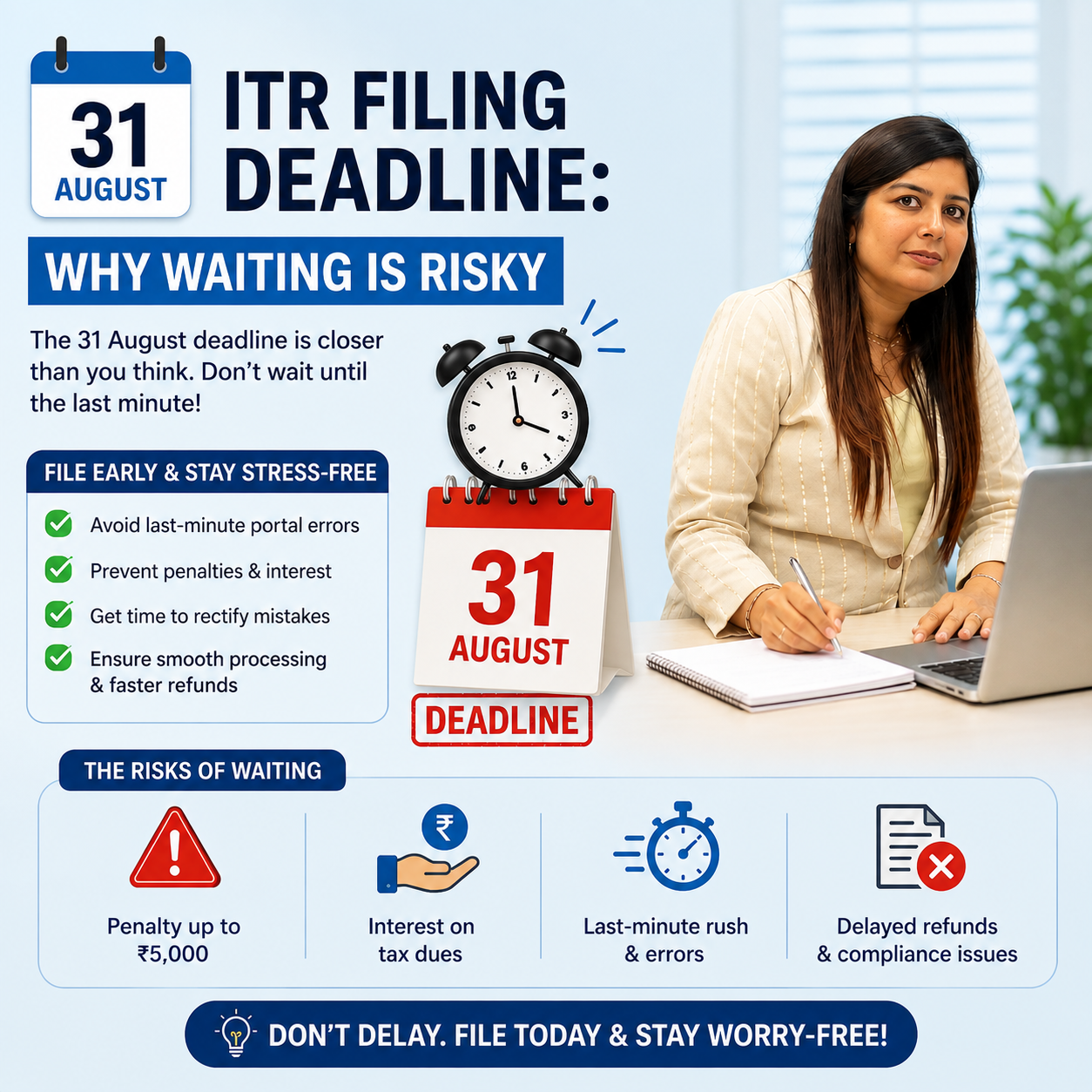
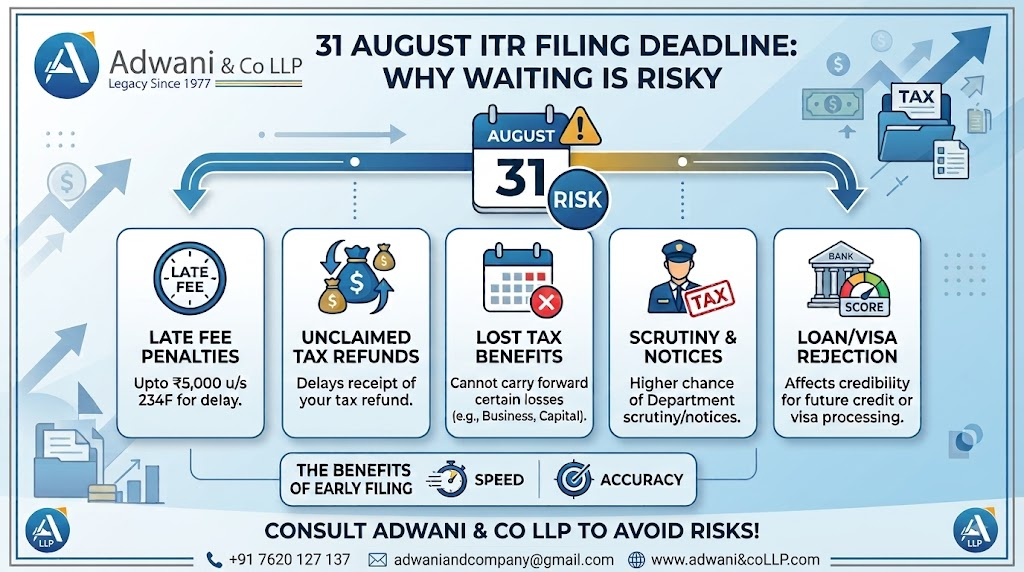
    5 Reasons Why Waiting Until the 31 August ITR Filing Deadline Is a Risky Strategy

    1. Portal Congestion Near the 31 August ITR Filing Deadline

    As lakhs of taxpayers log in on the same day, the Income Tax Department’s e filing portal experiences heavy traffic close to the 31 August ITR filing deadline. Slow load times, OTP delays, and payment gateway failures are common in the final 48 hours, and a single failed submission can push you past midnight.

    2. Missing Documents Discovered Too Late

    Many returns filed near the 31 August ITR filing deadline are delayed because of incomplete paperwork a forgotten bank interest certificate, an untracked Form 16A, a capital gains statement from a broker, or turnover figures that do not match the books. Gathering these on the last day rarely goes smoothly.

    3. Higher Chances of Errors

    Rushing to beat the 31 August ITR filing deadline increases the likelihood of small but costly mistakes incorrect income figures, missed disclosures, or a mismatch between your return and the AIS or Form 26AS. Errors like these frequently trigger a compliance notice long after the deadline has passed.

    4. Refund Delays

    Processing timelines depend partly on when a return enters the queue. Filing well before the 31 August ITR filing deadline generally means faster processing; filing on the last day pushes your return and your refund behind millions of others submitted the same week.

    5. Unnecessary Stress

    The final day before the 31 August ITR filing deadline should not be spent worrying about OTPs, portal errors, or whether the return went through. Tax compliance is far less stressful, and far more accurate, when it is planned weeks in advance rather than rushed in the final hours.

    A Real Example: What a Delay Near the 31 August ITR Filing Deadline Can Cost

    Example A consultant with ₹40,000 in unpaid self-assessment tax files 20 days after the 31 August ITR filing deadline. Under Section 234A, interest of 1% per month (or part of a month) applies on the outstanding tax, so even a 20-day delay counts as a full month adding ₹400 in interest. Because total income exceeds ₹5 lakh, a late filing fee of ₹5,000 under Section 234F also applies. That is ₹5,400 in avoidable cost, plus the risk of losing the ability to carry forward business or capital losses all for filing three weeks late instead of three weeks early.

    What the 31 August ITR Filing Deadline Really Tests

    A compliance notice rarely appears out of nowhere. Behind most last-minute filing problems is the same root cause: documentation that was never organised through the year. The 31 August ITR filing deadline is not really about the act of filing it is about whether your books, GST returns, TDS records, and bank statements are reconciled and ready.

    According to guidance available on the Income Tax Department’s official e-filing portal, taxpayers are encouraged to reconcile their AIS and Form 26AS before submitting a return, since these statements now draw data from banks, mutual funds, employers, and GST filings in one place. A mismatch anywhere in this chain can hold up processing well beyond the 31 August ITR filing deadline itself.

    Turnover mismatches between an ITR and financial statements filed with the Ministry of Corporate Affairs (MCA), or between GST returns on the GST Portal and income tax filings, are another common trigger for departmental scrutiny one more reason to reconcile early rather than rush late.

    At Adwani and Company, Dr. Haresh Adwani, a PhD holder in Commerce and a law graduate, leads our approach to pre-deadline compliance planning, combining taxation expertise with legal training to help business owners resolve documentation gaps before they become notices. Dr. Haresh Adwani has long maintained that the businesses least affected by deadline stress are the ones that treat tax filing as a year-round discipline rather than a once-a-year event.

    Learn more about our ITR Filing and Tax Advisory Services our team helps business owners reconcile GST, TDS, and AIS records well ahead of the 31 August ITR filing deadline, rather than in the final week.

    Read our detailed guide on ITR Filing 2026: Beat the Deadline & Save More

    How to File Before the 31 August ITR Filing Deadline Without the Rush

    • Start collecting Form 16A, interest certificates, and capital gains statements at least three weeks in advance.
    • Reconcile your AIS and Form 26AS against your own books, not the other way around.
    • Cross-check GST turnover reported on the GST Portal against the figures you plan to report in your ITR, and for companies, against financial statements filed with the MCA.
    • File the return, then verify it an unverified return is treated as not filed at all.
    • Keep a buffer of at least five working days before the 31 August ITR filing deadline for corrections.

    Dr. Haresh Adwani notes that a return filed accurately two weeks before the 31 August ITR filing deadline is worth far more than one filed in a panic on the last evening accuracy, not speed, is what protects a business from future scrutiny.

    The Best Strategy Isn’t the 31 August ITR Filing Deadline Itself

    The best tax strategy is not filing on the last day it is filing the right return, at the right time, with every figure reconciled. If your return is still pending, start gathering your documentation today. Don’t let the 31 August ITR filing deadline remind you to act; let it be the backup plan, not the strategy.

    Q1. Who has the 31 August ITR filing deadline for FY 2025-26 (AY 2026-27)?

    Business owners and professionals whose accounts do not require an audit have the 31 August ITR filing deadline. This is one month later than the 31 July deadline that applies to salaried taxpayers filing ITR-1 or ITR-2.

    Q2. What happens if I miss the 31 August ITR filing deadline?

    You can still file a belated return, but you will owe a late filing fee under Section 234F, interest under Section 234A on any unpaid tax, and you may lose the right to carry forward certain business or capital losses.

    Q3. Is the 31 August ITR filing deadline likely to be extended?

    Extensions are announced only by the Income Tax Department when technical or procedural issues justify one. Treating a possible extension as your filing strategy is a risky approach, not a plan.

    Q4. How does an AIS mismatch affect filing before the 31 August ITR filing deadline?

    A mismatch between your return and the Annual Information Statement can delay refund processing and may trigger a compliance query, even when the mismatch is minor or unintentional.

    Q5. Can a chartered accountant help me file faster before the 31 August ITR filing deadline?

    Yes. A CA can reconcile your AIS, Form 26AS and GST records in advance, flag missing documents early, and help you file an accurate return well ahead of the 31 August ITR filing deadline instead of in the final rush.

    Q6. What is the Section 234F penalty for missing the ITR deadline?

    For total income above ₹5 lakh, the late fee is ₹5,000; for income up to ₹5 lakh, it is ₹1,000. Taxpayers below the basic exemption limit generally face no late fee.

    Conclusion: File Before the 31 August ITR Filing Deadline, Not On It

    Waiting for the 31 August ITR filing deadline to force your hand rarely ends well the case we opened with is one of dozens we see every season. If your documentation is incomplete, your AIS shows a mismatch, or you are simply unsure where to start, connect with Adwani and Company today. Our team, led by professionals including Dr. Haresh Adwani, can help you file accurately and stress-free well before the 31 August ITR filing deadline arrives.

    Disclaimer: This blog is for informational purposes only and does not constitute professional tax, legal, or financial advice. Tax laws and deadlines are subject to change; readers should verify current provisions on the Income Tax Department’s official portal or consult a qualified chartered accountant before acting on any information here.

    About the Author
    Nidhi Adwani

    Nidhi Adwani is the Human Resources Manager at Adwani & Co. She is a Law Graduate and holds an MBA in Human Resources. She manages recruitment, employee engagement, team development, workplace culture, and the firm’s social media and content activities. Passionate about people and organizational growth, she also contributes articles for ITRAdvisor and Adwani & Co. Her writing focuses on HR practices, leadership, workplace engagement, and professional development, offering practical insights for professionals and businesses.
  • Income Below ₹12 Lakh? Why ITR Filing Below 12 Lakh Still Matters

    Income Below ₹12 Lakh? Why ITR Filing Below 12 Lakh Still Matters

    Income Below ₹12 Lakh?

    ITR Filing Below 12 Lakh Still Matters

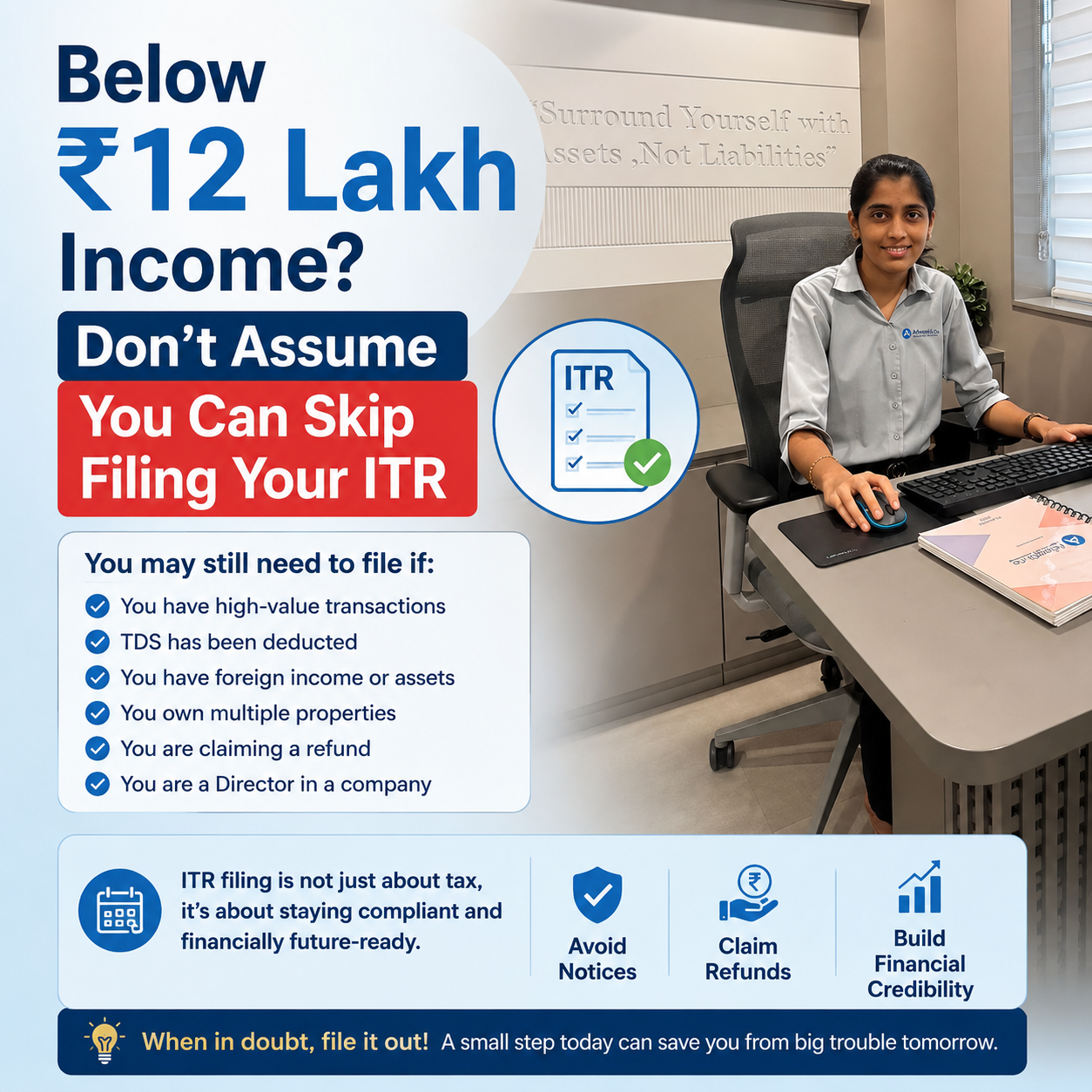
    “₹12 lakh” has become shorthand for “no tax” this filing season. Thanks to the enhanced Section 87A rebate, income up to ₹12 lakh under the new tax regime now attracts zero tax liability for AY 2026-27. But a dangerous myth has grown alongside this relief: many taxpayers assume that if their income sits below ₹12 lakh, they can skip filing an Income Tax Return altogether. That assumption is wrong and it can cost you a refund, delay a loan approval, or invite a penalty notice. Understanding the real rules around ITR filing below 12 lakh income is essential before you decide to sit this filing season out.

    The ₹12 Lakh Rebate vs the ITR Filing Below 12 Lakh Requirement

    The Section 87A rebate and the requirement to file are governed by two completely different provisions of the Income Tax Act, and conflating them is the root of the confusion around ITR filing below 12 lakh income.

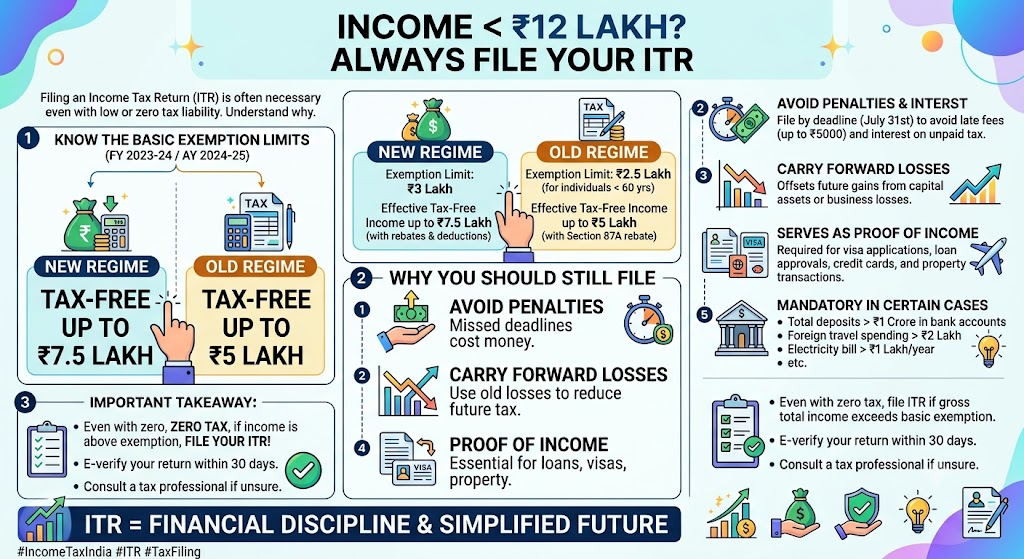
    The rebate under Section 87A brings your tax liability to nil if your taxable income does not exceed ₹12 lakh under the new regime (or ₹5 lakh under the old regime). But your obligation to file a return is tied to your gross total income before deductions crossing the basic exemption limit currently ₹4 lakh under the new regime and ₹2.5 lakh under the old regime. A taxpayer earning ₹10 lakh may pay zero tax after the rebate, yet their gross income of ₹10 lakh is still well above the ₹4 lakh exemption limit, which means ITR filing below 12 lakh income remains legally mandatory in this case.


    Key Distinction

    • Zero tax liability (Section 87A rebate) does not mean zero filing obligation.
    • Filing depends on gross total income crossing the exemption limit, not on the tax finally payable.

    The exemption limit is far lower (₹4 lakh) than the ₹12 lakh rebate threshold.


    When Is ITR Filing Below 12 Lakh Income Legally Mandatory?

    Beyond the basic exemption limit, the seventh proviso to Section 139(1) lists specific high-value transactions that trigger mandatory ITR filing below 12 lakh income even when no tax is due. You must file a return if, during the year, you have:

    • Deposited ₹1 crore or more in one or more current bank accounts
    • Deposited ₹50 lakh or more in one or more savings bank accounts
    • Spent ₹2 lakh or more on foreign travel for yourself or another person
    • Paid electricity bills exceeding ₹1 lakh in aggregate during the year
    • Earned business turnover above ₹60 lakh or professional receipts above ₹10 lakh
    • Had TDS or TCS of ₹25,000 or more deducted (₹50,000 for senior citizens)
    • Owned, held signing authority in, or benefited from any foreign asset or foreign bank account

    Meeting even one of these conditions is enough to make ITR filing below 12 lakh income compulsory, irrespective of your final tax liability.


    A Practical Example of ITR Filing Below 12 Lakh Obligation

    Consider Mr. Sharma, a salaried professional with a gross annual income of ₹10.5 lakh under the new tax regime. After the standard deduction and Section 87A rebate, his tax liability works out to nil. He assumes this means he has no filing obligation this year.

    However, Mr. Sharma spent ₹2.3 lakh on a family holiday abroad and maintains a savings account balance that saw deposits of ₹55 lakh during the year. Both facts independently trigger the seventh proviso to Section 139(1). Despite owing zero tax, Mr. Sharma is legally required to complete ITR filing below 12 lakh income and skipping it would expose him to penalty under Section 234F and possible scrutiny notices.


    Why ITR Filing Below 12 Lakh Income Is Still Worth Doing

    Even where filing is not strictly mandatory, voluntary ITR filing below 12 lakh income carries real advantages:

    • Claiming a refund of excess TDS deducted by your employer or bank
    • Building a verifiable income record for loan, credit card, or visa applications
    • Carrying forward capital losses or business losses to set off against future income
    • Reducing the chance of receiving a compliance or mismatch notice later
    • Strengthening your overall financial credibility with banks and regulators

    How to Check Your ITR Filing Below 12 Lakh Obligation

    1: Compute Gross Total Income Before Deductions

    Add up your salary, house property income, capital gains, and other income before claiming any Chapter VI-A deductions. Compare this figure with the basic exemption limit applicable to your regime and age.

    2: Review the Seventh Proviso Conditions

    Check your bank statements, electricity bills, and foreign travel spending against the thresholds listed above.

    3: Check TDS and TCS Credited to Your PAN

    Review your Annual Information Statement (AIS) and Form 26AS on the

    4: Consult a Professional When in Doubt

    Where multiple income heads, foreign assets, or high-value transactions are involved, professional review of your ITR filing below 12 lakh obligation prevents costly errors.


    Common Mistakes Taxpayers Make on ITR Filing Below 12 Lakh Income

    • Assuming nil tax under Section 87A automatically means no filing is required
    • Overlooking mandatory foreign asset and foreign income disclosure requirements
    • Missing out on legitimate TDS refunds by not filing at all
    • Selecting the wrong ITR form for their income profile
    • Ignoring high-value transaction thresholds under the seventh proviso

    Expert Guidance on ITR Filing Below 12 Lakh Cases

    GST law and income tax compliance today involve accounting, procedural, and legal interpretation working together. Dr. Haresh Adwani, PhD (Commerce) and a law graduate, brings this combined expertise to questions around ITR filing below 12 lakh income, helping clients distinguish between tax liability and filing obligation with confidence.

    At Adwani & Co LLP, clients receive a structured review of their income profile, high-value transactions, and TDS position before every filing season, ensuring ITR filing below 12 lakh income decisions are backed by an accurate, documented assessment rather than guesswork.

    Under Income Tax Department guidance and the seventh proviso to Section 139(1), the responsibility to evaluate your own filing obligation rests with the taxpayer — which is exactly where Dr. Haresh Adwani and the team at Adwani & Co LLP add the most value.

    Learn more about our Income Tax Return Filing Services. Read our detailed guide on GST Notice Compliance for Businesses.


    Key Takeaways on ITR Filing Below 12 Lakh Income

    • The ₹12 lakh Section 87A rebate removes your tax liability, not your filing obligation.
    • ITR filing below 12 lakh income is mandatory once gross income crosses ₹4 lakh (new regime) or specified high-value transactions apply.
    • Filing voluntarily helps you claim TDS refunds, carry forward losses, and build financial credibility.

    When in doubt, verify your eligibility against the seventh proviso to Section 139(1) instead of assuming.


    Do I need to file ITR if my income is below ₹12 lakh?

    Possibly yes. Filing depends on your gross total income crossing the ₹4 lakh (new regime) exemption limit or meeting specified high-value transaction conditions, not on whether tax is finally payable.

    Is ITR filing mandatory if my tax is nil under Section 87A?

    Yes, if your gross income before deductions exceeds the basic exemption limit or you meet any seventh proviso condition, ITR filing below 12 lakh income remains mandatory despite nil tax.

    What happens if I skip filing despite being required to?

    You may face a late fee under Section 234F, interest under Section 234A, loss of the right to carry forward losses, and possible scrutiny notices.

    Can I claim a TDS refund without filing an ITR?

    No. Filing a return is the only mechanism to claim a refund of excess TDS or TCS deducted during the year.

    What is the ITR filing deadline for AY 2026-27?

    For most salaried individuals and HUFs without audit requirements, the due date is 31st July 2026; audit cases generally fall due by 31st October 2026.

    Conclusion: Don’t Let the ₹12 Lakh Myth Cost You

    The ₹12 lakh rebate is genuine relief, but it answers only one question how much tax you owe. It does not answer whether you must file. Treat ITR filing below 12 lakh income as a compliance and financial-planning decision, not an assumption. Review your gross income, your high-value transactions, and your TDS position each year before deciding to skip filing.

    About the Author

    Vaishnavi Hole is a CA Finalist and Direct Tax Associate at Adwani & Co LLP, specializing in direct taxation, income tax compliance, and advisory services. She is passionate about simplifying complex tax laws into practical, easy-to-understand insights for businesses and individuals. Through her articles, Vaishnavi shares well-researched perspectives on direct tax developments, compliance, and regulatory updates to help readers make informed financial decisions.

    If you want expert guidance on your ITR filing below 12 lakh obligation, connect with Adwani & Co LLP today for a documented, professional review before the AY 2026-27 deadline.

    Disclaimer

    This article has been prepared by Adwani & Co LLP for general informational and educational purposes only. It does not constitute professional tax, legal, or financial advice and should not be relied upon as a substitute for consultation with a qualified chartered accountant. Readers should seek independent professional advice from Adwani & Co LLP before acting on any information contained herein, based on their specific facts and circumstances.