
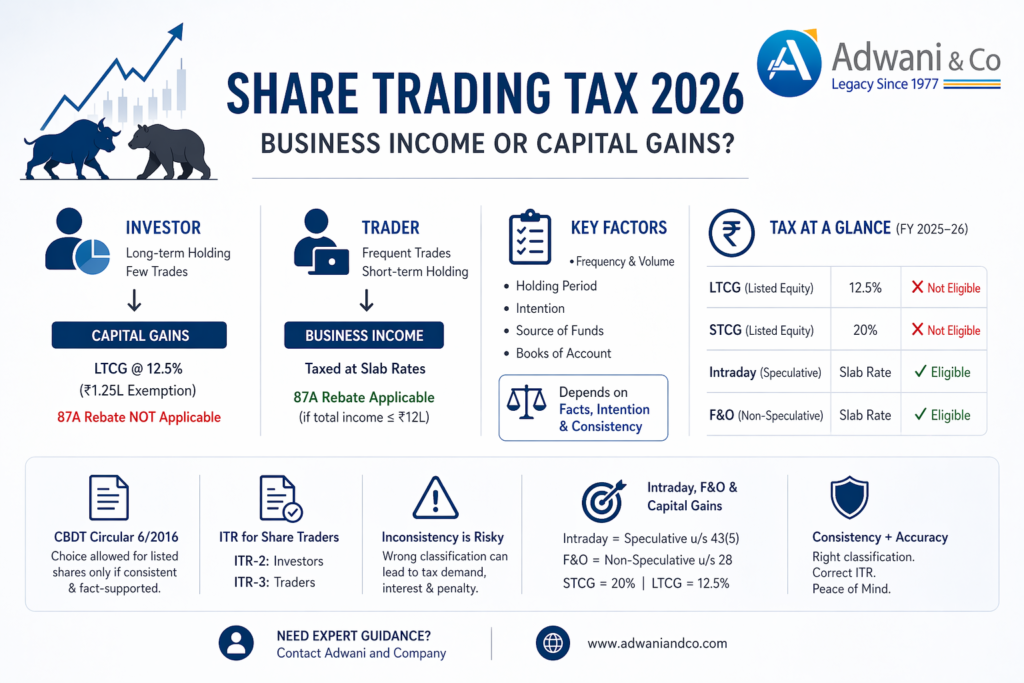
1. The ₹12 Lakh Question Every Share Trader Is Asking
Every tax season, a particular question circulates in trading groups, WhatsApp chats, and CA waiting rooms across India. In FY 2025–26 (AY 2026–27), with the new tax regime firmly in place and the ₹12 lakh rebate under Section 87A making headlines, that question has reached a fever pitch:
| “If my total income is below ₹12 lakhs, can I show my share trading profits as Business Income to bring my taxable income below the rebate threshold and pay zero tax?” |
It sounds clever. It sounds like a legal loophole. But according to Indian tax law and the consistent position taken by the Income Tax Department the share trading tax treatment is not a matter of personal convenience. It is a matter of legal classification governed by well-settled principles.
At Adwani and Company, one of Pune’s most trusted CA firms, we deal with exactly this share trading tax classification question every single week. Dr. Haresh Adwani, has guided hundreds of investors and active traders through the maze of share trading tax rules. This blog is your definitive guide to understanding how your share market profits are legally classified and what you absolutely must not get wrong in your ITR.
Also Read:
2. What the Income Tax Act Actually Says About Share Trading Tax
Let us start with the single most important truth in this entire debate: there is no specific section in the Income Tax Act, 1961 that categorically declares share trading income must always be Business Income. Equally, no provision forces every investor to treat profits as Capital Gains.
The share trading tax classification depends on applying principles drawn from three key provisions:
| Section | Provision | Relevance to Share Trading Tax |
| Section 2(13) | Definition of Business | Includes any trade, commerce, or adventure in the nature of trade. Courts have interpreted this broadly to cover frequent share trading. |
| Section 28 | Profits and Gains from Business or Profession | Governs taxation of profits from any business carried on by the assessee applicable when trading is the primary activity. |
| Section 45 | Capital Gains | Any profit from transfer of a capital asset is taxable here the natural classification for long-term investors holding shares as investments. |
The Income Tax Department does not automatically assign you a category. The classification of share trading tax whether as Business Income or Capital Gains is entirely fact-specific. It depends on who you are, how you trade, why you trade, and how you maintain your books of account.
Reference: Income Tax Department of India incometaxindia.gov.in
3. Business Income vs Capital Gains: The Real Legal Test
Courts and the Income Tax Department have consistently held that the real test in determining share trading tax treatment is a simple but powerful question: Are you an investor or a trader?
This is not a question you can answer arbitrarily based on what saves you tax. As Dr. Haresh Adwani explains to clients at Adwani and Company:
| “The answer to whether your share trading income is Business Income or Capital Gains must emerge from the facts of your situation not from whichever classification happens to reduce your tax liability.” Dr. Haresh Adwani, Adwani and Company |
Indian courts, including various High Courts and the Hon’ble Supreme Court, have developed a well-settled body of case law around this distinction. The intention of the taxpayer at the time of entering a transaction is a central factor but intention must always be corroborated by actual conduct and documentary evidence.
4. Key Factors That Determine Share Trading Tax Classification
The Assessing Officer (AO), during a scrutiny assessment under Section 143(3), applies a multi-factor test to determine whether your share trading income should be taxed as Business Income or Capital Gains. Here are the five factors the Income Tax Department consistently examines:
| Factor | What the AO Examines | Investor Signal | Trader Signal |
| Frequency & Volume | How many trades and how often? | Few trades per year | Hundreds of trades per month |
| Holding Period | How long were shares held? | Months to years | Days to weeks |
| Intention | Why were shares purchased? | Dividend & long-term growth | Profit from price movement |
| Source of Funds | Own money or borrowed? | Own savings / surplus funds | Margin / broker funding |
| Books of Account | How shares recorded? | Shown as ‘Investments’ | Shown as ‘Stock-in-trade’ |
These factors are never applied in isolation. The AO looks at the totality of facts. A taxpayer who holds shares for 8 months but trades daily in other stocks, or uses borrowed funds for some and own funds for others, will face a more nuanced and often unfavorable classification if records are not maintained carefully.
Learn more about our income tax filings and classification advisory services at Adwani and Company.
5. CBDT Circular 6/2016: What It Really Permits for Share Trading Tax
The Central Board of Direct Taxes (CBDT) issued Circular No. 6/2016 specifically to address the share trading tax classification issue for listed shares. This circular is frequently cited and even more frequently misunderstood.
| What CBDT Circular 6/2016 actually says: For listed shares and securities, the taxpayer’s consistent stand investor or trader may be accepted by the Assessing Officer, provided the stand is supported by facts and has been maintained over time. It does NOT create an open, free choice to switch classifications whenever it is tax-advantageous. |
The operative word in that circular is consistent. Dr. Haresh Adwani specifically cautions clients at Adwani and Company: if you have been classifying your share profits as Capital Gains for years, suddenly switching to Business Income in FY 2025–26 because the ₹12 lakh rebate makes it attractive is precisely the kind of inconsistency that flags a case for scrutiny.
The Income Tax Department has made this position clear through multiple assessment orders: income classification is not a menu from which taxpayers pick the most favorable option each year. The share trading tax treatment you choose must reflect your actual investment or trading behavior and it must be consistent.
Reference: CBDT Circular No. 6/2016 Income Tax Department of India
6. Real Example: Two Traders, Two Very Different Share Trading Tax Outcomes
To make the share trading tax classification concrete, consider this practical example from FY 2025–26:
| Profile | Trader A (Active Trader) | Trader B (Long-Term Investor) |
| Activity | 200+ trades/month, all held under 30 days | 15 trades/year, average holding 14 months |
| Source of Funds | Margin funding from broker | Own savings |
| Books of Account | Shares recorded as stock-in-trade | Shares recorded as investments |
| Profit (FY 2025-26) | ₹9 lakh | ₹9 lakh |
| Correct Classification | Business Income (slab rate) | Long-Term Capital Gains @ 12.5% |
| Tax Payable (approx.) | Taxable at applicable slab in new regime | Taxed @ 12.5% after ₹1.25L exemption |
| Can claim ₹12L rebate? | Yes if total income is below ₹12L | No LTCG under 112A is excluded from 87A rebate |
| Can Trader A claim LTCG? | No AO will reclassify during scrutiny if Trader A tries | N/A |
This example illustrates the critical point: both traders earn the same profit ₹9 lakh. But their share trading tax treatment is entirely different, and neither can simply choose the other’s classification because it saves tax. The facts determine the outcome, not the taxpayer’s preference.
| Key insight for FY 2025–26: Even if your share trading income qualifies as Business Income and your total income is below ₹12 lakhs, the Section 87A rebate only applies if the income is taxable at slab rates not at special rates. F&O and intraday business income may qualify. Ensure proper ITR filing with a CA to confirm eligibility. |
7. Which ITR Form Should Share Traders File?
One of the most Googled share trading tax questions in India is: ‘Which ITR form should I use for share market income?’ The answer depends directly on your income classification:
| ITR Form | Who Should Use It | Applicable Income Type |
| ITR-2 | Investors with capital gains only (no business income) | LTCG, STCG from listed/unlisted shares, mutual funds |
| ITR-3 | Traders with business income (F&O, intraday, or high-frequency delivery trading) | Speculative & non-speculative business income, plus capital gains |
| ITR-4 (Sugam) | Not applicable for share trading | Presumptive business income under Section 44AD cannot be used for F&O or share trading |
Important: Filing the wrong ITR form for example, using ITR-2 when you should have filed ITR-3 is a defective return. The Income Tax Department may issue a notice under Section 139(9) asking you to rectify it. A defective return, if not corrected within the prescribed time, is treated as if no return was filed at all.
Read our detailed guide on ITR form selection for share traders and investors.
8. Intraday and F&O: Where They Stand in Share Trading Tax
For two very common types of share market activity, the Income Tax Act leaves no room for classification debate:
| Activity | Tax Classification | Governing Section | Set-off of Losses |
| Intraday Trading (same-day, no delivery) | Speculative Business Income | Section 43(5) | Only against speculative profits (4-year carry-forward) |
| F&O Trading (Futures & Options) | Non-Speculative Business Income | Section 28 | Against all heads except salary (8-year carry-forward) |
| Short-Term Capital Gains (held < 12 months) | STCG @ 20% | Section 111A | Against STCG / LTCG only |
| Long-Term Capital Gains (held > 12 months) | LTCG @ 12.5% | Section 112A | Against LTCG only; ₹1.25L annual exemption |
As Dr. Haresh Adwani notes: “For intraday and F&O, there is no classification debate the law is settled. The complexity and the risk arises with delivery-based equity trades, where facts and intention govern the share trading tax outcome. This is where most taxpayers and many non-specialist accountants get it wrong.”
9. Why Reclassifying Share Trading Income for Tax Saving Is Risky
The Income Tax Department has been consistently expanding its data analytics capabilities. In FY 2025–26, the department cross-references data from stock exchanges, depositories (CDSL/NSDL), SEBI, and broker-furnished Annual Information Statements (AIS) and Statements of Financial Transactions (SFT) to identify high-frequency traders who may be misclassifying income.
When a taxpayer who has executed hundreds of transactions during the year then classifies all gains as long-term capital gains specifically to claim the ₹12 lakh rebate this inconsistency surfaces in the system. Such cases are flagged for scrutiny assessment under Section 143(3), and the Assessing Officer may:
- Re-examine the nature, frequency, and volume of all trades during the year.
- Reclassify the share trading income from Capital Gains to Business Income.
- Deny the LTCG exemption and 12.5% preferential rate entirely.
- Raise a demand for additional tax, plus interest under Sections 234B and 234C.
- Levy a penalty under Section 270A for under-reporting of income ranging from 50% to 200% of the tax evaded.
| A real cost calculation: If ₹5 lakhs in share trading income was misclassified to save ₹65,000 in tax, and the AO reclassifies it, the resulting demand could be: ₹65,000 (tax) + ₹15,000 (interest) + ₹32,500–65,000 (penalty) = up to ₹1,45,000 in total outgo more than double the original ‘saving’. The share trading tax shortcut costs more. |
The Adwani and Company team has represented multiple clients in scrutiny assessments arising from exactly this scenario. The financial cost and the stress of a wrongly filed return far exceeds any tax saved through incorrect share trading tax classification.
Learn more about our tax scrutiny assessment representation services at Adwani and Company.
10. Share Trading Tax Rates at a Glance (FY 2025–26)
| Type of Income | Section | Tax Rate | Section 87A Rebate Eligible? | Key Notes |
| Long-Term Capital Gains (LTCG) on listed equity | 112A | 12.5% | No | ₹1.25 lakh annual exemption applies |
| Short-Term Capital Gains (STCG) on listed equity | 111A | 20% | No | Held under 12 months; post-Budget 2024 revision |
| Speculative Business Income (Intraday) | 43(5) | Slab rate | Yes (if total income ≤ ₹12L) | Losses set off only vs speculative income |
| Non-Speculative Business Income (F&O) | 28 | Slab rate | Yes (if total income ≤ ₹12L) | Losses set off vs all heads except salary |
| LTCG Exemption | 112A | Nil up to ₹1.25L | N/A | First ₹1.25 lakh of LTCG is tax-free per year |
| Critical clarification Section 87A rebate and share trading tax (FY 2025–26): As per the Finance Act 2024 and subsequent CBDT clarifications, the ₹12 lakh rebate under Section 87A in the new tax regime is NOT available against special-rate incomes including LTCG under Section 112A and STCG under Section 111A. This point changes the entire tax-saving math for share investors. Slab-rate business income (F&O / intraday) may qualify for the rebate if total income is below ₹12 lakhs. But even this requires accurate ITR-3 filing and expert review. |
Conclusion: Correct Share Trading Tax Classification Is the Only Safe Path
The share market may reward bold bets but the Income Tax Department rewards consistency, accuracy, and documentation. The share trading tax treatment you choose must reflect the reality of your trading activity. It cannot be an annual arithmetic exercise designed to minimize liability.
The ₹12 lakh rebate under the new tax regime is a genuine benefit for eligible taxpayers. But attempting to engineer your share trading tax classification to fall within that threshold against the actual facts of your trading behavior is a risk the Income Tax Department is fully equipped to detect, examine, and penalize.
As Dr. Haresh Adwani often reminds clients: “Your share market profit may be correct. Make sure your share trading tax treatment is too.”
The right approach is to understand your classification honestly, document it consistently year after year, file your return in the correct ITR form, and consult a qualified Chartered Accountant who knows both the letter and the spirit of Indian tax law.
| Get Expert Share Trading Tax Guidance Adwani and Company Confused about how your share market profits should be classified? Whether you are a long-term investor, active delivery trader, intraday trader, or F&O participant Adwani and Company offers personaliszed, legally sound share trading tax advisory tailored to your exact situation. Dr. Haresh Adwani and CA Dipesh Gurubakshani have helped hundreds of traders and investors across India navigate ITR filing, income classification, scrutiny assessments, and tax planning with confidence. Connect with Adwani and Company today: Website: www.adwaniandco.com Based in Pune | Serving clients Pan-India. |
FAQs: Share Trading Tax Classification in India (FY 2025–26)
Q1. Can I choose whether my share trading income is Business Income or Capital Gains?
Not freely. While CBDT Circular 6/2016 gives some flexibility for listed shares, your classification must be consistent, fact-supported, and cannot be changed solely to reduce tax liability. The Assessing Officer retains the authority to examine and reclassify. Adwani and Company recommends documenting your investment intent clearly from the start of each financial year.
Q2. Is intraday trading always taxable as Business Income under share trading tax rules?
Yes. Under Section 43(5) of the Income Tax Act, intraday trading buying and selling shares on the same day without delivery is always classified as Speculative Business Income. This is non-negotiable. Losses from intraday trading can only be set off against speculative profits, not against other heads of income.
Q3. Is the ₹12 lakh rebate under Section 87A available on LTCG from shares?
No. The Section 87A rebate (up to ₹12 lakhs under the new tax regime) is not available against long-term capital gains taxable under Section 112A or short-term capital gains under Section 111A. These are taxed at special rates, and the rebate explicitly does not apply. This is one of the most common share trading tax misconceptions, and acting on it can result in a defective or incorrect return.
Q4. How is F&O trading income taxed in India?
Futures and Options trading income is classified as Non-Speculative Business Income under Section 28. It is taxed at the applicable slab rate under whichever tax regime the taxpayer has chosen. F&O losses can be set off against all heads of income except salary in the same year, and carried forward for up to 8 years.
Q5. Which ITR form should I file for share trading income?
Use ITR-2 if you have only capital gains (no business income). Use ITR-3 if you have F&O income, intraday trading income, or delivery-based trading income classified as business income. Filing ITR-4 for share trading income is incorrect ITR-4 is for presumptive income under Section 44AD, which explicitly excludes speculative and F&O income.
About the Author
Chartered Accountant | Adwani and Company, Pune CA Dipesh Gurubakshani is a Chartered Accountant with professional expertise in audit, direct taxation, and accounting advisory services. He supports clients across statutory compliance, financial reporting, and income-tax matters with a strong focus on accuracy, regulatory adherence, and practical guidance for investors and traders.