Tag: Income Tax

  • STT Hike 2024: How Rising Transaction Costs Are Quietly Cutting Your Trading Profits

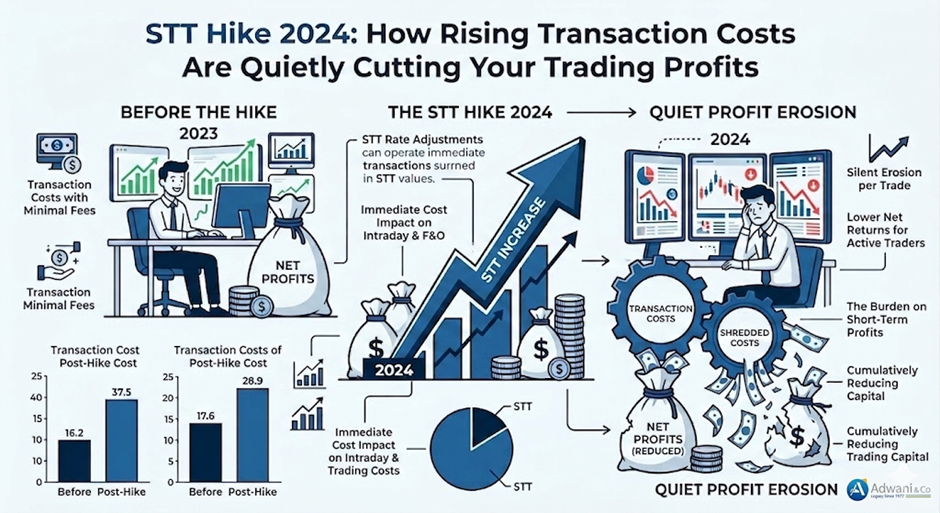
    STT Hike 2024: How Rising Transaction Costs Are Quietly Cutting Your Trading Profits

    By Dr. Haresh Adwani, PhD (Commerce), Law Graduate, Adwani and Company

    You haven’t changed a single line of your trading strategy. Your win rate looks fine on paper. Yet something feels off  your actual take-home profits are quietly shrinking. If this resonates with you, you are not alone, and the culprit may not be the market. The STT hike on trading profits introduced in the Union Budget 2024 is one of the most underreported yet financially significant changes affecting Indian F&O traders and equity investors today.

    In this guide, Dr. Haresh Adwani of Adwani and Company walks you through exactly what changed, why it matters far more than most traders realise, and what smart money is already doing to adapt for STT calculation with latest rates,examplees,and tips to understand your real post trading discruption

    +150%

    Futures STT hike (0.02% → 0.05%)

    +50%

    Options STT hike (0.10% → 0.15%)

    20%

    Interest deduction cap on dividends

    Capital Gains

    Buybacks now taxed as CG, not dividend

    What Is the STT Hike on Trading Profits and Why Should You Care?


    Securities Transaction Tax (STT) is a small percentage levy charged on every buy or sell transaction on Indian stock exchanges. It is collected at source by the exchange and remitted directly to the government. According to the Income Tax Department of India, STT was introduced under Chapter VII of the Finance (No. 2) Act, 2004, to bring transparency to equity markets and reduce tax evasion.

    The Union Budget 2024 revised STT rates significantly. The STT hike on trading profits affects two critical segments:

    SegmentOld STT RateNew STT Rate% Increase
    Futures (Sell side)0.0125%0.02%+60%
    Futures (on turnover)0.02%0.05%+150%
    Options (on premium)0.10%0.15%+50%

    For a casual investor making a handful of trades per month, this might seem trivial. For an active F&O trader executing dozens of trades per day, the STT hike impact on trading costs is anything but small.

    Key insight: STT is charged on the notional value of futures contracts and on the option premium  not just your profit. That means you pay STT whether the trade made money or not.


    Practical Example: How the STT Hike Drains F&O Trading Profits


    Real Numerical ExampleScenario: An active Nifty Futures trader executes 10 round trips per day, with an average notional value of ₹15,00,000 per trade (1 lot Nifty Futures ~ ₹15 lakh notional).

    Old STT per lot (sell side @ 0.02%): ₹15,00,000 × 0.02% = ₹300

    New STT per lot (sell side @ 0.05%): ₹15,00,000 × 0.05% = ₹750

    Extra STT per trade: ₹450

    10 round trips/day × ₹450 × 22 trading days: = ₹99,000 extra per month

    That is nearly ₹1.2 lakh in additional tax outgo per year from a single lot, trading conservatively. Scale this to a professional trader running multiple lots and strategies, and the STT hike on trading profits can easily erode ₹5–20 lakh annually.

    This is the number that most traders miss when they review their P&L. As Dr. Haresh Adwani, with deep legal expertise in taxation, consistently advises clients: “Your gross returns are vanity. Your post-cost, post-tax returns are reality.”

    Learn more about calculating your real post-tax trading returns.

    https://www.adwaniandco.com/blog/share-trading-tax-business-income-or-capital-gains-2026

    How Smart Traders Are Adapting Their Strategy After the STT Hike


    The STT hike on trading profits is not a reason to exit the market. It is a reason to trade smarter. Here is what experienced traders and institutions are already doing:Factoring STT into minimum profit targets: Instead of targeting ₹500 per trade, smart traders now set net targets after accounting for STT, brokerage, GST, and SEBI fees.

    • Reducing overtrading: More trades do not mean more profit. Post-STT hike, fewer, higher-conviction trades often produce better net P&L.
    • Position sizing discipline: Larger positions magnify STT costs. Traders are now more disciplined about lot sizes relative to expected profit.
    • Using spread strategies efficiently: Multi-leg strategies that reduce net premium exposure also reduce absolute STT outgo.
    • Annual tax-loss harvesting: Working with a CA to book and set off losses before year-end to reduce the tax impact on profitable trades.

    As Dr. Haresh Adwani frames it for clients at Adwani and Company: “Edge in trading is no longer just about entry and exit. In 2024 and beyond, it is equally about controlling costs and managing tax leakage. The traders who understand this will survive long-term. The rest will slowly bleed.”

    Government Compliance: What Every Trader Must Know


    The Ministry of Corporate Affairs (MCA) and the Income Tax Department have been systematically tightening compliance requirements for active market participants. Key compliance checkpoints include:

    • F&O trading turnover must be computed correctly for tax audit applicability under Section 44AB of the Income Tax Act.
    • Losses in F&O trading require filing ITR-3, not ITR-2. Incorrect ITR form can result in scrutiny or penalty.
    • GST registration may be required if your brokerage income or trading-as-business turnover exceeds the threshold.
    • STT paid is eligible for a rebate against your income tax liability in certain cases a benefit many traders miss.

    The Income Tax Department of India regularly updates guidelines for speculative and non-speculative business income treatment of F&O profits and losses (incometax.gov.in). Staying updated with these is critical.

    Read our detailed guide on ITR filing for F&O traders →https://www.adwaniandco.com/blog/fo-trading-taxation-in-india-2026-complete-simple-guide


    Conclusion: The STT Hike Is a Behaviour Filter – Adapt Now


    The STT hike on trading profits is not just a tax revision. It is the government’s way of filtering casual, high-frequency speculation from disciplined, informed trading. The traders and investors who understand this shift, adapt their cost structures, and plan their taxes proactively will continue to build wealth. Those who ignore it will see their edge slowly eroded not by bad trades, but by invisible costs. As Dr. Haresh Adwani,  always emphasises to clients at Adwani and Company: “In the new tax environment, your CA is as important to your portfolio as your broker.” The most

    successful investors combine market skill with tax intelligence  and that combination is exactly what Adwani and Company delivers.

    For further reference on official STT rates and compliance requirements, visit the Income Tax Department’s official portal at incometax.gov.in and the GST portal at gst.gov.in.

    Is your trading strategy accounting for the new STT hike?


    If you are trading F&O or investing actively and haven’t reviewed your real post-tax returns, now is the time. Connect with Adwani and Company  led by Dr. Haresh Adwani, PhD (Commerce) and Law Graduate  for personalised tax planning, ITR filing for traders, and compliance guidance that protects your profits.

    Frequently Asked Questions


    1. What is the STT hike on futures trading and when did it take effect?

    The Securities Transaction Tax on futures was revised in Union Budget 2024, effective from October 1, 2024. The rate on the sell side of futures contracts increased from 0.02% to 0.05% of the notional value  a 150% increase. This significantly increases the trading cost for active futures traders and directly impacts net trading profits.

    2. How does the STT hike affect options traders specifically?

    For options, the STT on the sell side increased from 0.10% to 0.15% of the option premium. For high-frequency options traders and those employing multi-leg strategies (straddles, spreads), this hike on trading costs is compounded across every leg of each strategy and across every expiry traded.

    3. Can I claim STT as a deduction in my income tax return

    Yes, in certain cases. If you are treating your trading as a business (non-speculative income in case of F&O), STT paid can be treated as a business expense and deducted from your gross trading income. However, if you are reporting F&O profits as capital gains (which is not the correct treatment per IT guidelines), the deduction rules differ. Consult a CA for accurate treatment specific to your profile.

    4. Will the STT hike on trading affect long-term equity investors?

    For long-term buy-and-hold investors, the direct STT impact is minimal since transactions are infrequent. However, the related changes  such as buybacks being taxed as capital gains and the 20% cap on dividend interest deduction  do affect equity investors’ post-tax returns

    5. Is redemption of Sovereign Gold Bonds (SGBs) always tax-free?

    No. Tax-free redemption at maturity is available only to original subscribers who purchased directly from the RBI during the issuance window and hold until the 8-year maturity date. If you bought SGBs from the secondary market (stock exchange), your redemption proceeds are subject to capital gains tax.

    6. How should I adjust my F&O trading strategy to manage the STT hike impact?

    Key adjustments include: recalibrating minimum profit targets to account for higher transaction costs, reducing unnecessary trades, employing tighter position sizing, using spread strategies to reduce net premium and thus absolute STT, and working with a qualified CA to optimise tax-loss harvesting and annual filings.

    7. Which ITR form should F&O traders use to report income?

    F&O income and loss must be reported under ITR-3 as business income (non-speculative). Filing under ITR-2 as capital gains is incorrect and can attract scrutiny. If total turnover exceeds ₹1 crore (or ₹10 crore in certain cases with cash turnover limits), a tax audit under Section 44AB is mandatory.

    Dr. Haresh Adwani holds a PhD in Commerce and brings over 20 years of expertise in GST compliance, income tax advisory, FEMA, and corporate law. Services include GST audit, ITR filing, GST appeal representation, notice response, NRI taxation, and FEMA compliance.

  • Old vs New Tax Regime2025: Stop Guessing, Start Calculating

    Old vs New Tax Regime2025: Stop Guessing, Start Calculating

    Old vs New Tax Regime

    The one financial decision most salaried Indians get wrong every single year.  

    Every year, crores of Indian taxpayers file their returns and every year, a significant portion of them quietly leave money on the table. Not because they chose the wrong investments. Not because they missed a deadline (though that happens too). But because they made one seemingly simple decision without running the numbers: choosing between the old vs new tax regime.

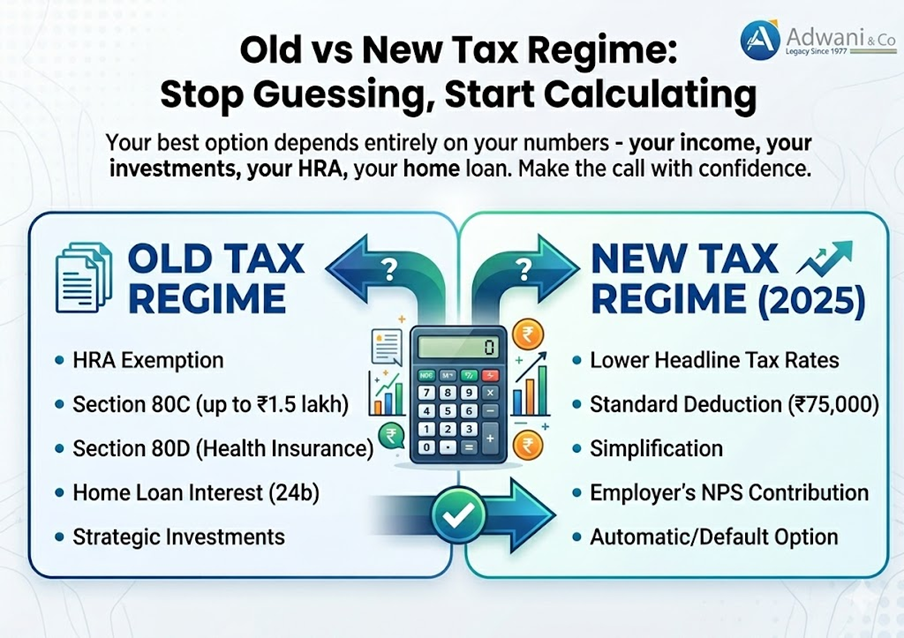
    With the rollout of the Income Tax Act, 2025, this choice has never carried more financial weight. The new regime offers lower headline tax rates, while the old regime rewards those who invest strategically and claim deductions. Neither is universally “better.” Your best option depends entirely on your numbers your income, your investments, your HRA, your home loan. This guide gives you everything you need to make that call with confidence.


    What is the Old vs New Tax Regime?

    India currently operates two parallel personal income tax systems, and every taxpayer must elect one at the time of filing or, in the case of salaried employees, communicate their preference to their employer at the start of the financial year.

    According to the Income Tax Department of India, the old tax regime allows taxpayers to claim a wide range of deductions and exemptions HRA, standard deduction, LTA, Section 80C (up to ₹1.5 lakh), 80D for health insurance, home loan interest under Section 24(b), and much more. These deductions directly reduce your taxable income, which means the effective tax you pay can be significantly lower than the published slab rates suggest.

    The new tax regime, significantly restructured in Budget 2023 and further refined under the Income Tax Act, 2025, offers lower slab rates but eliminates most deductions. The government has made it the default option meaning if you do nothing, you are automatically placed in the new regime. The new regime is designed to simplify compliance and is especially attractive for those who do not have significant deductions.

    Income SlabOld Regime RateNew Regime Rate (2025)
    Up to ₹3,00,000NilNil
    ₹3,00,001 – ₹7,00,0005%5%
    ₹7,00,001 – ₹10,00,00020%10%
    ₹10,00,001 – ₹12,00,00030%15%
    ₹12,00,001 – ₹15,00,00030%20%
    Above ₹15,00,00030%30%

    On the surface, the new regime looks attractive. But tax slabs alone don’t tell the full story. Your effective tax rate what you actually pay after deductions can be dramatically different.


    Key Deductions: What You Give Up in the New Tax Regime

    Understanding the old vs new tax regime comparison is impossible without understanding what deductions the new regime removes. Here is what salaried taxpayers commonly lose access to when they opt for the new regime:

    • HRA (House Rent Allowance): One of the most powerful deductions for metro and urban workers. Not available in the new regime.
    • Section 80C (₹1.5 lakh limit): Covers PPF, ELSS, LIC premiums, EPF, home loan principal repayment, and more. Not available in the new regime.
    • Section 80D: Deduction for health insurance premiums for self and family. Not available in the new regime.
    • Home loan interest (Section 24b): Up to ₹2 lakh deduction on interest for self-occupied property. Not available in the new regime.
    • LTA (Leave Travel Allowance): Not available in the new regime.

    What is available in the new regime? 

    The standard deduction of ₹75,000 for salaried individuals (revised in 2024) and the employer’s NPS contribution (up to 14% of basic salary under Section 80CCD (2) remain eligible in the new regime. These are important benefits often overlooked by taxpayers.


    Old vs New Tax Regime: A Real-World Numerical Example

    Practical Example

    Case: Ravi, Salaried Employee Gross Income ₹15,00,000

    Ravi earns ₹15 lakh per year. He pays rent in Mumbai, has an active PPF and ELSS investment, and pays health insurance premiums for his family. Here is how the two regimes compare for him:

    ItemOld RegimeNew Regime
    Gross Income₹15,00,000₹15,00,000
    Standard Deduction−₹50,000−₹75,000
    HRA Exemption−₹1,80,000Not Applicable
    Section 80C−₹1,50,000Not Applicable
    Section 80D−₹25,000Not Applicable
    Home Loan Interest (24b)−₹1,00,000Not Applicable
    Net Taxable Income₹9,95,000₹14,25,000
    Approximate Tax (incl. cess)~₹1,34,000~₹1,85,000

    In this scenario, Ravi saves approximately ₹51,000 more by choosing the old regime. Tax savings are illustrative and will vary with actual figures.

    This is the math most taxpayers never do. As Dr. Haresh Adwani, founder of Adwani and Company, consistently points out during consultations: “The regime that looks cheaper at the slab level often turns out to be more expensive at the effective tax level once you factor in the deductions a disciplined investor claims.

    Also Read:


    Which Regime is Better at Different Income Levels?

    The old vs new tax regime debate does not have a universal answer. But there are useful income-based patterns that emerge from detailed tax calculations:

    Income up to ₹12.75 lakh: The new regime, combined with the standard deduction of ₹75,000 and a tax rebate under Section 87A (up to ₹60,000 in the new regime for FY 2025-26), can result in zero tax liability. This makes the new regime extremely compelling for this income band especially if the taxpayer does not have significant deductions.

    Income around ₹15 lakh: This is the battleground. If you have HRA, 80C investments, and a home loan the old regime almost certainly wins. If you have minimal deductions, the new regime may be marginally better or comparable.

    Income above ₹20 lakh: The lower slab rates in the new regime start to overpower the benefit of deductions for many taxpayers, especially those without a home loan. The new regime often gains the advantage here but this must be calculated individually.


    Critical Mistakes to Avoid When Choosing Your Tax Regime

    Mistake 1: Not informing your employer on time

    If you are a salaried employee and you wish to opt for the old regime, you must inform your employer before the start of the financial year (typically before April 1). Failing to do so means your employer will deduct TDS under the new regime by default. This can result in lower in-hand salary throughout the year and an unexpected tax liability or a refund headache at the time of filing. As the Income Tax Department guidance clearly outlines, the responsibility of intimating regime choice lies with the employee.

    Mistake 2: Comparing regimes based on slabs alone

    A large number of taxpayers make regime decisions based on rate comparisons without plugging in their actual deductions. Running both scenarios through an income tax calculator or better, consulting a CA takes minutes and can save tens of thousands of rupees annually. Dr. Haresh Adwani, with his expertise spanning commerce, law, and taxation, emphasizes that personalised tax planning not generalized assumptions is what protects your income.

    Mistake 3: Business income taxpayers assuming unlimited regime switches

    Unlike salaried individuals who can switch regimes every year, taxpayers with business or professional income (who file under ITR-3 or ITR-4) can switch from the new regime to the old regime only once. After that, if they switch back to the new regime, they cannot return to the old regime again. This rule, as outlined in Section 115BAC of the Income Tax Act, is frequently misunderstood and can result in irreversible decisions.

    Mistake 4: Ignoring NPS employer contribution in the new regime

    Section 80CCD (2) allows a deduction for the employer’s contribution to the National Pension System up to 14% of basic salary in the new regime (10% in the old regime for private sector employees). Many employees miss negotiating this benefit with their employer. It is one of the most valuable, legitimate tax tools available in the new regime, and Adwani and Company frequently helps clients restructure their CTC to maximise this benefit.

    Old vs New Tax Regime for Business Owners and Freelancers

    Self-employed individuals, freelancers, and business owners face a different landscape than salaried employees. The ability to claim business expenses, depreciation, and set off losses makes the old regime more nuanced for this group. However, the presumptive taxation scheme under Section 44AD (for businesses up to ₹3 crore turnover) and 44ADA (for professionals) is compatible with the new regime offering simplicity without the burden of maintaining detailed books purely for deduction purposes.

    The GST Portal and MCA (Ministry of Corporate Affairs) registrations don’t directly impact your income tax regime choice but your business structure (proprietorship vs LLP vs private limited) significantly affects how income is taxed. For incorporated entities, regime choice applies to individual promoters on their personal income, not to the company’s corporate terms


    How to Calculate and Decide: A Practical Framework

    A simple five-step process for every taxpayer before the financial year begins:

    1. List your expected gross income for the year salary, rent, capital gains, business income.
    2. List all deductions you will legitimately claim HRA, 80C, 80D, home loan interest, NPS.
    3. Calculate your net taxable income under both regimes use the Income Tax Department’s online calculator or a CA-prepared spreadsheet.
    4. Apply the applicable slab rates to each and compute the final tax including surcharge and 4% cess.
    5. Choose the lower outcome and communicate it to your employer or record it in your ITR before the deadline.

    This process takes less than 30 minutes with a professional’s guidance, yet it directly determines how much of your hard-earned income stays in your pocket.


    Authority Reference: 

    The Income Tax Department’s official tax calculator at the incometax.gov.in portal allows taxpayers to compare their liability under both regimes using actual income and deduction inputs. It is updated for each assessment year and is the most reliable starting point for the comparison.


    Conclusion: Stop Following Others, Start Calculating

    The old vs new tax regime debate is not a matter of opinion it is a matter of arithmetic. And yet, year after year, taxpayers choose their regime the same way they pick a restaurant: by seeing what their colleagues are having.

    Your tax planning is personal. Your income is unique. Your deductions are different from your neighbour’s. The regime that saves your colleague ₹40,000 might cost you ₹60,000 and vice versa. The Income Tax Act, 2025 has given taxpayers more structure and clarity, but the decision still requires you to sit down with actual numbers and make a deliberate, informed choice.

    As Dr. Haresh Adwani has guided hundreds of clients over the years: “Tax saving is not about which regime old vs new looks better in a presentation. It is about which regime performs better with your specific income, your specific investments, and your specific life situation.”

    Don’t leave money on the table. Don’t wait until March. Start now, calculate both old vs new regimes, and make the right decision for your financial future.

    1. Which is better old vs new tax regime in 2025?

    There is no universally better regime. The old regime benefits those with significant deductions like HRA, 80C, and home loans. The new regime works better for those with minimal investments or income up to ₹12.75 lakh. Always calculate both before choosing.

    2. Can I switch between old vs new tax regime every year?

    Salaried individuals can switch regimes every financial year. However, taxpayers with business or professional income can switch from new to old only once; after reverting to new, they cannot switch back to old.

    3. Is HRA exempt in the new tax regime?

    No. House Rent Allowance (HRA) exemption is not available under the new tax regime. This is one of the most significant reasons why the old regime may be better for salaried employees living on rent in cities.

    4. What deductions are available in the new tax regime?

    The new regime allows the standard deduction of ₹75,000 (for salaried employees), employer’s NPS contribution under Section 80CCD(2), and a few other limited exemptions. Most major deductions (80C, 80D, HRA, 24b) are not available.

    5. Is income up to ₹12 lakh tax-free in the new regime?

    Under the new tax regime for FY 2025–26, taxpayers with income up to ₹12 lakh (and ₹12.75 lakh for salaried individuals after the ₹75,000 standard deduction) may have zero tax liability due to the revised Section 87A rebate. Consult a CA to confirm your specific eligibility.

    6. What happens if I don’t inform my employer about my regime choice?

    If you don’t inform your employer, TDS will be deducted under the new regime (the default). This could result in excess TDS (requiring refund) or insufficient TDS (resulting in a year-end demand) depending on which regime would have been optimal for you.

    7. Should I consult a CA for regime selection?

    Yes especially if your income exceeds ₹10 lakh, if you have business income, if you have a home loan or rental income, or if you are self-employed. A qualified CA like those at Adwani and Company can run a precise comparison and help you structure your income tax planning for maximum savings.

    About the Author

    CA Dipesh Gurubakshani is a Chartered Accountant with Adwani & Co LLP, Pune, specialising in income tax audit, direct taxation, and accounting advisory. He supports clients across statutory compliance, financial reporting, and income tax matters with a focus on accuracy, regulatory adherence, and disciplined execution.

  • Paid Your Taxes Honestly Still Got an Income Tax Notice? (2026 Guide)  Here’s Why

    Paid Your Taxes Honestly Still Got an Income Tax Notice? (2026 Guide) Here’s Why

    Dr. Haresh Adwani May 2026 12 min read

    Everything looks completely fine your books are in order, you filed your income tax return (ITR) on time, and business is running smoothly. Then, one morning, an income tax notice India arrives in your inbox. That familiar dread kicks in. What went wrong? Am I in trouble? What do I do next?

    You are not alone. Thousands of businesses and individuals receive income tax notices in India every year and a significant number of them are not the result of deliberate tax evasion. Many arise from minor data mismatches, incomplete documentation, or automated system flags triggered by the Income Tax Department’s AI driven scrutiny tools.

    The good news: an income tax notice India 2026 is not a verdict. It is a question. And with the right guidance, you can answer it confidently, professionally, and without drama.

    This guide walks you through everything you need to know about income tax notices India why they happen, what the different types mean, how to respond to an income tax notice, and how working with an experienced CA firm like Adwani and Company can protect your financial future.

    Why Income Tax Notices India Are Increasing in 2026

    The Income Tax Department of India has undergone a dramatic technological transformation over the past few years. The introduction of the new Income tax Act, 2025 (effective April 1, 2026) and the notified Income Tax Rules, 2026 have significantly strengthened the government’s compliance machinery.

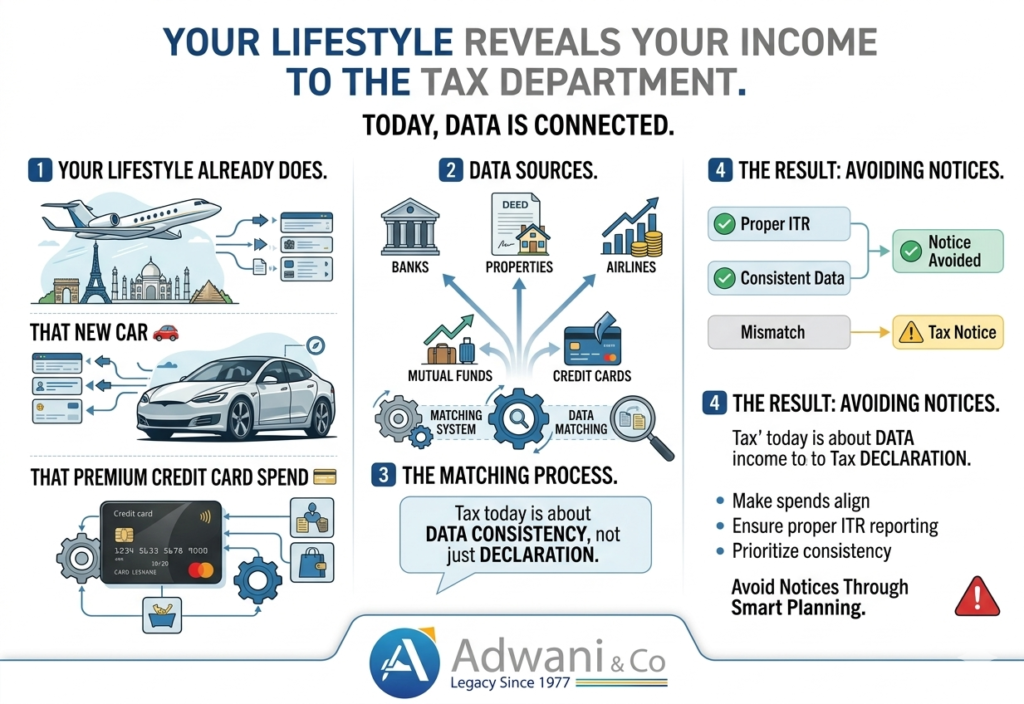
    According to the Income Tax Department’s official portal (incometaxindia.gov.in) and public advisories, the department now cross-verifies taxpayer data from multiple sources simultaneously, including:

    • Income Tax Returns (ITR) filed for FY 2025-26
    • TDS and TCS data submitted by employers and businesses
    • GST Portal records and GSTR filings
    • MCA (Ministry of Corporate Affairs) company filings
    • Bank transaction data and high-value financial statements
    • Social media spending patterns flagged against declared income
    • E-way bills and e-invoice records

    When any of these data points contradict each other, an automated flag is raised and that flag can trigger an income tax scrutiny notice under Section 143(2), a reassessment notice under Section 148, or a demand notice under Section 156, among others.

    As per updates from the Income Tax Department India and compliance advisories published under the Income tax Rules 2026, the department now uses sophisticated Computer Assisted Scrutiny Selection (CASS) systems to identify ITRs with statistical anomalies, making income tax compliance India more critical than ever before.


    Common Types of Income Tax Notices in India You Must Know

    Not all income tax notices India carry the same weight. Understanding which type of income tax notice you have received is the first and most important step.

    1. Section 143(1) Intimation Notice

    This is the most common notice and is largely automated. Issued after initial processing of your ITR filing 2026, it may flag arithmetic errors, TDS mismatches, or minor adjustments. In most cases, it requires a simple correction or no action at all.

    2. Section 143(2) Scrutiny Notice

    This is a more serious income tax scrutiny notice. The assessing officer wants to examine specific aspects of your return in detail. As per Section 143(2), this notice can only be issued within three months from the end of the financial year in which the return was filed.

    Example: If you filed your ITR on July 31, 2025, for FY 2024-25, an income tax scrutiny notice under Section 143(2) can be issued only until June 30, 2026. Beyond that, the notice is time-barred.

    3. Section 148 Reassessment Notice

    When the Income Tax Department believes income has escaped assessment, it may issue a notice under Section 148 to reopen completed assessments. This is often called an income tax reassessment notice, and the time limits are strictly governed under the Income-tax Act, 2025.

    4. Section 156 Demand Notice

    If the department determines a tax liability after assessment, it issues a demand notice under Section 156. A penalty of up to ₹10,000 under Section 272A can apply for failure to respond to certain notices within the stipulated timeframe.

    5. Section 142(1) Inquiry Notice

    Before completing an assessment, the assessing officer may ask for additional information or documents through this income tax inquiry notice. Prompt and accurate responses are essential to avoid escalation.


    PRACTICAL EXAMPLE

    A mid-sized trading business in Pune files its ITR for FY 2024-25 showing annual turnover of ₹1.80 crore. However, the GST Portal reflects GSTR-1 turnover of ₹2.05 crore for the same period. The e-way bill system shows goods movement worth ₹2.15 crore. The Income Tax Department’s automated system flags a discrepancy of ₹25 lakh between the ITR and GST data. An income tax scrutiny notice under Section 143(2) is issued not because the business evaded tax, but because the numbers don’t align across systems. A proper income tax notice reply, backed by reconciliation statements and supporting documents, is what resolves this situation.

    This is exactly the kind of scenario Dr. Haresh Adwani PhD in Commerce, law graduate, and founder of Adwani and Company has been warning clients about for years. In his experience advising businesses across Maharashtra and beyond, the majority of income tax notices India arise not from fraud but from data inconsistencies that proper compliance systems could have prevented.


    How to Respond to Income Tax Notice India: A Step by Step Guide

    Receiving an income tax notice India can feel overwhelming. But a structured, professional response is what separates a resolved case from an escalated one. Here is the approach recommended by experienced tax professionals:

    Step 1 : Read the Notice Completely and Carefully

    Identify the section under which the income tax notice is issued, the assessment year in question, the deadline for response, and the specific issue or mismatch being raised. Do not assume what the notice is about read every word.

    Step 2 : Do Not Ignore It

    Ignoring an income tax notice India is never a safe strategy. Failure to respond within the prescribed time can result in ex-parte assessments, penalties under Section 272A, and additional scrutiny. Even if you believe the notice is incorrect, a formal income tax notice reply must be filed.

    Step 3 : Gather All Relevant Documents

    Collect ITR acknowledgements, Form 26AS, AIS (Annual Information Statement), bank statements, GST returns, invoices, TDS certificates, and any other documentation relevant to the period under scrutiny.

    Step 4 :Reconcile the Data

    Compare your ITR figures against Form 26AS, AIS, GST data, and bank records. Identify where the mismatch exists and build a factual explanation supported by documents.

    Step 5 : Draft a Legally Sound Income Tax Notice Reply

    Your income tax notice reply must be factual, legally precise, and supported by evidence. Emotional or vague responses rarely help. If the matter involves complex legal interpretation which many income tax assessment notices do professional assistance is not optional; it is essential. Learn more about our Income Tax Notice Reply Services at Adwani and Company.

    Step 6 : Respond Through the Official E-Filing Portal

    All responses to income tax notices India must be filed through the official Income Tax e filing portal at incometaxindia.gov.in. Maintain digital acknowledgements of every submission for future reference.

    Income Tax Notice India 2026: Why Expert Guidance Matters

    The new Income Tax Rules, 2026 have introduced stricter disclosure requirements, more granular scrutiny parameters, and enhanced cross-border tax provisions. For businesses and individuals navigating this landscape, professional expertise is not a luxury it is a necessity. Dr. Haresh Adwani brings a rare combination of academic rigour and practical expertise to income tax compliance and notice management. Holding a PhD in Commerce and a law degree, Dr. Haresh Adwani understands the financial, legal, and procedural dimensions of income tax proceedings with equal depth. This multidisciplinary perspective is exactly what taxpayers need when facing complex income tax scrutiny notices or reassessment proceedings.

    At Adwani and Company, the team provides end-to-end support for clients receiving income tax notices India, covering everything from initial notice analysis and document reconciliation to drafting professional income tax notice replies and representing clients before assessing officers.

    Whether you are a salaried professional, a business owner, or an NRI with Indian income, Adwani and Company offers the structured, strategic approach that income tax matters demand.

    Read our detailed guide on Income Tax Return Filing and Compliance for businesses and individuals.

    Key Income Tax Changes in 2026 That Could Trigger a Notice

    The Income tax Act, 2025 and Income Tax Rules, 2026 have introduced several changes that increase the probability of income tax notices India for businesses and individuals who are not aware of the new compliance requirements:

    • New Form 124 replaces Form 12BB for HRA and investment declarations incorrect transitional filings may trigger discrepancies.
    • Enhanced perquisite valuation rules for employer-provided benefits such as accommodation, cars, and insurance.
    • Stricter TDS compliance with updated section references under the Income-tax Act, 2025 using old section numbers (e.g., Section 194C) for new transactions may cause filing errors.
    • Significant Economic Presence (SEP) threshold of 2 crore or 3 lakh users for digital businesses, with new scrutiny implications.
    • Mandatory PAN disclosure for landlords when annual rent exceeds 1 lakh, with explicit relationship disclosure requirements.
    • New audit trail requirements for stock exchanges relevant for investors and high net worth individuals.

    Businesses that continue operating under pre2026 compliance assumptions are at higher risk of receiving income tax notices India in the coming months. A proactive compliance review is strongly recommended.


    Income Tax Notice India 2026: What Small Businesses Must Do Now

    Small business owners often operate under the misconception that income tax scrutiny is reserved for large corporations. That belief is outdated. With AI based CASS systems and integrated data verification across GST, MCA, and banking records, no taxpayer falls completely under the radar.

    Here is what small businesses must prioritize to avoid income tax notices India:

    • File ITR 2026 accurately and on time do not leave discrepancies between income declared and financial statements
    • Reconcile turnover declared in income tax return with GST Portal data every quarter
    • Ensure TDS deductions under the new Income-tax Act, 2025 framework are accurately filed
    • Maintain proper invoicing records and banking documentation for all high-value transactions
    • Verify that all financial data submitted to MCA aligns with income tax return data
    • Conduct an Annual Information Statement (AIS) review before filing ITR to identify pre-existing discrepancies

    As Dr. Haresh Adwani often advises clients: the best income tax notice reply is the one you never have to write because proactive compliance prevented the notice from being issued in the first place.

    Learn more about our Business Tax Compliance Services for small and medium enterprises.


    AIS, Form 26AS, and Income Tax Notice India: The Hidden Connection

    Many taxpayers who receive income tax notices India are surprised to discover that the trigger was information already available on the Income Tax Department’s own portal — and that they never reviewed it before filing their return.

    The Annual Information Statement (AIS) and Form 26AS are the Income Tax Department’s comprehensive databases of financial transactions linked to your PAN. They include:

    • Salary income reported by employers
    • Interest income from savings accounts and fixed deposits
    • Dividend income from shares and mutual funds
    • High-value purchase and sale transactions in real estate and securities
    • Foreign remittances and international transactions
    • GST turnover data

    If the figures in your ITR do not match what appears in your AIS, the system is designed to flag it automatically. Reviewing and reconciling your AIS before filing your income tax return 2026 is one of the most effective ways to prevent an income tax scrutiny notice.

    For official guidance, visit the Income Tax Department India portal or the Ministry of Corporate Affairs for business-related compliance updates.


    Conclusion:

    An income tax notice India is not the end of the road. In most cases, it is the beginning of a conversation between you and the Income Tax Department a conversation that, with the right preparation and professional support, can end cleanly and quickly.

    The year 2026 marks a significant turning point in India’s tax compliance environment. With the Income tax Act, 2025 and Income Tax Rules, 2026 now in full effect, businesses and individuals face a more scrutinised tax landscape than ever before. Data cross-verification is automated, discrepancies are flagged in real time, and the margin for error has narrowed considerably.

    The professionals and businesses that will thrive in this environment are those who treat income tax compliance as a continuous, proactive discipline not a once a year filing exercise. They review their AIS before filing. They reconcile GST and income tax data regularly. They maintain robust documentation. And when an income tax notice India does arrive, they respond swiftly and professionally.

    Working with an experienced, multidisciplinary CA firm is the most reliable way to achieve this standard of compliance and notice preparedness.

    Frequently Asked Questions

    1. What is an income tax notice India and why did I receive one?

    An income tax notice India is a formal communication from the Income Tax Department asking you to clarify, confirm, or provide documentation for specific aspects of your filed return. Common reasons include data mismatches between your ITR and AIS/Form 26AS, unusual financial transactions, TDS discrepancies, or failure to report certain income. Receiving a notice does not automatically mean you owe additional tax.

    2. How do I respond to an income tax notice India 2026?

    Log into the official Income Tax e-filing portal at incometaxindia.gov.in, navigate to ‘Pending Actions,’ and respond within the prescribed deadline. Your income tax notice reply should be factual, supported by documentation, and — for complex cases — drafted with professional assistance from a qualified CA firm.

    3. What happens if I ignore an income tax scrutiny notice?

    Ignoring an income tax scrutiny notice can lead to ex-parte assessment under Section 144, where the assessing officer decides the case based only on the department’s information. This frequently results in higher demand, additional penalties, and potential legal proceedings. Never ignore an income tax notice India, regardless of how minor it appears.

    4. What is the time limit for responding to an income tax assessment notice?

    Time limits vary by notice type. Section 143(1) intimations typically require response within 30 days. Section 143(2) scrutiny notices have timelines specified in the notice itself. Always check the deadline stated in the notice and respond before it — late responses may be treated as non-compliance.

    5. Can income tax notices India be avoided with proper compliance?

    While no compliance system provides 100% immunity from notices, maintaining accurate records, reconciling AIS and GST data before ITR filing, using correct TDS sections under the Income-tax Act 2025, and engaging a professional CA firm like Adwani and Company for periodic compliance reviews significantly reduces income tax notice risk.

    6. How does the Income Tax Department India detect unreported income in 2026?

    The Income Tax Department now uses AI-based CASS systems that cross-verify data from GST returns, bank transactions, MCA filings, e-way bills, TDS records, and even high-value lifestyle expenditures visible in financial data. Any significant inconsistency between these sources can automatically trigger an income tax scrutiny notice, even if your ITR appears complete.

    About the Author
    Dr. Haresh Adwani
    Ph.D. in Commerce | Law Graduate | Managing Partner, Adwani & Co LLP Dr. Haresh Adwani holds a Ph.D. in Commerce and is a qualified Law graduate with over two decades of hands-on experience in GST advisory, direct taxation, and statutory compliance for businesses across Pune and Maharashtra. As Managing Partner of Adwani & Co LLP a firm established in 1977 by Advocate N. T. Adwani Dr. Adwani has guided hundreds of
    SMEs, startups, and corporates through India’s evolving tax landscape. He is a recognised advisor on GST compliance, company formation, and Virtual CFO services, and regularly
    contributes to professional seminars and industry forums in Pune.

  • Income Tax Notice Received?

     Income Tax Notice : Common Mistakes That Turn Small Issues into Big Problem

    Everything looks fine… until an Income Tax notice changes everything.

    In practice, most tax issues don’t arise because of wrong intent.

    They arise because of casual handling.

    Income Tax Notice

    An Income Tax notice is basically a message from the tax department asking you to check or clarify something about your return. It doesn’t always mean you’ve done something wrong sometimes it’s just a reminder, a correction, or a request for extra details. Getting a notice from the Income Tax department can feel alarming but it’s usually not as scary as it sounds.

    The key thing to remember: a notice is not a punishment. It’s a conversation the department wants to have with you just in writing

    Common Mistakes Taxpayers Make

    In many cases, the problem begins with small lapses:

    1. Ignoring a Notice for a Few Days

    One of the biggest mistakes taxpayers make is assuming that a notice can wait. Many people think, “I’ll deal with it later” or “It’s probably not urgent very Income Tax notice comes with a deadline. Miss it, and what was originally a simple question from the department can turn into a formal proceeding. Most people who’ve been through this say the same thing “I wish I had just replied sooner.” A few extra days of delay can change the tone of the entire proceeding. What starts as a routine query can start feeling like an interrogation, simply because the other side stopped getting answers. Don’t let that happen.

    2. Filing a Reply Without Proper Explanation

    Another common error is rushing through the reply. Taxpayers often submit a quick response without carefully explaining the issue or attaching supporting documents. While this may feel like “getting it off your plate,” it usually backfires. Since proceedings are faceless and document driven, the officer relies entirely on what you submit. Your transaction may be perfectly clean but if your explanation isn’t clear, it won’t look that way. One vague reply can turn a one-time query into a back-and forth that goes on for months.

    3. Not Keeping Proper Records of Your Transactions

    Poor record-keeping is a silent but serious mistake. When transactions aren’t backed by proper documentation invoices, bank statements, agreements even genuine entries can appear suspicious. During scrutiny, the burden of proof lies on the taxpayer. If you can’t produce clear records, the authorities may assume inconsistencies or non-compliance. This often results in unnecessary disputes, penalties, or adjustments that could have been avoided with organized documentation.

    Also Read : GST Show Cause Notices: Why ‘Others’ Isn’t Enough | Adwani & Co LLP

    Why Income Tax Notices Are Issued

    • Mismatch in income details – When the income you report doesn’t match with records in Form 26AS, AIS, or TIS.
    • Errors in filing – Wrong ITR form, missing details, or calculation mistakes.
    • High-value transactions – Large cash deposits, property deals, or big spends that don’t align with declared income.
    • Incorrect claims – Deductions or exemptions claimed without proper proof.
    • Non-disclosure of income – Forgetting to report rental income, interest, freelance earnings, or foreign income.
    • Late or non-filing of returns – Missing deadlines or not filing at all.

    When the Situation Changes

    Planning stops

    Pressure builds

    When an Income Tax notice moves from routine to scrutiny, the entire atmosphere changes. What once felt like a simple compliance task suddenly becomes a source of stress. Planning, which should guide your response, often takes a back seat as anxiety builds. Instead of calmly addressing the issue, taxpayers slip into damage control mode rushing to reply, scrambling for documents, and second guessing every step. The problem is that this reactive approach rarely helps. A matter that could have been resolved with a clear explanation and timely submission now stretches into a prolonged process, filled with repeated queries, clarifications, and mounting pressure. What started as a small oversight becomes a stressful ordeal, not because the case was inherently complicated, but because the response wasn’t handled with the structure and clarity it required.

    The Reality of Today’s Tax Proceedings

    In the past, dealing with Income Tax notices often meant visiting the tax office, meeting an officer, and explaining your side in person. Today, that has completely changed. Proceedings are now faceless and entirely document-driven. This means there is no opportunity to sit across the table and clarify things verbally. Your case is judged only on the papers, records, and explanations you submit online.That shift makes clarity and structure more important than ever. A casual or incomplete reply can easily be misunderstood because there’s no chance to explain it face-to -face. On the other hand, a well-organized response with proper documentation and a clear explanation can close the matter quickly. In this new system, your submission is your only voice. If it’s strong, precise, and logical, it speaks for you. If it’s weak or vague, even a simple issue can get complicated.

    What Actually Makes the Difference

    • Timely Response: Submitting your reply within the given deadline shows seriousness and prevents escalation.
    • Structured Explanation: A clear, logical, and well organized reply helps the officer understand your case easily.
    • Complete Documentation: Supporting documents that match your explanation strengthen your position.
    • Avoiding Delays or Vague Replies: Late, incomplete, or generic responses often create confusion and lead to repeated queries.
    • Quality Over Quantity: It’s not about how much you submit, but how clearly and accurately you present it.
    • Key Insight: Most cases don’t fail because the taxpayer’s position was weak they fail because the response was weak.

    How to Handle an Income Tax Notice Properly

    To avoid unnecessary complications:

    • Reply On Time — Every Time This isn’t something to put off until tomorrow. Every notice has a deadline, and even a short delay can turn a simple matter into something far more complicated. Treat the deadline like a bill payment miss it, and things get harder.
    • Attach complete and accurate documentation Don’t leave gaps. Attach all relevant proofs bank statements, invoices, agreements, or any supporting records. The stronger your documentation, the smoother the resolution.
    • Don’t Send a Vague Reply Writing details will be provided later” is one of the worst things you can do. It signals that you’re either unprepared or avoiding the question neither of which helps your case. Be specific, be direct, and address exactly what’s being asked..
    • Ensure your explanation is clear and logically presented Think of your reply as telling a story. Organize it step by step so the officer can easily follow your reasoning. A structured response shows professionalism and builds trust.
    • Seek professional guidance when required If the notice involves complex transactions or large amounts, don’t hesitate to consult a tax professional. Expert advice can save you from costly mistakes and unnecessary stress.

    The notice isn’t the problem. How you respond to it is

    “Handle notices smartly, and they’ll never handle you”

    Read More

    1.Does receiving an Income Tax notice mean I’ve done something wrong?

    Not necessarily. Many notices are simply requests for clarification or correction. They don’t always indicate fraud or wrongdoing.

    2.What should I do first when I receive a notice?

     Read the notice carefully, understand what it is asking, and note the deadline. Don’t panic — most issues can be resolved with a clear and timely response.

    3.What documents should I keep ready to avoid problems?

     Maintain bank statements, invoices, property documents, investment proofs, and any records of major transactions. Organized documentation makes replies easier.

    4.Can I reply to a notice myself or do I need a professional?

    For simple clarifications, you can reply yourself. But for complex cases involving large transactions or scrutiny, it’s wise to consult a tax professional.

    5.Where can I check the status of my notice?

    You can log in to the Income Tax e-filing portal and track the notice under the “e-Proceedings” or “Pending Actions” section