
Tax Litigation Myths
A tax notice does not always mean a mistake has been made. But the way a business responds to it can change everything that follows. Among the business owners we work with, the biggest driver of a bad outcome is rarely the underlying transaction it is a decision made in the first 48 hours, shaped by one of five persistent tax litigation myths. Dr. Haresh Adwani, who advises businesses on tax litigation matters at Adwani & Co LLP, notes that understanding what a notice really represents is the difference between a routine clarification and a drawn-out dispute.
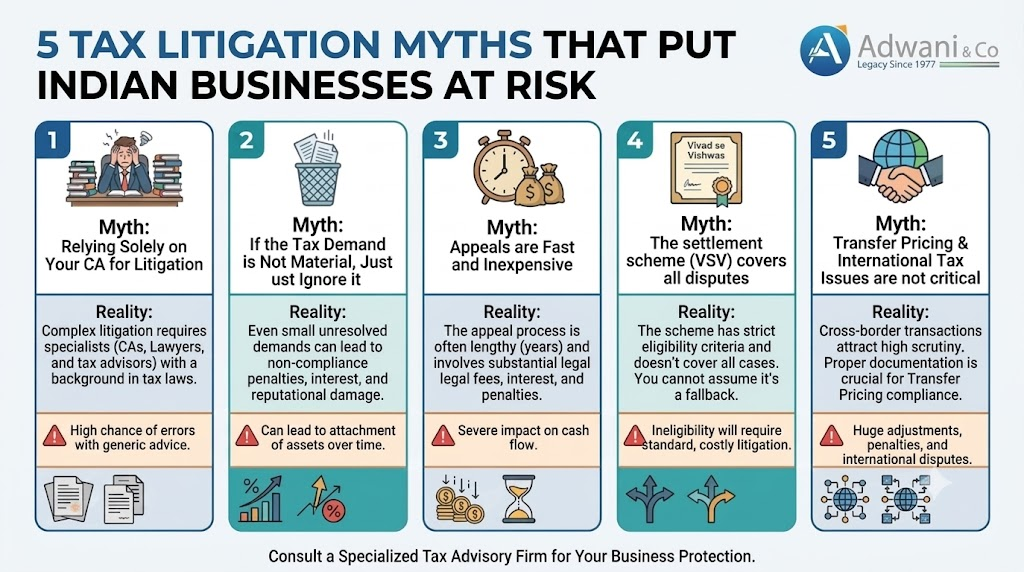
Why Tax Litigation Myths Cost Businesses More Than the Tax Itself
Ask most business owners what tax litigation means, and you will hear some version of “getting caught.” That assumption is one of the most damaging tax litigation myths in circulation, and it shapes almost every poor decision that follows a notice from panicked, incomplete replies to silence that turns a routine query into a full-blown dispute. In reality, tax litigation is simply the formal process by which a taxpayer and the department resolve a disagreement over facts, documentation, or interpretation of law.
It can begin with something as ordinary as a mismatch between two returns, and it can end just as ordinarily with a clarification accepted and the matter closed. What determines the outcome is rarely the notice itself; it is whether the business recognises the myths shaping its first response.
Myth 1: Tax Litigation Only Happens When You Have Made a Mistake
This is the Tax Litigation myth we hear most often, and it causes the most unnecessary anxiety. A large share of income tax and GST notices are triggered by system level mismatches rather than genuine errors a vendor filing late, a rounding difference between GSTR-1 and GSTR-3B, or a timing gap between when income is earned and when it is reported. None of this automatically indicates wrongdoing. Tax litigation frequently arises from differing interpretations of law, not concealment.
A business that has claimed a deduction under a genuinely debatable provision may still receive a notice even though its position is entirely defensible. Treating every notice as proof of an error leads owners to either over-apologise in their reply or panic into an incomplete, defensive response both of which weaken the case more than the original mismatch ever could.
Myth 2: Receiving a Notice Means the Business Is Already in Trouble
A notice is a question, not a verdict. Under the Income Tax Department‘s scrutiny framework, and under GST law, most notices exist precisely to give the taxpayer an opportunity to explain a position before any adverse action is taken. Whether it is a notice under Section 143(2), a show-cause notice under GST, or a query following AIS or Form 26AS reconciliation, the process is built around a response and that response is exactly what determines whether litigation escalates or closes quietly. Businesses that assume the worst often skip the most important step: reading the notice carefully enough to understand precisely what is being asked, and gathering evidence to answer only that question.
Myth 3: Ignoring a Notice Buys You Time
Of the five tax litigation myths on this list, this is the most expensive one. A notice left unanswered does not disappear it converts a matter that could have been resolved with documentation into an ex-parte order, often decided against the business simply because no explanation was on record. Once that happens, the business is no longer defending its original position; it is fighting a procedural default on top of the underlying issue, usually in appeal, which costs more time and money than a timely reply ever would have. Deadlines in tax litigation are not suggestions they are the single biggest lever a business has, and missing them hands that leverage to the department by default.
Myth 4: Only Large Companies Face Tax Litigation
Automated cross-verification between GST returns, e-way bills, income tax filings, TDS data and MCA filings means mismatches are now flagged regardless of company size. A proprietorship with a ₹40 lakh turnover can trigger the same category of scrutiny as a listed company if its numbers do not reconcile across systems. Believing that tax litigation is a “big company problem” leads many small business owners to under-invest in basic reconciliation GSTR-2B matching, TDS credit checks, turnover consistency across filings until a notice arrives and the gaps have already compounded across several return periods.
Myth 5: Any Accountant Can Handle a Tax Dispute
Filing returns and defending a position in litigation are different skills. Tax litigation increasingly turns on legal interpretation how a provision has been read in prior rulings, how facts should be framed in a reply, and when a matter genuinely warrants escalation to appeal rather than a straightforward clarification. This is why representation that combines accounting knowledge with legal grounding tends to produce materially better outcomes than a purely compliance-focused approach.
It is also why, at Adwani & Co LLP, tax litigation matters are handled with input from Dr. Haresh Adwani, whose background as a PhD holder in Commerce and a law graduate allows him to evaluate both the financial substance of a case and its legal defensibility before a reply is drafted.
A Real Example: Same Notice, Two Very Different Outcomes
Illustrative ExampleTwo businesses in the same industry each received an identical GST mismatch notice for a ₹6.2 lakh difference between their GSTR-1 and GSTR-3B figures for the same quarter. Business A assumed the mismatch meant an error had definitely occurred and submitted a rushed reply admitting partial liability without checking the underlying data it ended up paying interest and a penalty on an amount that later reconciliation showed was simply a timing difference.
Business B treated the notice as a question requiring evidence, reconciled the two returns line by line, identified that the gap was a credit note processed the following month, and submitted a documented explanation within the deadline. Its matter was closed with no additional liability. The transaction was almost identical; the outcome was shaped entirely by which tax litigation myths each business believed.
What This Means in Today’s Compliance Environment
Systems maintained by the Income Tax Department and the GST Portal are increasingly cross-linked with MCA filings, e-way bill data and banking information, which means inconsistencies that once went unnoticed are now flagged automatically. This makes proactive reconciliation more valuable than ever, but it does not change the basic logic of tax litigation: a well-documented, timely, legally sound reply resolves the overwhelming majority of notices without escalation.
Read our detailed guide on Tax Saving vs Wealth Creation: One Question That Will Transform the Way You Invest Forever
How Adwani & Co LLP Supports Businesses Through Tax Litigation
At Adwani & Co LLP, tax litigation support starts with reading the notice for what it actually asks, not what it might imply. The firm’s approach shaped by Dr. Haresh Adwani’s combined background in commerce and law focuses on building a factually accurate, legally grounded reply within the statutory timeline, rather than a generic template response. For businesses that want to reduce the chance of litigation altogether, learn more about our Income Tax and GST Notice Response services, or read our detailed guide on GST Compliance for Businesses to understand the reconciliation practices that prevent most notices before they are ever issued.
1.Does receiving a tax notice mean my business has made an error?
No. A tax notice is usually a request for clarification or documentation, not a finding of wrongdoing. Many notices are triggered by system-level mismatches or differing interpretations of law, not actual errors.
2.What happens if I ignore an income tax or GST notice?
Ignoring a notice can lead to an ex-parte order against the business, decided without your explanation on record. Reversing that later through appeal is far harder and more expensive than replying on time.
3.Can small businesses face tax litigation, or is it only a risk for large companies?
Small businesses are equally exposed. Automated cross-verification across GST, income tax, MCA and banking data flags mismatches regardless of company size or turnover.
4.How long do I have to respond to a tax notice in India?
Deadlines vary by notice type and section, typically ranging from about 7 to 30 days. The notice itself specifies the response window, and missing it can forfeit your opportunity to explain the matter.
5.Should I handle a tax litigation matter myself or get professional help?
Simple clarifications can sometimes be handled internally. Matters involving legal interpretation, larger amounts, or repeated notices benefit significantly from professional representation that understands both the accounting and legal dimensions.
6.How can Adwani & Co LLP help if my business has received a tax notice?
The firm reviews the notice, reconciles the underlying data, and prepares a documented, legally sound reply within the applicable deadline, with oversight from Dr. Haresh Adwani on matters requiring legal interpretation.
Conclusion: Don’t Let Tax Litigation Myths Cost You
Tax litigation myths persist because a notice feels alarming by design official language, statutory references, a deadline. But the businesses that navigate these situations well are the ones that pause long enough to ask what the notice is actually requesting, rather than reacting to the five assumptions covered here. If your business has received a notice, or you simply want your compliance systems reviewed before one arrives, connect with Adwani & Co LLP today for guidance grounded in both accounting and legal expertise.
About the Author
Dr. Haresh Adwani
Ph.D. in Commerce | Law Graduate | Managing Partner, Adwani & Co LLP Dr. Haresh Adwani holds a Ph.D. in Commerce and is a qualified Law graduate with over two decades of hands-on experience in GST advisory, direct taxation, and statutory compliance for businesses across Pune and Maharashtra. As Managing Partner of Adwani & Co LLP a firm established in 1977 by Advocate N. T. Adwani Dr. Adwani has guided hundreds of
SMEs, startups, and corporates through India’s evolving tax landscape. He is a recognised advisor on GST compliance, company formation, and Virtual CFO services, and regularly
contributes to professional seminars and industry forums in Pune.
Disclaimer
This article is intended for general informational purposes only and does not constitute professional tax, financial, or legal advice. While every effort has been made to ensure accuracy as of the date of publication, tax laws, forms, and procedures are subject to change. Readers should consult a qualified chartered accountant or tax professional before making decisions based on this content. Adwani and Company accepts no liability for actions taken solely on the basis of this article.