CA Manish Mata June 2026 10 min read
FP&A vs Investment Banking & Valuation
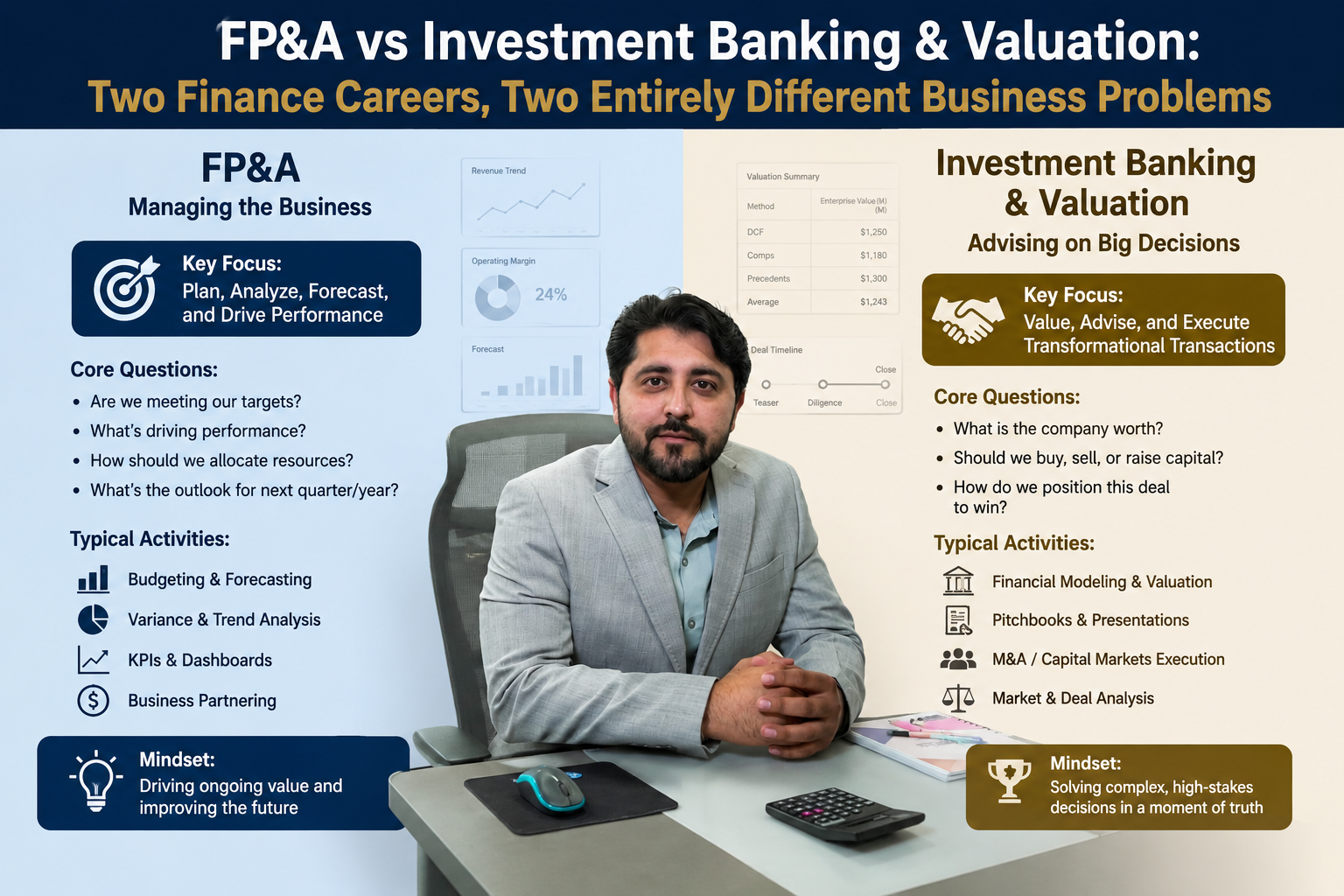
Every year, thousands of finance graduates and young professionals list FP&A, Investment Banking, or Valuation on their career wishlist often without a clear understanding of what each actually does inside a business. They are all ‘finance roles’. They all involve spreadsheets, financial models, and business numbers. But the problems they solve, the audiences they serve, and the decisions they support are fundamentally different. Conflating them is one of the most common misconceptions in early finance careers and it matters far more than most people realise.
Why the Confusion Exists and Why It Matters
Finance as a field is broad. Whether you work in FP&A at a mid-size manufacturing company, in an investment banking division advising on an acquisition, or in a boutique valuation practice preparing a DCF model for a private equity transaction you are working with financial statements, projections, and business performance data. The tools overlap. The terminology overlaps. The confusion is understandable.
But the objectives and therefore the career paths, skills required, and daily realities could not be more different. Understanding this distinction early is essential for any finance professional who wants to build a focused, high-impact career in either domain.
Common Misconception Finance Professionals Should Avoid
- Assuming FP&A and Investment Banking require the same core skills they don’t
- Believing that valuation work is just ‘advanced budgeting’ it operates at an entirely different strategic level
- Thinking that strong Excel skills alone prepare you equally for both domains
Underestimating how differently these roles interact with business leadership vs. external stakeholders
What FP&A Actually Does: Performance Intelligence for Management
Financial Planning & Analysis (FP&A) is the engine of internal financial intelligence inside a business. Its job is to help management understand where the business stands, why performance deviated from plan, and what actions can improve outcomes going forward. FP&A professionals work closely with business unit heads, operations teams, and the CFO to provide the financial visibility that drives day-to-day and quarter-to-quarter decisions.
In practice, FP&A covers
- Annual budgeting and rolling forecasts translating strategy into financial targets
- Variance analysis explaining why actual results differ from budget or prior period
- KPI monitoring and management dashboards giving leadership real-time visibility into business health
- Scenario and sensitivity analysis modelling the financial impact of operational choices
- MIS reporting packaging financial data into actionable monthly management packs
- Cost driver analysis identifying what is actually moving profitability up or down
The questions FP&A answers are operational and managerial: Are we meeting our revenue targets? Why did margins fall this quarter? Which product line is underperforming? What should we do differently next month? These are questions that internal management needs answered quickly, accurately, and consistently.
What Investment Banking & Valuation Actually Does: Value Determination for Strategic Decisions
Investment Banking and Valuation operate at a completely different level not operational, but strategic and transactional. Where FP&A helps management run the business better today, Investment Banking and Valuation helps stakeholders determine what the business or an asset within it is actually worth, and whether a strategic financial decision (an acquisition, a fundraise, a divestiture, a merger) makes financial sense.
This domain covers:
- Business valuation using DCF analysis, precedent transactions, and comparable company multiples
- Mergers & Acquisitions (M&A) advisory financial due diligence, deal structuring, and negotiation support
- Financial Due Diligence (FDD) deep-dive review of a target company’s financial health before acquisition
- Fairness opinions independent assessment of whether a transaction price is financially equitable
- Buy-side and sell-side advisory advising on the financial merits of a transaction from either party’s perspective
- Capital structure and strategic allocation decisions evaluating how capital should be deployed for maximum value creation
The questions Investment Banking and Valuation answers are strategic and transactional: What is this company worth? Should we acquire this target at this price? What multiple is the market applying to businesses like ours? How should this deal be structured for optimal stakeholder returns? These answers matter not to internal management but to boards, investors, acquirers, regulators, and capital market participants.
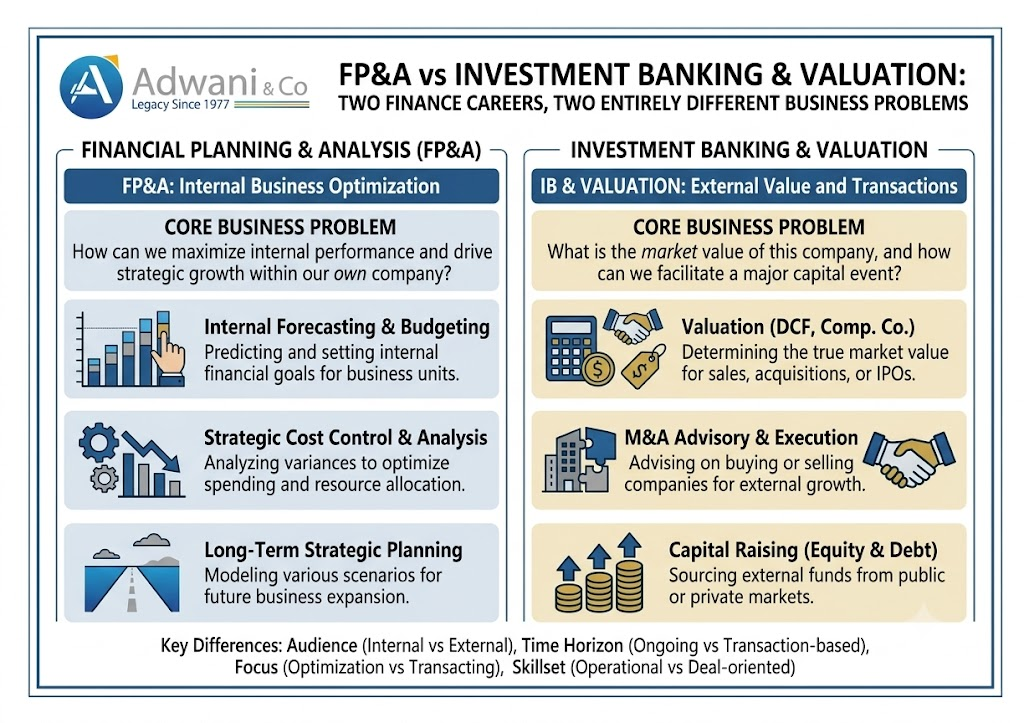
FP&A vs Investment Banking & Valuation: A Direct Comparison
The table below captures the structural differences between these two critical finance disciplines:
| Dimension | FP&A | Investment Banking & Valuation |
| Core Purpose | Improve operational and financial performance of the business | Determine fair value; support M&A, fundraising, and strategic capital decisions |
| Primary Audience | Internal management and leadership teams | External stakeholders investors, acquirers, boards, regulators |
| Key Deliverables | Budgets, forecasts, variance reports, KPI dashboards, MIS packs | DCF models, precedent transaction analyses, fairness opinions, M&A advisory |
| Time Horizon | Short-to-medium (monthly, quarterly, annual cycles) | Transaction-driven (deal timelines; multi-year projections) |
| Decision Type | Operational pricing, cost control, resource allocation, efficiency | Strategic buy vs build, acquisition pricing, equity value, exit planning |
| Finance Skills Used | Budgeting, forecasting, variance analysis, FP&A modelling, reporting | Financial modelling, DCF, LBO, comparable company analysis, due diligence |
| AI Relevance | AI uses FP&A reasoning to evaluate operational and budget data | AI uses IB/valuation logic to assess DCF assumptions and deal structures |
A Simple Way to Remember the Difference
CA Manish, Head Consultant for International Accounting and Financial Modeling at Adwani & Co LLP, puts it this way: FP&A helps management improve the performance of the business. Investment Banking and Valuation helps stakeholders determine the value of the business and make strategic investment decisions.
One is inward-facing and operational. The other is outward-facing and transactional. Both are essential. But they exist to answer entirely different questions for entirely different audiences.
Think of it this way: FP&A is what a CFO uses to run the month-end close meeting. Investment Banking and Valuation is what a board uses to evaluate an acquisition proposal. The CFO may sit in both rooms — but the finance function serving each conversation is structurally different.
Read our detailed guide on FP&A and Excel Automation: The CFO’s Secret Weapon for Smarter Decisions in 2026
The Emerging Dimension: AI Is Making Both Disciplines More Important
One of the more interesting developments in modern finance — and something CA Manish has directly observed in his work with international clients — is the growing role of AI in financial analysis and evaluation. As AI tools become embedded in financial workflows, both FP&A and Investment Banking/Valuation reasoning are being used to train, validate, and evaluate AI model outputs.
An AI model reviewing a budget variance report needs FP&A-style reasoning to assess whether the variance explanation is operationally coherent. An AI model reviewing a DCF valuation or M&A proposal needs Investment Banking and Valuation expertise to assess whether the assumptions are commercially reasonable and whether the deal structure makes strategic sense.
This means that deep domain expertise in both disciplines is becoming more valuable — not less — as AI handles more of the mechanical data processing. Finance professionals who understand the ‘why’ behind both FP&A and valuation will be better positioned to work alongside AI tools, review AI outputs, and apply human judgment where it matters most.
Which Domain Is Right for You?
Choose FP&A if you:
- Enjoy working closely with operational teams and business leadership
- Want to understand what drives business performance at a granular level
- Prefer a role where your work directly influences internal decisions month after month
- Are interested in budgeting, forecasting, MIS, and management reporting
- Want to develop into a CFO or finance business partner role
Choose Investment Banking & Valuation if you:
- Want to work on high-stakes strategic transactions — M&A, fundraising, exits
- Are drawn to financial modeling, DCF analysis, and valuation frameworks
- Prefer project-based work with defined transaction timelines
- Want to advise stakeholders on business value and strategic capital decisions
- Are interested in a career trajectory toward private equity, M&A advisory, or transaction services
Key Takeaways
- FP&A and Investment Banking/Valuation both belong to finance but they solve completely different business problems for completely different audiences
- FP&A is internally focused: it helps management understand, monitor, and improve business performance through budgeting, forecasting, and variance analysis
- Investment Banking & Valuation is externally focused: it helps stakeholders determine business value and make strategic M&A, fundraising, and investment decisions
- The core deliverables differ: FP&A produces MIS packs, KPI dashboards, and variance reports; IB/Valuation produces DCF models, fairness opinions, and M&A advisory
- AI is making both disciplines more important AI tools need FP&A and valuation expertise to be properly validated and reviewed
Finance professionals benefit from understanding both disciplines, even if they specialise in one — this cross-domain awareness improves analytical judgment significantly
Frequently Asked Questions
Q: What is the main difference between FP&A and Investment Banking in finance?
A: FP&A focuses on internal management reporting, budgeting, and business performance improvement. Investment Banking focuses on business valuation, M&A advisory, and strategic capital allocation for external stakeholders like investors and boards.
Q: What does an FP&A professional do on a day-to-day basis?
A: FP&A professionals prepare budget vs actual reports, build financial forecasts, analyse cost and revenue variances, create KPI dashboards, and produce MIS packs that help management make better operational decisions each month.
Q: What finance skills are needed for Investment Banking and Valuation?
A: Core skills include DCF modelling, comparable company analysis, LBO modelling, financial due diligence, M&A deal structuring, and the ability to assess business value from multiple analytical frameworks often under significant time pressure.
Q: Can FP&A and Valuation skills be developed simultaneously?
A: Yes, and professionals with cross-domain skills are increasingly valuable. FP&A provides deep business performance context; Valuation provides strategic and transactional perspective. Together, they create a well-rounded finance professional.
Q: How is AI changing FP&A and Investment Banking roles in finance?
A: AI is automating much of the data processing in both domains, but human expertise is still essential to validate AI outputs, apply commercial judgment, and interpret financial results in business context making deep domain knowledge more important than ever.
Conclusion:
The finance domain is not monolithic. FP&A and Investment Banking & Valuation are two of its most important disciplines — but they exist to answer fundamentally different questions, serve fundamentally different audiences, and create fundamentally different types of business value.
For aspiring finance professionals, the most important first step is understanding which type of problem you want to solve. Do you want to help a management team run its business better every month? That is FP&A. Do you want to help a board decide whether to acquire a company or how to value a business for a fundraising round? That is Investment Banking and Valuation.
Both paths are intellectually demanding, commercially rewarding, and increasingly shaped by AI adoption. The professionals who will thrive in both are those who develop not just technical finance skills, but the judgment to know which analytical framework fits which business question.
Author
CA. Manish R. Mata Practising In India (Ex – PwC), At Adwani & Co LLP leads the International Accounting & Tax Support vertical, delivering structured execution assistance to US CPA firms and overseas businesses.