
F&O Trading Taxation in India (2026)
Introduction
Futures & Options F&O trading has become increasingly popular among investors and traders.
However, the taxation of F&O transactions under the Income Tax Act is often misunderstood. Incorrect reporting may lead to non-compliance, disallowance of losses, or additional tax implications.
This article provides a simple and practical overview of F&O trading taxation in India for the financial year 2025–26.
Income Tax on Stock Market Gains in India 2026
Every year, millions of Indian investors celebrate market profits only to be caught off guard at tax time. If you have ever asked yourself, “Do I need to pay income tax on my stock market gains?” or “How much tax will I owe on my mutual fund returns?” you are not alone. Income tax on stock market gains in India is one of the most searched yet least understood topics among retail investors. With the Union Budget 2024 revising capital gains tax rates and SEBI tightening compliance norms, getting this right in 2026 is more critical than ever.
In this comprehensive guide, the experts at Adwani and Company break down everything you need to know about capital gains tax on equities, mutual funds, and intraday trading in India. Whether you are a first time investor or a seasoned trader, this guide will help you file smarter, pay less legally , and stay fully compliant.
What Is Income Tax on Stock Market Gains in India?
When you sell shares, equity mutual funds, or derivatives at a profit, that profit is called a capital gain. The Indian Income Tax Act, 1961, categorises these gains into two types : Short-Term Capital Gains (STCG) and Long Term Capital Gains (LTCG) and taxes each at a different rate. The type of instrument you trade and how long you hold it determines the income tax on stock market gains in India that you owe.
Key point: As per the Income Tax Department of India all capital gains from listed securities must be disclosed in your ITR filing, even if the total income is below the basic exemption limit.
STCG vs LTCG: Understanding Capital Gains Tax India 2026
Short-Term Capital Gains Tax (STCG) on Shares
If you sell listed equity shares or equity-oriented mutual funds within 12 months of purchase, the profit is classified as a Short-Term Capital Gain (STCG). As amended post-Budget 2024, STCG on listed equities (where Securities Transaction Tax or STT is paid) is taxed at a flat rate of 20% revised upward from the earlier 15%.
STCG Tax Rate: 20% (plus applicable surcharge and 4% health & education cess)
Long-Term Capital Gains Tax (LTCG) on Shares
If the holding period exceeds 12 months for listed equities, the gain becomes a Long-Term Capital Gain (LTCG). As per the Finance Act 2024, LTCG on listed shares exceeding ₹1.25 lakh in a financial year is taxed at 12.5% (without the benefit of indexation) revised from the earlier ₹1 lakh exemption threshold and 10% rate.
LTCG Tax Rate: 12.5% on gains above ₹1.25 lakh (plus surcharge + 4% cess)
For unlisted shares and immovable property, the holding period and rates differ. Always verify through the Income Tax Department’s official portal at incometaxindia.gov.in for the latest schedule of rates.
Practical Example: How Capital Gains Tax Is Calculated
Let us walk through a real-world example to understand income tax on stock market gains in India:
Scenario: Mr. Rajan, a salaried professional in Pune, bought 500 shares of Company X at ₹200 per share in April 2023. He sold all 500 shares in June 2024 at ₹400 per share.
Purchase cost: 500 × ₹200 = ₹1,00,000
Sale value: 500 × ₹400 = ₹2,00,000
Profit (LTCG): ₹1,00,000 (held for more than 12 months)
Exemption: ₹1,25,000 (no tax payable as gain is below exemption limit)
Tax liability: ₹0 (gain does not exceed the ₹1.25 lakh LTCG exemption)
Now, if Mr. Rajan had instead earned ₹2,50,000 as LTCG in the same year:
Taxable LTCG: ₹2,50,000 − ₹1,25,000 = ₹1,25,000
LTCG Tax @ 12.5%: ₹15,625 + cess @ 4% = ₹16,250 approx.
This is a simplified illustration. Actual tax computation may factor in STT paid, brokerage, demat charges, and any set-off of capital losses. For a precise calculation, consult a Chartered Accountant.
Also Read: https://www.adwaniandco.com/blog/share-trading-tax-business-income-or-capital-gains-2026
Income Tax on Intraday Trading in India
Intraday trading : buying and selling shares on the same day is treated very differently from delivery-based investing under income tax law. The Income Tax Department classifies intraday profits as speculative business income, not capital gains. This means:
Tax rate: Taxed at your applicable income tax slab rate (up to 30% for high earners)
Filing requirement: You must file ITR.3 (or ITR.2 if no business income) and maintain books of accounts if your turnover exceeds the specified threshold
Loss set-off: Speculative losses from intraday trading can only be set off against speculative gains, not against salary income
This is one area where many traders unknowingly under-report income or misclassify gains, leading to notices from the Income Tax Department.
Income Tax on Equity Mutual Funds: What Investors Must Know
Equity mutual funds (where at least 65% of the portfolio is in Indian equities) are taxed similarly to direct equity investments:
STCG (< 12 months): 20% flat rate
LTCG (> 12 months): 12.5% on gains exceeding ₹1.25 lakh per year
Debt mutual funds and hybrid funds follow different rules. Since April 2023, debt mutual fund gains (irrespective of holding period) are taxed at slab rates after the removal of indexation benefits. This is a major shift that investors in fixed-income mutual funds must account for.
For a detailed breakdown of how fund-type classification affects your tax liability:
Read our detailed guide on https://www.adwaniandco.com/blog/capital-gains-exemption.
F&O Trading and Income Tax: A High Stakes Zone
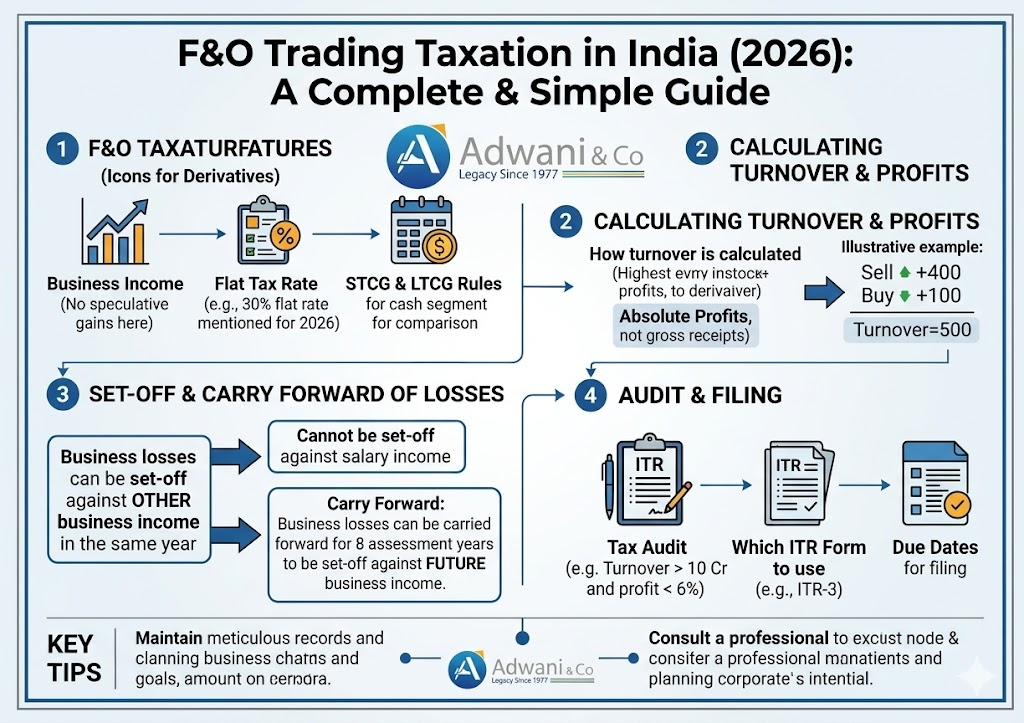
Futures and Options F&O trading is classified as non-speculative business income under Section 43(5) of the Income Tax Act. This means:
Taxable at: Your applicable income tax slab rate
Turnover computation: Based on absolute profits + losses (not just net profit)
Tax audit: Mandatory if turnover exceeds ₹10 crore (or ₹2 crore if opting out of presumptive taxation under Section 44AD)
GST: F&O trading transactions may also attract GST implications on brokerage; verify at the GST Portal (gst.gov.in)
F&O traders who do not maintain proper books and file returns accurately are among the most common recipients of scrutiny notices from the Income Tax Department. Adwani and Company provides end to end F&O trading tax compliance support for traders across India.
How to Save Tax on Stock Market Gains Legally
Smart tax planning within the bounds of law can significantly reduce your income tax on stock market gains in India. Here are proven, legal strategies:
1. Harvest LTCG before the threshold: Book profits up to ₹1.25 lakh each financial year to take advantage of the LTCG exemption limit. You can then reinvest immediately (this is called tax-loss/gain harvesting).
2. Set off capital losses: STCG losses can be set off against both STCG and LTCG gains. LTCG losses can only be set off against LTCG gains. Losses can be carried forward for 8 years if the ITR is filed on time.
3. Choose tax efficient instruments: ELSS (Equity-Linked Savings Schemes) offer a deduction under Section 80C (up to ₹1.5 lakh) along with equity-like returns.
4. HUF structure: High net worth investors may explore creating a Hindu Undivided Family (HUF) for additional exemption limits a strategy where Dr. Haresh Adwani’s legal background proves invaluable in ensuring compliance.
5. NRI tax treaties: Non resident Indians may benefit from India’s Double Taxation Avoidance Agreements (DTAA). Verify the applicable treaty at incometaxindia.gov.in.
ITR Filing for Stock Market Investors: What Form to Use?
Filing the correct ITR form is essential to avoid defective return notices. Here is a quick reference:
ITR.2: For individuals and HUFs with capital gains but no business income (ideal for delivery-based equity investors and mutual fund investors)
ITR.3: For individuals with business income including F&O trading and intraday trading
ITR.4 (Sugam): For those opting for presumptive taxation but NOT applicable if you have capital gains
The Ministry of Corporate Affairs (MCA) and Income Tax Department have increasingly integrated PAN and Demat data. Any discrepancy between your broker’s statement and your ITR can trigger an automated scrutiny notice under Section 143(1).
At Adwani and Company, Dr. Haresh Adwani and the team handle ITR filing for investors across asset classes from equities and mutual funds to REITs and InvITs ensuring maximum compliance and minimum tax outgo.
Conclusion
The income tax on stock market gains in India has become increasingly sophisticated with revised STCG and LTCG rates, stricter ITR compliance, and greater data-sharing between SEBI, BSE/NSE, and theIncome Tax Department. Whether you are a casual investor in equity mutual funds or an active F&O trading , understanding your capital gains tax obligations is no longer optional it is essential to protecting your wealth. The good news? With the right expert guidance, you can stay fully compliant, legally minimise your tax burden, and focus on growing your investments with confidence.
1. What is the income tax on stock market gains in India for 2026?
STCG on listed equity shares and equity mutual funds is taxed at 20% (for holdings under 12 months). LTCG above ₹1.25 lakh per year (for holdings over 12 months) is taxed at 12.5%, as revised by the Finance Act 2024. Intraday trading profits are taxed at slab rates as speculative business income.
2. Do I have to pay capital gains tax if I make a loss in the stock market?
No, capital losses are not taxed. In fact, they can be set off against capital gains of the appropriate type and carried forward for up to 8 assessment years provided you file your ITR within the due date. Accurate record-keeping is essential for this.
3. Is there income tax on intraday trading in India?
Yes. Intraday trading profits are classified as speculative business income and taxed at your applicable income tax slab rate. You must file ITR-3 and maintain books of accounts if required. Losses from intraday trading can only be set off against other speculative gains, not salary.
4. How is income tax on equity mutual funds calculated?
Equity mutual funds held for less than 12 months attract STCG at 20%. For holdings above 12 months, LTCG exceeding ₹1.25 lakh is taxed at 12.5%. Debt mutual fund gains regardless of holding period are taxed at your income tax slab rate since April 2023.
5. Which ITR form should I file if I trade in stocks and mutual funds?
Use ITR-2 if you only have capital gains (no business income). Use ITR-3 if you also have income from intraday trading or F&O trading . ITR-4 cannot be used if you have capital gains. Filing the wrong form can result in a defective return notice from the Income Tax Department.
Quick Overview
- F&O trading income is treated as business income
- It is considered non-speculative in nature
- Tax is levied as per applicable slab rates
- Losses may be carried forward for up to 8 years, subject to conditions
- Tax audit provisions may apply depending on turnover and other factors
Author
CA Dipesh Gurubakshani is a Chartered Accountant with Adwani & Co LLP, Pune, specialising in income tax audit, direct taxation, and accounting advisory. He supports clients across statutory compliance, financial reporting, and income tax matters with a focus on accuracy, regulatory adherence, and disciplined execution.
DISCLAIMER
This blog is intended for informational and educational purposes only. It does not constitute legal, financial, or professional tax advice. Tax laws and provisions under the Income Tax Act, 1961, are subject to amendment; figures and deadlines mentioned are based on information available as of the date of publication. Readers are strongly advised to consult a qualified Chartered Accountant or tax professional before taking any action based on this content. Adwani and Company and Dr. Haresh Adwani shall not be held liable for any decisions made on the basis of information provided herein. Always refer to official sources at incometax.gov.in and cbdt.gov.in for the latest and authoritative information.