
Tag: Cross Border Taxation

  • Cross Border Tax Certainty: Lessons From Cairn Energy

    Cross Border Tax Certainty: Lessons From Cairn Energy

    Cross Border Tax Certainty

    A single tax dispute can undo years of careful cross border Tax planning. Just ask Cairn Energy, the UK oil major that spent over a decade fighting a retrospective tax demand from the Indian government, a fight that began with a routine internal reorganisation in 2006 and ended with a landmark international arbitration award in 2020. If you are structuring a cross-border investment, planning an overseas expansion, or advising a multinational client on Indian operations, the real lesson is not about oil and gas. It is about cross-border tax certainty, and why it can never be treated as a one-time compliance checkbox.
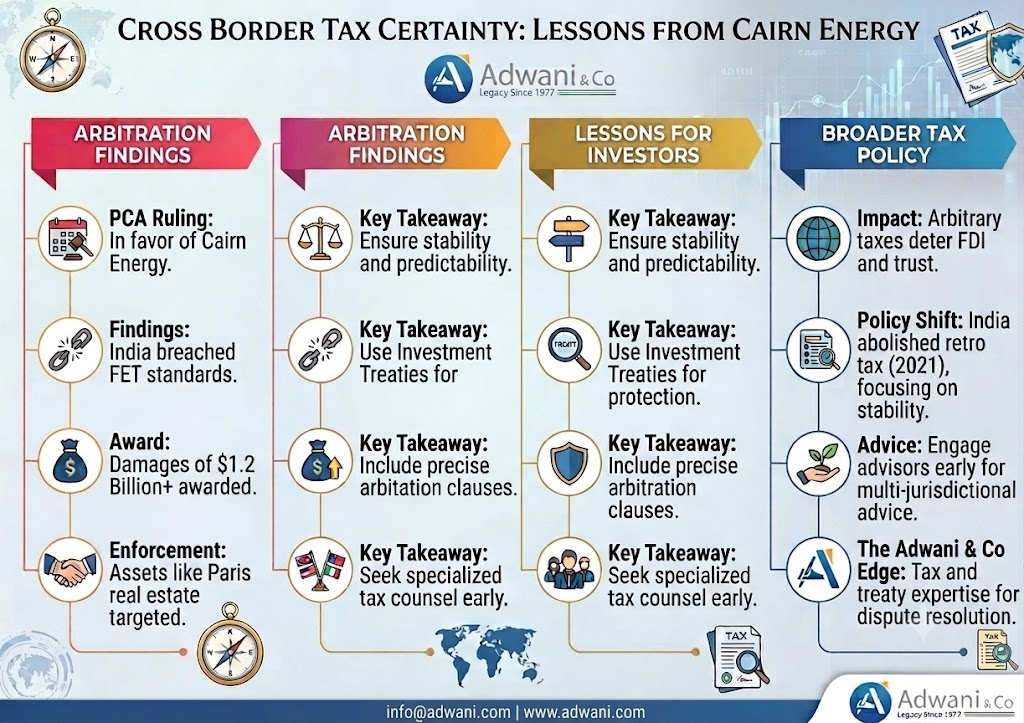
    Why Cross Border Tax Certainty Matters More Than the Tax Calculation

    Most businesses approach cross-border transactions the same way: calculate the tax outgo, structure around it, and move forward. But cross border tax certainty is not about knowing today’s tax rate. It is about understanding how today’s structure, documentation, and business rationale will stand up to scrutiny years later, under a rule that may not even exist yet. The Income Tax Department has repeatedly shown that a transaction considered clean at the time of execution can be reopened when the law, or its interpretation, changes.

    The Cairn Energy Case: What Actually Happened

    Cairn Energy carried out an internal reorganisation of its Indian business in 2006 to prepare for the 2007 listing of Cairn India. At the time, this was a standard pre-IPO restructuring step. Six years later, following the retrospective tax amendment introduced through the Finance Act, 2012, the tax department revisited the 2006 transaction and treated it as giving rise to taxable capital gains. In 2014, it issued a tax demand of roughly Rs 10,247 crore.

    To recover the demand, the department attached Cairn’s residual shareholding in what had by then become Vedanta, seized dividends of around Rs 1,140 crore, and adjusted a separate tax refund of about Rs 1,590 crore against the outstanding claim. Cairn Energy initiated international arbitration in 2015 under the India-UK Bilateral Investment Treaty, arguing that the retrospective demand breached the fair and equitable treatment guaranteed to foreign investors.

    In December 2020, the Permanent Court of Arbitration at The Hague ruled in Cairn’s favour, holding that India had failed to honour its treaty obligations, and directed the government to return the funds along with interest and costs. The matter was finally resolved after the Taxation Laws (Amendment) Act, 2021 nullified pre-2012 retrospective demands, prompting Cairn to withdraw its global enforcement proceedings.

    What the Cairn Case Teaches About Cross Border Tax Certainty

    Treaty Protection Is Not Automatic

    Cairn’s arbitration succeeded because it had treaty coverage and could show the tribunal that the demand breached specific investor protections. Not every cross-border structure enjoys this protection by default. Whether a Bilateral Investment Treaty or a Double Taxation Avoidance Agreement applies, and how strongly it applies, depends on how the investment is routed and documented from day one.

    Regulatory Change Can Reach Backward

    The single most unsettling aspect of the Cairn case is that a 2012 legislative amendment was applied to a 2006 transaction. Cross-border tax certainty planning has to account for the possibility that today’s compliant structure could be judged by tomorrow’s rules, not just today’s.

    Documentation Is Your First Line of Defence

    Eight years passed between the original transaction and the tax notice. Businesses rarely retain granular documentation, valuation workings, board rationale, and correspondence for that long, yet that is exactly the evidence a tribunal or assessing officer will ask for.

    Business Purpose Must Be Provable, Not Assumed

    A restructuring done for genuine commercial reasons, such as an IPO, still needs a documented business purpose that can be independently verified years later. Intent alone is not enough; it has to be evidenced.

    Exit Plans Need a Tax Lens Too

    Cairn’s eventual exit from its Indian holding was disrupted precisely because tax risk had not been priced into the exit structure. Any long-term cross-border decision should be tested against how an exit, sale, or restructuring event might be viewed under future tax scrutiny.

    Building Cross Border Tax Certainty Into Deal Structuring: A Practical Example

    Consider a mid-sized Indian technology company receiving a $10 million investment from a foreign holding entity, structured through a jurisdiction with DTAA benefits. If the investment agreement, valuation report, and board resolutions clearly document the commercial rationale, and the structure is reviewed against current FEMA and income tax provisions before signing, the business can defend its position even if scrutinised five or ten years later. Without that documentation trail, the same structure could face a reassessment, interest, and penalty exposure running into several times the original tax saved, simply because the “why” behind the structure was never recorded. This is the practical difference cross border tax certainty makes: not lower tax, but a defensible position.

    Where Routine Tax Compliance Ends and Cross Border Tax Advisory Begins

    Routine tax support answers “what do we owe this year.” Cross border tax certainty requires answering harder questions before the transaction is signed, not after a notice arrives:

    • What could change in the regulatory environment over the life of this structure?
    • What risks, treaty-related, procedural, or documentary, are we currently missing?
    • What happens if the structure itself gets challenged a decade from now?

    This is complex advisory work, and it looks very different from annual return filing or routine assessment support. As Dr. Haresh Adwani frequently reminds clients during structuring discussions, the real advisory work happens before the transaction is signed, not after a notice arrives.

    How Adwani and Company Helps Businesses Build Cross Border Tax Certainty

    Adwani and Company has advised businesses on cross-border and domestic tax positioning since 1977, and this kind of forward-looking risk review is central to how the firm approaches complex advisory mandates. Dr. Haresh Adwani, the firm’s founder, holds a PhD in Commerce and is also a law graduate, a combination that allows him to assess cross-border tax certainty questions from both a tax-technical and a legal-interpretation standpoint. Under Dr. Haresh Adwani’s guidance, the firm’s advisory practice focuses on stress-testing a structure before it is signed, not only reporting on it after the fact.

    For businesses exploring cross-border investment, restructuring, or exit planning, this proactive approach is exactly what separates routine compliance from genuine cross-border tax certainty. Learn more about our International Tax Advisory services for a structured review of your cross-border position.

    Read our detailed guide on NRI ITR Filing India: Are You Overpaying Tax? for related regulatory considerations.

    Government and Regulatory Signals Worth Watching

    The Income Tax Department continues to refine its approach to cross-border transactions, and businesses should track its guidance alongside disclosure norms maintained by the

    Ministry of Corporate Affairs, particularly where cross-border shareholding, restructuring, or related-party transactions are involved. Staying aligned with these evolving signals, rather than reacting to them after a notice, is itself a form of cross-border tax certainty.

    1.What is cross-border tax certainty and why does it matter?

    Cross-border tax certainty means structuring a transaction so that its tax treatment remains defensible even years later, under possible future changes in law or interpretation, not just under the rules in force today.

    2.What lessons does the Cairn Energy case offer businesses today?

    It shows that a transaction considered valid at the time can be reopened years later if the law changes retrospectively, and that treaty protection, documentation, and provable business purpose are what ultimately determine the outcome.

    3.Can retrospective taxation still affect current cross-border deals in India?

    The Taxation Laws (Amendment) Act, 2021 nullified pre-2012 retrospective demands and limited such taxation to transactions after May 2012, but businesses should still structure deals to survive changes in interpretation, not just changes in law.

    4.What documentation protects a business in a cross-border tax dispute?

    Board resolutions, valuation reports, correspondence establishing business rationale, and transaction agreements retained well beyond the statutory assessment period are typically what tribunals and tax officers rely on.

    5.How does treaty protection work for foreign investors in India?

    A Bilateral Investment Treaty or DTAA can protect an investor against unfair or retrospective tax treatment, but the extent of protection depends heavily on how the investment is routed, structured, and documented at the outset.

    6.When should a business consult a tax advisor for cross-border structuring?

    Ideally before the transaction is signed, when questions about treaty coverage, documentation, and future dispute risk can still shape the structure, rather than after a notice or scrutiny has already begun.

    Conclusion: Make Cross-Border Tax Certainty Part of Every Deal

    The Cairn Energy dispute is a reminder that cross-border tax certainty is not a formality to tick off during due diligence. It is an ongoing discipline that protects a business’s economics long after the deal is signed. Whether you are planning an inbound investment, an outbound structure, or an exit, the questions worth asking are the same ones complex advisory starts with: what could change, what risks are being missed, and what happens if the structure is challenged.

    Author

    CA Dipesh Gurubakshani is a Chartered Accountant with Adwani & Co LLP, Pune, specialising in income tax audit, direct taxation, and accounting advisory. He supports clients across statutory compliance, financial reporting, and income tax matters with a focus on accuracy, regulatory adherence, and disciplined execution.

    If you want expert guidance on building genuine cross-border tax certainty into your next transaction, connect with Adwani and Company and Dr. Haresh Adwani’s advisory team today.

    Disclaimer

    This article is intended for general informational and educational purposes only and does not constitute legal, tax, or financial advice. The Cairn Energy case details are drawn from publicly reported facts and are summarised for illustrative purposes; readers should not rely on this article as a substitute for professional advice specific to their own facts and circumstances. Adwani and Company recommends consulting a qualified professional before acting on any information contained herein.


  • Critical US Stock Investing for Indians: Tax Rules You Cannot Ignore in 2026

    Critical US Stock Investing for Indians: Tax Rules You Cannot Ignore in 2026

    US Stock Investing for Indias
    US Stock Investing for Indias

    US Stock Investing for Indians: What Most Investors Get Wrong About Tax Compliance

    US Stock Investing for Indians has become increasingly popular as investors seek global diversification, exposure to leading US companies, and long-term wealth creation opportunities. However, many investors underestimate the tax and compliance obligations that accompany foreign investments.

    What Indian Investors in US Stocks Are Getting Wrong About Tax Compliance

    The Investment Is Easy. The Compliance Is Not.

    Opening an account on a global brokerage platform and buying shares of Apple or Tesla takes less than fifteen minutes today. The process is smooth, fast, and remarkably accessible for Indian investors.

    What often takes months to untangle and sometimes costs far more than the original tax liability is the compliance that follows.

    Over the last few years, thousands of Indian residents have started building portfolios in US-listed stocks, drawn by the promise of currency diversification, global exposure, and participation in some of the world’s most valuable companies. The investing thesis is sound. The compliance understanding, in many cases, is not.

    In practice, most investors spend hours sometimes weeks deciding whether to buy a particular stock. Very few spend even thirty minutes understanding the tax and reporting framework that attaches the moment they make that first foreign investment.

    Also Read:-https://www.adwaniandco.com/blog/tax-saving-tips-before-july-31-2026-27

    That gap is expensive.


    US Stock Investing for Indians: Dividend Tax Rules You Must Understand

    Dividends Are Not Just Income They Come with a Foreign Tax Dimension

    When an Indian investor receives a dividend from a US-listed company, the US government typically withholds tax at source often at 25% under the default withholding rate, or at a reduced rate of 15% if the applicable India-US Double Taxation Avoidance Agreement (DTAA) provisions are properly invoked.

    The dividend then needs to be reported as income in India, where it is taxable at the applicable slab rate. However, the foreign tax withheld in the US can be claimed as a Foreign Tax Credit (FTC) under Section 90 of the Income Tax Act but only if the investor files the correct ITR form and submits Form 67 before the due date.

    Many investors claim the credit informally, file the wrong form, or miss the Form 67 deadline entirely resulting in double taxation that was entirely avoidable.

    US Stock Investing for Indians: Dividend Tax Rules You Must Understand

    For many investors, dividends are the first taxable income generated through US Stock Investing for Indians. While dividend-paying US companies can provide a steady income stream, investors must understand how US withholding tax, Indian income tax rules, and Foreign Tax Credit (FTC) provisions interact to avoid double taxation.

    Currency Movements Can Create a Taxable Gain Even When You Have Made No Profit

    This is one of the most misunderstood aspects of foreign investing.

    Suppose you invest ₹75,000 in a US stock when the exchange rate is USD 1 = ₹75. You hold the stock for a year. The stock’s price in US dollars remains exactly the same. You sell it. No gain in dollar terms.

    But if the exchange rate has moved to ₹85 per dollar at the time of sale, the Indian tax treatment will compute your capital gain in rupees. The currency appreciation itself can generate a taxable capital gain under Indian income tax law even though, from an investment standpoint, you “made nothing.”

    Understanding this mechanism before investing not after can meaningfully influence decisions around timing, holding periods, and tax planning.

    No Transactions Does Not Mean No Reporting Requirement

    A common assumption among foreign investors is: “I didn’t buy or sell anything this year, so I have nothing to report.”

    This is incorrect.

    Under Schedule FA (Foreign Assets) of the Indian Income Tax Return, a resident Indian is required to disclose all foreign assets held at any point during the previous financial year. This includes foreign equity holdings, foreign bank accounts, interests in foreign entities, and foreign insurance or annuity contracts.

    Failure to disclose foreign assets carries significant consequences under the Black Money (Undisclosed Foreign Income and Assets) and Imposition of Tax Act, 2015 a legislation with provisions that are materially more severe than standard income tax penalties.

    The obligation to disclose exists irrespective of transaction activity.

    Schedule FA Reporting Requirements for US Stock Investing for Indians

    Investors engaged in US Stock Investing for Indians should understand that foreign asset disclosure is an annual obligation. Failure to report overseas holdings correctly can attract scrutiny and penalties under applicable reporting laws.

    TCS on Overseas Remittances Recoverable, but Only if You Know How

    When you remit money overseas for investing under the Liberalised Remittance Scheme (LRS), the authorised dealer bank deducts Tax Collected at Source (TCS) under Section 206C(1G) of the Income Tax Act. At present, TCS applies on LRS remittances above specified thresholds.

    This TCS is not a final tax. It is a credit that can be set off against your overall income tax liability or claimed as a refund in your ITR. But it requires correct reporting matching your TCS certificates against your overall tax computation.

    Investors who are unaware of this mechanism often end up with blocked funds or file returns without claiming what is legitimately theirs.

    Estate-Tax Implications of a Large US Portfolio Are Increasingly Relevant

    This is a conversation that almost no investor has until it is too late.

    The United States levies estate tax on assets located in the US, including US-listed equity holdings by non-resident aliens (NRAs). The threshold for US estate tax applicability for NRAs is significantly lower than for US citizens or residents. A portfolio that crosses this threshold without any estate planning framework in place could expose the estate to a substantial US tax liability that Indian heirs were entirely unprepared for.

    This is not a theoretical concern. As Indian participation in US markets grows and portfolio values increase, this becomes a real, material planning issue.

    Key Compliance Checklist for US Stock Investing for Indians

    Before or immediately after you make your first investment in US equities, consider addressing the following:

    • ITR Form Selection: Are you filing the correct ITR form that includes Schedule FA and Schedule FSI for foreign income and assets?
    • Foreign Tax Credit Mechanism: Do you understand how to claim credit for taxes withheld abroad, and are you aware of the Form 67 filing requirement?
    • Capital Gains Classification: Are you clear on whether your gains will be classified as short-term or long-term, and how currency movement is factored into your computation?
    • LRS Compliance: Are you remitting within the annual limit and understanding how TCS deducted by your bank can be recovered?
    • Annual Disclosure: Are you prepared to include all foreign holdings in Schedule FA every year, regardless of whether any transactions occurred?
    • Estate Planning: If your US portfolio is substantial or growing, have you considered the cross-border estate-tax implications?

    None of these are obscure compliance requirements. They are standard obligations that arise the moment you become a holder of foreign assets.


    Key Takeaways

    • US dividend income is taxable in India; foreign tax withheld can be claimed as a credit, but only with correct documentation and timely filings.
    • Currency appreciation can create a taxable capital gain in India even when there is no profit in dollar terms.
    • Resident Indians must disclose all foreign assets annually in Schedule FA this obligation applies even when no transactions have occurred.
    • TCS deducted on LRS remittances is recoverable through ITR filings if correctly reported.
    • A growing US portfolio can trigger US estate-tax considerations for Indian investor estates this requires advance planning, not retrospective action.

    Frequently Asked Questions

    Q1. Which ITR form should be used for US Stock Investing for Indians?

    Resident Indians holding foreign assets must file ITR-2 at a minimum. If they have income from a profession or business, ITR-3 is applicable. Forms ITR-1 and ITR-4 do not contain Schedule FA and are not appropriate for investors with foreign holdings.

    Q2. How does the Foreign Tax Credit (FTC) work for dividends received from US stocks?

    Q1. Which ITR form should a resident Indian file if they have US stock holdings?
    Resident Indians holding foreign assets must file ITR-2 at a minimum. If they have income from a profession or business, ITR-3 is applicable. Forms ITR-1 and ITR-4 do not contain Schedule FA and are not appropriate for investors with foreign holdings.

    Q3. Do US Stock Investing for Indians rules require Schedule FA disclosure every year?

    exemption exists for resident Indians. The Schedule FA disclosure requirement applies to all foreign assets held during the year irrespective of the value of the asset, income earned from it, or whether any transaction occurred. Non-disclosure can attract severe penalties under the Black Money Act.

    Q4. What is TCS on LRS remittances, and how is it different from TDS?

    Collected at Source) under Section 206C(1G) is collected by the bank at the time of remittance abroad under the LRS. It is different from TDS in that it is collected from the remitter (you), not withheld from income. The amount is credited to your PAN and can be set off against your total income tax payable or claimed as a refund but you need to correctly account for it in your ITR.

    Q5. At what portfolio value do US estate-tax rules become relevant for Indian investors?

    The US estate-tax exemption for non-resident aliens (NRAs) is significantly lower than for US citizens. Investors with meaningful US equity holdings should seek professional guidance on this aspect the threshold and applicable rules can change, and the implications for Indian heirs can be substantial without proper advance planning.

    US Stock Investing for Indians offers significant opportunities for wealth creation and diversification. However, tax compliance, foreign asset reporting, FTC claims, Schedule FA disclosures, and estate tax considerations should be addressed proactively to avoid unnecessary penalties and tax costs.

    Connect with Adwani & Co LLP

    If you are investing in US stocks, planning to start, or are uncertain about your existing foreign asset disclosures, income tax filings, or cross-border compliance position, the team at Adwani & Co LLP is available to assist. We support individuals and businesses with international taxation, ITR advisory, foreign asset compliance, and cross-border financial matters.

    Explore our Taxation & Compliance Services | Connect with our Global Advisory Team | Contact Us


    Author

    CA Dipesh Gurubakshani is a Chartered Accountant with Adwani & Co LLP, Pune, specialising in income tax audit, direct taxation, and accounting advisory. He supports clients across statutory compliance, financial reporting, and income tax matters with a focus on accuracy, regulatory adherence, and disciplined execution.