
Late Filing Penalty AY 2026-27
Every year, thousands of Indian taxpayers miss the ITR filing deadline sometimes by a day, sometimes by months without realising how expensive that delay can truly be. For AY 2026-27, missing the due date does not just mean a late filing penalty: it triggers a cascading set of financial consequences including penal fees under Section 234F, interest under Sections 234A and 234B, loss of valuable carry-forward benefits, and in serious cases, prosecution under the Income Tax Act, 1961.
This authoritative guide, prepared by the experts at Adwani and Company, breaks down every penalty, every interest charge, and every consequence so you can make an informed decision about whether filing late is worth the cost, and what to do if you have already missed the deadline.
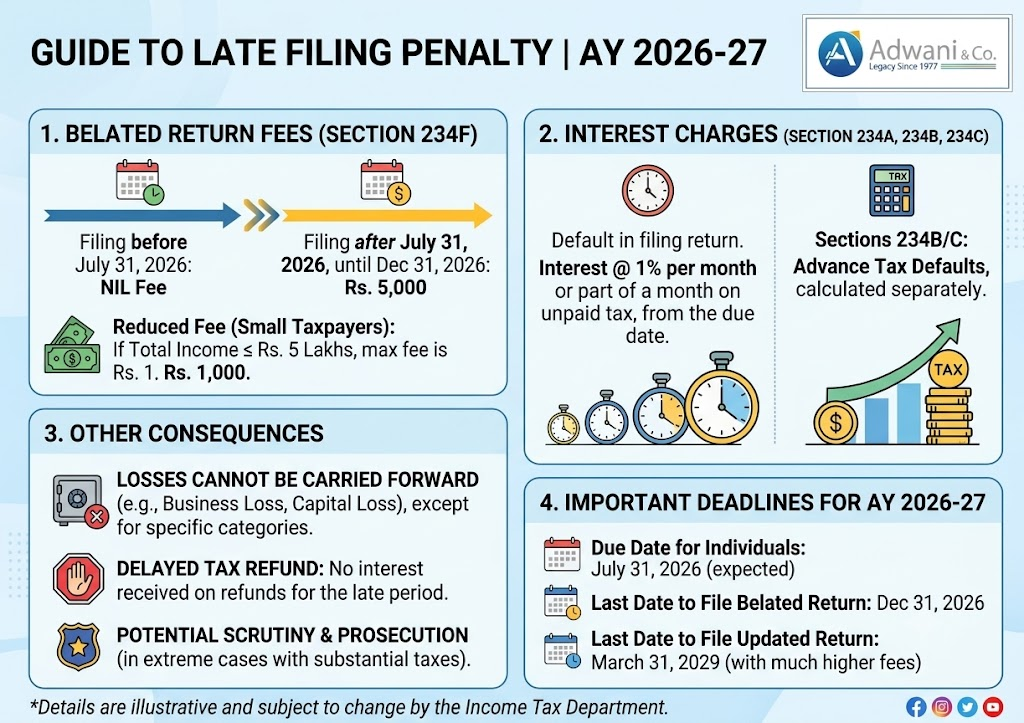
Late Filing Penalty Under Section 234F for AY 2026-27
The most direct consequence of missing the ITR filing deadline for AY 2026-27 is the late filing fee under Section 234F of the Income Tax Act. This fee is mandatory and non-waivable it is levied automatically when you file a belated return after July 31, 2026.
| Scenario | Filing Window | Late Fee (Section 234F) |
| Total income > ₹5 lakh | August 1 to December 31, 2026 | ₹5,000 |
| Total income ≤ ₹5 lakh | August 1 to December 31, 2026 | ₹1,000 (capped) |
| Total income below basic exemption limit | Any date (belated) | NIL no fee applicable |
| Return filed after December 31, 2026 | Not permitted (ITR lapses) | Only updated return u/s 139(8A) with higher tax cost |
As Dr. Haresh Adwani PhD in Commerce, law graduate, and founding expert at Adwani and Company explains: “Section 234F is a flat fee, not a percentage-based charge. For taxpayers with income above ₹5 lakh, the ₹5,000 penalty is non-negotiable regardless of whether your actual tax liability is zero. Never mistake a nil tax payable for a nil late filing penalty.”
Interest on Late ITR Filing: Section 234A, 234B, and 234C Explained
Beyond the late filing penalty under Section 234F, filing your ITR after the due date for AY 2026-27 also triggers interest charges under multiple sections. Together, these can significantly inflate your total tax dues
Section 234A : Interest for Delay in Filing Return
Section 234A imposes simple interest at 1% per month (or part of a month) on the unpaid tax amount from the due date of filing until the actual date of filing. This interest applies only if tax remains unpaid on the due date. If you have paid all taxes (through TDS, advance tax, or self-assessment) and only the return filing is delayed, Section 234A does not apply.
Section 234B : Interest for Default in Advance Tax Payment
If your advance tax payment was less than 90% of your assessed tax liability by March 31, 2026, Section 234B interest applies at 1% per month on the shortfall from April 1, 2026 until you pay the tax. This is entirely separate from the late filing penalty AY 2026-27 but compounds your dues significantly when both apply simultaneously.
Section 234C : Interest on Deferred Advance Tax Instalments
Section 234C interest applies when advance tax instalments (due in June, September, December, and March) were not paid in full during FY 2025-26. The rate is 1% per month for a period of 3 months per missed or short instalment, calculated on the shortfall.
Practical Example: Real Cost of Late Filing Penalty
Example : Priya, Freelance Consultant, Pune, AY 2026-27:
Priya’s gross income for FY 2025-26 is ₹8,20,000. Her total tax liability under the new regime is ₹54,600 (including cess). She paid advance tax of only ₹40,000 (i.e., shortfall of ₹14,600). She misses the July 31, 2026 deadline and files her ITR on October 15, 2026 2.5 months after the due date. Here is what her late filing penalty and interest for AY 2026-27 look like:
| Charge | Calculation | Amount |
| Section 234F (Late Filing Fee) | Income > ₹5L, filed Aug–Dec | ₹5,000 |
| Section 234A (Delay in Filing) | ₹14,600 × 1% × 3 months | ₹438 |
| Section 234B (Advance Tax Shortfall) | ₹14,600 × 1% × 6 months (Apr–Sep) | ₹876 |
| Self-Assessment Tax Balance | ₹14,600 due at time of filing | ₹14,600 |
| Total Additional Cost | Fee + Interest + Balance Tax | ₹20,914 |
Priya’s original tax liability was ₹54,600 but her cost of procrastination added ₹6,314 in penalty and interest (₹5,000 + ₹438 + ₹876) on top of the ₹14,600 unpaid balance. This is a preventable cost. Dr. Haresh Adwani of Adwani and Company notes: “The tragedy is that most delayed filers are not intentionally evading they are simply unaware of the compounding cost of delay. A single consultation with a CA before the deadline can save thousands.”
Other Consequences of Late ITR Filing Penalty
The financial penalties are only part of the story. Filing your ITR after the AY 2026-27 due date carries several other consequences that can affect your finances for years:
1. Loss of Carry Forward of Losses
Under the Income Tax Act, you can carry forward losses (capital losses, business losses under Section 72, speculative losses) to offset future income but only if you file your ITR on time. A late filed belated return under Section 139(4) forfeits this valuable benefit. For investors with F&O losses, STCG losses, or business losses, this can mean losing tax benefits worth lakhs over the next 8 years.
2. Inability to Revise a Belated Return (After December 31, 2026)
If you file a belated return by December 31, 2026, you can still revise it up to December 31, 2026 (the same deadline). However, once December 31 passes, you cannot file any revised return errors or omissions in your ITR become permanent unless the department issues a notice.
3. Difficulty in Loan Processing and Visa Applications
Banks and financial institutions including home loan lenders, personal loan providers, and mortgage companies typically require 2–3 years of ITR copies as proof of income. A missing or late ITR for AY 2026-27 can delay or derail your loan approval. Similarly, many countries require ITR filings as part of visa documentation. A late or absent filing can create complications.
4. Prosecution Risk for Wilful Default (Extreme Cases)
Under Section 276CC of the Income Tax Act, wilful failure to file an ITR when tax liability exceeds ₹25,000 can attract prosecution with imprisonment ranging from 3 months to 2 years (and up to 7 years in serious cases). While prosecution for individual salaried taxpayers is rare, it is a real legal risk for business owners, professionals, and high-income non-filers. The Income Tax Department has progressively tightened its enforcement since the introduction of the Annual Information Statement (AIS).
How to File a Belated ITR for AY 2026-27 Under Section 139(4)
If you have already missed the July 31, 2026 deadline, you can still file a belated return under Section 139(4) up to December 31, 2026. Here is how:
- Log in to the Income Tax e-Filing portal at incometax.gov.in using your PAN credentials.
- Click on ‘e-File’ > ‘Income Tax Returns’ > ‘File Income Tax Return’.
- Select Assessment Year 2026-27 and the applicable ITR form (ITR-1, ITR-2, ITR-3, or ITR-4).
- Under Filing Type, select ‘Belated Return u/s 139(4)’.
- Complete all income, deduction, and tax payment details accurately.
- Pay any outstanding tax along with the applicable Section 234A interest before submitting.
- Submit and e-Verify using Aadhaar OTP, Net Banking, or Digital Signature Certificate (DSC).
Remember: the late filing fee of ₹5,000 (or ₹1,000 for income below ₹5 lakh) under Section 234F is automatically added when you select the belated return option it cannot be avoided.
What if You Miss December 31, 2026? Updated Return Under Section 139(8A)
If you miss even the belated return deadline of December 31, 2026, your last option is an Updated Return under Section 139(8A), which can be filed up to 2 years from the end of the relevant assessment year (i.e., up to March 31, 2029 for AY 2026-27). However, this comes with a significant cost:
- Additional tax of 25% on the aggregate of tax and interest payable if filed within 1 year after the end of the assessment year
- Additional tax of 50% if filed after 1 year but within 2 years
- An updated return cannot be used to claim a refund or reduce your tax liability it can only be used to declare additional income or correct omissions
As Dr. Haresh Adwani of Adwani and Company advises all clients: “Section 139(8A) is a compliance tool of last resort. The additional 25–50% tax cost makes it extremely expensive. Filing on time or at least before July 31 is always the most financially prudent choice.”
Official Government Resources for ITR Filing and Penalty Information
The Central Board of Direct Taxes (CBDT), under the Ministry of Finance, regularly issues circulars, press releases, and FAQs regarding ITR filing deadlines and late filing penalties. Key official resources include:
- Income Tax e-Filing Portal: incometax.gov.in — file ITR, check refund, respond to notices
- CBDT Official Portal: cbdt.gov.in — CBDT circulars on deadline extensions and policy notifications
- Aaykar Sampark Kendra Helpline: 1800-103-0025 (toll-free, for ITR filing queries)
Always verify the current ITR deadline on the official portal, as CBDT has historically issued last-minute extensions in prior years (AY 2020-21, 2021-22, 2022-23). For AY 2026-27, no extension has been announced at the time of this publication file before July 31, 2026 to avoid all penalties.
Related Guides and Services by Adwani and Company
Explore these expert resources to stay fully compliant:
• Learn more about our ITR Filing Services for Salaried and Business Taxpayers.
• Read our detailed guide on How to Check Income Tax Refund Status Online for AY 2026-27.
• Read our detailed guide on Advance Tax Due Dates FY 2026-27: Instalments, Calculation & Penalty.
• Learn more about our Income Tax Notice Reply Services — Section 148, 143(1), 139(9) and more.
• Read our detailed guide on Old vs New Tax Regime 2026: Which One Saves More Tax for You.
Key Takeaways: Late Filing Penalty AY 2026-27
- The ITR filing due date for AY 2026-27 (non-audit cases) is July 31, 2026.
- Late filing fee under Section 234F: ₹5,000 (income > ₹5L) or ₹1,000 (income ≤ ₹5L) no fee if income is below the basic exemption.
- Interest under Section 234A: 1% per month on unpaid tax from the due date to actual filing date.
- Additional interest applies under 234B (advance tax shortfall) and 234C (deferred instalments).
- Belated return u/s 139(4) can be filed by December 31, 2026.
- Loss carry-forward is forfeited for belated returns a major tax cost for investors.
- Missing December 31 triggers Section 139(8A) Updated Return with 25–50% additional tax.
- Read our detailed guide on ITR Filing 2026: Deadlines, Penalties & Smart Tax Saving Guide
1. What is the late filing penalty for AY 2026-27?
The late filing penalty for AY 2026-27 is governed by Section 234F of the Income Tax Act. If your total income exceeds ₹5 lakh, the penalty is ₹5,000. If your income is ₹5 lakh or below, it is capped at ₹1,000. No penalty applies if your income is below the basic exemption limit.
2. What is the last date to file ITR for AY 2026-27 without penalty?
The last date to file your ITR for AY 2026-27 without attracting any late filing fee is July 31, 2026 (for non-audit cases, salaried individuals, and most individuals and HUFs). After this date, the Section 234F fee applies even if you owe zero tax.
3. Can I file a belated return for AY 2026-27 after the due date?
Yes. A belated return under Section 139(4) can be filed for AY 2026-27 until December 31, 2026. Late filing fees under Section 234F and applicable interest under Section 234A will be levied. After December 31, 2026, you can only file an Updated Return under Section 139(8A) at a significantly higher tax cost.
4. What is the interest on late ITR filing under Section 234A?
Section 234A charges simple interest at 1% per month (or part thereof) on unpaid taxes from the ITR due date (July 31, 2026) until the actual date of filing. This applies only if tax dues remain unpaid on the original due date. If all your taxes have been paid via TDS or advance tax and no balance tax is outstanding, Section 234A interest does not apply.
5. Does missing the ITR deadline affect my carry-forward of losses?
Yes, this is one of the most costly, least-discussed consequences of a late filing. If you file a belated return under Section 139(4) after July 31, 2026, you lose the right to carry forward most losses (capital losses, business losses, speculative losses) to future years. This rule does not apply to losses from house property, which can still be carried forward even in a belated return.
6. Is there any waiver or relaxation of the late filing fee for AY 2026-27?
The Income Tax Department does not have a formal waiver mechanism for Section 234F late filing fees. However, CBDT occasionally extends the ITR due date by notification which effectively pushes the penalty trigger date. As of the date of this publication, no extension has been announced for AY 2026-27. Monitor cbdt.gov.in for any official announcements.
7. What happens if I completely miss the December 31, 2026 belated return deadline?
If both the July 31 and December 31, 2026 deadlines are missed, you must file an Updated Return under Section 139(8A) by March 31, 2029. An additional tax of 25% on aggregate tax + interest is charged if filed within the first year after the assessment year ends, rising to 50% in the second year. An updated return cannot be used to claim a refund it is strictly a compliance tool for disclosing additional income
Conclusion: File on Time, Save More : Expert Guidance from Adwani and Company
The late filing penalty for AY 2026-27 is not just a small administrative fee it is the entry point to a chain of financial and legal consequences that compound over time. From the mandatory Section 234F fee and interest under 234A and 234B, to the permanent loss of carry-forward benefits and the risk of prosecution under extreme circumstances, the cost of delay is always higher than the cost of timely compliance.
With the ITR filing deadline for AY 2026-27 set at July 31, 2026, there is no better time to act than now. Gather your Form 16, reconcile your AIS and Form 26AS, compute your tax under both regimes, and file or consult a qualified Chartered Accountant who will do it accurately on your behalf.
Dr. Haresh Adwani PhD in Commerce, law graduate, and lead tax expert at Adwani and Company sums it up best: “In tax compliance, delay is never free. The cost is measured in fees, interest, lost deductions, and sleepless nights. Filing on time is not just a legal obligation it is the single smartest financial decision most taxpayers can make each year.”
About the Author:
About the Author
Dr. Haresh Adwani
Ph.D. in Commerce | Law Graduate | Managing Partner, Adwani & Co LLP Dr. Haresh Adwani holds a Ph.D. in Commerce and is a qualified Law graduate with over two decades of hands-on experience in GST advisory, direct taxation, and statutory compliance for businesses across Pune and Maharashtra has guided hundreds of SMEs, startups, and corporates through India’s evolving tax landscape. He is a recognised advisor on GST compliance, company formation, and Virtual CFO services, and regularly contributes to professional seminars and industry forums in Pune.
DISCLAIMER
This blog is intended for informational and educational purposes only. It does not constitute legal, financial, or professional tax advice. Tax laws and provisions under the Income Tax Act, 1961, are subject to amendment; figures and deadlines mentioned are based on information available as of the date of publication. Readers are strongly advised to consult a qualified Chartered Accountant or tax professional before taking any action based on this content. Adwani and Company and Dr. Haresh Adwani shall not be held liable for any decisions made on the basis of information provided herein. Always refer to official sources at incometax.gov.in and cbdt.gov.in for the latest and authoritative information.