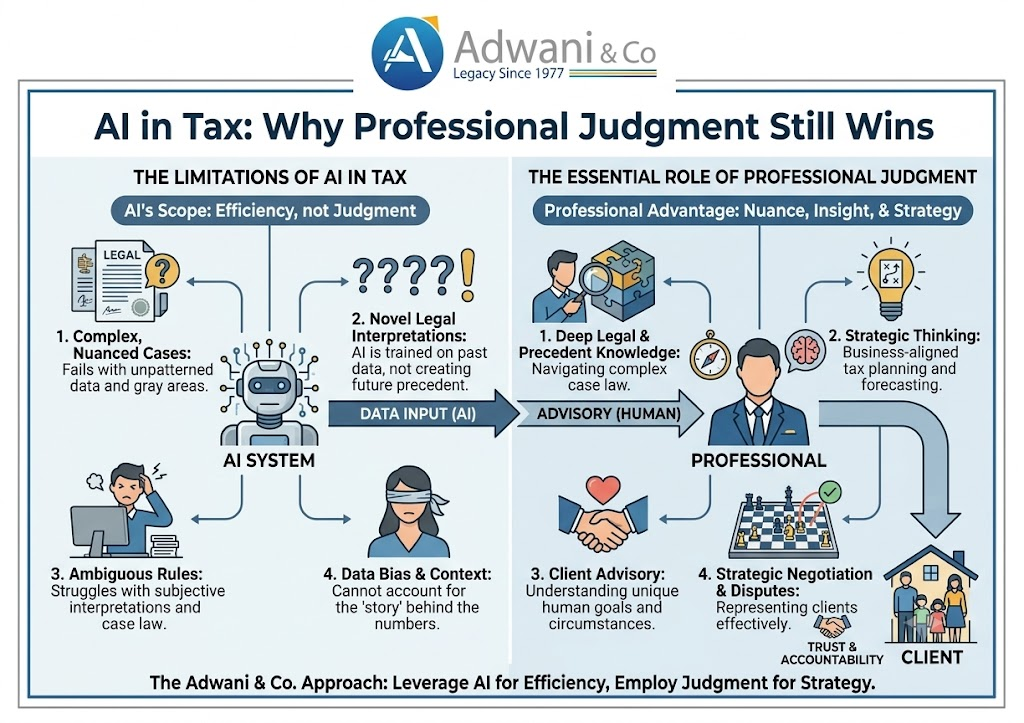
Tag: AI in Tax

  • AI Will Not Replace Professionals : It Will Empower Experts Who Adapt

    AI Will Not Replace Professionals : It Will Empower Experts Who Adapt

    By CA Manish 

    AI Will Not Replace Professionals

    The Question Every Professional Is Asking

    Will AI take my job?

    It is the most common question in boardrooms, CA chambers, law firms, and finance departments across India and globally. And while the anxiety is understandable, most professionals are asking the wrong question or at least framing it incorrectly.

    The more productive question is: How do I position myself to work with AI rather than be displaced by it?

    Having been personally involved in training and evaluating Agentic AI models across Indian taxation, US tax compliance, and financial analysis, I can tell you the professionals who will thrive in an AI-driven world are those who bring something no machine can generate on its own: real-world judgment, domain depth, and contextual experience.
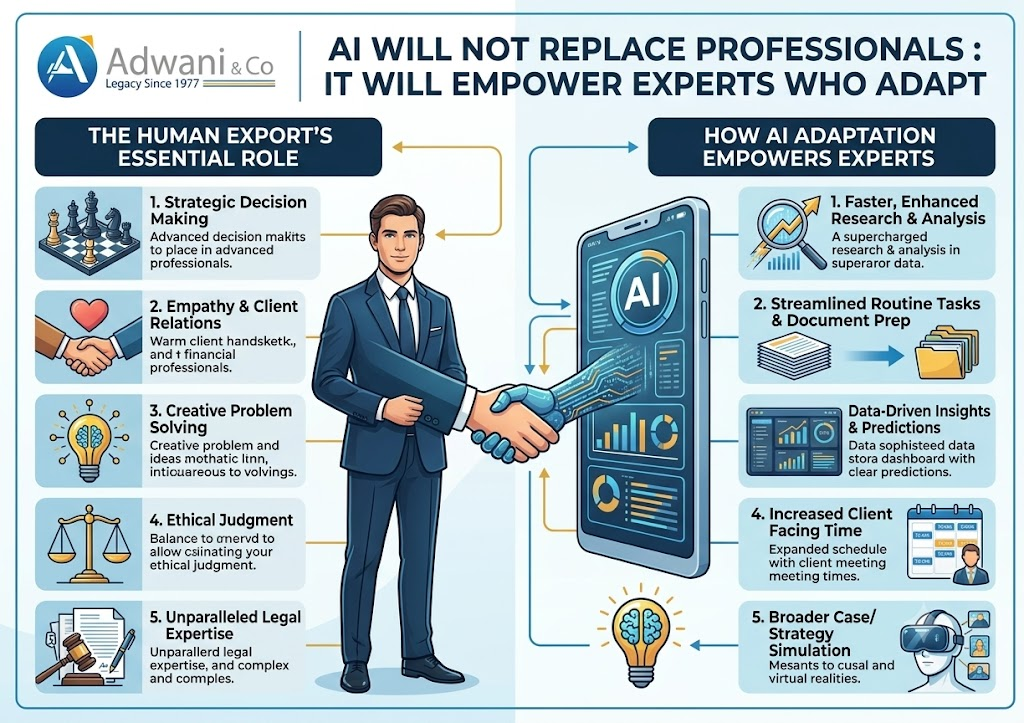
    What AI Actually Needs to Function

    Here is something that often surprises people outside the technology space: AI models, no matter how sophisticated, do not learn from textbooks alone.

    Effective AI systems in professional domains are trained on real-world decision-making. They need to understand industry-specific exceptions, regulatory nuances, client scenarios, workflow logic, and professional judgment none of which can be sourced from generic online data alone.

    This is precisely where experienced professionals become irreplaceable.


    When a large language model is being trained or evaluated for tax advisory, it needs inputs like:

    • How a Chartered Accountant thinks through an ITR filing involving multiple income heads
    • Why a particular FEMA compliance treatment applies in one cross-border scenario but not another
    • How a financial analyst structures a DCF model under real client constraints
    • What red flags a seasoned auditor spots in a set of books

    These are not answers you find in a compliance manual. They emerge from years of professional practice. And currently, that expertise is in significant demand not despite AI, but because of it.


    The Emerging Opportunity: Domain Experts as AI Trainers and Evaluators

    The AI industry is entering a phase where the quality of domain-specific training data is becoming the key competitive differentiator.

    Building a tax AI for Indian professionals requires Indian tax professionals. Building a financial modeling assistant for global finance teams requires experienced FP&A practitioners and valuation experts. The people who have spent years doing this work are exactly who AI developers need in the room.


    What This Looks Like in Practice

    Professionals with deep domain expertise are being engaged to:

    • Review and annotate AI-generated outputs for technical accuracy
    • Develop scenario libraries based on real client cases
    • Evaluate model responses for compliance, judgment quality, and practical reliability
    • Train AI systems to handle edge cases, exceptions, and regulatory ambiguity
    • Build quality benchmarks for AI tools operating in high-stakes advisory settings

    These are roles that did not exist five years ago. They require precisely the skills that experienced CAs, tax professionals, lawyers, financial analysts, and industry specialists have spent their careers building.


    Which Professionals Are Best Positioned?

    Across multiple AI evaluation projects, a clear pattern has emerged: the professionals who bring the most value are those with hands-on, applied expertise rather than purely theoretical credentials.

    Professionals particularly well-placed to contribute to AI training and evaluation include:

    • Chartered Accountants and Tax Professionals with multi-year client advisory experience
    • Financial Analysts and FP&A practitioners familiar with real-world modeling constraints
    • Auditors and forensic accountants who can identify anomalies and exceptions
    • Legal professionals with regulatory and cross-jurisdictional expertise
    • Industry specialists in healthcare, engineering, manufacturing, and supply chains
    • NRI and cross-border advisory experts who navigate FEMA, US tax, and double taxation treaties

    The common thread? All of these professionals have built something that AI still lacks: the ability to apply judgment in ambiguous, real-world situations.


    How Professionals Should Prepare Right Now

    The window for professionals to position themselves advantageously in an AI-augmented world is open — but it will not remain so indefinitely. Here is what I would suggest to any professional navigating this transition:

    1. Double Down on Core Domain Expertise

    AI amplifies expertise it does not substitute for the absence of it. The deeper your knowledge of your professional domain, the more valuable you become as an AI collaborator, trainer, or evaluator. Continuing professional development, advanced certifications, and specialized practice areas all strengthen your position.

    2. Understand How AI Systems Are Built

    You do not need to become a data scientist or software engineer. But a working understanding of how AI models are trained, how prompts are structured, and how outputs are evaluated gives you a meaningful advantage. This literacy is increasingly available through professional bodies, online courses, and industry events.

    3. Articulate Your Practical Experience Clearly

    The value AI developers are looking for is not just credentials — it is the specific, real-world scenarios you have worked through. A CA who can describe exactly how they analyzed a complex transfer pricing case, or how they resolved a GST reconciliation issue under audit pressure, is offering something genuinely useful to AI training efforts.

    4. Position Yourself as an AI Collaborator

    The professionals who will lead in the next decade are those who use AI tools effectively while providing the oversight, judgment, and accountability that clients and regulators will always require. Cultivating this positioning publicly through writing, speaking, or advisory work is a strategic advantage.


    The Adwani & Co LLP Perspective

    At Adwani & Co LLP, we are actively navigating this intersection between deep professional expertise and emerging AI capabilities. Our work across Indian taxation, international accounting, financial modeling, and cross-border advisory has always been grounded in practical experience which is precisely what the AI economy values.

    As CA Manish observes from ongoing AI model evaluation projects: the professionals most sought after by AI developers are not those with the broadest knowledge, but those with the deepest applied judgment in specific domains. The future of professional work is not about competing with AI it is about making AI more useful, more accurate, and more trustworthy by contributing what only experienced humans can provide.

    If your firm or practice is thinking about how AI adoption intersects with your advisory workflows, client service delivery, or financial reporting processes, this is a conversation worth having now.


    Key Takeaways

    • AI systems require real-world professional expertise for training, evaluation, and quality control creating new opportunities for experienced practitioners.
    • Domain knowledge in areas like Indian taxation, US accounting, financial modeling, and cross-border advisory is in active demand for AI development projects.
    • The professionals most likely to be displaced by AI are those who do not engage with it; those who help build and evaluate AI systems are gaining a first-mover advantage.
    • Building deeper domain expertise, understanding AI fundamentals, and positioning yourself as an AI-capable advisor are the three most impactful steps professionals can take right now.

    Judgment, contextual reasoning, and professional accountability remain human advantages that AI cannot replicate in high-stakes advisory settings

    Read our detailed guide on How Financial Analysts Really Read a P&L Before Building an FP&A Model

    Frequently Asked Questions

    1.Will AI replace Chartered Accountants in India?

    AI is unlikely to replace CAs entirely, particularly those working in complex advisory, international taxation, and strategic reporting. Routine compliance tasks may be increasingly automated, but the judgment-intensive aspects of CA practice cross-border structuring, audit interpretation, business advisory require human expertise. CAs who actively engage with AI tools and contribute to AI training projects are likely to see expanded opportunities rather than displacement.

    2.How are professionals involved in training AI models?

    Professionals contribute to AI model training through activities such as reviewing and annotating AI-generated outputs, providing expert feedback on model responses, developing scenario libraries based on real client cases, and setting quality benchmarks for AI tools in their domain. These roles are often contract-based engagements with AI development companies and research labs.

    3.What skills should finance professionals develop to stay relevant in an AI-driven world?

    Beyond maintaining strong core domain expertise, finance professionals should develop familiarity with AI tools used in their field (such as AI-assisted financial modeling or automated bookkeeping review), an understanding of prompt engineering basics, and the ability to critically evaluate AI-generated financial analysis for accuracy and compliance. Communication skills and client advisory judgment remain irreplaceable differentiators.

    4.Is there demand for Indian CA and tax professionals in global AI projects?

    Yes. Indian taxation, FEMA compliance, cross-border advisory, and international accounting are specialized domains where trained AI models require inputs from qualified Indian professionals. CA Manish has been directly involved in multiple AI evaluation projects across Indian and US tax domains, reflecting the growing global demand for this expertise.

    5.How can Adwani & Co LLP help businesses navigate AI adoption in finance?

    Adwani & Co LLP provides advisory support at the intersection of traditional finance expertise and emerging AI-augmented workflows. From financial reporting and virtual CFO services to international accounting and FP&A, our team helps businesses build systems that are both AI-ready and professionally robust. Connect with us to explore how your financial operations can evolve with confidence.

    Conclusion

    The fear that AI will eliminate professional jobs is understandable — but it is driven more by uncertainty than by a clear-eyed assessment of how AI actually works. The reality emerging from live AI development projects is that experienced professionals are not being replaced. They are being recruited.

    The professionals who combine deep domain expertise with a genuine understanding of AI capabilities — and the willingness to contribute to shaping those capabilities — will find themselves at the center of the most significant professional transformation in a generation.

    Now is not the time to wait and see. Now is the time to go deeper in your domain, engage with AI honestly, and position your expertise where it will be valued most.

    Work With Professionals Who Understand AI

    Adwani & Co LLP combines deep domain expertise in Indian taxation, international accounting, financial modeling, and cross-border advisory now increasingly integrated with AI-assisted workflows. Whether you are a founder, a finance team, or a professional looking to future-proof your role, our team is here to help.
    📧info@adwaniandco.com  | 
    🌐 www.adwaniandco.com  | 
    🌐 www.itradvisor.in Connect with us for international accounting, financial modeling, virtual CFO, and AI-integrated advisory support.

    Explore Our Related Services

    • Learn more about our Virtual CFO & Strategic Finance Advisory adwaniandco.com/virtual-cfo
    • Explore our Financial Modeling, Valuation & FP&A Services — adwaniandco.com/financial-modeling
    • Read about our International Accounting & Cross-Border Advisory adwaniandco.com/international-accounting
    • Discover our NRI Tax & FEMA Compliance Services — adwaniandco.com/nri-tax
    • Learn about our Indian & US Tax Support for Startups and SMEs itradvisor.in

    Disclaimer

    Adwani & Co LLP is a multi-disciplinary professional services platform. The blogs shared are for educational and informational purposes only and are intended to promote awareness around finance, accounting, taxation, reporting, and business advisory topics. Nothing contained herein should be construed as solicitation or advertisement of professional services. Where professional services are required under applicable laws or regulations, such services are rendered in accordance with relevant professional and regulatory requirements. The content has been reviewed for technical accuracy by professionals associated with Adwani & Co LLP.

    © 2025 Adwani & Co LLP. All rights reserved. | www.adwaniandco.com | www.itradvisor.in
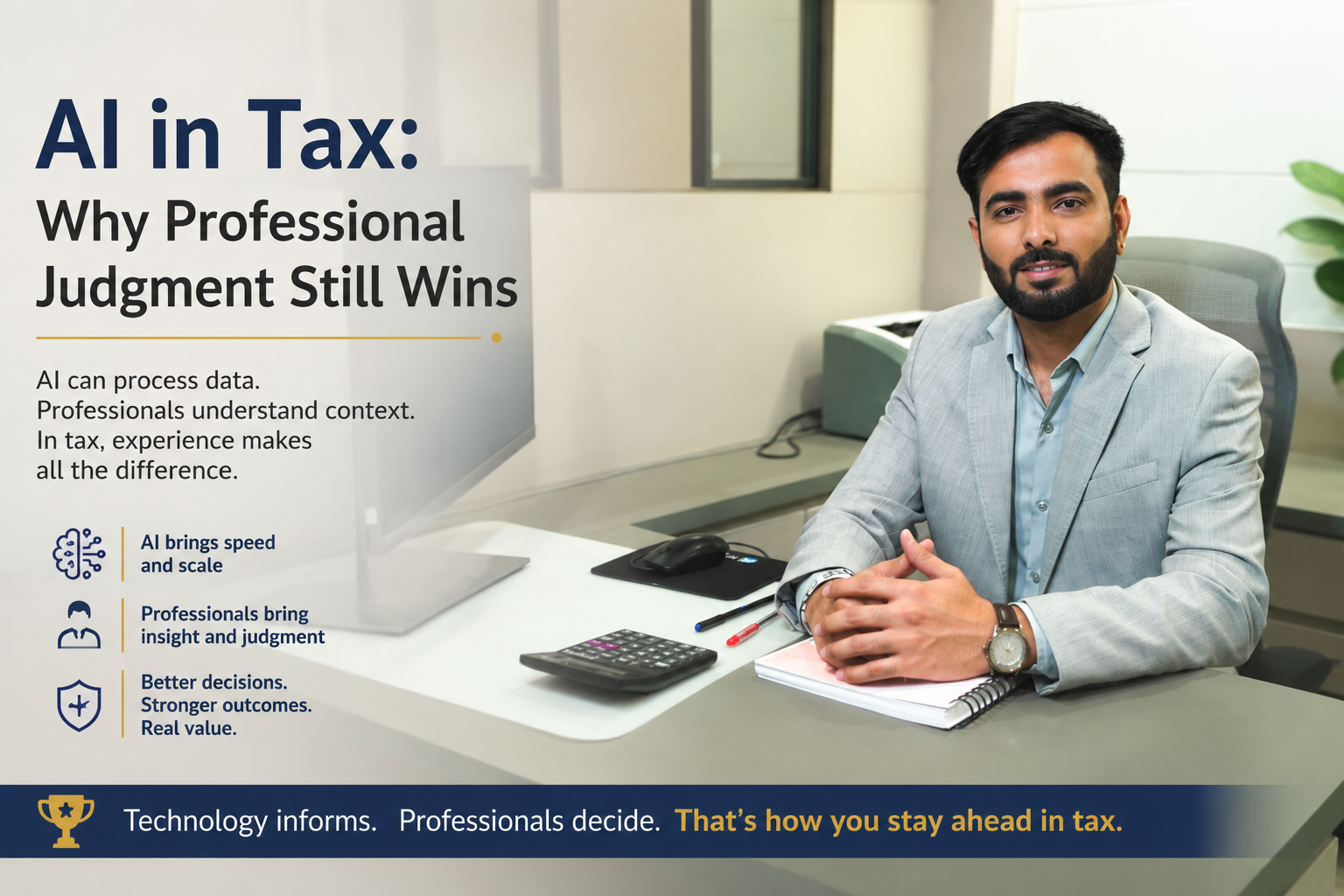
  • AI in Tax: Why Professional Judgment Still Wins

    AI in Tax: Why Professional Judgment Still Wins

    AI in Tax

    Everyone is asking whether AI can prepare tax returns. Almost nobody is asking the more important question: who will defend the tax position behind them?

    That single question who defends the reasoning, not just the numbers is quietly reshaping the future of tax compliance across India and globally. And for businesses, founders, and professionals navigating the increasingly scrutinised landscape of income tax, GST compliance, and cross-border taxation in 2026, it is the question that matters most.

    AI in tax return preparation is already impressive. It extracts data from documents, populates schedules, identifies missing information, and generates draft returns in minutes. The Income Tax Department’s own AIS (Annual Information Statement) system and the GST Portal now integrate AI-driven analytics to detect mismatches before a return even reaches a scrutiny desk. In that environment, a technically accurate return is just the starting point not the finish line.

    The real risk in modern tax compliance is not a calculation error. It is a reasoning error. And reasoning errors are exactly where AI in tax professional judgment gaps show up most sharply.


    AI in Tax Compliance: What It Does Well in 2026

    To be fair to the technology, AI is genuinely transforming the mechanics of tax compliance. What previously took hours of manual data entry now happens in minutes. For routine income tax return filing, GST return preparation, and reconciliation tasks, AI-assisted tools have meaningfully improved speed and reduced data-entry errors.

    The capabilities that AI brings to tax compliance include:

    • Extracting structured data from invoices, bank statements, Form 16, and TDS certificates
    • Pre-populating ITR forms based on AIS and Form 26AS data available on the Income Tax Department portal
    • Identifying gaps between GSTR-1 and GSTR-3B or flagging GSTR-2B mismatches before filing
    • Generating draft tax computations with standard deduction and exemption claims
    • Flagging potential income tax notice triggers based on patterns in prior filings

    These are genuine productivity gains. A CA firm that uses AI tools intelligently can serve more clients, reduce routine errors, and spend less time on administrative work.

    But productivity is not the same as judgment. And in taxation especially for businesses managing GST compliance 2026, handling cross-border transactions, or responding to income tax notices judgment is where the real risk lives.


    Why AI in Tax Return Preparation Is Not Enough on Its Own

    Consider a straightforward scenario.

    A business files its ITR. The numbers are correct. Every document is available. The return passes all system validation checks. Yet three critical questions remain unanswered:

    The Questions AI Cannot Answer for You

    →  Is the taxpayer actually eligible for the benefit claimed?

    →  Does a restriction or limitation provision apply under the Income Tax Act?

    →  Is there a more advantageous tax position available that has not been explored?

    →  What assumptions underlie the computation, and can they withstand scrutiny?

    →  If the Income Tax Department issues a notice, can the position be professionally defended?

    These are not edge cases. They represent the core of professional tax advisory and they are precisely where AI in tax professional judgment gaps become expensive.

    The Income Tax Department and CBDT have significantly increased their use of data analytics and AI-driven scrutiny. Cross-referencing of ITR data with AIS, TDS data, MCA filings, GST turnover, and banking transactions is now routine. As per guidance available through the Income Tax Department portal, cases are increasingly selected for scrutiny based on risk-scoring models that evaluate the consistency and commercial logic of reported positions not just the arithmetic.

    In that environment, a return that is numerically correct but logically indefensible is not a safe return. It is a delayed problem.


    A Real-World Tax Risk Example: Where AI Missed and Judgment Mattered

    Practical Example
    A proprietary trading firm with an annual turnover of ₹3.2 crore used an AI-assisted platform to prepare and file its ITR-3 for AY 2025-26.  
    The AI correctly:  
    • Computed speculative and non-speculative business income separately  
    • Applied the correct tax rates  
    • Populated all required schedules   What the AI did not evaluate:  
    • Whether certain derivatives transactions qualified as speculative or non-speculative under Section 43(5) of the Income Tax Act a distinction that affects set-off of losses  
    • Whether the firm’s expenses claimed as business deductions met the ‘wholly and exclusively for business’ test  
    • Whether turnover disclosed in the ITR was consistent with GST returns and bank statements, given the firm also had an NBFC registration  
    Result: An income tax notice was issued under Section 143(2) querying the loss set-off and expense claims.  
    A CA reviewing the return before filing would have identified these risk points and either restructured the position or documented the reasoning making the notice either avoidable or significantly easier to defend.

    This is not a rare situation. It is representative of exactly the kind of reasoning error that automated tax preparation cannot prevent because preventing it requires judgment about facts, law, and professional risk, not just calculation.


    AI vs. Professional Judgment in Tax: A Practical Comparison

    What AI Handles Well in Tax ComplianceWhere Professional Judgment in Tax Is Required
    Extracting data from Form 16, TDS certificates, AISEvaluating whether all income sources are correctly characterised
    Populating ITR schedules based on available dataDeciding which ITR form is appropriate given the taxpayer’s income profile
    Identifying GSTR-1 vs GSTR-3B mismatchesDetermining the legal significance of the mismatch and how to resolve it
    Flagging excess ITC claims against GSTR-2BAdvising whether to reverse ITC, dispute the claim, or pursue vendor rectification
    Generating draft tax computationsReviewing whether deductions, exemptions, and set-offs are correctly applied
    Detecting variance from prior-year filingsExplaining the variance and assessing whether it creates scrutiny risk
    Preparing income tax notice response templatesDrafting a legally sound reply that addresses the actual notice ground

    Professional Judgment in Tax: What It Actually Means

    The phrase is used frequently in professional circles, but it has a concrete meaning in the context of AI in tax compliance.

    Interpreting Provisions:Not Just Applying Them

    The Income Tax Act, 1961, and the GST law contain thousands of provisions. Many are straightforward. Some are ambiguous, subject to judicial interpretation, or apply differently depending on facts. An AI system applies the provision as trained. A professional interprets it in context.

    Dr. Haresh Adwani, a PhD holder in Commerce and a law graduate, regularly applies this dual lens at Adwani and Company evaluating tax positions not only through a finance lens but through the legal framework that governs their validity.

    Evaluating Whether Assumptions Are Commercially Defensible

    Every tax return carries assumptions about the nature of transactions, the classification of income, the eligibility for benefits. AI generates those assumptions from patterns. A professional evaluates whether they hold up to scrutiny in a specific business context.

    Managing Risk Across the Compliance Lifecycle

    Tax risk does not end at filing. It extends to assessments, scrutiny, notices, and appeals. Professional judgment in tax includes structuring positions that can be defended through the full lifecycle of compliance not just at the point of return preparation.

    As AI-driven scrutiny by the Income Tax Department and GST authorities becomes more sophisticated, the cost of an indefensible position rises. This is the core dynamic reshaping what tax professionals are paid to do.


    AI in Tax and the Income Tax Notice Risk

    One of the most practical implications of AI in tax compliance for businesses and individuals is the income tax notice risk.

    Under Section 143(2), Section 148, and other scrutiny provisions, the Income Tax Department can issue notices based on risk-scoring that increasingly relies on cross-database analytics. The parameters include:

    • Significant variation between ITR-reported income and AIS data
    • Mismatch between GST turnover and income tax turnover
    • High-value transactions without corresponding income disclosure
    • Unusual deduction or exemption claims relative to prior years
    • Discrepancies between MCA-reported financials and tax filings

    An AI-prepared return can tick all the validation checkboxes and still contain the exact kind of inconsistency that triggers one of these notices—because the inconsistency is in the reasoning, not the arithmetic.

    This is where Adwani and Company‘s approach to tax advisory adds measurable value. The firm’s review process, guided by Dr. Haresh Adwani‘s academic grounding in Commerce and legal knowledge, evaluates both the technical accuracy and the commercial defensibility of every significant tax position before filing.

    Learn more about our ITR Filing 2026: Deadlines, Penalties & Smart Tax Saving Guide.


    GST Compliance 2026 and the Same Judgment Problem

    Everything said about income tax applies equally and in some ways more acutely to GST compliance in 2026.

    AI tools can prepare GSTR-3B, match GSTR-2B for input tax credit reconciliation, and flag vendor-level discrepancies. But the judgment questions in GST compliance are substantial:

    • Is a particular supply correctly classified, and has the right GST rate been applied?
    • Does a transaction qualify for input tax credit eligibility, or does a restriction under Section 17(5) apply?
    • Is an export zero-rated correctly, or does a condition remain unsatisfied?
    • When a GST notice arrives questioning ITC claims, is the response legally adequate?

    According to compliance advisories and updates available on the GST Portal (gst.gov.in) and cross-referenced with MCA (mca.gov.in) data, authorities are increasingly scrutinising the commercial rationale of transactions—not just their documentation.

    A business with ₹80 lakh in ITC claims but a vendor base that shows irregular GSTR-1 filing is not just a documentation risk. It is a legal risk that requires professional assessment and, where necessary, a structured response strategy.

    Read our detailed guide on GST Compliance and Notice Response for businesses.


    The Most Valuable Tax Skills in an AI-Enabled World

    The LinkedIn post that inspired this article asked a pointed question: what will be the most valuable skill in an AI-enabled tax world?

    Based on work across diverse client engagements at Adwani and Company, here is a grounded answer:

    High-Value Tax Skills for the AI Era
    1. Analytical Review of AI Outputs ability to critically evaluate AI-generated computations, identify reasoning gaps, and flag positions that look correct but carry hidden risk
    2. Regulatory Interpretation applying the Income Tax Act, GST law, FEMA, and related frameworks to specific facts in a way that produces a defensible position
    3. Risk Communication translating technical tax risk into commercially actionable language for founders, CFOs, and business owners
    4. Notice and Litigation Management structuring responses to income tax notices, GST scrutiny, and assessment proceedings with legal and factual rigour
    5. Cross-Border Tax Judgment advising on NRI taxation, transfer pricing, DTAA benefits, and FEMA compliance in situations where AI outputs are least reliable

    These are not replaceable skills. They are enhanced by AI but their value lies precisely in the human judgment that AI cannot replicate.

    Key Takeaways

    Summary
    • AI in tax return preparation handles the mechanical and computational layer well data extraction, schedule population, reconciliation flagging.
    • The gap between an AI-prepared return and a professionally reviewed one lies in reasoning: assumptions, eligibility, risk assessment, and defensibility.
    • As the Income Tax Department and GST authorities increase AI-driven scrutiny, the cost of indefensible tax positions is rising.
    • Professional judgment in tax covers interpretation, commercial context, risk management, and accountability across the full compliance lifecycle.
    • The future of tax practice is not AI replacing professionals it is AI handling scale while professionals provide the judgment that determines outcome.
    • For any significant tax position, cross-border transaction, notice response, or restructuring, professional review is not a legacy stepit is the critical step.

    Frequently Asked Questions:

    1. Can AI tools file income tax returns accurately without a CA reviewing them?

    For straightforward salary-based returns with limited income sources, AI tools perform adequately. For business income, capital gains, multiple income sources, or any position that carries interpretation risk—such as deduction eligibility or income characterisation—professional review before filing is strongly recommended. An accurate calculation is not the same as a defensible position.

    2. What is the biggest risk in AI-generated tax computations?

    The biggest risk is not arithmetic—it is assumption. AI systems apply rules as trained, without evaluating whether those rules apply to the specific facts of a taxpayer’s situation. Where eligibility conditions, limitations, or judgment-based classifications are involved, the AI output may be technically formatted but commercially or legally incorrect.

    3. How does the Income Tax Department use AI to scrutinise returns?

    The Income Tax Department and CBDT increasingly use risk-scoring systems that cross-reference ITR data with AIS, TDS records, GST turnover, MCA filings, and banking data. Returns are selected for scrutiny based on inconsistency and risk indicators—not just arithmetic errors. A return that is numerically correct but logically inconsistent across data sources can still attract a Section 143(2) notice.

    4. What should a business do when it receives an income tax notice?

    First, read the notice carefully to identify the specific ground being raised—whether it concerns turnover mismatch, deduction claims, or unreported income. Second, do not respond without professional guidance; an incomplete or poorly structured reply can escalate the matter. Third, engage a qualified CA firm to assess the position and draft a legally adequate response. Adwani and Company provides structured income tax notice reply support across all major notice types.

    5. Is professional judgment still needed for GST compliance if I use accounting software?

    Yes. Accounting software and AI tools improve GST return preparation speed and reduce data entry errors. They do not evaluate whether your ITC claims are legally valid, whether your GST rate classifications are correct, or whether a vendor-mismatch creates a legal exposure requiring action. GST compliance in 2026 requires both good systems and professional advisory—especially for businesses with complex transactions or ITC-heavy operations.

    6. What makes Adwani and Company different from a standard CA firm for tax advisory?

    Adwani and Company brings a multi-disciplinary approach to tax advisory. Dr. Haresh Adwani combines a PhD in Commerce with a law degree, allowing the firm to evaluate tax positions through both a financial accounting lens and a legal framework. This is particularly valuable in situations where the tax question involves statutory interpretation, litigation risk, or cross-jurisdictional complexity.

    7. How can small businesses use AI in tax without taking on excessive risk?

    Small businesses can use AI tools for routine compliance tasks—return preparation, reconciliation, and data organisation—while ensuring that any significant position (deduction claims, ITC eligibility, income characterisation) is reviewed by a qualified professional before filing. Treating AI output as a first draft subject to professional review is the practical approach that balances efficiency with risk management.

    Conclusion: Professional Judgment in Tax Is the New Competitive Advantage

    AI is not a threat to the tax profession. It is a clarification of what the tax profession is actually for.

    When AI handles the mechanical layer data extraction, schedule population, reconciliation flagging what remains is the professional judgment layer: interpretation, risk evaluation, position defence, and client advisory. That layer has always been where the real value sits. AI just makes it more visible.

    The future tax professional, as the LinkedIn post that inspired this article noted, will spend less time preparing returns and more time validating assumptions, challenging conclusions, and managing risk. In the context of India’s increasingly analytics-driven tax administration where the Income Tax Department, CBDT, and GST authorities cross-reference multiple data sources in real time that shift is not optional. It is already underway.

    For businesses and individuals who want to stay ahead of that curve, the right question is not ‘can AI prepare my return?’ It is ‘who is reviewing the reasoning behind it?’

    Connect With Adwani and Company If you want expert guidance on income tax compliance, GST advisory, tax notice responses, or cross-border taxation, connect with Adwani and Company today.   Dr. Haresh Adwani and the team bring the combination of deep tax expertise and legal knowledge that complex tax positions require whether you are a founder filing business income, a company managing GST scrutiny, or an NRI with cross-border tax obligations.  
    → Learn more about our Income Tax Advisory Services
    → Explore our GST Compliance and Notice Reply Support
    → Read about our Virtual CFO and Financial Reporting Services   Website: adwaniandco.com

    Author

    CA Dipesh Gurubakshani is a Chartered Accountant with Adwani & Co LLP, Pune, specialising in income tax audit, direct taxation, and accounting advisory. He supports clients across statutory compliance, financial reporting, and income tax matters with a focus on accuracy, regulatory adherence, and disciplined ex