Balance Sheet Analysis
Every tax season, the same ritual plays out: books closed, ledgers reconciled, GST and TDS returns matched, and the balance sheet finalised usually for one audience, the tax department, the bank, or the auditor. Yet the most important reader of that balance sheet is rarely the business owner, which is a costly oversight. Done properly, balance sheet analysis is one of the few tools that shows not just how a business performed, but what it has actually become.
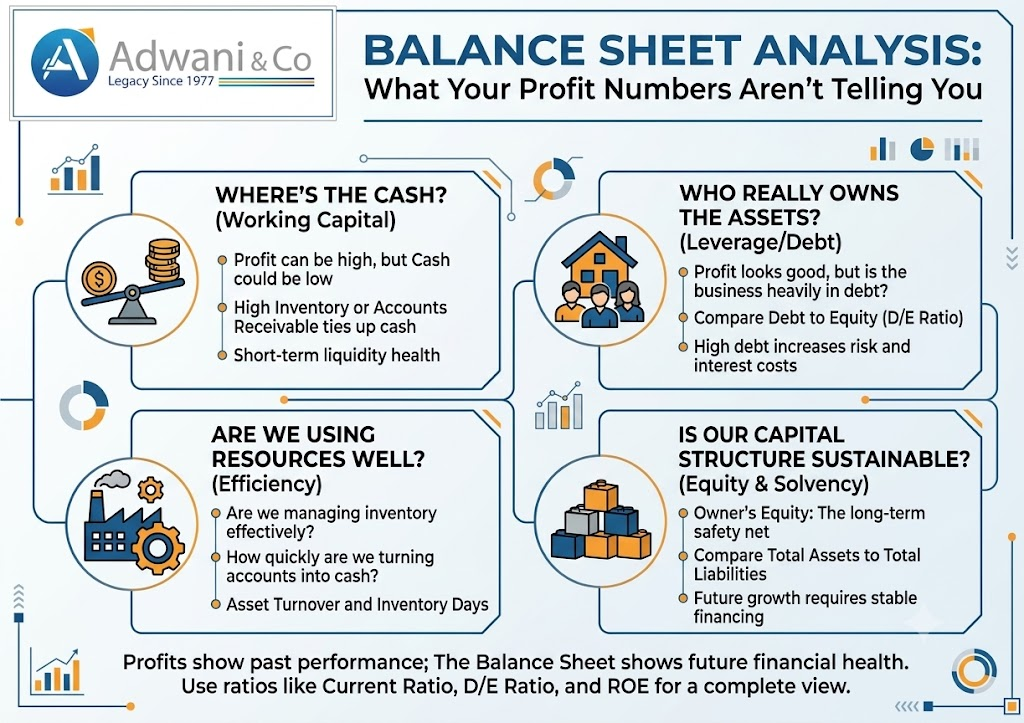
Many businesses fail after becoming profitable. The cause is rarely a sales problem it’s usually sitting quietly in the balance sheet, unread.
Why Balance Sheet Analysis Matters More Than Tax Compliance
Most business owners treat the balance sheet as a compliance document something prepared once a year for the Income Tax Department, a banker, or an auditor. Balance sheet analysis, when used correctly, is something else entirely: a leadership dashboard.
A profit and loss account tells you how the business performed over a period. Balance sheet analysis tells you what the business has become as a result. A company can report a healthy profit and still be in financial distress revenue growing while customers pay late, profits looking strong while cash flow stays weak, sales rising while inventory quietly eats up working capital. None of that shows up clearly in a P&L. It shows up in the balance sheet.
The Questions Balance Sheet Analysis Should Force You to Ask
A good leader shouldn’t stop at “how much profit did we make?” Balance sheet analysis pushes further:
- Where is the cash actually sitting in the bank, or stuck with customers?
- How efficiently is working capital being used?
- Are borrowings funding growth, or funding inefficiency?
- Is the business financially stronger than it was twelve months ago?
- Are GST, TDS, and other statutory positions clean, or building exposure?
These aren’t accounting questions they’re leadership questions, and balance sheet analysis is how you answer them with evidence instead of instinct.
Profit vs Cash Flow: What Balance Sheet Analysis Reveals
One of the clearest reasons to prioritise balance sheet analysis is the gap between profit and cash. Profit is an accounting figure; cash is what actually pays salaries, vendors, and statutory dues. A business can show a 15% profit margin on paper while its bank balance tells a very different story.
This gap usually shows up in trade receivables. When receivable days stretch out customers taking 60 or 90 days to pay instead of the agreed 30 profit sits on paper as debtors rather than as usable cash. Balance sheet analysis that tracks receivable days over multiple periods catches this drift before it becomes a cash crunch.
Working Capital and Balance Sheet Analysis: The Hidden Drain
Working capital is where balance sheet analysis often uncovers the most uncomfortable truths. Rising sales are usually treated as unambiguously good news. But if inventory grows faster than sales, or collection cycles lengthen while supplier payment terms shorten, the business quietly finances its own growth out of a shrinking cash cushion.
A simple working capital cycle calculation inventory days plus receivable days minus payable days is one of the most useful numbers a business owner can track. A lengthening cycle, spotted early through routine balance sheet analysis, is far easier to correct than one discovered during a liquidity crisis.
Learn more about our Working Capital Management Advisory to see how this is assessed for businesses like yours.
Borrowings and Debt: A Core Part of Balance Sheet Analysis
Borrowings are not inherently a problem used well, they fund expansion, equipment, and working capital gaps during growth phases. The question balance sheet analysis is built to answer is simpler: are borrowings rising in proportion to genuine business growth, or are they rising faster, quietly funding inefficiency instead?
Tracking the debt to equity ratio and interest coverage over consecutive years, rather than looking at a single year in isolation, is where balance sheet analysis earns its value. A debt-to-equity ratio that climbs steadily while turnover stays flat is an early warning sign worth acting on, not waiting out.
GST, TDS, and Statutory Mismatches: A Blind Spot in Balance Sheet Analysis
Statutory balances GST payable, TDS payable, provisions for tax often sit at the bottom of the balance sheet and get the least attention, despite carrying real legal and financial exposure. Reconciliation gaps between books and returns filed on the GST Portal, or mismatches flagged during scrutiny by the Income Tax Department, frequently trace back to balances that were never reviewed until the year end rush.
Businesses that also file with the Ministry of Corporate Affairs (MCA) carry an added cross-verification risk: turnover figures reported to MCA, GST, and Income Tax authorities are increasingly cross-checked, and inconsistencies can trigger scrutiny even without any fraud involved. Dr. Haresh Adwani a PhD holder in Commerce and a law graduate routinely advises clients to treat this reconciliation as part of ongoing balance sheet analysis, not a once-a-year scramble.
Read our detailed guide on GST and TDS Reconciliation for Businesses for a closer look at how these mismatches build up. For official filing references, see the GST Portal and the Income Tax Department.
A Practical Balance Sheet Analysis Framework for Business Leaders
Balance sheet analysis doesn’t need to be complicated to be useful. A workable quarterly routine covers:
- Receivable days : is collection speeding up or slowing down?
- Inventory days : is stock moving, or accumulating?
- Payable days : are supplier terms being honoured or stretched?
- Debt-to-equity ratio : is leverage rising faster than the business itself?
- Net worth trend : is the business genuinely stronger than a year ago?
- Statutory balances : are GST, TDS, and provisions reconciled and current?
Reviewed quarterly rather than only at year-end, this kind of balance sheet analysis turns a compliance document into an early-warning system.
Real Example: Balance Sheet Analysis in Practice
Practical Example A trading business with an annual turnover of ₹4 crore reported a net profit of ₹32 lakh (8% margin) healthy on the surface. Balance sheet analysis told a different story: trade receivables rose from ₹58 lakh to ₹95 lakh though turnover grew only 12%, inventory rose from ₹40 lakh to ₹68 lakh, and short-term borrowings jumped from ₹30 lakh to ₹72 lakh to plug the resulting cash shortfall. Nearly all of the reported profit and more was tied up in unsold stock and slow-paying customers, funded by expensive short-term debt.
On paper, the business was profitable. In practice, balance sheet analysis showed the business was quietly getting weaker, not stronger and without this review, it would likely have kept expanding into a worsening cash position.
How Adwani & Company Supports Balance Sheet Analysis for Businesses
At Adwani & Company, balance sheet analysis is treated as a core advisory service, not a year-end formality. The approach combines ratio analysis, working capital review, and statutory reconciliation across GST, TDS, and MCA filings, giving business owners an evidence-based picture of financial health rather than just a compliance-ready document.
Dr. Haresh Adwani, who holds a PhD in Commerce and is also a qualified law graduate, brings a combined financial and legal lens to balance sheet analysis valuable when statutory mismatches carry both tax and legal consequences. Under his guidance, Adwani & Company helps clients move from reactive, once-a-year reviews to structured quarterly balance sheet analysis.
1.What is balance sheet analysis and why does it matter for small businesses?
Balance sheet analysis reviews a company’s assets, liabilities, and net worth to assess financial health beyond the profit figure. For small businesses, it matters because profit alone can hide cash stress or working capital strain that a P&L doesn’t reveal.
2.How often should a business conduct balance sheet analysis?
Ideally, quarterly rather than annually. Reviewing receivables, inventory, payables, and borrowings every quarter catches problems early, while annual-only reviews often catch them too late.
3.Can a profitable business still fail due to poor balance sheet health?
Yes. Profit is often tied up in receivables and inventory rather than available as cash precisely the gap balance sheet analysis is designed to expose.
4.What ratios matter most in balance sheet analysis?
Receivable days, inventory days, payable days, the debt-to-equity ratio, and net worth trend over time are among the most useful indicators.
5.How does GST and TDS reconciliation connect to balance sheet analysis?
Statutory balances for GST and TDS sit within the balance sheet, and unreconciled figures can trigger scrutiny from the GST Portal or the Income Tax Department. Including statutory reconciliation in balance sheet analysis reduces this risk.
6.Can Adwani & Company help with balance sheet analysis for my business?
Yes. Adwani & Company offers structured balance sheet analysis covering working capital, borrowings, and statutory reconciliation, guided by Dr. Haresh Adwani’s combined financial and legal expertise.
Conclusion: Make Balance Sheet Analysis Part of How You Lead
Profit tells you how the business performed. Balance sheet analysis tells you what the business has become and whether it’s genuinely getting stronger. Treating the balance sheet as a leadership dashboard, reviewed regularly rather than once a year for the auditor or the bank, is one of the simplest shifts a business owner can make to catch financial stress before it becomes a crisis.
About the Author:
Mukesh Chavan is a dedicated indirect taxation and compliance professional associated with Adwani & Co LLP, specializing in GST advisory, GST audits, GST assessments, and RERA compliance services. With extensive experience in handling complex regulatory matters, he assists businesses in ensuring compliance with evolving GST laws and real estate regulations while minimizing risks and enhancing operational efficiency.
Mukesh has successfully guided clients through GST registrations, return compliance, departmental assessments, audits, litigation support, and tax planning strategies. He also possesses significant expertise in RERA compliance, helping real estate developers, promoters, and stakeholders navigate regulatory requirements and maintain seamless project compliance.
Through his articles and professional insights, Mukesh aims to simplify complex GST and RERA provisions, offering practical guidance that empowers businesses to remain compliant, avoid disputes, and make informed decisions in an increasingly dynamic regulatory environment. His approach combines technical expertise with practical business understanding, enabling clients to focus on growth while meeting their statutory obligations with confidence.
Disclaimer
This article is for informational purposes only and does not constitute financial, legal, or professional advice. Every business’s financial position is unique, and readers should consult a qualified chartered accountant or financial advisor before making decisions based on this content.