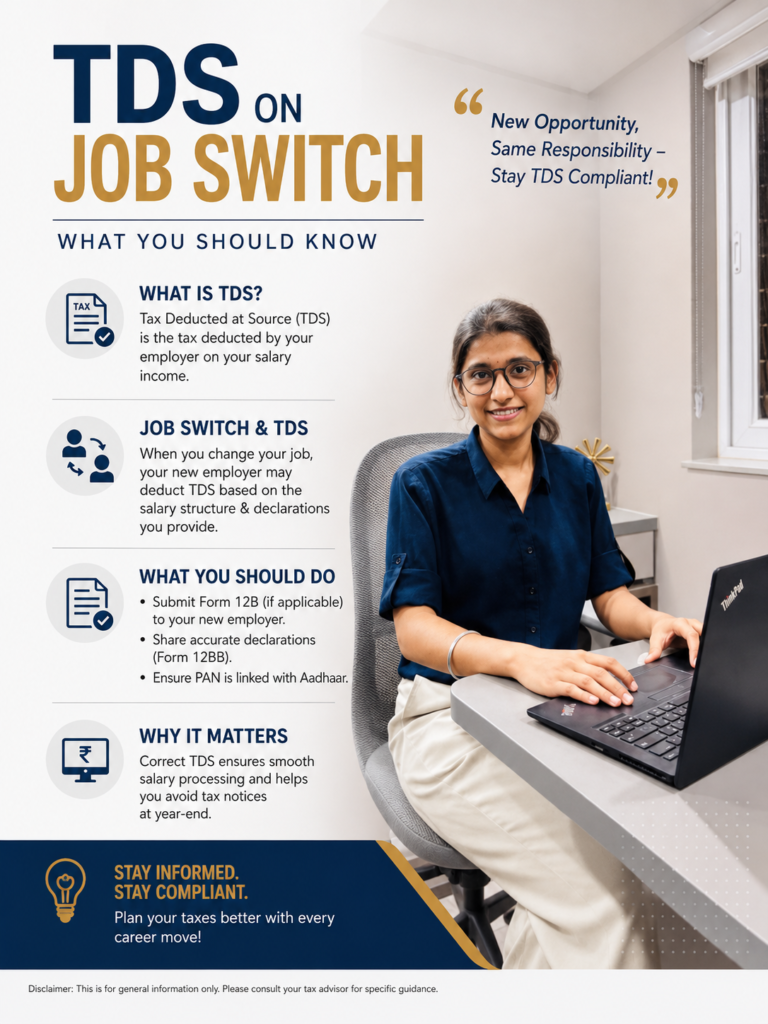
TDS on Job Switch
Got a massive hike when you switched jobs last year? Before you celebrate the raise, check your tax liability because TDS on job switch is one of the most common reasons salaried professionals receive an unexpected income tax notice in July. It rarely has anything to do with hidden income or non-compliance. In most cases, both employers deducted tax exactly as their payroll systems instructed. The real problem surfaces only when the two incomes are added together.
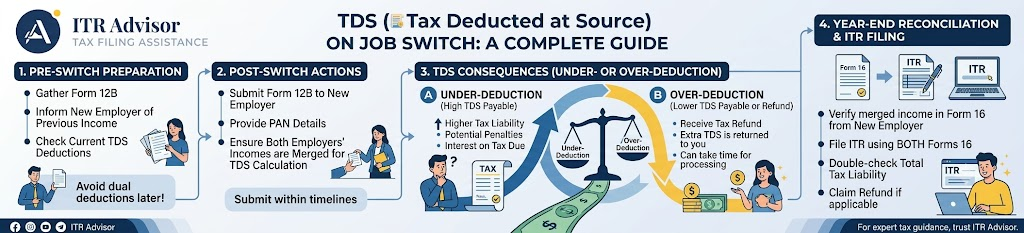
Understanding TDS on Job Switch: Why Two “Correct” Deductions Still Go Wrong
At Adwani & Co LLP, we recently reviewed a case that illustrates this perfectly. Our client had switched employers mid-year and had no other significant income apart from a small amount of savings bank interest. Both Form 16s showed accurate TDS deductions from each employer. There was no missing disclosure and no concealed income. Yet, while preparing the return, a substantial and unexpected tax demand appeared.
When the case was escalated internally, the mechanical reality of payroll software came into focus. This is what we now describe to clients as the “dual slab benefit” problem one of the most under-discussed causes of TDS on job switch mismatches in India today.
What Causes the “Dual Slab Benefit” Problem in TDS on Job Switch Cases
When you join a new company mid-year, its payroll software typically starts calculating tax from a clean slate. It computes TDS based only on the salary that particular employer pays you for the remaining months as if that were your entire annual income.
This means the new employer unknowingly applies the basic exemption limit and the lower tax slabs all over again. The previous employer, however, had already applied those same benefits to the income paid before the switch. Individually, each employer’s TDS calculation is technically correct. Once your total income is aggregated at the time of filing, the duplicate slab benefits disappear and you are pushed into a materially higher tax bracket than either employer accounted for.
A Practical Example of TDS on Job Switch Mismatch
Example: How the Numbers Add Up
- Employer 1 (April–September): pays ₹8,00,000. TDS is calculated as if this is the full annual income, applying the basic exemption and lower slabs in full.
- Employer 2 (October–March): pays ₹10,00,000. TDS is again calculated independently, applying the same exemption limit and lower slabs afresh.
- Combined actual annual income: ₹18,00,000 which should attract tax progressively at the higher applicable slabs on the full amount.
Result: Because both employers applied entry-level slab benefits separately, the TDS actually deducted falls well short of the tax computed on the aggregated ₹18,00,000 income creating a demand at the time of filing.
Three Rules to Avoid a TDS on Job Switch Tax Shock
Rule 1: TDS Is Only an Estimate, Not Your Final Tax
Your final tax liability is always computed on your global, consolidated annual income not on what any single employer withheld. Treat every Form 16 as a partial estimate, particularly in a job-switch year.
Rule 2: Submit Form 12B to Your New Employer
Form 12B is the prescribed statement for declaring your previous employer’s salary and TDS details to your new employer. Submitting it promptly allows the new payroll system to compute TDS on your combined income rather than restarting the slab calculation, which is the single most effective way to prevent a TDS on job switch mismatch before it happens.
Rule 3: Reconcile Before You File
Before filing your return, cross-check both Form 16s against your Annual Information Statement (AIS) and Form 26AS on the e-filing portal. Reconciling the two ensures you know your actual liability well before the deadline, rather than being surprised by a demand notice afterward.
Why Government Systems Now Catch TDS on Job Switch Errors Faster
In recent years, the Income Tax Department has significantly expanded data matching between employer TDS filings, Form 26AS, and AIS records available on the official e-filing portal. This means a dual slab benefit that may have gone unnoticed a decade ago is now flagged almost automatically during return processing making proactive planning far more important than reactive correction.
For authoritative reference on TDS provisions and return filing procedures, professionals often point clients to the Income Tax Department’s official e-filing portal, which publishes updated TDS and compliance guidance each assessment year.
How Adwani & Co LLP Helps You Navigate TDS on Job Switch Notices
This is precisely the kind of case Adwani & Co LLP handles regularly for salaried professionals across Pune and beyond, the firm combines decades of practical taxation experience with the legal grounding needed to respond to notices arising from TDS on job switch mismatches.
Dr. Haresh Adwani has long emphasised that most job-switch tax demands are not compliance failures they are structural gaps in how payroll systems calculate TDS independently. Understanding that distinction is often the difference between a stressful notice and a straightforward correction.
Learn more about our Income Tax Return Filing Services,
Read our detailed guide on Form 26AS and AIS Reconciliation for a deeper walkthrough of pre-filing checks.
Key Takeaways
- TDS on job switch mismatches usually stem from duplicate slab benefits, not hidden income.
- Submitting Form 12B to your new employer is the simplest preventive step.
- Always reconcile Form 16s with AIS and Form 26AS before filing.
Dr. Haresh Adwani and the team at Adwani & Co LLP regularly assist clients in resolving these notices.
Frequently Asked Questions About TDS on Job Switch
1.What is TDS on job switch and why does it cause a tax notice?
TDS on job switch refers to the tax withheld separately by two employers in the same financial year. Because each employer calculates TDS independently, duplicate slab benefits often reduce the total tax withheld below your actual liability, triggering a notice.
2.How does Form 12B prevent a TDS mismatch after changing jobs?
Form 12B informs your new employer of your previous salary and TDS, allowing them to calculate deductions on your combined income rather than starting the slab benefit calculation from zero.
3.Can I get a refund if excess TDS was deducted after a job switch?
Yes. If your combined TDS exceeds your actual tax liability, the excess is refunded when you file your income tax return and it is processed by the department.
4.What is the “dual slab benefit” problem in job switch taxation?
It occurs when two employers each apply the basic exemption limit and lower tax slabs to the portion of salary they paid, even though only one set of slab benefits applies to your total annual income.
5.How can Adwani & Co LLP help with a TDS on job switch notice?
Adwani & Co LLP, led by Dr. Haresh Adwani, reviews both Form 16s, reconciles them against AIS and Form 26AS, and represents clients in responding to demand notices arising from job-switch TDS mismatches.
Conclusion: Don’t Let TDS on Job Switch Catch You Off Guard
A job switch is worth celebrating, but it also changes how your tax is calculated behind the scenes. TDS on job switch is not usually a sign of wrongdoing it is a mechanical gap between two independent payroll systems. Submitting Form 12B, reconciling your Form 16s against AIS and Form 26AS, and understanding your consolidated tax liability early can prevent an unpleasant surprise in July.
About the Author : Shreya Kavitke
Shreya Kavitke is a CA Finalist and an Article Assistant at Adwani & Co. LLP, where she works across diverse areas of taxation, accounting, and regulatory compliance. With a strong academic foundation in commerce and practical exposure to advisory and compliance engagements, she contributes to research and analysis on evolving tax and business regulations.
Her areas of interest include direct taxation, Goods and Services Tax (GST), corporate compliance, and financial reporting.
At ITRadvisor, Shreya contributes articles that combine technical accuracy with practical applicability, helping readers stay informed about key tax developments, compliance obligations, and emerging regulatory trends. She believes that clear, reliable, and timely guidance is essential to navigating today’s dynamic tax environment.
This version reflects the polished, research oriented tone commonly found in publications by leading professional services firms while remaining authentic to Shreya’s current role and experience.
Want clarity on Section 44AD, ITR-4 filing, or how to present your financials to creditors? Visit ITRAdvisor.in for expert-reviewed tax guidance, practical tools, and authoritative content designed for small business owners across India. Stay compliant. Stay financially aware.
Legal Disclaimer: This article is published for informational and educational purposes only. Nothing contained herein constitutes legal, financial, or tax advice, nor should it be treated as a substitute for professional consultation tailored to your specific circumstances. Tax laws, rates, and provisions are subject to change; readers are strongly advised to consult a qualified Chartered Accountant or tax advisor before acting on any information in this article.
All content is original. References to government portals and statutory provisions are paraphrased for educational purposes in compliance with fair use principles. No content has been reproduced from third-party sources