
How the AIS (Annual Information Statement) is silently tracking your financial life, and what you can do before the tax department does it for you.
A doctor I work with called me recently not in a panic, but with that quiet unease you feel when something official lands in your inbox unexpectedly. “Haresh, I’ve always paid my taxes on time. Why am I getting a notice?”
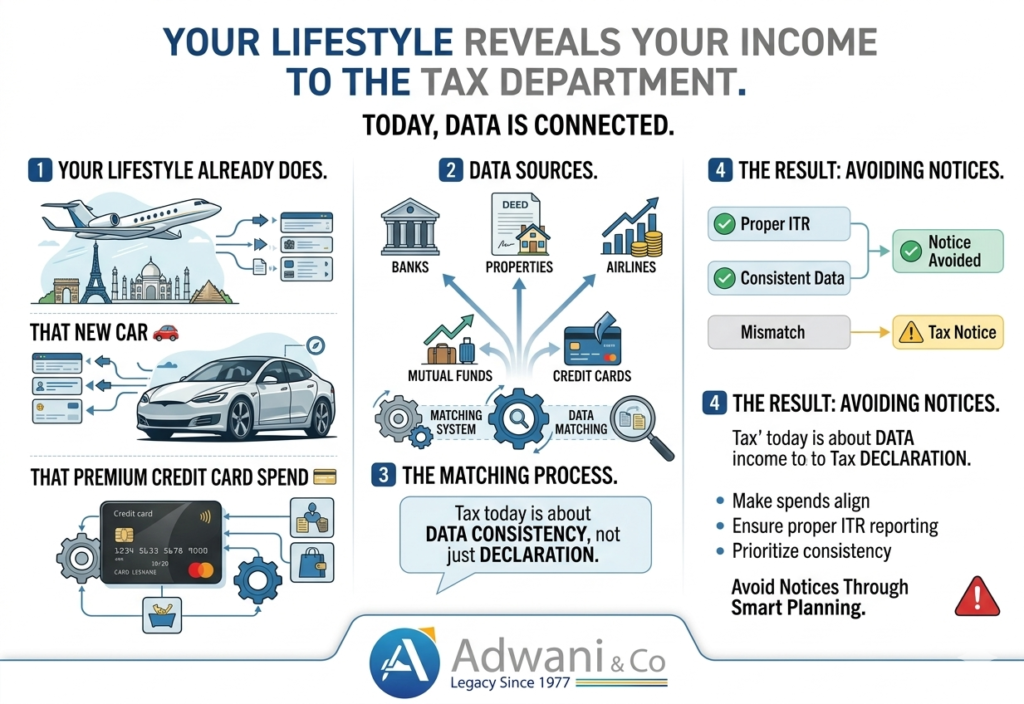
I looked at his case. He hadn’t hidden anything. No offshore accounts, no undisclosed income. But his filed return showed one picture of his financial life and his actual lifestyle showed quite another.
What his AIS showed that his ITR didn’t mention
- Significant credit card spending across the year
- An international trip (flights, hotels all tracked)
- A new car purchase registered in his name
- A property investment earlier that fiscal year
The Income Tax Department didn’t accuse him of evasion. It simply noticed the gap between declared income and observable financial activity and sent a notice asking him to explain it. This is what happens when your ITR doesn’t reflect your AIS.
Also Read:
https://www.adwaniandco.com/blog/section-143-2-notice-after-itr-u
How India’s income tax system tracks your financial activity
For years, India’s tax system was largely self-reported. You declared what you earned, paid accordingly, and moved on. That era is over. The department now receives data feeds from banks, registrars, mutual fund platforms, credit card companies, travel operators, and more all consolidated into one document.
“The AIS doesn’t just know what you declared. It knows what you did.”
The Annual Information Statement (AIS) available on the Income Tax e-filing portal is a detailed financial mirror. It shows income across sources, high-value purchases, TDS deducted, investments made, and spending patterns. When what you filed doesn’t match what the AIS reflects, the system flags it automatically. No human intervention needed.
Why honest taxpayers still get income tax notices 4 real reasons
This is the question I hear most often and it deserves a real answer, not a canned disclaimer. Here are the four most common triggers:
Reason 01
Income declared in ITR doesn’t match AIS figures
Reason 02
High-value transactions not explained by declared income
Reason 03
Missing income sources FD interest, dividends, rent, freelance
Reason 04
Wrong figures, missed entries, or timing mismatches
Most people who receive notices aren’t tax evaders. They’re people who didn’t know that FD interest needs to be declared, or that their consulting income appears in the AIS even if no TDS was deducted, or that the stamp duty on their flat purchase was reported to the department the day it was registered.
Why doctors and professionals get more income tax notices in India
Salaried employees with a single Form 16 have relatively simple tax lives. Professionals especially doctors often have five or six income streams running simultaneously: a hospital salary, visiting consultancy fees, private clinic income, interest on savings and FDs, dividends from investments, perhaps rental income from a property. Each of these shows up in the AIS. Miss even one, and the mismatch is created.
It’s not dishonesty. It’s the complexity of a professional’s financial life meeting a system that’s built to notice every thread.
Proven checklist to avoid income tax notice in India 2026
The fix isn’t complicated it’s about building one habit into your annual tax routine.
- Check your AIS before filing, not after. Log into the income tax portal and review every entry. Flag anything that looks incorrect you can submit feedback directly on the portal.
- Match your lifestyle to your declared income. If you bought a car, took a foreign trip, or made a large investment your ITR should reflect income that makes those transactions plausible.
- Report every income source, even small ones. Bank interest of ₹3,400 may feel trivial, but it appears in your AIS. Omitting it creates a mismatch that stands out more than the amount itself.
- Reconcile AIS vs ITR before submission. This one step treating it like a bank reconciliation catches 80% of potential notice triggers before they become actual notices.
Critical financial moves that trigger income tax notices automatically
Property purchase, foreign travel, a new luxury vehicle, a large lump-sum mutual fund investment all of these are automatically reported to the Income Tax Department. If your declared income doesn’t support the transaction, you’ll likely hear from the department asking you to explain the source of funds. Plan accordingly, and document everything.
Expert insight: what we see in most income tax notice cases
In the majority of notice cases we review, the issue was entirely avoidable. If the taxpayer had checked their AIS even once before filing the mismatch would have been visible. A 15-minute review can save months of correspondence with the department.
In today’s tax environment, compliance isn’t just about paying the right amount. It’s about ensuring that what you declare matches what your data shows. The AIS is the department’s lens into your financial life and it’s far more complete than most people realise.
Receiving a notice doesn’t make you dishonest. But ignoring the AIS before you file is a risk that’s easy to avoid.
Want a professional review of your AIS?
We help identify mismatches, correct discrepancies, and make sure your ITR and AIS tell the same story before the department notices they don’t.
What will happen if I get a notice from the Income Tax Department?
A notice doesn’t mean you’ve done something wrong. Most notices are triggered automatically when the Income Tax Department’s system detects a gap between what you declared in your ITR and what your Annual Information Statement (AIS) reflects.
Common reasons include unreported FD interest, missing consultancy income, or high-value transactions like a property purchase or foreign trip that weren’t explained by your declared income. The system flags the mismatch; it doesn’t assume intent.
FAQs
1.What are the different types of income tax notices?
Not every notice is serious. Here’s a quick breakdown:
Section 143(1) A routine intimation about a small adjustment in your return. Very common, often needs no action.
Section 139(9) Your return has a defect and needs to be corrected before the deadline.
Section 143(2) A scrutiny notice. The department wants a closer look at your return. This one needs proper attention.
Section 148 The department believes income has escaped assessment. Respond immediately.
Section 245 Your refund is being adjusted against an old outstanding tax demand.
The type of notice tells you exactly how urgently you need to act.
2.What should I do immediately after receiving a notice?
First don’t panic, and don’t ignore it. Here’s what to do right away:
Verify it’s genuine on the Income Tax portal (incometax.gov.in) under your account
Note the response deadline usually 15 to 30 days
Gather your ITR copy, Form 26AS, AIS, and relevant bank or transaction documents
Contact your CA or tax professional before drafting a response to any scrutiny or reassessment notice
Ignoring a notice is the one thing you should never do. Non-response allows the department to assess your tax liability without your input and that rarely goes in your favour.
3.Will I have to pay a penalty?
For most honest mismatches a missed FD interest entry, a forgotten dividend, an AIS discrepancy the outcome is usually additional tax plus interest under Section 234, at around 1% per month on the shortfall. That’s manageable.
Penalties under Section 270A are reserved for deliberate concealment of income not for genuine omissions or filing errors. If you respond promptly with proper documentation, penalties are unlikely in straightforward cases.