
NRI Investment Tax India Rules to Know
Thousands of NRIs invest in India every year, drawn by real estate, equities, mutual funds, and a fast-growing startup ecosystem. Most don’t realise their biggest mistake happens after they invest, not before.
India continues to attract strong interest from non-resident Indians looking to put capital into real estate, stocks, mutual funds, start ups, and businesses back home. Returns dominate the conversation, while NRI investment tax India rules quietly decide how much of those returns an investor actually keeps.
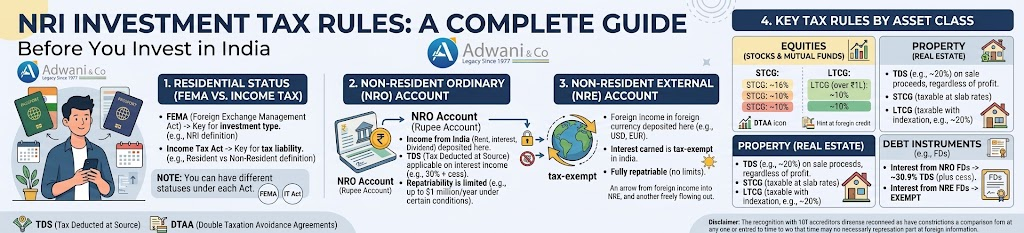
Getting your NRI investment tax India strategy right before you invest, rather than scrambling to fix it afterward, is what separates a smooth, compliant investment from a compliance headache involving notices, penalties, or blocked repatriation. This guide walks through five tax considerations every NRI should understand, along with a practical example, government context, and where professional advisory support genuinely adds value.
Why NRI Investment Tax India Planning Matters More Than Returns
An NRI evaluating an investment opportunity in India typically compares expected yield, capital appreciation potential, and market timing. What often gets skipped is a simple question: how much of this return survives Indian tax law and cross-border reporting requirements?
NRI investment tax India obligations touch nearly every stage of an investment, from the moment funds enter India to the day proceeds are repatriated abroad. Ignoring this layer doesn’t make it disappear; it just moves the cost from planning stage to enforcement stage, usually at a higher price.
1. Residential Status Determines Your NRI Tax Liability in India
Your tax liability in India depends on whether you qualify as a Non-Resident Indian or a Resident under the Income Tax Act, not on your passport, citizenship, or self-perception as “living abroad.” Residential status is calculated based on the number of days spent in India during the relevant financial year and the preceding years, under specific thresholds laid out in the Act.
This classification is foundational. It determines which of your global income becomes taxable in India, which exemptions apply, and which compliance obligations under Schedule FA or foreign asset reporting become relevant. Many NRIs assume their status is fixed once decided years ago, when in reality a longer-than-usual stay in India, a job relocation, or an extended family visit can shift residential status for a given financial year and change the entire tax calculation.
2. TDS Rules Every NRI Investor Must Understand
Many investment incomes and property transactions involving NRIs carry mandatory Tax Deducted at Source, often at materially higher rates than those applied to resident Indians. Rental income, interest on NRO accounts, and particularly the sale of immovable property typically attract TDS well above what a resident seller or investor would face.
Understanding applicable TDS rates before a transaction, not after receiving a lower-than-expected payout, is what protects cash flow. NRIs selling property in India, for instance, often discover TDS has been deducted at a flat rate on the full sale value rather than on the actual capital gain, unless a lower-deduction certificate has been obtained in advance from the Income Tax Department.
3. Capital Gains Tax for NRIs: Why Asset Type and Holding Period Matter
Capital gains tax for NRI investors is not a single, uniform rate. Listed equity shares, equity mutual funds, unlisted shares, and immovable property each carry distinct holding-period thresholds that separate short-term from long-term capital gains, and each classification carries a different tax rate.
Real Example: Capital Gains Tax Calculation for an NRI Investor
Consider an NRI who purchased an apartment in Pune for ₹60 lakh in 2019 and sells it in 2026 for ₹95 lakh. Since the property was held for more than 24 months, the gain of ₹35 lakh qualifies as long-term capital gains. TDS at a rate well above what a resident seller would face is typically deducted on the sale value unless the NRI has applied for and obtained a certificate for a lower or nil TDS deduction based on the actual computed gain.
Without that certificate, a large portion of the sale proceeds can get locked up as TDS, only recoverable later by filing an Income Tax Return and claiming a refund. This single example illustrates why NRI investment tax India planning has to happen before the transaction, not during return filing months later.
4. Claiming DTAA Benefits as an NRI Investor
If your country of residence has a Double Taxation Avoidance Agreement with India, you may be eligible to reduce, or in some cases entirely avoid, being taxed twice on the same investment income. DTAA benefits for NRI investors are among the most under-utilised reliefs in Indian tax practice, largely because claiming them correctly requires specific documentation, most notably a Tax Residency Certificate from the country of residence, along with Form 10F and a self-declaration in the prescribed format.
Skipping this documentation doesn’t mean the tax authority automatically applies the DTAA rate; more often, the higher domestic TDS rate is deducted by default, and the NRI is left to claim the differential through the return-filing process, along with the accompanying delay in accessing those funds.
5. Documentation That Protects Compliance and Repatriation
Keeping your PAN, NRE and NRO bank records, investment proofs, Form 26AS, Annual Information Statement, and prior tax filings updated and accessible is not administrative housekeeping for its own sake. It is what stands between a routine repatriation of funds and a delayed, document-heavy process when a bank or authorised dealer asks for supporting paperwork before releasing money abroad under FEMA’s remittance framework.
Read our Detailed guide on NRI ITR Filing India: Are You Overpaying Tax?
Government Frameworks Governing NRI Investment Tax in India
NRI investment tax India compliance sits at the intersection of two separate regulatory frameworks. The Income Tax Department administers residential status determination, TDS provisions, and return-filing obligations, with official guidance and utilities available through the Income Tax Department’s e-filing portal.
Separately, the Reserve Bank of India’s FEMA regulations govern how investment proceeds move in and out of India, including repatriation limits and reporting requirements for NRE, NRO, and FCNR accounts, detailed further on the RBI’s official website. Treating these as one combined framework, rather than addressing income tax and FEMA compliance separately, is what keeps an NRI investment compliant from entry to eventual exit.
How Adwani & Co LLP Helps NRIs Navigate Investment Tax Compliance
Dr. Haresh Adwani, founder of Adwani & Co LLP and a PhD holder in Commerce with a law degree, has spent decades advising NRIs and cross-border investors on structuring investments to remain compliant while genuinely maximising post-tax returns. Dr. Haresh Adwani frequently observes that NRI clients who involve a qualified CA firm before committing capital consistently retain more of their returns than those who only seek advice after receiving a lower-than-expected payout or an unexpected notice.
Under Dr. Haresh Adwani’s guidance, Adwani & Co LLP has built a dedicated NRI advisory practice covering residential status determination, TDS certificates, DTAA claims, and repatriation compliance, positioning the firm as a trusted partner for NRIs investing in Indian real estate, equities, and business ventures. Learn more about our NRI Taxation Advisory Services, or read our detailed guide on Who Is an NRI Under the Income Tax Act for a deeper look at residential status rules.
1.Do NRIs pay higher TDS on investment income in India?
Yes, TDS on NRI investment income and property sales is generally higher than for resident taxpayers, unless a lower-deduction certificate is obtained in advance.
4.Does residential status change automatically once someone becomes an NRI?
No. Residential status is reassessed every financial year based on days spent in India, and can change even for long-settled NRIs.
5.Is professional tax advice necessary before investing in India as an NRI?
While not legally mandatory, professional guidance helps NRIs plan TDS certificates, DTAA claims, and documentation before investing rather than after.
Conclusion
Smart investing isn’t just about choosing the right asset; it’s about planning your NRI investment tax India strategy from day one. Residential status, TDS, capital gains, DTAA benefits, and documentation together determine your real, post-tax return, and each piece is easier to get right before a transaction than to correct afterward. If you’re an NRI planning to invest in India or unsure about the tax implications of an investment you’ve already made, connect with Adwani and Company today for expert guidance tailored to your situation.
About the Author
Dr. Haresh Adwani
Ph.D. in Commerce | Law Graduate | Managing Partner, Adwani & Co LLP Dr. Haresh Adwani holds a Ph.D. in Commerce and is a qualified Law graduate with over two decades of hands-on experience in GST advisory, direct taxation, and statutory compliance for businesses across Pune and Maharashtra has guided hundreds of SMEs, startups, and corporates through India’s evolving tax landscape. He is a recognised advisor on GST compliance, company formation, and Virtual CFO services, and regularly contributes to professional seminars and industry forums in Pune.
Disclaimer:
This article is published for general informational purposes only and does not constitute legal, financial, or professional tax advice. Tax positions depend on individual facts and circumstances, and readers should consult a qualified professional before making investment or filing decisions. Professional services offered by Adwani & Co LLP are rendered in accordance with ICAI guidelines.