
By CA Dipesh Gurubakshani Updated: May 2026 9 min read
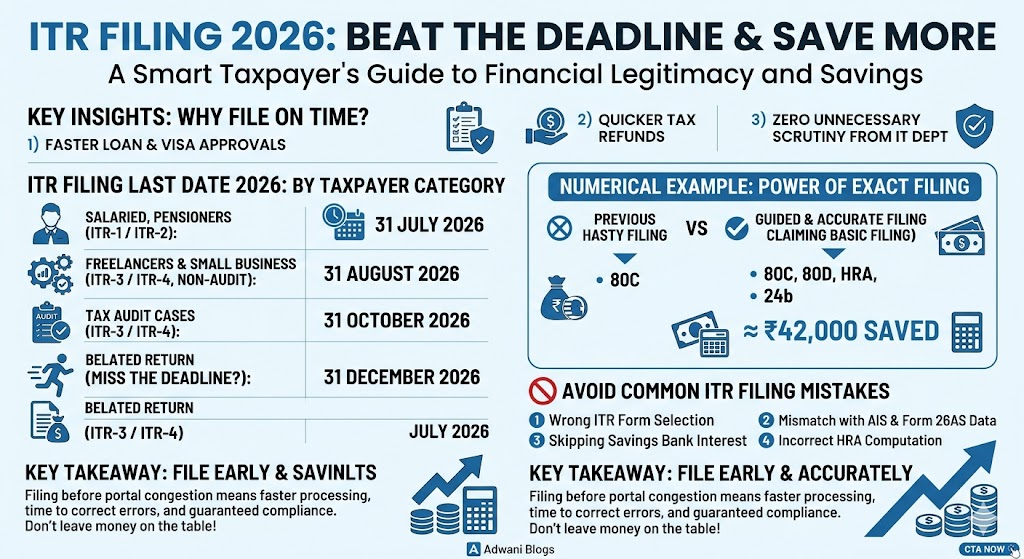
Introduction:Why ITR Filing 2026 Cannot Wait
Every year, thousands of Indian taxpayers rush to file their Income Tax Returns in the final days of July —crashing the government portal, making costly errors, and missing legitimate deductions worth lakhs of rupees. “The difference between a smart taxpayer and a stressed taxpayer is preparation and preparation begins the day the financial year ends, not the day the deadline arrives.”
ITR filing 2026 is not just a compliance formality. It is your single most powerful tool for financial legitimacy enabling faster loan approvals, smoother visa processing, faster refunds, and zero unnecessary scrutiny from the Income Tax Department. For FY 2025-26 (Assessment Year 2026-27), the filing season is open and the clock is ticking.
This comprehensive guide will walk you through everything you need to know about ITR filing 2026: the correct deadlines by taxpayer category, the right forms to use, common mistakes to avoid, and how Adwani and Company can help you file accurately, on time, and with maximum tax savings.
ITR Filing 2026 Last Date : Know Your Exact Deadline
One of the biggest sources of confusion every year is the ITR filing last date 2026. Budget 2026 introduced a landmark change: the deadline is no longer the same for everyone. It now depends on the ITR form you use, your income type, and whether your accounts require a statutory tax audit. incometax.gov.inOne of the biggest sources of confusion every year is the ITR filing last date 2026. Budget 2026 introduced a landmark change: the deadline is no longer the same for everyone. It now depends on the ITR form you use, your income type, and whether your accounts require a statutory tax audit.
Here is a category-wise breakdown confirmed by the Income Tax Department of India (incometax.gov.in)
| Taxpayer Category | Applicable ITR Form | ITR Filing Last Date 2026 |
| Salaried, pensioners, single house property | ITR-1 / ITR-2 | 31 July 2026 |
| Freelancers, professionals, small business (non-audit) | ITR-3 / ITR-4 | 31 August 2026 |
| Businesses requiring statutory tax audit | ITR-3 / ITR-4 | 31 October 2026 |
| Belated return (missed deadline) | All forms | 31 December 2026 |
| Updated Return (ITR-U) | ITR-U | 31 March 2031 |
Important Note: When logging into incometax.gov.in for AY 2026-27, always select
Tab 1: Income Tax Act, 1961
Tab 2 is for Tax Year 2026-27 returns to be filed in 2027. Selecting the wrong tab will invalidate your filing entirely.
At Adwani and Company, we explain“Knowing which deadline applies to you is step one. Choosing the wrong assumption about your due date can result in avoidable penalties and notices. Always verify your taxpayer category before filing.”
What Changed in ITR Filing 2026 : Budget 2026 Updates
Budget 2026 brought meaningful reforms that make ITR filing 2026 more taxpayer-friendly than any previous year. Understanding these changes is essential for every filer.
Extended Deadline for Freelancers and Small Businesses
For the first time, non-audit filers using ITR-3 and ITR-4 covering freelancers, consultants, small business owners, and independent professionals have been given an extra month to file. Their ITR filing last date 2026 is now 31 August 2026 instead of 31 July. This change, introduced specifically to reduce last-minute chaos and improve the quality of filings, gives business taxpayers adequate time to close accounts and perform proper reconciliations.
Revised Return Window Extended to March 31
One of the most taxpayer-friendly changes of the decade: the window to file a Revised ITR has been extended to 31 March 2027 for AY 2026-27. Previously capped at 31 December, this extension allows taxpayers who discover missed deductions or errors after filing to correct their returns without fear simply by paying a small revision fee. This change strongly reduces involuntary non-compliance.
Updated Return (ITR-U) Window Extended to 4 Years
Under Section 139(8A) of the Income Tax Act, 1961, the Updated Return window has been extended to 48 months (4 years) from the end of the relevant assessment year. For AY 2026-27, this means eligible taxpayers can file an ITR-U all the way up to 31 March 2031. This is particularly beneficial for taxpayers who realize they have missed reporting income from investments, freelance work, or capital gains.
How to File ITR Online for AY 2026-27 : Step-by-Step
ITR filing online has become progressively simpler, but errors are still common when taxpayers rush. Adwani and Company recommends the following structured approach for smooth ITR filing 2026:
1. Download Form 26AS and AIS: Log in to incometax.gov.in and download your Annual Information Statement (AIS) and Form 26AS. Cross-verify that all TDS credits, bank interest, and income entries are correct. Any mismatch with your Form 16 must be resolved with your employer or bank before proceeding.
2. Choose the Correct ITR Form: Using the wrong ITR form leads to defective return notices and rejection. ITR-1 is for salaried individuals earning up to ₹50 lakh from salary, one house property, and interest. ITR-2 covers individuals with capital gains or more than one property. ITR-3 and ITR-4 are for business and professional income.
3 . Compute Total Income and Deductions: Gather all your income sources salary, rental income, interest, capital gains, freelance income and list all eligible deductions under Section 80C (up to ₹1.5 lakh), Section 80D (health insurance), HRA, and home loan interest. “Most taxpayers leave money on the table simply because they don’t know which deductions they are legally entitled to. A one-hour consultation can save you ₹20,000 to ₹50,000 in taxes.”
4 . E-File and E-Verify: Complete ITR filing online through the Income Tax Portal (incometax.gov.in) and e-verify within 30 days using Aadhaar OTP, net banking, or by sending a physical ITR-V to CPC Bengaluru. An unfiled e-verification makes your return invalid.
5. Track Refund Status: After successful filing and e-verification, track your refund status on incometax.gov.in under “My Account → Refund/Demand Status.” Early filers typically receive refunds faster due to lower portal congestion.
[Learn more about our ITR Filing Services at Adwani and Company]https://www.adwaniandco.com/services/taxation-compliance
Practical Example
How Correct ITR Filing 2026 Saved ₹42,000
Consider Mr. Ramesh Sharma, a 34-year-old software engineer from Pune earning ₹12 lakh per year. In previous years, he filed his own return hastily in the last week of July, claiming only basic 80C deductions.
This year, guided by Adwani and Company, here is what his tax computation looked like:
| Deduction | Amount Saved |
| Section 80C (ELSS + PPF) | ₹1,50,000 |
| Section 80D (Health Insurance) | ₹25,000 |
| HRA Exemption (correct computation) | ₹84,000 |
| Home Loan Interest (Section 24b) | ₹2,00,000 |
| Total Deductions Claimed | ₹4,59,000 |
By correctly computing his HRA exemption which he had been computing incorrectly for three years and properly claiming home loan interest that he had been ignoring, Ramesh reduced his taxable income from ₹12 lakh to approximately ₹7.41 lakh. At applicable slab rates, this resulted in a tax saving of approximately ₹42,000 compared to his previous year’s filing.
This is the power of expert assisted ITR filing 2026, as practiced by Dr. Haresh Adwani and his team at Adwani and Company.
Penalty for Late ITR Filing 2026: What You Risk by Waiting
The Income Tax Act is clear about the cost of missing the ITR filing last date 2026. Under Section 234F, the following penalties apply:
- ₹1,000 late filing fee if your total income is below ₹5 lakh
- ₹5,000 late filing fee if your total income exceeds ₹5 lakh
- 1% interest per month on outstanding tax dues under Section 234A
- Loss of ability to carry forward losses from business, capital gains, or other heads — a particularly painful consequence for investors and traders
- Increased scrutiny risk from the Income Tax Department, including notices and assessments
The belated ITR filing last date for 2026 is 31 December 2026. Beyond that, the only recourse is the Updated Return (ITR-U) mechanism under Section 139(8A), which carries additional tax costs and cannot be used to claim fresh deductions.
As the Income Tax Department of India consistently emphasizes, voluntary and timely compliance is the most cost-effective path for every taxpayer.
Read our detailed guide on Penalty Provisions Under Income Tax Act: https://www.adwaniandco.com/blog/paid-your-taxes-honestly-still-got-an-income-tax-notice-2026-guide
ITR Filing 2026 for Salaried vs Business Taxpayers : Key Differences
Understanding the difference in ITR filing obligations between salaried and business taxpayers is critical for compliance under AY 2026-27.
Salaried Taxpayers (ITR-1 / ITR-2)
Salaried individuals represent the largest taxpayer category in India. Their income is primarily documented through Form 16 issued by employers, with TDS already deducted and deposited under Section 192. Their ITR filing 2026 due date is 31 July 2026. Key focus areas: correct HRA computation, Section 80C through 80U deductions, capital gains from mutual funds or stocks, and accurate AIS reconciliation.
Business and Professional Taxpayers (ITR-3 / ITR-4)
Freelancers, consultants, traders, and small business owners have more complex compliance needs. They must maintain proper books of account, compute business income accurately, reconcile GST returns with income tax filings, and — if turnover exceeds the prescribed threshold under Section 44AB — get a tax audit done before the October deadline. Dr. Haresh Adwani, with his dual expertise in Commerce (PhD) and law, specifically helps business owners navigate this intersection of income tax compliance, GST reconciliation, and legal risk — making Adwani and Company a one-stop solution for complete financial compliance
Common ITR Filing Mistakes to Avoid in 2026
Even wellintentioned taxpayers make errors that attract notices or reduce their refunds. Adwani and Company has compiled the most frequently observed mistakes during ITR filing 2026:
- Wrong ITR Form : Filing ITR-1 when you have capital gains from mutual funds requires ITR-2. Incorrect form selection results in defective return notices.
- Not Reconciling AIS and Form 26AS : Mismatches between your declared income and the government’s data are one of the top triggers for scrutiny.
- Missing Bank Interest Income : Interest from savings accounts, fixed deposits, and recurring deposits is fully taxable and must be reported even if TDS has been deducted.
- Incorrect HRA Calculation : HRA exemption is computed as the minimum of three values, not simply the full HRA received. Incorrect computation is a common, expensive error.
- Not Claiming Eligible Deductions : Many salaried employees are unaware they can claim Section 80TTA (savings interest up to ₹10,000) and Section 80EEA (first-home loan interest benefit).
- Skipping E-Verification : A filed but unverified ITR is treated as if it was never filed.
[Read our detailed guide on How to Avoid Income Tax Notices in India]
https://www.adwaniandco.com/blog/income-tax-notice-received
Why Choose Adwani and Company for ITR Filing 2026
At Adwani and Company, ITR filing 2026 is handled not by generic software but by qualified professionals led by Dr. Haresh Adwani — a PhD holder in Commerce and a law graduate with deep legal knowledge of Indian tax statutes.
What sets Adwani and Company apart:
- Complete AIS/Form 26AS reconciliation before filing to eliminate mismatch risk
- Deduction maximization thorough review of all eligible deductions the client is legally entitled to claim
- Dual expertise in income tax and GST ensuring your ITR filing is consistent with your GST returns, a critical requirement for business taxpayers
- Legal interpretation Dr. Haresh Adwani’s law background allows Adwani and Company to advise on legally gray areas such as capital gains classification, HUF planning, and business income structuring
- Year-round support not just at filing time, but for notices, assessments, appeals, and tax planning
Thousands of satisfied clients across Pune and India trust Adwani and Company for accurate, timely, and legally compliant ITR filing every year.
Conclusion:
ITR filing 2026 is not a task to defer until the last minute. Whether you are a salaried professional, a freelancer, or a business owner, your ITR is the foundation of your financial credibility in the eyes of banks, government authorities, and investment institutions.
The July 31 and August 31 deadlines for AY 2026-27 are firm. The Income Tax Department of India has made the e-filing infrastructure robust and accessible at incometax.gov.in but the portal still sees massive congestion in the final days of July every year. Filing early gives you faster refunds, time to correct errors, and the peace of mind that comes from knowing you are fully compliant.
“Tax compliance is not a burden. It is the most powerful financial habit an Indian citizen can build. File correctly, file on time, and let your tax record open doors for you.”
Frequently Asked Questions
Q1. What is the last date for ITR filing 2026 for salaried employees?
The ITR filing last date 2026 for salaried individuals filing ITR-1 or ITR-2 is 31 July 2026, as confirmed by the Central Board of Direct Taxes (CBDT) and the Income Tax Department of India.
Q2. What happens if I miss the ITR filing 2026 deadline?
You can file a belated ITR by 31 December 2026 with a late filing fee of ₹1,000 (income below ₹5 lakh) or ₹5,000 (income above ₹5 lakh) under Section 234F, plus applicable interest under Section 234A. Beyond December 31, you must file an Updated Return (ITR-U).
Q3. Can I file a revised ITR after July 31, 2026?
Yes. Budget 2026 extended the revised ITR deadline to 31 March 2027 for AY 2026-27. You can revise your original return to correct errors or claim missed deductions by paying a small revision fee.
Q4. Which ITR form should freelancers and consultants use for AY 2026-27?
Freelancers and independent professionals should use ITR-3 or ITR-4, depending on whether they are opting for presumptive taxation under Section 44ADA. Their ITR filing 2026 deadline is 31 August 2026 (non-audit cases).
Q5. Is it mandatory to file an ITR if my employer has already deducted TDS?
Yes, ITR filing is mandatory if your gross income exceeds the basic exemption limit, regardless of TDS already deducted. Filing also enables refund claims, carry-forward of losses, and financial documentation for loans, visas, and more.
Q6. What documents do I need for ITR filing 2026?
Key documents include Form 16 (from employer), Form 26AS (from income tax portal), Annual Information Statement (AIS), bank statements, investment proof for Section 80C, health insurance premium receipts, and home loan interest certificates.
Q7. Can Adwani and Company file my ITR if I’m an NRI?
Yes. Adwani and Company assists NRI taxpayers with ITR filing 2026, covering NRI capital gains tax on Indian assets, rental income from Indian properties, and DTAA (Double Taxation Avoidance Agreement) benefits.
CA Dipesh Gurubakshani is a Chartered Accountant with Adwani & Co LLP, Pune, specialising in income tax audit, direct taxation, and accounting advisory. He supports clients across statutory compliance, financial reporting, and income tax matters with a focus on accuracy, regulatory adherence, and disciplined execution.