
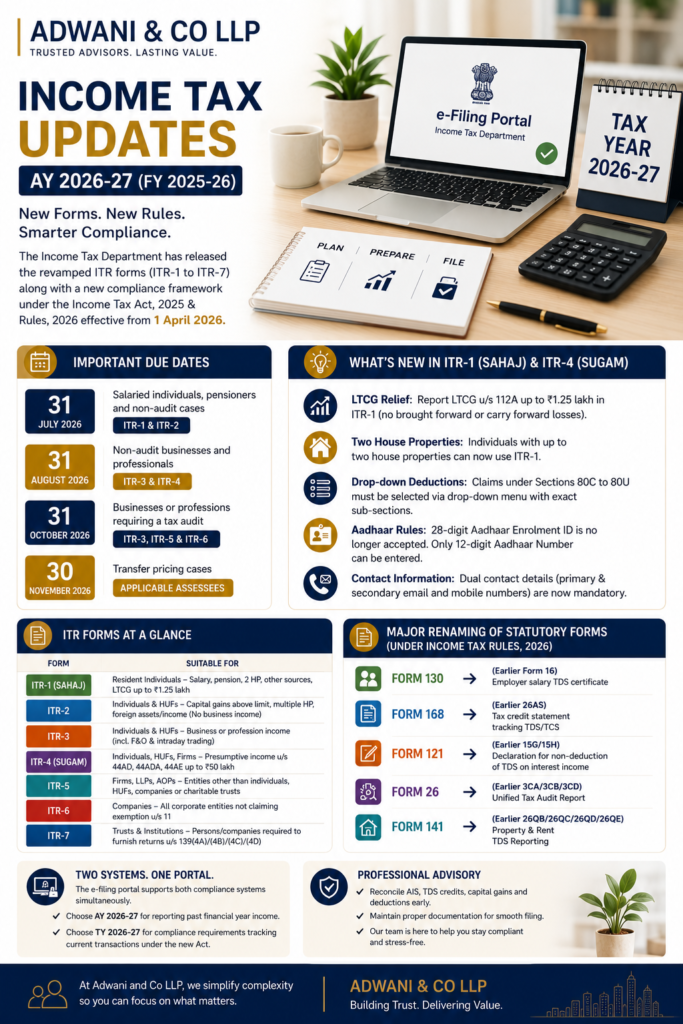
Key Highlights of AY 2026-27
- New Income Tax Act, 2025 effective from 1 April 2026
- ITR-1 now allows up to 2 house properties
- LTCG up to ₹1.25 lakh allowed in ITR-1
- Aadhaar Enrolment ID no longer valid
- Form 16 renamed as Form 130
- Dual mobile numbers and email IDs mandatory
- New drop-down deduction reporting system
A New Tax Era Begins Are You Ready?
If you have been putting off your return planning, here is the signal you needed: the Income Tax Updates AY 2026-27 represent the most comprehensive overhaul of the Indian income tax system in recent memory. From revamped ITR forms to entirely renamed statutory documents, every taxpayer salaried employee, business owner, or professional will feel the impact this season. Understanding these changes now is not just smart; it is essential to avoiding penalties and missed deadlines.
As per the official communication from the Income Tax Department of India, the department has released the fully revamped ITR forms ITR-1 through ITR-7 under the new Income Tax Act, 2025 and Income Tax Rules, 2026, effective from 1 April 2026. This is not a cosmetic update. The structural changes in compliance, deduction reporting, Aadhaar validation, and capital gain disclosures are significant and being unaware of them could cost you dearly.
Quick FactThe Income Tax Department has revamped ITR-1 to ITR-7 under a brand-new compliance framework effective from 1 April 2026. Both AY 2026-27 (for past income) and TY 2026-27 (for current compliance) are now managed through the same e-filing portal simultaneously.
In this detailed guide, Pavan Adwani– Corporate Advisory & Tax Compliance Lead at Adwani & Co LLP, with over two decades of hands-on practice since 2002 breaks down every critical change so you can file with confidence, avoid penalties, and stay fully compliant under the new regime.
The New Income Tax Framework: Act 2025 & Rules 2026
The Income Tax Act, 2025 replaces the decades-old Income Tax Act, 1961 in its compliance and procedural architecture. While the substantive tax rates remain broadly similar, the procedural rules governing income tax updates AY 2026-27 filings have been substantially modernised. The new Income Tax Rules, 2026 introduce precision-driven reporting, mandatory digital validation, and a cleaner form architecture.
According to the Income Tax Department’s official notification, the changes aim to reduce ambiguity in reporting, streamline deduction claims, and improve the accuracy of advance reconciliation between TDS credits and actual income declarations. incometax.gov.in
With over 22 years of structured, process-oriented advisory experience, Pavan Adwani notes that procedural changes consistently catch taxpayers off-guard. “Many clients understand what they owe but the new rules change how they must report it. One incorrect drop-down selection in deductions, or an outdated Aadhaar format, and your return gets flagged as defective. That triggers notices, delays, and unnecessary stress,” he explains.
Also Read:
Critical ITR Filing Due Dates for Income Tax AY 2026-27
Missing a due date under the income tax updates AY 2026-27 framework can attract late-filing fees under Section 234F, interest liability, and in some cases, loss of deductions. Mark your calendar with these non-negotiable deadlines:
31 July 2026
Salaried individuals, pensioners & non-audit casesITR-1 & ITR-2
31 August 2026
Non-audit businesses & professionalsITR-3 & ITR-4
31 October 2026
Businesses or professions requiring a tax auditITR-3, ITR-5 & ITR-6
30 November 2026
Transfer pricing cases Applicable Assessees
Pro Tip from Adwani & Co LLPDo not wait until July. Start reconciling your AIS (Annual Information Statement), TDS credits, and capital gain statements now. The new forms require more granular data, and gathering it at the last minute invariably leads to errors and missed deductions.
ITR Forms at a Glance: Which Form Is Right for You?
One of the most critical aspects of the income tax updates AY 2026-27 is selecting the correct ITR form. Filing the wrong form is treated as a defective return by the department. Here is a comprehensive overview of all seven forms:
| Form | Suitable For |
|---|---|
| ITR-1 (SAHAJ) | Resident Individuals Salary, pension, up to 2 house properties, other sources, LTCG up to ₹1.25 lakh (Section 112A) |
| ITR-2 | Individuals & HUFs Capital gains above limit, multiple HPs, foreign assets or foreign income |
| ITR-3 | Individuals & HUFs Business or profession income including F&O and intraday trading |
| ITR-4 (SUGAM) | Individuals, HUFs, Firms Presumptive income under Sections 44AD, 44ADA, 44AE up to ₹50 lakh |
| ITR-5 | Firms, LLPs, AOPs Entities other than individuals, HUFs, companies or charitable trusts |
| ITR-6 | Companies All corporate entities not claiming exemption under Section 11 |
| ITR-7 | Trusts & Institutions Persons/companies required to furnish returns under Sections 139(4A)/(4B)/(4C)/(4D) |
Key Income Tax Updates in ITR-1 (SAHAJ) & ITR-4 (SUGAM) for AY 2026-27
Among all the income tax updates AY 2026-27, the changes to the two most commonly used forms ITR-1 and ITR-4 will affect the largest number of taxpayers. Here is a detailed breakdown of what has changed:
1. LTCG Relief Now Available in ITR-1
For the first time, taxpayers with Long-Term Capital Gains (LTCG) under Section 112A of up to ₹1.25 lakh can report them directly in ITR-1 (SAHAJ) provided there are no brought-forward or carry-forward losses from previous years. This is a significant simplification that saves lakhs of small investors from filing the more complex ITR-2.Capital Gains Tax Information
2. Two House Properties Now Permitted in ITR-1
Previously, owning more than one house property meant moving to ITR-2. Under the new rules, individuals with up to two house properties can continue using the simpler ITR-1 form. This single change makes ITR-1 accessible to a much wider segment of the middle-class taxpayer base.
3. Drop-Down Deduction Selection No More Free-Text
Deduction claims under Sections 80C to 80U must now be selected via a mandatory drop-down menu with exact sub-sections. This requires taxpayers to know precisely which sub-section their investment falls under for example, Section 80C(a) for EPF contributions versus 80C(b) for PPF deposits.
4. Aadhaar Enrolment ID Is No Longer Valid
A critical compliance point under the income tax updates AY 2026-27: the 28-digit Aadhaar Enrolment ID is no longer accepted on the e-filing portal. Only the 12-digit Aadhaar Number will be accepted. Ensure your Aadhaar is linked to your PAN before filing.
5. Dual Contact Details Are Now Mandatory
The new ITR forms require both a primary and a secondary contact two email addresses and two mobile numbers. This is part of the department’s push to improve official communication and reduce undelivered notices.
Action Checklist Before Filing(1) Confirm your 12-digit Aadhaar is linked to PAN. (2) Identify the exact 80C–80U sub-section for each deduction. (3) Prepare two valid email IDs and mobile numbers. (4) Check your LTCG if under ₹1.25 lakh and no losses, you may use ITR-1. (5) Confirm whether you qualify for ITR-1 with your two house properties.
Major Renaming of Statutory Forms: Income Tax Rules, 2026
One of the lesser-known but highly impactful changes in the income tax updates AY 2026-27 is the comprehensive renaming of statutory forms. Many compliance documents that professionals and employers have used for years now carry entirely new form numbers under the Income Tax Rules, 2026. Submitting a document using its old name may cause confusion or rejection in tax proceedings.
130 New Form – Earlier: Form 16
Employer Salary TDS Certificate
168 New Form – Earlier: Form 26AS
Tax Credit Statement (TDS/TCS)
121 New Form – Earlier: Form 15G/15H
Declaration for Non-Deduction of TDS on Interest.
26 New Form – Earlier: Form 3CA/3CB/3CD
Unified Tax Audit Report
141 New Form – Earlier: Forms 26QB/26QC/26QD/26QE
Property & Rent TDS Reporting
Pavan Adwani strongly advises all HR teams, employers, and compliance officers to immediately update their internal document templates to reflect the new form numbers. “Using Form 16 instead of Form 130, or Form 26AS instead of Form 168, in a notice reply or regulatory submission can create avoidable complications. Update your templates now not after the notices arrive,” he advises from his two-plus decades of GST and income-tax advisory practice.
Two Systems, One Portal: AY vs TY – Know the Difference
A uniquely confusing aspect of the income tax updates AY 2026-27 is that the e-filing portal now simultaneously supports two distinct compliance frameworks. Many taxpayers are unsure which year to select at the time of filing. Here is the clear, practical distinction:
- AY 2026-27 :- Select this to report income earned during FY 2025-26 (1 April 2025 to 31 March 2026). This is your standard annual income tax return for the past financial year.
- TY 2026-27 :- Select this for compliance requirements tracking current transactions and ongoing obligations under the new Income Tax Act, 2025, starting from 1 April 2026 onwards.
Common Mistake AlertSelecting TY 2026-27 when you intend to file your regular annual return will result in a misclassified submission. Always choose AY 2026-27 for reporting your FY 2025-26 income. When in doubt, contact the Adwani & Co LLP team before submitting.
Practical Example: Choosing the Right ITR Under the New Rules
To make the income tax updates AY 2026-27 more tangible, consider this real-world scenario that the advisory team at Adwani & Co LLP frequently encounters:
Meet Rahul – Salaried IT Professional, Pune
Rahul earns ₹14.5 lakh per annum from salary, owns two residential flats (one self-occupied, one let out), and sold some mutual fund units in January 2026, generating LTCG of ₹92,000 under Section 112A. He has no brought-forward losses.
| Salary Income | ₹14,50,000 |
| Rental Income (Flat 2, after standard deduction) | ₹1,80,000 |
| LTCG under Section 112A | ₹92,000 |
| Section 80C Deductions (EPF + PPF) | ₹1,50,000 |
| Standard Deduction (Salaried) | ₹75,000 |
| ✅ Recommended Form: ITR-1 (SAHAJ) – qualifies under new AY 2026-27 rules (2 HPs now permitted + LTCG under ₹1.25 lakh) | |
Under the pre-2026 rules, Rahul would have been compelled to file ITR-2 due to his two house properties. The new income tax updates AY 2026-27 now allow ITR-1 saving significant time and reducing complexity for millions of taxpayers like him.
Professional Advisory: What Pavan Adwani Recommends for AY 2026-27
With over two decades of structured tax advisory experience spanning GST, income-tax consultation, corporate regulatory compliance, and statutory documentation Pavan Adwani of Adwani & Co LLP offers the following strategic guidance for taxpayers navigating the income tax updates AY 2026-27:
1. Reconcile Your AIS and TDS Credits Without Delay
The Annual Information Statement (AIS) available on the e-filing portal now captures a far wider range of transactions including mutual fund redemptions, dividend income, rent receipts, and foreign remittances. Any mismatch between your AIS and your ITR can trigger a scrutiny notice. Pavan Adwani recommends downloading your AIS today and reconciling it against your own records before the filing rush begins.
2. Verify All Capital Gain Statements from Brokers and AMCs
The new drop-down mechanism requires precise classification of capital gains by holding period and asset type. Pull your consolidated account statement (CAS) from CDSL or NSDL, and obtain capital gain statements from each mutual fund house separately. AMCs such as CAMS and KFintech provide structured reports that can be directly referenced for ITR preparation.
3. Maintain Supporting Documentation for Every Deduction Claim
Given the new mandatory sub-section-level drop-down for 80C–80U deductions, ensure you retain all supporting documents EPF statements, PPF passbooks, LIC premium receipts, home loan certificates, school fee receipts, and medical bills. In any scrutiny proceeding, the burden of proof rests with the taxpayer. Taxpayers can review and download their AIS directly from the official Income Tax portal.
4. Update PAN–Aadhaar Linking
If your PAN is not yet linked to your 12-digit Aadhaar, your ITR will be treated as invalid and TDS refunds may be withheld. The e-filing portal will not accept a 28-digit Aadhaar Enrolment ID under any circumstances for AY 2026-27. Verify your linking status at incometax.gov.in before attempting to file. PAN-Aadhaar Linking Portal
5. Evaluate Whether Presumptive Taxation Applies to Your Business
If you run a small business or are a professional with gross receipts under ₹50 lakh, ITR-4 (SUGAM) under the presumptive taxation scheme (Sections 44AD/44ADA/44AE) may substantially simplify your compliance burden. Pavan Adwani and his team regularly guide business clients through eligibility evaluation ensuring they are not over-filing or under-utilising available simplifications.
🏛 Advisory Note from Pavan Adwani“The new rules bring in much-needed procedural precision. But they also shrink the margin for error. Taxpayers who reconcile their AIS early, maintain clear documentation, and work with a structured compliance partner will find this season far smoother than those who rush at the deadline. Our team at Adwani & Co LLP has already begun proactive planning for all our clients for AY 2026-27.”
Frequently Asked Questions Income Tax Updates AY 2026-27
1. What are the major income tax updates for AY 2026-27?
The major income tax updates AY 2026-27 include: revamped ITR forms (ITR-1 to ITR-7) under the Income Tax Act, 2025 and Rules, 2026; LTCG up to ₹1.25 lakh reportable in ITR-1; two house properties now allowed in ITR-1; mandatory drop-down selection for 80C–80U deductions; rejection of 28-digit Aadhaar Enrolment IDs; mandatory dual contact details; and comprehensive renaming of statutory forms for example, Form 16 is now Form 130, and Form 26AS is now Form 168.
2. What is the last date to file ITR for AY 2026-27?
For salaried individuals and non-audit cases (ITR-1 and ITR-2): 31 July 2026. Non-audit businesses and professionals (ITR-3 and ITR-4): 31 August 2026. Businesses requiring a tax audit (ITR-3, ITR-5, ITR-6): 31 October 2026. Transfer pricing cases: 30 November 2026.
3. Can a salaried person with two houses use ITR-1 for AY 2026-27?
Yes. Under the income tax updates AY 2026-27, individuals with up to two house properties can now file ITR-1 (SAHAJ), provided their other income conditions are met salary or pension income, LTCG under ₹1.25 lakh under Section 112A with no carry-forward losses. This is a key change from prior years where two house properties required ITR-2.
4. What has Form 26AS been renamed to under the new income tax rules 2026?
Under the Income Tax Rules, 2026, Form 26AS (Tax Credit Statement) has been renamed Form 168. Similarly: Form 16 is now Form 130, Form 15G/15H is now Form 121, the Tax Audit Report (Form 3CA/3CB/3CD) is now Form 26, and the property/rent TDS forms (26QB/26QC/26QD/26QE) are consolidated as Form 141.
5. What is the difference between AY 2026-27 and TY 2026-27 on the e-filing portal?
AY 2026-27 is selected for reporting your income earned during FY 2025-26 (1 April 2025 to 31 March 2026) your standard annual return. TY 2026-27 is for compliance requirements under the new Income Tax Act, 2025, tracking transactions from 1 April 2026 onwards. Most individual taxpayers filing their regular return should select AY 2026-27.
Conclusion: Plan Early, File Smart, Stay Compliant
The income tax updates AY 2026-27 are not incremental tweaks they represent a structural transformation of India’s tax compliance framework. From the revamped ITR forms under the Income Tax Act, 2025 and Rules, 2026, to renamed statutory documents, tightened Aadhaar validation requirements, and new capital gain reporting flexibility in ITR-1, every taxpayer faces a meaningfully different filing experience this year.
The good news is that with the right preparation reconciling your AIS early, selecting the correct ITR form, updating your Aadhaar PAN linkage, and understanding the new form names the process can be entirely manageable. What separates a smooth filing season from a stressful one is almost always preparation and professional support.
As Pavan Adwani consistently emphasises with clients: “Tax compliance is not about fear it is about being informed, being organised, and having the right partner in your corner. With 22+ years of practice across GST, income-tax, and corporate compliance, our team at Adwani & Co LLP is already at work preparing every client for what AY 2026-27 demands. The earlier you start, the stronger your position.”
Ready to File with Confidence?
Get expert guidance on the income tax updates AY 2026-27 from Pavan Adwani and the professional team at Adwani & Co LLP Trusted Advisors. Lasting Value. Pimpri, Pune.Connect with Adwani & Co LLP Today →
Author
Pavan Adwani – Corporate Advisory, Tax Compliance & Regulatory Management.
He is actively involved in advising business entities on corporate compliance, tax management, and regulatory frameworks, with a structured and process-oriented approach.