
Income Tax Notice : Common Mistakes That Turn Small Issues into Big Problem
Everything looks fine… until an Income Tax notice changes everything.
In practice, most tax issues don’t arise because of wrong intent.
They arise because of casual handling.
Income Tax Notice
An Income Tax notice is basically a message from the tax department asking you to check or clarify something about your return. It doesn’t always mean you’ve done something wrong sometimes it’s just a reminder, a correction, or a request for extra details.
Getting a notice from the Income Tax department can feel alarming but it’s usually not as scary as it sounds.
The key thing to remember: a notice is not a punishment. It’s a conversation the department wants to have with you just in writing
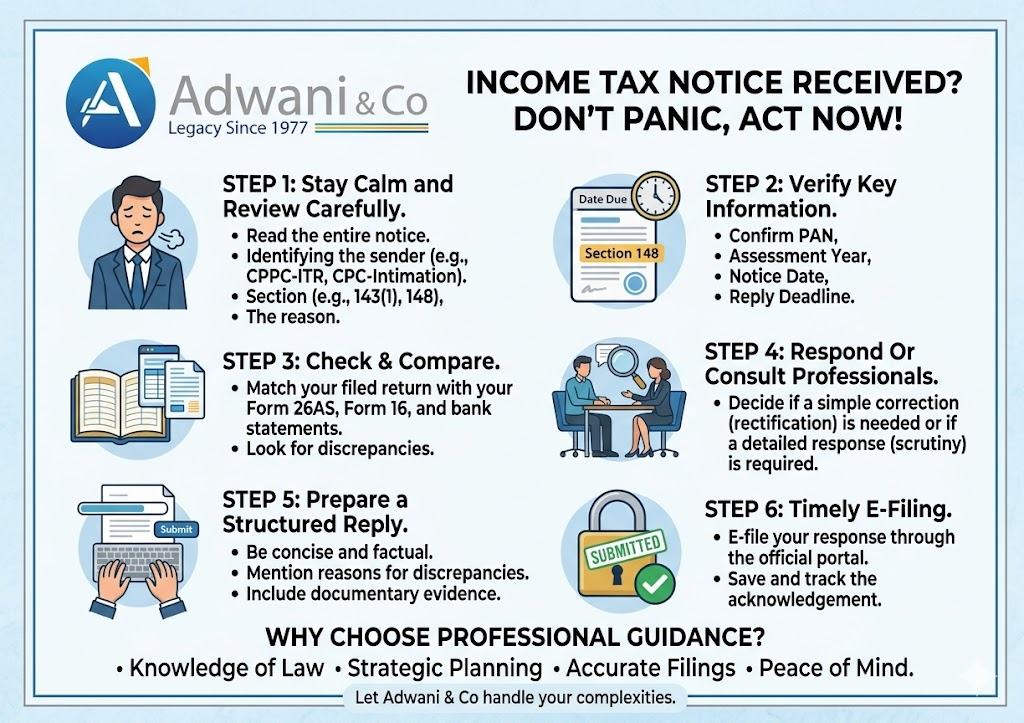
Common Mistakes Taxpayers Make
In many cases, the problem begins with small lapses:
1. Ignoring a Notice for a Few Days
One of the biggest mistakes taxpayers make is assuming that a notice can wait. Many people think, “I’ll deal with it later” or “It’s probably not urgent very Income Tax notice comes with a deadline. Miss it, and what was originally a simple question from the department can turn into a formal proceeding. Most people who’ve been through this say the same thing
“I wish I had just replied sooner.” A few extra days of delay can change the tone of the entire proceeding. What starts as a routine query can start feeling like an interrogation, simply because the other side stopped getting answers. Don’t let that happen.
2. Filing a Reply Without Proper Explanation
Another common error is rushing through the reply. Taxpayers often submit a quick response without carefully explaining the issue or attaching supporting documents. While this may feel like “getting it off your plate,” it usually backfires. Since proceedings are faceless and document driven, the officer relies entirely on what you submit. Your transaction may be perfectly clean but if your explanation isn’t clear, it won’t look that way. One vague reply can turn a one-time query into a back-and forth that goes on for months.
3. Not Keeping Proper Records of Your Transactions
Poor record-keeping is a silent but serious mistake. When transactions aren’t backed by proper documentation invoices, bank statements, agreements even genuine entries can appear suspicious. During scrutiny, the burden of proof lies on the taxpayer. If you can’t produce clear records, the authorities may assume inconsistencies or non-compliance. This often results in unnecessary disputes, penalties, or adjustments that could have been avoided with organized documentation.
Also Read : GST Show Cause Notices: Why ‘Others’ Isn’t Enough | Adwani & Co LLP
Why Income Tax Notices Are Issued
- Mismatch in income details : When the income you report doesn’t match with records in Form 26AS, AIS, or TIS.
- Errors in filing : Wrong ITR form, missing details, or calculation mistakes.
- High-value transactions : Large cash deposits, property deals, or big spends that don’t align with declared income.
- Incorrect claims : Deductions or exemptions claimed without proper proof.
- Non-disclosure of income : Forgetting to report rental income, interest, freelance earnings, or foreign income.
- Late or non-filing of returns : Missing deadlines or not filing at all.
When the Situation Changes
Planning stops
Pressure builds
When an Income Tax notice moves from routine to scrutiny, the entire atmosphere changes. What once felt like a simple compliance task suddenly becomes a source of stress. Planning, which should guide your response, often takes a back seat as anxiety builds. Instead of calmly addressing the issue, taxpayers slip into damage control mode rushing to reply, scrambling for documents, and second guessing every step. The problem is that this reactive approach rarely helps.
A matter that could have been resolved with a clear explanation and timely submission now stretches into a prolonged process, filled with repeated queries, clarifications, and mounting pressure. What started as a small oversight becomes a stressful ordeal, not because the case was inherently complicated, but because the response wasn’t handled with the structure and clarity it required.
The Reality of Today’s Tax Proceedings
In the past, dealing with Income Tax notices often meant visiting the tax office, meeting an officer, and explaining your side in person. Today, that has completely changed. Proceedings are now faceless and entirely document-driven. This means there is no opportunity to sit across the table and clarify things verbally. Your case is judged only on the papers, records, and explanations you submit online.That shift makes clarity and structure more important than ever.
A casual or incomplete reply can easily be misunderstood because there’s no chance to explain it face-to -face. On the other hand, a well-organized response with proper documentation and a clear explanation can close the matter quickly. In this new system, your submission is your only voice. If it’s strong, precise, and logical, it speaks for you. If it’s weak or vague, even a simple issue can get complicated.
What Actually Makes the Difference
- Timely Response: Submitting your reply within the given deadline shows seriousness and prevents escalation.
- Structured Explanation: A clear, logical, and well organized reply helps the officer understand your case easily.
- Complete Documentation: Supporting documents that match your explanation strengthen your position.
- Avoiding Delays or Vague Replies: Late, incomplete, or generic responses often create confusion and lead to repeated queries.
- Quality Over Quantity: It’s not about how much you submit, but how clearly and accurately you present it.
- Key Insight: Most cases don’t fail because the taxpayer’s position was weak they fail because the response was weak.
How to Handle an Income Tax Notice Properly
To avoid unnecessary complications:
- Reply On Time Every Time This isn’t something to put off until tomorrow. Every notice has a deadline, and even a short delay can turn a simple matter into something far more complicated. Treat the deadline like a bill payment miss it, and things get harder.
- Attach complete and accurate documentation Don’t leave gaps. Attach all relevant proofs bank statements, invoices, agreements, or any supporting records. The stronger your documentation, the smoother the resolution.
- Don’t Send a Vague Reply Writing “details will be provided later” is one of the worst things you can do. It signals that you’re either unprepared or avoiding the question neither of which helps your case. Be specific, be direct, and address exactly what’s being asked..
- Ensure your explanation is clear and logically presented Think of your reply as telling a story. Organize it step by step so the officer can easily follow your reasoning. A structured response shows professionalism and builds trust.
- Seek professional guidance when required If the notice involves complex transactions or large amounts, don’t hesitate to consult a tax professional. Expert advice can save you from costly mistakes and unnecessary stress.
The notice isn’t the problem. How you respond to it is
“Handle notices smartly, and they’ll never handle you“
1.Does receiving an Income Tax notice mean I’ve done something wrong?
Not necessarily. Many notices are simply requests for clarification or correction. They don’t always indicate fraud or wrongdoing.
2.What should I do first when I receive a notice?
Read the notice carefully, understand what it is asking, and note the deadline. Don’t panic most issues can be resolved with a clear and timely response.
3.What documents should I keep ready to avoid problems?
Maintain bank statements, invoices, property documents, investment proofs, and any records of major transactions. Organized documentation makes replies easier.
4.Can I reply to a notice myself or do I need a professional?
For simple clarifications, you can reply yourself. But for complex cases involving large transactions or scrutiny, it’s wise to consult a tax professional.
5.Where can I check the status of my notice?
You can log in to the Income Tax e-filing portal and track the notice under the “e-Proceedings” or “Pending Actions” section
Conclusion: Income Tax Notice India : Knowledge Is Your Best Defence
An income tax notice India is not the end of the road. In most cases, it is the beginning of a conversation between you and the Income Tax Department a conversation that, with the right preparation and professional support, can end cleanly and quickly.
The year 2026 marks a significant turning point in India’s tax compliance environment. With the Income-tax Act, 2025 and Income Tax Rules, 2026 now in full effect, businesses and individuals face a more scrutinised tax landscape than ever before. Data cross-verification is automated, discrepancies are flagged in real time, and the margin for error has narrowed considerably.
The professionals and businesses that will thrive in this environment are those who treat income tax compliance as a continuous, proactive discipline not a once-a-year filing exercise. They review their AIS before filing. They reconcile GST and income tax data regularly. They maintain robust documentation. And when an income tax notice India does arrive, they respond swiftly and professionally.
About the Author
Dr. Haresh Adwani
Ph.D. in Commerce | Law Graduate | Managing Partner, Adwani & Co LLP Dr. Haresh Adwani holds a Ph.D. in Commerce and is a qualified Law graduate with over two decades of hands-on experience in GST advisory, direct taxation, and statutory compliance for businesses across Pune and Maharashtra. As Managing Partner of Adwani & Co LLP a firm established in 1977 by Advocate N. T. Adwani. Dr. Adwani has guided hundreds of
SMEs, startups, and corporates through India’s evolving tax landscape. He is a recognised advisor on GST compliance, company formation, and Virtual CFO services, and regularly
contributes to professional seminars and industry forums in Pune.
Disclaimer
This article is for informational purposes only and does not constitute financial, legal, or professional advice. Every business’s financial position is unique, and readers should consult a qualified chartered accountant or financial advisor before making decisions based on this content.