
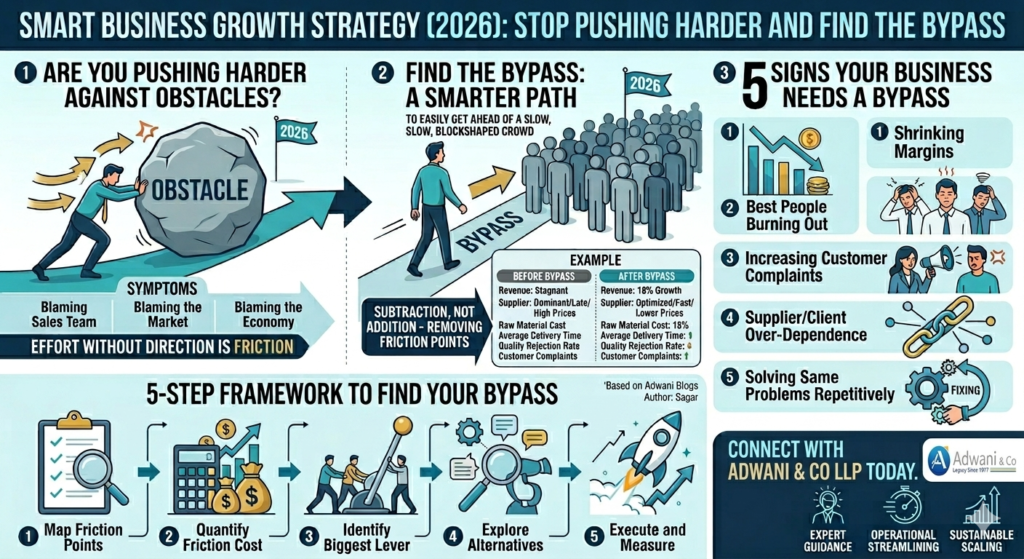
Smart Business Growth Strategy: Stop Pushing Harder and Find the Bypass
Here is a truth that most business owners learn too late: the biggest obstacle to growth is almost never what you think it is. You blame the sales team. You blame the market. You blame the economy. But the real problem the one quietly draining your revenue, your margins, and your energy is usually hiding in plain sight, disguised as something you have always accepted as normal.
The most effective business growth strategy is not about pushing harder through obstacles. It is about finding the bypass the smarter, faster, less crowded path that everyone else overlooked.
At Adwani and Company, we see this pattern repeatedly. Businesses generating ₹50 crore, ₹100 crore, or more in revenue come to us frustrated. Growth has stalled. Costs are rising. Customers are complaining. And the owner is convinced the solution is more effort, more investment, more pressure.
It rarely is.
In this blog, we will explore why the most powerful business growth strategy often involves subtraction, not addition removing the hidden friction points that silently sabotage your business. We will share a real-world example, actionable frameworks, and the thinking that separates businesses that scale from businesses that struggle.
Also Read:
Why Pushing Harder Is Not a Business Growth Strategy
There is a deeply ingrained belief in Indian business culture that success comes from relentless effort. Work longer hours. Hire more salespeople. Spend more on marketing. Push, push, push.
And effort absolutely matters. Nobody builds a successful business without hard work.
But here is the problem: effort without direction is just friction. And friction, compounded over months and years, destroys businesses.
Consider this scenario. You are walking briskly one morning clear mind, strong focus, productive energy. Then you encounter a group blocking your path. Moving slowly. Chatting casually. Unaware of anyone behind them.
You have three options:
- Wait behind them patient, but slow.
- Force your way through aggressive, but creates conflict.
- Find a side lane a simple bypass that gets you ahead without friction.
Option three is almost always the best choice. And it is almost always the one people overlook.
Business works the same way. The most effective business growth strategy is not about exerting more force against the same obstacle. It is about recognising the obstacle for what it is and finding a smarter route around it.
The Hidden Bottleneck: A Real-World Business Growth Strategy Example
Let us look at a situation that Dr. Haresh Adwani and the advisory team at Adwani and Company encountered with a client a mid-sized manufacturing business with annual revenue exceeding ₹50 crore.
The Symptoms
The business was showing classic signs of stagnation:
- Revenue growth had slowed to near zero.
- Customer complaints were increasing quarter over quarter.
- Gross margins were shrinking despite stable pricing.
- The operations team was working harder but achieving less.
The owner was convinced the problem was sales. “We need more customers. We need a better sales team. We need to spend more on marketing.”
The Diagnosis
When we looked deeper beyond the P&L statement and into the operational mechanics a different picture emerged.
The root cause was not sales. It was one supplier.
This supplier was well-known in the market. Popular. In demand. Every manufacturer wanted to work with them. And because of that dominant position:
- Prices kept rising 8–12% annually, far above market averages.
- Deliveries kept slipping lead times had grown from 2 weeks to 6 weeks.
- Quality became inconsistent rejection rates had doubled in 18 months.
The business was haemorrhaging money, not because of a sales problem, but because of a supplier dependency problem. More than ₹50 crore in annual revenue was being exposed to decisions made by someone else’s business.
The Bypass
Instead of renegotiating harder (pushing through the crowd), we helped the client find the bypass.
We conducted a comprehensive supplier review evaluating alternatives across quality, pricing, delivery reliability, and scalability. The result was a newer, less crowded supplier that offered:
- 15% lower pricing on key raw materials.
- 60% faster delivery times from 6 weeks back to under 2 weeks.
- Significantly better quality consistency rejection rates dropped by 70%.
The shift looked small on paper. One supplier changed.
The impact was anything but small:
| Metric | Before Bypass | After Bypass |
| Raw material cost | ₹18.5 crore/year | ₹15.7 crore/year |
| Average delivery time | 6 weeks | 1.5 weeks |
| Quality rejection rate | 8.2% | 2.4% |
| Customer complaints | 45/month | 12/month |
| Revenue growth (next 12 months) | ~0% | 18% |
That is the power of a well-executed business growth strategy not more effort, but better decisions.
Pattern Recognition: The Core of Every Great Business Growth Strategy
Warren Buffett does not succeed because he works harder than other investors. He succeeds because he sees patterns others miss. Steve Jobs did not build Apple by outspending competitors. He built it by recognising what customers wanted before they knew they wanted it.
The best business growth strategy is rooted in pattern recognition the ability to look at a complex business and identify the one lever that, when pulled, unlocks disproportionate results.
As Dr. Haresh Adwani often explains: “Numbers tell you what is happening. Patterns tell you why. And understanding why is where real advisory value begins.”
Most business owners are drowning in data. Revenue reports, expense dashboards, sales funnels, customer analytics. But data without interpretation is noise. The role of a strategic advisor is to cut through that noise and find the signal the one insight that changes the trajectory.
Five Signs Your Business Needs a Bypass, Not More Effort
How do you know when pushing harder is the wrong approach? Here are five patterns we frequently identify at Adwani and Company:
1. Revenue Is Growing but Margins Are Shrinking
If your top line is increasing but your bottom line is flat or declining, you have a structural problem not a sales problem. The bypass might be in your cost structure, your pricing model, or your customer mix.
2. Your Best People Are Burning Out
When high performers start leaving or disengaging, it is rarely about compensation. It is usually about friction inefficient processes, unclear priorities, or systemic bottlenecks that make their work unnecessarily difficult. The bypass is operational, not motivational.
3. Customer Complaints Are Increasing Despite Good Products
This almost always points to a supply chain or delivery issue. Your product may be excellent, but if it arrives late, arrives damaged, or arrives inconsistently, customers will leave. The bypass is upstream, not downstream.
4. You Are Over-Dependent on One Supplier, One Client, or One Channel
Concentration risk is the silent killer of mid-sized businesses. If more than 30% of your revenue or supply chain depends on a single entity, you are one decision away from crisis. The bypass is diversification systematic, strategic, and planned.
5. You Keep Solving the Same Problems
If the same issues resurface every quarter cash flow crunches, inventory mismatches, compliance delays you are treating symptoms, not causes. The bypass requires going deeper and restructuring the root process.
How to Build a Business Growth Strategy Around Finding Bypasses
Here is a practical framework that any business owner can implement:
Step 1: Map Your Friction Points
List every area where your business experiences recurring delays, cost overruns, or quality issues. Be brutally honest. Common areas include procurement, logistics, compliance, hiring, and collections.
Step 2: Quantify the Cost of Friction
For each friction point, estimate the annual cost in money, time, and opportunity. You will be surprised how much “accepted” inefficiency is actually costing you. A ₹50 crore business can easily be losing ₹3–5 crore annually to friction it has never measured.
Step 3: Identify the Biggest Lever
Not all friction points are equal. Find the one that, if resolved, would have the largest cascading impact on revenue, margins, and customer satisfaction. This is your primary bypass.
Step 4: Explore Alternatives Relentlessly
Do not accept the first alternative you find. Evaluate multiple options. Test small before committing large. The best business growth strategy decisions are informed, not impulsive.
Step 5: Execute and Measure
Implement the change, track the metrics, and iterate. A bypass is not a one-time fix it is a new path that needs to be maintained and optimised over time.
The Role of Advisory in Modern Business Growth Strategy
Here is something most business owners do not want to hear: you cannot see your own blind spots.
You are too close to the business. You have too many emotional attachments to existing relationships, processes, and decisions. The supplier who is costing you ₹3 crore a year might also be someone you have known for 15 years. The process that is bleeding efficiency might be one you designed yourself.
This is where external advisory becomes invaluable not to replace your judgment, but to complement it with objectivity.
At Adwani and Company, our advisory approach goes beyond spreadsheets and compliance. Led by Dr. Haresh Adwani, our team works with business owners to identify hidden friction, quantify its impact, and design practical solutions that drive measurable growth.
Whether it is a supplier review, a cost restructuring, a compliance overhaul, or a full strategic reassessment, the goal is always the same: find the bypass that unlocks your next phase of growth.
The Ministry of Corporate Affairs (MCA) and regulatory frameworks like the Companies Act increasingly demand that businesses maintain robust governance and operational structures. A strong business growth strategy must account for compliance as a growth enabler, not just a cost centre.
Conclusion: The Smartest Business Growth Strategy Is Seeing What Others Miss
Every business owner faces crowded paths saturated markets, rising costs, difficult suppliers, demanding customers. The instinct is to push harder, move faster, and outwork the competition.
But the most successful businesses the ones that scale sustainably and profitably do something different. They pause. They observe. They find the bypass.
The side lane nobody noticed. The supplier nobody evaluated. The process nobody questioned. The insight nobody connected.
That is not laziness. That is strategic intelligence. And it is the foundation of every truly effective business growth strategy.
Where in your business are you pushing harder when you should be looking for the bypass?
If you want expert guidance to identify hidden growth opportunities, streamline operations, and build a business growth strategy that actually works, connect with Adwani and Company today. Dr. Haresh Adwani and our advisory team are ready to help you find the path that transforms your business.
1. What is a business growth strategy?
A business growth strategy is a structured plan to increase revenue, improve margins, and scale operations sustainably. It involves identifying opportunities, removing bottlenecks, and making strategic decisions about markets, products, pricing, and operations.
2. Why does pushing harder sometimes fail as a business growth strategy?
Because effort without direction creates friction. If the underlying problem is structural a bad supplier, an inefficient process, a flawed pricing model more effort will not solve it. You need to identify and address the root cause.
3. How do I identify hidden bottlenecks in my business?
Start by mapping every area where recurring problems occur delays, cost overruns, complaints, rework. Quantify the cost of each. The largest hidden cost is usually your biggest bottleneck and your most valuable bypass.
4. How often should a business review its growth strategy?
At minimum, annually. However, high-growth businesses benefit from quarterly strategic reviews. Market conditions, supplier dynamics, and customer needs change constantly your business growth strategy must evolve accordingly.
5. Can a single supplier really impact business growth?
Absolutely. As our real-world example demonstrated, one over-relied-upon supplier can silently erode margins, delay deliveries, and damage customer relationships putting crores of revenue at risk.
6. What role does a CA firm play in business growth strategy?
A modern CA firm like Adwani and Company goes beyond compliance. We analyse financial data, identify operational inefficiencies, advise on tax-efficient structuring, and help business owners make strategic decisions backed by numbers and expertise.
Author
CA. Manish R. Mata Practising In India (Ex – PwC), At Adwani & Co LLP leads the International Accounting & Tax Support vertical, delivering structured execution assistance to US CPA firms and overseas businesses.